Discernment, False Doctrine

Touch Not My Anointed?

โ€œNever challenge or speak out against Godโ€™s anointed,โ€ I recently read in a book for Christian women.

โ€œNever challenge or speak out against Godโ€™s anointed,โ€ I recently read in a book for Christian women. Have you ever heard someone say this? Is it biblical?

Have you ever heard someone say this? Is it biblical? Who are โ€œGodโ€™s anointedโ€? Why should we never challenge or speak out against them? What does it mean to be โ€œanointedโ€ anyway?

This is just one more of the many dangerous false teachings coming out of the Word of Faith and New Apostolic Reformation heresies. It is an adulteration of Psalm 105:15/1 Chronicles 16:22 (same text).

saying, โ€œTouch not my anointed ones,
do my prophets no harm!โ€

Psalm 105:15 / 1 Chronicles 16:22

The phrase โ€œtouch not My anointedโ€ is lifted out of context and imbued with the meaning โ€œnever criticize, correct, or rebuke the pastor.โ€ Unfortunately, churches that wield this false teaching like a weapon usually do so because they are pastored by a false teacher whoย needs to be (or is being) biblically criticized, corrected, or rebuked.

The context of Psalm 105/1 Chronicles 16 makes it obvious that this is not what this verse means, even in the Old Testament, as anyone who takes the trouble to read the whole chapter can clearly see. This verse is about God protecting the Israelites from oppression by foreign kings when they were wandering in the wilderness. โ€œTouch not My anointed oneSโ€ and โ€œdo my prophets no harmโ€ is a warning to pagan nations to leave Godโ€™s people – all of them, the common people as well as the prophets – alone during the Exodus.

This has nothing whatsoever to do with New Testament churches and the idea that one should never challenge or speak out against a pastor. Pastors are only โ€œanointedโ€ today in the same sense that every believer is โ€œanointed.โ€

In the Bible, โ€œanointโ€ simply means to apply oil or another substance (Luke 7:38, John 9:6) to a body part (your own or someone elseโ€™s). In the Old Testament, one of the occasions for applying oil was in ceremonies to consecrate – set apart – someone (or something: Genesis 31:13, Exodus 29:36) for a particular purpose. For example, David was anointed with oil when God set him apart as king. All Old Testament priests were anointed with oil. Elisha the prophet was anointed with oil.

But we do not see this in the New Testament. No one is anointed with oil as part of a consecration ceremony. In the New Testament, the verses containing the word โ€œanointโ€ fall into one of three categories: medicinal/hygienic application of oil and other substances, references to Jesus as the โ€œAnointed Oneโ€ (Messiah), and two passages (2 Corinthians 1:21-22, 1 John 2:20,27) speaking of all Christians as being allegorically โ€œanointedโ€: set apart as Godโ€™s special people (the same way Psalm 105/1 Chronicles 16 talk about the Israelites as Godโ€™s special, set apart people).

The only individual in the New Testament who was anointed – literally or allegorically – in the Old Testament, ceremonial, consecrated sense is Jesus. Why? Because He fulfills all three of those Old Testament โ€œanointedโ€ positions: prophet, priest, and king. He is the final prophet, the Great High Priest, and the eternal King.

Jesus fulfills all three of those Old Testament โ€œanointedโ€ positions: prophet, priest, and king. He is the final prophet, the Great High Priest, and the eternal King.

Therefore, no New Testament believers are โ€œanointedโ€ to any position but we areย all spiritually anointed – set apart to and for Christ as His special possession. We are to submit to our pastors and elders (Hebrews 13:17) insofar as they teach and obey Godโ€™s written Word (1 Timothy 5:19-20, Acts 5:29), but โ€œnever challenge or speak out against Godโ€™s anointedโ€? Only if the Anointed One youโ€™re talking about is Jesus.

โ€œNever challenge or speak out against Godโ€™s anointedโ€? Only if the Anointed One youโ€™re talking about is Jesus.

Discernment

Throwback Thursday ~ Still Be Discerning about Discerners Discerning Discernment Ministries

discerners discerning discernment

Recently, one of my favorite blogs, ParkingSpace23ย (a fantastic, doctrinally sound blog I’d encourage everyone to subscribe to), published an excellent article by John Chester called Still Be Discerning about Discernment Ministries. It’s all about John’s thoughts on discernment blogs and podcasts and why he has chosen to swear off of them.

John seems like a thoughtful guy and he handled what can be a touchy subject evenly, calmly, scripturally, and with grace. As someone who frequently writes on discernment topics, it gave me some good food for thought and an opportunity to biblically examine both my writing and reading/listening habits. It’s a great article, I was thankful for it, and I agree with a lot of his points.

But while John has decided not to partake of discernment blogs and podcasts, I still find discernment ministry to be an important aspect of this blog as well as my personal spiritual “diet”. Does that mean I think John, or any other Christian, is wrong for not wanting to regularly read or listen to discernment material? Absolutely not! But I’d like to present a bit of a different perspective regarding the value of discernment ministry.

In the first few paragraphs of his article, John draws a distinction between two different types of discernment ministries- a disctinction which I think is both astute and important. John differentiates between what I would call “propositional” discernment sites like CARM, and, if I’m understanding him correctly, mine – which generally post single, position paper-type articles on a given false teacher or false doctrine – and what I would call “daily news” discernment ministries such as Berean Research and Fighting for the Faith – which report on the shenanigans du jour of false teachers and apostate churches.

John’s position is that the propositional discernment ministries [PDM] can be helpful when needed, but he is not fond of the daily news discernment ministries [DNDM]. I think both can be beneficial, assuming they’re done biblically. Take a look at John’s points and my counterpoints, and then you can prayerfully decide whether or not it would be profitable for your sanctification to include discernment media as part of your spiritual fare.

John’s point: “[DNDMs] often spend much time dissecting sermons or blog posts that someone with even a rudimentary sense of discernment would have stopped listening to or reading within the first few phrases.”

Michelle’s counterpoint: “Someone with even a rudimentary sense of discernment” is the crucial phrase here. Perhaps John is blessed to pastor a body of believers who are good bereans and most of the Christians he knows are discerning. I hope that’s the case. It shouldย be the case that every believer has “a rudimentary sense of discernment” and immediately rejects false doctrine when she hears it. Nothing would bring me more joy.

But, sadly, that’s not the case. In fact, in my experience, the exact opposite is true, especially among Christian women. The vast majority of Christians are very undiscerning when it comes to false teachers and false doctrine. Often, people lack discernment because they’re false converts. But because most churches don’t proactively teach discernment, there are also plenty of genuninely born again believers who take at face value that anything which wears the label of “Christian,” is sold at a Christian retailer, or is proclaimed by a Christian celebrity is biblical and trustworthy.

I know, because I used to be one of those undiscerning Christians who hadn’t been taught any better by my church. Sure, I could pick out charlatans like Benny Hinn or Todd Bentley, and I probably would have described people like Kenneth Copeland and Jesse Duplantis as “wrong” or “that’s not what Baptists believe” without really knowing why. But the Beth Moore Bible studies that every church I’ve ever been a member of has pushed on its female membership? I had no idea she was teaching false doctrine, especially since my own church was endorsing her books.

It wasn’t until I Providentially “stumbled across” Todd Friel’s TV program,ย Wretched, one night several years ago that I began to understand what false doctrine was, why it was wrong, biblically, and how it could hurt me and the church. And it wasn’t until I discovered Chris Rosebrough’s Fighting for the Faith that I learned how to compare everything to Scripture – to listen to sermons with a discerning ear and read Christian books with a discerning mind. Todd and Chris taught me the discernment no church ever bothered to mention to me. And from the myriad of discerning Christians I’ve known, heard from, and read about, people like me are the rule, not the exception.

It’s not right that the church isn’t teaching Christians how to be discerning. I think every biblically responsible discernment ministry would agree that it is the church’s job, not a discernment ministry’s, to teach Christians to be bereans. But that’s not happening. And I thank God for those ministries who are standing in the gap- who have helped thousands of Christians like me.

John’s point: “[DNDMs] are unbiblical. What I mean is that there seems to me to be no biblical model or mandate for this kind of ‘ministry’.โ€

Michelle’s counterpoint: John may hold more closely to the regulative principle than I do, which would, understandably, account for my difference in perspective from this point. We do a lotย of things, both in church and in parachurch ministry, that there’s no specific biblical model or mandate for. There’s no biblical model or mandate for vacation Bible school or crisis pregnancy ministry or handing out gospel tracts or even writing for a Christian blog. Yet these, and many other ministries, can carry the gospel to the lost (I’ve heard of many people who have read/listened to DNDMs, realized they were false converts, and have become believers.) and edify the saved – just like discernment ministries can. And there’s certainly a biblical mandate for that.

John’s point:ย “Did Jesus ever engage in a point by point take down of a particular Phariseeโ€™s teaching that is recorded in Scripture? How much do we know about the Nicolaitans…in Revelation 2:15?… Or… the Colossian heresy…in Colossians 2:8?”

Michelle’s counterpoint: Jesus didn’t do sermon reviews (that we know of) the same way Chris Rosebrough does. But He did publicly enumerate and correct many of the Pharisees’ false teachings in Matthew 23. He publicly clarified Scripture and corrected unbiblical beliefs and false teachings – “You have heard it said…but I say to you…” – in the Sermon on the Mount. He publicly warned people against the false teaching of the scribes, Pharisees, and Sadducees. And every time those scribes, Pharisees, and Sadducees confronted Him with questions or after a miracle, He set them straight for the whole crowd to hear.

As to the Nicolaitan and Colossian heresies, Colossians and Revelation 2 were addressed to particular churches. Just because weย may not know much about these heresies doesn’t mean the Ephesian and Colossian churches weren’t thoroughly familiar with them. Perhaps that’s why John and Paul didn’t elaborate- because their intended audiences were already knowledgeable about those heresies. And perhaps the reason they might have been familiar with those heresies is that they were constantly being warned about them. Every book in the New Testament (except Philemon) warns against false teaching or false teachers.

Not so with the church today. Christians are not only notย being warned about the heresies and false teachers running rampant in evangelicalism, undiscerning pastors are actually embracing false teachers, inviting them to speak at their churches, simulcasting their conferences, sharing their social media posts, and ordering their materials for the church’s small groups. And the church at large is so biblically illiterate that Christians have no idea they’re being fed false doctrine.

John’s point: “Curiously many discernment mavens will quote 1 Peter 3:15 as a text that supports what they do. But to be blunt, it doesnโ€™t, not by a long shot…. This is about being ready to proclaim Christ to those who would persecute you.”

Michelle’s agreement: I could not agree with this point more. This verse isn’t about discernment. (I usually hear this verse more frequently in support of apologetics ministries, and it isn’t about apologetics, either.) It’s about evangelism.

One of the main features of today’s false doctrine is the twisting of Scripture and ripping it out of context. How can we who do discernment work rebuke false teachers for taking Scripture out of context and then turn right around and do the same to justify our own ministries? We knowย better. Specks and logs, anyone?

There are plenty of other passages of Scripture (such as the ones I’ve cited above and others) that speak of the importance of warning against false teachers and removing false doctrine from the church. We should not be using a verse that has nothing to do with discernment to justify discernment ministry.

John’s point: “Donโ€™t get me started on the lack of gentleness and respect [from 1 Peter 3:15] that permeates many of these blogs and podcasts.”

Michelle’s agreement/counterpoint: John is right, here. Some of the discernment ministries that (incorrectly) claim the first part of 1 Peter 3:15 as justification for their ministry are not following the second part of the verse which says to “do so with gentleness and respect”. There are discernment ministries whose articles I absolutely will not share or link to because their snideness and name calling are so over the top it overshadows the valid point they’re trying to make, sometimes even damaging their own credibility.

At the same time, we do see instances of Jesus using harsh language and calling false teachers names, and Paul, Elijah, and others couldn’t always be characterized as gentle or respectful.

The thing is, their cultural context was a little different from ours, and these are descriptive passages, not prescriptive. Sometimes different cultures call for different approaches. Additionally, one woman’s “gentle and respectful” is another woman’s “harsh and unkind.” I’ve written discernment articles that were characterized as hateful by some Christians and too nice toward the false teacher by others- both about the same article!

Although I fail miserably at it – often – I try to use 2 Timothy 2:24-26 as my guideline when I write:

And the Lord’s servant must not be quarrelsome but kind to everyone, able to teach, patiently enduring evil, correcting his opponents with gentleness. God may perhaps grant them repentance leading to a knowledge of the truth, and they may come to their senses and escape from the snare of the devil, after being captured by him to do his will.

It not only reminds me of howย to contend for the faith (not quarrelsome, kind, patient, gentle), it reminds me whoย I’m contending for (those being held captive by Satan’s snare of false doctrine), and whyย I’m contending (that they might repent, know the truth, come to their senses, and escape captivity).

John’s point: “[DNDMs] are unhealthy…’you are what you eat’…A diet of constant critical speech and reading is naturally going to produce a critical spirit.”

Michelle’s agreement: This is absolutely true. I don’t know whether it makes me over-critical or not, but when I OD on discernment media it certainly makes me feel angry, frustrated, depressed, and that there’s no hope for the church. It takes my eyes off Christ and the very real salvific and sanctifying work He is still doing in churches across across the globe, and causes me to focus on the monster of false doctrine instead.

It’s exceedingly important that we not go overboard on discernment or any other single aspect of theology or or spiritual life. In order to be spiritually healthy, we mustย have a balance of allย the good things: discernment, Bible study, prayer, evangelism, fellowship, worship, service, etc. When I find myself spending too much time in Discernment Land, I know it’s time to step back and readjust my focus.

John’s point: “They are not very helpful…I donโ€™t think very many Christians, especially the kind who read theological blogs, are going to be taken in by [blatantly obvious false teachers].”

Michelle’s agreement/counterpoint: I’ve already shared my thoughts on the helpfulness of discernment ministries for Christians who are not discerning, but, if I’m understanding him correctly, I think what John is saying here is that Christians who are alreadyย discerning aren’t going to be taken in by false teachers, and, therefore, have little need for regular consumption of discernment media. I generally agree with that. I still subscribe to a few DNDMs and peruse their daily headlines, not because I need to learn discernment, but because I like to know what’s going on in the church, just like people skim section A of the newspaper because they like to know what’s going on in the world.

I might add, though, that just because someone is the type of person who reads theological blogs doesn’t mean he’s on top of things, discernment-wise. Thom Rainer writesย a theological blog (and books, and has a seminary Ph.D), yet persists in allowing false doctrine onto the shelves of LifeWay despite the many rebukes he has received from pastors, seminarians, lay people, and, yes, discernment media. Not long ago, I took a class via video from a conservative Southern Baptist seminary president who positively (albeit in passing) cited Beth Moore and Rick Warren in one of the sessions. And these are just two isolated examples. There are many more.

John’s point: “[DNDMs] often have significant blindspots…In their rush to expose the errors of others, often discernment bloggers/podcasters can overlook real problems with themselves or with their theological allies, especially in the areas of tone and conduct.”

Michelle’s agreement: This is so true. There’s no way I could disagree with this, because I have been guilty of it myself far too often. I would only add that this is not a problem specific to discernment ministry. Every ministry has blind spots because every Christian has blind spots. We’re all guilty of hypocrisy, myopia, failure, and sin. And, because we’re believers, when a brother or sister points out our sin, we repent, we receive God’s wonderful, cleansing, restorative grace, mercy, and forgiveness, and we move forward in obedience to Him and His word.

John closes out his insightful article with this thought:

I am not saying that you must swear off โ€œdiscernmentโ€ blogs and podcasts, but I am saying I did, for the reasons above along with others, and I think I am better off for it. I would challenge you to consider what I have written and to think deeply about your spiritual diet.ย I am exhorting you to be discerning about discernment ministries.

I am not saying you mustย partake of discernment blogs and podcasts. But I am saying I do, for the reasons above along with others, and I think I am better off for it. I would challenge you to consider what John and I have written and to think deeply about your spiritual diet. I am exhorting you to think about it, study about it, pray about it, and discern what God would have you do about consuming discernment media.


Mailbag

The Mailbag: Potpourri (Soul Ties, SBC Communion, Women in children’s ministry, Heretical book disposal)

Welcome to another โ€œpotpourriโ€ edition of The Mailbag, where I give short(er) answers to several questions rather than a long answer to one question. I also like to take the opportunity in these potpourrri editions to let new readers know about my comments/e-mail/messages policy. Iโ€™m not able to respond individually to most e-mails and messages, so here are some helpful hints for getting your questions answered more quickly. Remember, the search bar can be a helpful tool!


I was wondering what your views were on โ€œungodly soul tiesโ€, in reference to past relationships? If I was in a previous relationship with someone who I was involved with physically, mentally, spiritually and emotionally, how would I loose myself from that?

The concept of “soul ties” is not biblical. It is not mentioned or even hinted at in the Bible. Proponents of this heretical doctrine, as you can see in this article, Basic Introduction to Soul Ties,ยน will try to convince you that soul ties are biblical by taking all manner of Bible verses out of context and stretching and twisting them like Silly Putty to try get them to mean what they want them to mean. All you have to do is look up the verses they cite, and read them in context to see that none of these passages say that one person’s soul can be literally bound to another person’s soul.

I find it especially laughable that many of the verses they cite in support of soul ties are the “one flesh” verses, such as Ephesians 5:31 (which is actually a quote of Genesis 2:24). Don’t you think that if God, the creator of language, meant to convey in these verses that two people’s souls were tied together, that He would have said “one soul” instead of “one flesh“? Or that He would have clearly said: “In this type of close relationship, the two people’s souls are bound together.”? This is God we’re talking about, here. He’s perfectly capable of explaining Himself clearly. He knows what words mean, and He never makes a mistake and chooses the wrong word. And yet, time and time again in Scripture, He uses the words “one flesh” to describe the intimacy of marriage and sexuality, and He never, anywhere in Scripture, even suggests that the souls of two people are bound together under any circumstances.

Soul ties are just one more piece of false doctrine usually taught by those in the heretical New Apostolic Reformation camp. (When I Googled “soul ties”, articles by Kris Vallotton {Bethel}, Terri Savelle Foy, and Paula White – all among the worst of the worst of the NAR and prosperity preaching – were on the first page of results. That should tell you something.) There is no way your spirit can be tied or bound to someone else’s spirit.

I’m not sure what you mean by being involved with someone “mentally” and “spiritually”, but I’m assuming you don’t mean that you were in Mensa together or that you had long talks about theology and frequently prayed together. Those might be fond memories that make you wistful, but no mental or spiritual activity you participate in with someone else binds your soul to his or is something you need to be “loosed” from.

What you need to do is read your Bible, understand what it says about sin, and if you sinned in any way in this relationship (for example, sex outside of wedlock, putting your love for this person ahead of your love for the Lord, being influenced by this person to lie, etc.) you need toย repent, not “be loosed” (because you’re not bound to this person, and because repentance from sin is the biblicalย way of thinking about this situation). You may also need to avoid spending time with or talking to this person for a while. And if you’re really having trouble getting over the relationship, you might want to seek counsel from a doctrinally sound pastor (one who understands that soul ties are unbiblical) or an ACBC certified Biblical Counselor.

That’s truly all there is to it. The spirit-realm mumbo jumbo of “soul ties” is a bunch of mystical malarkey. Your spirit isn’t tied to anyone else’s spirit, you’re just sad that the relationship is over, having difficulty moving on with your life, and, perhaps missing the person. And it’s OK if that sounds earthly and pedestrian. Because it is. But if Christ is your Savior, you can trust Him to carry you through it.

Here are some resources you might find helpful:

What does the Bible say about soul ties? at Got Questions

Soul Ties? I at Fighting for the Faith (starts around 34:14)

Soul Ties? II at Fighting for the Faith

ยนJust in case it isn’t abundantly obvious, this is a heretical New Apostolic Reformation article/website, and I certainly don’t recommend it.

We recently moved and have been attending a Southern Baptist church. They have not had communion for over two months. Isn’t it the norm to have communion at least once a month? 

Also there is no women’s ministry that I can be involved with which is very disappointing to me. I would even be willing to teach/lead a women’s study but since we are new to this church we are still waiting and learning our place. We hesitate to make ourselves known as possibly unsubmissive or question why they do things the way they do.

Why no communion or women’s Bible study? Your thoughts would be enlightening.

These are such great questions because they help me, as a Southern Baptist, think about the way we do things and how those practices might be perceived by visitors or new members.

Communion/Lord’s Supper:ย Every Southern Baptist church is autonomous, so each church has its own policy or practice about how often the Lord’s Supper is observed. There are some SBC churches who hold the Lord’s Supper every week and probably others who hold it only once or twice a year, although I don’t personally know of any who hold it that infrequently.

In my experience, most Southern Baptist churches observe the Lord’s Supper several times a year, usually on a schedule like the first Sunday of the month, once a quarter, or every “fifth Sunday” (in months that have five Sundays). In addition to these scheduled observances, many churches also observe the Lord’s Supper at their Christmas Eve, Good Friday, or Easter service.

Women’s Ministry:ย I understand your disappointment in the lack of women’s ministry at the church. I would be somewhat disappointed too. There could be a variety of reasons for this. Maybe they had a women’s ministry that veered off into error or personality conflicts, so the pastor put it on hiatus for a while. Maybe no one stepped up to volunteer to lead it. Or, maybe the pastor wants everyone’s focus to be on the worship service and Sunday School with no distractions. But even if there isn’t a formal women’s ministry, you can still invite women over to your home, go out for coffee or dinner together, or study God’s word and pray together with a few others. I found this article –ย Ministry to Women When Thereโ€™s No โ€œWomenโ€™s Ministryโ€ย – really helpful.

Asking Questions: I would encourage you and your husband to set up an appointment with the pastor and ask away! It is certainly not unsubmissive to sit in his office and politely say, “We’re new here and we were just wondering about…” Most pastors I know would love for potential members to do this. (In fact at my church, once a month my pastor holds a sort of “orientation”/Q&A class for potential members during the Sunday School hour.) You need to know where he and the church stand on various doctrinal issues and practices so you won’t be unpleasantly surprised after you’re already members. This is especially important if you’re new to being a Southern Baptist as well as being new to the church. If the pastor in any way discourages you from asking genuine, courteous questions or sees your questions as a threat to his authority, that’s a red flag telling you that you should not join this church.


In the past I purchased books and โ€œstudiesโ€ by authors I now know are false teachers- an embarrassing amount of them really. I am wondering now what do with all of them…I donโ€™t feel I am mature enough in my walk with Christ yet to read any of them and test them against Scripture myself, but I also donโ€™t feel like passing them on to someone else is right either. Just wondering your thoughts on this.

You’re correct, you should not pass on books containing false doctrine to others, donate them to libraries (especially church libraries), Goodwill, or thrift stores, or sell them in a garage sale. The only scenario I can think of in which passing along a book authored by a false teacher would be OK is if it is to someone you know is a mature, doctrinally sound Christian who needs it for research purposes or to write a review of it warning people away from it.

I would also suggest that you not simply throw throw the books in the trash or recycling unless you render them unreadable (ex: scribbling on or tearing up the pages) first. People have been known to take “freebies” out of the trash.

Here are two ways I’ve handled heretical books I’ve been given:

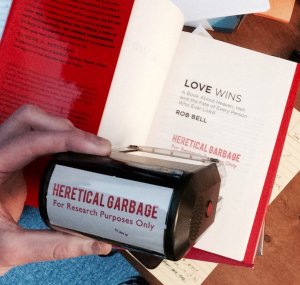
1. Keep them for research purposes. (If you think you might be tempted to read them and you don’t feel like you’re spiritually mature enough to handle that yet, maybe box them up and put them in storage for a later date.) You might want to mark them in some sort of way – in case you lose the book and someone else finds it or something like that – indicating that the book is false doctrine. My friend, Pastor Nate Pickowicz, has an awesome stamp for his “research only” books:

2. Burn them. I know it reeks of Nazism and censorship by wild-eyed preachers of yesteryear, but it’s biblical, it keeps false doctrine out of the hands of others, and these books can actually have a positive use for kindling if you have a fireplace or chiminea. (Please use all fire safety precautions. Also, it is not necessary to burn the books publicly.)


Is it Biblical for a woman to be in charge of the childrenโ€™s ministry? Especially one who is not doctrinally sound?

It isn’t biblical for anyone who’s unrepentantly and unteachably doctrinally unsound to be in charge of anything in the church.

If it’s a case like Apollos, in which the person in question simply doesn’t know any better, but changes her ways and embraces sound doctrine when corrected, that’s cause for giving glory to God. (Also, she might need more training in the Scriptures before she resumes her position of service.)

But if it’s a case in which the person persists in teaching false doctrine or acting sinfully, that’s cause for church discipline. And if she steadfastly refuses to repent despite biblical rebuke, she needs to be disfellowshipped from membership in the church. Of course, it should go without saying (unfortunately, it doesn’t these days) that people who aren’t church members and/or aren’t saved should not be given any position of service or leadership in the church.

It could be OK for a doctrinally sound woman to be in charge of the children’s ministry, depending what you mean by “in charge”, and depending on whether or not she can do so without violating Scripture:

1. She should not be considered as, or bear the professional title of, “pastor”. It is unbiblical for a woman to be a pastor, and if she’s not a pastor, then bearing the professional title of “pastor” is lying.

2. In her leadership duties, she should not teach adult men (for example, men who teach children’s Sunday School classes, if she oversees children’s Sunday School) the Scriptures or exercise authority over them.

3. The pastor, or an appropriate elder, should vet and approve any curricula and materials, guest speakers, activities, etc., she wishes to use.

If a pastor or elder oversees her leadership so that she is acting under his authority and at his direction, and she is not violating Scripture by preaching to men, teaching men Scripture, or exercising authority over men, I don’t see why it would be a problem for a woman to lead the children’s ministry. In fact, Christian women and churches who handle this properly could be a superb example and model for other Christian women and churches.


If you have a question about: a Bible passage, an aspect of theology, a current issue in Christianity, or how to biblically handle a family, life, or church situation, comment below (Iโ€™ll hold all questions in queue {unpublished} for a future edition of The Mailbag) or send me an e-mail or private message. If your question is chosen for publication, your anonymity will be protected.

Share Your Testimony

Testimony Tuesday: Carey’s Story

Carey’s Story

I grew up with a mentally ill single mother. My father had had an affair with her and went back to his wife before I was born. After my Christian step mother found out about me, she would witness to my mother and I over the phone. My home life was very unstable and chaotic and I almost committed suicide at the age of 13. I had decided I did not believe in God.

A few months later, Child Protective Services took me away from my mother and placed me in foster care. The first time my father ever called me was to ask if I would like to live with him and his wife- under the condition I would go to church with her. He did not go nor was he the spiritual leader of their home.

My father was awarded temporary custody and the day I moved in with him was the day I met him face to face.

I began to go to my stepmom’s charismatic, nondenominational church when I was 14 and was saved several months later. I had a deep rooted resentment and bitterness towards my dad and it was at this church that I was introduced to being “slain in the spirit”. The leaders would pray over me at the altar and although it felt as though they were pushing me over at times, I would fall to the floor “overcome by the Holy Spirit”. I grew up around prophesy, tongues, and women in unbiblical roles. Despite- and not because of- this, the Lord was merciful and gracious and through the years He did indeed deliver me of the stronghold of hatred towards my dad and I grew in my faith of God’s sovereignty. Unfortunately, however, my stepmom was heavily influenced by televised false teachers such as Joyce Meyer, Creflo Dollar, Benny Hinn, Marilyn Hickey, etc., and would share many unbiblical, yet convincing, ear tickling things with me. She was my number one mentor and a best friend. I also struggled tremendously in trying to be a good Christian but fell into many temptations such as extreme promiscuity and partying over the course of almost a decade. It seriously is only by God’s unfailing mercy that I am alive today.

In my early 20s, I married my second husband while in the Army. We were a “dual military couple”. I became pregnant with our son and discharged from the service to become a stay at home mom. I found a Southern Baptist Church while we were stationed in Texas and it was there that I grew tremendously in my love for God’s infallible Word and was discipled by our Sunday school leaders, particularly the wife. I was baptized and my husband soon began attending after initially refusing to.

However, our marriage was in a very terrible state and he was abusive.

Being an Army wife afforded me many opportunities and it was through joining the military ministry, PWOC (Protestant Women of the Chapel) that in many ways stunted my growth in biblical discernment, wisdom, and Truth. I became super involved and volunteered on and off for several years. I did many Bible “studies” by Beth Moore and others by leaders such as Priscilla Shirer.

At our next duty station, which was in my home state, we joined a church where I joined a prayer group that was led by the worship and youth pastor. He was a young man that was deeply deceived by the teachings of Bethel Church in Redding, California and many like-minded leaders, including the “Toronto Blessing”. The focus is on bringing heaven to earth, spiritual gifts, and signs and wonders. It is all very much based on emotionalism and New Age mysticism, but laced with Christian lingo and severely twisted Scriptures. I became even more influenced by leaders in the Word of Faith, “Name it and claim it”, NAR, post-modern Christianity, etc.

It was during this time that I fell into going outside of God’s Word and I would literally beg God for “more”, to be “undone” by the Holy Spirit and for Him to “visit” me. I wanted the power that I was duped into believing I deserved more of and was entitled to as a child of God. I would ask and even sing along to the song, “Fill me up, God”. I experienced being “drunk in the spirit”, received numerous visions, words of knowledge, operated in the gifts of tongues and prophesy, and had many incredibly convincing experiences. Much of what I was caught up in was contemplative prayer- emptying ourselves and letting “jesus” speak to us and giving “him” control over our prayer times. Only occasionally was a Bible actually opened (honestly, I used it the most during our meetings) yet we took precious care of the journal we would write in to document our prophesies and visions. Some of the other prayer group “members” would travel up to the “Toronto Blessing” church and even attended Sozo meetings out in the west. We also operated in automatic writing and speaking, and spoke in tongues without interpretation. The pastor also would take the teenagers on “treasure hunts”. They would pray, receive “clues” in visions and other ways “the spirit” would tell them, then go out into the city and find their targets. They would then approach the people and pray for them. This of course was very special, secretive operations only to be known by certain people.

We were taught that every decision in life should be directed by “the spirit”, neglecting the truth that “All Scripture is breathed out by God and profitable for teaching, for reproof, for correction, and for training in righteousness (2 Tim. 3.16). It was all very mystical and completely unbiblical.

During all of this I was still in the Word and there were many red flags that would wave, yet I was so caught up in the feelings and “power” of the experiences I was having. Not to mention I was being taught by a pastor who seemed very knowledgeable and had a “passion for the Lord” so what did I know? Truly he must know more than me.

When you are caught up in this heresy, you are always looking for the next high. You are never satisfied with God, despite the fact that Psalm 107.9 says “For he satisfies the longing soul, and the hungry soul he fills with good things.” One is truly enslaved by greed, lust, and idolatry.

You will do anything you think is necessary to remain on the mountaintop and avoid the valleys at all costs. Although I never wavered in faith of God, my walk was extremely chaotic and like a roller coaster. I would go through severe bouts of depression. Yet I also would experience extreme highs and excitement while reading Scripture eisegetically. I based my “spiritual maturity” and my relationship with Jesus on my feelings and by whether or not I could “feel His presence”, as the focus in most of these “ministries” is on how you feel. Because I was always “up and down”, I actually wondered if I was mentally ill, given family history. Throughout the years โ€“ I would “storm the gates of hell”, interceding for my kids and “binding” the devil of his plans for myself and my family. I would actually yell at satan, deceived of what true Biblical spiritual warfare is.

Keep in mind, it was during this time that the abuse in my marriage was close to being at its worst. My husband was not at all the spiritual leader of our home and I held a tremendous hatred towards him and would fantasize and even pray that he would die. I knew that this was wrong; I just kept begging God to deliver me in whatever way He saw fit.

Our group was very secretive and the attitude among us was prideful; we had elevated opinions of ourselves and “our gifts”. But never would we have admitted that. Thankfully the other pastor and elders of the church soon caught on to what the pastor was teaching the teenagers and the heresy that he was spreading. He was removed from his position and it caused a division within the church. This threw my world upside down and our prayer group split, with certain members leaving the church. One lady actually said “my gifts are not welcome here”. However, I had never felt like I was a true member of the group- something was always off and I felt as if they didn’t fully trust me. Another former “member” I have since spoken with admitted to feeling the same. I’m pretty confident that I don’t even know the full extent of the dangers they were involved with. And for that โ€“ I am now thankful!

I also was incredibly involved in the church and volunteered in many areas. I even had a key to the building- which was a source of pride, one sin that I was very enslaved by.

I love to read so it was also during this time I had many “Christian” books and I began to be very confused and unsure of what exactly I believed because I had so many “teachers”.

We are currently at another duty station and it has been during this last year and a half that God placed someone in our Facebook newsfeed that will at times biblically expose false teachers. Despite other times where I would start to research and seek the truth, yet fall right back into the lies, this time I dove in. I have found legitimate sources and people who shine the light on Biblical truth. With the Lord removing the blinders I had on for so long, reading the Word exegetically and for how God inspired it to be written, and resolving to not look outside of His Truth, I am coming to a true, Biblical understanding of Who He really is (and who He is not).

It has taken me many months to let go of the “mind blowing” experiences I have had throughout the years and accept the realization that the majority of what I thought was the Holy Spirit was not Him. I had opened myself up to the occult- all in the name of Christianity and being tricked into believing I was “anointed”.

I am thankful that during all these years I had been journaling almost every day so I have proof of the horrendous dangers I was caught in. I have considered destroying them but have chosen to keep them and instead plan to write a letter such as this testimony to precede the journals for anyone who may someday read them. I want people to understand that where I am in life now and in my understanding of God and His sovereignty does not come from a fundamentalist, legalistic, outside opinion. I was very much involved in and deceived as you have read.

When we arrived at our current duty station, I was not as discerning as I am now growing to be. We started attending and stayed at a church for over a year. In the time the Lord has been exposing the lies I have been trapped by, He showed me that it is not a church to be at. There are many reasons we left, but one is that their “worship” music is more self and “spirit” focused. Much of it comes from Bethel, Jesus Culture, and Hillsong. We have since made the move and now attend one where God is truly glorified in the exegesis preaching, studying of the Scriptures (not some topical study some “teacher” has written), music worship, and fellowship.

I am truly thankful for all the Lord has done, is doing, and will continue to do in my life. Especially for delivering me from the stronghold of false teaching. Now that I am being led in truth and I’m growing in discernment, my mind is clear, and I am on a steady path walking with my Lord.

And as a side note (which is another testimony in itself!)- He has delivered me from my abusive marriage by way of revealing to my husband his sin- he has since admitted to and has repented of the abuse. He truly is not the man I was married to all those years. He no longer treats me the way he did for 9.5 years. Although he is not a “super spiritual leader”, God continues to work in him. And I am continuing to learn to follow the whole counsel of God- to not pick Scriptures out of context to support my opinions or what someone is trying to teach. It was in doing this with verses on marriage that kept me bound in abuse and almost destroyed our family. Our marriage is definitely not perfect and there are still things that the Lord is working on in my heart, but we overcame almost divorcing and the Lord continues to heal us.

I truly believe that our marriage- as well as my father and stepmother’s- is an example of the destruction that can happen when men do not accept their God-given roles in leading their families centered on Christ and grounded in the Bible. Of course, women also neglect their ordained roles and our society suffers because of each person’s choices.

For everyone reading this โ€“ please know that God’s inspired Word and His grace is all sufficient. We do not need to- nor should we- look to any false gospel (which is no Gospel at all) to have our needs and/or desires met. Every need/desire we will ever have in this life has already been provided for by Jesus Christ dying on the cross and His resurrection.

I want to thank Michelle for her work in contending for the faith once for all delivered (Jude 1.3) and for allowing me to share my condensed (at least I tried to keep it short!) testimony.


Ladies, God is still at work in the hearts and lives of His people, including yours! Would you like to share a testimony of how God saved you, how He has blessed you, convicted you, taught you something from His word, brought you out from under false doctrine, placed you in a good church or done something otherwise awesome in your life? Private/direct message me on social media, e-mail me (MichelleLesley1@yahoo.com), or comment below. Try to be brief (3-4 paragraphs or less) if possible. Iโ€™ll select a few to share on the blog another time. Letโ€™s encourage one another with Godโ€™s work in our lives!

Discernment, Mailbag

The Mailbag: Potpourri (Replacement Theology, Spiritual Gifts Test, Books by false teachers…)

Welcome to another “potpourri” edition of The Mailbag, where I give short(er) answers to several questions rather than a long answer to one question. I also like to take the opportunity in these potpourrri editions to let new readers know about my comments/e-mail/messages policy. Iโ€™m not able to respond individually to most e-mails and messages, so here are some helpful hints for getting your questions answered more quickly. Remember, the search bar can be a helpful tool!


Can you explain what replacement theology is?

I can, but there are pastors and theologians way smarter than I am who have done a much better job of it than I could. I reached out to my friend Pastor Gabe “WWUTT” Hughes for some help and he addressed the question in this episode of the When We Understand the Text podcast (starting at about 1:30):

WWUTT 565 Q&A Replaced Protesting Eligibility?

You may also find the following resources helpful:

The Church and Israel: The Issue at Ligonier

What is replacement theology / supersessionism? at Got Questions

What is replacement theology? at CARM

Supersessionism at Theopedia


I want to get more involved in serving my church. Can you recommend a spiritual gifts survey web site so I can find out what my spiritual gifts are and how I should be serving?


If you have a question about: a Bible passage, an aspect of theology, a current issue in Christianity, or how to biblically handle a family, life, or church situation, comment below (Iโ€™ll hold all questions in queue {unpublished} for a future edition of The Mailbag) or send me an e-mail or private message. If your question is chosen for publication, your anonymity will be protected.