Church, Southern Baptist/SBC

10 Things I Wish Southern Baptists Knew About Southern Baptists

Originally published June 26, 2015

Some things have changed in the SBC, at LifeWay, the ERLC, etc., since this article was originally written in 2015 (see footnotes), however the bulk of what is mentioned here is still relevant. It also helps us see just how longstanding and pernicious many of these problems are.

Earlier this week, Russell Moore, president of the Southern Baptist Convention’s Ethics and Religious Liberty Commission3 published a nifty little article called “10 Things I Wish Everyone Knew About Southern Baptists“. Although I disagree with Dr. Moore on a number of things, I thought the article was pretty good, overall.

But it got me thinking. Yes, there is a lot of ignorance about Southern Baptists out there among those who aren’t part of our denomination. However, there’s also a lot of ignorance inside the SBC about what’s really going on in our denomination, our doctrine, practices, leadership, and so on. These are ten SBC realities I wish the average Southern Baptist church member were more aware of.

1. LifeWay sells lies and heresy, and they don’t want you to know.
Now I’m not saying everything they sell is lies and heresy. I’ve bought lots of good doctrinally sound materials from them over the years. However, the fact remains that they continue to sell books and materials from false teachers like T.D. Jakes, Sarah Young, and Andy Stanley on their shelves. They will order books by false teachers like Joyce Meyer and Joel Osteen for you if you just ask at the counter.ยน They continued to sell The Boy Who Came Back from Heaven (a book recounting Alex Malarkey’s supposed trip to Heaven after a car accident) for nearly a year even after Alex, his mother, Beth, and respected SBC pastor, speaker, and author Justin Peters repeatedly told LifeWay leadership that the story was a lie. Emails and phone calls about heretical materials at LifeWay are either ignored or the caller placated (I know this from first hand experience). Questions from the floor at the Southern Baptist Convention about LifeWay carrying false doctrine are quashed.

This entity of your denomination which purports to love and serve the Lord Jesus Christ is selling lies about Him to make a fast buck, and they need to stop.

2. There are plenty of apostate Southern Baptist churches, and we have no mechanism in place for kicking them out of the SBC.
This is a verbatim quote from the FAQ section (5th question from the top) of the SBC’s web site:ยฒ

“According to our constitution, if a church no longer makes a bona fide contribution to the Convention’s work, or if it acts to ‘affirm, approve, or endorse homosexual behavior,’ it no longer complies with the Constitution of the Southern Baptist Convention and is not permitted to send messengers to the annual meeting. These, however, are the only explicitly stated instances in which the SBC has the prerogative to take action.”

What does that mean? As long as your church doesn’t affirm homosexuality and gives to the Cooperative Program, you’re in. Never mind if your pastor twists God’s word until it’s unrecognizable. Or lets women and false teachers get behind the pulpit like Steven Furtick does. Or plays AC/DC’s “Highway to Hell” on Easter Sunday and says he probably wouldn’t have strippers on stage like Perry Noble does. Or any of the other ridiculous and blasphemous shenanigans so many of the seeker sensitive types in our denomination pull. Nope, as long as you give your money and stand on the right side of homosexuality, you’re good to go.

3. Beth Moore is a false teacher.
That’s right, the queen of SBC3 women’s Bible study, divangelista Beth Moore, does not rightly handle God’s word, partners with false teachers, and violates Scripture by preaching to men, among other things. And Priscilla Shirer is right there with her.

4. Having a small church isn’t a sin and it doesn’t necessarily mean your pastor (or your church) isn’t trying hard enough.
The average church size in America is 186 members, and 94% of church goers attend a church of 500 or fewer people, yet the constant drumbeat of SBC leadership is “bigger is better.” Countless articles harangue exhausted pastors about breaking the 200 or 250 or 300 member attendance “barrier.”

Listen, if your pastor is faithfully preaching and rightly handling God’s word and your church members are serving one another and carrying out the Great Commission in their daily lives, that’s what counts in God’s eyes, not how many butts are in a pew.

5. The Bible doesn’t require you to tithe, and neither should your church.
The tithe is part of the Old Testament law that Christians today are no longer bound by because we are under the covenant of grace, not the Mosaic covenant. Christians are to gladly give the amount we determine in our own hearts to give out of love for our Savior and a desire to serve Him- not under compulsion from someone else.

6. The “sinner’s prayer” won’t save you.
If you think you’re saved because you parroted a prayer someone led you in when you were five but your life shows no love of Christ and no evidence that you belong to Him, then your faith is in the prayer you prayed, not in Christ, and you are not saved. The evidence that you’re a Christian is that you love the Lord, and are growing in holiness, not that you once repeated a prayer (or that you were baptized, attend church regularly, are a “good person,” etc.) Examine yourself to see if you’re really in the faith.

7. Your church probably has a significant number of lost people in it.
Jesus Himself said, there are few who find eternal life and that there are many who call Him “Lord” whom He does not know and will turn away on the Day of Judgment. This is why it is absolutely imperative that pastors, Sunday School teachers, and all other church leaders know the gospel inside out and teach it incessantly, even to people who claim to know Christ.

8. Lots of Southern Baptist churches violate 1 Timothy 2:12ff.
We do fairly well at not permitting women to serve as pastors, but beyond that there are plenty of churches and pastors who sin by allowing women to serve in positions in the church that are restricted to men. Do women in your church preach the Sunday sermon or teach co-ed Sunday School classes? Do they head up committees or ministries that put them in authority over men? Do they, as worship leaders or in some other capacity, stand before the congregation and instruct or exhort them? Then your church is in sin.

9. Politics won’t save America.
This country is imploding. You don’t have to be a prophet to see that. Voting according to biblical principles, running for office, working through the system to right wrongs, signing petitions, and other political activity is fine, but don’t put your eggs in those baskets. The Titanic has hit the ice berg, and Christians in this country will soon be facing real persecution like we see overseas. We need to rescue the perishing with the gospel. It can’t be done with the White House or the state house. When is the last time you shared the gospel with someone?

10. Jesus wins.
Things are bad and getting worse. In our world, in our country, in our denomination, in our churches. But the good news of Scripture for all people is that, in the end, Jesus is coming back for His bride. He will conquer evil and those of us who truly belong to Him will spend eternity with Him. This world is not all there is. Jesus wins.


ยนIt is possible LifeWay has changed this policy. I called my local LifeWay last week (Jan. 2017) and asked them to order a Joyce Meyer book and a Joel Osteen book. I was told the store could not order books by either of these authors. I applaud LifeWay for this step in the right direction.

ยฒAs of 2019, this verbiage has been removed from the FAQ section of the SBC website. Conceptually similar language can be found here (see Article III: Composition).

3Russell Moore and Beth Moore (no, they’re not related) both left the SBC in 2021.

Christian women, Discernment

Throwback Thursday ~ Sammy

Originally published August 8, 2017

12920430_1066615836718518_8458002385968974867_n

See this dog? His name is Sammy and he belongs to our next door neighbors. The way I know this is that Sammy frequently escapes from their yard and comes over to visit mine.

Sammyโ€™s a good egg. Heโ€™s friendly and just looking to collect a few more buddies. Heโ€™s also dumb as a sack of hair and totally disobedient to his masters. He runs when they tell him to come. He stays in my yard when they tell him to go home.

A few days ago, I went for my regular power walk and Sammy happened to be out in his own front yard. I headed past his house for the pond where I usually walk, and soon noticed that he was following me. I turned and told him to go home. Sammy sneezed in protest and completely disregarded my instruction. OK, I thought, Iโ€™ll ignore him, heโ€™ll get bored, and heโ€™ll go back home. Problem solved.

Only it wasnโ€™t. Sammy continued to follow me for the next half mile or so, far away from his home. I was worried heโ€™d get lost on his way back. I was worried heโ€™d get hit by a car on his way back. I was worried heโ€™d never BE on his way back. I was also a little worried people would think this hare-brained dog was mine and yell at me when he explored their flower beds.

Finally, a little farther down the road, I turned around and Sammy had disappeared. He must have made it back home all right because heโ€™s still getting loose and visiting my house pretty regularly.

Sammy reminds me of a lot of Christian women these days. They have a Master โ€“ Christ – who loves them, provides for them, cares for them, and has adopted them into His family. And because Christ loves them, He has put up the fence of His word and His precepts to keep them safe and protected- to give them a place where they can flourish in Him.

But these โ€œSammysโ€ refuse to be hemmed in, either because theyโ€™re ignorant of Godโ€™s word or theyโ€™re rebellious against it. All they know is that there are a million fun and exciting things on the other side of the fence. Things they feel like doing and experiencing.

And one day, when theyโ€™ve put a toe over the line by wandering around in the front yard instead of the back, a false master strolls by. Sheโ€™s different. New. Shiny. A change of pace from the regular routine. This master isnโ€™t Sammyโ€™s real master. She doesnโ€™t care for Sammy, keep her safe, provide for her, or make sure Sammy grows and flourishes. But this false master is exciting. Sheโ€™s going to the pond Sammy has always wanted to visit. She doesnโ€™t put up fences, get out the leash, or holler, โ€œCome!โ€ She lets Sammy do what Sammy wants to do. And she leads Sammy farther and farther away from her home with her true Master.

Some Sammys manage to find their way back home. Some get hit by cars along the way. But most just keep wandering from one false master to another, forgetting that their true Master never intended for them to end up a stray.

Go home, Sammy. Sit, and stay.

Christian women, Discernment

Sammy

12920430_1066615836718518_8458002385968974867_n

See this dog? His name is Sammy and he belongs to our next door neighbors. The way I know this is that Sammy frequently escapes from their yard and comes over to visit mine.

Sammyโ€™s a good egg. Heโ€™s friendly and just looking to collect a few more buddies. Heโ€™s also dumb as a sack of hair and totally disobedient to his masters. He runs when they tell him to come. He stays in my yard when they tell him to go home.

A few days ago, I went for my regular power walk and Sammy happened to be out in his own front yard. I headed past his house for the pond where I usually walk, and soon noticed that he was following me. I turned and told him to go home. Sammy sneezed in protest and completely disregarded my instruction. OK, I thought, Iโ€™ll ignore him, heโ€™ll get bored, and heโ€™ll go back home. Problem solved.

Only it wasnโ€™t. Sammy continued to follow me for the next half mile or so, far away from his home. I was worried heโ€™d get lost on his way back. I was worried heโ€™d get hit by a car on his way back. I was worried heโ€™d never BE on his way back. I was also a little worried people would think this hare-brained dog was mine and yell at me when he explored their flower beds.

Finally, a little farther down the road, I turned around and Sammy had disappeared. He must have made it back home all right because heโ€™s still getting loose and visiting my house pretty regularly.

Sammy reminds me of a lot of Christian women these days. They have a Master โ€“ Christ – who loves them, provides for them, cares for them, and has adopted them into His family. And because Christ loves them, He has put up the fence of His word and His precepts to keep them safe and protected- to give them a place where they can flourish in Him.

But these โ€œSammysโ€ refuse to be hemmed in, either because theyโ€™re ignorant of Godโ€™s word or theyโ€™re rebellious against it. All they know is that there are a million fun and exciting things on the other side of the fence. Things they feelย like doing and experiencing.

And one day, when theyโ€™ve put a toe over the line by wandering around in the front yard instead of the back, a false master strolls by. Sheโ€™s different. New. Shiny. A change of pace from the regular routine. This master isnโ€™t Sammyโ€™s realย master. She doesnโ€™t care for Sammy, keep her safe, provide for her, or make sure Sammy grows and flourishes. But this false master is exciting. Sheโ€™s going to the pond Sammy has always wanted to visit. She doesnโ€™t put up fences, get out the leash, or holler, โ€œCome!โ€ She lets Sammy do what Sammy wants to do. And she leads Sammy farther and farther away from her home with her true Master.

Some Sammys manage to find their way back home. Some get hit by cars along the way. But most just keep wandering from one false master to another, forgetting that their true Master never intended for them to end up a stray.

Go home, Sammy. Sit, and stay.

Book Reviews

A Review of Justin Peters’ “Do Not Hinder Them”

As I’ve mentioned before, solicited book reviews are not part of my regular repertoire here at the blog. In fact, for a variety of reasons, I have a policy against writing them.

But when one of your heroes in the faith asks, you make an exception. And, for me, Justin Peters is one of those heroes in the faith (even more so because I’m sure he wouldn’t want me calling him that).

I introduced Justin this way in my article, A Few MORE Good Men: 10 Doctrinally Sound Male Teachers:

โ€œJustin Peters Ministries exists to preach the Gospel of Jesus Christ to the lost and to help equip the saved to โ€˜speak the truth in loveโ€™ (Ephesians 4:15). Great care is taken to preach and teach Godโ€™s Word in its proper context and simply let the text speak for itself.โ€

The first thing I ever noticed about Justin Peters is his striking example of biblical meekness. Justin is soft-spoken and peaceable, but firm in his gospel convictions and aflame with the desire for the lost to come to salvation. You must read Justinโ€™s testimony of coming to know Christ after years in seminary and ministry as a false convert. What Justin is perhaps best known for is his teaching and discernment ministry exposing the Word of Faith movement. It started with a trip to a faith healer as a teen to have his own cerebral palsy healed and grew into Clouds Without Water, a seminar designed to educate the church on the history, growth, and metastasization of the Word of Faith heresy.

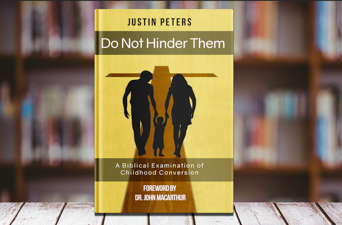
But Justin doesn’t limit himself to discernment ministry, and his new book, Do Not Hinder Them: A Biblical Examination of Childhood Conversion, opens the door to another of his theological interests- salvation and baptism, especially as they pertain to children.

A simple, yet fundamental, point of theology which needs to be understood in order to grasp the concept of the book is the difference between credo-baptism and paedo-baptism. Credo-baptism is also called “believer’s baptism.” This means that a new believer stands before the church, professes her faith in Christ, and is then baptized out of obedience to Him- to demonstrate that she has passed from death unto life and now wishes to be identified as a follower of Christ. Credo-baptists believe strongly that baptism is onlyย to be administered to professing believers.

Paedo-baptism is infant baptism. It is administered to all babies and children (by definition, unable to profess faith in Christ) by a number of Protestant denominations as a symbol that a child has been born into a covenant (believing) family who will raise her in the nurture and admonition of the Lord and the knowledge of the gospel.

There’s an angst that Bible believing credo-baptist parents often experience, which, undoubtedly, is foreign to paedo-baptist parents:

My young child has come to me claiming to have asked Jesus into her heart and wants to be baptized. How can I tell if she’s really saved and that it’s right for her to be baptized at this age?

It’s a long standing dilemma for Southern Baptists like Justin…and me. My mother happened to mention in passing a few years ago that I had begged to be baptized when I was about six. It made sense because that’s about the time all of my little friends were being baptized, but, I was very surprised to hear this story because, as an adult, I had no recollection of it whatsoever, and I can guarantee you I wasn’t saved at the time. My parents wisely said no.

As parents ourselves, my husband and I have faced the same struggle. Five of our six children were baptized as young children. One is not currently walking with the Lord and two of them were re-baptized later at their own request when they realized they had not been saved the first go round.

This is the central issue Justin tackles inย Do Not Hinder Them.

But don’t be fooled by the title of the book. While it’s a must read for Christian parents, pastors, and those who work in children’s ministry, you also need to read this book if…

…you’ve ever wondered ifย you’reย really saved.
…you’re wondering if that loved one (of any age) who claims to be a Christian is really saved.
…you’re a paedo-baptist wanting to get a better grip on credo-baptist beliefs and struggles
…you’re brand new to the study of theology and are looking for a resource that will easily help you to “dip a toe in the water” (so to speak)

In other words, though Justin addresses the issue of genuine conversion as it applies to children seeking baptism, the question of “How can I know if I/my loved one is really saved?” is one we all face at some point in our walk with Christ. So, while there may be a few parts of this book that don’t apply if you’re not a pastor, children’s ministry worker, or parent, most of it is helpful for every Christian.

One of the foundational issues Justin cites as having gotten us into the muck and mire of baptizing unregenerate children, only to have them “walk away” from the Lord (though, indeed, they were never saved in the first place) as teens or young adults – sullying the name of Christ and His church – or to seek a second baptism once they realize they were unsaved the first time, is the fact that we have so watered down the gospel and the soteriology our churches subscribe to and practice. “Getting saved” has been reduced to parroting a sinner’s prayer, or mental assent to a simplistic set of facts that even the demons believe.ย There is little to no presentation of sin and rebellion, guilt before a holy God, God’s wrath toward the sinner, and the eternal punishment of sin. And when was the last time you heard a pastor urge someone contemplating following Jesus to count the costย of being His disciple? Instead, it’s, “Don’t you want to go to Heaven when you die?” or “Just believe A, B, and C, and you’re saved!” or “God loves you and has a wonderful plan for your life!” Rarely are young children mature enough in their thinking to be able to grasp the true nature and meaning of why they need a Savior and what repentance, regeneration, and discipleship really entail.

And that’s largely our fault. As Christian parents, we understandably want our children “in,” safe from an eternity in Hell. So we make it as easy as possible for them to complete the transaction. Instead of raising our children up to understand and attain to the high bar of the demands of the gospel, we lower the bar so far that even the youngest child can toddle right over it. In the end, the problem is not that we’re baptizing unsaved babes as our paedo-baptist brothers and sisters do, but that we’re presenting a false gospel that creates false converts who hang their eternity on having repeated a prayer and passed through the baptistry.

The second key issue Justin says has contributed to the epidemic of baptizing unregenerate children is the fact that we base our decision to baptize them solely on their verbal profession of faith rather than on the fruit of a changed life.

I remember all too well the worry over my own small children’s salvation in this regard. How could I tell if they were really saved or not? They had been in church and raised in a Christian home all their lives- they knew all the right answers to give when we questioned them about their salvation experiences.

As Justin wisely points out, this is often the case with “church kids.” They know how to repeat back what they’ve learned in Sunday School, and, because they’ve been raised in a godly atmosphere, they’re likely already good kids, outwardly behaving in what looks like a Christlike way. When they come to us and say, “I’ve asked Jesus into my heart,” how can we tell if it’s genuine saving faith?

Most of the time, the answer is- we can’t. Until, that is, that faith has been tested and their testimony proven true through the refining process of trial, temptation, and persecution. Until he is able to bear fruit in keeping with the repentance he claims. Does your child freely choose obedience to Christ over giving in to temptation? Does he cling to Christ during times of difficulty? Does he visibly stand for Christ when ridiculed for doing so by his peers? What five year old even faces such situations?

And that’s precisely Justin’s point. We rush our children through the baptismal waters as soon as they claim to have received Christ rather than waiting to see their faith prove out over the ensuing years. Your five year won’t face the temptation to use drugs or engage in sex. But your teenager will. It’s unlikely a gang of kindergartners will surround your child and mock his belief in Christ and biblical values. Sophomores and juniors do so gleefully. How does your young adult, who claims to be born again, handle these types of situations? When it’s hisย choice, not yours, does he consistently and unrepentantly go along with the worldly crowd or does he bear up and walk faithfully with Christ? Justin suggests, and I can’t help but agree, that the testing of our children’s faith that comes with age and independence, and the fruits of Christlikeness they bear – such as: godly sorrow over sin, personal holiness, hunger for the Word, and increasing discernment – ย are a much more reliable barometer of their spiritual state than the “right answers” they are able to give as small children. It is for this reason that Justin suggests postponing baptism until the late teens or early 20s, while encouraging and nurturing our children’s faith as they grow and mature.

Do Not Hinder Them so effectively addresses these matters of concern to the church that I unhesitatingly recommend it to all Christians. Justin writes in a simple, unassuming style that even the newest believer would be comfortable with, and explains complicated theological terms and issues with ease. The book is chock full of helpful footnotes rife with Scripture references and supplementary resources, and is only 112 pages long, making it an easy evening’s read.ย Do Not Hinder Them is available in soft cover format (not available in e-book format at this time) and is endorsed by Dr. John MacArthur. You can purchase a copy at Justin’s web site or onย Amazon.


All brown “pull quotes” in this article are taken from:
Peters, Justin.ย Do Not Hinder Them: A Biblical Examination of Childhood Conversion.ย Justin Peters Ministries, 2017.

Mailbag

The Mailbag: My “Christian” Family Member Bears Rotten Fruit

mailbag


I have a family member, *Fran, who claims to be a Christian, but follows several major false teachers, drinks, habitually lies, is very proud, boastful, and manipulative. She has been shown that these teachers are false but chooses to follow them anyway.

Should I treat her as though she were a sister in Christ by going to her and rebuking her and going through the โ€œdisciplinaryโ€ steps in hopes of reconciliation? Or should I go about it as if she werenโ€™t a sister in Christ?ย  I have been praying for her and for wisdom for myself to handle this in a God honoring way.
(*Name changed)

It’s always difficult to watch a loved one choose sin over Christ and false doctrine over sound doctrine. Praying for Fran and for God’s wisdom and guidance are the first and best step.

You’ve asked about “going through the ‘disciplinary’ steps in hopes of reconciliation.” I believe what you’re referring to here is the process described in Matthew 18:15-17:

If your brother sins against you, go and tell him his fault, between you and him alone. If he listens to you, you have gained your brother. But if he does not listen, take one or two others along with you, that every charge may be established by the evidence of two or three witnesses. If he refuses to listen to them, tell it to the church. And if he refuses to listen even to the church, let him be to you as a Gentile and a tax collector.

This is the basic outline Christ has given us for disciplining sin in the local church. One thing to notice about that last step is that if the person sinning does not listen to the church, the church is to excommunicate (remove, or disfellowship) him from membership and regard him as someone who is lost and in need of the gospel. This brings us to the question of whetherย Fran is a member of your church or another church. A church obviously can’t excommunicate someone who isn’t a member of that church. This helps us to see that each local body is responsible for disciplining its own members.

If Fran is a member of your church, then, yes, the steps in the Matthew 18 passage should be applied. The wisest course of action, especially if you’ve never done something like this before, is to seek the counsel of your pastor or an elder as to the best way to approach Fran and handle the meeting. Set aside some one on one time to talk to Fran, and be sure you listen to her as well. Part of that one on one meeting is forย you– to make sure you are correctly assessing the situation, not, for example, reacting to a rumor you heard, a misunderstanding of an incident, etc. Lovingly and humbly point her to the Scriptures she has transgressed. Pray with her if she is willing.

After that initial meeting, give her some time to consider what you’ve said and to respond to the Holy Spirit’s work in her heart. Check back in with her at a later date and find out if she has repented. If not, prayerfully gather two or three others Fran likes and respects and repeat the process. If she still doesn’t repent, take those two or three people, meet with your pastor or the appropriate elder, and seek his guidance on the next step to take.

You didn’t specify in your e-mail, but it sounded as though Fran is not a member of your church. In this case, you really don’t have any ecclesiological redress (i.e. excommunication) to back you up. What you have is a family member who appears to be a false convert because she is bearing the fruit of someone who is unsaved rather than the fruit of someone who is saved.

I would again encourage you to meet with your pastor, an elder, or a godly, older, spiritually mature woman at your church for counsel as to the best way to proceed. It might be possible to carry out the first two steps of the process simply as an act of love and concern, considering what steps you would take in your personal relationship with Fran if she refuses to repent. First Corinthians 5:9-13 is a good passage to study as you consider this situation:

I wrote to you in my letter not to associate with sexually immoral peopleโ€” not at all meaning the sexually immoral of this world, or the greedy and swindlers, or idolaters, since then you would need to go out of the world. But now I am writing to you not to associate with anyone who bears the name of brother if he is guilty of sexual immorality or greed, or is an idolater, reviler, drunkard, or swindlerโ€”not even to eat with such a one. For what have I to do with judging outsiders? Is it not those inside the church whom you are to judge? God judges those outside. โ€œPurge the evil person from among you.โ€

This passage is also written to the church body regarding church discipline, but we can glean from it, as well as from the Matthew 18 passage, that there is to be some noticeable degree of separation between Christians and individuals who call themselves Christians yet unrepentantly persist in sin.

As you mentioned, the whole point of lovingly confronting someone you care for about her sin is to – for the good of her own soul – point her back to Christ so that she may first be reconciled with Him through repentance and forgiveness, and then be reconciled with her church family and others. Two good Scriptures to remember and take to heart when we have no other choice but to approach a sinning sister are:

And as you wish that others would do to you, do so to them. Luke 6:31

For with the judgment you pronounce you will be judged, and with the measure you use it will be measured to you. Matthew 7:2

It can be difficult, painful, and embarrassing to hear someone tell you you’re in sin. Put yourself in that sister’s shoes. Treat her as kindly and mercifully as you would want someone to treat you.ย Weย never confront another in her sin with the motive of shaming, punishing, seeking revenge, or proving her wrong and ourselves right. That is not the gospel. It is not how Christ treats us when we sin. If she repents when you approach her, forgive and rejoice with her in the good work Christ has done in her heart.

Additional Resources:

What is Excommunication in the Bible? at Got Questions

What does the Bible say about church discipline?ย at Got Questions

A Church Discipline Primerย at 9 Marks

In Order that You May Know at Grace to You


If you have a question about:ย a well known Christian author/leader, a Bible passage, an aspect of theology, a current issue in Christianity, or how to biblically handle a family, life, or church situation, comment below (Iโ€™ll hold all questions in queue {unpublished} for a future edition of The Mailbag) or send me an e-mail or private message. If your question is chosen for publication, your anonymity will be protected.