Basic Training, Evangelism

Basic Training: The Great Commission

For more in the Basic Training series, click here.
Have you ever heard the phrase “The Great Commission“? Do you know what it means? If not, you’re not alone…
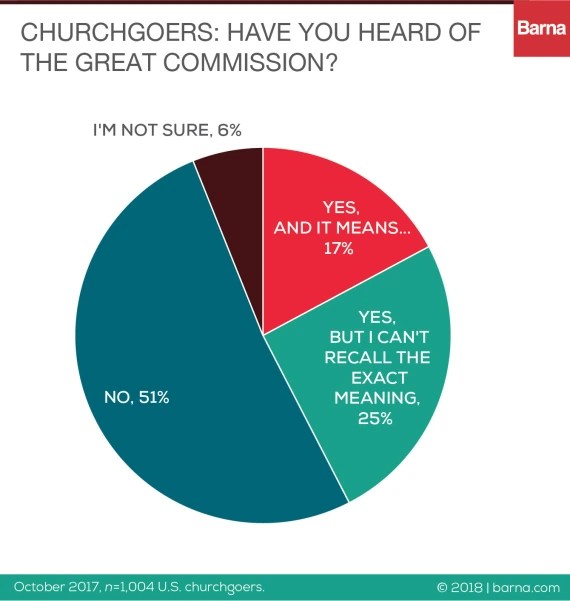
photo courtesy of barna.com

The Barna Group recently conducted a study asking churchgoers if they had previously “heard of the Great Commission.” In their report, 51% of Churchgoers Don’t Know of the Great Commission the results of the study were summarized thusly:

“…half of U.S. churchgoers (51%) say they do not know this term. It would be reassuring to assume that the other half who know the term are also actually familiar with the passage known by this name, but that proportion is low (17%). Meanwhile, ‘the Great Commission’ does ring a bell for one in four (25%), though they can’t remember what it is. Six percent of churchgoers are simply not sure whether they have heard this term ‘the Great Commission’ before.”

Now, if you know anything about statistics, you know how important it is to structure your questions carefully and get a representative sampling of the population you’re surveying in order to get the most accurate results. What does “churchgoer” mean? Is it possible people have never heard the term “The Great Commission” simply because churches don’t use this particular phrase any more? It’s important to take things like this into consideration because it affects the results of the survey. (You can find out more about Barna’s structuring process for this study at the end of the article linked above.) But even if the numbers of the Barna survey aren’t exact, I think it’s safe to say there are a lot of people out there in churchland who aren’t familiar with The Great Commission.

Just for fun, let’s see what the results would be if we surveyed readers of my blog:

The Great Commission refers to some of Jesus’ final words to the disciples before His ascension and is cited from Matthew 28:18-20:

And Jesus came and said to them, ‘All authority in heaven and on earth has been given to me. Go therefore and make disciples of all nations, baptizing them in the name of the Father and of the Son and of the Holy Spirit, teaching them to observe all that I have commanded you. And behold, I am with you always, to the end of the age.’

With these words Jesus commissioned the eleven remaining disciples to go out into the world and carry on His mission. Since every Christian is a disciple, or follower, of Christ, this is our commission from Him as well. Let’s examine what it says.

All authority in heaven and on earth has been given to Me.
Before commissioning his disciples, Jesus reminds them that everything He’s about to say is founded on and imbued with His authority. Jesus alone has the divine authority to establish the church and to dictate the way in which His church is to be set up and to grow.

We 21st century Christians would do well to keep forefront in our minds and hearts the authority of Christ over His church. There is no need for churches to “cast vision” or come up with mission statements. Christ is the head of the church and has already given us His vision for it. The Great Commission is His mission statement for the church.

Go therefore
“Therefore” in this little phrase refers back to what Christ has just said about His authority. In other words, because all authority in heaven and on earth has been given to Me, I am telling you to go.

“Go” is a very generic verb in English. We can “go” into the kitchen or we can “go” to the moon or we can “go” out and conquer the world. We can “go” anywhere from our own personal microcosm to the edges of the known universe. And that is the same sense the Greek word πορεύω captures: as you “go your way,” as you “go forth,” as you “walk”, as you “pursue the journey on which [you have] entered.” Wherever life takes us, whether it’s across the street or across the world, we go as ambassadors of Christ, carrying the good news of the gospel with us.

All nations
Revelation 7:9 tells us that God will save people from “every nation, from all tribes and peoples and languages.” So that’s who we share the gospel with as we go our way. Everybody. Regardless of where they’re from, what they look like, or how they talk. We are not to withhold the gospel from anyone, and we’re to make sure the church is proactively carrying the gospel to every populated geographical location on earth.

Make disciples…teaching them to observe all that I have commanded you
Notice the language Jesus uses here. He doesn’t say “make converts” or “make Christians”. He says “make disciples.”

Think about what the disciples did while Jesus was on earth. First, they answered His call to follow Him. Then, they began the journey of following Him wherever He went. He trained and equipped them day and night. They loved Him and worshiped Him. They imitated the things He did and said. They carried on His work after He ascended. Jesus is saying to the disciples, and to us, “Replicate yourselves. Make more like you.”

That means that the Great Commission starts with sharing the gospel with a lost person, but it doesn’t end there. There’s more to our mission than just evangelism. We are to train and equip Christians to follow Jesus daily, to love and worship Him, to imitate Him in obedience, and to carry on His work.

Baptizing them in the name of the Father and of the Son and of the Holy Spirit
After salvation, baptism is the first step a new Christian takes on the road of discipleship. It is not optional. Baptism publicly identifies a person – to the church and to the world – as a Christian, and is a personal pledge to follow Christ obediently all the days of one’s life.

Being baptized “in the name of the Father and of the Son and of the Holy Spirit” carries several layers of meaning.

💧Again, pay careful attention to the language in this phrase. Jesus does not say “in the nameS” – plural. He says, “in the name” – singular. This is a boldly Trinitarian statement directly from two of its members: Jesus, who spoke these words to the disciples, and the Holy Spirit, who breathed them out through the pen of Matthew. This is God Himself telling us who He is. Jesus spoke these words to good Jewish boys who were born and bred on the shema: “Hear, O Israel: The Lord our God, the Lord is one.” There was to be no confusion for new Believers back then, Believers today, or to the onlooking world, as to who these Christians are following. They are not following three different gods. They are following the one true God in three Persons: God the Father, God the Son, and God the Holy Spirit – the whole ball of wax.

💧Names meant far more in biblical times than they do to us today. We see God changing people’s names – Abram to Abraham, Jacob to Israel, Simon to Peter, etc. – when He commissioned them for a new mission or phase of life. Being baptized “in the name of” the Father, Son, and Holy Spirit echoes that tradition of God changing people’s names. You are no longer your own, you are Christ’s. You are no longer “Sinner”, you are “Saint”. You no longer go forth in your own name, but in the name of the Father, Son, and Holy Spirit as their emissary, endowed with the power and authority of God to live for Him and to proclaim the gospel to a lost and dying world.

💧Because Christians are, by definition, Trinitarians, and because baptizing a Believer is commissioning her to go forth into the world as a representative of Christ, it’s appropriate for pastors to take this verse literally when performing a baptism and verbalize its words: “I baptize you in the name of the Father, and of the Son, and of the Holy Spirit.”

Basic Training: Baptism

And behold, I am with you always, to the end of the age.
What a sweet promise, both to the disciples and to us today. Obediently following Christ in our daily lives, sharing the gospel, and making disciples can be lonely, exhausting, and discouraging at times. But we don’t have to do it alone, and we don’t have to do it in the flesh. Christ is with us and He knows all too well how hard it can be. God has given the Holy Spirit to indwell and empower Believers to live for Him and to carry out The Great Commission.

Additional Resources

What is the Great Commission? at Got Questions

The Great Commission by John MacArthur

The Great Commission by Burk Parsons

Mailbag

The Mailbag: How can we get women to WANT to come to Bible study?


My church is blessed to have two strong ladies’ Bible study leaders – one during the week for those who are available and one on Saturday for those who cannot attend during the week – who have the discernment to choose biblical content, study, and lead scripturally sound discussion. My prayer is that more women in my church would have the desire to attend these Bible studies, not only learning and growing spiritually but also for fellowship with each other and drawing closer to each other. If you have any ideas for actually getting women to want to study God’s word with other women I would love to hear them.

Been there, done that. I once taught a women’s Bible study class that consistently had only one to two women in it. I think our maximum attendance was one day when we had a whopping…four. The other women of the church chose to attend the “fluffier” classes that were being offered, and many just didn’t attend at all.

There could be any number of spiritual and practical reasons women aren’t attending your (or another reader’s) Bible studies.

☞ People are extraordinarily busy these days, especially women. Jam-packed schedules are probably the main reason for your low attendance. I’ll be honest, if I worked a full time job outside the home as well as taking care of my home and family, I’d be very unlikely to attend any Bible study class besides Sunday School. I’d want to devote that time to my family or to rest.

☞ Perhaps there are more false converts in your church than you’re aware of. People who aren’t saved are not new creatures in Christ and are devoid of the Holy Spirit, so they have no organic desire to spend time in God’s Word or with God’s people beyond the minimal amount required to fulfill whatever fleshly agenda brings them to church in the first place. There’s no human way to give them the desire to attend Bible study. Only God can accomplish that by saving them.

☞ If you go to a doctrinally sound church, your ladies may feel like they get plenty of good Bible study already and what they really want is unstructured fellowship time. See my article All Word and No Play: The Importance of Fun and Fellowship in the Doctrinally Sound Church.

☞ There may be something about the teaching style or the materials, that – even though they’re doctrinally sound – are rubbing people the wrong way. Maybe the teacher lectures and your ladies want more discussion. Maybe she talks over their heads in a very academic style. Maybe the materials are too expensive or there’s something about the book that is off-putting. Maybe your church only does “canned” (workbook, DVD, etc.) studies and what your ladies really want is to study books of the Bible, or vice versa.

☞ Hopefully this isn’t the case, but if there are factions in your church, someone could be surreptitiously – out of jealousy, sowing discord, or other reasons – discouraging the women from attending.

☞ The logistics of the class might be inconvenient for some. Do you offer child care for those who need it? Is the class held on a convenient day of the week and time of day? Is your church and the room you’re using for the class accessible to women with disabilities? 

These are just a few things that came to mind. Some of them may have to do with the class or the teacher. Others have more to do with the women themselves. What can you do to encourage more women to attend?

✔ Pray – and be ready to be in it for the long haul – that God will change hearts and give the women of your church a greater desire for His Word. In the end, God is the only One who knows all of the reasons women aren’t attending Bible study, and He is the only One with the power to transform them and overcome those reasons. Pray fervently and trust Him.

✔ If you’re truly stumped as to why women aren’t attending Bible study, ask them. You could do so face to face, individually, or, with your pastor’s permission, send out an anonymous survey (you’ll probably get a better response this way) asking things like, “Is the lecture style teaching we offer a fit for you?” or “Would you be able to attend if we offered child care?”, and also leave space to write in comments. (Naturally, you would not be asking things like whether or not you should water down the theology of the class, but if you can remove a practical barrier to attendance, why wouldn’t you?)

✔ Ask your pastor for advice. He knows the heartbeat of your congregation and will probably have some valuable counsel and suggestions.

✔ Be willing to try something different in the class. If you’ve only ever done workbook studies, do a study of a book of the Bible. Maybe a Saturday class isn’t convenient for a lot of people but a Sunday class would be. “I Shall Not be Moved” is for the theology of the class, not the logistics of it.

✔ Be willing to try something different than the class. There’s more than one way to skin a cat, and there’s more than one way to do discipleship. Bible studies are awesome, but how about taking a semester off and doing some one on one Titus 2 mentoring instead? Or some unstructured “let’s just sit and chat” fellowships or ladies’ night outs? Or a prayer group? Or some outreach projects? If your ladies are already getting good preaching in the worship service and good teaching in Sunday School, it’s OK to try a discipleship method other than a Bible study class.

✔ Are you doing enough publicity well in advance of the class? You should start a minimum of 3-4 weeks before the class begins, and you should blitz with a variety of media: verbal announcements in multiple worship services, announce it in the church bulletin, newsletter, web site, and social media pages, have Sunday School classes announce it, send out a church-wide e-mail, put up fliers around the church, and encourage the ladies who are already attending the classes to personally, individually invite other women.

✔ If your pastor is OK with it, consider having one of the women who has been a faithful member of the class give a testimony (during the worship service, in the church newsletter, or wherever appropriate) about how the class has helped and blessed her, the relationships she has built through the class, etc.

In the end, the old saying is true: “You can lead a horse to water, but you can’t make him drink.” You may bend over backwards and pray your kneecaps off and you may still have a small attendance. That’s OK. That’s on God. All you are responsible for is to pray, trust and obey Him, and be faithful to Him where He has planted you. God doesn’t measure your success by how many women attend, but by your faithfulness to Him.


If you have a question about: a Bible passage, an aspect of theology, a current issue in Christianity, or how to biblically handle a family, life, or church situation, comment below (I’ll hold all questions in queue {unpublished} for a future edition of The Mailbag) or send me an e-mail or private message. If your question is chosen for publication, your anonymity will be protected.

Doctrinally Sound Teachers, Special Events

Report Back: Reflections on G3 Conference 2018


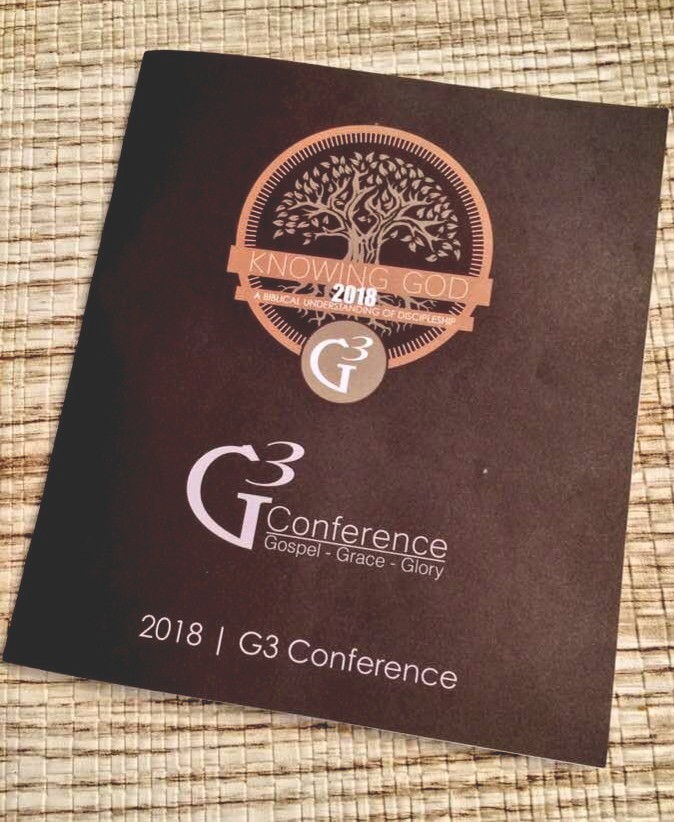
A week ago today, I was drinking from the fire hose of good teaching and good fellowship at the 2018 G3 Conference: Knowing God – A Biblical Understanding of Discipleship. I not only had the blessing of being able to hear many of my heroes in the faith speak for the first time in person, but I also had the joy of meeting numerous social media friends – finally! – face to face.

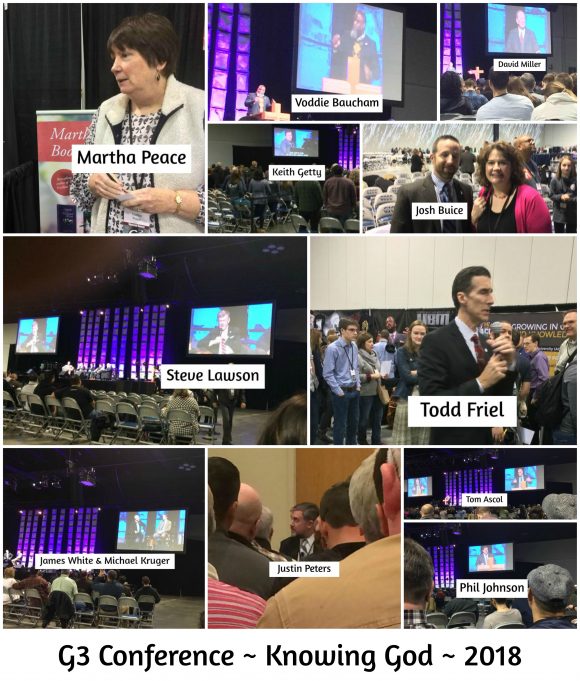
Some of the wonderful brothers and sisters I got to hear from:

I remarked to a friend that it felt strange to me when readers approached me during the conference to thank me for being a good resource for them. “I’m not really a resource,” I said, “I point people to others who are good resources.” So, in keeping with pointing you to good resources, I’d like to share a little about some of the pastors and teachers I sat under last weekend – not so much about what they taught, but more about how God uniquely crafted and fit each of them into the Body to minister to their local churches, and the church at large, in their own special way. I highly recommend each of them to you.

Josh Buice

A superb example to other pastors, Josh has the heart of a shepherd and a servant. He is genuine and humble, and his greatest concern is that His people know and serve God through their local church. I’ve previously recommended Josh here and have had the pleasure of linking to many of his materials.


Tim Challies

Tim is someone who has figured out his ministry context and is flourishing in it. He not only serves his church well, but is intent on learning from his church in order to serve it better. Tim’s is one of the handful of blogs I follow regularly.


David Miller

Kindness and grace personified, David has a way about him of speaking hard truths in gentleness. Due to degenerative muscular atrophy, David uses a wheelchair and had to memorize his entire sermon including the lengthy Scripture passages he cited, which was very encouraging to me for my own Scripture memory. David reminded me of older, small church pastors I have known who are so good at loving and caring for their sheep.


Justin Peters

If you’ve ever wondered what biblical meekness looks like, you need to get to know Justin Peters. Calm, kind, graceful, knowledgeable, and with a quick wit, Justin cares deeply about sound doctrine and calling out false teachers because he has a heart for people to be saved and know the truth of the gospel. Justin taught two breakout sessions on the New Apostolic Reformation, and I am overjoyed to report to you that there was standing room only (and there were many standing) for both sessions. What a joy to see Christians getting informed so they can protect themselves and their churches! I have recommended Justin here and have linked to several of his resources.

Justin’s a Louisiana expat in the Northwest, so I brought him

some essentials from home: king cake and crawfish :0)


Voddie Baucham

Voddie is intense. He is passionate about preaching and the Scriptures to such an extent you begin to sense that, if he could, he’d grab you by the shoulders and physically stuff you with Scripture and a proper understanding of it. He wants the church to get it. I’ve recommended Voddie here.


Martha Peace

Gracious. Godly. Gutsy. That’s the “G3” of Martha Peace. Unlike so many of today’s “divangelistas” Martha is not a young, silly, hyper Barbie doll. She’s older, mature, and sedate, yet still fun to be around. She doesn’t have the perfect figure or the trendiest clothes. She looks and acts like your average, older, wiser sister at church. And that’s a good thing. We need far more mature sisters like that to look up to. It was a blessing to see her breakout sessions full of younger women who want that kind of biblical teaching and example from a Titus 2 woman. I’ve recommended Martha before, based largely on others recommending her to me. Now it’s my pleasure to commend her to you, having personally heard her speak.


My dear friend, Darlene (left), with her hero of Biblical Counseling and women’s Bible study, Martha Peace.


James White and Michael Kruger

Drs. White and Kruger presented a joint session on the canon of Scripture. Lovable eggheads both, they showcased the fact that Believers don’t have to gullibly check their intellects at the door of Christianity and that academicians don’t have to be godless liberals. They made “doctrinally sound smart” look beautiful.

Paul Tripp

I thought I was a fairly decent parent until I sat under Paul Tripp’s teaching, but I get the feeling he can make pretty much any parent feel like a failure. There’s a purpose to that: without God’s grace and the empowerment of the Holy Spirit, relying on your own efforts, you are a failure as a parent. Paul wants you to see that so you’ll stop trying to parent in the flesh and parent with the gospel instead so that your children might be saved.


Derek Thomas

Derek Thomas is the iconic image of an elder statesman pastor, a breath of fresh air standing in stark contrast to today’s cool, hipster, twentysomething pastors. There is a Bible-fueled furnace deep in Derek’s soul that empowers his preaching. He is living proof that formal doesn’t have to equal cold and boring.


Tom Ascol

This is a man who knows God and wants you to know Him, too. Tom is a regular Joe who’s good at explaining biblical concepts simply and lovingly, like the uncle who taught you how to tie your shoe or ride a bike. I was pleased to learn that he is Southern Baptist as well as the executive director of Founders Ministries, and am looking forward to hearing more from him.


Steve Lawson

Long one of my favorite pastors, Steve Lawson is the definition of unction in preaching. The man is a preaching machine, and I don’t see how he replenishes all the calories he must burn off in the pulpit. There is an urgency about his preaching that says, “You need to know this, and you need to know it now because it will help you love Jesus more, and you don’t want to wait another second to love Him more, do you?” It’s been my pleasure to recommend Dr. Lawson here. If you listen to preaching and podcasts, you’ll want to add him to your queue.


Phil Johnson

The man knows his stuff, and he tells it like it is. He’s a straight shooter. That’s the main thing I appreciate about Phil Johnson. There’s no way I could briefly capture the awesomeness that is Phil, so I’ll just leave you with a little tidbit I learned on this trip, that made him even dearer to my heart. He said he was a terrible extemporaneous speaker, but a decent writer, so when he preaches, he writes out his manuscript word for word and reads from it at the pulpit. I’m exactly the same way when it comes to speaking. If you’re not already listening to, and reading Phil, get caught up. I’ve enthusiastically recommended him here.


Equally as important as the wonderful teaching at G3 was the opportunity to meet so many good friends I’d only been able to get to know on social media. I even got to meet a few readers, too!

Nate Pickowicz, Gabriel Hughes, Me, Beki Hughes, Sonya Walker

Josh Buice said something during his sermon that really stuck with me: Attending a conference is an unbelievably wonderful experience, but it isn’t church. Church is where we go back to when a conference is over – to do the hard and joyful work of ministry and the long-term labor of love of discipling and being discipled in the local body.

And Josh was absolutely right. God doesn’t call us to be conference junkies, bouncing from event to event because we’re addicted to the high we get from “mountaintop experiences.” That’s not real life. And it’s not biblical life, either. God calls every Christian to be plugged into a local body of Believers. To walk with the same group of people week in and week out through sorrows and joys, sins and victories.

Aaron Armstrong                                                            Allen Nelson

But in another sense, the very reason conferences like G3 are so addictive, is that they are the church. The universal church. The church catholic. The family of Believers we’ll spend eternity with.

I can’t tell you how many times I totally tuned out the preaching or the music and just looked out over that sea of people I’d never seen before – enraptured by the words of  God, praising the name of our dear Savior – and thought, “This is the tiniest little taste of what Heaven is going to be like.”

Kevin and Lynnette

And every time I shrieked with delight at the first glimpse of a precious friend I’d previously known only online, I thought again, “This is what Heaven will be like!” A glorious family reunion with loved ones – those we’ve known personally, those we’ve known from afar, and those we’ve never met before – all bound together by our mutual love, adoration, and worship of Jesus.

Thanks so much to those of you who generously gave financial gifts which enabled me to attend G3. Your investment and kindness meant so much to me, and I hope you’ll be blessed by the way God has grown and encouraged me through this conference as I continue to serve you through this online ministry.

If you ever get the chance to attend G3, I can’t recommend it enough. But if you don’t, you can download the G3 app, listen to all the teaching from past conferences, and soon, from this year’s conference.

The G3 Conference was a wonderful experience, and I hope I’ll have the opportunity to go back. I think the most important thing I learned at G3 is that a Christian conference can do lots of things, but if it doesn’t send you back home loving your own church more and equipped to serve it better, it hasn’t done its job. I came home with both. Thanks, Josh Buice, Pray’s Mill Baptist Church, and everyone associated with the G3 Conference.

Podcast Appearances

Scripture Matters Podcast Guest Appearance: Women In Ministry


Recently, I had the opportunity to sit down and chat with Richard Swartz, host of the Scripture Matters podcast. Listen in as we talk about some of the major issues in women’s ministry today, women’s discipleship, false teachers, and “golden calf tipping”. Richard and I also discussed the importance of husbands, fathers, and pastors protecting the souls of the women in their lives, so there’s something edifying for everyone!


Got a podcast of your own or have a podcasting friend who needs a guest? Need a speaker for a women’s conference or church event? Click the “Speaking Engagements” tab at the top of this page, drop me an e-mail, and let’s chat!

Guest Posts

Guest Post: How to Do Biblical Self-Counseling

If your theology pretty much matches up with mine (as outlined in the “Welcome” and “Statement of Faith” tabs) and you’d like to contribute a guest post, drop me an e-mail at MichelleLesley1@yahoo.com,
and let’s chat about it.

How to do Biblical Self-Counseling
by Lara d’Entremont

I can be far too dependent upon others for growth and change. When a problem, question, decision, or sin becomes apparent in my life, my first step is to run to the comfort of others and seek their help. There’s nothing inherently wrong with this; believers within the body of Christ are meant to support and build one another up. Galatians 6:1-2 says, “Brethren, even if anyone is caught in any trespass, you who are spiritual, restore such a one in a spirit of gentleness; each one looking to yourself, so that you too will not be tempted. Bear one another’s burdens, and thereby fulfill the law of Christ” (NASB).

However, the book of Galatians doesn’t end there. If we keep reading, we find an interesting exhortation: “For if anyone thinks he is something when he is nothing, he deceives himself. But each one must examine his own work, and then he will have reason for boasting in regard to himself alone, and not in regard to another. For each one will bear his own load.” (vv. 3-6).

So while fellow believers are to help, support, exhort, and encourage us, there comes a time when we must bear our own load and deal with our own sins. While your fellow sisters in the faith may be able to point sin out to you, give you advice to overcome it, keep you accountable, and pray for you, there comes a point where you need to step up and actually do something. We cannot rely on other people to change us and fix our issues. We need to do biblical self-counseling.

This is what Paul called, “Working out your salvation with fear and trembling” (Philippians 2:12). In other words, this is our side of sanctification. In realizing all this, I was intimidated. If you are feeling that same overwhelm, don’t panic; I have a few steps to help you.

Step One | Choose an Issue to Work On

It may be tempting to become distressed by all the sins in your life and feel hopeless (at least that’s what I often experience). But we can’t allow that to discourage us. Instead, simply choose ONE issue to attack.

Once you choose your sin or issue, find a journal and write out this problem in detail, explaining what it is, when it shows up, what causes it, and why you should stop it. I would also suggest doing some biblical research and finding a few Bible verses to support your decision and writing them down to memorize in the future.

At this point, you should also be confessing to those who have been effected by this problem, especially God. He’s the one our sin is truly against, and we must own up to it. Remember, “If we say that we have no sin, we are deceiving ourselves and the truth is not in us. If we confess our sins, He is faithful and righteous to forgive us our sins and to cleanse us from all unrighteousness” (1 John 1:8-9 NASB).

Step Two | Create a Thought Journal

You will want to create a thought journal in which you track when the problem shows up. Here is a list of things you could include in your thought journal:

  • The temptation/sin/emotional issue
  • The circumstance:
    • What happened?
    • Who was involved? What did they do and/or say?
    • How did you respond? (To the people and/or situation)
  • The unbiblical thought & response
    • What did you want in that situation?
    • What did you get that you didn’t want in that situation?
    • What were your sinful thoughts in this situation?
    • What was sinful about how you responded? (provide Scripture)
  • The biblical thought & reaction: (provide Scripture for each answer)
    • How could you have reacted biblically?
    • How could you have changed your thinking to be biblical?

Answering questions like these will help you to see if there are any common denominators in your problem and help you root out the true root sin. For example, you may realize that your anxiety comes up whenever there’s a financial issue, which then leads you to realize that you love money too much. Knowing that, you can now better attack the sin; rather than managing your anxiety symptoms, you can work on loving money less.

If you would like a journal for your specific issue, you can find a few like that here.

I suggest keeping this journal during the entire process so you can see how you are improving on the issue as you go.

Step Three | Develop a Plan of Action

Now that we have a sin to attack and are learning what the root cause may be, we need to determine a biblical plan of action.

Start with choosing a few Bible verses to memorize. People sometimes undervalue the power of memorizing Scripture, but it is a great tool for overcoming sin. The Psalmist knew this: “Your word I have treasured in my heart, that I may not sin against You” (Psalm 119:11 NASB).

Important Side Note: Please make sure you don’t take a random verse and rip it out of context. Instead, study the passage and make sure it means what you have interpreted it to mean. This will also be helpful in both your memorization and conquering your issue.

Along with the Bible verses, find some biblical material to read on the subject. When I was working at my anxiety, I read Trusting God by Jerry Bridges, which taught me why I did not need to fear but instead trust God wholly. I suggest looking for resources on ACBC’s approved reading list.

Through doing those steps, you should be able to create a put off (sins to stop) and put on (righteous actions to start) list. If you were struggling with anger, your list may look like this:

Put Off:

  • Angry outbursts
  • Impatience
  • Listening to angry music
  • Hitting things
  • Unkind words

Put On:

  • Kindness & patience
  • Trusting God with how people react
  • Praying in moments of anger

Finally, find at least two or three accountability partners to keep you on track. This doesn’t mean confessing to two people who will never bring this up again. Find people who will be intentional and love you enough to ask, “Did you sin today? Did you remember to put on patience?” Find people who will remember you in prayer and are mature in their faith to provide biblical guidance.

Step Four | Rely On God

At this point you’re probably feeling one of two things:

  1. Easy enough! I’ll be on my way to overcoming this sin on my own in no time.
  2. It’s too much! I’ll never be able to do all this on my own.

Neither of these feelings are biblical or helpful to the self-counseling process. Consider Paul’s words to the Philippians: “So then, my beloved, just as you have always obeyed, not as in my presence only, but now much more in my absence, work out your salvation with fear and trembling; for it is God who is at work in you, both to will and to work for His good pleasure” (2:12-13 NASB).

To the person who thinks this is easy and will be finished before the end of the week, remember that you are a depraved sinner incapable of change on your own. You are utterly dependent on God in this. That means it’s in His timing and His power. So put off your pride and conquer your sin with reverent “fear and trembling” knowing that it is “God who is at work in you, both to will and to work for His good pleasure.”

To the discouraged person, you are right that you cannot do it on your own! Congrats on humbly recognizing your own inability. Now, find courage and confidence, because you have the Holy Spirit working in you. Consider 2 Corinthians 12:9, “But he said to me, ‘My grace is sufficient for you, for my power is made perfect in weakness.’ Therefore I will boast all the more gladly about my weaknesses, so that Christ’s power may rest on me.” Find your boast in your weakness, realizing that your ability to conquer sin is found in the power of God.


Lara d’Entremont is a child of God, a wife, and Biblical Counselor in training. Having been made new by God and completely transformed by Him, her desire is to point others back to that same gracious Saviour. Find more of Lara’s writing at her blog, Renewed in Truth.


ALTHOUGH I DO MY BEST TO THOROUGHLY VET THE THEOLOGY OF THE BLOGGERS WHO SUBMIT GUEST POSTS, IT IS ALWAYS POSSIBLE FOR THINGS TO SLIP THROUGH THE CRACKS. PLEASE MAKE SURE ANY BLOGGER YOU FOLLOW, INCLUDING ME, RIGHTLY AND FAITHFULLY HANDLES GOD’S WORD AND HOLDS TO SOUND BIBLICAL DOCTRINE.