Mailbag

The Mailbag: I’ve been asked to teach a Beth Moore study…

mailbag


I’m part of the women’s ministry leadership at my church. We did a Beth Moore study last year. A lot of things bothered me about it, but I kept my mouth shut because all of the women who participated loved the study. Now that I have read your article, and others, on the theological problems with Beth Moore, I understand why I had so many issues with the study. Today, I was given a copy of another Beth Moore book so that I could prepare to teach it in the fall. I can’t do it, and I feel like I’m the only one in my church who sees a problem with Beth Moore studies. How should I handle this situation?

I always want to be very careful about making definitive statements about how people should or shouldn’t handle specific scenarios with people I don’t know and circumstances I’m not familiar with. Instead, I’d like to share with you what I would do in a similar situation. I encourage you to think and pray about it and ask God to help you decide if this would be the wisest approach for your situation.

First, I would spend some serious time in prayer. I would pray for the the other members of the women’s ministry leadership, as well as my pastor and elders, and ask God to open their eyes to see, their minds to understand, and their hearts to embrace and desire biblical truth. I’d ask God to give me the wisdom to know how best to approach this situation and the right words to say. I would ask Him to make my motives pure, biblical, and loving.

Next, Iโ€™d gather the leaders group, or the main leader, or whichever people I felt were appropriate, and kindly, gently, and biblically explain the problems with Beth Moore. At some point before or after this meeting, the pastor or appropriate associate pastor or elders would need to be given a heads up as to what was going on.

Finally, I canโ€™t tell you how often I hear from women who say things like, โ€œMy church is offering six small group Bible studies right now and theyโ€™re all using book studies (Beth Moore, Priscilla Shirer, etc.). I just want to study the Bible itself, but they wonโ€™t offer a class that just studies the Bible.โ€ I would express that to the women’s ministry leadership during the meeting and, if they continued to insist on using a Beth Moore book, offer to teach a class on a book of the Bible as an alternative for women who might prefer studying the Bible itself. Churches usually like to be able to offer various options to their members.

I would also be prepared for strong opposition. While I would be hopeful that the women of my church would love Christ and His word more than they love Beth Moore, this, sadly, has not been my experience when dealing with diehard Beth Moore disciples. My experience has been that when you topple an idol, her worshipers will defend her at almost any cost.


If you have a question about:ย a well known Christian author/leader, a Bible passage, an aspect of theology, a current issue in Christianity, or how to biblically handle a family, life, or church situation, comment below (Iโ€™ll hold all questions in queue {unpublished} for a future edition of The Mailbag) or send me an e-mail or private message. If your question is chosen for publication, your anonymity will be protected


Discernment

Still Be Discerning about Discerners Discerning Discernment Ministries

discerners discerning discernment

Recently, one of my favorite blogs, ParkingSpace23ย (a fantastic, doctrinally sound blog I’d encourage everyone to subscribe to), published an excellent article by John Chester called Still Be Discerning about Discernment Ministries. It’s all about John’s thoughts on discernment blogs and podcasts and why he has chosen to swear off of them.

John seems like a thoughtful guy and he handled what can be a touchy subject evenly, calmly, scripturally, and with grace. As someone who frequently writes on discernment topics, it gave me some good food for thought and an opportunity to biblically examine both my writing and reading/listening habits. It’s a great article, I was thankful for it, and I agree with a lot of his points.

But while John has decided not to partake of discernment blogs and podcasts, I still find discernment ministry to be an important aspect of this blog as well as my personal spiritual “diet”. Does that mean I think John, or any other Christian, is wrong for not wanting to regularly read or listen to discernment material? Absolutely not! But I’d like to present a bit of a different perspective regarding the value of discernment ministry.

In the first few paragraphs of his article, John draws a distinction between two different types of discernment ministries- a disctinction which I think is both astute and important. John differentiates between what I would call “propositional” discernment sites like CARM, and, if I’m understanding him correctly, mine – which generally post single, position paper-type articles on a given false teacher or false doctrine – and what I would call “daily news” discernment ministries such as Berean Research and Fighting for the Faith – which report on the shenanigans du jour of false teachers and apostate churches.

John’s position is that the propositional discernment ministries [PDM] can be helpful when needed, but he is not fond of the daily news discernment ministries [DNDM]. I think both can be beneficial, assuming they’re done biblically. Take a look at John’s points and my counterpoints, and then you can prayerfully decide whether or not it would be profitable for your sanctification to include discernment media as part of your spiritual fare.

John’s point: “[DNDMs] often spend much time dissecting sermons or blog posts that someone with even a rudimentary sense of discernment would have stopped listening to or reading within the first few phrases.”

Michelle’s counterpoint: “Someone with even a rudimentary sense of discernment” is the crucial phrase here. Perhaps John is blessed to pastor a body of believers who are good bereans and most of the Christians he knows are discerning. I hope that’s the case. It shouldย be the case that every believer has “a rudimentary sense of discernment” and immediately rejects false doctrine when she hears it. Nothing would bring me more joy.

But, sadly, that’s not the case. In fact, in my experience, the exact opposite is true, especially among Christian women. The vast majority of Christians are very undiscerning when it comes to false teachers and false doctrine. Often, people lack discernment because they’re false converts. But because most churches don’t proactively teach discernment, there are also plenty of genuninely born again believers who take at face value that anything which wears the label of “Christian,” is sold at a Christian retailer, or is proclaimed by a Christian celebrity is biblical and trustworthy.

I know, because I used to be one of those undiscerning Christians who hadn’t been taught any better by my church. Sure, I could pick out charlatans like Benny Hinn or Todd Bentley, and I probably would have described people like Kenneth Copeland and Jesse Duplantis as “wrong” or “that’s not what Baptists believe” without really knowing why. But the Beth Moore Bible studies that every church I’ve ever been a member of has pushed on its female membership? I had no idea she was teaching false doctrine, especially since my own church was endorsing her books.

It wasn’t until I Providentially “stumbled across” Todd Friel’s TV program,ย Wretched, one night several years ago that I began to understand what false doctrine was, why it was wrong, biblically, and how it could hurt me and the church. And it wasn’t until I discovered Chris Rosebrough’s Fighting for the Faith that I learned how to compare everything to Scripture – to listen to sermons with a discerning ear and read Christian books with a discerning mind. Todd and Chris taught me the discernment no church ever bothered to mention to me. And from the myriad of discerning Christians I’ve known, heard from, and read about, people like me are the rule, not the exception.

It’s not right that the church isn’t teaching Christians how to be discerning. I think every biblically responsible discernment ministry would agree that it is the church’s job, not a discernment ministry’s, to teach Christians to be bereans. But that’s not happening. And I thank God for those ministries who are standing in the gap- who have helped thousands of Christians like me.

John’s point: “[DNDMs] are unbiblical. What I mean is that there seems to me to be no biblical model or mandate for this kind of ‘ministry’.โ€

Michelle’s counterpoint: John may hold more closely to the regulative principle than I do, which would, understandably, account for my difference in perspective from this point. We do a lotย of things, both in church and in parachurch ministry, that there’s no specific biblical model or mandate for. There’s no biblical model or mandate for vacation Bible school or crisis pregnancy ministry or handing out gospel tracts or even writing for a Christian blog. Yet these, and many other ministries, can carry the gospel to the lost (I’ve heard of many people who have read/listened to DNDMs, realized they were false converts, and have become believers.) and edify the saved – just like discernment ministries can. And there’s certainly a biblical mandate for that.

John’s point:ย “Did Jesus ever engage in a point by point take down of a particular Phariseeโ€™s teaching that is recorded in Scripture? How much do we know about the Nicolaitans…in Revelation 2:15?… Or… the Colossian heresy…in Colossians 2:8?”

Michelle’s counterpoint: Jesus didn’t do sermon reviews (that we know of) the same way Chris Rosebrough does. But He did publicly enumerate and correct many of the Pharisees’ false teachings in Matthew 23. He publicly clarified Scripture and corrected unbiblical beliefs and false teachings – “You have heard it said…but I say to you…” – in the Sermon on the Mount. He publicly warned people against the false teaching of the scribes, Pharisees, and Sadducees. And every time those scribes, Pharisees, and Sadducees confronted Him with questions or after a miracle, He set them straight for the whole crowd to hear.

As to the Nicolaitan and Colossian heresies, Colossians and Revelation 2 were addressed to particular churches. Just because weย may not know much about these heresies doesn’t mean the Ephesian and Colossian churches weren’t thoroughly familiar with them. Perhaps that’s why John and Paul didn’t elaborate- because their intended audiences were already knowledgeable about those heresies. And perhaps the reason they might have been familiar with those heresies is that they were constantly being warned about them. Every book in the New Testament (except Philemon) warns against false teaching or false teachers.

Not so with the church today. Christians are not only notย being warned about the heresies and false teachers running rampant in evangelicalism, undiscerning pastors are actually embracing false teachers, inviting them to speak at their churches, simulcasting their conferences, sharing their social media posts, and ordering their materials for the church’s small groups. And the church at large is so biblically illiterate that Christians have no idea they’re being fed false doctrine.

John’s point: “Curiously many discernment mavens will quote 1 Peter 3:15 as a text that supports what they do. But to be blunt, it doesnโ€™t, not by a long shot…. This is about being ready to proclaim Christ to those who would persecute you.”

Michelle’s agreement: I could not agree with this point more. This verse isn’t about discernment. (I usually hear this verse more frequently in support of apologetics ministries, and it isn’t about apologetics, either.) It’s about evangelism.

One of the main features of today’s false doctrine is the twisting of Scripture and ripping it out of context. How can we who do discernment work rebuke false teachers for taking Scripture out of context and then turn right around and do the same to justify our own ministries? We knowย better. Specks and logs, anyone?

There are plenty of other passages of Scripture (such as the ones I’ve cited above and others) that speak of the importance of warning against false teachers and removing false doctrine from the church. We should not be using a verse that has nothing to do with discernment to justify discernment ministry.

John’s point: “Donโ€™t get me started on the lack of gentleness and respect [from 1 Peter 3:15] that permeates many of these blogs and podcasts.”

Michelle’s agreement/counterpoint: John is right, here. Some of the discernment ministries that (incorrectly) claim the first part of 1 Peter 3:15 as justification for their ministry are not following the second part of the verse which says to “do so with gentleness and respect”. There are discernment ministries whose articles I absolutely will not share or link to because their snideness and name calling are so over the top it overshadows the valid point they’re trying to make, sometimes even damaging their own credibility.

At the same time, we do see instances of Jesus using harsh language and calling false teachers names, and Paul, Elijah, and others couldn’t always be characterized as gentle or respectful.

The thing is, their cultural context was a little different from ours, and these are descriptive passages, not prescriptive. Sometimes different cultures call for different approaches. Additionally, one woman’s “gentle and respectful” is another woman’s “harsh and unkind.” I’ve written discernment articles that were characterized as hateful by some Christians and too nice toward the false teacher by others- both about the same article!

Although I fail miserably at it – often – I try to use 2 Timothy 2:24-26 as my guideline when I write:

And the Lord’s servant must not be quarrelsome but kind to everyone, able to teach, patiently enduring evil, correcting his opponents with gentleness. God may perhaps grant them repentance leading to a knowledge of the truth, and they may come to their senses and escape from the snare of the devil, after being captured by him to do his will.

It not only reminds me of howย to contend for the faith (not quarrelsome, kind, patient, gentle), it reminds me whoย I’m contending for (those being held captive by Satan’s snare of false doctrine), and whyย I’m contending (that they might repent, know the truth, come to their senses, and escape captivity).

John’s point: “[DNDMs] are unhealthy…’you are what you eat’…A diet of constant critical speech and reading is naturally going to produce a critical spirit.”

Michelle’s agreement: This is absolutely true. I don’t know whether it makes me over-critical or not, but when I OD on discernment media it certainly makes me feel angry, frustrated, depressed, and that there’s no hope for the church. It takes my eyes off Christ and the very real salvific and sanctifying work He is still doing in churches across across the globe, and causes me to focus on the monster of false doctrine instead.

It’s exceedingly important that we not go overboard on discernment or any other single aspect of theology or or spiritual life. In order to be spiritually healthy, we mustย have a balance of allย the good things: discernment, Bible study, prayer, evangelism, fellowship, worship, service, etc. When I find myself spending too much time in Discernment Land, I know it’s time to step back and readjust my focus.

John’s point: “They are not very helpful…I donโ€™t think very many Christians, especially the kind who read theological blogs, are going to be taken in by [blatantly obvious false teachers].”

Michelle’s agreement/counterpoint: I’ve already shared my thoughts on the helpfulness of discernment ministries for Christians who are not discerning, but, if I’m understanding him correctly, I think what John is saying here is that Christians who are alreadyย discerning aren’t going to be taken in by false teachers, and, therefore, have little need for regular consumption of discernment media. I generally agree with that. I still subscribe to a few DNDMs and peruse their daily headlines, not because I need to learn discernment, but because I like to know what’s going on in the church, just like people skim section A of the newspaper because they like to know what’s going on in the world.

I might add, though, that just because someone is the type of person who reads theological blogs doesn’t mean he’s on top of things, discernment-wise. Thom Rainer writesย a theological blog (and books, and has a seminary Ph.D), yet persists in allowing false doctrine onto the shelves of LifeWay despite the many rebukes he has received from pastors, seminarians, lay people, and, yes, discernment media. Not long ago, I took a class via video from a conservative Southern Baptist seminary president who positively (albeit in passing) cited Beth Moore and Rick Warren in one of the sessions. And these are just two isolated examples. There are many more.

John’s point: “[DNDMs] often have significant blindspots…In their rush to expose the errors of others, often discernment bloggers/podcasters can overlook real problems with themselves or with their theological allies, especially in the areas of tone and conduct.”

Michelle’s agreement: This is so true. There’s no way I could disagree with this, because I have been guilty of it myself far too often. I would only add that this is not a problem specific to discernment ministry. Every ministry has blind spots because every Christian has blind spots. We’re all guilty of hypocrisy, myopia, failure, and sin. And, because we’re believers, when a brother or sister points out our sin, we repent, we receive God’s wonderful, cleansing, restorative grace, mercy, and forgiveness, and we move forward in obedience to Him and His word.

John closes out his insightful article with this thought:

I am not saying that you must swear off โ€œdiscernmentโ€ blogs and podcasts, but I am saying I did, for the reasons above along with others, and I think I am better off for it. I would challenge you to consider what I have written and to think deeply about your spiritual diet.ย I am exhorting you to be discerning about discernment ministries.

I am not saying you mustย partake of discernment blogs and podcasts. But I am saying I do, for the reasons above along with others, and I think I am better off for it. I would challenge you to consider what John and I have written and to think deeply about your spiritual diet. I am exhorting you to think about it, study about it, pray about it, and discern what God would have you do about consuming discernment media.


Christian women, Church

10 Ways Godly Women Can Help Improve the Spiritual Health of Their Churches

10 ways healthy churches

Let’s face it, ladies- not one of us goes to a church that’s one hundred per cent spiritually healthy. Every church has its problems. Some, just a few; others, well… they’re more like “fixer uppers”. From the encroachment of false doctrine to women serving in improper places of authority to toxic personalities to sin being swept under the rug, what are we to do when we see things in our churches that conflict with Scripture? How can we bring aboutย spiritual change without stepping outside the boundaries of biblical womanhood?

1. Make sure you’re understanding, viewing, and responding to the problem biblically
Are you basing your concern about the situation on a correct or incorrect understanding of Scripture? Is the problem actually a violation of Scripture or just something that rubs you the wrong way personally? Is it possible something you’re doing is contributing to the problem? Sometimes what needs to be changed in your church might be your incorrect understanding of Scripture, your behavior, or your heart attitude.

2. Pray
We are waaaaaaaaaaaaaaaaaaaaaaaaaaaaaaaaaaaaaaaaaaaaaaaay (yes, it really does require that many a’s) underestimating the role prayer plays in our churches in general, but especially the role it plays in changing things in the church. Don’t blow prayer off as unimportant or a last resort. Pray for your church every day. Pray about the problems you’re seeing in the church and the people involved. Pray for wisdom for your pastor and whoever is in charge of handling the problem. Pray about it faithfully, fervently, and according to Scripture. It’s not just a biblical motion to go through. I’ve seen God change things in response to prayer time and time again.

3. Approach the appropriate person
If you’ve been praying about the problem and the people involved, and you’re certain you have a biblically correct understanding of and outlook on the situation, and you think you need to address the issue with someone, go to the appropriate person in humility, kindness, gentleness, and patience and discuss it with him or her in the same way you would want to be approached. (And use wisdom- in some cases it might be best for your husband or another man to approach the person.)

Most of the time, the appropriate person to approach first is the person at the center of the problem. A lady in your Sunday School class is a gossip? Go to her first, not the Sunday school teacher. The women’s ministry director is selecting materials authored by false teachers? Go to her first, not the board of elders. Hopefully, you’ll “win your brother.” If not, Matthew 18:15-20 outlines the appropriate subsequent steps to take when dealing with sin. (And, P.S., don’t stop praying. Pray more.)

4. Set a good example
Conduct yourself like a lady – a godly lady – whether you’re dealing with a problematic issue, worshiping, serving, fellowshipping, teaching, learning, or whatever you’re doing at church. Be a velvet covered brick. Strong, firm, and unwavering from Scripture on the inside, meek, gentle, kind, and loving on the outside. Be obedient to Scripture. Repent and seek forgiveness when you sin. Maintain a reputation that’s above reproach. People are watching you, even looking up to you.

5. Be faithful
As Christians we are supposed to be faithful members of the local body of Christ. That means you become an official member. You attend services unless Providentially hindered. You show up on time. You give offerings. You join a Sunday school/Bible study/small group class. You plug in and serve. You bond with your brothers and sisters in Christ. You get invested in the life of the church. You can’t be a strong, godly influence on your church or have people take you seriously when you address a problem if you’re lackadaisical in your approach to church or you’re only there half the time.

6. Be humble and willing
Sometimes helping to resolve a problem in a godly way might require you to do something that, while biblical and appropriate, makes you feel uncomfortable. Maybe you’re introverted and scared to death to address an issue of sin with a fellow church member. Maybe you’re needed in a position of service you don’t have much experience in. Maybe that sister at church that you don’t really like needs a friend. Are you willing to humble yourself, put your own preferences aside, and serve the body of Christ in whatever way is needed?

7. Teach
If you know how to properly handle God’s word and you’re able to teach, find an open position and get in there, whether it’s a children’s Sunday School class, a women’s Bible study, discipling a younger sister one on one, or helping out with the youth girls. Biblical illiteracy is absolutely and astonishingly rampant in the church, which means there are Christians in your church who don’t know how to behave biblically, which means issues of sin will arise. Prevent those issues before they happen by correctly teaching God’s word to as many women and children as you can. (And if you don’t know how, get trained.)

8. Put on your work clothes and roll up your sleeves
We can no longer go to church with the attitude that we’re going to just row our boats gently down the stream and if a problem arises and somebody else doesn’t deal with it to our satisfaction, we’re leaving. Church isn’t the buffet line at Golden Corral, existing only to provide us with multiple options and opportunities for a pleasant worship experience. Church is often more like being employed by Roto Rooter- it’s hard, hot, sweaty, unpleasant work. Don’t turn tail and run at the first sign of trouble. God may have put you in that church to be a catalyst for biblical change. Maybe the problematic situation at church is not about your comfort. Maybe it’s about you helping the body of Christ.

9. Encourage, help, and pray for your pastor and other church leadership
Pastoring (and other ministry leadership positions) is a tough, often thankless job. Your pastor, associate pastor, minister of music, elders, deacons, teachers, etc., can use all the support they can get. Be generous with your attaboys. Volunteer to help out where you can (teach, disciple, train others, help vet curricula and conference speakers, mediate, visit). And, again, pray. Pray for wisdom and discernment for your pastor and leadership. Pray that God will grow them in their understanding and teaching of the word. Pray for their marriages and parenting. Do what you can to support your leadership so they can be strong, healthy shepherds for the flock.

10. Keep your focus on Christ and trust Him
It’s easy to get so wrapped up in the details of a problem at church that we forget about God. Are you remembering that God loves and wants what’s best for your church and the people involved in the problem far more than you do? Have you stepped back, taken a deep breath, and recognized that changing people’s hearts and growing the church to maturity is on God’s shoulders, not yours? Are you acknowledging the fact that God is in control and is working in the situation even if you can’t see it? Do you believe that God is out for His glory and the good of His people even if visible circumstances suggest otherwise? Are you trusting in Christ Himself or are you trusting in a positive outcome to the situation?


No church is perfect, ladies. Your church has problems. My church has problems. Let’s work together with our brothers and sisters in the local body of Christ – humbly, lovingly, patiently, and as mature, godly women – to solve those problems and encourage our churches toward holiness and spiritual health.

Christian women, Church, Discernment

Do You MIND? : Five Reasons for Pastors to Mind What Their Brides Are Reading

A while back, my husband and I were driving down the road on the way to the store discussing various aspects of ministry. At some point the conversation turned to a pastor with whom we were both vaguely familiar. Neither of us knew much about him, so we decided to look him up on Facebook to see if we could get a better handle on where he was coming from, theologically. Aside from a couple of mildly iffy posts that it wasn’t a stretch to extend the benefit of the doubt about, it didn’t seem as though there were any major doctrinal red flags. He just seemed like your average, Bible believing pastor who needed to brush up a little on his discernment. (Hey, who doesn’t, right?)

I was actually more interested in the pastor’s wife and what kind of ministries she was involved in that I might also like, so I clicked over to her page. I was pretty disappointed by what I saw. She had posted materials from several major false teachers- the female equivalents of people from Joel Osteen all the way down to Benny Hinn.

I remarked to my husband that I thought there might be some concerns about this pastor’s theology if he was OK with his wife following and sharing materials from high profile false teachers. And my husband gently reminded me that wasn’t necessarily the case:

“He probably doesn’t even know those women are false teachers.”

My husband went on to say that he wouldn’t have known that people like Beth Moore and Joyce Meyer are false teachers if I hadn’t done the research and filled him in. Not because he doesn’t care whether or not I read sound doctrine, but because pastors and Christian men in general don’t often pick up and read books written for Christian women to examine the theology we’re feeding on.

Until the last few decades, they haven’t always needed to. If your wife went shopping and came home with a book from LifeWay, it never crossed your mind to question whether or not it was biblical. It was LifeWay for heaven’s sake. LifeWay is run by pastors and theologians with years of experience and doctoral degrees from seminary. Of course it was biblical.

Well not any more, it isn’t. The majority (and that’s not an exaggeration) of the “Bible” studies and other materials marketed to Christian women by Christian retailers are authored by false teachers.

what rose reads_kindlephoto-19662398

Pastors, on behalf of Christian women everywhere, I plead with you: check out the theology of the authors and bloggers (including me) your wife is reading and the Christian personalities she follows and shares on social media. Please thoroughly vet the materials your Sunday School/small group/Bible study classes and women’s ministry are using. Find out about the speakers headlining the women’s conference or simulcast your ladies are attending. Make sure guest speakers appearing at your church’s women’s event teach sound doctrine.

Why?

It’s not my place to instruct you (and I’m sure you already know, anyway) in what the Scriptures say about being the spiritual leader of your family, responsible for its theological health or your obligations as a pastor to guard your church against false doctrine. I’ll leave that to godly men, fellow pastors, theologians, etc. What I’d like to do is to offer you some practical insights (in no particular order) from the pink side of the pew that you might find to be helpful tools as you think about and pray through how to handle vetting the teachers your wife or church ladies follow:

1. Your wife’s decision to follow false teachers could cost you a job. There are women out there like me who are familiar with the “twisted sisters” your wife is sharing on social media. If I could wrongly make assumptions about the theology of the aforementioned pastor based solely on his wife’s Facebook activity (because wives can be a reflection of their husbands’ spiritual leadership), others could do the same – maybe even those on a pulpit search committee – and that could impact your search for a pastoral position.

2. You don’t want to shoot yourself in the foot. A pastor’s wife can have a huge influence on her church. She is often the one teaching the women’s Bible study or heading up the women’s ministry, and even if she doesn’t, her input on curricula, guest speakers for women’s events, etc., is usually seen by the women of your church as carrying the weight of your approval or preferences. If you’re up in the pulpit preaching sound doctrine every week while your wife or women’s leader is importing false doctrine into the women’s ministry, it’s like bailing water out of a boat with a hole in the hull.

3. Your wife or (women’s ministry leader) may be chasing off spiritually healthy church members. (If you’ve stuck with me thus far, what follows is unlikely to describe your wife, but I’m going to go ahead and throw it out there for awareness’ sake.) I have heard the following prototypical scenario from dozens of Christian women (and experienced it myself):

“My pastor’s wife is in charge of our church’s women’s ministry, and is a big Beth Moore fan. We only do Beth Moore studies in our small groups, and last year our church hosted a Beth Moore simulcast. I participated in a couple of the studies, but they just seemed “off” biblically, so I started doing some research.

I discovered Beth Moore was teaching false doctrine, partnering with false teachers, and doing other unbiblical things. I went to the pastor’s wife and very kindly, humbly, and patiently showed her the scriptural evidence of Beth Moore’s false teaching. I couldn’t believe it when she flew into a rage, screamed at me, and accused me of trying to create disunity in the church! My husband and I tried to talk to the pastor about it, but he seemed completely unaware of what goes on in the women’s ministry or any problems with Beth Moore, and backed up his wife. We are now looking for a new church.”

This is not an exaggeration or isolated case. I don’t know what it is about Beth Moore’s disciples, but they (especially the ones who are pastors’ wives) seem to be some of the most vicious defenders of false teachers out there. And if your wife or women’s ministry leader acts like this it could cost you godly, spiritually mature church members.

4. Your children’s spiritual lives are at stake, both at home and at church. As with any dad who works long hours, your wife probably has more of an influence in the moment to moment aspects of your children’s lives than you do, even when it comes to training them in godliness. If her spiritual diet consists of false teaching, that’s what is being imparted to your children on a daily basis.

The same goes for the children at your church. The majority of children’s Sunday School teachers and children’s ministry workers are women. The false doctrine these women consume today will be taught to the children of your church on Sunday.

5. When women are spiritually healthy, the whole family benefits. Statistically, women make up about 60% of church attenders, and, of course, 50% of a marriage. That is an enormous influence on your own family and your church family. You want those women spiritually healthy. It’s not only biblical and good for them personally, but everyone they influence and interact with benefits.

When women are taught sound doctrine, they grow to Christlike maturity. They exhibit the fruit of the Spirit. They want to share the gospel. They walk in humility, patience, love, repentance, forgiveness, and biblical submission. They encourage their husbands toward godliness. And you know what else they do?

They teach other women to do the same. They train up children who are godly. They’re self-replicating.

Spiritually healthy, mature, godly women make your life easier, more peaceful, and more of a joy, both at home and at church, because they’re working with you, not against you.

But your wife and the women of your church are not going to get the pure milk of the Word they need to grow in Christlikeness from the pantheon of divangelistas lining the shelves of your local Christian bookstore. And most of those precious ladies you shepherd are completely unaware of that fact. So they need your help, Pastor. Your bride, and the Bride, desperately need you to mind what they’re reading.

Encouragement

God is Still Working and I’ve Got Proof

Has the world lost its collective mind, or what? From our presidential candidate options to perversion in public restrooms, to Christian business people having to risk their livelihood in order to operate in keeping with biblical principles, it seems like every time I turn around there’s some new piece of bad news smacking me in the face.

And it’s not just “out there,” either. The hits just keep on coming for the church as well. I hear almost daily from ladies who are distressed that the women of their church are being indoctrinated with false teaching in the name of “women’s Bible study.” Women who have left no stone unturned in their search for a doctrinally sound church to attend, and simply can’t find one in their area. Women who weep over their friends and loved ones held captive by the latest pop heresy.

It’s enough to discourage even the most bubbly of Pollyannas.

I wish good news got as much press as bad news, because, believe it or not, I hear from at least as many, if not more, women with encouraging stories to share about how God has been at work in their own lives, in their churches, and the in the lives of their friends and loved ones.

It always builds me up and gives me hope to hear their stories, so I thought it might encourage you, too. Take a look at what Christian women (and men!) like you are saying* about what God is doing in their lives – and what He can do in yours, too!

Wanted to share with you regarding your authors and speakers list. I sent it via e-mail to some friends. I received three positive responses back. One was already questioning [the doctrine of a particular false teacher]. She has been invited to one of [that false teacher’s] conferences. She will not be attending after reading this and will warn her friends that are attending.

[Another friend] shared with me that she feels God is calling her out of [a false doctrine church].

A pastor’s wife that thanked me for the information and said she will never be a a part of someone who embraces false doctrine.

I was thankful for your post on Priscilla Shirer and sent it to some women in our church. I had one very positive response with a request to learn more of the Scriptures.

I am thankful to be a member of a local church that is taught the Word of God through expository preaching and teaching. In fact, our pastor leads our “women’s ministry”. We are being taught theology and how to minister to one another and other women within our body and the ultimate body of Christ.

I told [the person leading the book study by a famous women’s Bible study author] that I was not signing up for the next one. I have just finished John MacArthur’s How to Study Your Bible, and I will begin reading the Bible through starting tomorrow morning. I just finished reading [the Bible] through this morning, but I am starting over again using the method he outlines in his book.

[I recently read your article] regarding Lysa TerKeurst. It made me extremely sad to read about her emergent-leaning doctrines. Iโ€™d been following P31 ministries for about two months when [I read the article]. I would appreciate any advice or direction you give me for biblically sound studies!

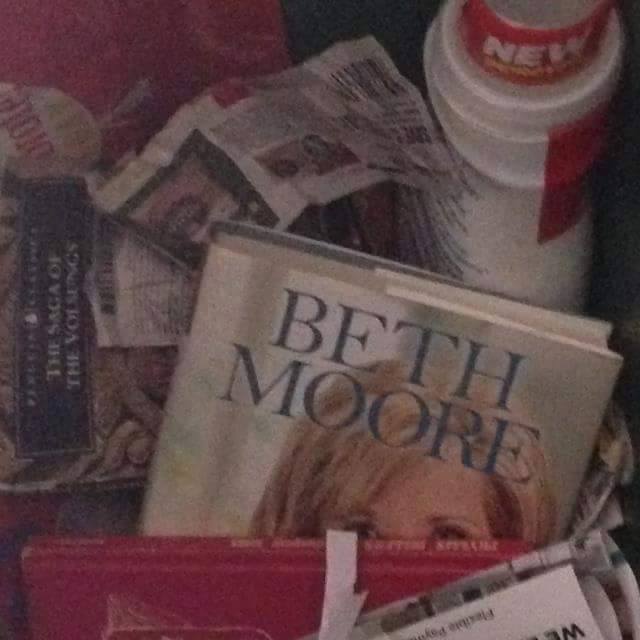
Here’s the view into my recycling bin. I was going to get rid of it last year, but ended up holding on to it. It’s gone now!

12227009_984483224931780_4841028828370165098_n


(From an elder at a doctrinally sound church)- I was not familiar with Beth Moore until I realized our womenโ€™s Bible group was hooked on Beth.

After bringing her un-biblical teachings to the attention of our elder board I am now charged with finding something better.Keep us in prayer as we attempt to wean the women off of Beth and onto the solid rock of the Word.

Iโ€™ve recently felt prompted to study more about sound Christian doctrine. Can you please provide a list for all your recommended Christian sound doctrine women [teachers]?

I went to the movie theater the day [Fifty Shades of Grey] came out. Iโ€™d say, on average there were 4 women to every man. They came in droves. I stood outside the theater and passed out gospel tracts. Seizing every opportunity, we must carry the gospel to them.

[As a women’s leader at my church, I got rid of] Beth Moore, Priscilla Shirer, Angela Thomas, and Lysa Terkeurst studies. My pastor is fully on board and is faithful to preach the Word each and every time we gather.

I have gotten rid of my copy of [a Christian mysticism book]. Now [female false teacher’s] book will follow.

[Several of us had to leave our former church due to false doctrine.] We all prayed [for a new, doctrinally sound church] and God answered our prayers. We have a church building and a pastor. We [recently] celebrated our church’s fourth anniversary.

My wife and I left our church of 20+ yrs. because God was gracious and truly regenerated our hearts, giving us eyes to see and ears to hear the unbiblical nature of what was happening.

I have left the last two churches I was a part of. Thankfully, we are now in a wonderful, Bible-believing, Gospel-centered, theologically/doctrinally sound church who believe discipling true Believers the way God has instructed us in the Bible is more important than how many people fill the seats.

This is just a tiny sampling of the many e-mails, comments, and private messages I’ve received from readers who are growing in Christ, serving in healthy churches, and helping others to grow in biblical truth. If you’re going through a rough time at your church, in your walk with the Lord, or are troubled by what’s going on in the world around you, rejoice with those who rejoice, and don’t be discouraged! The same God who carried these folks through their difficulties will carry you through yours.

Now it’s your turn to be an encourager.
How has God grown you in your relationship with Him, opened the eyes of a loved one to biblical truth, or made your church holier and more obedient to Scripture?


*I’ve changed or deleted a few identifying details to protect the writers’ anonymity.