Mailbag

The Mailbag: Potpourri (“Potty Prayers,” Women as Children’s/Worship Pastors, Solid churches with heretical music, Eternal Security)

Welcome to another โ€œpotpourriโ€ edition of The Mailbag, where I give short(er) answers to several questions rather than a long answer to one question. I also like to take the opportunity in these potpourri editions to let new readers know about my comments/e-mail/messages policy. Iโ€™m not able to respond individually to most e-mails and messages, so here are some helpful hints for getting your questions answered more quickly. Remember, the search bar (at the very bottom of each page) can be a helpful tool!

In these potpourri editions of The Mailbag, I’d also like to address the three questions I’m most commonly asked:

“Do you know anything about [Christian pastor/teacher/author] or his/her materials? Is he/she doctrinally sound?”

Try these links: 
Popular False Teachers /
 Recommended Bible Teachers / search bar
Is She a False Teacher? 7 Steps to Figuring It Out on Your Own
(Do keep bringing me names, though. If I get enough questions about a particular teacher, I’ll probably write an article on her.)

“Can you recommend a good women’s Bible study?”

No. Here’s why:
The Mailbag: Can you recommend a good Bible study for women/teens/kids?
The Mailbag: โ€œWe need to stop relying on canned studies,โ€ doesnโ€™t mean, โ€œWe need to rely on doctrinally sound canned studies.โ€.

“You shouldn’t be warning against [popular false teacher] for [X,Y,Z] reason!”

Answering the Opposition- Responses to the Most Frequently Raised Discernment Objections


I know this is going to sound silly or troll-like, but I’m serious! I have a habit of praying a quick prayer when thoughts cross my mind, like “God, please help Aunt Pam to feel better from her cold today,” or “Lord, thank You for providing that salary bonus I needed.” Sometimes those same kinds of thoughts and prayers cross my mind when I’m using the bathroom. Is that wrong? Should I wait until I get out of the bathroom to think that little prayer? What about what Deuteronomy 23:14 says about using the bathroom, “that God may not see anything indecent among you and turn away from you”?

I don’t think that’s a silly or troll-like question at all, and I’ll bet there are bunches of Christians out there who do the exact same thing and now, after reading this question, are wondering the exact same thing.

First Thessalonians 5:17 instructs us to “pray without ceasing,” which means our hearts are to be constantly oriented toward prayer even though we’re not consciously praying every moment of the day. (Kind of like your compass’ needle always points north even if it’s just sitting in a drawer not being used.) For most Christians, that means we’re intermittently speaking to God, just like you described, throughout the day as things happen, as random thoughts cross our minds, as we see various things. And this becomes such a habit (a good one!) that it doesn’t occur to us to think about where we are or what we’re doing as we utter those prayers in our hearts. Honestly, I think that mindset of reflexive prayer is pleasing to God, because it embodies what it means to pray without ceasing.

Deuteronomy 23:12-14 is part of the Old Testament ceremonial law regarding, in this particular case, the way Israel was to set up camp. When you give the law a good, thorough reading, you’ll notice that the underlying principle of most of the laws is that Israel is to be set apart and holy – different – from the pagan nations surrounding them. And He gives them laws to this effect that touch every aspect of their lives so that, at every turn, throughout the course of their day, there are little reminders, through the law, to “Be holy for I am holy.” This law is just one more of those little reminders: Don’t act like animals like the pagan nations around you, Israel, and just potty willy nilly in the street or the front yard or wherever you take a notion to. Step it up and keep your camp to a higher standard, because God is with you and you are His people.

The Deuteronomy passage is not about offending God by relieving yourself. God has seen every single time every person on the planet has ever relieved himself/herself, because God is omnipresent. If that were offensive to Him, He would not have designed your body to work that way.

Although I don’t think “bathroom time” should be the only time you pray, I don’t see anything in Scripture indicating that God considers it offensive for you to reflexively pray even though you happen to be in the bathroom at that moment. However, if it offends your sensibilities, wait until you get out of the bathroom and then pray.


Would you read 1 Tim 3 1-7 to read women can’t be “overseers/leaders/official” as in they can’t be “Children pastors” or “Women Pastors” in the church with those actual titles or even as directors? The verses only say men and state guidelines on how to choose. I’ve noticed some red flags in my church with a woman Worship Leader, which I don’t agree with since she sometimes teaches in between songs, but they are also giving women the pastor title, but only for children and women.

If I’m understanding correctly, you’re asking:

  • Is it biblical for women to hold a position of leadership over the women’s ministry or children’s ministry of a church?
  • Is it biblical for a woman to be the worship leader of a church?
  • If so, is it biblical to give those women leaders the title of, for example: “Pastor of Women’s Ministry” or “Children’s Pastor”?

Here are the fast and dirty answers. Below are a couple of links where I’ve discussed these issues in more detail.

Assuming the woman is doctrinally sound, has a godly character, her husband (if she’s married) is on board, and she’s otherwise qualified for the job, it’s fine for a woman to lead women or children in the church as long as the position she holds (which will vary from church to church) doesn’t require her to preach to or teach Scripture to men, or hold unbiblical authority over men.

No, it is not biblical for a woman to be the worship leader of a church. This is supposed to be a pastoral position.

No, churches should not give any woman on staff the title of “Pastor,” even if she isn’t violating Scripture in her position. Because Scripture doesn’t permit women to be pastors it is misleading and confusing, and will probably give people the impression that she is violating Scripture and that that’s OK. Neither should the converse be true – churches should not have women on staff in any capacity that violates Scripture (preaching to/teaching men, holding authority over men) and try to conceal that fact by giving her a title (instead of “pastor”) like “minister,” “facilitator,” “coach,” “associate,” “director,” etc.

Rock Your Role: Jill in the Pulpit

Rock Your Role FAQs (see #16, 21)


We have been searching for a doctrinally sound church in the area we moved to, and unfortunately it has not been easy! The few that we have found still use a Hillsong, Bethel or Elevation music. I usually cross a church off the list quickly if they sing from those artists. But like I said, now I am finding even doctrinally sound churches are throwing some of those songs in. Do you have any insight to this dilemma?

It can be really difficult to find a doctrinally sound church these days. Unfortunately even some churches that are fairly solid use music from these groups. The first thing I would recommend is that you check out the Searching for a new church? tab in the blue menu bar at the top of this page, just to make sure you haven’t overlooked any doctrinally sound churches in your area. There are lots of church search engines there and other resources that might help.

My counsel would be to find the most doctrinally sound church you possibly can (following your husband’s leadership, of course, if you’re married, {and assuming, in this particular case, that he’s saved}), attend for a while to get a feel for whether or not it’s a fit for your family, and set up an appointment with the pastor to ask any questions you might have (check out the articles under “What to look for in a church” at the “Searching…” tab for suggestions of questions you may want to ask). (I would recommend the appointment with the pastor regardless of how perfect the church seems.)

If the church uses Bethel, etc. music, this would be the time to gently and lovingly address it with the pastor, but let him know that this is a reason you’re a bit reticent about joining the church so he’ll understand the seriousness of the problem. I would approach the subject giving him the benefit of the doubt that he simply doesn’t know the problems with these groups (the vast majority of pastors are ignorant of things like this – they shouldn’t be, but it is what it is).

If he seems open, you might want to ask if you can send him some information. (You can find links on all three groups at the “Popular False Teachers & Unbiblical Trends” tab. Pick the 2 or 3 most convincing links for each group and send those rather than sending him the link to that tab. For someone who’s ignorant in the area of discernment, opening up that tab would be information overload, and he’ll tune it out.) If he says yes, send the links and then touch base with him again in a couple of weeks to get his reaction.

The only other counsel I would offer you is to remember that no church is perfect, and God may put you into a particular church to help it with those imperfections.

I would now like to take a moment to highlight this reader’s question for pastors and ministers of music. This is yet one more reason it is detrimental to your church to use music from Bethel, Jesus Culture, Hillsong, Elevation, any musician connected these groups (such as Phil Wickham who’s very prolific and has strong ties to Bethel), or any other musician who isn’t doctrinally sound (after you have thoroughly vetted him/her/them.) regardlessย of how biblical the lyrics of any particular song of theirs that you’re using might be. You could potentially be turning away solid, mature, discerning Believers who might otherwise be interested in joining your church. The woman who sent in this question is not the first to ask me something like this – not by a long shot. This issue is increasingly of concern to Christians looking for a solid church. (For that reason, I do not list churches – even Reformed or seemingly otherwise doctrinally sound churches – on my Reader Recommended Churches list, who use music from heretical sources like these.)

When a visitor walks into your sanctuary for the first time, your worship service is the “face” of your church to her. What kind of a first impression are you making? When you use music by doctrinally unsound musicians, it does not say, “We’re really a doctrinally sound church – honest! We only use songs from these groups whose lyrics are biblical.”. It says, “This church has leaders who aren’t discerning,” or “If this church uses music by these heretical groups, what other doctrinal problems does it have?”. Why put that stumbling block out there when there is plenty of music available with biblical lyrics written/performed by doctrinally sound musicians?

And there’s another stumbling block that using this type of music puts in front of weaker brothers and sisters that you may not have realized. I have heard from a number of Christians whom God graciously saved and rescued out of the pit of “churches” similar to Bethel, Hillsong, and Elevation. They tell me that when they walk into what they think is a doctrinally sound church and hear music from these and other heretical sources, it triggers a form of spiritual PTSD. It’s traumatizing to them. They immediately become fearful that your church is mere steps from turning into one of these types of “churches.” Will they grow out of that reflexive reaction? Yes, someday, as God continues to sanctify them. In the meantime, do you want the music at your church to cause them unnecessary anxiety? I hope not.

Even for Christians who have not come out of “churches” like these but are knowledgeable about their heretical theology, using these songs in your worship service is putting a stumbling block in front of them, too. Take me, for example. I’ve studied these groups. I’ve seen their heresy and the damage they do to both the Kingdom and to the individuals who follow them. And because of that, I’ve zealously spoken out against them. If I visit your church and an Elevation song suddenly flashes up on the screen, my ability to worship is completely derailed in grief that your church would use a song from that source – especially if you know about their theology and are well acquainted with music from doctrinally sound sources that you could have used instead. I cannot sin against my conscience by singing those songs. Consider me a “weaker brother” if you like, but do you care more about me as your sister in Christ, or your “right” to use music from these sources? What about Paul’s posture in 1 Corinthians 8:9-13?

But take care that this right of yours does not somehow become a stumbling block to the weak. For if anyone sees you who have knowledge eating in an idol’s temple, will he not be encouraged, if his conscience is weak, to eat food offered to idols? And so by your knowledge this weak person is destroyed, the brother for whom Christ died. Thus, sinning against your brothers and wounding their conscience when it is weak, you sin against Christ. Therefore, if food makes my brother stumble, I will never eat meat, lest I make my brother stumble.

If this was true in Paul’s personal life, shouldn’t it surely be true of our worship services? If you wouldn’t put a Christmas tree or portrayals of Jesus in your sanctuary because it might offend a brother in Christ, why would you use worship music that causes offense to your brothers and sisters?

Finally, what is the proactively good reason for intentionally choosing music from a heretical source? In other words, when you’re selecting music for the worship service, why would you choose, say, a Hillsong song about God’s glory, or Psalm 23, or the crucifixion, when you could just as easily choose a song from a doctrinally sound source about any of those things – a source that isn’t a stumbling block to anyone, won’t give anyone the wrong impression about your church, won’t lead anyone to follow a heretical “church,” and won’t use your church’s offerings to support a heretical “church”? What makes the Hillsong song you’re choosing better than the song from the doctrinally sound source? It doesn’t seem to me that there’s a good enough reason to use songs from these sources that outweighs all the good, biblical reasons not to use them.
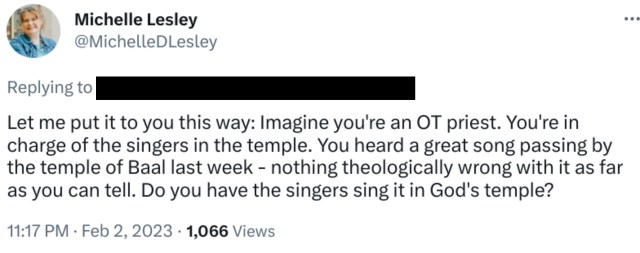
There is simply no good reason for a doctrinally sound church to use music from heretical sources like these.

The Mailbag: False Doctrine in Contemporary Christian Music

Why Our Church No Longer Plays Bethel or Hillsong Music (or Elevation or Jesus Culture), and Neither Should Yours

Hillsongโ€™s Theology of Music and Worship

The Mailbag: Should Christians listen to โ€œReckless Loveโ€?


Hello there. I read your blog about Priscilla Shirer being a false teacher. Read some parts of your blog. Found your recommended preachers with sound doctrine. I don’t know what denomination you’re in. But I just wanted to ask if you believe if we can lose our salvation?

Hi there! I’m a Reformed Southern Baptist. You can read more about my denomination and my beliefs at the Statement of Faith tab and the Welcome tab (both in the blue menu bar at the top of this page.

No, I do not believe genuinely regenerated Christians can lose their salvation because that’s not what the Bible teaches. I discussed this at length, including the relevant Scriptures, in my article The Mailbag: Can unforgiveness cause you to you lose your salvation?.


If you have a question about: a Bible passage, an aspect of theology, a current issue in Christianity, or how to biblically handle a family, life, or church situation, comment below (Iโ€™ll hold all questions in queue {unpublished} for a future edition of The Mailbag) or send me an e-mail or private message. If your question is chosen for publication, your anonymity will be protected.


Random Ramblings Ruminations Resources

Random Ramblings, Ruminations, and Resources

Great balls of fire, the world has gone ya ya and we haven’t had a 4R sinceย last July.ย Goodness. Well, we’ll fix that faster than a Costco shopper on a pallet of toilet paper.

Let’s jump into someย Random Ramblings, Ruminations, and Resources, shall we?

Photo Credit

M-m-m-my Corona(virus)

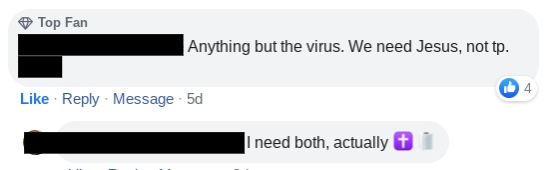
The other day I asked on Facebook if y’all wanted an article about Christians and the Coronavirus or something else. The overwhelming response was, “Something else!ย Anythingย else!” It seems many of us have reached out saturation point when it comes to hearing about the virus:
But there were a few hardy souls who wanted to hear a Christian perspective on how we and our churches should be reacting to all the ramifications of quarantines, social distancing, and church closures. So here are a few brief thoughts I had:

๐Ÿ˜ทWash your hands like your life depends on it, because it might. Instead of singing a song while you’re washing your hands, recite your memory verses. Or if you’re in a public restroom, share the gospel with the poor sap ladyย who’s washing her hands in the sink next to you. You know she’s going to be there a while- captive audience!

๐Ÿ˜ทYou shouldn’t have to be told to cover your mouth when you cough or sneeze. You should already be doing it. That is basic home training and basic loving and serving your neighbor.

๐Ÿ˜ทStay home if at all possible (I thought this was just called “being normal, but it turns out I’m an introvert. Or a hermit.). The sooner this thing stops spreading, the sooner we can all get back to church, work, and normal life (which, for me, is staying home if at all possible – it’s the circle of life. Or something.).

๐Ÿ˜ทChristians are not hoarders. Christians are sharers. It’s one thing to lay in a reasonable supply. It’s a whole ‘nother animal to buy into the mindset that purchasing huge amounts of supplies will somehow magically ward off harm. It won’t. That’s superstition. It is failing to trust God to provide for you. Do business with God and discern whether or not you’ve been hoarding. If you have, repent, and make like Zacchaeus and give it away to people who need it.ย 

๐Ÿ˜ทIf you have a godly pastor, he has probably agonized over whether or not to cancel worship service or modify your church’s regular activities. It doesn’t matter what decision he makes, somebodyย is going to be unhappy about it and give him an earful. Don’t be that person. Give him some love and encouragement (from a safe social distance). He probably needs it now more than usual. And on that same note, whatever decision he makes, just roll with it for the time being, OK? We’re all playing this thing by ear right now, including your pastor. Don’t make me go all Hebrews 13:17 on y’all.

๐Ÿ˜ทIf you think nothing of skipping church for frivolous reasons, it’s hypocritical to complain now about your church’s services being canceled or modified for a much more important reason. (I’m not talking about First Amendment stuff here, I’m talking about your heart.)

๐Ÿ˜ท”Online church” can be a blessing in an emergency situation like this, but this virus is going to pass and things are going to get back to normal. Do notย fall into the fleshly mindset of, “Online church worked out just fine during the crisis, so I’ll just keep doing that instead of physically going back to church.” Uh uh. That’s spiritually lazy, and it’s sinfully forsaking the assembly. For Christians, Church is Not Optional, and that’s Non-Negotiable.

๐Ÿ˜ทHave you ever stopped to think that this whole quarantine and limiting of meeting sizes thing could be God giving us a dry run of what it’s going to be like when real persecution comes, our church buildings are shuttered for good, and we have to meet in small groups in secret? That’s already real life for many of our brothers and sisters across the world. Maybe we should quit complaining and use this as a drill.

๐Ÿ˜ทWhere are Benny Hinn, Todd White, Bethel, and the rest of the faith healing crowd in all this? Time to put up or shut up.

๐Ÿ˜ทTake reasonable precautions, but look for opportunities to help others and to share the gospel. Let your faith in God be greater than your fear of illness.

That’s pretty much my take on the whole shebang. If you haven’t had enough of all things Coronavirus, here are some more good resources:

Coronavirus Articlesย at The Cripplegate

Coronavirus and the Christian Faith on The Sword and the Trowel Podcast

The Coronavirus Pandemic – Bringing Hope to Those in Fear on Voice of Reason Radio

Q&A Corona Virus, Saturday Podcast, the Bible Project? at When We Understand the Text

Wisdom, Not Worry on Relatable with Allie Beth Stuckey

Kudos to one of my followers, Camille, who has been hard at work curating the best Coronavirus memes on the web, part 1 and part 2. (This is meant to be lighthearted and funny. If you only do serious, please don’t click.)

Get Your Worship On

This kind of goes along with my TBT article from yesterday, Godโ€™s Not Like โ€œWhatever, Dude,โ€ About The Way Heโ€™s Approached in Worship. (Also meant to be lighthearted and funny, so please don’t click if that’s not your bag.). And some of you youngsters wonder why us old codgers like hymns so much!

The Real Deal, or the Fake Heal?

I was reading Acts 3, the story of Peter and John healing the lame beggar, and it struck me how starkly different this account is from the chicanery of New Apostolic Reformation “faith healers” today…

๐Ÿ’ฅPeter and John didn’t have a “healing ministry”, they had a “preaching the gospel ministry.”

๐Ÿ’ฅThe lame beggar didn’t show up at “church” (i.e. the temple) to be healed, and didn’t seek Peter and John out for healing.

๐Ÿ’ฅThe lame beggar asked them for money rather than them asking him for money.

๐Ÿ’ฅPeter and John had no silver, no gold, no Rolexes, no mansions, no private jetsโ€ฆ

๐Ÿ’ฅPeter said, โ€œ…what I have, I give to you.โ€ The beggar was not asked to โ€œsow a seedโ€ into Peter and Johnโ€™s ministry.

๐Ÿ’ฅFaith isnโ€™t mentioned once prior to the healing. Peter didnโ€™t tell the beggar that if he just had enough faith, God would heal him.

๐Ÿ’ฅNo faith or money was required. The beggar played no part in โ€œearningโ€ his healing with his own good works. God healed him for His own glory.

๐Ÿ’ฅThe beggar was healed from a lifelong, obvious, eyewitnessed disability, and his healing was immediate and permanent.

๐Ÿ’ฅPeter downplays both himself and the miracle and points to the Miracle Worker, Jesus.

๐Ÿ’ฅPeter uses the opportunity of the gathered crowd to preach the gospel.

๐Ÿ’ฅThe gospel Peter preached was not, โ€œCome to Jesus for miracles,โ€ but โ€œJesus came to you, and you killed Him. Repent.โ€

๐Ÿ’ฅPeter didnโ€™t make crazy prophecies that didnโ€™t come true. He pointed to the prophets of Scripture, and their prophecies fulfilled in Christ.

NAR preachers and faith healers want us to think theyโ€™re just like the apostles – even calling themselves “apostles” – but their words and actions donโ€™t match up with what the apostles said and did.

They Aren’t Heretics Because You Disagree with Them

Of course not. So I’m not going to call Jared Wilson – who I have no reason to believe is anything other than a good, solid brother in Christ – a heretic because I disagree with the thrust of his article,ย They Aren’t Heretics Because You Disagree with Them. But, with genuine respect, I am going to call him “perhaps under educated” and “possibly somewhat lacking in experience” when it comes to the depth of the seemingly bottomless pit of false teaching and heresy out there.

Or perhaps our experiences are just different. Perhaps, in his world, there are throngs of people running around calling Presbyterians heretics because they believe in paedo-baptism. Or who cry “Heretic!” on anyone with a different eschatalogical view from their own.

That’s not the world I – and I would guess, most Christians – live in. In my world, the people who get called heretics and false teachers have generally earned the label by their biblically demonstrable false teaching and sinful behavior. There might be a few Baptists calling Presbyterians heretics and vice versa, but in my experience they are the rare exception, not the rule Jared’s article – putting the best possible construction on it – seems to be trying to address. And I get the feeling I swim in these particular waters much more frequently than he does.

I would certainly agree with Jared that the aforementioned types of issues are not matters of heresy, they are secondary issues on which Christians in good standing can disagree. But he lumps in some other issues (the role of women, extra-biblical revelation, yoking in ministry with “people who teach wacky things”) we cannot “agree to disagree” on because they are sin or false teaching that undermine the authority of Scripture, the sufficiency of Scripture, and the spiritual health of the church.

Jared has made the same categorization error regarding “secondary issues” that I believe Al Mohler made in his article on “theological triage” (which Jared links to in his article) – namely, that issues of sin (disobedience to clear Scripture) are not the same thing as secondary theological issues. Sin belongs all in its own category: sin. (I discussed this categorization error at length in my article Women Preaching: It’s Not a Secondary Doctrinal Issue.)

Jared uses no Scripture used to back up his opinions, making them no more valid than the โ€œopinionsโ€ he critiques. He cites the Baptist Faith and Message (the statement of faith of the Southern Baptist Convention), but the BFM is not Scripture, and we are Christians first, Baptists second. We are Bible first, BFM second. So anywhere the BFM might contradict Scripture, go beyond Scripture, or not rise to the level of Scripture (and it does not rise to the level of Scripture regarding the role of women in the church, restricting only the office of pastor, but not the function of preaching), it is moot and useless.

Does Jared not recall that Scripture says, “A little leaven leavens the whole lump.”? And that we are to “cleanse out the old leaven…and celebrate with the unleavened bread of sincerity and truth“? Yet the thrust of his article seems to be akin to saying, โ€œDonโ€™t worry about that little misshapen mole on your arm. Itโ€™s just your arm having a ‘different view’ of skin. Only rampant, stage 4 cancer should be called cancer and treated.โ€ That is not a biblical approach to false teaching.

How would Jared have advised Old Testament people who had a โ€œdifferent viewโ€ of worshiping household gods alongside God? Or offering strange fire in worship? Or syncretism and idol worship taking place inside the house of God? Or marrying and divorcing foreign wives? Or, in the New Testament, Ananias and Saphira? Or those who forbid marriage and certain foods? None of these are soteriological heresies, and yet look how strenuously God dealt with each situation. Most involved the death of the perpetrators.

As much as many Christians would like us all to get along and play nice with anyone and everyone who names the name of Christ, we cannot do that and still be faithful and obedient to the Word of God that tells us to contend for for the faith and silence false teachers. False teaching, even non-soteriological false teaching, is a big deal to God, and it should be to us, too.

Podcast Appearances

Tulips & Honey Podcast Guest Appearance: Women’s Discipleship


Amy Spreemanย (my co-host at A Word Fitly Spoken) and I had a super fun time interviewing on the Tulips & Honeyย podcast with Lauren and Emily. Listen in (and watch!) as we chat about women’s discipleship, older women mentoring younger women, the importance of the local church, and most importantly – where Amy and I each land on pineapple on pizza (spoiler alert – we are not in unity! :0)). We will upload the audio of the recording above to A Word Fitly Spoken’s podcast platforms and website next week in case you’d rather listen than watch.

You can subscribe to the Tulips & Honey podcast on a variety of podcast platforms. Be sure to check out their YouTube channel too, and give Tulips & Honey a follow onย Facebook andย Twitter.

My articles mentioned or touched on in the interview:

Rock Your Role

Rock Your Role: Oh No She Di-int! Priscilla Didnโ€™t Preach, Deborah Didnโ€™t Dominate, and Esther Wasnโ€™t an Egalitarian

Women and False Teachers: Why Men Donโ€™t Get It, and Why Itโ€™s Imperative That They Do

Searching for a new church?, Biblical Counseling,ย and Bible Studiesย tabs are at the top of this page.


Got a podcast of your own or have a podcasting friend who needs a guest? Need a speaker for a womenโ€™s conference or church event? Click the โ€œSpeaking Engagementsโ€ tab at the top of this page, drop me an e-mail, and letโ€™s chat!

Podcast Appearances

Things Above Us Roundtable Guest Appearance at Cruciform Conference


I had a great time chatting with Michael Coughlin of the Things Above Us Roundtable podcast during the Cruciform Conference last month. Listen in as we discuss feminism, femininity, biblical womanhood, and Moore!

(Michael and I briefly touched on the Open Letter to Beth Moore. If you’d like to sign it {ladies only, please}, you may do so by adding a comment here.)


And if you haven’t had a chance to listen to my two teaching sessions at Cruciform, but would like to, you can find them here.

You can subscribe to the Things Above Us Roundtable podcast on a variety of podcast platforms. Be sure to check out the Things Above Usย blog too, and give Things Above Us a follow onย Facebook andย Twitter.


Got a podcast of your own or have a podcasting friend who needs a guest? Need a speaker for a womenโ€™s conference or church event? Click the โ€œSpeaking Engagementsโ€ tab at the top of this page, drop me an e-mail, and letโ€™s chat!

Complementarianism

Putting on the “You Can!” of Complementarianism

It never really hit me until I started teaching the book of 1 Timothy how many instructions in the pastoral epistles pertain to women, and how weighty those instructions are. The pastoral epistles are the โ€œpolicy and procedure manualsโ€ for the church, and, far from relegating the ministry of women to nothing more than crafts and tea parties while the men do all the โ€œimportantโ€ stuff, you come away with the impression that a healthy, well-balanced church actually depends on godly women working hard to carry out the ministries that God has uniquely created and gifted us to fulfill, alongside men fulfilling their own ministries.

These epistles donโ€™t view โ€œwomanโ€™s workโ€ around the house of God as trivial or menial, but as a high and holy calling. Vital. Necessary. Honorable.

But is that the lofty perspective of the biblical role of women that the local complementarian church is conveying to its female and male members? Are we, especially those of us in womenโ€™s ministry, proactively teaching that the calling of motherhood or the task of discipling other women or serving those in need is qualitatively just as imperative and noble as the calling of pastor or elder?

Intentionally or not, the egalitarian movement has maneuvered biblical complementarians into constantly playing defense. Their offensive squad keeps moving the ball forward by offering women a no holds barred buffet of powerful and prestigious ministry positions. Our defensive line correctly and biblically pushes back with, โ€œNo, the Bible says women are not to โ€˜teach or to exercise authority over a manโ€™  in the church setting.โ€ But often, only two or three members of our offensive squad are dressed out to play, and they never get off the bench and into the game. And as any football fan knows, you have to have a good defense and a good offense if youโ€™re playing to win.

Egalitarians offer women โ€œyou can,โ€ but all too often all we complementarians have offered godly women yearning to serve is, โ€œyou canโ€™t.โ€ Where is the big, beautiful, biblical showcase of complementarian โ€œyou canโ€?

Not long ago, I was teaching a group of ladies the biblical process of putting off the old self and putting on the new self in Ephesians 4:20-32. We explored how interesting it was that every โ€œdonโ€™tโ€ in the passage was coupled with a โ€œdo.โ€ We donโ€™t just put off lying, we put on proactive truth-telling instead, and so on. Nature abhors a vacuum in the physical realm, and it would seem this is true in the spiritual realm as well. When we subtract the ungodly, we must replace it with the godly. If we donโ€™t, something will rush in to fill the void thatโ€™s been created, and that “something” isnโ€™t usually biblical or fruitful. 

So how can we shift the perspective in our churches from โ€œyou canโ€™tโ€ to โ€œyou can,โ€ and create an atmosphere, not merely of โ€œput off,โ€ but also โ€œput onโ€? How can we get our offensive team suited up, on the field, and moving the ball toward the goalpost while at the same time retaining a strong defense?

We can, so to speak, make complementarianism great again.ย 

As I studied 1 Timothy 5, I was struck by Paulโ€™s description of women who are โ€œtruly widows.โ€ These are women who have spent their lives being busy and intentional about the work of the Lord in their homes and in the church. They adorned themselves with the good works proper for women who profess godliness, and they were honored and revered for it by the church. I didnโ€™t come away from this passage with the feeling that these women were frustrated, oppressed, or seen as โ€œlesserโ€ by the church because they werenโ€™t allowed to teach or exercise authority over men. I came away from this passage thinking, โ€œThose women were awesome. Thatโ€™s the kind of woman I want to be.โ€

What would the climate in our churches look like if womenโ€™s ministries and the church at large recaptured that same reverential posture and purposefulness toward biblical womanhood? If, instead of teaching the biblical role of women strictly as, โ€œYou canโ€™t eat the fruit from this apple tree,โ€ we followed that admonition with a grand tour of the Garden, focusing on the delicious fruit of the pear tree, the cherry tree that needs a good pruning, the fig tree just waiting for the right woman to come along, harvest its fruit, and make some preserves, the banana tree that needs an expert in fertilizers, and the orange tree dying for someone to water it?

In my experience, what happens in churches of that climate is that – just like the godly widows of 1 Timothy 5 – women are so busy and fulfilled tending the other trees of the Garden, that they have neither the time nor the desire to go apple picking. 

May our churches strengthen themselves and grow to more robust spiritual health by proactively encouraging Christian women to joyfully throw ourselves into the godly โ€œgood works which God prepared beforehand, that we should walk in themโ€ – the biblical โ€œyou canโ€ of complementarianism.


Additional Resources

Rock Your Role: Jill in the Pulpit

Let Me Count the Ways: 75 Ways Women Can Biblically Minister to Others

Unforbidden Fruits: 3 Ways Women MUST Lead and Teach the Church

Servanthood

The Servanthood Survey