Mailbag

The Mailbag: Nursing Home Ministry Questions

Originally published July 26, 2021

I recently received some questions about nursing home ministry, so I thought I’d put all the answers I’ve given in the past in one post so they’d be handy.


Originally published January 22, 2018:
The Mailbag:
Men attending womenโ€™s Bible study class at nursing home

A female relative of mine teaches a women’s Bible study at a Catholic nursing home (my relative is a Protestant Christian). Sometimes, a male resident or two – none of whom are saved – will wander in and attend her class. Occasionally, one of them attempts to correct her according to Catholic doctrine. Even though she’s not technically teaching “in the church” (1 Timothy 2:12) she’s uncomfortable with men attending the class, as well as with having to biblically correct their unscriptural Catholic doctrine. On the other hand, she shares the gospel every time she teaches, and she doesn’t want to turn away anyone who might receive the good news and be saved. What should she do?

I love it when Christians think deeply about issues like this. It is encouraging to interact with godly people who want to be obedient to Christ, and it pushes me to desire to obey Him better myself.

Foreword:

Just to lay a quick foundation for my answer to this question, it needs to be understood that people who currently believe and practice Catholic doctrine as it is written in Catholic documents are not saved. There are numerous unbiblical beliefs Catholics hold to (which I will not go into right now because that’s beyond the scope of this article) but for the purposes of understanding my answer, in a nutshell, the Catholic religion does not teach salvation by grace alone through faith alone in Christ alone (in fact, Catholicism anathematizes {condemns to Hell} anyone who teaches this), works must be included in the salvation process. If you believe your own good works play any part in earning your salvation, you are not saved. Salvation is all of Christ, and Christ alone.

โœขโœขโœขโœขโœข

I am assuming that whoever invited this teacher to teach a Bible study in the nursing home knows that she is Protestant and will be teaching Protestant (biblical) doctrine. I am also assuming that the person who invited her to teach is OK with this. I would not advise someone to give the appearance of teaching in compliance with Catholic doctrine and then surreptitiously “sneaking in” Protestant doctrine. That’s deceitful and dishonest, and it would be understandable for the Catholic residents to be correcting her.

โœขโœขโœขโœขโœข

If you’re unclear as to why having men in her Bible study class is a dilemma for the female teacher, I’d encourage you to read these two articles before moving on to my answer:

Jill in the Pulpit

Rock Your Role FAQs (this article expands on my brief comments below)

Here are my thoughts on the issue:

1. If the people attending the study are Catholic, then the female teacher is evangelizing the lost outside of the church, not discipling (teaching) Believers who are the church, unless some of those attending the study have gotten saved (the question indicates none of the male “drop ins” are saved). Evangelism falls under the “do” of the Great Commission, not the “don’t” of 1 Timothy 2:12. (see #11)

2. We always have to keep the definition of “church” in mind when we’re talking about women teaching or holding authority over men “in the church.” The gathered body of Believers is the church, not the building in which they meet. The mere fact that a group meets in a nursing home, house, park, community center, or other edifice that isn’t a church building doesn’t automatically mean a woman is free to teach men (see #7). It doesn’t automatically mean she can’t teach them either.

3. If the male attendees are being disruptive and introducing false doctrine, the teacher is well within her biblical rights and wisdom to say that this a women’s only group and exclude the men. (The same would apply to excluding any women who behave the same way.)

4. If, at some point, genuinely regenerated men begin attending the class because they want to be taught the Bible, praise God! The best case scenario would be for the teacher to go to her pastor, explain the dilemma, and have him ask one of the associate pastors, elders, or another appropriate male church member to volunteer to teach the men.


Originally published February 18, 2019
The Mailbag: Potpourri (Prayer quilts, Discouraged husband, Jesus Calling at the CPCโ€ฆ)

I need some direction. Iโ€™ve been teaching/sharing Godโ€™s Word at a nursing home for over two years on Sunday mornings. We have mostly women, but there are two men who join us. I was asked by the nursing home to lead our little church because they havenโ€™t been able to find any men willing to do it. Thatโ€™s my dilemma, I know Paul said he wouldnโ€™t allow a woman to teach men, I donโ€™t know how to handle this. I myself am not part of any other church, so I donโ€™t have a pastor to help. Iโ€™ve reached out to some churches, but no one is getting back to me. Since we canโ€™t find a man willing to lead, am I okay to keep doing what Iโ€™m doing? 

That is quite the dilemma! Let me see if I can help.

You started your e-mail by saying, โ€œI need some direction,โ€ so I hope youโ€™ll be open to some direction thatโ€™s in a bit of a different direction than the one youโ€™re asking about.

Itโ€™s wonderful that youโ€™re wanting to help out at the nursing home and teach Godโ€™s Word. We need more women in mercy ministries like this, and Iโ€™m sure youโ€™re a joy and a blessing to the ladies. But Iโ€™m afraid thereโ€™s a bigger issue you need to deal with than whether or not to be teaching at the nursing home.

You need to find a doctrinally sound church, become a member of it, and attend and serve it faithfully. Church membership, fellowship, and service are not optional for Christians (Basic Training: 7 Reasons Church is Not Optional and Non-Negotiable for Christians).

The Bible knows nothing of unchurched Christians, and serving at the nursing home is not a reason not to be joined to a local church. You could always serve at the nursing home on Sunday afternoons after worshiping at your own church, or serve on another day. If youโ€™re asking around at churches for someone to volunteer on Sunday mornings, this is why youโ€™re not getting much of a response โ€“ youโ€™re contacting churches. Pastors and their church members are supposed to be in church on Sunday mornings, not somewhere else.

I know you might be thinking that your group of ladies at the nursing home is your church because you called it โ€œour little churchโ€. It might be an awesome group of ladies with super close fellowship, but what you have there is a womenโ€™s Bible study class, not a church. It doesnโ€™t have a pastor, elders, or deacons. It doesnโ€™t have a membership, so thereโ€™s no mechanism for church discipline. Nobody is giving offerings or serving the Body. Youโ€™re not performing the ordinances of baptism and the Lordโ€™s Supper (I hope). This is not a church.

Have you ever been on an airplane and noticed that when the flight attendant gives the safety instructions, she always tells you to put on your own oxygen mask first before assisting others with theirs? Itโ€™s good advice in this situation too. Right now, youโ€™re disobeying Scripture by not being joined to a local church, so youโ€™re setting a sinful example for your ladies while simultaneously teaching them that they need to obey Godโ€™s Word. Put your mask on first. Repent and join a local church. You also need to be sitting under good preaching and teaching at your own church so youโ€™ll have something to give these ladies and to keep your own theology on track so you can make sure what youโ€™re teaching them doesnโ€™t veer off into false doctrine. Put your mask on first. You canโ€™t help other people breathe if youโ€™re passing out from lack of oxygen. Finally, joining a local church will fix the problem you mentioned of, โ€œI donโ€™t have a pastor to help.โ€ If youโ€™ll put your mask on first by finding a good church to join, you will have a pastor, elders, deacons, and lots of other men to help.

When we do things Godโ€™s way, in Godโ€™s order, most of the secondary things, like your dilemma about the men at the nursing home, tend to fall into place. Tell you what. You find a good church to join โ€“ maybe one of the ones you contacted for help (check out the โ€œSearching for a new church?โ€ tab at the top of this page if you need it) โ€“ get plugged in, and ask your pastor for some help with this. If he canโ€™t or wonโ€™t help you, write me back, and weโ€™ll go from there, OK? Iโ€™ll bet you wonโ€™t need to.


Originally published July 5, 2021
The Mailbag: Asked and Answered

Is it appropriate for a woman chaplain to teach men, evangelizing and then answering questions using the Bible to present truth in nursing home one on one or in a coed worship service at the nursing home?

I think I must have a number of followers who visit and care for those in nursing homes, because Iโ€™ve received several questions over the years about nursing home ministry. Can I just take a moment to say โ€“ thank you so much. What a blessing and an encouragement you must be to those precious ladies and gentlemen.

Letโ€™s unravel your question just a bit because there are several issues at play:

First of all, should a woman even be a chaplain? I donโ€™t want to give an across the board โ€œnoโ€ because โ€œchaplainโ€ is such a catch-all term these days, and different organizations (hospitals, prisons, the military, nursing homes, etc.) probably all have different job descriptions for their chaplains which may or may not require a woman in that position to violate Scripture.

But if I were asked, โ€œShould women be chaplains?โ€ and I had to give a yes or no answer, my answer would be no, for the simple reason that most lost people (or even Christians) arenโ€™t going to differentiate a chaplain from a pastor. To them, a chaplain is just a pastor who works in a hospital (or wherever) instead of a church. And itโ€™s unbiblical for women to be pastors, so you donโ€™t want to give the evil appearance of someone living in unrepentant sin. Even if youโ€™re not technically violating Scripture in your position, you appear to be.

OK, for your next several questions, itโ€™s immaterial whether or not these things take place in a nursing home:

Is it OK for women to evangelize (share the plan of salvation with a lost person) and answer biblical questions one on one with a man? Yes. Carefully and with wisdom: Rock Your Role FAQs #11

Is it OK for a woman to evangelize (share the plan of salvation with lost people) a co-ed group? Not if sheโ€™s essentially preaching a sermon and functioning as a preacher, which is what Iโ€™m inferring by your use of the term โ€œworship serviceโ€. Rock Your Role FAQs #11

If itโ€™s something more akin to you hanging out with 5 or 6 friends, some male and some female, and you start sharing the gospel with them, thatโ€™s different. Thatโ€™s really more like a one on one situation.

Is it OK for a woman to preach/teach in or lead a co-ed worship service? No, regardless of the venue or her title. Rock Your Role FAQs #7 Rock Your Role: Jill in the Pulpit


If you have a question about: a Bible passage, an aspect of theology, a current issue in Christianity, or how to biblically handle a family, life, or church situation, comment below (Iโ€™ll hold all questions in queue {unpublished} for a future edition of The Mailbag) or send me an e-mail or private message. If your question is chosen for publication, your anonymity will be protected.

Complementarianism, Mailbag

The Mailbag: Women teaching men- Questions from a young reader

Originally published March 14, 2022

I received this very astute line of questioning from a young lady who left a comment on one of my articles. The comment and questions were rather lengthy, so I’ve broken it up into portions in order to answer it in an organized way. If you need to read the entire comment, uninterrupted, for context or ease of understanding, scroll down, reading only the portions in bold.


Hi! Just to let you know, though it may seem, I have no intention of being rude in this question, and genuinely want to know your response to this. I am only in 9th grade, so I have a lot to learn, and want to know what you think about my comment...Thank you, and I am very curious to find out what you think about my questions and things that I might have misunderstood or missed.

That’s awesome! I wish I had been thinking as deeply about these things as you are when I was in the ninth grade. And, rest assured, your questions didn’t seem rude to me at all. I’m so glad you want to learn! I hope you’ll understand that my answers aren’t meant to be rude either, although they may not be quite what you’re expecting or wanting to hear.

You didn’t mention whether or not you’re a Christian or what your church background, if any, is, so let me just start off by saying, if you’ve never been genuinely born again, my answers might not make much sense. I would encourage you, even if you’re pretty sure you’re saved, to examine the materials at the What must I do to be saved? tab in the blue menu bar at the top of this page before moving ahead.

I was just wondering, if women are not allowed to teach men, and you are a woman and this blog is public to men and women, then arenโ€™t you technically providing biblical insight and evangelizing to whatever gender is reading this to inform them of the Bible?

Nope. I’ve answered that question in detail in my article Are Female Bloggers Violating Scripture by โ€œTeachingโ€ Men?

Additionally, “evangelism” and “teaching” (“providing insight” isn’t really a biblical category) are two different, separate things. You might find our podcast episode Women Preaching the Gospel? helpful for understanding the distinction.

Also, the book of Timothy, like you said, was a letter written from Paul to Timothy, so this was just the teachings that Paul gave to Timothy as instructions for the churches, and not necessarily coming from God.

I’m afraid that’s one of the things you’ve misunderstood. This wasn’t just a letter from one human being to another. The words in 1 Timothy, just like every word of every book of the Bible are from the very lips of God Himself. Second Timothy 3:16 tells us that “All Scripture is breathed out by God.” There aren’t some parts of Scripture that are from God and others that aren’t. It all comes from God, from Genesis 1:1 to Revelation 22:21.

First and second Timothy and Titus are what we call the pastoral epistles (“epistle” means “letter”). That means they are God’s instructions, written through His human instrument, Paul, to Timothy and Titus and every pastor who came after them, about how to run the church.

I know Paul was a prophet and one argument could be that he got this information from God,

No, Paul was not a prophet, he was an apostle. And, as I discussed above, the Bible says that all Scripture is breathed out by God, so “Paul got his information from God” is the only argument that can be made, especially for Christians. Because, for Christians, the Bible is our authority on what to believe, not human arguments, opinions, and ideas.

but even prophets (besides Christ) make mistakes in their instructions to others,

I’m afraid that’s also incorrect. There’s not a single prophet in the Bible who, when speaking as a prophet to people on God’s behalf ever made one iota of a mistake about what He said. There were false prophets (who received the death penalty for saying they spoke for God when God had not really spoken to them), but none of God’s true prophets – like Isaiah, Jeremiah, Micah, Habakkuk, etc. – ever got anything wrong or “made mistakes in their instructions to others” when speaking on behalf of God.

such as Abraham, who instructed people to be stoned for certain sins,

I think you mean “Moses” here. Abraham wasn’t a prophet, and I don’t recall any instance in Scripture in which Abraham “instructed people to be stoned for certain sins”. Moses didn’t either. God did. God gave Moses the law on Mt. Sinai, and Moses wrote it down and taught it to the people.

and you can see that it was unlawful in Godโ€™s eyes

I’m sorry, but that’s incorrect as well. Since God is the One who gave the laws about stoning people for certain sins, He would never have said that someone properly obeying His law was doing something unlawful. That would be like God saying He was wrong when He made that law. And, of course we know that God is never wrong.

and you can see that it was unlawful in Godโ€™s eyes when Jesus told the priests about to stone Mary of Magdala that they should not stone her because they have sinned as well and God sees all sins as the same.

I think you’re talking about the story of the adulterous woman in Luke 7-8, right? Again, I’m sorry, but there are many things that need to be corrected here:

  • Stoning a woman caught in adultery was not “unlawful in God’s eyes”. It was lawful. God is the one who gave this law. The scribes and Pharisees correctly cited the law in 8:5.
  • Jesus wasn’t speaking to the priests, He was speaking to the scribes – experts in the law (which was an important point of this passage) – and Pharisees.
  • The text does not say the unnamed woman was Mary Magdalene.
  • Look carefully at the passage. In which verse does Jesus say “they should not stone her”? Answer: He didn’t say, “Don’t stone her.”. On the contrary, He said that they could commence with the stoning as long as whichever one of them was without sin cast the first stone.
  • He also didn’t say they couldn’t stone her because “they have sinned as well”. Every lawful stoning that has ever taken place on planet earth was carried out by sinners, because (except for Jesus) every human being is a sinner.
  • The Bible doesn’t say that God “sees all sins as the same” (In fact, we can see in the way that God deals with various sins in various ways throughout Scripture that this isn’t true.), so Jesus would never have said this nor given it as a reason that these men should not have stoned this woman.

Jesus didn’t say the law against stoning an adulteress was wrong. That would have been equal to saying God was wrong for giving that law. He didn’t tell the men not to obey the law, either. The key to understanding this story is in verses 4-7:

4 they said to him, โ€œTeacher, this woman has been caught in the act of adultery. 5 Now in the Law, Moses commanded us to stone such women. So what do you say?โ€ 6 This they said to test him, that they might have some charge to bring against him. Jesus bent down and wrote with his finger on the ground. 7 And as they continued to ask him, he stood up and said to them, โ€œLet him who is without sin among you be the first to throw a stone at her.โ€

They didn’t care about this woman or what happened to her. They didn’t care about the man who was sinning right along with her. They didn’t care that this sin wrecked the man’s and woman’s lives. They didn’t care that God’s law had been broken. They didn’t care that adultery grieves the heart of God. They didn’t care.

All of those things were just a means to an end for them. All they cared about was trying to get the advantage over Jesus. To trick Him into saying something they could use against Him so they could discredit Him or bring Him up on charges with the Sanhedrin (Jewish court). And they were using God’s precious and holy Word as a tool to accomplish this evil goal. They were blasphemously using God’s own Word against Him.

That is the entire point of this story. God’s Word is His representation of Himself to us. It is our lifeline to Him, because it is how we come to know Christ as Savior. It should be revered as high and holy, not twisted and abused for wicked purposes.

This is just one example of many things that Godโ€™s prophets have taught wrongly.

No, none of the things you’ve mentioned, nor the corrections I’ve given, have demonstrated that any true prophet of God has ever taught anything wrong when it comes to prophecy or commands of Scripture. Second Peter 1:20-21 tells us:

…knowing this first of all, that no prophecy of Scripture comes from someone’s own interpretation. For no prophecy was ever produced by the will of man, but men spoke from God as they were carried along by the Holy Spirit.

So, since times were different in the first century and women were not seen as important to men, couldnโ€™t this have been something Paul told Timothy to do based off of his own understandings culturally?

No. Again, 1 Timothy is a passage of God-breathed Scripture, not Paul’s personal human opinion. It was not based on Paul’s human understanding (see 2 Peter 1:20-21, above), culturally, or in any other way. This is God’s command to pastors, based solely on God’s reasons.

And God kindly shares those reasons with us in verses 13 and 14 of 1 Timothy 2:

11Let a woman learn quietly with all submissiveness. 12 I do not permit a woman to teach or to exercise authority over a man; rather, she is to remain quiet.

13 For Adam was formed first, then Eve; 14 and Adam was not deceived, but the woman was deceived and became a transgressor.

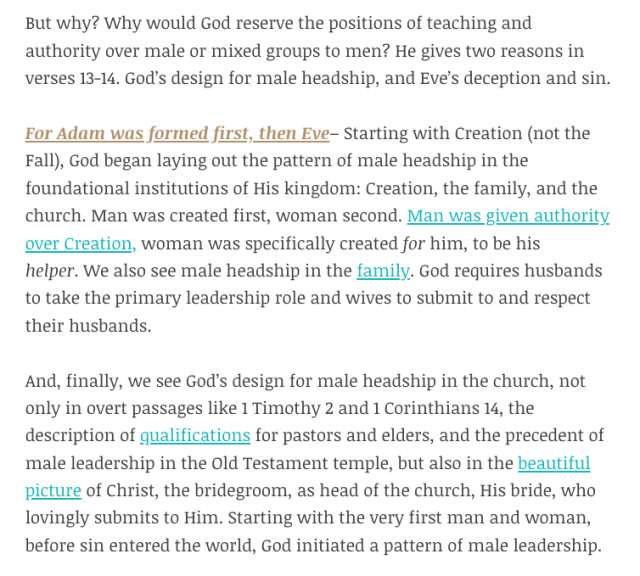
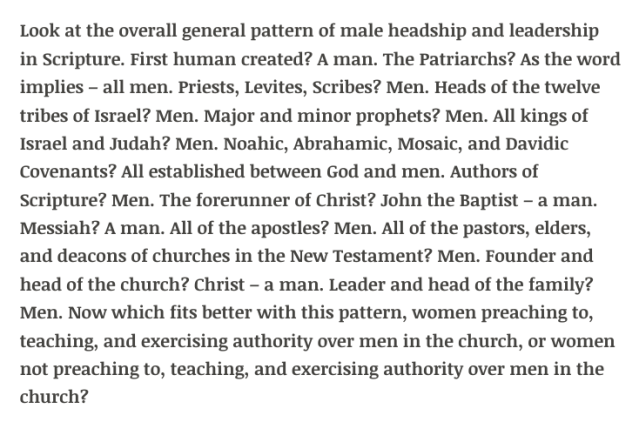
God gives us two reasons for His command that women are not to teach or exercise authority over men in the gathering of the church body: the creation order and pattern of male headship (13), and the fact that the woman was the one who was deceived into sin (14).

That’s why. Not culture, not Paul’s personal opinions, not because men didn’t value women at the time, not because the women in that particular church at that particular time were unruly or false teachers, not for any of the man-made theories that people have come up with. God tells us exactly why He made this rule for the church in verses 13-14. I’ve discussed this in greater detail in my articles Rock Your Role: Jill in the Pulpit and The Mailbag: Counter Arguments to Egalitarianism. Here are a few of the pertinent excerpts:

You’ve asked some really great questions here, and your reasoning skills are sharp. It was my pleasure to serve you by answering your comment. Keep asking questions, studying, and learning all God has to teach us through His authoritative, inspired, all-sufficient written Word.


If you have a question about: a Bible passage, an aspect of theology, a current issue in Christianity, or how to biblically handle a family, life, or church situation, comment below (Iโ€™ll hold all questions in queue {unpublished} for a future edition of The Mailbag) or send me an e-mail or private message. If your question is chosen for publication, your anonymity will be protected.

Christian women, Discernment, Men

Throwback Thursday ~ Women and False Teachers: Why Men Don’t Get It, and Why It’s Imperative That They Do

Originally published September 22, 2017

Confession time: Sometimes – OK, often – I think my brain works more like a man’s than a woman’s. You’ve got a problem? Suck it up- here’s the solution. The mall? A perfectly horrifying way to ruin a Saturday. And why do we have to hug people hello and goodbye when we see each other multiple times a week?

I’ve always been more comfortable around men, and when I was single, I had mostly male friends. They’re generallyยน less mysterious and easier to figure out than women, and they don’t usually play those manipulative emotional games some women can be notorious for. If a man says he wants a cheese sandwich, there’s no hidden “you don’t bring me flowers often enough” meaning there. He just wants a cheese sandwich. I like that. It’s pretty much how I operate.

Which makes me the perfect person for God to plunk down smack dab in the middle of women’s ministry, right?

Harrumph.

God just has this way about Him of stretching us and growing us beyond our comfortable little confines. I used to be terrified of walking into a room full of women (They’re so unpredictable! You never know when a big emotional scene might break out!) But after years of teaching and discipling women, developing close friendships with women, serving and ministering to women, I now walk into that room and see precious sisters, created oh so tenderly and intricately by God’s loving hands.

God purposefully and intentionally made each woman unique, but with common traits and perspectives that bind us together as sisters and differentiate us from men. And because men aren’t wired by God the same way women are, sometimes they’re just not going to get the way women think about things, approach people, or respond to issues. Sometimes (shopping, flowers, hugginess) that’s no big deal. They can shrug their shoulders, extend grace, and make space for the women in their lives to think, feel, and react differently than men would without really taking the time to understand why.

There’s at least one biblical issue women respond to differently at the core level of their spiritual DNA than men do. And men, it’s crucial that you get it on this one.

But there’s at least one biblical issue women respond to differently at the core level of their spiritual DNA than men do. And men, it’s crucial that you get it on this one. You’re the pastors. The elders. The husbands. The fathers. The ones responsible before God for leading your churches and your families in doctrinally sound spiritual growth. You’ve got to get this for the sake of the girls and women you lead:

Women respond differently to false teachers than men do.

And, ladies, we need to understand this about ourselves, too.

It started, not with the advent of modern feminism, or the church age, or even the Fall. It started in the Garden.

Genesis 3 begins…

Now the serpent was more crafty than any other beast of the field that the Lord God had made. He said to the woman

Have you ever wondered why the serpent approached Eve instead of Adam?

Before sin entered the world, before that snake in the grass even thought up his dastardly plan of deception, there was a void in the world. None of the animals or birds could fill it. Neither could Adam. God determined that, in order to make His creation complete, there was a need for woman to fill that void. So He reached down with His own two hands (so to speak) and personally crafted a woman.

God had made both animals and Adam out of cold, dead dirt. Not so with woman. God made woman out of soft, warm, living flesh, already coursing with life. God made man to tend the ground from which he had come. God made woman to tend the man from which she had come.

God made man to tend the ground from which he had come. God made woman to tend the man from which she had come.

And in the same way that God used a different method for creating man and woman and gave them different modes of work, He also gave them different mental and emotional makeups.

God created women with some incredible strengths. Women are usually much better nurturers than men. We’re often better at negotiating, compromising, and making peace between opposing parties. We’re more sensitive to what others are going through and how to treat people in a kind and compassionate way. We bear up under certain pains and stressors better than men do. We’re usually better communicators than men. And, frequently it’s much easier for women to trust, love, and give the benefit of the doubt to others.

And along with those unique strengths come unique challenges that we have to watch out for and that men need some insight about.

We’re kinder and more compassionate, so we have to be careful about people who would take advantage of that. Nurturing is great for raising our children, but if we baby them all their lives, that’s not healthy. Being trusting is a fantastic character trait, but it’s imperative that we be vigilant not to put our trust in the wrong person.

Could it be that the serpent approached Eve instead of Adam because he thought she would be more trusting, give him the benefit of the doubt, and thus be easier to deceive?

First Timothy 2:14 echoes this idea. In 1 Timothy 2:11-14, God explains that women are not to teach men or exercise authority over men in the gathered body of Believers – the church. He gives two reasons for this in verses 13-14. The first reason (13) is the Creative order: “Adam was formed first, then Eve”. God’s second reason is in verse 14:

and Adam was not deceived, but the woman was deceived and became a transgressor.

It’s interesting that verse 13 refers to the specific woman, Eve, but verse 14 uses the more generic term “the woman.” Are women, as a whole, more likely to be victimized by deceivers than men are? Scripture seems to point us that direction.

In 2 Timothy 3:1-9, Paul warns Timothy that people – including those in the church – will become more and more degenerate during the last days. There will even be those who have an outer facade of godliness but are not operating by the power and indwelling of the Holy Spirit (5). In other words: false teachers. Verses 6-7 tell us that among these false teachers are those…

…who creep into households and capture weak women, burdened with sins and led astray by various passions, always learning and never able to arrive at a knowledge of the truth.

In verse 16 of this same chapter we read that “all Scripture is breathed out by God,” and we know that God never makes mistakes or chooses His words haphazardly. So we know there’s a reason God uses the words “weak women” here. Not weak men, not weak Christians, not weak people – weak women. God graciously gives a warning to women not to be taken in by these false teachers, and an exhortation to men – particularly pastors, since this is a pastoral epistle – to protect the women of their churches and families against those who would prey upon tenderhearted, trusting women.

One reason these women are weak is that they’re led astray by various passions. Today, the word “passion” or “passionate” often has a sexual connotation, but that’s not the only meaning, especially not here. Dictionary.com defines passion as “any powerful or compelling emotion or feeling, as love or hate; a strong or extravagant fondness, enthusiasm, or desire for anything.” Merriam-Webster says passion is, “the emotions as distinguished from reason; a strong liking or desire for or devotion to some activity, object, or concept.”

As with so many other valuable characteristics God has blessed women with, passion is a two-edged sword. God wants us to have a passion for holiness, pursing Christ, and biblical ministry to others, but we have to be extremely careful to steward that passion with the reins, bit, and bridle of discernment and knowledge of the Scriptures. Otherwise, we will pour our passion – our powerful and compelling loyalty, enthusiasm, fondness, and love – into the wrong teachers and doctrines.

Which brings us full circle to Eve, because that’s where her train jumped the tracks.

But the serpent said to the woman, โ€œYou will not surely die. For God knows that when you eat of it your eyes will be opened, and you will be like God, knowing good and evil.โ€ So when the woman saw that the tree was good for food, and that it was a delight to the eyes, and that the tree was to be desired to make one wise, she took of its fruit and ate, and she also gave some to her husband who was with her, and he ate.
Genesis 3:4-6 

Notice the serpent doesn’t invite Eve to do something blatantly evil. “God knows…” “…you will be like God.” He’s tempting her to do something she thinks is godly. Then Eve takes her eyes off God and His Word and looks instead at the tree.

๐ŸƒIt was good for food The fruit would satisfy a felt need. It was practical. She and Adam needed supper. Here was an easy solution. And, besides, it looked delicious and nutritious.

๐ŸƒIt was a delight to the eyes– The fruit appealed to Eve’s sense of beauty. It looked good to her.

๐ŸƒIt was to be desired to make one wise– Eve had a passion to grow in wisdom and godliness, and this beautiful, appealing, practical, attractive fruit seemed, in her eyes, the best and most enjoyable way to reach that goal.

This is the same way women are being deceived today. The attractive “tree” (Ever notice that most false teachers are at least somewhat physically attractive – “a delight to the eyes”?) extends a branch with lovely-looking, supposedly nutritious fruit on it which she says will lead to godly wisdom and growth (even though her teaching conflicts with God’s written Word). And it’ll be delicious too. Those who bite the apple will feast on love, positive thoughts, encouragement, and self-esteem-building teaching. It’s too appealing to the woman’s senses – and she’s too weak in her knowledge of Scripture and her desire to obey it – to pass up. She succumbs to the passions of her senses, plucks the fruit, and eats.

And then a fascinating phenomenon begins to take place. The weak woman feeds her passions with the fruit of false doctrine, and then she begins to pour that passion – that intense, compelling loyalty, love, fondness, and enthusiasm – into the false teacher herself. As anyone who has ever tried to gently open a devotee’s eyes can attest, hell hath no fury like a confronted Beth Moore disciple. I have seen women defend their favorite false teachers – against clear Scripture, mind you – with a viciousness I’m not sure I could muster to protect my own children against physical harm.

Men may enjoy a particular false teacher, but women worship them.

Men may enjoy a particular false teacher, but women worship them.

And this is the crux of the difference that men rarely grasp when the topic of discernment comes up. I’ve talked to countless pastors who don’t understand why simply preaching and teaching sound doctrine from the pulpit and in the Sunday School class isn’t sufficient to protect their churches from the infiltration of false doctrine and false teachers. This is why.

I’ve talked to countless pastors who don’t understand why simply preaching and teaching sound doctrine isn’t sufficient to protect their churches from false doctrine and false teachers. This. is. why.

Maybe a man will hear hear a biblical truth, realize the preacher he’s been listening to conflicts with it, and simply walk away. A woman won’t. Because, not only has the teaching a woman listens to inextricably wrapped its tentacles around the very core of her soul, she has also formed an emotional bond with the teacher that’s almost impossible to break. She loves her. And she will nearly always choose that loving, bonded “relationship” over biblical truth, giving the teacher the benefit of the doubt and making excuses for her every step of the way.

A woman will nearly always choose that loving, bonded “relationship” with the teacher over biblical truth, giving the teacher the benefit of the doubt and making excuses for her every step of the way.

The Holy Spirit gets it. He understands the power false teachers wield over weak women and the destruction false teaching in general brings upon the church, so He inspired Paul to write Titus 1:9:

[A pastor] must hold firm to the trustworthy word as taught, so that he may be able to give instruction in sound doctrine and also to rebuke those who contradict it.

Pastors who only preach sound doctrine are only doing half their job.

Pastors who only preach sound doctrine are only doing half their job. And notice that this verse doesn’t merely say to “rebuke teaching that contradicts sound doctrine” in a generic sort of way. It says rebuke “those who” contradict it. “Those who” are people. Specific people. People with names.

Many pastors and teachers don’t want to name names of false teachers. They’ll quote false teachers, allude to them, describe them, and drop hints as to their identity, hoping against hope their church members will figure out who they’re talking about and stop following them. But they don’t want to call specific names. I understand the fear of naming names. It opens pastors up to attack by the aforementioned disciples of false teachers. I’ve experienced their venom, and believe me, nobody wants to go through that.

Guys – pastors, teachers, husbands – I’m telling you the women you’re preaching to, the women who are in the tightest clutches of false teachers aren’t getting your veiled allusions to generic, unnamed “false teachers”.

But guys – pastors, teachers, husbands – I’m telling you the women you’re preaching to, the women who are in the tightest clutches of false teachers aren’t getting it. They are not going to hear your veiled allusions to “some Christian authors who say…” or “the pastor of one of the largest churches in America teaches…” and think you’re talking about the false teacher they’re following. They think you’re talking about somebody else. The guy their neighbor is following. That crazy preacher on TBN. But not my favorite Southern Baptist “Bible” study teacher who’s a best seller at LifeWay and is touted on social media by well known pastors.

It takes courage – manly courage – to stand up in front of your congregation, class, or wife and warn them against specific false teachers, but that’s what godly men – who love the women in their churches and families and want to see them spiritually healthy – do.

We need your help, men. The church needs your help. Your family needs your help. Please get this so you can help other “Eves” not to be deceived and weak women to become strong followers of Christ, not false teachers.


ยนIf it’s not abundantly clear from context, please understand that I’m speaking in generalities in this article. Naturally, individuals vary.


Additional Resources

Popular False Teachers & Unbiblical Trends

Is She a False Teacher? 7 Steps to Figuring it Out on Your Own

Clinging to the Golden Calf: 7 Godly Responses When Someone Says Youโ€™re Following a False Teacher

Basic Training: Being Berean- 8 Steps for Comparing Teaching toย Scripture

Do You MIND? : Five Reasons for Pastors to Mind What Their Brides Areย Reading

Women In Combat

Mailbag, Prayer

The Mailbag: Help! Our ladies’ prayer meeting is a disaster!

Originally published August 6, 2018

I am married to a pastor of a small SBC church. Every Sunday evening I have a 30-minute prayer time for the ladies of the church. It feels like a disaster! Women ramble on and on with “prayer requests” that really seem to be either gossip or current news events. When it comes time to actually pray, I’m the one who is praying and everyone else is completely silent. Recently, the women were so out of control with talking that they didn’t even notice when I said it was time to pray, so I canceled the prayer meeting until further notice.

I know praying together as sisters couldn’t be a bad thing, but what do I do if it seems like no one else is actually praying? Am I giving up too soon? And just to be clear I’ve tried different “formulas” for the meeting (having specific scriptures that we pray, having a specific theme for the prayer, etc.).

Oh dear sister, I’m so sorry for your frustration! I have led a few ladies’ prayer groups myself, and I know it isn’t easy. If I could offer you one word of encouragement, though – your ladies are showing up! One of my dilemmas was having ladies who didn’t see prayer as important enough to even come to a prayer meeting. You’ve got them there – that’s a huge hurdle that’s out of your way.

But once you’ve got them there, what do you do with this gaggle of gals? Let’s see if we can figure that out together.

A few things I’m surmising from your e-mail:

First, I’m guessing you’re a sweet, younger lady and that at least some of the ladies in your group are 10+ years older than you are. (Even if I’m wrong, I’m going to go with this for a minute because there are probably some ladies reading this who are in that dynamic.)

Trying to lead ladies who are older than you are can be intimidating, especially when you have the added pressure of your husband being the pastor – you want to reflect well upon him and not be the cause of any issues he would have to deal with. If your personality is very easy going and less assertive, that’s going to add to the challenge and result in things like the ladies ignoring you when you say it’s time to start praying.

Another dynamic that’s probably affecting your group is that at least some of the ladies are there mainly because you’re the pastor’s wife, and they either feel a sense of duty to be there or they want to support you with their presence because they love you, or both. Neither of which are bad things, because it’s getting them to show up (and, hey, a little love and support never hurts, right?). But it may mean that prayer isn’t the primary reason some of them are there.

The way you describe the ladies’ talking, behavior, and “prayer requests” leads me to believe that they probably don’t know how to pray in a corporate prayer meeting, especially one that’s not an “organ recital” (all the prayer requests revolve around people who are sick, having surgery, etc.). Sadly, this is pretty typical for SBC churches in my experience.

The extensive conversing may also signal that these ladies are starved for meaningful fellowship with one another.

So taking all of that into consideration, here are a few thoughts I had:

๐Ÿ™ I think taking a hiatus was a good idea. It will give you time to regroup and reorganize your approach. My counsel would be that as long as you have ladies who are willing to attend, it’s too soon to give up (assuming, of course, that your husband is in agreement with that).

๐Ÿ™ Set aside a block of time to talk this through with your husband and ask his advice. Just by virtue of being a man, he has a different perspective than you do, and probably has some helpful ideas and suggestions. As your pastor, he likely has additional insight on the ladies in your group, as well as some leadership strategies and experiences that could be beneficial to you.

๐Ÿ™ When you start the group up again, you might want to consider, if it’s possible, having your husband lead for a couple of months. It’s just a fact of life that people act differently around pastors than they do around others. My guess is that your ladies will sit quietly and attentively for your husband. If you can develop that habit in them over the course of a couple of months, it will be easier for you to step in with more confidence and assertiveness when you resume leading the group.

๐Ÿ™ Find an older godly lady who has experience teaching and leading women’s classes and ask her to mentor you. 

๐Ÿ™ If that older godly lady is one of your church members, and you and she are both willing, maybe it would work for her to lead the group for, say, six months to a year while you attend as a participant. That could be helpful in two ways: a) You could learn by observing her leadership, and, b) You could model for the other ladies what it should look like to be a participant in this group, and they could learn from your example.

๐Ÿ™ It sounds like these ladies need to be discipled regarding what prayer is and how to do it. Instead of immediately diving back into praying when you start the group back up, consider taking a few months to study prayer together first. You’re welcome to use any of my articles on prayer (I’d recommend this one and this one in particular.) Or, you could take them through my Bible study: Sweet Hour of Prayer: Learning to Pray from the People of Scripture. And be sure to check the bookstores at GTY and Ligonier.

๐Ÿ™ It also sounds like your ladies need more structure and guidance. One thing you might want to do is dispense with the verbal sharing of prayer requests as it’s traditionally done and restructure that aspect of the meeting. There are several different ways you can do this:

โ‡’ You decide the prayer focus (praying for the lost, missionaries, revival, an upcoming church event, etc.) for each week. Write down specific things to pray for – nearly verbatim, if you have to – on an index card or piece of paper and hand one to each lady as she comes in. For example, if you’re praying for missionaries, give the name of the missionary and a few needs he has.

โ‡’ Homework assignments. At the end of each meeting, tell the ladies what the prayer focus will be for the next week, give each one a card with a different aspect of that topic, ask her to be praying about it during the week and to come prepared to pray aloud about it at the next meeting. For example, if you’re going to be praying about VBS next week, the cards might say things like leaders, teachers, students, gospel presentation, safety, etc.

โ‡’ “Conversation prayer“. This works really well with children and people who are inexperienced with corporate prayer. Basically, what you’re doing is replacing prayer request time with praying for the request as it’s mentioned. You open with a brief prayer. After that, the floor is open for anyone to pray about anything they would ordinarily have mentioned as a prayer request. The only catch is, they have to keep it to three sentences, max (You’ll want to stress this rule and remind them of it often). This keeps the prayer time from being dominated by long-winded people, and it introduces an idea others can build on in prayer which encourages more people to participate. Additionally, it takes the pressure off of those who are nervous about praying out loud. For example, one person might pray, “Lord, please comfort and strengthen Sally in the death of her husband,” which might prompt the next person to pray, “Please provide for her material needs now that she’s without George’s income,” and the next: “Please show us ways we can minister to Sally.” There are going to be long silences at first. That’s OK. Wait it out. When it’s time to wrap up, you lead the closing prayer.

โ‡’ Guided conversation prayer. Same as conversation prayer, but more structured. You choose a few areas of prayer focus and let the ladies know what they are before the prayer time begins. Open in prayer, introducing the first topic. The floor is now open for anyone to pray up to three sentences on that topic (and, of course, people can pray more than once if they want to, but only three sentences at a time). When it’s time to move on, announce the next topic or pray a brief prayer introducing it.

โ‡’ Small group prayer. If you have enough people, break them into groups of 2-4, and assign each group a topic to pray about. When the groups start getting quiet, hand them another topic to pray about. (Be sure you’re giving them plenty of time to pray, though. I’ve been in prayer meetings using this method where the leader hops from one topic to the next so fast that the first person in the group doesn’t even finish praying before the topic is changed.) For a 30 minute meeting and groups of 2-4, I’d recommend no more than 3-4 topics for each group.

๐Ÿ™ If you think lack of fellowship might be a factor in the ladies’ behavior, there is nothing wrong with making the last “prayer meeting” of each month a low key fellowship – a “three weeks on, one week off” kind of thing – where they have the unprogrammed space to just sit and talk (and snack – gotta have snacks!). Fellowship is vital to the life of the church, and, believe me, as they get to know each other better and bear one another’s burdens, they will bring more things to the table to pray about during the three weeks of prayer meetings.

๐Ÿ™ Most importantly, you pray. Pray for patience and confidence as you lead. Pray for each of the ladies in your group. Pray that God will grow them in maturity in prayer. Pray that He will help everyone stay focused. Pray that those who are timid will be emboldened and that God will rein in those who have a tendency to dominate. Prayer is an area of spiritual growth, and only God can produce that growth. Ask Him to.

Additional Resources:

Articles on Prayer

Sweet Hour of Prayer Bible Study

Episodes about Prayer at A Word Fitly Spoken


If you have a question about: a Bible passage, an aspect of theology, a current issue in Christianity, or how to biblically handle a family, life, or church situation, comment below (Iโ€™ll hold all questions in queue {unpublished} for a future edition of The Mailbag) or send me an e-mail or private message. If your question is chosen for publication, your anonymity will be protected.

Podcast Appearances

Podcast Guest Appearance – The Biblical Mom-alogue

I had such a wonderful time chatting with Michelle Flaningan on her podcast The Biblical Mom-alogue! This episode is called False Teaching and How to Discern Biblical Truth.

On the show, we discussed how I got started in discipleship ministry, how women can develop better discernment, how to teach our children discernment, and more! Check it out!


Articles / resources mentioned or touched on in the episode:

Going Beyond Scripture: Why It’s Time to Say Goodbye to Priscilla Shirer and Going Beyond Ministries

Bible Studies

Chronological Bible reading plan (and other plans)

Choose What Is Right: A Study in Discernment (Discernment Bible study)

Searching for a new church?

Popular False Teachers & Unbiblical Trends

Recommended Bible Teachers, Authors, Etc.


Got a podcast of your own or have a podcasting friend who needs a guest? Need a speaker for a womenโ€™s conference or church event? Click the โ€œSpeaking Engagementsโ€ tab in the blue menu bar at the top of this page, drop me an e-mail, and letโ€™s chat!