Rock Your Role

Rock Your Role: Jill in the Pulpit? (1 Timothy 2:11-12)

Rock Your Role is a series examining the โ€œgo toโ€ and hot button Scriptures that relate to and help us understand our role as women in the church. Donโ€™t forget to prayerfully consider our three key questions
as you read.

Let a woman learn quietly with all submissiveness. I do not permit a woman to teach or to exercise authority over a man; rather, she is to remain quiet.
1 Timothy 2:11-12

I’ve never met a Christian woman, who, upon reading these verses for the first time joyfully embraced them without the slightest hint of balking, surprise or, “Wait, what?”. I have no doubt that such women are out there, somewhere, it’s just that I’ve never met one of them.

For 21st century American Christian women, these are hard verses. Whether you’re old enough to remember bra burnings and hard line feminists like Gloria Steinem and Jane Fonda or you were born into a world replete with female engineers, construction workers, and urologists, you’ve probably been inundated with the “anything boys can do, girls can do better” message since the doctor announced, “It’s a girl!”

And that’s exactly why this passage seems to us like a cold bucket of water. It’s what we bring to the table, our presuppositions, that make these verses feel like a big, fat, arbitrary “no” from a God who just wants to spoil our plans, when everything else in the world says “yes” to whatever we might aspire to.

I’ve struggled with God’s instruction in these verses, trying to stretch it, Silly Putty style, into what I wanted it to mean, so that I could do what I wanted to do and still be “covered” biblically. And, ladies, let me tell you something- that is a sinful, wicked, self-seeking, and self-centered way of approaching this or any other Scripture. An approach from which I have had to repent many, many times.

Looking for loopholes and exceptions and trying to see how close to the line of sin we can get without actually putting a toe over is a characteristic of a carnal mind, not a mind set on pleasing God. Godly women don’t look for ways to get around Scripture. Godly women look for ways to obey Scripture. It’s God’s desire that we flee as far away from sin as we possibly can, and, instead, “pursue righteousness, faith, love, and peace.” He wants us to love, embrace, and obey His word, not rebel against it, even in our hearts, even in the name of “ministry” or “serving God.” So let’s keep that in mind as we take a look at this passage.

Has the Lord as great delight in burnt offerings and sacrifices, as in obeying the voice of the LordBehold, to obey is better than sacrifice, and to listen than the fat of rams. For rebellion is as the sin of divination, and presumption is as iniquity and idolatry. 1 Samuel 15:22-23a

As always, we must examine every biblical passage in context, which means we need to start off by understanding a little background about the book and its author, and by reading the whole chapter.

First Timothy (along with 2 Timothy and Titus) is one of the pastoral epistles. It was written by Paul to young pastor Timothy as sort of a job description and operations manual for pastors, elders, and the church. So right off the bat, an important point we often miss about 1 Timothy is that it was written to a man, Timothy, a pastor, who would use this letter to train his elders (also men) and, subsequently, his congregation. That doesn’t mean that 1 Timothy doesn’t apply to women, or shouldn’t be studied by women, or that women aren’t required to obey 1 Timothy. It just means that when we open the letter of 1 Timothy, we need to understand that we, as women, are reading somebody else’s mail. Mail that pertains to us, yes, but mail that’s addressed to Timothy, and by extension, to pastors and elders today. That will help us better understand the tone and perspective of the passage.

The focal verse of this chapter is verse 4

God our Savior, who desires all people to be saved and to come to the knowledge of the truth.

Everything else Paul talks about in chapter 2 revolves around the idea that God wants to save people. He wants the church to pray for people, including governmental officials so that they will be saved. Paul was appointed a preacher and apostle so that people might be saved. Men shouldn’t detract from the gospel by quarreling or anger so that people can be saved. Women’s attire should not distract from the preaching of the gospel, and their good works should point people to the gospel so that people can be saved.

And, finally – an exhortation to men – Timothy and the elders are to allow women to be taught the gospel so that they might be saved. See that word “let” right there at the beginning of verse 11? Timothy and the elders have the responsibility to step up and make sure women are allowed to come into the church and be taught the gospel. That’s something we take for granted now, but in a time when women were routinely regarded with the same value and intelligence as a stick of furniture or the family cow, this was huge. This just reinforces what we learned from Galatians 3:28: everybody is welcome at God’s table. There are no second class citizens in God’s kingdom. God wants to save women, too. We modern women rarely appreciate how precious this concept would have been to first century women hungry to know and be known by God. And the men were to make sure it happened.

But, as Jesus said, “to whom much was given, of [her] much will be required.” The men had the responsibility to make sure women were taught God’s word so they could be saved and grow spiritually, but the women had the responsibility to listen, learn, and conduct themselves in a way that would not hinder others (or even themselves) from learning and hearing the gospel.

Paul goes on to explain in verse 12 what he means by “quietly with all submissiveness”: Women are not to teach men or exercise authority over them. In the first century church, this would have been relatively easy to understand, since church services were fairly simple and didn’t include programs, parachurch organizations, Christian conferences, etc. But in our day, perhaps a little more explanation would be helpful.

Teaching includes any situation in the gathering of the body of Christ in which women would be giving instruction to men in the Scriptures and/or on spiritual matters (which, in a biblical church gathering, would necessarily include Scripture), whether in an official position of teacher (pastor, teaching elder, Sunday School/Bible study teacher, or other leadership position) or any other situation requiring exhorting, teaching, or explaining of the Scriptures.

Exercising authority includes any official position (pastor, pastoral positions, certain committee positions, elder, teacher, director, or other leadership position) or other situation which places a woman in charge of, over, or responsible for men or places men in a role subordinate to a woman.

But why? Why would God reserve the positions of teaching and authority over male or mixed groups to men? He gives two reasons in verses 13-14. God’s design for male headship, and Eve’s deception and sin.

For Adam was formed first, then Eve– Starting with Creation (not the Fall), God began laying out the pattern of male headship in the foundational institutions of His kingdom: Creation, the family, and the church. Man was created first, woman second. Man was given authority over Creation, woman was specifically created for him, to be his helper. We also see male headship in the family. God requires husbands to take the primary leadership role and wives to submit to and respect their husbands.

And, finally, we see God’s design for male headship in the church, not only in overt passages like 1 Timothy 2 and 1 Corinthians 14, the description of qualifications for pastors and elders, and the precedent of male leadership in the Old Testament temple, but also in the beautiful picture of Christ, the bridegroom, as head of the church, His bride, who lovingly submits to Him. Starting with the very first man and woman, before sin entered the world, God initiated a pattern of male leadership.

And Adam was not deceived, but the woman was deceived and became a transgressor– Here, Paul reminds us that, when Eve listened to the serpent, she stepped out from under her husband’s oversight, was deceived, and sinned. Eve’s sin reminds us that she not only was deceived into rebelling against God’s command about eating the fruit, but she also broke His design for male headship in marriage. In establishing male leadership in the church, God is recalling, reflecting, and restoring His pattern of male headship that started in the Garden.

But I’ve been taught that 1 Timothy 2:12 only applied to the particular time and culture in which it was written.

No, that’s not the case. We’ve just seen that clearly spelled out in verses 13-14. God explains exactly why He’s delegating the teaching of men, and authority over men, to men. There’s nothing in these two verses that even hint that this command is temporary or restricted to the women in the first century Ephesian church. The first reason was the Creative order โ€“ Adam was formed first, then Eve. The second reason is that Eve was deceived. Both of those reasons are universal (applying to all women and churches everywhere regardless of era or culture). It makes no sense that these two reasons related to Eve would apply only to first century Ephesus any more than it would make sense for them to apply only to tenth century Damascus or seventeenth century Paris.

Next, again, we examine the context of 1 Timothy 2. There are all sorts of instructions to the church in that chapter. Was the instruction to pray for governmental leaders (1-2) limited to the first century Ephesian church? Were only the men of the first century Ephesian church to pray without quarreling (8)? Was modesty (9-10) only required of women in the first century Ephesian church? Then why pick out this one instruction in verse 12 and claim it was limited to that time and culture?

Finally, look at the overall general pattern of male headship and leadership in Scripture. First human created? A man. The Patriarchs? As the word implies โ€“ all men. Priests, Levites, Scribes? Men. Heads of the twelve tribes of Israel? Men. Major and minor prophets? Men. All kings of Israel and Judah? Men. Noahic, Abrahamic, Mosaic, and Davidic Covenants? All established between God and men. Authors of Scripture? Men. The forerunner of Christ? John the Baptist โ€“ a man. Messiah? A man. All of the apostles? Men. All of the pastors, elders, and deacons of churches in the New Testament? Men. Founder and head of the church? Christ โ€“ a man. Leader and head of the family? Men. Now which fits better with this pattern, women preaching to, teaching, and exercising authority over men in the church, or women not preaching to, teaching, and exercising authority over men in the church?

But what about women in the Bible who served in leadership roles like Deborah, Esther, or Priscilla? Doesn’t that mean it’s OK for women to preach, teach men, and exercise authority over men in the church?

No it doesn’t. The Bible does not contradict itself because its author, the Holy Spirit, doesn’t contradict Himself. If you’d like to read more about how Deborah, Esther, Priscilla and other women of the Bible were actually acting in obedience to God’s role for women, please read my article Rock Your Role: Oh No She Di-int! Priscilla Didnโ€™t Preach, Deborah Didnโ€™t Dominate, and Esther Wasnโ€™t an Egalitarian.

But I’ve been told it’s OK for women to teach co-ed Bible classes or preach to co-ed audiences as long as they don’t hold the office of pastor and as long as they’re preaching/teaching “under the authority” of their husband and/or pastor.

No, that’s not OK with Scripture. First Timothy 3 and Titus 1 restrict the office of pastor to biblically qualified men, but, as we’ve seen in this article, 1 Timothy 2:12 prohibits women from carrying out two of the functions of pastors (preaching/teaching the Bible to men, and exercising authority over men) as well, and neither 1 Timothy 2 nor any other passage of Scripture gives husbands or pastors the authority to grant women permission to violate God’s Word. For more information on this question, see my article Fencing off the Forbidden Fruit Tree.

In God’s perfect plan, Janes and Jills are not to serve as pastors. They are not to preach to or teach men at Christian conferences or other gatherings of the body of Christ. They are not to teach co-ed Sunday School classes. They are not to serve in positions or places of authority over men in the church.

But even though we daughters of Eve bear the taint of her reproach in this small way all these years later, God has graciously provided us with many, many ways to redeem the name of womankind by serving Him if we “continue in faith and love and holiness, with self-control.” (15) One of those ways is the gospel influence mothers are able to have in their children’s lives. Think about it. Samuel had a godly mother. Timothy had a godly mother and grandmother. Jesus had a godly mother. It is no small thing to pour the gospel into your children and raise them up to be mighty men and women of God.

So, ladies, let’s stop clinging to the fence God has placed around the pulpit, bemoaning the fact that He doesn’t want us to cross it, and trying to figure out a way to sneak over, under, or around it. If we’ll just turn around and leave that fence behind us, we’ll find a wide open field of opportunities to serve God in His church, His way.

Photo courtesy of Our State.
If you’re wondering about the title of this article, this is called a Jack-in-the-Pulpit.


Additional Resources:

Rock Your Role FAQs

Women in Ministry and the Authority of Scripture by Mike Stone

No, Women Can’t Preach by Scott Aniol

The Role of Women from Grace Community Church’s doctrinal distinctives

Women Pastors are a Fundamental Problem for Southern Baptists by Gabriel Hughes (The bulk of this article is an exegesis of the Scriptures dealing with the biblical roles of men and women in the church and is not specific to Southern Baptists.)

Ten Things You Should Know About 1 Timothy 2:11-15 and the Relationship Between Men and Women in the Local Church at The Council on Biblical Manhood and Womanhood (CBMW) This is a refutation of the most common egalitarian arguments against the plain meaning of 1 Timothy 2:11-15.

Why Women Should Not Teach the Bible to Men by Josh Buice

Will the Next SBC Resurgence Include a Redefining of Complementarianism? by Tom Buck The springboard issue for this article series was the movement to elect a female president of the Southern Baptist Convention, however, it is largely an exposition of the text of 1 Timothy 2:11-15. Regardless of whether or not you’re familiar with this issue, and even if you’re not Southern Baptist, these articles are helpful and easy to understand. Part 1  Part 2  Part 3  Part 4

Only Men May be Pastors at Founders Ministries

What Does It Mean That Women Should โ€œRemain Quietโ€ in Church? at Crossway

Why Asking Women to Preach Is Spiritual Abuse by Josh Buice

Should Women Be Pastors? by Virgil Walker

Has God Really Said on the Just Thinking podcast

The Paul-Side Gambit: How A Proper Understanding of Apostolic Authority Defeats Womenโ€™s Ordination by Chris Rosebrough

Christian women, Women

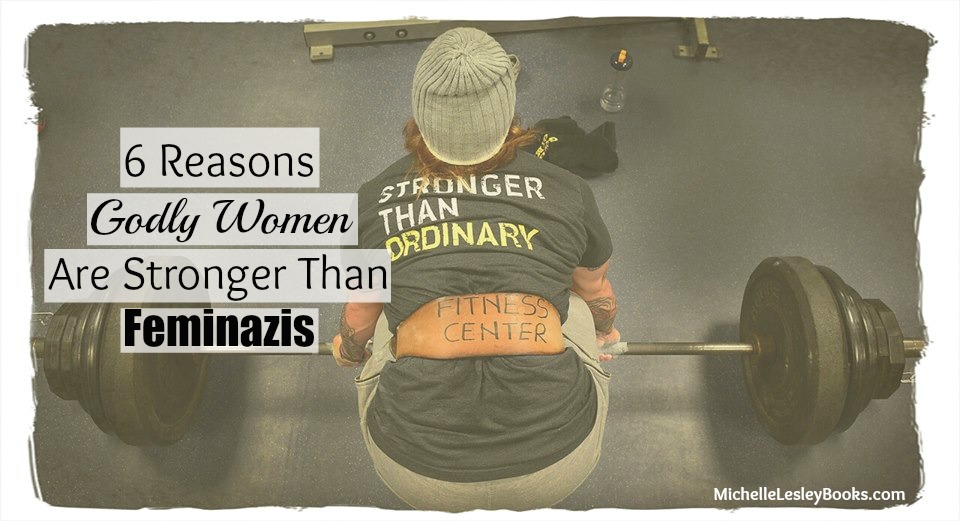
6 Reasons Godly Women are Stronger Than Feminazis

feminazis

Gloria Steinem. Bra burning. The ERA. “I Am Woman Hear Me Roar.” Maybe you remember them, or have at least heard of them. That was the heyday of feminism. It was going to be a new era of strong, powerful women. And they’re still fighting the battle today. Never let a man get the upper hand. Sacrifice whatever you have to for a successful career. And Christian women who submit to their husbands or choose to stay home with their children are sneered at or dismissed as weak, barefoot and pregnant ignoramuses.

But as any woman brave enough to follow in the footsteps of Christ can tell you, it ain’t necessarily so. Secular feminists will never understand the kind of strength it takes to strive towards godly womanhood.

1. Only the strongest of women can voluntarily relinquish the right to be in control.

It’s easy (at least for decisive, type A control-freaks like me) to walk into a room assess a situation, lay down the law, and expect your instructions to be carried out. It’s much harder to step back and hand off the decision-making to your husband, or to offer your input and stand aside and watch when he decides not to follow it. But God expects us to follow in the footsteps of our Savior, who voluntarily surrendered control of His very life to the men who took it from Him.

2. It takes a strong woman to trust God enough to put her life and her children’s lives into her husband’s hands.

Let’s just get real here for a minute. It can be hard to trust God sometimes. Even though we know He is perfect and has our best interests at heart, we can’t see Him or touch Him. We can’t ask Him a question and get an audible yes or no answer.

It can be even harder to trust our husbands. Even though we can see, hear, touch, and talk to them, we know all too well that they’re fallible. Sometimes they have their own interests at heart. Sometimes they mean well and still make the wrong decisions.

But God tells us to trustย Him. Even when it’s hard. Even when we don’t understand what’s going on. Even when we think we could lead better than our husbands. We trust God enough to obey His word even when.

3. It takes tremendous strength to control our mouths.

James tells us “no human being can tame the tongue,” and all who have tried know how true that statement is. Still, God expects godly women to control our speech. We’re not to nag and be quarrelsome. We’re to speak wisely and kindly. Sometimes, we’re not to speak at all,ย but let our actions do the talking. The strength to bite your tongue or think before you speak? It’s a daily trial by fire for Christian women.

4. Godly women have to be incredibly strong to deal with the heartaches that come our way.

John once said, “I have no greater joy than to hear that my children are walking in the truth.” (3 John 4). While he was talking about his spiritual “children,” godly wives and mothers have that same joy when our husbands, children and loved ones are walking in the truth of the gospel. And unspeakable agony when they are not. We not only have to cope with the regular griefs of life that everyone experiences, we also must deal with the pain of those closest to us who rebel against Christ and His word, all the while trusting God and walking in His ways.

5. We must develop the godly strength it takes to stand against the culture.

It’s easy to do the godly thing when everybody’s rooting for you, but in a society that is openly hostile to biblical womanhood, we often (sadly, even in the church) find ourselves fighting our way upstream like so many spawning salmon. Many times, we are seen as – and called – doormats, uneducated, gullible, traitors to the cause of women’s rights. We must rely on the strength God has promised us to stand for godliness in the face of opposition.

6. Only strong, godly women can joyfully deny self and serve rather than being served.

In a “because you’re worth it” world, putting our own desires aside to serve our husbands, children, and others is utterly incomprehensible to many, and, often, even to ourselves. The flesh rears its ugly head again and again, demanding to have its every wish fulfilled by the very people God put us here to serve. It takes a mighty woman of God to do battle with that enemy, send it packing, humble herself, and tend to the needs of others. But we have been bought by the blood of a Savior who declared that He “came not to be served but to serve,” and we conform to Hisย wishes, not our own.


They can push and nag and argue and boss and control. They can be soldiers, construction workers, CEOs, and President. They can wear the pants in their families and have cowed husbands. But the shrillest of feminazis will never know the strength it takes to be a godly woman, because what they’re attempting is miniscule compared to the high standard God calls His daughters to. And any fleshly strength they can conjure up couldn’t in a million eternities touch the supernatural, mighty, rushing force that is the power of the Holy Spirit which God promises to His own, enabling us to say, “I can do all thingsย through him who strengthens me.”

God doesn’t call us to have dominance over men, He calls us to become likeย a man, the God-man, Jesus Christ. And in our feebleness and brokenness, He gives us the power to attempt that feat of greatness for His glory. That, my sisters, is where real strength lies.

Family, Marriage, New Testament, Parenting, Sunday School

All in the Family ~ Sunday School Lesson ~ 12-21-14

10155179_895067380534197_3187729447766830470_n

These are my notes from my ladiesโ€™ Sunday School class this morning. Iโ€™ll be posting the notes from my class here each week. Click here for last week’s lesson.

Through the Bible in 2014 ~ Week 51 ~ Dec.14-20
Acts 27-28, Colossians, Philemon, Ephesians, Philippians,
1 Timothy, Titus, 1 Peter

All in the Family

Background

This week we looked at seven New Testament epistles, all, except 1 Peter, written by Paul. All were written to encourage and/or instruct churches and pastors in doctrine and practices as they lived out the Christian life in the church, at home, and in the world. Four of these seven epistles specifically instruct family members on their roles in the home. Today, we’re going to take a look at God’s instructions to wives, husbands, children, and parents.

We’ll be using Colossians 3:18-21 as our outline, fleshing out each role with passages from the other epistles.

Colossians 3:18-21


Wives- Submit

Interestingly, in each of the four passages we’ll be studying today, the roles in the home are addressed in the same order: wives, husbands, children, parents. It’s of particular interest to me that wives are always addressed first. Although Scripture doesn’t tell us why this is the case, I would speculate that this might be for two reasons. First, it follows the order of the Fall (Genesis 2). Eve fell first, then Adam, and God gave her consequences first, then Adam’s. Second, wives -then and now- normally have the most responsibility for the day to day, “in the trenches” management of the home. We have an enormous impact on the emotional and spiritual tone of our marriages and family life.

Colossians 3:18- Submit for the Lord
We are submit to our husbands because it is “fitting in the Lord.” Not because they deserve it. Not because they’re awesome (and when they’re not we don’t have to submit). Not because we want to be the perfect wife. Because it is “fitting” in God’s eyes. This is the role God has ordained for us, and it honors Him when we obey Him.

Ephesians 5:22-24, 33b- Submit for the church
We are to submit to and respect our husbands as a picture of the church’s submission to Christ. In the same way that Hosea’s marriage to Gomer was a picture to Israel of God’s faithfulness to His adulterous people, our submission to our husbands should be a picture, especially to the church, of how the church is to be faithful and obedient to Christ.

1 Peter 3:1-6- Submit for our husbands
We are to be subject to our husbands to win them to godliness– to salvation if they are lost, to obedience to Christ if they are saved. Notice that this is accomplished by our example and behavior, not by nagging or talking them to death. Our “respectful and pure conduct” and our “gentle and quiet spirits” are attractive and winsome and can smooth the way for our husbands to desire to be more godly men.

Titus 2: 3-5- Submit for the world
We are to submit to our husbands “that the word of God may not be reviled.” Lost people are watching us. Will we live in obedience to God’s word and show them that it proves true? That they can trust the same Christ we trust?

Husbands- Love

Colossians 3:19- Love for your wife
Husbands are to love their wives and treat them kindly. The Greek form of the phrase “do not be harsh” means not to be bitter or resentful. Wives are imperfect, sinful people (just like husbands) and husbands are to be merciful and forgiving when their wives fall short, not hold bitterness or resentment against them.

Ephesians 5:25-33- Love for the world and the church
Husbands are to love their wives as a picture of Christ’s love for His bride, the church. Christ gave both His life and His blood for the church. When husbands daily love their wives in a self-sacrificing way, they are showing the world -and the church- Jesus.

1 Peter 3:7- Love for your own spiritual life
Husbands are to be understanding with their wives and honor them because they are brother and sister in Christ. Just as a rift between two fellow Christians can hamper their worship and church unity, sinning against his wife by failing to love her as Christ commanded will hinder a man’s relationship with the Lord.

Children- Obey

Colossians 3:20- Obey for the Lord’s pleasure
Children are to obey their parents. In everything. They are not to be allowed to back talk or do as they please in defiance of their parents. Why? It’s so simple even a child can understand it: this pleases the Lord. When children obey their parents, they are fulfilling the role God has ordained for them.

Ephesians 6:1-3- Obey because it’s right. Obey for your well-being.
Obedience to parents is right because God says it is. It is His very first “horizontal” (our relationship with others) Commandment in the Decalogue (the first four are “vertical”- our relationship with God). It is also the first Commandment with a promise- that things will go well for those who obey it.

Parents- Train

Colossians 3: 21- Train for their emotional well-being
Whom does Paul address in this statement? Fathers. While mothers have a huge responsibility to train their children in godliness on a daily basis, the buck stops with Dad. God has been holding dads responsible for their families since He called out, “Adam, where are you?” in the Garden. Fathers are not to rule with an iron fist, but encourage and grow their children in the ways of the Lord.

Ephesians 6:4- Train for their spiritual well-being
Paul again addresses fathers. Fathers are to take seriously their responsibility for the spiritual health of their families. They are not to act or treat their children in ways that frustrate them needlessly. Fathers are to train their children in the Scriptures and discipline them biblically.

Titus 2:4- Train out of love
This is the only part of these passages where Paul specifically addresses a mother’s relationship with her children. She is simply to love them. Of course, it is not loving to let a child do as he pleases. We have already seen that God commands children to obey their parents. So a mother is to lovingly train her child in God’s word and in obedience to God and to parents.

In His wisdom and goodness, God has ordained certain roles and responsibilities for each member of the family. We show our love and honor for God when we seek to obey Him by fulfilling our roles as He empowers and enables us to do so.

Marriage

Blog Swap ~ When Fulfilling Your Marital Duty Is a Matter of Self Control

blog swap

It’s time for another awesomeย blog swap! Blog swaps give me the opportunity to share other talented bloggers with you, plus offer you fresh content that’s a great supplement to our regular fare here. If you’d like to do a swap, click on the link above for more information.

I’m excited to be swapping again with Kaylene of Faithful Feat.ย Kaylene has a beautiful way of writing about Christian marriage with gentility and grace, and today’s article, dealing with marital intimacy, is no exception.

feet-224680_640+(2)

Let’s be honest, ladies. Sometimes, we’re just not “in the mood.” But do we ever stop to think that Scripture never mentions being in the mood when it talks about our responsibility to the marriage bed? What if we put our husbands first and lovingly give of ourselves?

The question is not, “Do I feel like fulfilling his sexual need tonight?” But rather, “Am I going to use my body to bless my husband, according to his need and according to my marital duty?

Check out Kaylene’s awesome articleย When Fulfilling Your Marital Duty Is a Matter of Self Control,ย and don’t forget to follow Faithful Feat on social media.

Christian women

Mighty Amazon Women of God

amazon 2

โ€œShe lovesโ€ฆtraining church ladies to be mighty Amazon women of God.โ€

Waitโ€ฆwhat?

Yep, thatโ€™s the last line of my bio here at my blog, at my other blog, on Facebook, on Instagram,ย and, ironically, at Amazon.

And it occurs to me that thatโ€™s sort of an odd phrase. One that people arenโ€™t familiar with. And, maybe, Iโ€™d better explain.

apr14_c01_amazon.jpg__800x600_q85_crop
(ยฉ RMN-Grand Palais / Art Resource, NY)

The Amazons were supposedly a race of very tall warrior women. They first appeared in Greek literature in Homerโ€™s The Illiad in the 8th century B.C. Scholars canโ€™t seem to agree as to whether the Amazons were strictly products of Greek mythology or whether they actually existed somewhere and the mythology was โ€œbased on a true storyโ€. Interestingly, in the 1990โ€™s archaeologists discovered the 2000 year old burial grounds of the Sarmatian tribe near the border of Kazakhstan, and think this tribe might be the origin of the Amazon legend. Unlike the mythological Amazons, a number of the women of this tribe appear to have been married with children, but many of them were buried with their weapons of war. The Sarmatian womenโ€™s average height was 5โ€™6โ€, which was fairly tall for women at that point in history.

Maybe that description evokes images of some sort of โ€œfemi-naziโ€ overlaid with a pseudo-Christian veneer when you hear the phrase โ€œmighty Amazon women of God.โ€

Not at all.

So what on earth does it mean?

I think we 21st century church ladies have, in some ways, a skewed perspective of what it means to be a Christian woman. You see, a lot of people seem to think that being a godly woman means you have to be shy and quiet, never confrontational, a doormat, nothing of substance to say, nicey-nice, always ready with a casserole for the church potluck. A caricature of feminine fluff.

But the longer I live as a woman of God, the farther from the truth that caricature becomes. Being a godly woman requires a kind of strength that a man will never know. Courage of a sort the most valiant warrior does not possess. Endurance and self control that the best trained athletes will never attain. Because we have to be strong and soft. Bold and restrained. Leaders and followers.

Being a godly woman is not for the faint of heart.ย And, yet, itโ€™s the faint of heart God loves to turn into His heroines of the faith.

A mighty Amazon woman of Godโ€ฆ

โ€ฆstudies and rightly handles Godโ€™s word (2 Timothy 2:15)

โ€ฆloves her enemies (Matthew 5:43-45)

โ€ฆrefuses to have her ears tickled (2 Timothy 4:3-4)

โ€ฆis a faithful and active church member (Hebrews 10:24-25)

sculpture-786752-mโ€ฆholds to a biblical view of womenโ€™s roles in the church (1 Timothy 2:12ff)

โ€ฆforgives completely (Ephesians 4:32)

โ€ฆsubmits to her husband (Ephesians 5:22-24)

โ€ฆserves her family (Proverbs 31:10-31)

โ€ฆis more concerned with Godโ€™s opinion than manโ€™s (Acts 5:29)

โ€ฆloves Christ more than her family (Luke 14:26)

โ€ฆtrains her children in godliness (Deuteronomy 6:6-7)

โ€ฆshares the gospel with the lost (Matthew 28:18-20)

โ€ฆhelps her husband (Genesis 2:18)

โ€ฆrefutes false teaching instead of embracing it (2 Timothy 3:1-9)

โ€ฆtrains younger women in godliness (Titus 2:3-5)

โ€ฆcontrols her tongue (James 1:26)

โ€ฆworks heartily as unto the Lord (Colossians 3:23-24)

โ€ฆisnโ€™t led by her emotions (Jeremiah 17:9)

โ€ฆis merciful (Luke 6:36)

โ€ฆrepents when she sins (Matthew 3:8)

โ€ฆis strong (Ephesians 6:10)

โ€ฆis joyful (Philippians 4:4)

None of us are there yet, ladies, but as one of my favorite Bible teachers likes to say, โ€œItโ€™s not perfection; itโ€™s direction.โ€ Is this the direction youโ€™re walking? Is God conforming you more to His image day by day? Are we settling for being little girls in the faith or anxious to grow up and be the mighty Amazon women of God He created us to be?

What kinds of things come to mind when you hear the phrase
“mighty Amazon woman of God”?