Obviously, there are many, many serious issues in the church and world today, and if you’ve followed the blog for any length of time, you know I have a good track record of dealing with those issues on a regular basis in a serious way: Bible study…the gospel…sin…obedience to Scripture…discernment…and so on.
But sometimes, as human beings, we just need a momentary break from the serious to be silly and laugh. Ecclesiastes 3:4 says that just as there is a time to weep, there is an equally valid, and righteous, and good time to laugh. Sometimes I talk to Christians who seem to believe that we’re supposed to have our sense of humor amputated when we get saved, and that’s just not true. Proverbs 17:22 says:
A merry heart doeth good like a medicine: but a broken spirit drieth the bones. Proverbs 17:22
We need to laugh. We need moments of of refreshing.
If you disagree with any of that, or you just don’t like, or are easily offended by humor for whatever reason, this would be a good time to stop reading and go do something you enjoy, or tackle that “to do” list, or whatever. You’ve been warned. No complainies.
In case you’ve somehow managed to avoid them, there are feminists out there who can’t wrap their tiny little closed minds around the fact that godly women actually find joy in loving and serving our husbands and families. They seem to think – out loud, vociferously, and frequently, particularly on social media – that the only reason a woman might do such a thing is because she’s been brainwashed, downtrodden, or forced to.
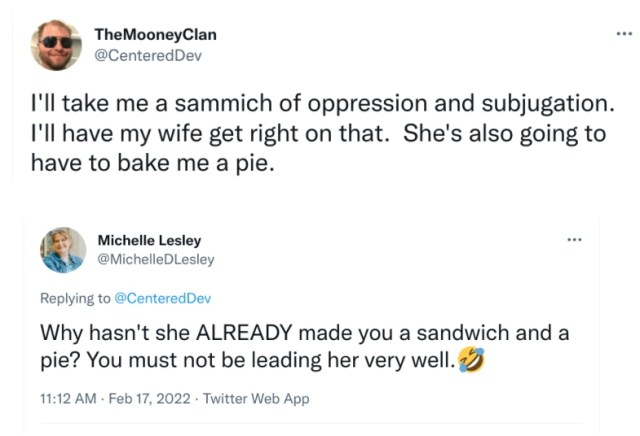
So, I did a thing on Twitter the other day, and I thought it might give you a smile…
Everything – I mean, everything – has to be caveated and explained to death these days (are y’all as sick of that as I am?)…
I kid you not, somebody asked me what my motive was for saying, “I *are* one,” instead of, “I *am* one.” Humor, my friend. Humor.
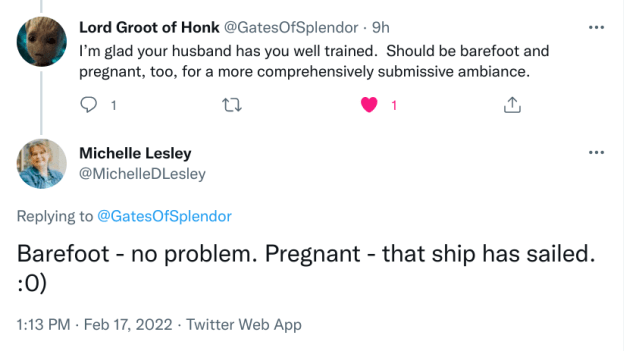
Of course, then everybody had to get in on the act. Back off, people. Can’t you tell I’m a humor professional?
Men. They’re just lost without a helper.
Leslie is usually so on the ball with these sorts of things. It’s not like her to leave out an ingredient.
I started to say, “That heifer is out of the barn,” but I’m sure that’s sexist…to somebody.
These men will never learn…
That’s right, just keep on wallowing in your wrongy-wrongness of manhood.
Yes, three slices. That’s why you’re still aspiring, honey.
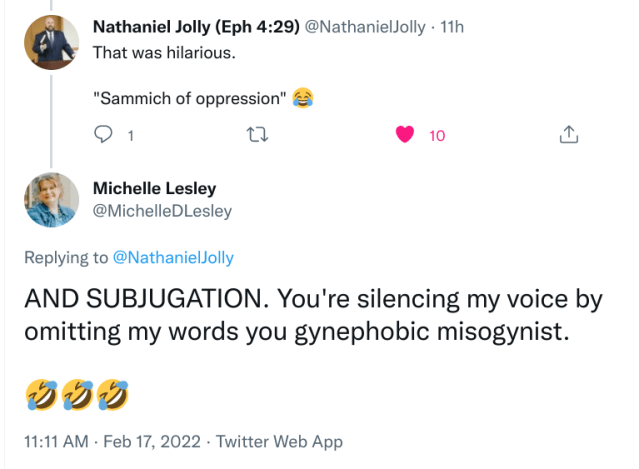
Everybody’s a comedian. But since he’s a MAN, I’ll let him have the last word, as is fitting.
Now get in the kitchen and make your man a sammich of oppression and subjugation, ladies. (My husband said it was OK for me to say that. :0)
This is more of a testimony within a testimony. I suppose part of my journey and part of the sanctification process that will take from salvation to eternity to complete. It is something that has weighed on my heart for years though never seemed the right opportunity to share or discuss it aside over a cup of coffee at my kitchen table.
My name is Jenny. I am a mother of five and have been married fourteen years. We started homeschooling our clan about 7 years ago. Our marriage has been one that has been rocked by adversity and brought to redemption through the glorious grace of Jesus Christ. However, this will not be about why we homeschool, or how God saved my marriage…this is about how I came to see all Scripture is profitable for teaching, for reproof, correcting and training in righteousness.
I was a feminist. Girl Power, women can do everything, and anything, men are idiots and would be dead were it not for women, loud, haughty and always up for a debate. Set on a course like this as a young girl, I looked disdainfully at marriage and children. Why would I want either of those things? I was going to travel the world, be a missionary; a husband and kids would get in the way.
I was a feminist.
I had a worldview written both by man and by God. I loved the Lord; since I was a little girl I had an intense love of Jesus that governed most everything I did, except in areas of my ambition and attitude towards that dirty “S-word” – submission. Submit- HA! I am not a dog! I can do what I want. I can be educated, independent, and preach. And I did. I grew up being taught that women can do anything in the church and I accepted that as truth, with zero hesitation. It affected every part of my biblical femininity. Do not think for a minute that you can walk hand in hand with secular feminism and biblical truth. They collide. That’s what happened to me.
There was a woman who I would see at church softball games. I enjoyed conversing with her dearly. Having come to Christ later in life, she was a testimony of continuing openness of her sanctification through the Word. At this point, I still held a view that, although I had salvation, my behaviors earned blessings or punishments, and that working for the Lord proved my love for Him and could somehow satisfy the debt I owed. She knew what I did for work, she knew I had taught/preached to large groups of men and women in church and college settings; and she never batted an eye when speaking to me. A beautiful example of an older woman teaching a younger woman.
A beautiful example of an older woman teaching a younger woman.
One day she said to me, “I am praying you get fired.” EXCUSE ME!!! We rely on that income! I have a great job. My husband and I both work. We juggle our children between our schedules. I AM MORE THAN A MOM!!!! How dare she! She pointed me to Scripture. I thought, “How archaic. Doesn’t she know it is meant in context of culture and region?”. She gently kept pushing me- that if I am so adamant the Scripture is true, why am I so man-centered in this? I came face to face with the thought, “All scripture is breathed out by God.” But if I accepted this, it would change everything, including my identity. And praise be to God- it has. I have been able to come to see the glorious good workings of God, and the free grace offered through Jesus Christ my Lord. He does not demand anything from me, save my obedience and trust in Him.
My outlook has changed, and it is liberating. Feminism kills Christian women and Christian homes. We miss out on the beauty and strength and glory of God, through our proposed design and structurings, starting with male and female, into marriage, and foremost through the bride of Christ and His church.
This is why we NEED women heeding Titus 2:4-5:
Then they can urge the younger women to love their husbands and children, to be self-controlled and pure, to be busy at home, to be kind, and to be subject to their husbands, so that no one will malign the word of God.
No one told me I was maligning the Word of God. I was being cheered on. I was living the Christian American Dream. However, my identity was not in Christ, it was in myself serving Christ the best I thought how.
This verse is not a popular one. It is not often taught in churches and most squirm when it is read out loud. We read Pinterest and blogs and posts that mock housewives, and women that love, rather than bash, their husbands, and who strive hard in the home. We celebrate the chaos running amok and dismiss stay at home moms with the question, “Well, what did you do before that?”.
I am forever thankful to the older woman, who was not concerned if I thought she was judging me, but loved me enough to point me back to the Word. I am grateful to the grace of God, Who allowed me still yet a teachable heart, Who has forgiven me for sins of my past, and Who allows me yet to model strength and dignity to my own daughters, so that they can learn who they are through Jesus Christ, and that His banner over them is love!
I am grateful to the grace of God.
I have learned that the ultimate example of submission comes from Christ, through his demonstration on the cross. That the Word of God is living and active, sharper than any two-edged sword. I also, would call sisters reading this to remember to be patient with others as Paul teaches, and as Christ is patient with us. Rather than cast down our looks at women fighting for authority and leadership, pray for them. Pray that they would have a Titus woman in their lives willing to speak truth in love, and continue in prayer. Pray that they would submit to Scripture instead of cherry-picking and trivializing it! I am ever grateful to a beautiful soul who cared more about truth than being liked. I am ever encouraged by great examples of the past, from Ruth to Mary to women of today, who share and strive in biblical truth and love.
This is not a popular message, neither in society, nor in the church. But the warning in Titus is clear: “that the Word of God would not be maligned”. And that has become my prayer, that my life would be a pleasing aroma unto the Lord. That I would not be known for works, or remembered by name, but that fragrance left behind the vapor of my life simply, only and always is Christ.
Ladies, God is still at work in the hearts and lives of His people, including yours! Would you like to share a testimony of how God saved you, how He has blessed you, convicted you, taught you something from His Word, brought you out from under false doctrine, placed you in a good church or done something otherwise awesome in your life? Private/direct message me on social media, e-mail me (MichelleLesley1@yahoo.com), or comment below. Your testimony can be as brief as a few sentences or as long as 1500 words. Let’s encourage one another with God’s work in our lives!
What are some of your favorite counter-arguments to egalitarian theology?
Such a great question for a plethora of reasons. One important reason is that it’s a hot topic right now that needs to be dealt with biblically in order to silence the lies and to make onlookers aware that the Bible does address this issue with the correct answer. Another reason is that, when you think through an issue via an apologetics, “point-counterpoint” framework, it really helps solidify in your mind, and give you confidence in, what the Bible has to say about the issue.
So let’s start off with some basics…
If “egalitarian” is a new term for you, let’s nail down what egalitarianism is and what complementarianism is. Both have to do with the issue of women’s roles in the church and in the home.
Egalitarianism is the anti-biblical view that women can do anything men can do in the context of the church and home. Women can be pastors, elders, heads of denominations, preach whenever, wherever, and to whomever they want, and they don’t have to submit to their husbands.
Currently, there is a movement afoot to establish a third position regarding this issue. It’s often called soft complementarianism – an attempt to straddle the fence, make everybody in both camps happy, and have your cake and eat it too. There are a variety of beliefs among those who choose this label. Many would argue, for example, that a woman may not hold the office of pastor (i.e. she can’t be on staff as the pastor of a church), but it’s perfectly OK for her to guest preach the Sunday morning sermon. At least on Mother’s Day.
Let’s dispense with soft complementarianism right now. It is a position of compromise between the biblical and the anti-biblical. Compromising with sin has never been a biblical stance for God’s people to take. Ever. The Bible tells us “a little leaven leavens the whole lump.” You don’t have to consider yourself a full-blown egalitarian to infect the church with ungodliness. Just a little compromise, a little leaven, a little dab’ll do ya. And that little dab never makes the church or individual Christians more godly, more biblical, or more Christlike. It always leads to more compromise and greater ungodliness.
Furthermore, we don’t treat other sin and rebellion this way. No one would dream of saying, “I hold to a soft view of adultery. Only actual extra-marital sex is off the table. Kissing, touching, dating other people – that’s all fine.”
For those who would argue that complementarianism vs. egalitarianism is a secondary theological issue, I would argue vehemently that it should not be categorized this way. Egalitarianism is sin because it is rebellion against God’s Word. And it is extremely detrimental when high profile complementarians unhelpfully classify it as a “secondary issue”. I know all they mean when they say that is that it is not part of the ordo salutis or a linchpin doctrine of soteriology. But when Christians hear “secondary issue” what they think is, “Oh, this is an issue where both sides have genuine biblical support like pre/post/a- millennialism or credo/paedo baptism. We can just agree to disagree and both sides are biblical.” Nobody thinks that about adultery, murder, gossip, lying or any other sin, and we need to be more careful in our terminology lest we give people an opening to think that way about egalitarianism.
Rebelling against God’s commands regarding the role of women is either a sin or it is not. There is no middle ground, so so-called soft complementarianism is not a biblically legitimate position to take. If you’re a “soft complementarian,” you’re a functional egalitarian. And if you’re a Christian who’s toying with this idea, I urge and encourage you to repent, love Christ and His Word more than you love the world and its ideals, and unashamedly embrace and promote what the Bible says about the role of women.
The next foundational issue we need to explore is whom we’re addressing when we make these apologetic arguments.
There are only two kinds of people in the world: saved people and unsaved people. Which means there are only two kinds of people who hold the egalitarian view: saved people and unsaved people.
The Bible is abundantly clear that saved people have the mind of Christ. That means we think the way Jesus thinks and we view the world and the church the way Jesus views the world and the church. We deny ourselves, putting aside whatever we might want or think, and we submit, as Jesus did, to “It is written…“. Additionally, obedience (or lack thereof) to the commands of Scripture is an indicator of whether or not someone actually belongs to Him. In fact, God says if you claim to be a Christian and you habitually and unrepentantly walk in disobedience to, and rebellion of heart against, His commands, you’re a liar, and you don’t know Christ.
What this means in practical terms when dealing with any biblical issue – egalitarianism, evolution, abortion, homosexuality, etc. – is that a sizable portion of the people on the unbiblical side of the issue are unsaved. Because a saved person has the mind of Christ, she will embrace, believe, and obey God’s Word regarding these issues and come out of these unbiblical camps, and an unsaved person will continue to fight for the unbiblical position. A new or previously poorly discipled Christian may need to be taught what Scripture says about these things, and it may take some time for her to come to grips with God’s commands, but her nature is to fight her flesh to submit to God’s Word, not to make provision for her flesh to fight against God’s Word.
Why do we need to understand this crucial foundational concept in debating this issue? Because people who are unsaved regard the things of God as foolishness and they cannot accept them no matter how much you explain Scripture to them or how much sense you make. This is a spiritual issue that requires a spiritual solution – the Holy Spirit must save the person and open her eyes to the truth of His Word. Often, what the person you’re arguing with needs most is the gospel, not an argument about a theological issue. And you will need to be careful and wise to discern when your apologetics are helpful and effective with someone who truly wants to learn and accept the biblical view, and when it’s time to gather up your pearls, step out of the pigpen, and go home until the Holy Spirit does His good work in her heart.
So I guess all of the above would be my primary apologetic argument against egalitarianism: If you’re truly saved, the fruit of your new nature in Christ will be to forsake and repent of any opinions or positions you hold that conflict with Scripture and submit to, love, and obey God’s commands. If you’re not saved, your opinion doesn’t really matter when it comes to how the church is run because the church is the body of Christ – Believers – not the house of unbelief.
Another argument I’m fond of is what I call the “let’s take a stroll through the Bible” argument, because it addresses so many arguments about 1 Timothy 2:12 that it’s almost a “one size fits all” argument:
But the Bible only says one timethat women can’t preach to men!
That was just Paul, as a human, saying women can’t teach men, not God.
That passage is about wives taking authority over their husbands, not about women preaching to or exercising authority over men in the church.
That instruction only applied to the women of the Ephesian church at that particular time.
Look at the overall general pattern of male headship and leadership in Scripture. First human created? A man. The Patriarchs? As the word implies – all men. Priests, Levites, Scribes? Men. Heads of the twelve tribes of Israel? Men. Major and minor prophets? Men. All kings of Israel and Judah? Men. Noahic, Abrahamic, Mosaic, and Davidic Covenants? All established between God and men. Authors of Scripture? Men. The forerunner of Christ? John the Baptist – a man. Messiah? A man. All of the apostles? Men. All of the pastors, elders, and deacons of churches in the New Testament? Men. Founder and head of the church? Christ – a man. Leader and head of the family? Men. Now which fits better with this pattern, women preaching to, teaching, and exercising authority over men in the church, or women not preaching to, teaching, and exercising authority over men in the church?
It’s not just one verse. The entirety of Scripture backs up 1 Timothy 2:12. Which means it wasn’t just Paul’s human idea, just for the women of Ephesus, or just about wives and husbands. Male headship and leadership in God’s foundational institutions – family and church – has been God’s idea, God’s plan since the dawn of Creation (as 1 Timothy 2:13-14 clearly explains). It’s much harder for someone claiming to be a Christian to throw out the whole Bible than to sweep one verse aside.
Another argument that often needs to be made is explaining the difference between descriptive and prescriptive passages of Scripture, because one of the most common arguments egalitarians will make is, “Look at Deborah! Look at Priscilla! Look at the women at Jesus’ tomb! Look at the women Paul commends in Romans 16! They were all in some sort of leadership or teaching position, so that means women can do anything in the church that men can do!” No. No it doesn’t.
Broadly speaking, there are two main types of Scripture: descriptive and prescriptive. Descriptive passages describe something that happened: Noah built an ark. Esther became queen. Paul got shipwrecked. These passages simply tell us what happened to somebody. Prescriptive passages are commands or statements to obey. Don’t lie. Share the gospel. Forgive others.
If we wanted to know how to have a godly marriage, for example, we would look at passages like Ephesians 5:22-33, 1 Corinthians 7, and Exodus 20:14,17. These are all passages that clearly tell us what to do and what not to do in order to have a godly marriage.
What we would not do is look at David’s and Solomon’s lives and conclude that polygamy is God’s design for marriage. We would not read about Hosea and assume that God wants Christian men to marry prostitutes or adulteresses. We would not read the story of the woman at the well and think that being married five times and then shacking up with number six is OK with Jesus.
And when looking for instruction about the role of women in the church, we look to clear, prescriptive passages which tell us what to do and what not to do, not descriptive passages about various women in the Bible. Descriptive passages may support, but never trump, the clear instruction of prescriptive passages.
Some try to make the argument that it’s OK for a woman to preach or teach Scripture to men if she’s doing it “under her husband’s/pastor’s authority”. Excerpted from my article Fencing off the Forbidden Fruit Tree:
When God tells us (in context, rightly handled, correct covenant, etc., of course) not to do something and we do it anyway, that is sin, right? Only God has the authority to say what is sin and what is not. No one – not your pastor, your husband, your parents, your best friend, the Pope, nobody – has the authority to tell you that it’s OK to do something God has said is sin. That authority belongs to God alone.
Try inserting any other sin into that situation. Does your husband, pastor, etc., have the authority to tell you it’s OK to lie? Cuss? Covet? Of course not. And why would they even consider doing such a thing?
If you were to ask your husband and pastor to show you from Scripture where God says it’s OK for them to allow you to teach men, they would quickly realize that they are not basing their decision on Scripture (because there is no Scripture that allows them to do this), but on their own opinion that it’s OK.
When God says “no,” no man has the right to say, “yes.”
And there’s the “You don’t know Greek, so you don’t know what that passage really means. I do.” fallacy.
Some have tried to make the argument that 1 Timothy 2:12 is mistranslated – that “woman” and “man” should be translated as “wife” and “husband” – and that this passage isn’t prohibiting women from teaching men at all, it’s really about marriage. The short answer to that is: hogwash. If you’d like to read the longer version, check out my article The Mailbag: Potpourri (…Mistranslating 1 Tim. 2:12…) (second question).
And finally, if a Christian struggles with the biblical argument against egalitarianism, God has graciously given us a real-time, tangible, visible argument against it. Take a look at all the once doctrinally sound Christian churches and denominations that are now apostate – the ones that embrace homosexuality, New Apostolic Reformation heresy, preach morality or liberal politics instead of the gospel, etc. They all followed the same pattern. The very first step they took on the road to apostasy was “soft complementarianism”: letting women teach co-ed Sunday school classes, preach on Mother’s Day, hold committee positions that placed them in biblically improper authority over men, and so on. The next step was full blown egalitarianism: allowing women to be elders, ordaining women as pastors, placing women in unbiblical denominational leadership positions. Next came embracing homosexuality: extending church membership to unrepentant, practicing homosexuals (and now, transgender people), ordaining them, and allowing them to serve in any and every position of church and denominational leadership, including the pastorate. And the final step is abandoning the gospel and the authority and sufficiency of God’s Word altogether. It happened to the Lutherans, the Episcopalians, the Methodists, the Presbyterians, scores of non-denominational churches, and now it’s happening to Southern Baptists. Not a single church or denomination that has embraced egalitarianism has become holier, truer to God’s Word, or more spiritually healthy. They have all ended up dead eventually, and the true Christians in those churches and denominations have left to form biblical churches and denominations.
Egalitarianism is anti-biblical, harmful to men, women, and the church, and dishonoring to God. We may not be able to convince every egalitarian to repent and embrace what God’s Word says about the role of women, but it’s important to think through this issue in a biblical way, and using an apologetic framework is a great way to do that.
If you have a question about: a Bible passage, an aspect of theology, a current issue in Christianity, or how to biblically handle a family, life, or church situation, comment below (I’ll hold all questions in queue {unpublished} for a future edition of The Mailbag) or send me an e-mail or private message. If your question is chosen for publication, your anonymity will be protected.
Lesson 10 focused on our role as godly daughters. In lesson 11, we’ll be examining God’s design for women who are wives.
Questions to Consider
1. In lessons 2 and 3 (links above) we took a look at some of the attributes of a godly wife that we can emulate. Because Proverbs 31 mainly zeroes in on godly character, most of that passage easily applied to most women regardless of marital status. In today’s lesson, rather than attributes to emulate, we’ll be focusing on God’s instructions to obey for wives. Some of these instructions can also apply to unmarried women. Read over today’s passages and explain how unmarried women might apply some of these Scriptures. Why is it important for unmarried women to study passages about married women and vice versa?
2. Examine the Genesis 2 passage. What are the main points God is making about wives and marriage in this passage? What word does this passage use (18,20) to encapsulate a woman’s role in marriage? What does it mean for a woman to be a helper “fit for” or “corresponding to” her husband? Whom did God create first, man or woman? Second? Whom did God create to be the helper, man or woman? How do these two things point to and undergird male headship in marriage? Does the Genesis passage mean that all women have to marry or that the only purpose for which women were created was to be wives?
3. Look at the Ephesians and Colossians passages together. Explain how the relationship between husband and wife is a picture of the relationship between Christ and His church. Write a character sketch of a godly husband and a character sketch of a godly wife according to these passages. Why does God instruct husbands to “love” their wives, but wives to “respect” their husbands? (33) What is the difference, and why doesn’t God give the same instruction to husbands as to wives? What should motivate a wife to submit to her husband? Pretend you are discipling a newly married, newly saved woman who has never read these passages. How would you explain biblical submission to her? How is it “fitting in the Lord” (3:18) to submit to your husband?
4. Study the 1 Peter passage. In verse 1, what is the spiritual state (lost or saved?) of the wives Peter is addressing? The husbands? Imagine Peter wrote this part of his letter to answer a question he had been asked by some of the women of the church. What was the question they asked? Carefully examine the end of verse 1. Does this mean a wife should never share the gospel with her unsaved husband and that he can be saved simply by watching her good behavior? What does it mean? How is biblical submission an aspect of holiness? (5) Some women believe they only have to submit to their husbands if their husbands are saved or if their husbands are acting in a godly way. How does this passage answer that misconception?
What does “adorning” (3-4) mean? Why and how do women usually adorn themselves? How are godly women to adorn themselves? For whom? Why? Explain external adorning versus internal adorning. Which do you think is more winsome to your husband? Compare 3-4 with 1 Samuel 16:1-13. Which is more important to God, the external or internal? Why?
Explain what it means to have a “gentle and quiet spirit“. (4) Can a woman with an outgoing, vivacious personality still have a gentle and quiet spirit? How? How is your spirit different from your personality? How should a godly spirit inform a godly personality? Explain why a gentle and quiet spirit is beautiful and how that beauty is imperishable. Why is a gentle and quiet spirit precious in God’s sight?
5. Make a list, in your own words, of God’s instructions about a husband’s and wife’s sexual relationship found in the 1 Corinthians 7 passage. God considered these instructions important enough to include in the Bible. Why? How is the marriage bed a protection against sexual temptation and sin? (2) How does this passage teach and emphasize the mutuality of the sexual relationship? Is this mutuality limited to the bedroom, or does it extend to other aspects of marriage? Explain the terms “rights” (3) and “authority” (4) in the context of this passage. In our culture, we most often think of sex in terms of pleasure or recreation. Is pleasure or recreation the main concern of this passage? What adjective would you choose to describe the perspective of this passage toward sex?
Homework
Consider the concepts each of today’s passages addresses: the husband’s headship, the wife’s role as helper, respecting your husband, submitting to your husband, your marriage imaging the relationship between Christ and the church, witnessing to an unsaved husband, external adornment vs. internal adornment, the sexual relationship, etc. Pinpoint one aspect you need growth in. Repent of any sin in this area, and spend the next week praying that God will grow you to more Christlikeness in this area. You may even wish to memorize and meditate on a verse you found particularly helpful.
Suggested Memory Verse
Do not let your adorning be external—the braiding of hair and the putting on of gold jewelry, or the clothing you wear— but let your adorning be the hidden person of the heart with the imperishable beauty of a gentle and quiet spirit, which in God’s sight is very precious. 1 Peter 3:3-4
Toxic masculinity. It’s a buzzword that’s gaining momentum as it’s bandied about in pop culture like a shuttlecock over a badminton net. There’s a clinical definition of the term (which, in the ivory towers of the scholarly world is, properly, “hegemonic masculinity“):
Hegemonic masculinity is defined as a practice that legitimizes men’s dominant position in society and justifies the subordination of women, and other marginalized ways of being a man. Conceptually, hegemonic masculinity proposes to explain how and why men maintain dominant social roles over women, and other gender identities, which are perceived as “feminine” in a given society.
And then there’s the sort of similar working definition of the huddled masses: Anything a man does that others, especially women, don’t like that can, by any stretch of the imagination, be blamed on the fact that he’s a man.
If a man cuts you off in traffic, it’s not that he’s a jerk or didn’t see you, it’s toxic masculinity. If a man holds a door open for a woman, it’s not that he’s polite and helpful, it’s toxic masculinity. If a man leaves his socks on the bathroom floor, it’s not that he’s sloppy and has no home training, it’s toxic masculinity. In other words, he’s not doing these things because he’s a polite or rude or aggressive or helpful human being, it’s because he’s a man who just wants to keep women down and exercise dominance over them.
Pardon my French, but what a bunch of malarkey.
Yes, I’m sure there’s a fringe element of men out there who consciously think they’re better than women, that women shouldn’t have any rights or hold any positions of responsibility, blah, blah, blah. And you know what? They’re considered fringe kooks, and rightly so. But I’m not buying this business of these elitist gnostics telling us that every little move a man makes is a subconscious act of belittling women or exercising domination over them, and neither should you. It’s like the race-baiters who say that every single white person is racist, deep down, and this latent racism manifests itself in everything we do, from the way we tie our shoes to the breakfast cereal we buy at the store. We’re just not aware of it, supposedly.
Poppycock.
You want to know where this notion of toxic masculinity came from? It sprang from the loins of toxic feminism. Zoom out and look at the big picture. This is a manufactured concept, baptized in the (assumed) credibility of academia, designed to help women leverage power and control over men. How? By denigrating them at every turn, thereby convincing the world that men are intrinsically bad and women are good and must be elevated to prominence. Call me crazy if you want to, but it doesn’t take a prophet or the son of a prophet to look down the road and see that the feminist end game here is a matriarchal world where women rule and men drool. And there are plenty of brazen females out there who would openly and unashamedly admit this.
That, however, is not my concern. Sinners gonna sin, and God’s going to deal with them in His own way and in His own good time.
My concern is the way this attitude is fleshing (pun intended) itself out in Christian families and the visible church, and creeping into evangelical women’s (and men’s) hearts. Because, whether or not we’d like to admit it, this worldliness is advancing upon us, and we need to be aware of – and biblically approach – the facets of this issue that are already at our doorstep:
On the Top of the World Looking Down on Creation
I actually laughed out loud when reading some of the academic definitions of so-called toxic masculinity. There seemed to be an air of, “We just don’t understand it! This pattern of male dominance seems to transcend all cultures and time periods!”
Well here’s a really academic response to that: Duh.
I mean, you have to wonder if these researchers and scholars have ever said to themselves, “I wonder if there’s a reason for that. I wonder if this tendency in men that defies time and culture can be traced back to a pinpointed source.”
There is, and it can. It’s called Creation, and God is the one responsible. God created man first and then woman. God created husbands to lead and wives to be helpers. God set up the Old Testament patriarchal society that became the nation of Israel, which was led by male tribal heads and, later, male kings. God established male leadership in the temple, and subsequently, in the church. The major and minor prophets were male, Jesus was male, the apostles were male, the writers of Scripture were male. And all of this traces back to that one moment in Genesis 2 in which God decided to create man first and hard-wire him to lead, protect, and git ‘er done. Broadly¹ speaking, the reason we see a general¹ pattern of male leadership across time and culture is because God set those wheels in motion.
As Christians, we recognize that sinful men sometimes abuse the positions of leadership God has given them, but that doesn’t negate the entire pattern and call for us to turn it on its head. We study our Bibles and embrace and submit to the way God has instructed men and women to behave in the roles He has bestowed upon us.
(Don’t) Do the Woke-Emotion
One of the components of God’s creative work that adds inexplicable beauty to this world is the tender-heartedness, passion, and empathy He built into women in a uniquely feminine way. Emotions. Feelings. God created them, and they are good. What a dreary and heartless world this would be if women didn’t bring nurturing, caring, sympathy, and love to the table. God uses us to soften the hard edges of life and make the planet pleasantly inhabitable.
But along with that good gift comes the challenge to steward it wisely and in obedience to God so that we may use it to glorify Him rather than dishonoring Him.
I see Christian women wisely stewarding their emotions to the glory of God every day as they care for their husbands and families, friends and co-workers, and serve in their churches. It is a beautiful picture of the mature fruit of biblical womanhood.
Unfortunately, I also see the exact opposite. I see (ostensibly) Christian women who scream like banshees any time their pastor preaches on the passages of Scripture dealing with women’s roles in marriage or the church. I’ve seen women who claim to believe and follow the Bible throw an everloving fit when someone points out – from Scripture – that their favorite women’s “Bible” study author is a false teacher. I see women formulating their beliefs and practices about God, worship, the Bible, their own behavior, their families, and their churches based on their own personal opinions, experiences, and feelings rather than on rightly handled Scripture.
And, just like secular feminists demand domination over men because they feel oppressed, have experienced sexism, or resent the world’s history of male dominion, I see Christian women letting their emotions rule the day as they demand unbiblical solutions to their real or perceived personal experiences with men and male leadership.
The anger, the outrage, the hurt feelings, and being offended are nearly as evident in evangelicalism as they are in society at large.
Godly women are not ruled by their feelings. We are ruled by the Bible. We make our feelings submit to and obey God’s Word. We don’t make decisions based on what we like or don’t like, or what makes us feel good about ourselves. We base our decisions on what the Bible says. When our feathers get ruffled, we take a step back and evaluate the situation with rightly handled Scripture. Maybe we’re upset because someone actually sinned against us, but maybe we’re upset because our pride or vanity was wounded, or our unbiblical notions were biblically challenged, or because God used someone to expose an idol we’re worshiping. Maybe it’s not that the other person sinned, but that we’re in sin. Those hurt feelings could be a wake up call from God to humble ourselves and repent.
Ladies, we must learn to put our feelings aside and act on the objective truth of God’s Word instead of our fickle and deceptive emotions. If we display the same sorts of fleshly emotionalism as unsaved women, how are we being salt and light in the world, pointing the way to Christ? We’re supposed to be set apart and different from the world.
Why Can’t a Woman Be More Like a Man?
Because – speaking of salt and light – embracing and submitting to our biblical roles in the family and in the church sets us apart from the world. Now, more than ever, we have a unique opportunity to be counter-cultural – simply by obeying God’s Word.
Women being hired as pastors and teaching and exercising authority over men in the church and leading denominations and becoming popular evangelical conference speakers with co-ed audiences – that’s what the world expects because that’s the way they do things. But a Christian woman who happily puts her foot down and refuses to teach men in the church setting or joyfully insists on submitting to her husband? That’s different. It’s against the grain, not the norm.
Remember that out of the ordinary burning bush that caught Moses’ attention and he turned aside out of curiosity to investigate? And remember how, when Moses was watching it burn, wondering what in the world was going on, that God called to him out of that fiery shrub – “Follow Me.”? God can do the same thing with our obedience to Scripture.
Lost people see this anomaly of our “weird” behavior, and they want to know what in the world is going on. Why do we act differently than they do? And that’s when we get to explain it to them. We get to share the gospel. God can call to them out of our passionate burning for Christ and His Word, “Follow Me.”.
People in darkness gravitate toward light. Salt makes people thirsty. Do we care more about giving them the Light of the World and the Living Water or our own selfish and fleshly desires for power and position? Our embrace of and obedience to the biblical roles God has laid out for us as Christian women is one gateway to sharing the gospel with the lost.
Toxic femininity is worldly and fleshly. It has no place in Christian homes and churches. How do we combat it? We take up the sword. We submit to the authority and sufficiency of Scripture. We recognize that God is the authority in our lives, not self, and that we are to obey Him at any cost – even at the cost of our convenience and pleasure. We trade our desires for His.
¹I’m well aware that there are plenty of exceptions to this generalization. I’m referring to a broad pattern across time and culture, here. There are many biblical ways women can contribute and lead in the family, society, and the church.