1 John Bible Study

Am I Really Saved?: A First John Check Up ~ Lesson 5: Practicing Sin

Am I Really Saved? A First John Check Up
Lesson 5: Practicing Sin
Please Read: 1 John 3:1-10

Previous Lessons: 1, 2, 3, 4

Examine yourselves, to see whether you are in the faith. Test yourselves. Or do you not realize this about yourselves, that Jesus Christ is in you?—unless indeed you fail to meet the test!

2 Corinthians 13:5

1 John 3:1-3

The first three verses of this chapter are such a comfort to those who know Christ. John marvels over the love of God and the fact that He chooses to call us His children.

  • How does it impact your faith in Christ to know that you are loved by God and that you are His child?

John then goes on to assure Christians of our identity in Christ and His certain return.

  • What are three ways (v. 1b, 2, 3) that John identifies us with Christ or says we are, or will be, like Him?
  •  Christians tend to long for the return of Christ. Do you? Why or why not?

1 John 3:4-10

Am I Really Saved? Checkpoint 9: Do I Make a Practice of Sinning or Righteousness?

Everyone who makes a practice of sinning also practices lawlessness; sin is lawlessness. You know that he appeared in order to take away sins, and in him there is no sin. No one who abides in him keeps on sinning; no one who keeps on sinning has either seen him or known him. Little children, let no one deceive you. Whoever practices righteousness is righteous, as he is righteous. Whoever makes a practice of sinning is of the devil, for the devil has been sinning from the beginning. The reason the Son of God appeared was to destroy the works of the devil. No one born of God makes a practice of sinning, for God’s seed abides in him, and he cannot keep on sinning because he has been born of God. 10 By this it is evident who are the children of God, and who are the children of the devil: whoever does not practice righteousness is not of God, nor is the one who does not love his brother.

Here, John again uses polarizing words to draw a sharp contrast between the saved and the unsaved. Sin and righteousness. Children of God and children of the devil.

John also talks about the “practice” of sinning or righteousness. He has already made clear in chapter 1 (and other places) that Christians will fall into sin, but that they will confess their sin and be forgiven of it. Generally, Christians desire to practice righteousness and make an effort to do so.

Here, John focuses on those who make “a practice of sinning,” meaning a habitual lifestyle of unrepentant sin. He equates the habit of sinning with practicing lawlessness. The word “lawlessness” takes us beyond the surface “wrongness” of the particular sin that’s being committed to a deeper contempt for, and rebellion against the Law and the God who gave it.

  • Does John give any indication of how “big” the sins have to be or how often they have to be repeated to fall under the umbrella of a “practice of sinning,” or is his focus more on the attitude of the heart?
  • What do verses 6, 8, and 10 say about people who practice sinning? Are such people Christians?
  • Who is our standard for righteousness? (v.7) What are some attributes and personal habits of Christ that show us what righteousness is? Can you list some verses where Christ explained what it means to be righteous?
  • What do verses 7 and 9 say about people who practice righteousness? Is John talking only about outward, visible righteous behavior or righteousness that springs from a regenerated heart? How might 2 Corinthians 5:17 help our understanding of these verses?
  • Read Paul’s description of his battle against sin in Romans 7:15-25. Does this war between the desires of the flesh and the spirit seem familiar or foreign to you?
  • Verses 5 and 8b explain the reason Christ “appeared.” What was that reason, and what does the reason for His death have to do with whether people practice sinning or righteousness?

This week we’ve looked at one more checkpoint in our “Am I Really Saved?” study:

Do I make a practice of sinning or a practice of righteousness?

People who are saved look forward to the return of Christ in His glory. As they live day by day hoping in His return, God conforms them to the image of Christ so that they habitually walk in the direction of righteousness.

Unsaved people may dread or try not to think about the return of Christ and its implications on their eternities. They habitually sin – whether those sins are small or big in the eyes of the world – without repenting.

How are you doing so far as you examine your heart against the checkpoints in 1 John? If you think you might not be saved, please see lesson 3 or the “Good News” video (at the top of the left side bar) to learn how to repent of your sin and trust Christ for salvation. Need help? Please feel free to click on the “contact” tab at the top of this page and e-mail me.

Additional Resources:

1 John 3– Matthew Henry’s Commentary

True or False? A Study in 1 John– at Naomi’s Table (lessons 11-12)
Church

Six Ways Not to Forsake the Assembly

not forsake assembly

“We’ve been looking for a biblically sound church for seven years.”

“There isn’t a church that preaches sound doctrine within a 90 minute drive of our house.”

“My husband and I have given up on church.”

It was heartbreaking to read these and scores of similar comments responding to my recent article “Nine Reasons Discerning Women Are Leaving Your Church.” On the other hand, it was encouraging to hear from so many women (and even a few brave men!) whose love for Christ and fidelity to His word have moved them out of apostate churches and set them on the hunt for a body of believers which worships Him in spirit and in truth.

Even though most commenters already seemed to know this, I wanted to go back and clarify for everyone that leaving an apostate church is not the end of the story. God is quite clear in His word that we are not to abandon meeting together with other Christians for fellowship, worship, and the preaching and teaching of God’s word:

And let us consider how to stir up one another to love and good works, NOT neglecting to meet together, as is the habit of some, but encouraging one another, and all the more as you see the Day drawing near. Hebrews 10:24-25

Look around. Read the paper. Watch the news. Do “you see the Day [of Christ’s return] drawing near”? I do. God says that makes it even more important for Christians to stick together, meeting regularly to encourage each other and stir one another up to love and good works. We need each other. But how can we meet together, when it’s so hard to find a church that teaches and preaches sound doctrine?

1. Make sure you’re only leaving a church for essential reasons.
There are biblical issues and then there are issues of preference. You may not like the genre of music at your church, but is it theologically sound? Perhaps you’d prefer that your pastor wear a suit instead of jeans, but does he rightly handle God’s word?

If you’re a member of a church that is, generally speaking, doctrinally sound, you should probably stay, even if – or maybe especially if – you see some areas that seem slightly “off,” biblically. It may be that God has placed you in that church to shed some light on the situation and to be a catalyst for bringing things back in line with Scripture. Sometimes when a church member or leader bobbles a little it’s simply because they don’t know that what they’re doing conflicts with Scripture. See if you can come along side the person and help out. Remember, there was a time when you didn’t know any better, either.

2. Leave no stone unturned.
If your church is apostate and you do have to leave, you should immediately begin looking for a doctrinally sound church to join. Staying home from church for a while just makes it that much easier not to go back. Ask trusted Christian friends about their churches, look on line, drive around town, but look. Don’t give up your search until you’ve checked out every single church you can possibly get to.

Keep in mind that you may have to make some sacrifices to find a church that adheres to God’s word. It might not be very close to your house. They might meet earlier or later or be bigger or smaller than you prefer. You may have to choose a church of a different denomination than you grew up in. That’s OK. Keep looking.

3. Think outside the steeple.
It seems impossible, but some people, even in populous areas, leave no stone unturned and still can’t find a church that rightly handles God’s word. (Unfortunately, we are going to see more and more of that “as the Day draws near.”) If you absolutely cannot find a doctrinally sound established church you may need to begin meeting with other Christians outside of the established church: in homes, community centers, after work, etc.

I want to be clear that I advise this only as a last resort after exhausting every possibility of joining a biblical established church. I have known of people who withdrew from established churches because of doctrinal problems, and instead of searching for a sound, established church, decided to form a house church, which then fell into other doctrinal problems of its own. House churches can be very vulnerable to doctrinal error.

If you must meet with other believers outside of an established church, make sure whoever is pastoring the group is biblically qualified to do so, and that your home church carries out all of the components of a biblical church: Bible teaching, worship, prayer, care for members, the Lord’s Supper, baptism, and church discipline. There are many wonderful, trustworthy resources such as sermons, Bible teaching, and Bible study lessons available on line for free. Take advantage of them. You may also wish to contact your denomination’s headquarters, a reputable missions organization (such as NAMB or IMB), or a doctrinally sound church planting organization and ask about the possibility of a missionary or church planter coming to plant a new church in your area.

4. Can’t find other Christians to meet with? Make them.
I say that somewhat jokingly. Of course you should not evangelize for the sole purpose of having other Christians to meet with. You should already be sharing the gospel with others simply because you are a Christian. Every Christian, regardless of her own church situation, is called to take the good news of Christ to those around her. However, whereas you might previously have shared the gospel with someone and then invited her to church with you, now you might invite her to your home church.

5. Move.
Yep, it’s a pretty radical idea, but we still have the freedom in the U.S. to move to any area of the country we want. If you absolutely cannot find a way to meet together with other Christians, you might want to prayerfully consider moving somewhere else. Desperate times call for desperate measures, and obeying Scripture is worth any sacrifice. Yes, it’s that important.

6. Pray.
God’s word says we’re not to forsake meeting together with our brothers and sisters in Christ. God wants you to obey His word. If you want to obey His word and you ask Him to make a way for you to do that, He will answer that prayer. It might not be in the way you’re hoping or expecting, but He will provide a way for you to obey Him.


God wants you to be in fellowship with other believers. I know it can be hard to find a biblical church, but where there’s a will, there’s a way. God’s will. God’s way. It’s my prayer that each of you reading this will find that biblical place of worship, fellowship, and teaching so that each time you get ready for assembly you can say with David:

I was glad when they said to me,
“Let us go to the house of the Lord!”
Psalm 122:1

1 John Bible Study

Am I Really Saved?: A First John Check Up ~ Lesson 4: Truth and Righteousness

Am I Really Saved? A First John Check Up
Lesson 4: Truth and Righteousness
Please Read: 1 John 2:18-29

Previous Lessons: 1, 2, 3

Examine yourselves, to see whether you are in the faith. Test yourselves. Or do you not realize this about yourselves, that Jesus Christ is in you?—unless indeed you fail to meet the test!

2 Corinthians 13:5

1 John 2:18-20

Am I Really Saved? Checkpoint 6: Do I want to be faithful to a doctrinally sound church?

Children, it is the last hour, and as you have heard that antichrist is coming, so now many antichrists have come. Therefore we know that it is the last hour. 19 They went out from us, but they were not of us; for if they had been of us, they would have continued with us. But they went out, that it might become plain that they all are not of us. 20 But you have been anointed by the Holy One, and you all have knowledge.

Let’s start off by looking at a few words in verses 18 and 19: “children,” “antichrist,” “antichristS,” and “they”.

It’s always helpful to keep in mind who the audience of a passage of Scripture is. “Children,” as I mentioned last week, reminds us that John is addressing the church, his “children” in the faith (which, by extension, includes Christians today). Apparently, the church had already been taught that Christ would be coming back and that the antichrist would be making his appearance before the Lord’s return. This antichrist is the one-world leader who will fight against and attempt to overthrow Jesus at the end of time.

But just as John has children in the faith, the antichrist (Satan) also has children, and these are the “many antichristS” to whom John refers. These were people, who at one time had been meeting with the church and seemed to be Christians, but who had left the church and become (or joined with) false teachers (see lesson 1 for more info.). This is who “they” in verse 19 is referring to.

John is making clear to the church that those who leave the fellowship of biblical Christianity to follow false teachers and teachings do so because they were never truly saved (“not of us”) in the first place. This is one way we can tell (“that it might become plain”) who is a believer and who is not. Those who are saved desire to stay in fellowship and assembly with a doctrinally sound body of true believers.

  • Have you left sound biblical doctrine behind to follow after false teachers (for example: Joel Osteen, Joyce Meyer, TD Jakes, Beth Moore, Paula White, Benny Hinn, etc.)? Do you argue with biblically knowledgeable Christian friends who show you from Scripture that you’re following a false teacher?
  • Have you stopped going to (a doctrinally sound) church because…

…you’re not sure you believe in God, the truth of Scripture, or that Jesus is the only way of salvation any more?

…what your professors are teaching, what your friends believe, or the tenets of a group you’ve joined seem to make more sense than the Bible?

…you’re just not interested in church any more and have better things to do?

…you’re tired of feeling guilty for participating in your favorite sin?

  • Do you love fellowshipping, worshiping, and studying God’s word with other believers? Do you faithfully attend (a doctrinally sound) church because your heart craves it? Would you rather hear sound teaching in which God’s word steps on your toes than false teaching that tickles your ears?

1 John 2:21-28

  • Again, John uses two polarizing words (as he did with “light” and “darkness” in chapter 1) several times in this passage to draw a sharp distinction between those who are saved and those who are not. What are the two words John uses? (v. 21, 22, 27)

Am I Really Saved? Checkpoint 7: Do I believe in the Jesus of Scripture?

I write to you, not because you do not know the truth, but because you know it, and because no lie is of the truth. 22 Who is the liar but he who denies that Jesus is the Christ? This is the antichrist, he who denies the Father and the Son. 23 No one who denies the Son has the Father. Whoever confesses the Son has the Father also. 24 Let what you heard from the beginning abide in you. If what you heard from the beginning abides in you, then you too will abide in the Son and in the Father. 25 And this is the promise that he made to us—eternal life.

Here, John continues to explain to the church what constitutes an antichrist and why antichrists are not believers. Notice what he says in verse 21, “no lie is of the truth.” It seems like such an obvious statement, but have you ever said, when told that a teacher you’re following teaches things that are unbiblical, “Oh I just chew up the meat and spit out the bones”? John is saying that if the teacher you were following were biblical, there wouldn’t be any bones to spit out. Doctrinally sound preachers, teachers, and authors might make a mistake and repent of it from time to time, but they don’t persist in teaching lies. No lie is of a true teacher.

Another thing to take note of in this passage, again, is that John is talking to believers. When he uses words like “Jesus,” “Christ,” “Father,” and “Son,” they, and we, understand that he means Jesus, Christ, Father, and Son as defined in Scripture alone. Even as early as John’s day there were false teachers who led people to believe in a Jesus who was a mere man, others who taught he was only God at certain times, and others who completely twisted the biblical definition of who God and Jesus are.

It’s the same today. Mormons are one good example. They say the believe in Jesus, but they aren’t using the biblical definition of who Jesus is. They’re using the Mormon definition of Jesus, the spirit brother of Lucifer, born of a sexual relationship between God and Mary. John is saying that if you deny the Jesus of the Bible, you are not a Christian.

  • Mormons may be a clear cut example of people who deny the biblical Christ, but are you sure you believe in the Jesus of Scripture? Have you ever said anything like:

The God I believe in would never send people to hell.

Jesus was just a good moral teacher.

God is love. He forgives everybody.

Jesus just wants people to be happy. He would be fine with me divorcing my husband/being a homosexual/living with my boyfriend/not attending church/etc.

  • What is “what you heard from the beginning” in v. 24, and what does it mean for “what you heard from the beginning” to “abide” in you? How does this phrase/concept help John pivot from talking about what an unbeliver is to what a believer is?
  • What is the “if/then” statement John makes in verse 24? What does God promise in verse 25 to the “then” people?
  • John uses the word “abide” several times in verses 26-28. Examine his meaning in each use of the word. What does verse 28 say the ultimate result of abiding in Christ will be?

1 John 2:29

Am I Really Saved? Checkpoint 8: Do I practice righteousness?

If you know that he is righteous, you may be sure that everyone who practices righteousness has been born of him.

Last week we were careful not to get the cart before the horse in that it is not good or righteous behavior that turns someone into a Christian. It’s the opposite. Genuine, visible righteousness springs from a heart that has truly been born again.

John also makes sure we know he’s talking about habitually being righteous like Christ was righteous. Remember, the Pharisees acted righteous, and Jesus saw right through them and gave them a piece of His mind.

  • Describe what it means that Jesus is “righteous”. What are some Scriptures that show how Jesus’ righteousness manifested itself during His earthly ministry?
  • Is Christlike righteousness a habit that springs from your heart because you love Jesus? What are some ways you see the righteousness of Christ working itself out in your daily life?
  • Do you ever find yourself having to “put on” outward righteous behavior in front of others to keep up the appearance that you’re a Christian?

This week we’ve looked at three more “Am I Really Saved?” checkpoints:

Do I want to be faithful to a doctrinally sound church?

Do I believe in the Jesus of Scripture?

Do I practice righteousness?

A saved person will be able to honestly answer “yes” to all of these questions. While none of us are perfect at it, we trend towards a desire for righteousness of both heart and behavior. We love the Jesus of Scripture and the churches, pastors, and teachers who dare to teach Him in all of His glorious truth and splendor.

An unsaved person might be able to put on righteous behaviors, but has no righteousness of heart, because she is still dead in her trespasses and sins. She may believe in a “Jesus” who conforms to her own opinions and worldly standards, but not the true Jesus of Scripture. And she certainly has no desire to attend a doctrinally sound church where her self-made label of “Christian” or “good person” will be challenged by a call to repentance and faith in the true Christ of the Bible.

Additional Resources:

1 John 2– Matthew Henry’s Commentary

Are You Really a Christian? by Todd Friel

True or False? A Study in 1 John– at Naomi’s Table (lessons 10-11)

Church

Persecution in the Pew

Beheadings of Christians by ISIS. Crosses forcibly torn off churches by the Chinese government. Pastors imprisoned. Believers tortured for leaving Islam or sharing the gospel.

The treatment our brothers and sisters across the globe receive at the hands of pagans is nearly unfathomable. They are made to suffer – simply for claiming the name of Christ – by those who openly hate God and want nothing more than to stamp out Christianity.

This is how we, as the American church, have come to define persecution. Outsiders, non-Christians, and the government, all on the attack against the Bible, our faith, our practices, and other beliefs we have long held dear. It’s a correct definition, but it’s not a complete definition.

While we already see a “light” form of this type of persecution in the U.S. – mainly over the issue of homosexuality – there’s another kind of Christian persecution that is mushrooming right under our noses, which most church members either seem oblivious to, or are actually participating in. It’s the persecution in the pew.

If you’re a Christian who has ever dared to vocally take a stand on the truth of God’s word against the false teaching so prevalent in today’s pop Christianity, you’ve almost certainly experienced this type of persecution at the hands of people who call themselves “Christians.”

Don’t believe me?

Try posting a Facebook status that says the Bible prohibits women from being pastors or teaching men.

Demonstrate from Scripture to a Beth Moore, Joyce Meyer, or Joel Osteen groupie that she’s following a false teacher.

Talk to a church member who supports Planned Parenthood “because they provide health care”.

Explain why Christians ought not attend same sex weddings.

Discuss the Bible’s account of Creation with someone from your church who has embraced Darwinian evolution.

Certainly, there are new and immature Christians who simply don’t know these things are unbiblical and are still struggling to embrace God’s Word in these areas. And there are those who know what God’s Word says, but rebel against it in these areas, who silently ignore Christians who espouse biblical truth, or can politely discuss why their “Christian” views differ from Scripture. However, the willfully biblically ignorant, “screaming banshee” contingent is growing, both in volume and in number.

Surprised? Me too. I’ve been on the receiving end of verbal abuse (and I do mean abuse – name calling, swearing, mocking, the questioning of my salvation, and any number of other nasty and condescending remarks) from “Christians” defending these and other unbiblical views numerous times and I still can’t get over my shock every time it happens.

Call me crazy, I guess I just expect people who call themselves “Christians” to love, obey, and uphold Scripture, not attack those who actually do.

But this kind of thing really shouldn’t be cause for wonder and amazement. We should expect it. Persecution of God’s people by those who claim to be God’s people has been happening since the Old Testament.

Jeremiah:
Now Pashhur the priest, the son of Immer, who was chief officer in the house of the Lord, heard Jeremiah prophesying these things. Then Pashhur beat Jeremiah the prophet, and put him in the stocks that were in the upper Benjamin Gate of the house of the Lord. Jeremiah 20:1-2

Amos:
Then Amaziah the priest of Bethel sent to Jeroboam king of Israel, saying, “Amos has conspired against you in the midst of the house of Israel. The land is not able to bear all his words… And Amaziah said to Amos, “O seer, go, flee away to the land of Judah, and eat bread there, and prophesy there, but never again prophesy at Bethel, for it is the king’s sanctuary, and it is a temple of the kingdom.” Amos 7:10, 12-13

Isaiah:
For they are a rebellious people, lying children, children unwilling to hear the instruction of the Lord; who say to the seers, “Do not see,” and to the prophets, “Do not prophesy to us what is right; speak to us smooth things, prophesy illusions, leave the way, turn aside from the path, let us hear no more about the Holy One of Israel.” Isaiah 30:9-11

Perhaps Jesus had in mind some of these instances of Israel’s persecution of the prophets when He said in the Sermon on the Mount:

Blessed are those who are persecuted for righteousness’ sake, for theirs is the kingdom of heaven. “Blessed are you when others revile you and persecute you and utter all kinds of evil against you falsely on my account. Rejoice and be glad, for your reward is great in heaven, for so they persecuted the prophets who were before you. Matthew 5:10-12

The balance of the New Testament is rife with examples of Christians, and even Jesus Himself, being persecuted by those who claim to be God’s people:

Stephen was martyred by “the people and the elders and the scribes,” while Paul, “circumcised on the eighth day, of the people of Israel, of the tribe of Benjamin, a Hebrew of Hebrews; as to the law, a Pharisee;” who went on to be a zealous “persecutor of the church” held their coats.

It was the “high priest, the senate of the people of Israel, and the Pharisees” who imprisoned and flogged the apostles and “charged them not to speak in the name of Jesus” in Acts 5:17-42.

Peter and John were arrested by “the priests and the captain of the temple and the Sadducees” and threatened by “Annas the high priest and Caiaphas and John and Alexander, and all who were of the high-priestly family.”

Even Jesus “came to his own, and his own people did not receive him.” He was nearly stoned twice by Jewish leaders. And, even though it was the Romans who actually carried out the crucifixion, it was only because it was illegal, under current Roman law, for the temple authorities to execute their own criminals.

It was one of Jesus’ own followers who betrayed him to the chief priests. It was the “chief priests and the elders” who arrested Jesus. It was “the high priest…scribes and the elders” who presided over the kangaroo court that condemned Jesus to death. And it was “all the chief priests and the elders of the people” who finally handed Jesus over to Rome.

We may think of these people as Jews, scribes, and Pharisees, but they were the “church people” of their day. It was these “church people” – as much, if not, at times, more so than pagans – who were the ones shouting down, threatening, persecuting, and murdering Jesus and Christians who upheld the truth of His Word.

Jesus knew this would happen. In John 16:2-4 He warned the disciples:

They will put you out of the synagogues. Indeed, the hour is coming when whoever kills you will think he is offering service to God. And they will do these things because they have not known the Father, nor me. But I have said these things to you, that when their hour comes you may remember that I told them to you.

And so it goes today. Deceived, self-proclaimed “Christians”, those inside the church who are often just as unsaved as the pagans outside the church, those who prove that they don’t belong to Christ by fighting against His Word instead of loving and obeying it, these “church people” are the ones viciously attacking Christians who dare to stand on and for the truth of Scripture. And they think they’re doing God a favor by acting this way.

Continue to cling to Christ and His Word and you’ll be one of their victims. It’s inevitable. Jesus said, “If they persecuted me, they will also persecute you.” But keep your eyes on Jesus, not on your circumstances, and remember He also said, “Blessed are those who are persecuted…theirs is the kingdom of heaven.” When you’re persecuted, even by “Christians” you can “rejoice and be glad, for your reward is great in heaven!”

Evangelism, Missions

Missions Monday: Buy a Book ~ Be a Missionary

I’m just going to come right out and say it:

I want you to buy my book. I want you and your church and any other Christian organization you’re a member of to buy as many copies of my book as you possibly can.

Why?

Well, it’s certainly not because I want to become rich and famous and have a monopoly on Bible study sales at your local Christian bookstore. I really couldn’t care less about that.

And it’s not because I want to make a lot of money for my publishing house, or feed my ego, or prove myself to people, or score some sort of brownie points with God.

I want to be a missionary. And I want you to come with me.

How can buying my book turn you into a missionary?

Be a missionary to yourself:
If you’ve never turned from your sin and trusted in Christ’s death on the cross to pay the penalty for your sin, you’ll find out all about that in my book (and FYI– you do NOT have to buy the book for that. E-mail me at michellelesley1@yahoo.com, and we’ll chat, or click on the video “Good News!” on the side bar.) YOU are your first mission field.

If you have been born again, buy this book and use it to study God’s word so that He can build you up into an even mightier woman of God than you already are. Let Him turn you into a praying, studying, praising, worshiping, Gospel-sharing machine!

Be a missionary to those closest to you:
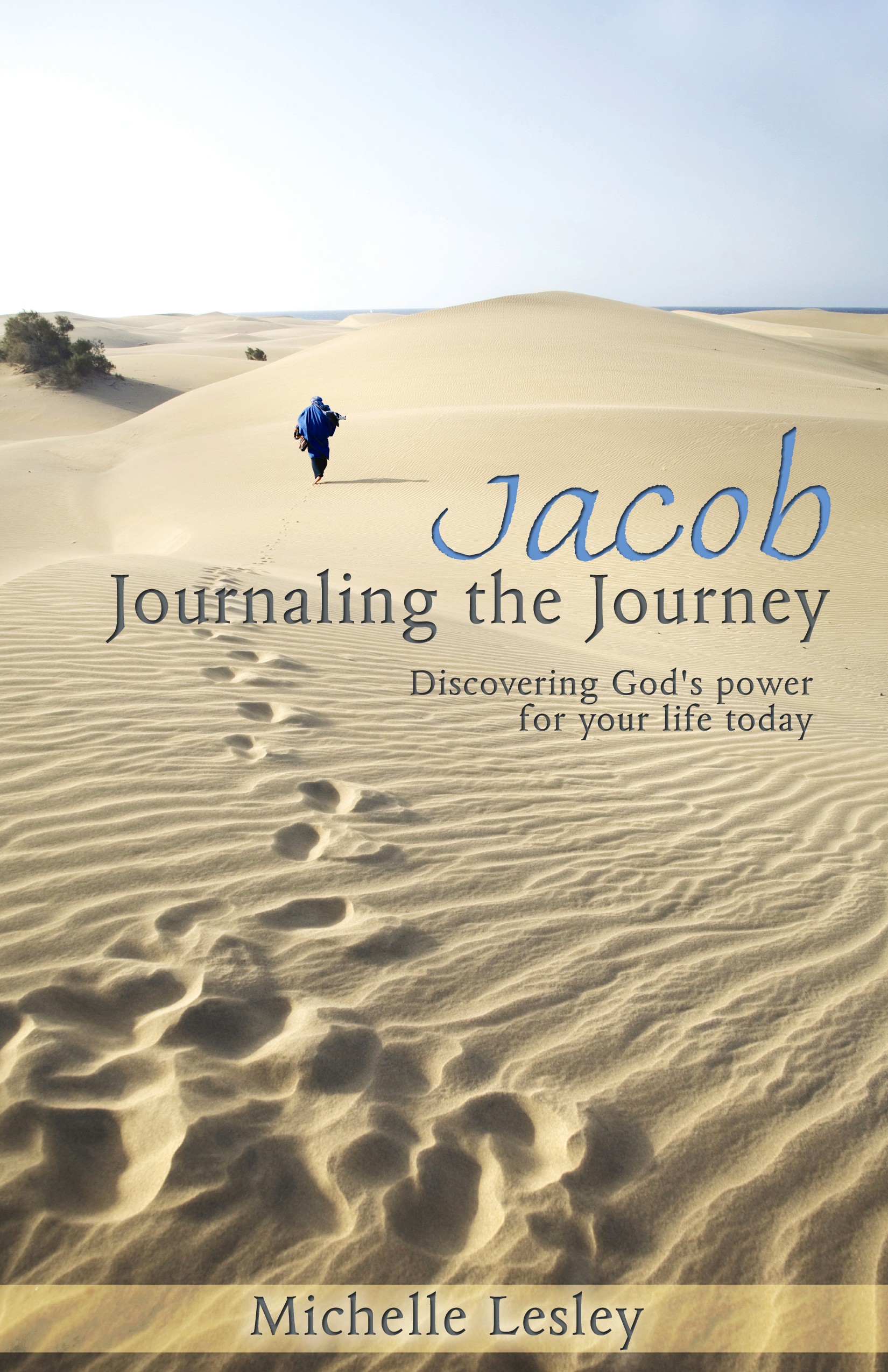
Give Jacob as a gift to someone who needs to know Jesus as Savior–a friend, your child’s teacher, your beautician… Give it to a Christian friend or loved one to help her grow in her faith. Give copies to your local battered women’s shelter. Start a lunchtime ladies’ Bible study at work. Invite the women of your neighborhood to study Jacob in a small group in your home.

Be a missionary to those far away:
All of my profits from the sale of this book–ALL of them- I am personally not making a penny from book sales– are going to the International Mission Board to reach an Unreached People Group in the Middle East with the Gospel of Jesus Christ. These are people who have never heard the name of Jesus or that He is the only way they can be forgiven of their sin and escape an eternity in hell. (Find out more by clicking the UPG tab at the top of this page.)

You can also buy copies to send with missions teams from your church to distribute to the people they’ll be ministering to, or ship them to an overseas church that your church supports.


And all you have to do is buy a book.