Missions

Missions Monday ~ 10 Fun, Practically Effortless, and Free Ways to Do Missions and Evangelism

I’m taking some time off this week.
I hope you’ll enjoy this selected article.

Originally published at
Satisfaction Through Christ

missions

And Jesus came and said to them, “All authority in heaven and on earth has been given to me. Go therefore and make disciples of all nations, baptizing them in the name of the Father and of the Son and of the Holy Spirit, teaching them to observe all that I have commanded you. And behold, I am with you always, to the end of the age.” Matthew 28:18-20

This passage in Matthew is called The Great Commission. It is Christ’s mandate to all Christians to preach the gospel, clearly and verbally, as often as we can, everywhere. Some of the most important ways we can do this are sharing the gospel with our friends and loved ones, praying for our missionaries, and giving missions offerings at church. But while you’re doing these things, did you know that there are a lot of other little ways you can get involved in missions and evangelism? Here are some I’ve tried and loved:

Free Giving– Gospel for Asia has a number of ways you can give to missions for FREE. From air miles to eBay, you can support the spread of the gospel in Asia. My favorite is the grocery store scan card.

Good Newsfeed– Get the good news to all five thousand of your closest friends simultaneously by posting a short gospel presentation video to your Facebook page. The two I like best are here and here.

The Main At-tract-ion– Living Waters has some awesome, attention grabbing tracts that make it easy and fun to start a gospel conversation. I like to use “Celebrity Millions.” As a Christian author, I sometimes have the opportunity to do book signings at secular venues. I lay a bunch of those “Celebrity Millions” out on the table, and it draws people like flies. (Sometimes, people are more interested in the tracts than my book, which is ok with me–they’re getting the gospel!) It’s fun to try to guess who some of the less identifiable celebrities are, and if you can’t get a foot in the door with a verbal gospel presentation, all you have to do is say, “There’s a great message on the back. Be sure to read it!”
great commission

Missions on the Amazon– Are you familiar with Amazon Smile? It allows you to designate a portion of your Amazon.com purchase for donation to the charity of your choice. I like to donate to the “International Mission Board of the Southern Baptist Convention” (copy and paste that into the Smile search bar if you’d like to donate to the IMB).

Left Behind– If you’re new to sharing the gospel with strangers, an easy way to do it is to leave a tract or a New Testament (preferably one with a page that explains the plan of salvation, or tuck a tract inside) behind when you go somewhere. Some good places to leave one: waiting areas of doctors’ offices, hospitals, airports, the DMV, and salons, in restrooms, on a park bench (in a plastic bag in case of rain), or at a restaurant (with a GENEROUS tip). Use wisdom with regard to any rules the business may have about litter or soliciting, especially if your (or another) church’s contact information is printed on the tract or Bible. When I leave a Bible, I like to write a note on the inside (“I’m not lost, I was left as a gift for you. Please take me home and read me.”) so the person who finds it knows she’s free to keep it.

Be a Twit– Tweet gospel centered Bible verses, and, if appropriate and safe, let people know they can contact you (maybe via a designated, anonymous e-mail account?) if they want to know more about the gospel. You can purchase Bibles inexpensively at the dollar store, or ask your pastor about ordering them in bulk.

Throw Me Somethin’, Mister!– Down here in Louisiana, we have tons of parades, and in good Mardi Gras tradition, we throw things to the spectators. Instead of worthless plastic beads and trinkets, how about throwing New Testaments, or little bags of candy with tracts inside? If parades aren’t the thing in your neck of the woods, you can also give tracts and Bibles away from your booth at the fair, festival, or flea market, at your garage sale, at your kids’ lemonade stand, etc. And if your church does fundraisers like bake sales, car washes, or other events that are open to the public, be sure there are church members available to share the gospel and pray with people who are open to it.
acts 1 8

Memorial Bibles– Gideons International has a wonderful program that allows you to donate Bibles in memory of a lost loved one. If you think it would be meaningful to the family of the deceased, consider donating Bibles instead of sending flowers. “…flowers fade, but the word of our God stands forever.” (Isaiah 40:8)

Be a Designated Donor– If you own your own business, have garage sales, sell craft items, etc., commit to setting aside a percentage of each sale for missions. The more specific the focus, the better. For example, adopt a particular unreached people group or give to an organization that focuses on getting the gospel to a certain focus group (such as victims of human trafficking or ESL students). Learn about the people the money will help and briefly tell your customers about them with each transaction. This may also open a door for sharing the gospel with your customers! Here’s how I’ve done it with the royalties from the sale of my book.

Group Project– Looking for a great evangelism activity for your youth group or small group? Join up with The Biggest Project. It’s an operation that aims to get an awesome DVD gospel presentation called “The Biggest Question” into as many hands as possible by handing them out on college campuses, at sporting events, or anywhere else there’s a lot of foot traffic. Like the idea but your group isn’t quite ready? You can sponsor DVDs for groups who want to distribute them but can’t afford the cost to order.

There are probably more different ways and opportunities for sharing the gospel and furthering mission work now than ever before. Get creative, get out there, and let’s get the good news of the gospel to a lost and dying world.

What are some creative ways YOU like to share the gospel with others or contribute to missions work?
Wednesday's Word

Wednesday’s Word ~ 2 Kings 7

2 ki 7 9

2 Kings 7

But Elisha said, “Hear the word of the Lord: thus says the Lord, Tomorrow about this time a seah of fine flour shall be sold for a shekel, and two seahs of barley for a shekel, at the gate of Samaria.” 2 Then the captain on whose hand the king leaned said to the man of God, “If the Lord himself should make windows in heaven, could this thing be?” But he said, “You shall see it with your own eyes, but you shall not eat of it.”

3 Now there were four men who were lepers at the entrance to the gate. And they said to one another, “Why are we sitting here until we die? 4 If we say, ‘Let us enter the city,’ the famine is in the city, and we shall die there. And if we sit here, we die also. So now come, let us go over to the camp of the Syrians. If they spare our lives we shall live, and if they kill us we shall but die.” 5 So they arose at twilight to go to the camp of the Syrians. But when they came to the edge of the camp of the Syrians, behold, there was no one there. 6 For the Lord had made the army of the Syrians hear the sound of chariots and of horses, the sound of a great army, so that they said to one another, “Behold, the king of Israel has hired against us the kings of the Hittites and the kings of Egypt to come against us.” 7 So they fled away in the twilight and abandoned their tents, their horses, and their donkeys, leaving the camp as it was, and fled for their lives. 8 And when these lepers came to the edge of the camp, they went into a tent and ate and drank, and they carried off silver and gold and clothing and went and hid them. Then they came back and entered another tent and carried off things from it and went and hid them.

9 Then they said to one another, “We are not doing right. This day is a day of good news. If we are silent and wait until the morning light, punishment will overtake us. Now therefore come; let us go and tell the king’s household.” 10 So they came and called to the gatekeepers of the city and told them, “We came to the camp of the Syrians, and behold, there was no one to be seen or heard there, nothing but the horses tied and the donkeys tied and the tents as they were.” 11 Then the gatekeepers called out, and it was told within the king’s household. 12 And the king rose in the night and said to his servants, “I will tell you what the Syrians have done to us. They know that we are hungry. Therefore they have gone out of the camp to hide themselves in the open country, thinking, ‘When they come out of the city, we shall take them alive and get into the city.’” 13 And one of his servants said, “Let some men take five of the remaining horses, seeing that those who are left here will fare like the whole multitude of Israel who have already perished. Let us send and see.” 14 So they took two horsemen, and the king sent them after the army of the Syrians, saying, “Go and see.” 15 So they went after them as far as the Jordan, and behold, all the way was littered with garments and equipment that the Syrians had thrown away in their haste. And the messengers returned and told the king.

16 Then the people went out and plundered the camp of the Syrians. So a seah of fine flour was sold for a shekel, and two seahs of barley for a shekel, according to the word of the Lord. 17 Now the king had appointed the captain on whose hand he leaned to have charge of the gate. And the people trampled him in the gate, so that he died, as the man of God had said when the king came down to him. 18 For when the man of God had said to the king, “Two seahs of barley shall be sold for a shekel, and a seah of fine flour for a shekel, about this time tomorrow in the gate of Samaria,” 19 the captain had answered the man of God, “If the Lord himself should make windows in heaven, could such a thing be?” And he had said, “You shall see it with your own eyes, but you shall not eat of it.” 20 And so it happened to him, for the people trampled him in the gate and he died.


The Holy Bible, English Standard Version Copyright © 2001 by Crossway Bibles, a division of Good News Publishers.


Questions to Consider:

1. What events led up to this story? Why was the situation so dire?

2. Why did Elisha tell the king’s captain he would not eat of the food the next day? (v.2) Did the captain’s statement show faith or doubt? What ended up happening to the captain? (v. 18-20)

3. How do the lepers (v.3-4) symbolize people, pre-salvation, who are lost and dying and on their way to hell? Which of their words and actions symbolize a sinner throwing himself on the mercy of Christ? What might their actions in verse 8 prefigure for a new Christian?

4. What were the lepers doing that was not right? (v.9) Is it right for Christians to keep the good news of the gospel to themselves? Do you see any parallels between the lepers’ story and the story of the prodigal son?

5. Elisha’s words from verses 1-2 came true in verses 17-20, and he continually pointed Israel back to the one true God. This tells us that God really was speaking through him and he was a true prophet. Contrast this with the two proofs of a false prophet in Deuteronomy 13:1-3 and 18:20-22. Have you ever heard a modern day “prophet” give a prophecy that did not come true or point people to a “God” or a “Jesus” that doesn’t match up with what Scripture says about Him?

Wednesday's Word

Wednesday’s Word ~ 1 Kings 17

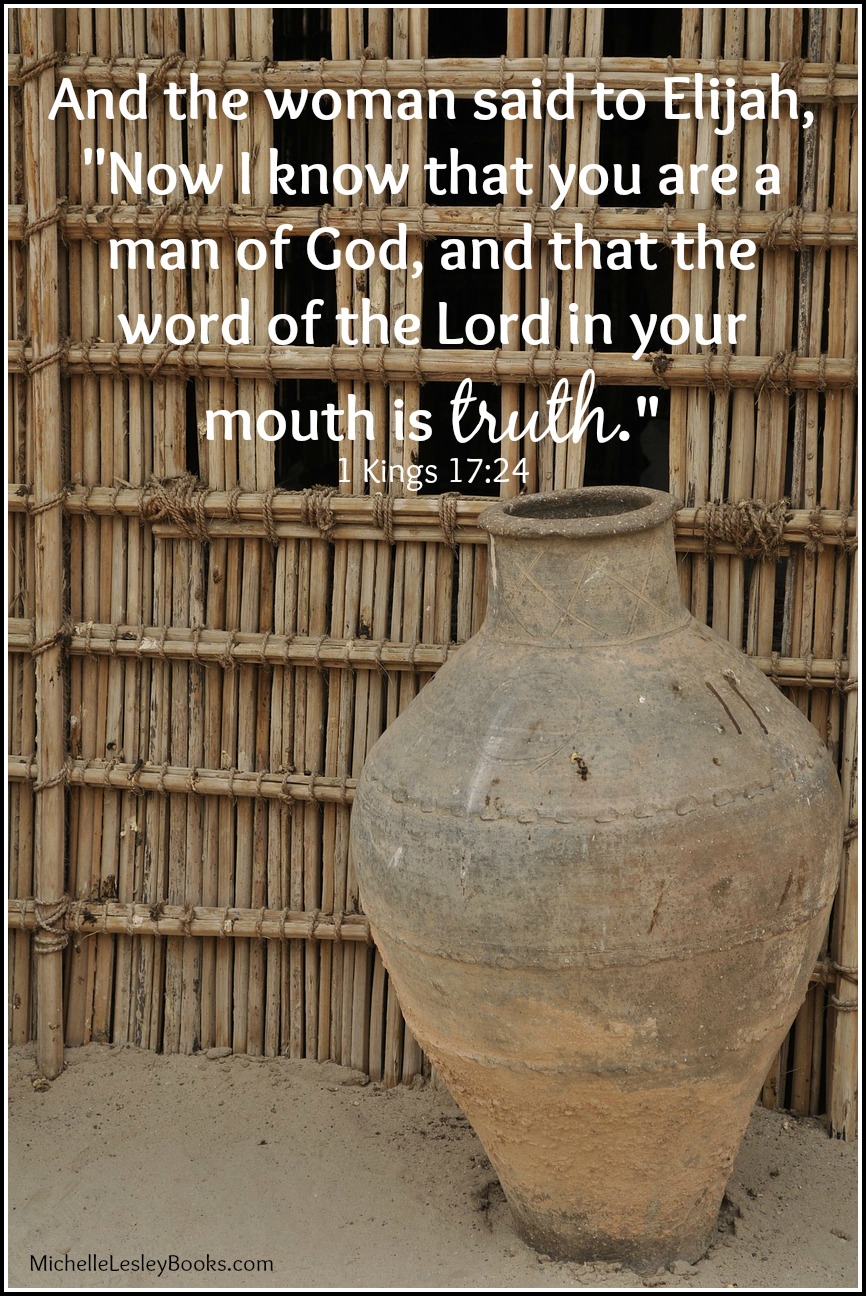
1 kings 17 24


1 Kings 17

Now Elijah the Tishbite, of Tishbe in Gilead, said to Ahab, “As the Lord, the God of Israel, lives, before whom I stand, there shall be neither dew nor rain these years, except by my word.” 2 And the word of the Lord came to him: 3 “Depart from here and turn eastward and hide yourself by the brook Cherith, which is east of the Jordan. 4 You shall drink from the brook, and I have commanded the ravens to feed you there.” 5 So he went and did according to the word of the Lord. He went and lived by the brook Cherith that is east of the Jordan. 6 And the ravens brought him bread and meat in the morning, and bread and meat in the evening, and he drank from the brook. 7 And after a while the brook dried up, because there was no rain in the land.

8 Then the word of the Lord came to him, 9 “Arise, go to Zarephath, which belongs to Sidon, and dwell there. Behold, I have commanded a widow there to feed you.” 10 So he arose and went to Zarephath. And when he came to the gate of the city, behold, a widow was there gathering sticks. And he called to her and said, “Bring me a little water in a vessel, that I may drink.” 11 And as she was going to bring it, he called to her and said, “Bring me a morsel of bread in your hand.” 12 And she said, “As the Lord your God lives, I have nothing baked, only a handful of flour in a jar and a little oil in a jug. And now I am gathering a couple of sticks that I may go in and prepare it for myself and my son, that we may eat it and die.” 13 And Elijah said to her, “Do not fear; go and do as you have said. But first make me a little cake of it and bring it to me, and afterward make something for yourself and your son. 14 For thus says the Lord, the God of Israel, ‘The jar of flour shall not be spent, and the jug of oil shall not be empty, until the day that the Lord sends rain upon the earth.’” 15 And she went and did as Elijah said. And she and he and her household ate for many days. 16 The jar of flour was not spent, neither did the jug of oil become empty, according to the word of the Lord that he spoke by Elijah.

17 After this the son of the woman, the mistress of the house, became ill. And his illness was so severe that there was no breath left in him. 18 And she said to Elijah, “What have you against me, O man of God? You have come to me to bring my sin to remembrance and to cause the death of my son!” 19 And he said to her, “Give me your son.” And he took him from her arms and carried him up into the upper chamber where he lodged, and laid him on his own bed. 20 And he cried to the Lord, “O Lord my God, have you brought calamity even upon the widow with whom I sojourn, by killing her son?” 21 Then he stretched himself upon the child three times and cried to the Lord, “O Lord my God, let this child’s life come into him again.” 22 And the Lord listened to the voice of Elijah. And the life of the child came into him again, and he revived. 23 And Elijah took the child and brought him down from the upper chamber into the house and delivered him to his mother. And Elijah said, “See, your son lives.” 24 And the woman said to Elijah, “Now I know that you are a man of God, and that the word of the Lord in your mouth is truth.”


The Holy Bible, English Standard Version Copyright © 2001 by Crossway Bibles, a division of Good News Publishers.


Questions to Consider:

1. Compare verse 1 with James 5:16-18. What can we learn about prayer from Elijah’s example in these passages?

2. How did God provide for Elijah in verses 2-7? In verses 8-16? In both cases, how did he obtain the food? How did God provide for the widow and her son (15-16)? What does this chapter show us about God as Provider? How might Philippians 4:19 fit with this portrayal of God as Provider?

3. How do the three miracles in this chapter – the control over weather, the creation of food, and the raising of the child – point to the miracles of Jesus? Can you think of similar miracles Jesus performed? Might this explain why some people in Jesus’ time thought he was Elijah resurrected?

4. In verse 24, what purpose did the miracle serve according to the widow? How did Jesus’ miracles serve to confirm His message and His deity?

5. In one sentence, what is the overall theme of this passage?

Sin

9 Things that Are Still Sins Whether We Agree or Not

9 still sins


I do it all the time, Mother, and I’ve decided something-
it’s not a sin.

I heard this line several years ago on a popular sitcom, spoken by an adult daughter to her Christian mother about a behavior the Bible unambiguously calls a sin. I mean, it’s right smack dab in the middle of the Big 10; “thou shalt not” and everything.

It’s one thing to say, “I know it’s a sin, but I don’t care. I’m going to do it anyway,” but how depraved is the world when they think they – in God’s place – are the ones who get to define what sin is? And what’s even worse is that the church has begun to adopt this audacious depravity as well, whether approving of sin by fiat or by simply ignoring God’s word and letting sin slide without rebuke.

When it comes to what’s a sin and what’s not, God made up His mind a long time ago. And He’s not changing it, regardless of what you or I or Joe Politician or Jane Celebrity might think. Maybe we all need a remedial course in hamartiology, so let’s start with the basics. These things are all still sins whether the world and the church agree with God or not:

1. Homosexuality

Let’s just get it out of the way right up front. I don’t care how many celebrity “pastors” and “Christian” authors twist God’s word to say otherwise, or how many people declare themselves to be (unrepentant, practicing) “gay Christians,” or how many homosexuals declare that God made them that way, God’s word is clear: homosexual lust and behavior are sins.

2. Abortion

Abortion is the taking of an innocent human life. We don’t murder people because they’re small or sick or inconvenient or will hinder our sucess. God didn’t say, “You shall not murder, except when…” He said, “You shall not murder.” Period.

3. Extra-Marital (Heterosexual) Sex

Adultery, fornication, whatever form it might take, if you’re not legally married to the person you’re engaging in sexual activity – up to and including actual intercourse – with, you’re sinning.

4. Cohabitation

See #3. And don’t try to whitewash it by saying you’re living together but not sleeping together. A) The Bible says we’re to flee temptation, not move in with it, and B) we’re supposed to avoid every form of evil, even the appearance of it. If you call yourself a Christian and you’re shacking up, you’re living in sin (that’s why they call it “living in sin”). Repent and move out or marry up.

5. Divorce

Yep, still a sin, except in two cases: unfaithfulness or an unsaved spouse leaving a saved spouse. In those two cases the spouse who was wronged is not sinning and is free to marry again.

6. Swearing

The air is saturated with it. Foul language coming from our TVs, music, movies, social media, and the people we’re around all day. But expletives have no place in the vocabulary of a Christian. Is your potty mouth on Saturday the same one you praise God with on Sunday?

7. Taking God’s Name in Vain

It’s gotten to the point where we think so little of casually punctuating our sentences with, “Oh my G-d,”  or using the name of Jesus as an exclamation that pastors are even doing so from the pulpit these days. God’s name is high and holy and should be spoken only reverently and worshipfully. How can we look people in the eye and call them to repentance and faith in a Person whose name we use as a cuss word?

8. Gluttony

We have almost completely amputated gluttony from the spiritual realm by cordoning it off as merely a physical or medical issue. We’ve renamed it “overeating,” but that doesn’t change the fact that it’s a sin. God created good food for us to enjoy, but just as with all the other good gifts He gives us, He expects us to exercise Spirit-enabled self control when we receive it.

9. Female Usurpation

God makes it abundantly clear in His word that women are not to instruct men in the Scriptures or hold authority over them in the church. Women sin when they pastor churches, preach sermons in church, teach men in Sunday School classes, and hold other positions of authority over men in the church. Men, however, bear the primarily responsibility for this when they sin by failing to rebuke usurping women, or when women feel they have no other choice but to take on male responsibilities in the church because men are shirking their own duties before God.


We don’t get to decide what sin is. That’s God’s job. And all of us – whether we’ve committed one of these nine sins or not – are guilty of sinning against Him. That’s the bad news.

But, in Christianity, we never give the bad news without following it up with the good news. And, oh what wonderfully good news it is: forgiveness. Jesus paid for our sin at Calvary so that if we will only turn from it and trust Him, He will forgive us for all nine of these sins and countless others.

If we confess our sins, he is faithful and just to forgive us our sins and to cleanse us from all unrighteousness.
1 John 1:9

Wednesday's Word

Wednesday’s Word ~ 2 Samuel 9

2 sam 9 8

2 Samuel 9

And David said, “Is there still anyone left of the house of Saul, that I may show him kindness for Jonathan’s sake?” 2 Now there was a servant of the house of Saul whose name was Ziba, and they called him to David. And the king said to him, “Are you Ziba?” And he said, “I am your servant.” 3 And the king said, “Is there not still someone of the house of Saul, that I may show the kindness of God to him?” Ziba said to the king, “There is still a son of Jonathan; he is crippled in his feet.” 4 The king said to him, “Where is he?” And Ziba said to the king, “He is in the house of Machir the son of Ammiel, at Lo-debar.” 5 Then King David sent and brought him from the house of Machir the son of Ammiel, at Lo-debar. 6 And Mephibosheth the son of Jonathan, son of Saul, came to David and fell on his face and paid homage. And David said, “Mephibosheth!” And he answered, “Behold, I am your servant.” 7 And David said to him, “Do not fear, for I will show you kindness for the sake of your father Jonathan, and I will restore to you all the land of Saul your father, and you shall eat at my table always.” 8 And he paid homage and said, “What is your servant, that you should show regard for a dead dog such as I?”

9 Then the king called Ziba, Saul’s servant, and said to him, “All that belonged to Saul and to all his house I have given to your master’s grandson. 10 And you and your sons and your servants shall till the land for him and shall bring in the produce, that your master’s grandson may have bread to eat. But Mephibosheth your master’s grandson shall always eat at my table.” Now Ziba had fifteen sons and twenty servants. 11 Then Ziba said to the king, “According to all that my lord the king commands his servant, so will your servant do.” So Mephibosheth ate at David’s table, like one of the king’s sons. 12 And Mephibosheth had a young son, whose name was Mica. And all who lived in Ziba’s house became Mephibosheth’s servants. 13 So Mephibosheth lived in Jerusalem, for he ate always at the king’s table. Now he was lame in both his feet.


The Holy Bible, English Standard Version Copyright © 2001 by Crossway Bibles, a division of Good News Publishers.The Holy Bible, English Standard Version Copyright © 2001 by Crossway Bibles, a division of Good News Publishers.


Questions to Consider:

1. Who were Saul and Jonathan, and why did David want to show kindness to someone from the house of Saul? (v. 1)

2. The story of David and Mephibosheth is a type and shadow of Christ. How does David’s heart in this story remind you of Jesus’ heart? How do his actions remind you of Jesus’ actions during His earthly ministry?

3. If David is playing the part of Jesus, who does Mephibosheth represent in Jesus’ earthly ministry? How do David and Mephibosheth foreshadow or symbolize what Jesus did for sinners?

4. With what sort of attitude and countenance did Mephibosheth respond to David? (v. 6,8) What does this tell us about our heart attitude as we respond to Christ?

5. In verses 9-13, Mephibosheth, due to David’s kindness, ends up financially comfortable with servants to take care of him. Is this a promise to Christians today that we will be wealthy and comfortable in this life? How do you know? How might Philippians 4:19 and John 16:33 work with verses 9-13?