Mailbag

The Mailbag: I Have to Preach Because No Man Will Step Up

Iโ€™ve recently met a woman who is a โ€œpastorโ€ of a church. When asked why she is preaching to men, her response was this:

โ€œMen will not teach. None will stand up. We started as a congregation of women and slowly some husbands came, as well as their sons. But none will take responsibility. So if I do not speak truth and stand up, who will?โ€

This was in another country I recently visited where men do not take authority, nor do they desire it. Women are primary in every area.

This is a difficult situation to be in, and I do sympathize. I’ve been in church and family situations in which men were not being the godly leaders they were supposed to be. It’s very frustrating. Even more so in the case of your friend, because Scripture prohibits women from stepping in and taking over when a man will not lead the church.

But in addition to the fact that the Bible is very clear that your friend is not to preach to men, she’s doing a terrible job as “pastor” on several other counts:

โœข She doesn’t believe God’s Word.

โœข She doesn’t trust God enough to obey His Word.

โœข She doesn’t fear God enough to obey His Word.

โœข She doesn’t believe in the necessity of prayer, or in God’s provision, enough to ask Him to provide a pastor.

โœข She’s not teaching her “congregation” to cry out to the Lord and trust Him to provide. Instead, she’s teaching them to take matters into their own hands when they need something, even if it means disobeying God’s Word. (Kind of like Sarah did.)

โœข She’s teaching her “congregation” that they it’s OK to disobey God if it’s difficult or inconvenient to obey Him.

โœข She’s teaching the women that they don’t have to submit to God’s design for biblical womanhood.

โœข She’s teaching the men to continue to be lazy and shirk their God-given duty to lead. Why should they when a woman is all too willing to step in and do the work for them?

She asks, “If I do not speak truth and stand up, who will?โ€. My answer to that question is, “That’s God’s business to take care of, not yours.” Her business is to obey Him and trust Him to work out everything else. And besides, she’s not “standing up and speaking truth”, she’s standing up and speaking or demonstrating all the untruths I enumerated above.

My counsel to this woman would be to immediately step down as “pastor,” stop preaching to and instructing the men, and publicly repent to God and to everyone in the church for her sins of disobeying God’s Word and setting a bad example for the church. She should inform them that she will no longer be preaching but that she will be praying for God to raise up a pastor, either from among the men of the church or from outside the church.

The men and women can, and should, meet to pray and sing together every Sunday. One of the other women (the former “pastor” needs to sit out of leadership for a while) can certainly teach a women’s Bible study class. But if the men want a Bible teacher or pastor, one of them is going to have to step up and do it. And the women need to be sure they’re holding their ground and refusing to step into that role. What a godly testimony of obedience they will be to the men! Hopefully, it will shame the men over their own disobedience.

God doesn’t give anyone permission to disobey Him just because it’s hard or inconvenient. It was the hardest thing in the world for Jesus to go to the cross, but He did it anyway because He was obedient to His Father. He was willing to die rather than disobey. That is the example she needs to follow.

No temptation has overtaken you that is not common to man. God is faithful, and he will not let you be tempted beyond your ability, but with the temptation he will also provide the way of escape, that you may be able to endure it.
1 Corinthians 10:13

In your struggle against sin you have not yet resisted to the point of shedding your blood.
Hebrews 12:4

In all your ways acknowledge him,
    and he will make straight your paths.
Proverbs 3:6

Commit your way to the Lord; trust in him, and he will act.
Psalm 37:5

When we face tests of our faith, it is not time to take the easy way out and sin, it is God stretching us and giving us an opportunity to trust and obey Him so He can use that situation as a vehicle for growing us to greater maturity and Christlikeness.

This lady, and the rest of the church, has the opportunity here to cry out fervently to God to provide them with a pastor and then trust Him to act on their behalf.

Ask, and it will be given to you; seek, and you will find; knock, and it will be opened to you. For everyone who asks receives, and the one who seeks finds, and to the one who knocks it will be opened. Or which one of you, if his son asks him for bread, will give him a stone? Or if he asks for a fish, will give him a serpent? If you then, who are evil, know how to give good gifts to your children, how much more will your Father who is in heaven give good things to those who ask him!
Matthew 7:7-11

Which would bring more glory to God and be more of a testimony to His greatness: for this lady to have taken matters into her own hands and sinned, or for her and the rest of the women to obey God, for everyone to pray and trust God for a pastor, and then to have the awesome experience of God answering that prayer?

There’s nothing amazing, especially in that culture, about men being lazy and women stepping in and picking up the slack. Why have a Christian church that is supposed to be following the all powerful God of the universe be just one more example of that? Instead, they could have an incredible testimony of God providing a pastor and changing the hearts of the men of the church to take responsibility and lead. What kind of an impact would that have on the surrounding culture? How many doors might that open for that church to share the gospel?


Additional Resources

Rock Your Role: Jill in the Pulpit

Basic Training: Obedience: 8 Ways to Stop Making Excuses and Start Obeying Scripture

Basic Training: 5 Ways to Face Tests and Trials Biblically


If you have a question about: a Bible passage, an aspect of theology, a current issue in Christianity, or how to biblically handle a family, life, or church situation, comment below (Iโ€™ll hold all questions in queue {unpublished} for a future edition of The Mailbag) or send me an e-mail or private message. If your question is chosen for publication, your anonymity will be protected.

Christian women, Church, Discernment, Guest Posts

Guest Post: Building a Biblically Healthy Women’s Ministry (by a pastor, for pastors)

If your theology pretty much matches up with mine (as outlined in the โ€œWelcomeโ€ and โ€œStatement of Faithโ€ tabs) and youโ€™d like to contribute a guest post, drop me an e-mail at MichelleLesley1@yahoo.com,
and letโ€™s chat about it.


Building a Biblically Healthy Women’s Ministry
(by a pastor, for pastors)

by Pastor John Chester

It is no secret that I am not a fan of discernment ministries, and that I think the concept of Biblical discernment is grossly misunderstood by many. But that in no way means that I donโ€™t think telling truth from error and sound theology from errant (or even heretical) theology is unimportant.

And nowhere is it more important than in womenโ€™s ministry. The reason I say that is simple, more than 50% of the people in our churches are either women or they are growing into women. According to The Pew Research Center 55% of those attending Evangelical churches are women.ย 

Yet womenโ€™s ministry is often not thought of much by us pastors, I think because we view โ€œwomenโ€™s ministryโ€ as a thing or program, rather than ministry to women who make up more than half of the congregation we are charged to shepherd. And so we spin it off to someone else or put it on our benign neglect list so that we can concentrate on โ€œmore importantโ€ things. But nothing is more important than the souls of the women of the church. And practically speaking, any error introduced in a womenโ€™s Bible study will work its way through whole families and infect the whole church.

With that in mind, let me offer some tips to guard against error in your churchโ€™s womenโ€™s ministry.

Preach The Bible

The pulpit sets the tone for the church and everything that the church does, or at least it should. The good news is that even the smallest church with the least talented preacher can have a strong pulpit, because the strength of the pulpit depends on what is preached, not the preacher. What the church needs is a healthy dose of Bible. And by a healthy dose, I mean all that should be preached is the Bible.

It is the Scripture that is inspiredย and the Word of God that is living and active,ย and it is the word of God that makes your pulpit strong, not your ability. No one needs your ten tips on having a more productive quiet time or your five steps toward a healthy marriage even if you sprinkle them with a few verses. The people the Lord hasย entrusted to you need to hear from Him, not you. Your job as a preacher is to decrease while the whole counsel of God is declared. By all means, illustrate, explain, introduce, conclude and apply the text, just stick to the text!

Why this is so important for womenโ€™s ministry and guarding the women of your church from error is that it will trickle down in to the church’s Bible studies. If on Sunday (and whenever else you preach) the women of the church get a strong dose of Godโ€™s truth, they are going to be better able to spot error and less susceptible to it. And when they see that you have a high view of Scripture, they will develop a high view of Scripture too. When they see you are a Berean who evaluates everything in light of what Scripture says, they will be more likely too as well.

And as a corollary, when youโ€™re preaching the Bible, use it as an opportunity to teach the church, women included, how to think about and interpret the Bible. Iโ€™m not saying that the pulpit is a place for a discourse on the grammatico-historic hermeneutic, but it is a place to (often) say things like โ€œthis would have meant to the original readersโ€ or โ€œcontext determines meaningโ€ or โ€œWhenever you see a ‘therefore,’ ask yourself, ‘What is the ‘therefore’ there for?’.โ€ These may be throwaway phrases to you, but they teach the congregation, including the women, how to approach Scripture.

Pay Attention

This seems very basic but it needs to be said, you need to know what is going on, what is being taught and what materials are being used. And you need to read any material being used in any class or study. Read, not skim, not look up on the internet, not ask your seminary alumni group on Facebook, but actually read. Need I remind you that you will give an account for how you cared for the souls the Lord entrusts to you? When you stand before God to give an account, โ€œWell, I Googled it,โ€ is not going to be good enough.

You need to pay attention to what is popular in the world of womenโ€™s ministry too. The women in your church buy and read more books than the men. Pay attention to what is out there, and donโ€™t be afraid to address any errors that are gaining traction inย โ€œchurchianityโ€.

Be The Bad Guy

What I mean by that is be willing to be the one to take the heat. Be willing to veto a book, a curriculum, or even a topic that the womenโ€™s Bible study wants to use, and be willing to have the leader lay the blame for the veto on you. I would much rather have someone say to me, โ€œWe wanted to use ________ book. Why did you say to use ________ instead?โ€ than have a bad book used, or quash the joy of the womenโ€™s Bible study leader if she became an object of scorn. And quite frankly (and this actually happened to me) I would rather have the womenโ€™s Bible study leader mad at me, than to have the women be taught something that is wrong.

Invest In Your Leaders

I am genuinely baffled by the lack of investment in womenโ€™s leaders. We pastors will often go out of our way to invest both time and treasure in a young man we think might one day have a significant ministry in our church (or dare we hope and pray) or even go into pastoral ministry themselves.. But we often fail to invest our time and treasure in women who have a significant ministry in our churches right now. Might I suggest that the bare minimum you should do for every Bible study leader (man or woman) is to provide basic instruction in hermeneutics. A great resource is Grasping Godโ€™s Word by Scott Duvall and Daniel Hays, and there is an excellent companion workbook that makes teaching basic hermeneutics a snap.ย I promise you that if you teach the teachers of the women in your church how to approach Scripture, it will rub off.

Invest time and invest treasure too. Provide at your (or the churchโ€™s) expense good reliable resources for deeper study to leaders of your churchโ€™s womenโ€™s Bible study. If the women are going through a book of the Bible (with an approved curriculum as the guide) provide reliable (and accessible) commentaries on that book. If the womenโ€™s Bible study is topical or using a topical book as a guide, provide some other good books for deeper study and reading.ย 

Be Approachable

The women of your church need to feel comfortable sending you an email, shooting you a text or even Facebook messaging you with a question. They should even feel OK picking up the phone and calling you if need be. I get the wisdom in erecting hedges and being careful how you interact with women. But you canโ€™t shepherd effectively if you treat over half of your congregation as walking third rails. Rest assured the women of the church will pick up on your reluctance to interact with them and they will be reluctant to approach you with any questions, doctrinal or otherwise.

If you are married, this is one area where your wife can really help you. Her saying โ€œyou should ask my husbandโ€ will go a long way. And as a corollary one of the worst things that can come out of your mouth when a woman from your church asks you a theological question is โ€œyou should ask my wife.โ€

If you are like me you will have to work at this. The one thing I can say that always gets a laugh from my wife is, โ€œIโ€™m a people person.โ€ Itโ€™s not that I donโ€™t love people, itโ€™s that I tend toward shyness, and Iโ€™m not super outgoing. So I work at being an accessible resource for the women of the church, and you can too. And who knows, you may one day be rewarded with a call where a newer believer asks โ€œIs it true that the Israelites ate the scapegoat?โ€. (That is a real question I got from a real woman in the church and why it is so important that women feel like they can pick up the phone and call you.)

Write

Your pulpit ministry and other teaching at the church is not enough. You need need to be regularly writing. As Al Mohler observed, โ€œLeadership is about communication, and much of that communication is necessarily writtenโ€ฆleaders must learn to write and to set time aside for writing.โ€

But you say you donโ€™t have time. Mohler, one of the busiest men on the planet offers this helpful bit of advice, โ€œYou do what you have to do.โ€ I contribute to a group blog with other pastors and a couple of former seminary professors. We all write with an audience in mind – our own church. Why? For two reasons, it builds a resource library that they can access, and it allows us to address issues that we may not get to address in a systematic fashion from the pulpit. Iโ€™ve covered topics like the various approaches to apologetics, what goes into a worldview, basic pneumatology, basic anthropology, how to bring Scripture to bear on anxiety, the sanctifying power of suffering, and much more. And yes I have written some things that would fall into the broad category of discernment, like why our church isnโ€™t charismatic, the danger of letting a prolife social gospel supplant the biblical gospel and the respect for life that flows from it, why assisted suicide is unbiblical and even why events like Together 2016 (which for the record took place in our proverbial back yard) should be avoided. I write because I want to educate the church, especially the women of the church, who as a rule read more, about these issues.

Be willing to Sacrifice

Whatever cherished activity or ministry is keeping you from being all in on your churchโ€™s ministry to the women of the church, give it up! Let me give you an example. I love our menโ€™s Bible study, so much so that I had the next three topics for the study preplanned. But currently there is no overlap in our church between the women qualified to lead a womenโ€™s Bible study and the women with the desire and time to do so. So the Wednesday night Menโ€™s Bible study I have taught since the church opened has been tabled and replaced with a coed midweek Bible study. Sure, I had planned on going through the topics covered in Men Counseling Men edited by John Street, but instead I am teaching an Old Testament survey course geared to Christians of both genders. Truth be told Iโ€™d rather be with the guys, but that is not the best thing for the church, and as pastors we should lead in counting others (including the women of the church) as more significant than ourselves.

I could go on and on, but Iโ€™ll close with this; it breaks my heart that Michelle asked me to write this guest post. When she asked me to write this post she said that multiple women had contacted her and asked if there was anything about how important it is to help church ladies tell truth from error that they could print out and give to their pastors. For shame! No one should be more concerned with the spiritual well being and growth of the women in the church than their pastors. That in some places and in some cases that is not true is a blight on our brotherhood. This is a profound failure to fulfill the charge of 1 Peter 5:1-4, and there is no excuse for it. As the Apostle said:

So I exhort the elders among you, as a fellow elder and a witness of the sufferings of Christ, as well as a partaker in the glory that is going to be revealed: shepherd the flock of God that is among you, exercising oversight, not under compulsion, but willingly, as God would have you; not for shameful gain, but eagerly; not domineering over those in your charge, but being examples to the flock. And when the chief Shepherd appears, you will receive the unfading crown of glory.


John Chester is the pastorย of Piedmont Bible Church, a Grace Advance church plant in Haymarket, Virginia. Prior to ministry John worked as a lacrosse coach, a pizza maker, a writer, a marketing executive, and just about everything in between. He hails from The City of Champions: Pittsburgh, Pennsylvania, and is blessed to be married to his wife Cassandra. Read John’s blog articles at ParkingSpace23.


Note from Michelle: I first had the pleasure of “meeting” John when I read and responded to this excellent article of his on ParkingSpace23. While he and I have a couple of differences on discernment ministry, I think the world of him as a brother in Christ, pastor, and fellow blogger. I literally teared up when I first read this guest post, because I wish every church could have a pastor like John.


ALTHOUGH I DO MY BEST TO THOROUGHLY VET THE THEOLOGY OF THE BLOGGERS WHO SUBMIT GUEST POSTS, IT IS ALWAYS POSSIBLE FOR THINGS TO SLIP THROUGH THE CRACKS. PLEASE MAKE SURE ANY BLOGGER YOU FOLLOW, INCLUDING ME, RIGHTLY AND FAITHFULLY HANDLES GODโ€™S WORD AND HOLDS TO SOUND BIBLICAL DOCTRINE.
Discernment

Throwback Thursday ~ Disney, Dalai, or Divangelista?

Originally published February 26, 2016.

disney dalai divangelista1Social media and the internet are a gold mine for inspirational quotes, and today’s most popular divangelistasย post a lot of them. But, does inspirational always equal biblical? Shouldn’t you be able to tell the difference between a line from a Disney movie, a platitude from the Dalai Lama, and biblical truth from a Christian leader? In homage to Tim Challies’ Joel Osteen or Fortune Cookie? I give you Disney, Dalai, or Divangelista?. Try to guess who said it, then click on the link below the quote to see if you were right.

1.ย All major religious traditions carry basically the same message, that is love, compassion and forgiveness. The important thing is they should be part of our daily lives.

Disney, Dalai, or Divangelista?

2. Compassion naturally creates a positive atmosphere, and as a result you feel peaceful and content.

Disney, Dalai, or Divangelista?

3. Venture outside your comfort zone. The rewards are worth it.

Disney, Dalai, or Divangelista?

4.ย Patience to wait does not come from suffering long for what we lack but from sitting long in what we have.

Disney, Dalai, or Divangelista?

5. Today is a new day, and every day you can be one step closer to conquering your fears!

Disney, Dalai, or Divangelista?

6.ย You’re braver than you believe, and stronger than you seem, and smarter than you think.

Disney, Dalai, or Divangelista?

7. In our struggle for freedom, truth is the only weapon we possess.

Disney, Dalai, or Divangelista?

8. In every situation, in every interaction, in every day, be a noticer of the good.

Disney, Dalai, or Divangelista?

9. ย All our dreams can come true, if we have the courage to pursue them.

Disney, Dalai, or Divangelista?

10. When we stop fearing failure, we start being artists.

Disney, Dalai, or Divangelista?

11.ย Happiness is not something ready-made. It comes from your own actions.

Disney, Dalai, or Divangelista?

12. Our fate lives within us. You only have to be brave enough to see it.

Disney, Dalai, or Divangelista?

13.ย You must not let anyone define your limits because of where you come from. Your only limit is your soul.

Disney, Dalai, or Divangelista?

14.ย If you want others to be happy, practice compassion. If you want to be happy, practice compassion.

Disney, Dalai, or Divangelista?

15. It is useless to compare yourself to someone else. That person has a completely different path to follow.

Disney, Dalai, or Divangelista?


What was your score?
0-3:
You spend waaaay too much time reading your Bible and listening to sermon podcasts to keep up with the latest fluff from divangelistas or to get out and see a movie. The Dalai Lama? Is that the Thursday special at that Asian restaurant down the street?

4-10:
Cut back on the “inspirational” Pinterest boards and trade out your kids’ DVD ofย Frozen for an Awana CD. Read some books by the old dead guys like Spurgeon or Ryle, and learn how different (and how much better) Christian doctrine is from Buddhism.

11-15:
Would you consider yourself a good person?
(I kid! I kid! You probably just have a photographic memory!)

Women of Genesis Bible Study

The Women of Genesis: Lesson 11- Sarah and Hagar

Previous Lessons: 1, 2, 3, 4, 5, 6, 7, 8,ย 9, 10

๐Ÿ“–๐Ÿ“–๐Ÿ“–๐Ÿ“–๐Ÿ“–

Read Genesis 16:1-6

๐Ÿ“–๐Ÿ“–๐Ÿ“–๐Ÿ“–๐Ÿ“–


Questions to Consider

1. Briefly review lessons 9 and 10 (links above) about Sarah and what brought her to this place in her life in chapter 16. Compare and contrast Sarah’s position in life to Hagar’s position in life.

2. How old was Abraham when God first called him and promised to make him a great nation? How old was he when Ishmael was born? So, approximately how many years had he and Sarah been trying to conceive? (3)

3. What do Sarah’sย wordsย in verse 2, “the Lord has prevented me from bearing children” tell us about her belief in God’s sovereignty and control over her situation? What do herย actions in the remainder of verse 2 and 3 tell us about her belief in God’s sovereignty and control over her situation? Whose sovereignty did she really trust, God’s or her own? If Sarah trusted that God was the One who had closed her womb, why did she not trust that God would open it?

4. Think back to the promises of offspring God made to Abraham, of which Sarah was aware. Note the repeated phrase, “I will…” in all of God’s promises. Did God, at any time, ask Sarah or Abraham for their help in accomplishing these things? Did God know about Sarah’s barrenness? Did He ever suggest a surrogate mother for the offspring He promised? Whose idea was using Hagar as a surrogate? Was this an idea Sarah got from God or from her surrounding culture?

5. Think about Sarah’s relationship with God and her response to His promises. How did Sarah’s actions demonstrate that she did notย believe God’s word,ย trust God’s character to keep His promise, nor accept andย submitย to God’s timetable?

6. Compare Sarah’s plan to give Hagar to Abraham, and the problems that resulted, to Genesis 2:24. Has plural marriage or fathering children through adultery ever been pleasing to God? As a godly husband, how should Abraham have responded to Sarah’s plan? Howย didย he respond? (2,4)

7. Compare and contrast the influence Sarah had over Abraham (2-4) with the influence Eve had over Adam (Genesis 3:6-12). Was either woman, in these two incidents, a good steward of the influence God gave her? Why or why not? Was either man a good steward of the headship of his home God gave him? Why or why not?

8. What were some of the negative consequences of Sarah’s actions for herself, for Abraham, and for Hagar? (4-6) Would these things have happened if Sarah had obediently trusted God to keep His promise instead of taking matters into her own hands?

9. How does the story of God promising a long awaited son to a woman unable to conceive foreshadow the incarnation of Christ? What are some things that might have happened if Mary had taken matters into her own hands instead of trusting and obeying God?


Homework

Sarah’s words told one story about her belief in God’s sovereignty, but her actions told another story. Think about the situations in your life right now. Do youย believe God’s Word,ย trust God’s character to keep His promises in His Word, andย accept andย submitย to God’s timetable? Write down one way your actions could better line up with what you profess to believe, and implement it over the next week.


Suggested Memory Verse

So she called the name of the Lord who spoke to her, โ€œYou are a God of seeing,โ€ for she said, โ€œTruly here I have seen him who looks after me.โ€
Genesis 16:13

Mailbag, Speaking Engagements

The Mailbag: Potpourri (Joni’s testimony, “Messy”, Female seminary profs…)

Welcome to another โ€œpotpourriโ€ edition of The Mailbag, where I give short(er) answers to several questions rather than a long answer to one question. I also like to take the opportunity in these potpourrri editions to let new readers know about my comments/e-mail/messages policy. Iโ€™m not able to respond individually to most e-mails and messages, so here are some helpful hints for getting your questions answered more quickly. Remember, the search bar can be a helpful tool!


Our church has a ministry for the homeless where once a week, lunch is provided and a Bible Study is given usually by a woman, occasionally by a man to a mixture of both men and women. Some might be saved, probably most are not. What are your thoughts in regard to this situation from a Biblical perspective?

Great question! I’ve answered it in #11 of my article Rock Your Role FAQs.


We watched a video of Joni Eareckson Tada speaking at a recent Shepherds Conference. She gave her testimony and shared the meaning of Scripture and what some Greek words were so there was teaching going on as well as testimony. I know she is thought of highly but I was wondering about her speaking and teaching to groups of men.

Joni is not someone I follow closely, though I did read her first book, Joni, when I was a teenager. John MacArthur heads up the Shepherds Conference, which is a conference for men in church leadership, particularly pastors (“shepherds”).

Just to give a little background for anyone not familiar with him, Dr. MacArthur is a staunch complementarian and is a doctrinally sound pastor, teacher, and author I am happy to recommend to my readers. He would never invite a woman to preach at ShepCon nor invite a doctrinally unsound speaker. So I trust Dr. MacArthur’s judgment and reasons for inviting her to speak – that he was not inviting her to preach.

That foundation being laid, there are instances in which it is perfectly biblically appropriate for a woman to speak in front of a co-ed Christian group or a group of Christian men, and giving her testimony – so long as she does not veer off intoย preaching (instructing and/or exhorting men in the Scriptures) – is one of them. I’ve written more about that, giving examples, in these articles:

Rock Your Role FAQs (#7, 14)

The Mailbag: Should women give testimonies and reports, lead prayer and worship in church?

I have not listened to the talk Joni gave at ShepCon. It is possible that I would think her explanations of Scripture crossed the line into teaching, but it is also possible I would not. I just can’t say since I haven’t listened to it. (I would not consider giving the definition of a Greek word or two to be the type of biblical instruction prohibited by 1 Timothy 2:12.)

I would be more inclined to look at Joni’s history and intentions. Did she come to ShepCon with the intent of preaching or instructing men in the Scriptures? Does she have a track record of preaching sermons or giving Bible instruction to men at conferences? If the answer to both is no and she is normally very careful to stay within the parameters of biblical womanhood, I’d be inclined to extend grace on any bobbles she made during her testimony at ShepCon. It’s a very fine line to walk, and I’m sure I would probably make a few mistakes too if I were in that situation.

Update: Thanks to reader DebbieLynne (see comments section) for the heads up that Joni actually gave her testimony at the Strange Fire Conference (2013, also spearheaded by John MacArthur), not at the Shepherds Conference. Strange Fire was co-ed rather than men only. Whether or not women were in attendance at the conference doesnโ€™t really change my answer to the reader, but itโ€™s good to have the facts straight.


Is it OK for women to teach pastors-in-training at seminaries?

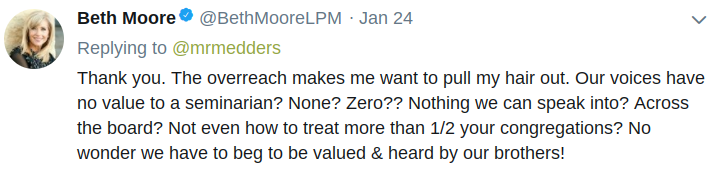
John Piper recently answered this question on an episode of Ask Pastor John. You should read his response for yourself (it’s not long), but, essentially his answer was that experienced pastor-mentors should be training up young pastors, and since it is unbiblical for women to serve as pastors themselves, they lack the experience necessary to mentor pastors-in-training. And, my word, the egalitarian world had a fit – including Beth Moore and her daughter Melissa (who helps run Beth’s ministry):

While I consider him to be a generally doctrinally sound brother in Christ, I’m not particularly a fan of John Piper, but I do want to say that I think his answer was taken wildly out of context by those pushing unbiblical agendas, that he was treated shabbily by many on social media, and that I thought his answer was very good, biblical, and just plain old made sense. Women are not qualified to serve as pastors. Why on earth would we want them training pastors? Moreover, what student wouldn’t want the most qualified and experienced professors he could get for his tuition money?

Let’s say you were the dean of the neurosurgery department at a medical school. A gentleman, totally blind from birth, comes in and applies for a position teaching surgical practicum (cutting, suturing, removing tumors, etc.). He has held positions teaching various subjects at other universities so his ability to impart information is not in question, but he has never performed surgery in his life because he’s blind. Would you hire him to train neurosurgeons to perform brain surgery?

The reason Dr. Piper’s answer caused a bit of a kerfuffle is that he limited his answer to the question he was asked. Imagine that. He was asked if women should train pastors and that’s the question he answered. The agenda-driven screaming neemies took his answer of “no” to mean that no woman should ever teach anything to anyone in any seminary anywhere ever. That is not what Dr. Piper said. He said women should not train men for the pastorate.

I would have answered the same way. However, if I were to expand on Dr. Piper’s answer, what I would further explain is that most seminaries (at least the ones I’m familiar with) do far more than simply train men for the pastorate. Take the seminary my husband attended for example, New Orleans Baptist Theological Seminary. If you’ll click on the “Academics and Admissions” tab at the top of the page and examine the various degree and non-degree programs, you’ll find that most of them are not strictly preaching programs. There are programs for women’s ministry and children’s ministry (Surely we wouldn’t say women are unqualified to teach in these areas?), college ministry, urban ministry, music ministry, missions, counseling, languages, and many more. There’s nothing wrong with women teaching things like music theory, finance, general education classes like math, history, and English, archaeology, legal issues, languages, business, etc., even in a seminary.

There are definitely some classes women shouldn’t be teaching in seminaries, but there are plenty of other classes that would be fine for them to teach.


Since we’ve become parents my husband and I have mostly attended churches that were larger and offered childcare. We were saved out of Mormonism eight years ago which has its own order of services and no childcare provided for the main service, but I don’t know what to expect from a Christian service that doesn’t offer childcare. I don’t know what will be expected of me and my family. I have a four-year-old and I worry that he will end up running around or asleep on the pew. Do we call ahead? Pack a busy bag? Are snacks alright? How do you ever get anything out of the service for yourself?

Before I answer, I want to encourage readers who are experienced church members to really let this precious sister’s question sink in and inform the way you respond to visitors and new members. Increasingly, the people who are new to your church will have very little church background. Church culture may be old hat to you, but it’s like landing on Mars to many of them. They have no idea where to go or what to do, and they don’t speak Christianese. Make sure you warmly welcome and encourage newbies and let them know that it’s OK to ask questions.

I think my article Churchmanship 101: Training Your Child to Behave in Church will help with some practical tips and expectations. You should not allow your child to run around the sanctuary during the worship service any more than you would allow him to run around a restaurant if you went out to eat, or a store if you were shopping, but I would not get overly stressed about him making a few minor noises or dropping the occasional Bible during church. If a church doesn’t offer childcare, they’re surely used to children making a little noise during the service from time to time. Sermon-time naps at four years old are not the end of the world, but you’ll want to curb those as he approaches school-age (if he can stay awake all day in school, he can stay awake for 30 minutes or an hour in church).

Until your child gets into the routine of attending worship and learns how you expect him to behave, you may not get very much out of the service. That’s just one of those parts of being a mom that we all have to accept – like stretch marks :0) But if you will be consistent and diligent as you train your child, he’ll get with the program soon enough.

When you ask if you should “call ahead”, if what you mean is calling the church office prior to Sunday and asking any questions you might have, that is a super idea! Most pastors I know would be delighted to chat on the phone or in person to welcome you to the church and help you feel at ease. That is the point at which I would ask about snacks. Different churches have different policies about food and drink in the sanctuary. I’ve never heard of one that wouldn’t allow a baby bottle, but some may not be keen on the idea of Cheerios ground into their carpet. You could also ask if they have a “cry room”. Some churches have set aside a room near the sanctuary where you can take a fussy baby or jumpy toddler. Many of them have the sermon “piped in” so you can listen until you go back into the worship service. You might also want to ask if the worship service is recorded and posted online so you can listen at home to any parts of the sermon you may have missed. Never be afraid to ask an honest and polite question.


I have been hearing the word messy a lot in reference to our lives..has this word replaced the word sin?

Well…I suppose it may have for those who are trying to sand off the sharp edges of the gospel, but the biblical term is sin, so that’s the correct word to use, despite how popular “messy”, or any other trendy word, might be.


Can you recommend any doctrinally sound female speakers for women’s events?

(I promise this is an actual question I recently received, not one I made up for promotional purposes! :0)

Yes, me. Click the “Speaking Engagements” tab at the top of this page for more information.

If I’m not really your cup of tea, or I’m too far away for your travel budget, I happily recommend any of the women listed under the “Recommended Bible Teachers” tab at the top of this page (although I’m not positive all of them do speaking engagements).


If you have a question about: a Bible passage, an aspect of theology, a current issue in Christianity, or how to biblically handle a family, life, or church situation, comment below (Iโ€™ll hold all questions in queue {unpublished} for a future edition of The Mailbag) or send me an e-mail or private message. If your question is chosen for publication, your anonymity will be protected.