Christian women, Marriage, Sanctification

What Your Godly Wife Wants You to Know About Leading Her – An Open Letter to My Brothers

My Brother in Christ –

I received an e-mail from your dear wife today.

She’s struggling, and she’s not quite sure how to communicate that struggle to you. She has tried to explain it to you in the past, but you either haven’t listened or haven’t done anything about it. And now she feels that if she brings it up again she’ll just make things worse. Or you’ve told her to stop nagging you. Or stop preaching at you.

She’s not nagging you or preaching at you. That’s not her heart. She’s trying to tell you she needs something from you that only you can provide, and that God says you should be providing. And while she’s praying fervently that God would move upon your heart, there should also be the understanding between husband and wife that if one of you needs something all you have to do is ask your spouse, and your spouse will do everything possible to provide it.

But you’re not doing that. And that’s why, in desperation, your wife wrote to me asking me what to do. And that’s why I’m writing to you to plead with you on her behalf…

Your wife needs you to grow up, spiritually, and lead your family biblically.

She has told me about the multiple, blatant examples of false doctrine in your church and how she wants the family to leave and find a doctrinally sound church. But you refuse because you like it there or you think objecting to false doctrine creates disunity in the church.

…or…

She has told me you refuse to stand up for what is right and godly at church, at work, with your friends, or with family members because it’s easier and you’re afraid of rocking the boat.

…or…

She has told me you won’t lead her and the children in prayer and the study of God’s Word because you don’t see it as important, or you don’t know how, or you’d rather watch TV.

…or…

She has told me how you frequently blow off attending church to play golf, fish, hunt, or pursue other hobbies.

…or…

She has told me that you use worldly standards for making decisions for the family rather than praying, searching the Scriptures, and using biblical wisdom.

…or…

She has told me that you put up a good Christian front at church, but at home, you’re foul-mouthed or lazy or greedy or lustful or dishonest or refuse to discipline the children.

Or…or…or…

I’ve heard so many of these types of scenarios of husbands neglecting or refusing to lead you’d think there was an epidemic of spiritual immaturity among Christian men. Perhaps there is.

Maybe it’s the result of the decades-long cultural attack on masculinity by virulent feminism. Maybe it’s a consequence of feel good, seeker-driven silliness, fun fun fun “church”. Finding the root cause could be an interesting academic exercise, but you don’t begin the arson investigation while your house is still burning. You put out the fire before it spreads. And you don’t ignore or get angry with the person pointing out the flames.

Brother, your wife isn’t upset with you for trying, failing, and having to try again. She’s upset with you for not trying.

And that’s what’s at issue here. Let me be crystal clear about something: your wife isn’t upset with you for trying, failing, and having to try again. She’s upset with you for not trying. It’s not that you’re using the wrong color hose or that it takes you a minute to remember where the fire extinguisher is, it’s that you’re sitting in a lawn chair in the front yard denying that the house is on fire.

Your wife doesn’t expect you to lead your family perfectly. She wants you to *want to* and *try to*.

Your wife doesn’t expect you to lead your family perfectly. She wants you to want to and try to. And, though you might be afraid to try because you think you’ll mess up and your wife will see you as a failure, you need to know that a wife who is godly enough to want her husband to be the spiritual leader of her home sees your attempts and desires to lead as success – even if the results aren’t perfect. You’re judging yourself on the outcome. She’s valuing your heart and your trajectory in the process.

Brother, you’re judging your leadership on the *outcome*. Your wife is valuing your heart and your trajectory in the *process*.

Because when you try, it says something to her. It says, “I love God enough to obey Him, even when it’s hard or I don’t feel like it.” and “I love my wife enough to take the burden of leadership off of her and bear it myself.”

And when you don’t try, that communicates something too: “I care more about myself and what I want to do than caring for my wife’s needs and being obedient to what God has called me to do.”

When a husband abdicates biblical leadership, it nearly always backs his wife into a corner, pitting obedience to God against submission to, and peace with, her sinning husband.

I think a lot of husbands don’t realize what an extremely difficult position they put their godly wives in when they abdicate biblical leadership. It nearly always backs her into a corner of pitting obedience to God against submission to, and peace with, her sinning husband.

❥ My husband refuses to leave this apostate church, but my children and I are being fed poison every week. Do I stay at this church with him or leave against his wishes?

❥ My husband won’t lead us in the study of God’s Word. Our children need to be taught the Scriptures. Do I step in even though it’s his responsibility and my taking over might further enable his sin?

❥ My husband makes decisions for our family based on pragmatism, even if those decisions conflict with Scripture. Should I take over family decision-making using biblical principles?

When you refuse to lead biblically, you’re sinning twice. First, by disobeying to God. Second, by becoming a stumbling block to your wife. No wife of a Christian husband should ever have to decide whether to obey God or her husband.

Brother, when you refuse to lead biblically, you’re sinning twice. First, by disobedience to God. Second, by becoming a stumbling block to your wife. No wife of a Christian husband should ever be put in the position of having to decide, “We must obey God rather than men.” It creates a tremendous amount of stress, anxiety, instability, and uncertainty for her when you create a void of leadership by your disobedience.

I can’t build you into a spiritually mature, godly husband. Neither can your wife. And it’s not my job to instruct you in the Scriptures, either. But if, by seeing things from your wife’s perspective, the Holy Spirit is now convicting you that you haven’t been leading your family in a godly way, may I just throw out a few points you might decide to consider as you pray and study God’s Word in this area?

❥ Listen to your wife. Really listen. Ask her what she needs from you, generally, as the spiritual leader of your home, as well as in specific situations as they arise. Ask if she knows of any particular Scriptures that would be helpful to you as you study and pray over various circumstances. Ask for her input in solving problems and making decisions.

❥ Commit to praying and studying God’s Word as part of your daily schedule. Ask God to grow you in maturity and leadership. He is the only One who can change and strengthen your heart.

❥ If you think you might be spiritually immature, put everything frivolous aside, and make growing up your top priority. Pour yourself into the study of the Word, prayer, and serving and nurturing your wife and children. 

❥ Make sure you’re in a doctrinally sound church (there are lots of tools to help you at the “Searching for a new church?” tab at the top of this page) and get plugged in. Lead your family in faithful attendance at worship and Sunday School. Take every opportunity to sit under solid preaching and teaching. Set a godly example by finding a place of service and committing to it wholeheartedly. 

❥ Surround yourself with godly men in your church who will sharpen you, teach you, and disciple you.

❥ Consider setting up an appointment with your pastor for godly counsel, pointers, and good resources on growing in spiritual maturity and leading your family.

❥ Consume biblical media during the week. Ask those godly men at your church for suggestions of theologically meaty books and blogs to read and sermons and podcasts to listen to. (Until you get a chance to ask them, here are some suggestions {check the list of men}.)

I hope pulling back the curtain on the female perspective can serve as a helpful tool in your toolbox that you can use as you pursue Christ and seek to grow in spiritual maturity and biblical leadership. Brother, with God’s help and the empowering grace of the Holy Spirit, you can do this – so be encouraged, and don’t be afraid to try!

I’m rooting for you, and I know your wife is, too.

Women of Genesis Bible Study

The Women of Genesis: Lesson 34

Previous Lessons: 1, 2, 3, 4, 5, 6, 7, 8, 9, 10, 11, 12, 13, 14, 15, 16, 17, 18, 19, 20, 21, 22, 23, 24, 25, 26, 27, 28, 29, 30, 31, 32, 33

📖📖📖📖📖

Read Genesis 46:1-47:26

📖📖📖📖📖


Questions to Consider

1. Briefly review previous lessons (links above) to refresh your memory on the background of today’s passage. What events led up to the action in chapters 46-47?

2. Review previous lessons regarding the role the Abrahamic Covenant has played in the lives of Abraham, Isaac, and Jacob, especially with regard to physically living in Canaan and “possessing the land”. Trace Israel’s journey from Hebron to Egypt on a Bible map. Why would he have stopped and sought the Lord at Beersheba, specifically, and why would God have assured him it was OK to leave Beersheba and enter Egypt? (46:1-4)

3. Compare 46:3 to Genesis 12:2. How is this a promise to Israel of fulfillment of the Abrahamic Covenant? How can this passage be a reminder to us that God does not forget His promises and that He has a right to carry out those promises in any way and any timing He chooses, even if it doesn’t make sense to us? What does this teach us about God’s sovereignty, His authority, and His infinite wisdom, compared to our humility and limited knowledge?

4. Why would it have been important to the nation of Israel’s history and record-keeping to list the names, numbers, and relationships (46:8-27) of the people who left Canaan to settle in Egypt?

5. Consider 47:5-6 and recall 45:16-20. Why was Pharaoh, a pagan, so favorably disposed toward Joseph, and consequently, Joseph’s family? What character traits had Joseph displayed while serving Pharaoh that had such an impact on him? Think about the way you serve your employer, your family, and your church. How does the Fruit of the Spirit you display impact your relationships with those you serve?

6. Compare 47:11-2 with these passages. How does Joseph’s provision for his family who has come to him paint a picture of God taking care of the needs of those who come to Him?

7. Consider 47:13-26 with regard to Egypt’s rise to power in the ancient world. What did Pharaoh take from the people first? (47:14-15) Next? (47:16-17) Next? (47:18-21) How did this shift the balance of power between the people and the Egyptian government? Was it God’s will for Egypt to become a powerful and prominent nation? Who sent the famine that set these wheels in motion and who could have stopped it? Thinking ahead to the Exodus, what was the significance of having an “almighty” Pharaoh and empire as the backdrop for Almighty God’s signs, wonders and deliverance?

8. Think about 47:23,35 in light of these passages. How does Joseph purchasing the people to save their lives point to Christ’s redemption of sinful man? Was there any way for the people to save themselves? How did Joseph show mercy and compassion to them? What was the people’s response to becoming servants? Were they resentful? Grateful? What does this teach us about why we should serve Christ, and the attitude with which we should serve Christ?


Homework

Again compare 46:3 to Genesis 12:2, and consider 46:1-4, this time putting yourself in Israel’s shoes. God has promised Canaan to Abraham’s descendants. Israel already lives there with a decent number of descendants. (46:8-27) From Israel’s human vantage point, does it make sense for him to pack everybody up and leave the Promised Land (46:5-7) rather than staying, increasing in number, and taking over Canaan? But can Israel see the big picture, centuries into the future, the way God does?

Think about a time God worked in your life in a way that, humanly speaking, didn’t make sense. Compare your finite knowledge of the situation with God’s infinite knowledge of it and His “big picture” plans. Considering this, write down three reasons it is important to trust God and three reasons it is important to obey God, especially when things don’t make sense.


Suggested Memory Verse

And they said, “You have saved our lives; may it please my lord, we will be servants to Pharaoh.”
Genesis 47:25

Share Your Testimony

Testimony Tuesday: Charla’s Story

Charla’s Story

As far back as I can remember, Christianity has always been a part of my life. I grew up in a small, traditional, Southern Baptist church, was active in youth group, and even attended a small Baptist college. Around the age of 7, I “accepted” Jesus as my Savior and was baptized. Looking back, I don’t remember much about this experience. I certainly didn’t understand the gravity of sin except that I knew I did not want to go to hell. Counting the cost and true repentance were not part of my childhood “decision,” but I also grew up in a tradition where people believed and taught that repeating “the sinner’s prayer” would most assuredly save someone, especially if one prayed sincerely.

Despite the fact that my life may have looked religious, my soul was far from God and I didn’t even know it. Nonetheless, I seldom doubted my salvation because I knew I had prayed to receive Jesus and I sincerely believed that that was the way to salvation. If I did experience doubts, I would just pray again. A “deceived deceiver,” that’s who I was: pretending to be something I wasn’t, living a double life, and under the delusion that all was well with my soul. I could play the part of the model Christian or delight in the evils of the world – it just depended on where I was and who I was with.

My habitual, heinous sins only really bothered me if they got me in trouble. Granted, I sometimes felt guilty about my behavior, but I would ignore the authority of my conscience and the written commands of God and would purposefully pursue sin ever while tightly clutching to my “sinner’s prayer” as my get-out-of-hell-free card. Sure, I prayed when I needed something and sometimes would even ask God to forgive me and help me to live better. But my sorrow over sin was worldly and not godly; I was distraught that my behavior didn’t line up with the Christian image I was trying to maintain, not that my grievous sins were a direct assault on God.

When I was 27 years old, I met my husband, Jeremy. Even though we both expressed a desire for a Christian home, I now know that you can have “Christian” desires without the desire for Christ Himself. But God, being rich in mercy, brought my husband under conviction and repentance in the tenth year of our marriage. Jeremy immediately and suddenly surrendered his life to God’s leading and call to preach.

As my husband began to submit to the Lord, he also began to lead our family spiritually. Our conversations started to change and I often thought the level of his commitment to Christ and Scripture was a bit too radical. The idea of complete surrender to God was a frightening thought. During this time, we found a more doctrinally-sound church and I began to listen to expository, biblical preaching centered around the truth of Scripture, the preeminence of Christ and the holiness of God. I began hearing words I’d never heard or understood before – words such as atonement, justification, propitiation, sanctification, and regeneration. Although I resisted at first, I slowly came to realize that my understanding of salvation and the gospel were shallow and even unbiblical.

At some point during the past six or seven years, God opened my eyes to the beauty of His gospel. He showed me how detestable my sin really was. God showed me that my behaviors and even my “good intentions” or “good works” were evil because the motives that produced them were evil and sinful (self-serving), and no matter how hard I would try to conform to the religious image of the “Model Christian,” my real problem was that on my own, I would never be able to conform to the image of Christ.

My attempts to be “good” flowed out of selfish and self-righteous motives, not out of a grateful heart that longed to please and obey my Father. God gave me a godly sorrow for all my sins, not only my past sins, but even the stubborn sins that still often plague my heart: pride, selfishness, and ingratitude. I came to understand the truth about salvation: That I am only saved because of Christ’s finished work on the cross and it is by His work alone.

I began to meditate on this truth: the entirety of my own, actual sins was placed on Christ as he voluntarily endured the wrath of God in my stead while he hung on the cross. The reality that God chose me for Himself before the foundations of the world and that He sent his Son to ransom me became a source of great joy and thanksgiving. When I came to understand that His act of grace and mercy was not because of anything I had done, nor was it because of his foreknowledge of any future actions or “decision” on my part and that I had done nothing to deserve or merit salvation, I stood in awe of my Redeemer! Salvation is completely, entirely and wholly a work of God. He shall receive ALL the glory for the salvation of his people!

“For by grace you have been saved through faith; and that not of yourselves, it is the gift of God; not as a result of works, so that no one may boast.”
Ephesians 2:8-9

Jesus Christ has ransomed and redeemed me – I BELONG to Him. I didn’t “decide” to be a Christian – Christ bought my life. There is nothing about my life that belongs to me, but ALL to Him I owe!

As I spend time with God in prayer and in His Word, He continues to show me the glorious beauty of the gospel. There was a specific instance during this past presidential election when I had been having discussions with several Christian friends who just didn’t see things the same way I did. I couldn’t understand how they could justify supporting the “lesser” of two evils when I believed that supporting neither candidate was obviously the “holier” choice. Didn’t they trust in the sovereignty of God? How can we have the same Holy Spirit guiding our lives and yet have such different convictions, I wondered? I even began to contemplate that perhaps they weren’t truly saved. Maybe they were just pretend Christians. As I thought about these things, a question popped into my mind: Well, Charla, how do you know YOU are saved?

So, I thought about it for a while. Well, I know I’m not saved by a prayer, of course. And then I began to go through all the reasons why I knew I was truly saved. I began to justify myself before God: “I am saved because I know it is a work you have done. I believe what your word says. I know I am a sinner. I know Jesus lived a sinless life. I know He was my substitute. I know He died for my sins. I believe He was raised on the third day. I even understand the doctrines of grace, such as total depravity, unconditional election, and limited atonement.”

And as I began to unload all my incredible theological wisdom before God, I felt an emptiness in my spirit as if all of these reasons were just not enough. There was simply – “No.” Immediately, I became desperate and undone. I thought to myself, “No? No? Then I have nothing. What can I say? How can I know for sure that I am saved?” And it was at that moment that I saw with my spiritual eyes – Christ crucified: Christ hanging on the cross for ME, Christ spilling out his blood for ME, Christ drinking the cup of God’s wrath for ME, Christ giving his life for ME. Christ. Only Christ. He is why I am saved. He is my assurance. My faith rests entirely on Christ and what He accomplished on the cross. In that moment, the gospel was so clear and so glorious that I literally covered my mouth with my hand and gasped.

God has truly done a miraculous work in my life. He has given me a desire to know Him, a desire to follow Him, and a desire to love Him. I am not who I once was. I truly am a new creation! I am being sanctified as the Holy Spirit convicts me daily of that residual sin that is still at war in my flesh and by His grace, He helps me to crucify my flesh, pick up my cross and follow Him. Even though I’m not sure when the exact moment of regeneration took place in my spirit, I can always look to the finished work of Christ on the cross. That day is the most significant date of my salvation! Recently, I came under the conviction that I should follow Christ in believer’s baptism and so a few months ago, I was baptized by my pastor (who happens to also be my husband). God is so, so good. What a gracious, merciful Savior!


Ladies, God is still at work in the hearts and lives of His people, including yours! Would you like to share a testimony of how God saved you, how He has blessed you, convicted you, taught you something from His Word, brought you out from under false doctrine, placed you in a good church or done something otherwise awesome in your life? Private/direct message me on social media, e-mail me (MichelleLesley1@yahoo.com), or comment below. Your testimony can be as brief as a few sentences or as long as 1500 words. Let’s encourage one another with God’s work in our lives!

Mailbag

The Mailbag: Potpourri (Heretical church music, Mistranslating 1 Tim. 2:12, Books for women…)

Welcome to another “potpourri” edition of The Mailbag, where I give short(er) answers to several questions rather than a long answer to one question. I also like to take the opportunity in these potpourri editions to let new readers know about my comments/e-mail/messages policy. I’m not able to respond individually to most e-mails and messages, so here are some helpful hints for getting your questions answered more quickly. Remember, the search bar can be a helpful tool!


I need guidance in approaching the worship director of the church I started attending 6 months ago (haven’t joined yet) due to his frequent use of Bethel/Jesus Culture/Hillsong/Elevation Church music. I stand there in silence most of the worship time because I just don’t feel comfortable singing those songs. I don’t want to meet with him and be that person who is critical and legalistic but I feel convicted that someone needs to. Should I go talk to the pastor first (we have somewhat of a relationship since I’ve met with him a couple times and agree with his theology)?

It’s awesome that you are discerning enough to know that music from these heretical and New Apostolic Reformation organizations shouldn’t be used by any church. I encourage you to keep having those “powers of discernment trained by constant practice” of distinguishing good from evil (Hebrews 5:14).

I also want to encourage you that inquiring about the theology of a church or its music – especially as someone who is deciding whether or not to join that church – is not being “critical and legalistic”. That is what scoffers say about discernment issues, but it is not the biblical way of viewing “contending for the faith”. Do not allow ungodly people with their unbiblical personal opinions to deter you or even make you feel bad for doing what is right and good and godly.

I agree with you that someone needs to address the issue of the music. It is possible that’s why God put you into this church at this time – to pray for the church, the minister of music, and the pastor about this, and to lovingly explain the issues.

Since I’m not personally involved in the situation, I can’t offer any advice as to whether to approach the minister of music or the pastor first. I would suggest you pray and ask God to give you the wisdom to know which one of them to speak to first, and trust Him to direct your paths. You might want to consider which of these men you feel will be more receptive to what you have to say. If you go to the minister of music first and he brushes you off, I would encourage you to go to the pastor next. I think both of their responses will help you decide whether or not you want to join this church.

Here are some resources that may help:

The Mailbag: How should I approach my church leaders about a false teacher they’re introducing?

Hillsong’s Theology of Music and Worship

The Mailbag: Should Christians listen to “Reckless Love”?

Popular False Teachers (further information on Hillsong, Bethel, Jesus Culture, Steven Furtick)


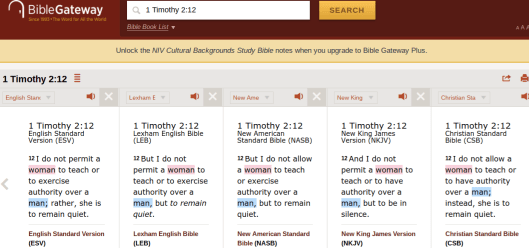
A popular Christian apologist I follow says that the prohibition against women preaching, teaching Scripture to men, and holding authority over men in the church in 1 Timothy 2:12 is translated incorrectly.

I do not permit a woman to teach or to exercise authority over a man; rather, she is to remain quiet.

He says it should not be translated as “woman” and “man” “but as “wife” and “husband”, and that he believes Bible translators mainly translate it as man woman due to tradition (i.e. men have historically been the pastors and teachers in the church).

This is why linguists – professional experts in the biblical languages – are hired to translate Scripture, not apologists.

Bible translators (of reliable translations) are true to the text, not church tradition or personal convictions. Furthermore, when translators are working on the text, it is not a lone individual who writes down what he thinks the Greek words say and that’s the Bible you end up reading. There are teams of translators, linguists, editors, and even computer experts who work on the text. They check, and double check, each other’s work. So even if one translator was translating according to tradition or opinion, it would be caught by others and not allowed to slip through the cracks.

All of the most reliable English translations translate the words as “man” and “woman”, not “husband” and “wife”.

And just for kicks, I checked this verse in about a dozen of the less reliable translations, and every single one of them translates it “man” and “woman”. Even versions that got other parts of verse 12 incorrect still use “man” and “woman.” For goodness sake, even The Message and The Passion “Translation” possibly the two worst English versions of the Bible (They’re not even translations. The Message is a paraphrase, written by someone who endorsed the heresy-laden book The Shack and has made statements affirming homosexuality. And Passion is the new New Apostolic Reformation version of the Bible, based, supposedly, on new revelation directly from God.) both say “man” and “woman”. And the NAR is totally OK with female preachers, so you know they’re not using “man” and “woman” due to tradition.

So we’ve got one apologist who’s of the opinion that it should be “husband” and “wife” against scads of translators who are experts in their fields and whack job NAR “translators” who approve of female pastors, who all use “man” and “woman”. You would think someone out of all of those people would have translated it “husband” and “wife” if that was the correct translation. It’s telling that even “translators” who push the egalitarian agenda won’t go so far as to change it to “husband” and “wife”. I think the apologist is somewhat out of his depth here.

A few more quotes from said apologist:

Verse 11 and following is directed at women in the context of their relationship with a man to whom they are supposed to be entirely submissive. That is a marriage relationship…1 Timothy 2 talks about the relationship between husband and wife; it’s chapter 3 that talks about church leadership.”

No, verse 11 is not directed at women. Neither are any of the other verses in chapter two or the rest of the book. First Timothy is a pastoral epistle. It was directed at Timothy by the Holy Spirit via Paul as sort of a “policy and procedure manual” for the church. This passage is not talking to women about their marriages, it is talking to pastors and elders about how to run the church. Verses 11-12 are talking about the role and behavior of women (all women, not just wives) in the church setting. They are not to instruct men in the Scriptures or exercise authority over men. That  definitely “talks about church leadership” by excluding women from leadership roles that place them in authority over, or instructing, men.

And keep in mind that when 1 Timothy was written, there were no chapter and verse markings. The text was one continuous flow. If you begin reading in 2:11 and go through 3:13 (try reading it here, adjusting the settings to remover chapter and verse markings), I believe there’s a strong case to be made that 2:11-15 is actually the introduction to the qualifications for pastors, elders, and deacons. The passage (2:11-3:13) starts by stating who is disqualified from those positions and why (2:11-15) and then moves on to who is qualified and how (3:1-13).

Furthermore, if you’ll take a look at verses 8-10 of chapter two, which immediately precede the verses in question (11-12) and provide context, you’ll see more instructions to both men and women. Are only husbands to pray? Are only wives to dress modestly and respectably and adorn themselves with good works? What about single men and women, divorced men and women, widows and widowers?

No other place in Scripture teaches that all women should be under the authority of all men in the church. If this passage is to be interpreted the traditional way, this makes a new and unusual pattern of submission.

And this passage (1 Timothy 2:12) doesn’t teach that either. The statement that women are not to have authority over men doesn’t flip around to mean that all men are in authority over all women. That’s fallacious logic, silly reasoning, and patently unbiblical. The text says what it says and that’s it. You can’t turn it inside out and make an inference from an incorrect converse. That’s being a poor workman and mishandling Scripture.

It’s abundantly clear that “man” and “woman” are the correct translation in 1 Timothy 2:12. If anyone is being more loyal to an agenda than to the text here, it’s the apologist, not the translators.

Rock Your Role: Jill in the Pulpit (1 Timothy 2:11-12)

I Know Greek, So That Verse Is Wrong!


What do you recommend as daily devotionals for children, ages 2 and 10? I am looking to start daily Bible time with the kids before we start school.

I don’t recommend “canned” Bible studies and devotionals, but rather teaching straight from Scripture itself. I’ve explained this more, including a few suggestions for teaching your children, in my article The Mailbag: Can you recommend a good Bible study for women/teens/kids?

If you’re looking at a 5-10 minute time frame, you might want to work your way through Proverbs one verse at a time, or possibly some of the shorter Psalms. I usually set aside a 30 minute block of time and read through a book with my boys one chapter a day, asking questions and explaining things along the way. If you’d like, feel free to use any of my studies at the “Bible Studies” tab at the top of this page, selecting and simplifying the questions you feel are most appropriate for your children.


How can I subscribe to your blog via e-mail?

If you’re on a computer, there’s a little box in the left sidebar where you can enter your e-mail address:

Inline image

I don’t know if your phone is the same as mine or not, but here’s what the e-mail sign-up on my phone looks like:

Inline image


I was wondering if you had a list of recommended books for women. I’m trying to offer an alternative to an NAR book that has nice ideas and some good thoughts but also strays into Spiritual Formation and, of course, really off-base hermeneutics. 

I don’t really know of any off-hand along those lines that I would recommend. The problem with “Christian” books for women by women is that most of them contain false doctrine. A couple of suggestions:

1. The Bible. If you’re looking for a book with nice ideas and good thoughts, Psalms might be a good place to start. Getting grounded in God’s Word and digging deep into Scripture itself is the best way to guard your ladies against the false doctrine you’re describing.

2. There’s no reason women can’t read books authored by men. If you already have a particular doctrinally sound book in mind that was authored by a man, go right ahead and use that one. I would recommend any of the male authors under my “Recommended Bible Teachers” tab (as well as any of the female authors listed there). You might also find the kind of book you’re looking for at GTY or Ligonier.


If you have a question about: a Bible passage, an aspect of theology, a current issue in Christianity, or how to biblically handle a family, life, or church situation, comment below (I’ll hold all questions in queue {unpublished} for a future edition of The Mailbag) or send me an e-mail or private message. If your question is chosen for publication, your anonymity will be protected.

Death, Suffering

On Funerals, Grieving, and Suffering

I’m at a funeral today. Earlier this week we received the sad news that a young, dear member of our church family passed away unexpectedly. If you have a moment, your prayers for his parents and family would be most appreciated.

If you’re a long-time reader, you’ll recall me saying that blogging is something I do in my spare time. After serving my husband and children. After serving my church family. This week, there’s just no time to spare to write an original article for today. My husband needs shirts ironed for the services. There’s food to cook and helping to do. And, honestly, that’s where my heart and mind are – not on writing, but with my family and church family.

Sadly, at one time or another, death will intrude like an unwelcome visitor on all of our lives. Living in a fallen world, we will lose someone dear to us and we’ll have the opportunity to comfort and serve others who are grieving the death of a loved one.

I’ve written several articles along those lines, and I thought it might be helpful to gather them all into one place for handy reference. Whether you are suffering or you are ministering to the bereaved, I hope you’ll find these to be beneficial resources.

Ministering to the Bereaved

The Mailbag: Ministering to the Bereaved

Churchmanship 101: Funerals

Weeping with Those Who Weep

Band-Aids vs. Chemotherapy: Why Suffering Women are
Drawn to False Doctrine and 7 Things We Can do to Help

Suffering

Christ- the Suffering Servant

Six Reasons to Rejoice that Christ is Enough in Our Suffering

In the Mean Time

True or False: Is Your Theology of Suffering Biblical?

God’s Good Purposes in Suffering