I know regret should lead us to repentance. My question is: After repentance and salvation what do we do with regret? Is it sinful to continually experience regret? Is it just a consequence we must live with? I feel like I’m being swallowed up by it the more I read the Bible, which is not the end of the world, but I just want to handle it correctly.
Great question. I think correct context and semantics can help us out a lot here.
The verse you’re referring to is 2 Corinthians 7:10 (which I have linked in context in your question above):
For godly grief produces a repentance that leads to salvation without regret, whereas worldly grief produces death.
There are several concepts at play here between your question and the verse, and we need to be sure we’re not conflating them: regret, godly sorrow or grief, shame, and guilt.
When we American English speakers say, Frank Sinatra-style, “Regrets….I’ve had a few….,” what we mean is that there are things we’ve done in the past that we wish we hadn’t done, and that if we had it to do over again, we would do things differently. Every Christian has had incidents we feel this way about, whether they took place before or after we got saved. If your love for Christ and your growing understanding of the blackness of sin have led you to regret rebelling against Him, that’s not a bad thing. What would be bad is if you had no regrets. When we look back on past sins, we should always do so with an attitude of regret for having committed them.
But doesn’t this verse say repentance leads to salvation “without regret”? Yes. But that phrase doesn’t mean we’ll never look back at our past sins and wish we had obeyed God instead. Read the verse in context. Paul had written his “severe letter” rebuking the Corinthian church for their sin. It cut them to the heart in godly sorrow over their transgressions and they joyfully repented, never once looking back and wishing for their old way of life. Even with the hardships and persecution many first century Christians faced, they never, for a single moment, regretted turning from their life of sin and following Jesus. (I think we could all say a hearty “Amen!” to that!) That’s what “salvation without regret” means- we don’t regret casting our lot with Christ.
Another aspect of this verse and question we need to address is this: The verse doesn’t say our regrets produce repentance that leads to salvation. It says “godly grief”, or “sorrow,” or “sorrow that is according to the will of God,” is what produces repentance that leads to salvation. There’s a big difference.
Regrets are more in line with the “worldly grief” mentioned at the end of the verse, which produces death. Even lost people like Ol’ Blue Eyes can look back over their lives and recall their embarrassing or jerky behavior and the choices they made that hurt others or themselves, and they can wish they hadn’t done those things. Why? Because of the natural consequences of sin. He got caught. He lost his job or his wife or a friend.
He had to pay the piper, and he didn’t like the looks of the bill.
Not a thought to the Lord whose laws he broke. Not a twinge of guilt and shame for committing sins that crucified the Savior who loves him. No fear and trembling at the feet of a thrice holy God of wrath who has the power to cast him into Hell for all eternity.
That is godly grief. It’s a grief that goes vertical first…
…and then, springing from that godly grief, seeks horizontal forgiveness from and reconciliation with others.
When godly grief over sin produces repentance, repentance leads to salvation. And when Christ saves you, a transaction takes place in God’s legal system in which Christ absorbs the shame,guilt, and penalty for your sin, and God, the righteous Judge, rules you not guilty.
But what can you do when you’ve been genuinely saved and you look back at your past sin not only with regret, but also feeling the weight of guilt and shame? I think maybe that’s the heart of what you’re asking.
You have to hold on to what you know to be true according to God’s Word over and above what you feel. God’s Word is objectively trustworthy. Our feelings are not. Our feelings can be fickle and fleshly. Subjective and deceptive. We have to tame those feelings like wild horses with the bit, bridle, and spurs of Scripture, and rein them in or turn them in the direction God wants them to go.
So what do we know to be true about feeling guilt and shame for our past sin?
• Whatever we may feel, the fact is that, in Christ, we are not guilty, and our shame has been removed:
I give thanks to my God always for you because of the grace of God that was given you in Christ Jesus…who will sustain you to the end, guiltless in the day of our Lord Jesus Christ. 1 Corinthians 1:4,8
“Fear not, for you will not be ashamed; be not confounded, for you will not be disgraced; for you will forget the shame of your youth, and the reproach of your widowhood you will remember no more. For your Maker is your husband, the Lord of hosts is his name; and the Holy One of Israel is your Redeemer, the God of the whole earth he is called. Isaiah 54:4-5
• It isn’t God who is leading us to feel a way that doesn’t line up with His Word. Satan is the only one who makes false accusations against Christians:
And I heard a loud voice in heaven, saying, “Now the salvation and the power and the kingdom of our God and the authority of his Christ have come, for the accuser of our brothers has been thrown down, who accuses them day and night before our God. Revelation 12:10
• It is not God’s will for us to focus on the past, but to move forward like the Christians we are, keeping our eyes on Jesus:
But one thing I do: forgetting what lies behind and straining forward to what lies ahead, I press on toward the goal for the prize of the upward call of God in Christ Jesus. Let those of us who are mature think this way, and if in anything you think otherwise, God will reveal that also to you. Only let us hold true to what we have attained. Philippians 3:13b-16
Therefore, since we are surrounded by so great a cloud of witnesses, let us also lay aside every weight, and sin which clings so closely, and let us run with endurance the race that is set before us, looking to Jesus, the founder and perfecter of our faith, who for the joy that was set before him endured the cross, despising the shame, and is seated at the right hand of the throne of God. Hebrews 12:1-2
When you look back on your former life and are overwhelmed by guilt and shame, remember the words above are from the very lips of God Himself. Remember that you wereguilty and covered with shame, and let that knowledge lead you to thank, praise, and worship the One who took your sin and wretchedness upon His own shoulders. Who absorbed your punishment, your blame – and set you free. Free to honor and obey Him. Free to glorify Him and enjoy Him forever.
If you have a question about: a Bible passage, an aspect of theology, a current issue in Christianity, or how to biblically handle a family, life, or church situation, comment below (I’ll hold all questions in queue {unpublished} for a future edition of The Mailbag) or send me an e-mail or private message. If your question is chosen for publication, your anonymity will be protected.
If you are considering commenting or sending me an e-mail objecting to the fact that I warn against certain teachers, please click here and read this article first. Your objection is most likely answered here. I won’t be publishing comments or answering emails that are answered by this article.
This article is kept continuously updated as needed.
I get lots of questions about particular authors, pastors, and Bible teachers, and whether or not I recommend them. Some of the best known can be found above at my Popular False Teachers tab. The teacher below is someone I’ve been asked about recently, so I’ve done a quick check (this is brief research, not exhaustive) on her.
Generally speaking, in order for me to recommend a teacher, speaker, or author, he or she has to meet three criteria:
a) A female teacher cannot currently and unrepentantly preach to or teach men in violation of 1 Timothy 2:12. A male teacher or pastor cannot allow women to carry out this violation of Scripture in his ministry. The pastor or teacher cannot currently and unrepentantly be living in any other sin (for example, cohabiting with her boyfriend or living as a homosexual).
b) The pastor or teacher cannot currently and unrepentantly be partnering with or frequently appearing with false teachers. This is a violation of Scripture.
c) The pastor or teacher cannot currently and unrepentantly be teaching false doctrine.
I am not very familiar with most of the teachers I’m asked about (there are so many out there!) and have not had the opportunity to examine their writings or hear them speak, so most of the “quick checking” I do involves items a and b (although in order to partner with false teachers (b) it is reasonable to assume their doctrine is acceptable to the false teacher and that they are not teaching anything that would conflict with the false teacher’s doctrine). Partnering with false teachers and women preaching to men are each sufficient biblical reasons not to follow a pastor, teacher, or author, or use his/her materials.
Just to be clear, “not recommended” is a spectrum. On one end of this spectrum are people like Nancy Leigh DeMoss Wolgemuth and Kay Arthur. These are people I would not label as false teachers because their doctrine is generally sound, but because of some red flags I’m seeing with them, you won’t find me proactively endorsing them or suggesting them as a good resource, either. There are better people you could be listening to. On the other end of the spectrum are people like Joyce Meyer and Rachel Held Evans- complete heretics whose teachings, if believed, might lead you to an eternity in Hell. Most of the teachers I review fall somewhere in the middle of this spectrum (leaning toward the latter).
If you’d like to check out some pastors and teachers I heartily recommend, click the Recommended Bible Teachers tab at the top of this page.
Jen Wilkin Not Recommended
Jen is a women’s Bible study author, blogger, and conference speaker, and until 2023, when she left to focus on her own ministry, was on staff at The Village Church as the Executive Director of Next Gen Ministries (TVC’s ministry to “children and students ages 0–18”).
Jen’s older books and Bible study materials have a reputation for being generally doctrinally sound. I’ve published a review of Jen’s book, Women of the Word, and here is one reader’s take on her book 1 Peter: A Living Hope in Christ:
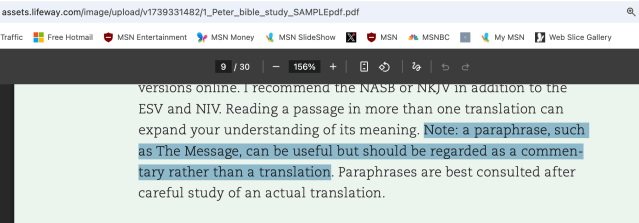
“…in the foreword Jen wrote, ‘a paraphrase, such as the NLT or The Message,* can be useful but should be regarded as a commentary rather than a translation.’ However, aside from that, I have found no other problems with the book at all. It is an eight week long study of 1 Peter based on the method of Bible study that she writes about in Women of the Word. My favorite thing about this study is that it causes us to focus on what the text is telling us about God. I love how Jen Wilkin is teaching women to study the Bible properly. I wish she would be more discerning about who and what she endorses though. There are so few women who bring us solid teaching and discernment.”
*Please see “February 2026 Update” at the end of this article. Jen Wilkin herself brought to my attention that in later editions of this book, she removed her reference to the NLT from this sentence. She did not explain why, but my guess would be (and she has thus far not corrected me) that she removed “the NLT” because The New Living Translation is considered to be a translation, and Jen mistakenly referred to it as a “paraphrase”.
The reader’s concern (and mine, too) in mentioning this quote, however, is not that Jen mistakenly called the NLT a paraphrase, but that Jen recommended The Message as an acceptable paraphrase. You need only to click on the link above to see why this is concerning.
Also in the past, Jen limited her speaking engagements and teaching to audiences of women, which is the biblical parameter for Christian women teachers. And although her website speaking engagement request form says she is a “teacher who helps women…” she has been increasingly preaching to and instructing men in recent years.
For example, Jen’s former staff position as TVC’s “Executive Director” of children’s and student ministries, depending on the exact nature of her job responsibilities, probably (I am making a reasonable inference, as TVC’s website does not explicitly say) required her to teach Scripture to, or exercise improper authority over young men in the student ministry (which includes students through age 18) and men who teach or volunteer in the student ministry. The title “Executive Director” makes it sound as though she was over the entire ministry and everyone in that ministry was under her purview.
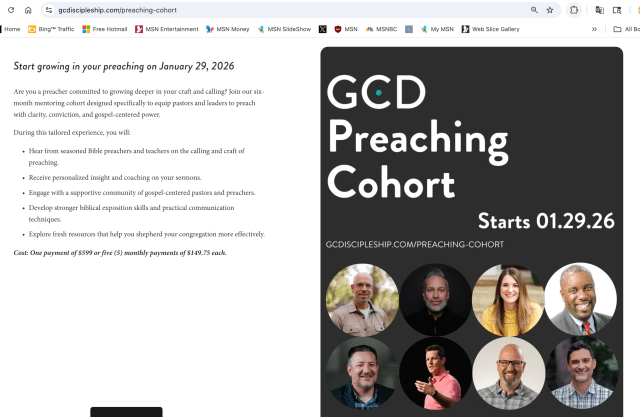
A more recent example demonstrating Jen’s increasing rebellion against Scripture regarding the role of women in the church is the Gospel Centered Discipleship “Preaching Cohort” in which Jen is a “Coach”. She (along with the other coaches) is described as a “seasoned Bible preacher and teacher,” and will be coaching pastors“on the calling and craft of preaching”.
In the past, there have also been questions about exactly where Jen stood on the biblical role of women in the church. She presented herself -and still does- as a complementarian, stating clearly that women are not to hold the office of pastor. What she did not make clear in the past, but what has become abundantly clear in recent years, is that she is (or has developed into) what’s often called a “soft” or “narrow” complementarian. This is the belief that women can do anything men can do in the gathering of the church body except hold the office of “senior pastor” – women can preach the Sunday sermon, hold any other office in the church (for many that includes the office of elder, “associate pastor,” etc.), exercise authority over men in the church, and so on. This is unbiblical. And what’s dangerous here is that Jen doesn’t call herself a “soft/narrow” complementarian, she just calls herself a complementarian, leading Christians who haven’t kept up with her to think she holds a biblical position and practice of the role of women, when she, in fact, does not.
As an example of Jen’s murkiness on the role of women, in the video* below (~32:05), she says:
“We need [women’s] visible leadership. How visible? As visible as your church’s complementarianism allows.”
This remark is at best, unhelpful, and at worst, opens the door for women and pastors to rebel against Scripture. The biblical answer to this question (aside from the fact that the church should be far more focused on servanthood than leadership) is: Women may serve in any position in the church that does not require them to preach to, teach Scripture to, or exercise authority over men, and which does not violate any other principles of Scripture.
Whatever position on the role of women Jen may have held in the past, she is now a “soft/narrow complementarian,” which is, in reality, a functional egalitarian.
In addition to the aforementioned preaching cohort in which Jen instructs pastors, she has spoken at several co-ed conferences in recent years. Give the first 15 minutes of the video below a listen*. Despite the fact that Jen’s very first remark is that she is not teaching the Bible in this session for pastors and church planters, she almost immediately goes on to quote and allude to the opening chapters of Genesis (and later in the video, other passages) and teach on them. I would challenge you to listen to what she says and ask yourself, “If I heard a pastor give this type of instruction, would I consider it a sermon/Bible lesson?” I think most of us could easily answer, “yes”. *(Unfortunately, the full length video of Jen’s complete teaching session has been removed from the internet. The video below is an excerpt of the full length video.)
(This is also the teaching session in which Jen made her infamous remarks about menstruation helping women to understand the gospel differently from men, which is not only a private and potentially uncomfortable subject to address in public – especially for an audience of men – it’s a patently ridiculous teaching. Menstruation teaches us nothing about the gospel. The two subjects are completely unrelated. Also, aside from Jen, I’ve never heard a single woman say her period helped her better understand the shedding of Christ’s blood.)
In another instance of preaching to a co-ed audience, Jen has been featured as a speaker multiple times at The Gospel Coalition’s national conference* at least as far back as 2017. (In the opening seconds of this 2017 TGC conference session, Why It’s Good that God Is Different from Us, Jen acknowledges and welcomes the men in her audience.) TGC, as many have noted, has been on a woke / social justice trajectory for years. Jen has been featured on TGC’s site numerous times.
*Jen has also been a featured speaker at TGC’s women’s conference (TGCW), not to be confused with TGC’s national conference, which is co-ed.
Again, one of the reasons it’s especially problematic for Jen to be teaching men, or to even to seem to be teaching men, is that she openly and unashamedly wears the label of complementarian. Boldly proclaiming complementarianism while teaching men muddies the waters and confuses the women who follow her as to what the Bible truly teaches about the role of women in the church. Are there times when it is technically not a violation of Scripture for a woman to speak with men in the audience? Yes (see #7 here). But weigh the impact Jen has on the church by speaking to men against the counter-evangelicultural impact someone of her stature could have by flagrantly refusing to teach men. Which would cause more people to sit up and take notice, set a better example for Christian women, and have a more biblical influence on the church?
Another concern about Jen is that she seems to be increasingly associating and appearing with false or problematic teachers.
Several years ago, Jen was added to LifeWay Women’s stable of Women’s “Bible” study authors including many of the aforementioned teachers and others. In addition to my normal concerns about someone yoking with false teachers (i.e. the Bible says not to, and disobeying God’s Word is a sin), I’m guessing LifeWay Women may have initially signed Jen in order to use her – that is, her reputation for being a doctrinally sound teacher and a complementarian – to lend credibility to the false teachers they promote. And, of course, Jen’s previously perceived good reputation has suffered by being associated with these false teachers.
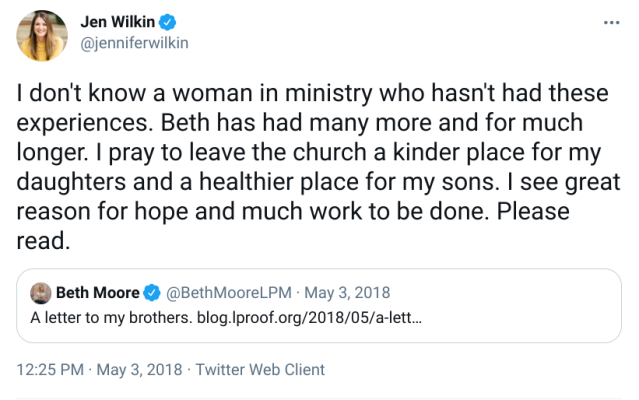
In March 2021, when Beth Moore cut ties with the Southern Baptist Convention, Jen offered this glowing farewell…
In a strange irony, in the midst of unbiblically partnering with these false teachers, in her session, The Gospel and The Future of Bible-Centered Discipleship at the 2018 Southern Baptist Convention Pre-Conference (also to a co-ed audience), Jen teaches the following…
[Biblical literacy] guards against false teaching…Basic comprehension-level mastery of the text guards against false teaching. (~30:12)
You know what our [discipleship] formula has been for the last 20 years? [We’ve said], ‘We’re going to keep making [the level of biblical teaching] lower and lower’…It is our high calling, in the face of a biblical literacy crisis, to raise the bar in an age of low expectations. (~43:40…44:39)
And yet, Jen’s level of “mastery of the text” – to the point that she is instructing people in the text and teaching them how to improve discipleship – has not sufficiently guarded her against partnering with women who are largely responsible for the bulk of false teaching aimed at women today, who don’t teach “basic comprehension-level mastery of the text,” and who have continued to lower the bar and perpetuate low expectations for biblical literacy. Jen has associated with, talked to, and listened to the teaching of these women far more than I have, I’m certain. How does she not see this?
(February 2026 UPDATE- I’ve removed a small section of this article {unrelated to the paragraph above or below} that previously appeared here. Please scroll down to the “Additional Resources” section for an explanation, and for additional extra information.)
Finally, in the same way that the influence Steven Furtick has on Lysa TerKeurst as her pastor is worrisome, I’ve seen some things over the years with Jen’s pastor, Matt Chandler, and his wife, Lauren Chandler (with whom Jen has appeared at conferences; screenshot), that have given me pause.
As a member of The Village Church, Jen is pastored by Matt, and as a ministry leader there (though no longer a staff member), she works under his direction and influence. Over the past few years, Matt has publicly praised or affirmed false teachers like Ann Voskamp, Beth Moore, and Jesus Culture. He has raised some questions about the extent of his continuationism with His notorious “pirate ship prophecy“. He allows Bethel and Israel Houghton (Joel Osteen’s former worship leader) music to be used for worship at his church. Matt allows his wife, a worship leader at TVC, to select this music, and to yoke with and be influenced by numerous false teachers. Matt and Lauren and their associations with false teachers have undoubtedly influenced Jen. Additionally, Matt’s character and personal integrity were sullied in 2022 when he had to take a leave of absence after admitting to an “inappropriate” texting relationship with another woman.
In summary, I would urge you not to follow Jen Wilkin, attend her conferences, or use her materials due to her trajectory of increasingly unbiblical teaching and behavior.
Prior to February 14, 2026, this small section appeared in the above indicated area of this article:
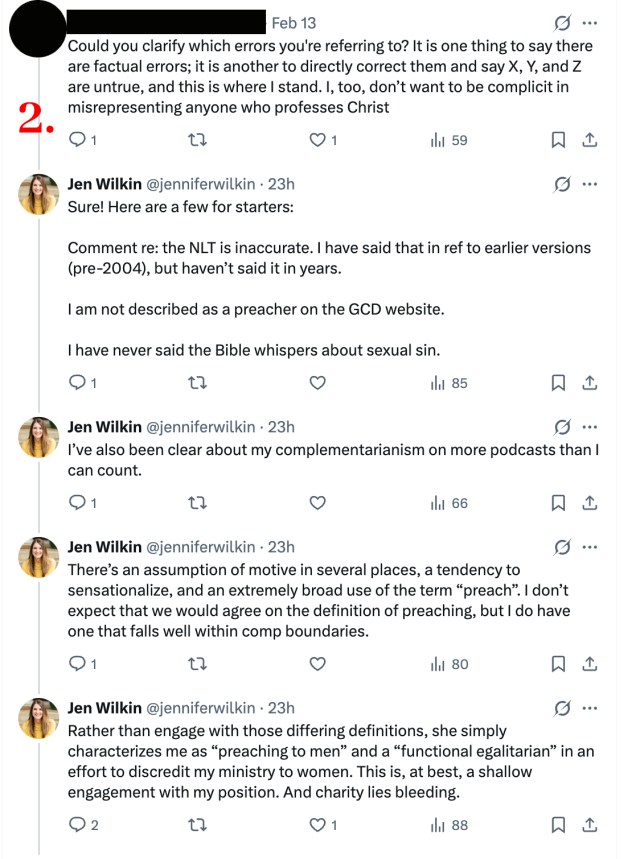
On February 13-14 Jen Wilkin and I had an exchange on X in which she said, “I have never said the Bible whispers about sexual sin.” (see image 2 below)
The first part of J.D.’s statement, “We ought to whisper about what the Bible whispers about and we ought to shout about what it shouts about,” was a quote of Jen. J.D. then added his own opinion, “…and the Bible appears more to whisper when it comes to sexual sin…” to the end of the quote of Jen, making it sound like the entire quote was something she said.
I apologize – to Jen and to my readers – for making this mistake, and ask your forgiveness. I hope my character speaks for itself when I assure you that this was simply a misunderstanding of an unclear statement. It was not a fabrication, nor was it done maliciously. But I am still sorry for making the mistake and for any negative consequences it resulted in for Jen or anyone else.
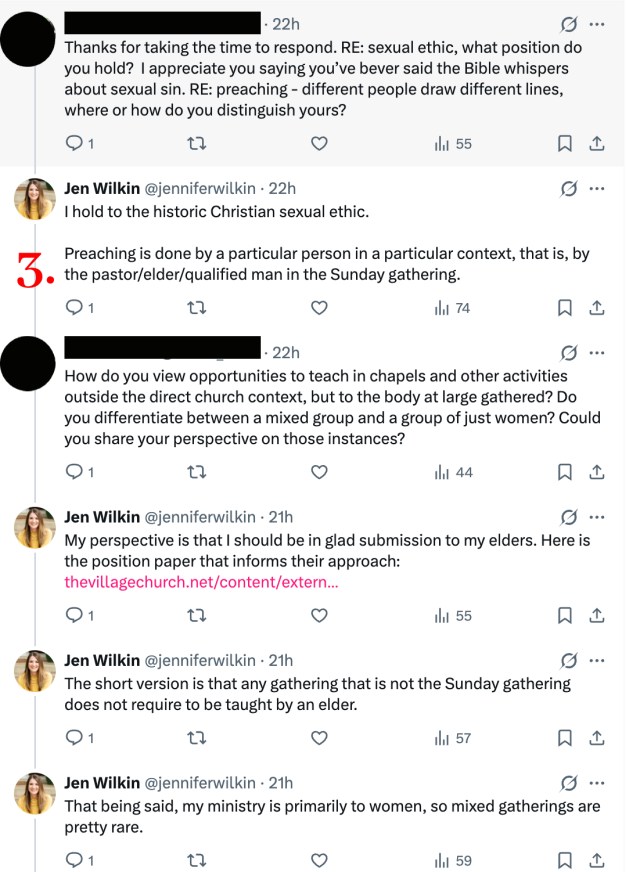
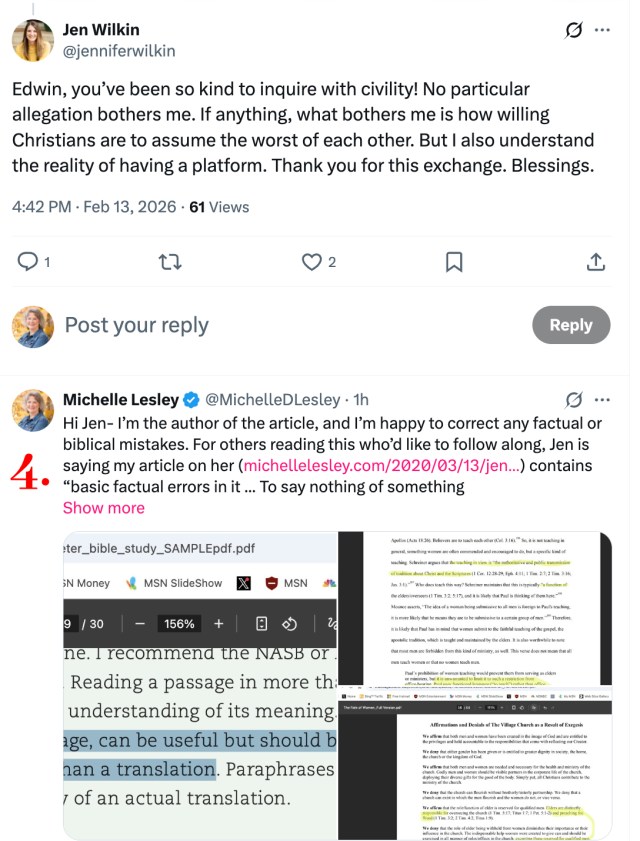
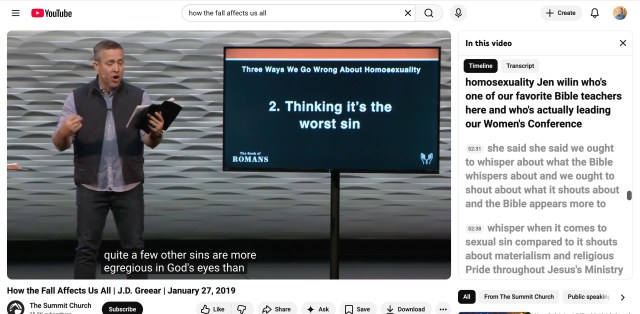
This point, however, was not the only thing Jen took issue with about this article, as you can see from the images in the slideshow above. Here is the original exchange. My response to Jen’s allegations is below in article format for ease of reading:
Hi Jen- I’m the author of the article, and I’m happy to correct any factual or biblical mistakes. For others reading this who’d like to follow along, Jen is saying my article on her contains “basic factual errors in it … To say nothing of something that misrepresents a fellow believer’s character and actions”.
I apologize for the length of this answer, but I wanted to address all of your concerns clearly, accurately, biblically, and citing sources:
“Comment re: the NLT is inaccurate. I have said that in ref to earlier versions (pre-2004), but haven’t said it in years.”
First, this is a quote from an email I received from a reader commenting on your book 1 Peter: A Living Hope in Christ. I introduced the quote by saying, “Jen’s older books and Bible study materials have a reputation for being generally doctrinally sound.” (I also linked to a positive review on my blog of your book Women of the Word in which I actually recommended [at that time] that my readers buy themselves a copy of it. The reader’s quote begins:
“…in the foreword Jen wrote, ‘a paraphrase, such as the NLT or The Message, can be useful but should be regarded as a commentary rather than a translation.’…”
I checked the most recent version of your book (2024 edition; sample on Amazon), of 1 Peter: A Living Hope in Christ, and you’re correct, you’ve removed the part about the NLT. The quote now says, “a paraphrase, such as The Message, can be useful but should be regarded as a commentary rather than a translation.”.
My guess is that you removed “the NLT [New Living Translation]” because it’s considered a translation, not a paraphrase. Is that correct? If not, please feel free to explain. I’m glad to add a note to the article saying that you’ve removed the phrase “the NLT” from that sentence in later editions, and if you have a link to an article or other material that explains why you removed it, I’ll be happy to add that link as well.
So just to clarify here, the quote from your book (in which you mistakenly called the NLT a “paraphrase”) actually is accurate. You are the one who changed it in later editions, presumably to correct your error. So this is not, in fact, a “factual error”. The reader’s quote was accurate.
However, the primary concern here is not that you mistakenly called the NLT a “paraphrase” instead of a translation (if that’s why you removed the part about the NLT), or even that you recommended the NLT. The primary concern is that you recommended – and, apparently, STILL recommend- The Message, one of the worst, most grossly inaccurate “paraphrases” out there, written by Eugene Peterson, who, along with mangling the text of Scripture, wrote a cover endorsement for the heresy-laden book, “The Shack,” and said he would officiate a same sex wedding.
But you still cite The Message as an acceptable paraphrase to use. So that part is factually correct.
Your next concern was: “I am not described as a preacher on the GCD website.”
Here, you’re misquoting me and either misunderstanding or misrepresenting what the article actually says (so you’re the one guilty of a “basic factual error” in this case).
The article contains a screenshot of the GCD (Gospel Centered Discipleship) web page picturing you and describing the event, and quotes directly from that web page. This is the actual quote from my article:
“…the Gospel Centered Discipleship “Preaching Cohort” in which Jen is a “Coach”. She (along with the other coaches) is described as a “seasoned Bible preacher and teacher,” and will be coaching pastors “on the calling and craft of preaching”.
The point of these two sentences is that you will be instructing pastors on how to be better pastors/preachers, when this is unbiblical and you have no place doing so. Neither of these sentences says that GCD called you, specifically, a “preacher”. (Additionally, albeit tangentially: just from a logical perspective, why would GCD engage someone who isn’t a pastor and isn’t qualified to be a pastor to instruct pastors about being better pastors? That’s like a hospital hiring someone who isn’t a doctor and isn’t qualified to be a doctor to instruct doctors about being better doctors.)
Finally, you said, “I have never said the Bible whispers about sexual sin.”
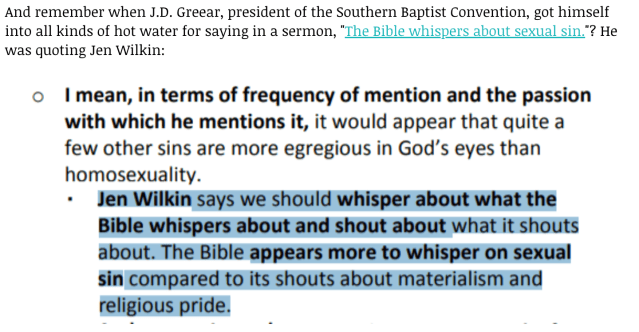
In this instance, you’re correct. Here’s what I said in the article: “And remember when J.D. Greear, president of the Southern Baptist Convention, got himself into all kinds of hot water for saying in a sermon, “The Bible whispers about sexual sin.“? He was quoting Jen Wilkin…”
My statement was based on a misunderstanding of JD’s quote in the video of his sermon. He was quoting you when he said, “We ought to whisper about what the Bible whispers about and we ought to shout about what it shouts about,” but then added HIS OWN thought to the end of that quote, and HE stated his opinion that “the Bible appears more to whisper when it comes to sexual sin compared to it shouts about materialism and religious Pride”.
I apologize for getting that wrong. I’ll be glad to remove that small section entirely. I’ll make a note in the article, and explain publicly on social media, how I got that wrong, along with a public apology to you, both in the article and on my other social media platforms. I’m very sorry for my mistake there.
“I’ve also been clear about my complementarianism on more podcasts than I can count.”
Yes, you’ve said you’re a complementarian, but as I accurately explained in the article, you’re not using the original definition of “complementarian”. You’re using the current, twisted definition of complementarian, i.e. women can do anything in the church that men can do except hold the office of pastor. That’s what used to be called “soft complementarianism” or “narrow complementarianism” and it is functional egalitarianism. I’m not the one in “factual error” here.
Calling yourself a “complementarian” and using that twisted definition is -whether you intend it to be or not, and I’m assuming “not”- deceptive and misleading. It’s similar (I’m using this strictly as an analogy, not accusing you of heresy) to Mormons saying, “We believe in Jesus,” when the Mormon version of Jesus is very different from what Scripture says about Jesus.
Furthermore, as a Southern Baptist, I’m sure you’ve heard (as have I), our leadership say regarding women preaching to men, “The function IS the office,” meaning that a woman functioning in the role of pastor -i.e. preaching- is usurping the office of pastor, as Dr. Albert Molher explains here in refutation of the definition of “complementarianism” you espouse, namely, that “a woman ought to be able to do…or authorized to do everything a non-ordained man can do.”
“There’s an assumption of motive in several places, a tendency to sensationalize…”
This is your personal, subjective opinion, not a “factual error”.
You’ll need to specifically quote at least one of these “several places”. And I would remind you that what you characterize as “assumption of motive” the Bible would likely characterize as, “out of the abundance of the heart, the mouth speaks” (Luke 6:45) and/or “You will know them by their fruit” (Matthew 7:16,20). But until you cite a specific “assumption of motive/tendency to sensationalize” we can’t know for sure, I can’t apologize if something is, in fact, an unbiblical “assumption of motive,” or “sensationalism,” and this is an unsubstantiated accusation.
“an extremely broad use of the term “preach”
No broader than the Bible’s definition. The actual prohibition in 1 Timothy 2:12, as I’m sure you know, is against women “teaching” men. Preaching is just one form of teaching.
“I don’t expect that we would agree on the definition of preaching, but I do have one that falls well within comp boundaries.”
As evidenced by the fact that you preach to men, your definition of preaching falls well within the aforementioned current twisting of “complementarian” boundaries: functional egalitarianism, which unbiblically allows women to preach to men.
There is no definition of women preaching to men that falls within traditional complementarian boundaries because traditional complementarianism – which simply describes what the Bible says about the role of women in the church- does not allow women to preach to men.
“Rather than engage with those differing definitions,”
I did “engage with those differing definitions”. I compared your so-called “complementarian” definition of preaching to men – i.e. “it’s OK for women to preach to men” – to Scripture. Scripture forbids this. Engagement over.
“she simply characterizes me as ‘preaching to men’”
I didn’t “characterize” you as preaching to men, I flat out stated a fact: You preach to men. There’s plenty of evidence of it in the article. If you’re going to preach to men why not just proudly and unashamedly say so and clearly enumerate your reasons for doing so, rather than preaching to men and then going around and saying, “I’m not really preaching to men, I’m really a complementarian.”? If it’s OK for you to preach to men, you should be able to easily back up that assertion with clear, rightly handled (2 Timothy 2:15), in context Scripture.
“and a ‘functional egalitarian’”
You are. When you function like an egalitarian by preaching to men, you’re a functional egalitarian.
“in an effort to discredit my ministry to women.”
Your “ministry to women” should be discredited because you’re teaching them to disobey Scripture. Every time you stand up and preach to men, your behavior is teaching women (and men) that if they come to a command of Scripture they don’t like (like 1 Timothy 2:12), they’re free to ignore it and disobey it. That teaching is false doctrine and a defiance of Scripture, and should, therefore, be discredited (and that’s only one of the points in the article – I’ve cited many other reasons why your ministry should be discredited).
“This is, at best, a shallow engagement with my position.”
No it isn’t. Your position is in direct conflict with the plain and clear teaching of Scripture. Concisely demonstrating that (and linking to two other articles refuting your position and explaining at length what the Bible says about the role of women in the church) is not “shallow engagement”.
“Preaching is done by a particular person in a particular context, that is, by the pastor/elder/qualified man in the Sunday gathering.”
Where does the Bible specifically say that, rightly handled and in context? Chapter and verse, please.
Christians are first and foremost to be in glad submission to Scripture, because Scripture is infallible and perfect, and elders – as your pastor, Matt Chandler, has amply demonstrated over the last several years – are not.
So if your elders are not upholding what Scripture teaches, and you are submitting to them, both you and your elders are in disobedience to Scripture, which is the standard for Christians.
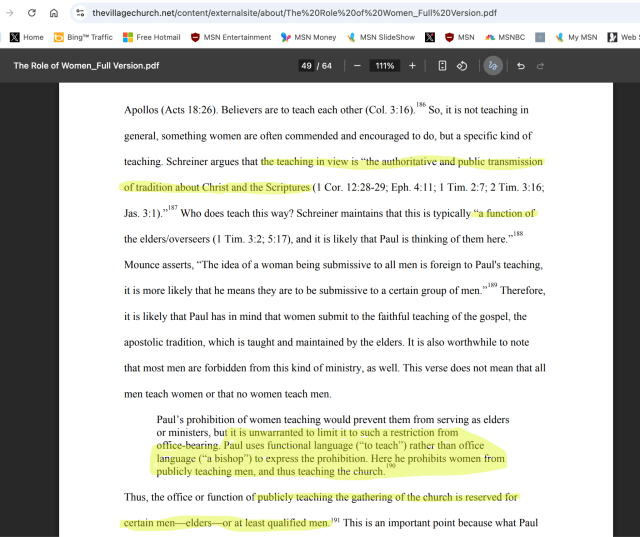
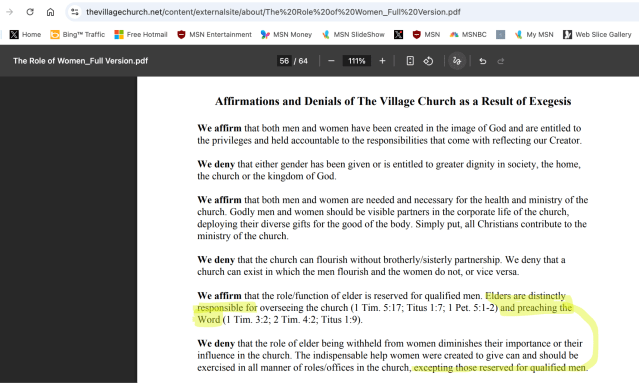
Nevertheless, in the document you cited, your own elders say this:
So your own elders say that publicly preaching the Word to the gathering of the church is restricted to men.
We often have to clarify to Believers and unbelievers alike that the “church” is not the building we meet in, it’s the people – Christians. So whenever Christians are gathered for the purpose of worship, instruction in the Scriptures, etc., it is a gathering of the church, and the prohibition of women teaching men applies.
But, in any event, the document makes clear on p. 55 that this is the position of “the role of women at The Village Church.” My article doesn’t deal with you preaching at TVC, but at other gatherings of the church outside TVC, so TVC’s policy for TVC is irrelevant to those events.
“The short version [of the TVC document] is that any gathering that is not the Sunday gathering does not require to be taught by an elder.”
I didn’t see that statement or any statement similar to that in the document, but I may have missed it. What page is that on?
“That being said, my ministry is primarily to women, so mixed gatherings are pretty rare.”
1. “Rare” does not equal “not sinful”. You still need to repent of preaching to men and stop doing it.
2. It doesn’t look “rare” considering all of the instances I’ve cited in the article (and including any instances I may have missed and haven’t included).
3. It isn’t “rare,” as though you used to preach to men and no longer do. This is something you’re continuing to do and currently doing. The GCD Cohort in which you’ll be unbiblically instructing pastors started less than three weeks ago.
So, to summarize, you found one actual error of fact in this entire, lengthy article (which I apologized for and will gladly delete and explain to my audience). The remainder of the article – dealing with far more than you’ve brought up here – is correct and is not “basic factual errors” or a “misrepresentation” of your “character and actions”.
And by implying that the article, overall, consists of “basic factual errors” and “misrepresents [your] character and actions,” you have actually misrepresented my character and actions.
But all of that aside, what’s more important here is you. I care about you, and I hate to see you going down the same road that so many of your Lifeway Women compatriots – like Beth Moore, Lysa TerKeurst, Priscilla Shirer, etc. – have gone.
I have taken a moment to pray for you, and, in love, I urge you to repent of the sins of preaching to men, yoking with false teachers, and the other things I’ve cited in the article, for the glory of God, for the good of your own soul before Christ, and for the biblical discipleship of your followers.
“This really is actually, literally true,” I found myself urging the ladies to whom I was teaching a Bible lesson.
It was a surreal moment. There wasn’t a woman in that room who would have denied the Bible’s inerrancy or trustworthiness. All of them wholeheartedly agreed with the passage we were discussing and, if asked by anyone, would have said unequivocally that they believed the truth of it.
But there was just this…this thing…nagging at the back of my heart. Why…why did I get the feeling I needed to dig down under their profession of belief in God’s Word and convince them of the gut-level truth of the passage?
I believe these ladies and I were a representative sample of average, genuinely regenerated, Bible-believing Christians. But when I look out across the landscape of denominations and churches and ministries made up of average, genuinely regenerated, Bible-believing Christians, there’s a disconnect between what we say we believe – even what we’re convinced in our hearts we believe – about God, and the way we do life and church.
We’re not living out what we say we believe.
We don’t truly trust who God is, how He works, or what He has told us to do (or not to do) enough to simply take Him at His word and do things His way. And most of the time, we don’t even realize it.
We trust profession over fruit
If someone has walked the church aisle, prayed a “sinner’s prayer”, been baptized, attends an organization that calls itself a church, or simply declares herself to be a Christian, we trust that she’s truly been born again – despite the fact that she follows a myriad of false teachers, gets angry at or argues against the plain reading of God’s Word, lives as a practicing homosexual, runs her life by her own feelings, opinions, and experiences rather than obedience to Scripture, or her behavior is otherwise completely indistinguishable from that of a non-Christian. When it’s our grown children or other deeply loved ones, we cling even more desperately to the belief that “she’s saved because _____”, and she’s safe from an eternity in Hell, regardless of everything we can see in her life to the contrary.
But that is not God’s way. God’s way is that if it walks like a lost duck and quacks like a lost duck, we are to treat it like a lost duck. Yet, we don’t do that. We hide behind “Only God knows the heart,” or “Maybe she’s just backslidden or a ‘carnal Christian’,” when the Bible teaches nothing of the sort. Yes, God is the judge of whether or not someone is ultimately saved, but God has not called us to be the final arbiter of salvation. He has called us to lovingly urge sinners to repent and believe the gospel regardless of their church pedigree or claims of being a Christian. Those who repent and pursue holiness, though imperfectly, are the ones who are genuinely saved.
You will recognize them by their fruits. Are grapes gathered from thorn bushes, or figs from thistles? So, every healthy tree bears good fruit, but the diseased tree bears bad fruit. A healthy tree cannot bear bad fruit, nor can a diseased tree bear good fruit. Every tree that does not bear good fruit is cut down and thrown into the fire. Thus you will recognize them by their fruits. “Not everyone who says to me, ‘Lord, Lord,’ will enter the kingdom of heaven, but the one who does the will of my Father who is in heaven. On that day many will say to me, ‘Lord, Lord, did we not prophesy in your name, and cast out demons in your name, and do many mighty works in your name?’ And then will I declare to them, ‘I never knew you; depart from me, you workers of lawlessness.’ Matthew 7:16-21
“If your brother sins against you, go and tell him his fault, between you and him alone. If he listens to you, you have gained your brother. But if he does not listen, take one or two others along with you, that every charge may be established by the evidence of two or three witnesses. If he refuses to listen to them, tell it to the church. And if he refuses to listen even to the church, let him be to you as a Gentile and a tax collector. Matthew 18:15-17
But now I am writing to you not to associate with anyone who bears the name of brother if he is guilty of sexual immorality or greed, or is an idolater, reviler, drunkard, or swindler—not even to eat with such a one. For what have I to do with judging outsiders? Is it not those inside the church whom you are to judge? God judges those outside. “Purge the evil person from among you.” 1 Corinthians 5:11-13
Do we trust the profession faith of someone whose life screams, “LOST!” over God’s Word that teaches us that saved people bear fruit in keeping with repentance and pursue holiness?
We trust man-made solutions over
God’s prescribed methods
Nowhere is this clearer at present than in the social justice movement. Even professing Christians are dreaming up all sorts of ways to right real and perceived wrongs against sexual perversion minorities, blacks (What about other ethnic minorities?), and women. It’s only natural that the world would come up with man-made solutions to these problems, but the church is embracing the ways of the world instead of applying the ways of God.
The world’s solution to the “problem” of sexual perversion not being embraced and celebrated is to socially and legally force dissenters to comply. Financial reparations from people who never owned slaves to people who have never been slaves is the solution to racism. Replacing men in power with women in power will end sexism. Many in evangelicalism are aping these humanistic ploys by accepting the idea of “gay Christianity,” insisting on fabricated “diversity” in congregations, ministries, and denominational leadership, and allowing women to serve as pastors and in other positions of teaching or authority over men in the church.
Again, coming up with our own solutions is not God’s way. God’s way is for us to understand what is sin and what is not, and how to biblically deal with sin.
We need to trust God’s word that there’s a difference between sinfully hurting someone and hurting someone who’s sinning. Just because someone’s feelings have been hurt doesn’t mean she has been sinned against. If I call someone names or treat her unkindly because she is a homosexual or a certain ethnicity or a woman, I am sinfully hurting her. If people are hurt when I humbly, lovingly, and kindly teach what the Bible says about homosexuality or repenting for the sins of my ancestors or the biblical role of women in the church, and call to repentance those who believe and act unbiblically in these areas, they are hurt because they are sinning.
Faithful are the wounds of a friend; profuse are the kisses of an enemy. Proverbs 27:6
We also need to stop viewing sin as systemic – as though racism, “homophobia”, and sexism were living, breathing beings we need to conquer – and start trusting God’s way of holding individuals responsible for their own sins. What is God’s way for us to deal with an individual who is, according to God’s Word, sinning?
✢ Lost sinners:We share the gospel with that person. When God raises a sinner from death in her trespasses and sins to new life in Christ, He breaks the power sin has over her and enables her, through the indwelling of the Holy Spirit, to obey His commands. He changes her from a creature who loves sin into a new creature in Christ who hates sin. If you want someone to stop being racist, sexist, or unkind to sexual perversion minorities, plucking leaves off the weed isn’t going to do it. You need the Master Gardener to pull that pernicious plant up by the roots and plant a rose bush in its place. If we really trusted God to transform the heart of a sinner like He says He will, we’d be out there sharing the gospel with everyone we know and we would stop relying on man-made solutions to sin.
And you were dead in the trespasses and sins in which you once walked, following the course of this world, following the prince of the power of the air, the spirit that is now at work in the sons of disobedience— among whom we all once lived in the passions of our flesh, carrying out the desires of the body and the mind, and were by nature children of wrath, like the rest of mankind. But God, being rich in mercy, because of the great love with which he loved us, even when we were dead in our trespasses, made us alive together with Christ—by grace you have been saved…For we are his workmanship, created in Christ Jesus for good works, which God prepared beforehand, that we should walk in them. Ephesians 2:1-5,10
Therefore, if anyone is in Christ, he is a new creation. The old has passed away; behold, the new has come. 2 Corinthians 5:17
And I will give you a new heart, and a new spirit I will put within you. And I will remove the heart of stone from your flesh and give you a heart of flesh. And I will put my Spirit within you, and cause you to walk in my statutes and be careful to obey my rules. Ezekiel 36:26-27
✢ Saved Sinners:When a Christian sins, we go to her in love, humility, and kindness, and gently point out what God’s Word says about her sin and her need to repent. If she doesn’t immediately repent, we continue praying for her and calling her to repentance until she proves that she loves her sin more than she loves Christ. Then we regard her as a lost person in need of salvation and preach the gospel to her (see “Lost Sinners” above).
“If your brother sins against you, go and tell him his fault, between you and him alone. If he listens to you, you have gained your brother. But if he does not listen, take one or two others along with you, that every charge may be established by the evidence of two or three witnesses. If he refuses to listen to them, tell it to the church. And if he refuses to listen even to the church, let him be to you as a Gentile and a tax collector. Matthew 18:15-17
Brothers, if anyone is caught in any transgression, you who are spiritual should restore him in a spirit of gentleness. Keep watch on yourself, lest you too be tempted. Galatians 6:1
God has never asked us to brainstorm solutions to these issues. He has already laid out in the Bible how we’re to handle problems and hurt and wrongdoing. We often give lip-service to His instructions, but we don’t trust that they will “work”, because, fundamentally, we don’t trust God to do what He says He’ll do in the heart of a sinner or a Believer.
We trust our own efforts over the power of God
It’s a good thing – a godly and biblical thing – to want unsaved people to know Christ and avoid an eternity in Hell. All of us who claim the name of Christ should have this burden for the lost.
But we have to sit down and really come to grips with the fact that salvation is all of God. If a person gets saved, it ultimately does not matter what lengths you went to in order to “get her saved”. Your efforts didn’t save that person. God drew her to Himself and gave her the gift of repentance and faith in Christ. He saved her. He knows whom He will save and when and under what circumstances. We have to trust that God knows what He is doing when it comes to salvation.
It is the Spirit who gives life; the flesh is no help at all. The words that I have spoken to you are spirit and life. But there are some of you who do not believe.” (For Jesus knew from the beginning who those were who did not believe, and who it was who would betray him.) And he said, “This is why I told you that no one can come to me unless it is granted him by the Father.” John 6:63-65
For by grace you have been saved through faith. And this is not your own doing; it is the gift of God, not a result of works, so that no one may boast. Ephesians 2:8-9
The vehicle God has chosen to deliver the message of salvation to the lost is the preaching of the gospel.
How then will they call on him in whom they have not believed? And how are they to believe in him of whom they have never heard? And how are they to hear without someone preaching?…So faith comes from hearing, and hearing through the word of Christ. Romans 10:14,17
We have the joy and the duty to share the gospel with the lost, but our faith should not be in our ability to share, or our method of sharing, but in the power of God working through His Word that is shared.
Every Christian I know would agree with that statement. But do we really believe it? Instead of simply presenting the gospel to people as we go about our daily lives (as the Great Commission instructs us), pastors preaching the gospel, and elders and teachers teaching the gospel, we trust in our own efforts more than we trust God’s sovereignty in salvation.
We change our church services to be “seeker sensitive,” trusting in cool music and coffee bars and skinny jeans to make Jesus appealing to haters of God. We join cultural causes – like the aforementioned social justice movement – to get the world to like us, thinking, “If we can compromise with the world just enough, we can get them to like us, and then we can introduce them to Jesus, and they’ll like Jesus too.” Wives of unsaved husbands nag-vangelize – undoubtedly out of love and concern – thinking if they just keep trying, they’ll manage to come up with the exact right combination of words at the exact right time, and their husbands will get saved. We offer a dumbed-down gospel, simplistic sinner’s prayers, mood-altering music during the altar call, urgency, scare tactics, guilt – anything, anything, anything…as long as it’s the magic formula to get them through the gates of the Kingdom.
It is wonderful and godly to have that kind of zeal for people to know Christ, but zeal becomes the sin of presumption if it leads us to trust in our own efforts to save someone – especially if those efforts conflict with Scripture or alter the gospel – rather than presenting the biblical gospel, stepping back, and trusting God do His amazing work of salvation. Do we really trust God to be able to save someone through the simple proclamation of His Word?
And Jesus came and said to them, “All authority in heaven and on earth has been given to me. Go therefore and make disciples of all nations, baptizing them in the name of the Father and of the Son and of the Holy Spirit, teaching them to observe all that I have commanded you. And behold, I am with you always, to the end of the age.” Matthew 28:18-20
I charge you in the presence of God and of Christ Jesus, who is to judge the living and the dead, and by his appearing and his kingdom: preach the word; be ready in season and out of season; reprove, rebuke, and exhort, with complete patience and teaching. 2 Timothy 4:1-2
If we truly took God at His Word, the visible church would look very different today. We say we want to see God at work in our churches, families, and the world, but, somehow, we think we’ve got to push Him along to make that happen. We over-complicate things and get lost in the weeds of programs and movements and methods and efforts instead of opening our Bibles, believing what God says to believe, doing what God says to do, and trusting Him to do everything else – in His power, in His way, and in His time.
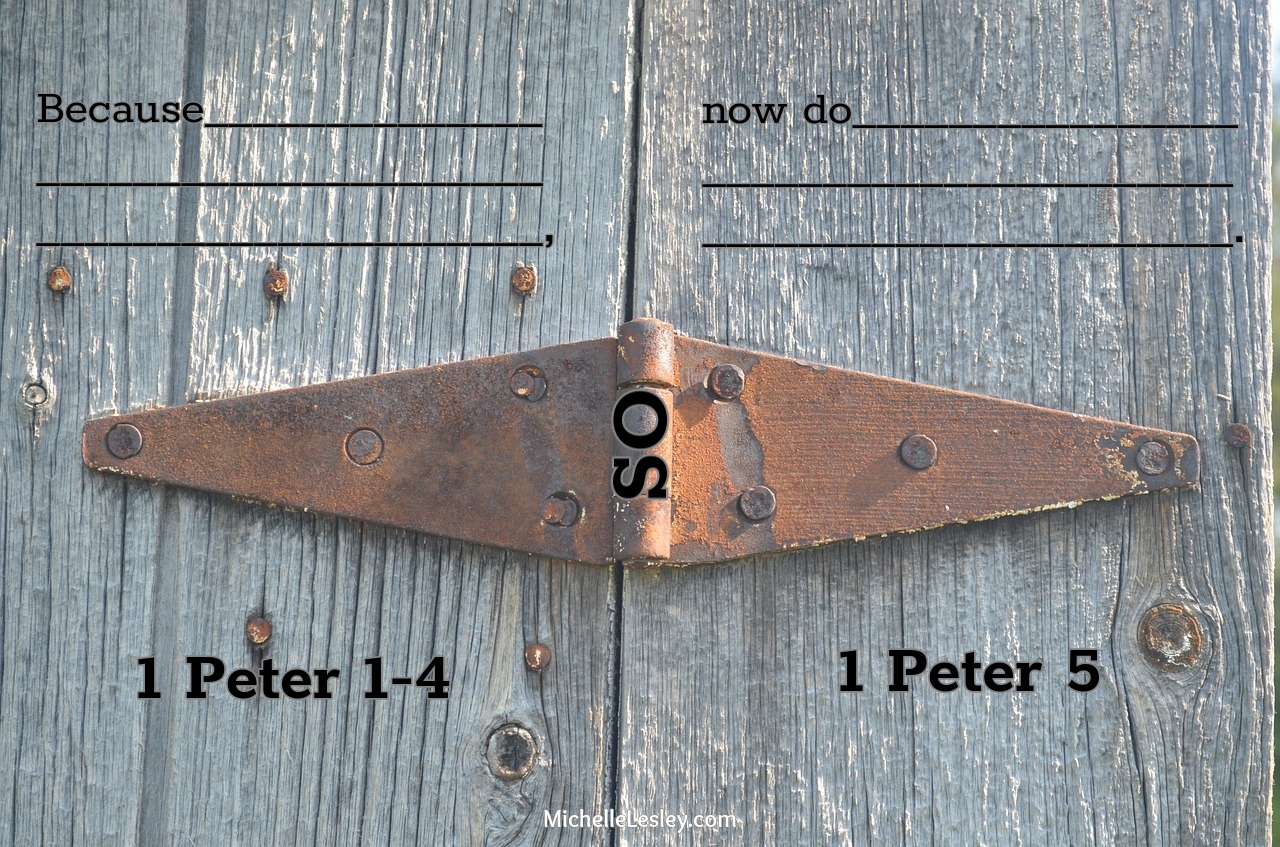
1. Verse 1 begins with another pivot (transitional) word. (Review lesson 2 if necessary – link above). What is that word? How does the word “so” act as a hinge between what we studied in chapter 4 (and the preceding chapters – links above if you’d like to review) and what Peter says in chapter 5?
2. Peter gave minimal credentials at the beginning of his letter, choosing instead to save the details of his authority until his closing. What credentials does he list supporting his authority to instruct pastors and the church? (1)
3. Who is Peter instructing in verses 1-3? (1) Chart Peter’s instructions to pastors and elders in verses 2-3:
Do this:Not this:But this:
Verse 2:
Verse 3:
Explain how each of these instructions speaks to a pastor’s character and how having a pastor who obeys these instructions is beneficial to a local church. What is a pastor’s reward for obeying these instructions? (4) What is the congregation’s responsibility? (5) Describe the dynamics of a church whose pastors/elders are obeying the instructions in 1-3, and whose members are obeying the instructions in 5. How does the pastor’s obedience make for better church members and vice versa?
4. What topic does verses 6-7 address? Verses 8-10? In each of these verses, Peter gives an instruction to obey and a reason for/explanation of that instruction. Chart these:
Instruction:Reason/Explanation:
Verse 6:
Verse 7:
Verse 8:
Verse 9:
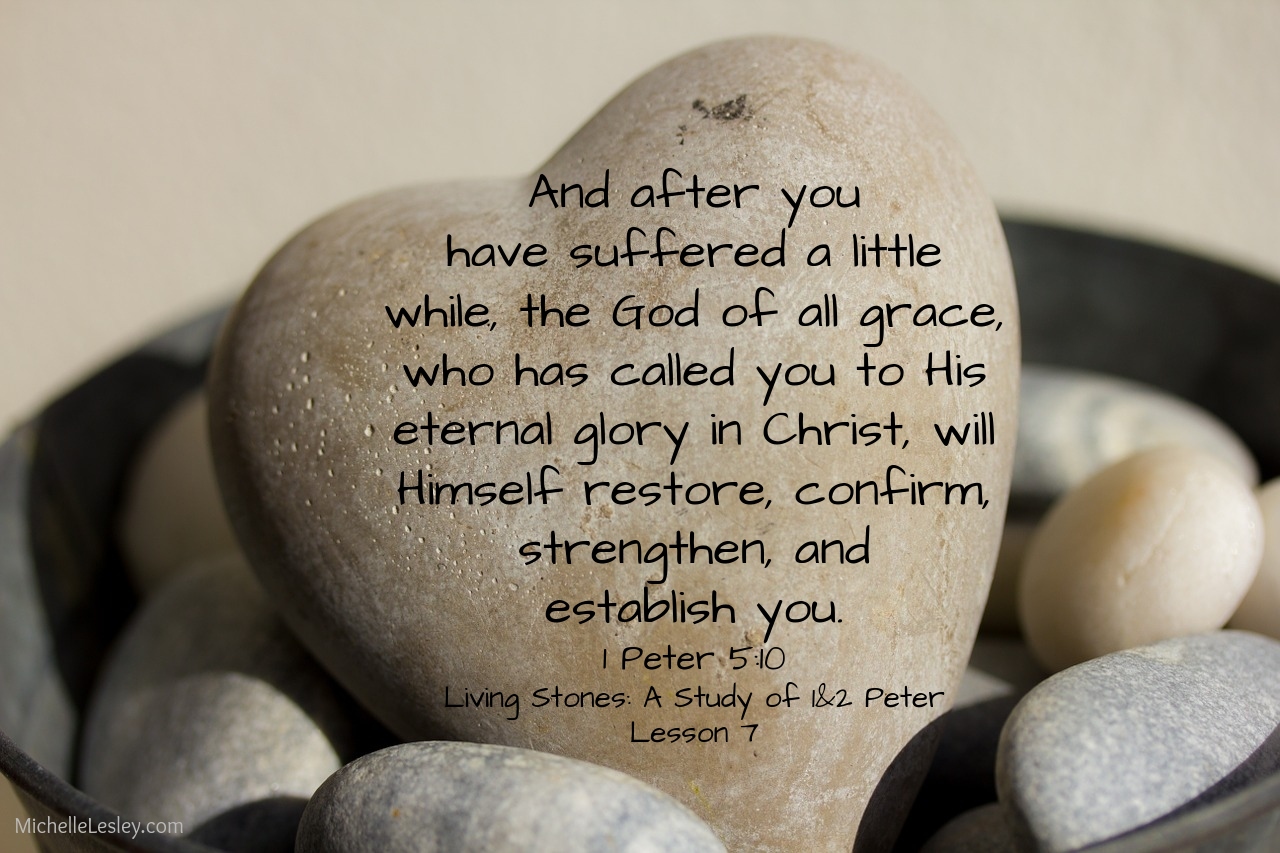
Verse 10:
How are each of these instructions practical in the life of a Believer? How do the reasons/explanations bring comfort and assurance to Believers? How would these instructions and reassurances have been a perfect fit for the dispersed, persecuted church of Peter’s day?
5. How does God receive dominion and glory (11) from pastors and church members obeying His instructions in verses 1-10? How does a healthy church glorify God?
6. Read verses 12-14. Using your cross-references and footnotes, who are Silvanus and Mark? What task was Silvanus performing for Peter? (12) Was Mark Peter’s biological son or his “son in the faith”? (13). Who is “she who is at Babylon”? (13) (Hint: See 1 Peter 1:1, and review lesson 1, link above) Why would Peter have been careful to speak in “code” like this? Is 14a a literal command to all churches for all time, or was it merely an instruction to the church to greet each other warmly in a culturally acceptable way? How might Peter have instructed Believers today to greet one another?
Homework
Review the instructions to pastors/elders in 2-3. Which of these instructions is your pastor really good at carrying out? Send him a brief note or e-mail thanking him for obeying God and benefiting your church in this regard.
I was saved at an early age and always had a heart for the things of God, reading His Word, memorizing it, and prayer. As an adult I was very active in my Baptist church, in children’s ministry or leading Bible studies for women, which I realize now were not actually Bible studies, but rather studying a book about someone’s interpretation of Scripture. I was very intrigued by Henry Blackaby’s book Experiencing God, and began to wonder how I might recognize God at work in my own life, how I might hear his voice. I read books on prayer and fasting by Bill Bright, learning of the “coming revival”.
It wasn’t until I began to read God Chasers by Tommy Tenney, though, that I thought perhaps I was missing something, since I had never felt the “manifest” presence of God. A friend loaned me Surprised by the Power of the Holy Spirit by Jack Deere, A Final Quest by Rick Joyner, and I was off into the world of the NAR (The New Apostolic Reformation), inhaling every book I could on intercessory prayer, especially enjoying Prayer Shield, written by C. Peter Wagner himself, the father of the NAR. I read about past revivals, about The Toronto Blessing. I had no understanding of the history or doctrines behind the movement, but was drawn in by the incredible experiences with God those in the movement seemed to have. Prophetic words, words of knowledge, Holy Spirit manifestations – they all seemed so much more exciting than what I had experienced in my Christian life. Much to my shame, I even went to see Todd Bentley when he was in town. I became convinced revival was on its way.
I thought perhaps I was missing something..
I was especially fascinated by listening prayer. Although I continued to read my Bible and memorize scripture, my focus became my time of contemplative prayer, listening to what I felt God was saying to me personally. This quote from my prayer journal shows the idol that listening prayer had become in my life. “I could die for you right now God, die for more of you.”
I began to assist a Baptist deliverance minister in town as well, in what was called “discernment,” listening to what God told me about the spirits that were impacting a person. I would also listen for a personal prophetic word for each person in ministry.
As my family was now in a Pentecostal church, it was very accepted to be hearing from God personally; I was just “prophetic”. Although I had previously written devotionals for the Proverbs 31 Homemaker, I now felt called to begin typing up my prayer journal notes into devotionals, much in the style of Sarah Young, who wrote her devotionals because she wanted more of God than the Bible. I had 400 in all, hoping to get them published and support different missions organizations.
The Pentecostal church we were attending became progressively more NAR, even having a church plant patterned after Bethel. It wasn’t uncommon to have a pastor from Bethel speak at our church’s conferences. I had never agreed with the doctrine that it was God’s will to heal everyone, which Bethel emphasized, but I had no idea that they actually were preaching a false gospel.
I had no idea they were preaching a false gospel.
Last fall I happened upon a YouTube video on Bethel’s theology by Mike Winger, which God used to begin to remove the scales of deception from my eyes. However, it was reading Angels of Light; False Prophets and Deceiving Spirits at Work Today in the Church & World by Eddie Hyatt, specifically his chapter on contemplative prayer, which made me realize I had been wading in dangerous waters. As I watched the Strange Fire Conference on the internet, I was terribly convicted by the true Holy Spirit. This propelled me into an incredibly intense, painful season of soul-searching – questioning what I believed against biblical doctrine – and a time of repentance. As I listened to YouTube videos of Doreen Virtue and Melissa Dougherty, two wonderful women God has brought out of the New Age, I realized that my “Listening Prayer” had more in common with hearing from Spirit Guides, that my getting “prophetic words” for people had more in common with cold readings, than with either prayer or the gifts of the Holy Spirit.
I was convicted by the true Holy Spirit…
Psalm 116 has become very precious to me, especially verse 6: “The Lord protects the unwary; when I was brought low, he saved me.” Although it truly sickens me that I could have been so deceived, I am very aware of how God’s hand was protecting me and my whole family through the whole process, and know that God is able to use my experience to bring about good.
Classes on listening prayer are becoming rampant in the church today, even in mainstream churches. The following is taken from a non-charismatic church offering such a class. “Learning to hear God’s voice and learning to use the gift of prophecy will be taught in alignment with biblical principles…” “loving and safe community to learn how to hear God’s voice for oneself and for others….designed to provide opportunities to encounter Father God, Jesus and Holy Spirit through a variety of worship experiences and listening exercises.”
If you are practicing listening prayer, or contemplative prayer, I beg you to look into its history, and examine scripture – see that Christ never told us to pray in such a way, either by example or as a teaching. You may think that you are practicing listening prayer, but still holding God’s Word as His revelation to you higher. From experience, I believe it is impossible to practice listening prayer and not have it erode your view of the sufficiency of Scripture as well as erode and distort your view of Jesus, God the Father, and the Holy Spirit. In the past I believed that what I was hearing from God was completely in line with Scripture. However, not only was it incredibly narcissistic, it began to reflect more and more the NAR teaching I was receiving.
In my spiritual journey, I believed that I was experiencing “revival” when I became involved in contemplative prayer, and extra biblical practices. But in God’s word, biblical revival was accompanied by a renewed love for God through the Scripture. I can honestly say that coming out of the NAR, with all of its deception, as painful as it has been, has brought with it true revival. I have never had such a profound sense of being “saved”, along with a growing hunger for Scripture and true knowledge of God. I realize that I was in NAR lite for several years, even in my Baptist church.
I have never had such a profound sense of being “saved”…
If you diligently seek scripture, you will not lose anything that is true; you will only lose the false. Please, don’t allow fear or pride to keep you from researching thoroughly. I only wish there had been someone to warn me earlier. Although in many NAR books you will be warned away from biblical discernment by being taught that thinking critically is a “critical spirit” or that if you compare a teaching to Scripture you are “religious or have a religious spirit” please follow scripture.
“Dear friends, do not believe every spirit, but test the spirits to see whether they are from God, because many false prophets have gone out into the world.” 1 John 4:1
Just a gentle word of caution. Do balance your research with time spent in God’s Word. It is easy to become almost obsessive in your quest for truth, in wanting to root out any lies of deception you believe, to be hyper-sensitive about being deceived again. Coming out of deception is a very painful experience. Have patience for yourself, and grace. God is a tremendous rescuer and he will lead you to freedom in His truth, as laid out in Scripture, as you seek Him.
Ladies, God is still at work in the hearts and lives of His people, including yours! Would you like to share a testimony of how God saved you, how He has blessed you, convicted you, taught you something from His Word, brought you out from under false doctrine, placed you in a good church or done something otherwise awesome in your life? Private/direct message me on social media, e-mail me (MichelleLesley1@yahoo.com), or comment below. Your testimony can be as brief as a few sentences or as long as 1500 words. Let’s encourage one another with God’s work in our lives!