Complementarianism, Mailbag, Rock Your Role

The Mailbag: Counter Arguments to Egalitarianism

What are some of your favorite counter-arguments to egalitarian theology? 

Such a great question for a plethora of reasons. One important reason is that it’s a hot topic right now that needs to be dealt with biblically in order to silence the lies and to make onlookers aware that the Bible does address this issue with the correct answer. Another reason is that, when you think through an issue via an apologetics, “point-counterpoint” framework, it really helps solidify in your mind, and give you confidence in, what the Bible has to say about the issue.

So let’s start off with some basics…

If “egalitarian” is a new term for you, let’s nail down what egalitarianism is and what complementarianism is. Both have to do with the issue of women’s roles in the church and in the home.

Egalitarianism is the anti-biblical view that women can do anything men can do in the context of the church and home. Women can be pastors, elders, heads of denominations, preach whenever, wherever, and to whomever they want, and they don’t have to submit to their husbands.

Complementarianism is the biblical view that women and men are of equal value and worth in salvation and in the imago dei, but have different, yet equally important roles in marriage and the church. Complementarians embrace the Bible’s teaching that women are privileged to portray the relationship of the church to Christ by graciously and joyfully submitting to our husbands. Complementarians honor and respect the high calling and unique gifting women have to disciple other women and to raise up the next generation of godly men and women by discipling our own, and other, children. Because this is such a weighty and arduous responsibility, we consider it a blessing that God has not also burdened us with the responsibility to preach, teach the Scriptures to men, or exercise authority over men in the context of the gathering of the church. Rather, we encourage the men who have been given this responsibility, leaving godly women free and unfettered to carry out the ministry God has given us.

Currently, there is a movement afoot to establish a third position regarding this issue. It’s often called soft complementarianism – an attempt to straddle the fence, make everybody in both camps happy, and have your cake and eat it too. There are a variety of beliefs among those who choose this label. Many would argue, for example, that a woman may not hold the office of pastor (i.e. she can’t be on staff as the pastor of a church), but it’s perfectly OK for her to guest preach the Sunday morning sermon. At least on Mother’s Day.

Let’s dispense with soft complementarianism right now. It is a position of compromise between the biblical and the anti-biblical. Compromising with sin has never been a biblical stance for God’s people to take. Ever. The Bible tells us “a little leaven leavens the whole lump.” You don’t have to consider yourself a full-blown egalitarian to infect the church with ungodliness. Just a little compromise, a little leaven, a little dab’ll do ya. And that little dab never makes the church or individual Christians more godly, more biblical, or more Christlike. It always leads to more compromise and greater ungodliness.

Furthermore, we don’t treat other sin and rebellion this way. No one would dream of saying, “I hold to a soft view of adultery. Only actual extra-marital sex is off the table. Kissing, touching, dating other people – that’s all fine.”

For those who would argue that complementarianism vs. egalitarianism is a secondary theological issue, I would argue vehemently that it should not be categorized this way. Egalitarianism is sin because it is rebellion against God’s Word. And it is extremely detrimental when high profile complementarians unhelpfully classify it as a “secondary issue”. I know all they mean when they say that is that it is not part of the ordo salutis or a linchpin doctrine of soteriology. But when Christians hear “secondary issue” what they think is, “Oh, this is an issue where both sides have genuine biblical support like pre/post/a- millennialism or credo/paedo baptism. We can just agree to disagree and both sides are biblical.” Nobody thinks that about adultery, murder, gossip, lying or any other sin, and we need to be more careful in our terminology lest we give people an opening to think that way about egalitarianism.

Rebelling against God’s commands regarding the role of women is either a sin or it is not. There is no middle ground, so so-called soft complementarianism is not a biblically legitimate position to take. If you’re a “soft complementarian,” you’re a functional egalitarian. And if you’re a Christian who’s toying with this idea, I urge and encourage you to repent, love Christ and His Word more than you love the world and its ideals, and unashamedly embrace and promote what the Bible says about the role of women.


The next foundational issue we need to explore is whom we’re addressing when we make these apologetic arguments.

There are only two kinds of people in the world: saved people and unsaved people. Which means there are only two kinds of people who hold the egalitarian view: saved people and unsaved people.

The Bible is abundantly clear that saved people have the mind of Christ. That means we think the way Jesus thinks and we view the world and the church the way Jesus views the world and the church. We deny ourselves, putting aside whatever we might want or think, and we submit, as Jesus did, to “It is written…“. Additionally, obedience (or lack thereof) to the commands of Scripture is an indicator of whether or not someone actually belongs to Him. In fact, God says if you claim to be a Christian and you habitually and unrepentantly walk in disobedience to, and rebellion of heart against, His commands, you’re a liar, and you don’t know Christ.

What this means in practical terms when dealing with any biblical issue – egalitarianism, evolution, abortion, homosexuality, etc. – is that a sizable portion of the people on the unbiblical side of the issue are unsaved. Because a saved person has the mind of Christ, she will embrace, believe, and obey God’s Word regarding these issues and come out of these unbiblical camps, and an unsaved person will continue to fight for the unbiblical position. A new or previously poorly discipled Christian may need to be taught what Scripture says about these things, and it may take some time for her to come to grips with God’s commands, but her nature is to fight her flesh to submit to God’s Word, not to make provision for her flesh to fight against God’s Word.

Why do we need to understand this crucial foundational concept in debating this issue? Because people who are unsaved regard the things of God as foolishness and they cannot accept them no matter how much you explain Scripture to them or how much sense you make. This is a spiritual issue that requires a spiritual solution – the Holy Spirit must save the person and open her eyes to the truth of His Word. Often, what the person you’re arguing with needs most is the gospel, not an argument about a theological issue. And you will need to be careful and wise to discern when your apologetics are helpful and effective with someone who truly wants to learn and accept the biblical view, and when it’s time to gather up your pearls, step out of the pigpen, and go home until the Holy Spirit does His good work in her heart.

So I guess all of the above would be my primary apologetic argument against egalitarianism: If you’re truly saved, the fruit of your new nature in Christ will be to forsake and repent of any opinions or positions you hold that conflict with Scripture and submit to, love, and obey God’s commands. If you’re not saved, your opinion doesn’t really matter when it comes to how the church is run because the church is the body of Christ – Believers – not the house of unbelief.


Another argument I’m fond of is what I call the “let’s take a stroll through the Bible” argument, because it addresses so many arguments about 1 Timothy 2:12 that it’s almost a “one size fits all” argument:

But the Bible only says one time that women can’t preach to men!

That was just Paul, as a human, saying women can’t teach men, not God.

That passage is about wives taking authority over their husbands, not about women preaching to or exercising authority over men in the church.

That instruction only applied to the women of the Ephesian church at that particular time.

Look at the overall general pattern of male headship and leadership in Scripture. First human created? A man. The Patriarchs? As the word implies โ€“ all men. Priests, Levites, Scribes? Men. Heads of the twelve tribes of Israel? Men. Major and minor prophets? Men. All kings of Israel and Judah? Men. Noahic, Abrahamic, Mosaic, and Davidic Covenants? All established between God and men. Authors of Scripture? Men. The forerunner of Christ? John the Baptist โ€“ a man. Messiah? A man. All of the apostles? Men. All of the pastors, elders, and deacons of churches in the New Testament? Men. Founder and head of the church? Christ โ€“ a man. Leader and head of the family? Men. Now which fits better with this pattern, women preaching to, teaching, and exercising authority over men in the church, or women not preaching to, teaching, and exercising authority over men in the church?

It’s not just one verse. The entirety of Scripture backs up 1 Timothy 2:12. Which means it wasn’t just Paul’s human idea, just for the women of Ephesus, or just about wives and husbands. Male headship and leadership in God’s foundational institutions – family and church – has been God’s idea, God’s plan since the dawn of Creation (as 1 Timothy 2:13-14 clearly explains). It’s much harder for someone claiming to be a Christian to throw out the whole Bible than to sweep one verse aside.


Another argument that often needs to be made is explaining the difference between descriptive and prescriptive passages of Scripture, because one of the most common arguments egalitarians will make is, “Look at Deborah! Look at Priscilla! Look at the women at Jesus’ tomb! Look at the women Paul commends in Romans 16! They were all in some sort of leadership or teaching position, so that means women can do anything in the church that men can do!” No. No it doesn’t.

Broadly speaking, there are two main types of Scripture: descriptive and prescriptive. Descriptive passages describe something that happened: Noah built an ark. Esther became queen. Paul got shipwrecked. These passages simply tell us what happened to somebody. Prescriptive passages are commands or statements to obey. Donโ€™t lie. Share the gospel. Forgive others.

If we wanted to know how to have a godly marriage, for example, we would look at passages like Ephesians 5:22-33, 1 Corinthians 7, and Exodus 20:14,17. These are all passages that clearly tell us what to do and what not to do in order to have a godly marriage.

What we would not do is look at Davidโ€™s and Solomonโ€™s lives and conclude that polygamy is Godโ€™s design for marriage. We would not read about Hosea and assume that God wants Christian men to marry prostitutes or adulteresses. We would not read the story of the woman at the well and think that being married five times and then shacking up with number six is OK with Jesus.

And when looking for instruction about the role of women in the church, we look to clear, prescriptive passages which tell us what to do and what not to do, not descriptive passages about various women in the Bible. Descriptive passages may support, but never trump, the clear instruction of prescriptive passages.

(Excerpted from my article Oh No She Di-int! Priscilla Didnโ€™t Preach, Deborah Didnโ€™t Dominate, and Esther Wasnโ€™t an Egalitarian. I’ve also addressed each of the women often trotted out in defense of the sin of role-busting in this article.)


Some try to make the argument that it’s OK for a woman to preach or teach Scripture to men if she’s doing it “under her husband’s/pastor’s authority”. Excerpted from my article Fencing off the Forbidden Fruit Tree:

When God tells us (in context, rightly handled, correct covenant, etc., of course) not to do something and we do it anyway, that is sin, right? Only God has the authority to say what is sin and what is not. No one โ€“ not your pastor, your husband, your parents, your best friend, the Pope, nobody โ€“ has the authority to tell you that itโ€™s OK to do something God has said is sin. That authority belongs to God alone.

Try inserting any other sin into that situation. Does your husband, pastor, etc., have the authority to tell you itโ€™s OK to lie? Cuss? Covet? Of course not. And why would they even consider doing such a thing?

If you were to ask your husband and pastor to show you from Scripture where God says itโ€™s OK for them to allow you to teach men, they would quickly realize that they are not basing their decision on Scripture (because there is no Scripture that allows them to do this), but on their own opinion that itโ€™s OK.

When God says “no,” no man has the right to say, “yes.” 


And there’s the “You don’t know Greek, so you don’t know what that passage really means. I do.” fallacy.


Some have tried to make the argument that 1 Timothy 2:12 is mistranslated – that “woman” and “man” should be translated as “wife” and “husband” – and that this passage isn’t prohibiting women from teaching men at all, it’s really about marriage. The short answer to that is: hogwash. If you’d like to read the longer version, check out my article The Mailbag: Potpourri (…Mistranslating 1 Tim. 2:12…) (second question).


And finally, if a Christian struggles with the biblical argument against egalitarianism, God has graciously given us a real-time, tangible, visible argument against it. Take a look at all the once doctrinally sound Christian churches and denominations that are now apostate – the ones that embrace homosexuality, New Apostolic Reformation heresy, preach morality or liberal politics instead of the gospel, etc. They all followed the same pattern. The very first step they took on the road to apostasy was “soft complementarianism”: letting women teach co-ed Sunday school classes, preach on Mother’s Day, hold committee positions that placed them in biblically improper authority over men, and so on. The next step was full blown egalitarianism: allowing women to be elders, ordaining women as pastors, placing women in unbiblical denominational leadership positions. Next came embracing homosexuality: extending church membership to unrepentant, practicing homosexuals (and now, transgender people), ordaining them, and allowing them to serve in any and every position of church and denominational leadership, including the pastorate. And the final step is abandoning the gospel and the authority and sufficiency of God’s Word altogether. It happened to the Lutherans, the Episcopalians, the Methodists, the Presbyterians, scores of non-denominational churches, and now it’s happening to Southern Baptists. Not a single church or denomination that has embraced egalitarianism has become holier, truer to God’s Word, or more spiritually healthy. They have all ended up dead eventually, and the true Christians in those churches and denominations have left to form biblical churches and denominations.

Egalitarianism is anti-biblical, harmful to men, women, and the church, and dishonoring to God. We may not be able to convince every egalitarian to repent and embrace what God’s Word says about the role of women, but it’s important to think through this issue in a biblical way, and using an apologetic framework is a great way to do that.

Additional Resources:

Rock Your Role Series

Jill in the Pulpit

Oh No She Di-int! Priscilla Didnโ€™t Preach, Deborah Didnโ€™t Dominate, and Esther Wasnโ€™t an Egalitarian

Women Preaching: Itโ€™s Not a Secondary Doctrinal Issue

All Things Being Equal

Rock Your Role FAQs

Fencing off the Forbidden Fruit Tree

The Mother of All Rebellions: Having a Woman Preach on Mother’s Day

Ten Things You Should Know About 1 Timothy 2:11-15 and the Relationship Between Men and Women in the Local Churchย at The Council on Biblical Manhood and Womanhood (CBMW) This is a refutation of the most common egalitarian arguments against the plain meaning of 1 Timothy 2:11-15.

The Paul-Side Gambit: How A Proper Understanding of Apostolic Authority Defeats Womenโ€™s Ordination by Chris Rosebrough


If you have a question about: a Bible passage, an aspect of theology, a current issue in Christianity, or how to biblically handle a family, life, or church situation, comment below (Iโ€™ll hold all questions in queue {unpublished} for a future edition of The Mailbag) or send me an e-mail or private message. If your question is chosen for publication, your anonymity will be protected.

Christian women, Complementarianism

The Mother of All Rebellions: Having a Woman Preach on Mother’s Day

When you gaze out across the landscape of the visible church through an earthly, superficial lens, you’ve got to scratch your head and wonder, “Has evangelicalism lost its ever-lovin’ mind?”.

And the answer is to take off those inch-deep dollar store glasses, fire up the electron microscope of Scripture, look long and deep into God’s Word, and reply to yourself, “Of course it has, silly rabbit. What did you expect?”. The Bible is perfectly clear about these things and why they happen.

Exhibit A: The trend in recent years to invite a woman to preach the Sunday morning sermon in church, to the whole congregation (including men) just because it’s Mother’s Day. Not a brief personal testimonythe sermon. This isn’t anything brand new. Lisa Harper has done it at Max Lucado’s church. Christine Caine has done itLisa Bevere has done it. Lysa TerKeurst has done it. Priscilla Shirer has done it. And a host of other famous and unfamous women at famous and unfamous churches have been doing it for years, even at churches that normally obey Scripture and don’t let women preach.

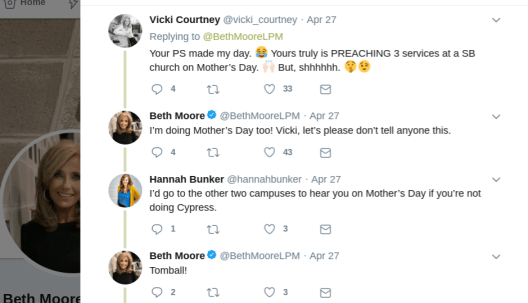
This year (2019), Beth Moore has caused quite the stir by hiding in plain sight the fact that she will be preaching the sermondoing Mother’s Day” this coming Sunday, presumably at the Tomball, Texas, campus of the church she attends (founded and pastored by her son-in-law Curtis Jones1) Bayou City Fellowship:

I say “hiding in plain sight” because she has given enough of an impression here that she is preaching the sermon to test the waters and see what the reaction will be, but has worded her tweet vaguely enough that if she meets too much resistance she can still decide to back out of preaching, give a brief word of biblically appropriate Mother’s Day greeting or encouragement to the ladies at another point during the service, and come back and claim with wide-eyed innocence that that’s what she meant all along by saying she was “doing” Mother’s Day. (Someone asked Beth point blank, in a subsequent tweet if Beth’s tweet meant that she would be preaching the Sunday service and Beth did not answer her. If she’s not, why not just say so? And if she is and isn’t ashamed of it, why not just say so?)

I say “presumably” at BCF-Tomball because, even though she publicizes specific details about time and place with other speaking engagements, she has not mentioned (at least not anywhere I can find as of the time I’m writing this) the specific church she’s preaching at on Sunday, and the church hasn’t mentioned on their website that she’ll be the guest preacher. Additionally, unlike other speaking engagements Beth does, this speaking engagement is not listed on the calendar of events at her website and she hasn’t mentioned it (other than the tweet above) on social media. With all this “open secrecy” I will be surprised if the video or audio of her sermon is posted on YouTube and/or the church website.

Why all this cloak and dagger about the highest profile woman in the Southern Baptist Convention2, possibly in the entirety of evangelicalism, preaching the Mother’s Day sermon?

Because she knows it’s unbiblical. Because we know it’s unbiblical. And it doesn’t take an electron microscope to see it. It’s right there, in black and white, jumping off the pages of Scripture:

I do not permit a woman to teach or to exercise authority over a man; rather, she is to remain quiet. 1 Timothy 2:12

It couldn’t be more clear. And for pastors who ought to know better to either fall prey to or intentionally perpetuate the serpentine seduction of “Did God really say you can’t preach?”, using Mother’s Day as an excuse to induce a woman to sin by having her deliver the sermon is a slap in the face – to God, to the church, and to women.

Using Mother’s Day as an excuse to induce a woman to sin by having her deliver the sermon is a slap in the face – to God, to the church, and to women.

What do his actions say to God? “I don’t like Your way and I won’t submit to it. I don’t trust that Your way is right regardless of what the world says. I’ll do what’s right in my own eyes.” It’s the lesson his church learns from his actions as well.

But why is inviting a woman to preach an affront to Christian women? Take a stroll down to verse 15 of 1 Timothy 2:

Yet she will be saved through childbearingโ€”if they continue in faith and love and holiness, with self-control.

Not only does the pastor who invites a woman to preach adulterate the role God has set aside specifically for men, he also denigrates one of the good and holy roles God has specifically and intentionally set aside for women: the role of literal, and spiritual, mother.

Eve shattered God’s perfect, unique design for women by allowing herself to be seduced into rebellion. But are we daughters of Eve forever doomed to bear the shame and guilt of her sin, never to have a role in building the Kingdom? Pariahs, to be shunned and shut out of God’s plan? No, praise God! Through the cross, the good works Christ has ordained for Christian women to do – including mothering our own children and being spiritual mothers to our daughters in the faith – redeem the prestige of women. Mothering, in every sense in which God intended it, raises the role of women back to its rightful place in God’s plan.

And we don’t need men – especially men who are supposed to be rightly leading God’s people – to come along and entice us to mess that all up again.

But that’s exactly what’s happening.

When a pastor invites a woman to sin by taking over the pulpit, he drags her and the women of his church right back to post-Fall Eden. He trashes the rank and repute of our God-given high and holy role of mother and implicitly says Being a woman isn’t good enough. You have to steal the role of men to be valued and esteemed. 

When a pastor invites a woman to sin by taking over the pulpit, he implicitly says, “Being a woman isn’t good enough. You have to steal the role of men to be valued and esteemed.”

Ladies, he’s wrong.

We don’t need to be second rate imitations of men in order to “count”. We need to be first rate, full throttle, take it to the limit women of God. God loves us and values us so much more than to give men a special and amazing role and leave us without an equally special and amazing, yet totally distinct, role. The God who spoke the universe into existence and planned out an unparalleled purpose for every single plant, animal, bacterium, and every other atom of the cosmos, did not leave the queen of His creation roleless. He did not bring us into being only to toddle along after the Hairy Ones trying to copy their every move. How unloving of God, and devaluing to women, would that be? Why would you want to act like a man when God blessed you with the gift of being a woman?

If, by God’s good Providence, you’ve “stumbled across” this article and you’re a woman who has been invited to preach, I plead with you: don’t buy the lie. Say no. Your Savior has a whole treasure chest of good works for you to do as a woman. You are worth infinitely more to Him as the woman He created you to be than you are to the world, or a worldly church, as a cheap knock-off of a man.

The practice of denigrating women, devaluing our God-given role, disobeying God, and darkening the understanding of the church by inviting women to sinfully take the pulpit must stop in the house of God.

Let us be the mothers our own children need, raising up a godly seed unto the Lord. Let us be the spiritual mothers longed for by younger women in the faith, daughters orphaned by Christian women who have abandoned them to take on the role of men. The practice of denigrating women, devaluing our God-given role, disobeying God, and darkening the understanding of the church by inviting women to sinfully take the pulpit must stop in the house of God and be replaced by strong godly women, unafraid and unashamed to flourish in the precious role our Lord has blessed us with.

Especially on Mother’s Day.


Updates to this article:

1Curtis Jones (Beth Moore’s son-in-law) resigned his pastorate at BCF in July 2020.

2Beth Moore has left the Southern Baptist Convention.


Additional Resources:

Beth Moore vs. Owen Strahan on WWUTT Podcast
(Related links):
โ€ขMichelle Lesley’s Twitter thread on Beth’s Sunday sermon preaching
โ€ขBeth Moore’s Twitter response to Midwestern Seminary professor Owen
Strahan’s article on biblical complementarianism

โ€ขDivine Order in a Chaotic Age: On Women Preaching by Owen Strahan

Why Asking Women to Preach Is Spiritual Abuse by Josh Buice

Complementarianism, Mailbag

The Mailbag: “What’s a Woman to Do?” Potpourri

Welcome to another โ€œpotpourriโ€ edition of The Mailbag, where I give short(er) answers to several questions rather than a long answer to one question. I also like to take the opportunity in these potpourri editions to let new readers know about my comments/e-mail/messages policy. Iโ€™m not able to respond individually to most e-mails and messages, so here are some helpful hints for getting your questions answered more quickly. Remember, the search bar can be a helpful tool!

In these potpourri editions of The Mailbag, I’d also like to address the three questions I’m most commonly asked:

“Do you know anything about [Christian pastor/teacher/author] or his/her materials? Is he/she doctrinally sound?”

Try these links: 
Popular False Teachers /
 Recommended Bible Teachers / search bar
Is She a False Teacher? 7 Steps to Figuring It Out on Your Own
(Do keep bringing me names, though. If I get enough questions about a particular teacher, I’ll probably write an article on her.)

“Can you recommend a good women’s Bible study?”

No. Here’s why:
The Mailbag: Can you recommend a good Bible study for women/teens/kids?
The Mailbag: โ€œWe need to stop relying on canned studies,โ€ doesnโ€™t mean, โ€œWe need to rely on doctrinally sound canned studies.โ€.

“You shouldn’t be warning against [popular false teacher] for [X,Y,Z] reason!”

Answering the Opposition- Responses to the Most Frequently Raised Discernment Objections


It’s ladies night!…er…day…or whatever. I’ve accumulated several questions that have to do with women’s roles in the church and home, so that’s the theme of today’s Mailbag. If you have similar questions, you might find my article Rock Your Role FAQs to be helpful.


Is it biblical for women to serve as children’s ministry leaders or directors in the church?

It could be, depending on the situation. (You should not bear the title Children’s “Pastor,” though. Biblically, women are not pastors so carrying that title would be dishonest and misleading.)

It is perfectly biblical for women to teach and lead children in the church setting. (And when I say “children”, I mean birth to about age 12. I’ve addressed women teaching youth/teens here, #13.) The biblical prohibition is against teaching and holding authority over men in the church. Male children are not men.

The potential 1 Timothy 2:12 issue is not with teaching and leading children or supervising other women who teach children. The issue at play is whether or not you’ll be holding unbiblical authority over any men who work or volunteer in the children’s department as Sunday school teachers, Awana leaders, nursery workers, etc. And that’s something that’s got to be examined on a case by case basis. It could be completely biblical for you to serve as a children’s director in one church but not in another simply due to circumstances of the environment.

Does your church only have women working in the children’s department? Is there an associate pastor or elder over you that handles any issues of authority? Would you have to train, evaluate, or correct male volunteers? What kinds of things would male volunteers need to come to you about? These and other questions all need to be carefully considered by your pastor, elders, your husband, and you.

Generally speaking, it is biblically OK for a woman to serve as children’s ministry leaders as long as that position, in that particular church, does not require her to instruct men in the Scriptures or hold unbiblical authority over men.


My husband is a new Christian (Praise the Lord!). I was raised in church and have a firm foundation in the Word, but unfortunately he was not blessed with such an upbringing. When we study the Bible together at home, how can I handle his lack of knowledge in a Godly way? I know what the Bible says about women not teaching men, and I strongly desire to be obedient to God’s Word. I’m just a little confused about what that looks like in this situation.

I rejoice with you over your husband’s salvation! This is a great question that’s probably on the minds of many godly women.

First, I think we might need to review a little bit of “what the Bible says about women not teaching men.” When Scripture prohibits women from teaching or holding authority over men, it does so in a specific setting: the gathered body of Believers (the church – You may want to go back over my article Jill in the Pulpit.). You are talking about helping your newly saved husband privately, at home. That’s different, and it is not included in the 1 Timothy 2:12 prohibition.

At home, between the two of you, the only issue is whether you’re submitting to him and respecting him. If your husband wants you to explain things to him from Scripture and you do that in a loving, kind, and submissive way, there’s absolutely no biblical problem with that. (It’s also important that you know the correct answers to his questions and can handle Scripture rightly. If not, study it together or ask your Sunday School teacher, pastor, etc., for help.)

In Scripture, we see Priscilla and her husband Aquila taking Apollos aside privately (likely in their home) and helping him understand “the way of God more accurately.” And Paul commends Priscilla in “the great thank you list” of Romans 16. She would not have been mentioned in a positive light in Acts nor commended by Paul in Romans if she had been sinning by helping Apollos. And if she wasn’t sinning by helping Apollos, who wasn’t even her husband (again, recalling that this was a private conversation, not teaching in the church), it would not make sense that it would have been wrong for her, or any other woman to help her own husband.

In 1 Peter 3 and 1 Corinthians 7 we see that a woman can be instrumental in bringing her unsaved husband to Christ. Why, then, would she not – privately, at his own request – continue to answer his questions, explain things, or suggest passages of Scripture for him to read after he got saved?

It would be beneficial to your husband for him to begin learning from godly men, not because it’s wrong for you to help him learn, but because other men can help him learn his role as a Christian man and how to handle things men go through better than a woman – even his wife – can. It might be helpful to your husband for you to suggest good books by doctrinally sound men for him to read and good preaching and podcasts to listen to (see some of my favorites in the sidebar to your left). He would probably also benefit tremendously from getting involved with a men’s group or Bible study at church, or having a godly older man disciple him.

What a blessing that God has given your husband a knowledgeable, godly wife who can help him!


I teach the Bible to women and young people in the home of a Christian sister. Frequently, her husband brings his Bible and sits in on the group. I usually just ignore the fact that heโ€™s in there and focus on the youth, because, technically, that’s who I’m there to teach. I feel uncomfortable with him there because I agree with the Bible that I’m not supposed to be teaching men, but I also feel uncomfortable asking him to leave his own den. What do you recommend in this case?

It’s a bit of a sticky situation, but more because of etiquette and logistics than because of Scripture. Let’s explore a few different aspects of this situation.

โœข Is the husband saved? If he’s unsaved, the dilemma stops here. He’s not part of the church (the universal body of Believers), he’s an outsider observing Christians, and the things of God are folly to him. He’s not even capable of understanding Christian teaching on a spiritual level, so you’re not teaching him. At best, he’s absorbing enough of the gospel to eventually lead him to Christ. That would fall under the category of evangelism, and Scripture doesn’t prohibit women from sharing the gospel with men. (See #11 here)

โœข Take into consideration that different people sometimes have different ideas about etiquette and social interactions. Whether or not he’s saved, it’s possible the husband is sitting in on the group because he feels, as the host, it would be rude of him not to. By talking with him about your discomfort with his presence, you might actually be letting him off the hook when there are other things he’d rather be doing.

But from here on out, we’ll assume the husband is saved and doesn’t fully understand that women aren’t to teach men in the gathered body of Believers.

โœข You mentioned that you are teaching “women and young people”/”youth”. I’m inferring from that phraseology that this group of “young people/youth” is a co-ed group in their teens. If I’m correct about that (and maybe I’m not), this could be part of the issue depending on the age of the kids in the group. First, of all, if the males in this group are in their late teens to early 20s or older, you really don’t have a leg to stand on. You’re teaching men (even if they are young men), so that needs to stop. But this could also be a contributing factor to why the husband is coming to the study, especially if he is a younger man. If he sees you teaching 18 year old young men and he’s 25, he probably doesn’t see much difference between those young men and himself and assumes he’s welcome to attend. There’s no hard and fast biblical command about it, but I usually recommend women stop teaching boys around the time they start middle school (12ish). I’ve explained more here, #13.

โœข It’s possible the husband only has a partial understanding of the applicable Scriptures here. Perhaps he thinks Scripture only says women can’t be pastors or that as long as you’re outside the four walls of the church building you can teach men. Maybe you and his wife can pull him aside privately after the meeting or at another time and explain a little bit more about what Scripture says, your desire to obey it, your discomfort with him there, and your discomfort with asking him to leave.

โœข You know the husband and his wife better than I do. Would it work better to explain things to the wife and ask her to talk to him? Or possibly for you and your husband to talk to him and his wife together? It might also be beneficial for you to set up a meeting with your pastor and get some wise counsel from him on how to proceed.

โœข Enlist the aid of your husband and/or some other godly men at church. They could invite this fellow to join them during your class time for a men’s Bible study, bowling, a movie, dinner, watching the game on TV, or whatever. Maybe the husband just needs some friends or a better offer! :0)

โœข If you’ve talked to the husband and he understands what Scripture says, and your dilemma, and he refuses to refrain from attending the class, it’s time to move the class meeting to another location – perhaps your house, the church, or the home of someone else in the group. If it gets to this point, things have moved beyond whether or not you’re teaching a man. Now he’s intentionally being a stumbling block to a sister in Christ (which, if you belong to the same church, actually requires church discipline). He is sinning and he causing you to sin against your conscience. Scripture says if something causes you to sin, remove it. Since you can’t remove him from his house, you’ll have to remove yourself from his house.

โœข Finally, along the lines of removing things from your life that cause you to sin, if you’ve tried every possible way of working things out and you’re still going to be in a situation where you’re sinning against your conscience, step down from teaching. As much as you might want to, you do not have to teach that class. And it’s far better to  give up a “want” and not sin than to keep doing a “want” and sin. God takes sin very seriously, and we should, too.

I’ve tried to cover a range of possibilities and solutions, and some of them may sound extreme, but most of the time situations like this among friends, and especially among church family, can be resolved with a simple, loving conversation. Try talking to him about it, and you’ll most likely be able to work it out.


If you have a question about: a Bible passage, an aspect of theology, a current issue in Christianity, or how to biblically handle a family, life, or church situation, comment below (Iโ€™ll hold all questions in queue {unpublished} for a future edition of The Mailbag) or send me an e-mail or private message. If your question is chosen for publication, your anonymity will be protected.

Christian women, Complementarianism

Toxic (Evangelical) Femininity

Toxic masculinity. It’s a buzzword that’s gaining momentum as it’s bandied about in pop culture like a shuttlecock over a badminton net. There’s a clinical definition of the term (which, in the ivory towers of the scholarly world is, properly, “hegemonic masculinity“):

Hegemonic masculinity is defined as a practice that legitimizes men’s dominant position in society and justifies the subordination of women, and other marginalized ways of being a man. Conceptually, hegemonic masculinity proposes to explain how and why men maintain dominant social roles over women, and other gender identities, which are perceived as “feminine” in a given society.

And then there’s the sort of similar working definition of the huddled masses: Anything a man does that others, especially women, don’t like that can, by any stretch of the imagination, be blamed on the fact that he’s a man.

If a man cuts you off in traffic, it’s not that he’s a jerk or didn’t see you, it’s toxic masculinity. If a man holds a door open for a woman, it’s not that he’s polite and helpful, it’s toxic masculinity. If a man leaves his socks on the bathroom floor, it’s not that he’s sloppy and has no home training, it’s toxic masculinity. In other words, he’s not doing these things because he’s a polite or rude or aggressive or helpful human being, it’s because he’s a man who just wants to keep women down and exercise dominance over them.

Pardon my French, but what a bunch of malarkey.

Yes, I’m sure there’s a fringe element of men out there whoย consciouslyย think they’re better than women, that women shouldn’t have any rights or hold any positions of responsibility, blah, blah, blah. And you know what? They’re considered fringe kooks, and rightly so. But I’m not buying this business of these elitist gnostics telling us that every little move a man makes is a subconscious act of belittling women or exercising domination over them, and neither should you. It’s like the race-baiters who say that every single white person is racist, deep down, and this latent racism manifests itself in everything we do, from the way we tie our shoes to the breakfast cereal we buy at the store. We’re just not aware of it, supposedly.

Poppycock.

You want to know where this notion of toxic masculinity came from? It sprang from the loins of toxic feminism. Zoom out and look at the big picture. This is a manufactured concept, baptized in the (assumed) credibility of academia, designed to help women leverage power and control over men. How? By denigrating them at every turn, thereby convincing the world that men are intrinsically bad and women are good and must be elevated to prominence. Call me crazy if you want to, but it doesn’t take a prophet or the son of a prophet to look down the road and see that the feminist end game here is a matriarchal world where women rule and men drool. And there are plenty of brazen females out there who would openly and unashamedly admit this.

That, however, is not my concern. Sinners gonna sin, and God’s going to deal with them in His own way and in His own good time.

My concern is the way this attitude is fleshing (pun intended) itself out in Christian families and the visible church, and creeping into evangelical women’s (and men’s) hearts. Because, whether or not we’d like to admit it, this worldliness is advancing upon us, and we need to be aware of – and biblically approach – the facets of this issue that are already at our doorstep:

On the Top of the World Looking Down on Creation

I actually laughed out loud when reading some of the academic definitions of so-called toxic masculinity. There seemed to be an air of, “We just don’t understand it! This pattern of male dominance seems to transcend all cultures and time periods!”

Well here’s a really academic response to that: Duh.

I mean, you have to wonder if these researchers and scholars have ever said toย  themselves, “I wonder if there’s a reason for that. I wonder if this tendency in men that defies time and culture can be traced back to a pinpointed source.”

There is, and it can. It’s called Creation, and God is the one responsible. God created man first and then woman. God created husbands to lead and wives to be helpers. God set up the Old Testament patriarchal society that became the nation of Israel, which was led by male tribal heads and, later, male kings. God established male leadership in the temple, and subsequently, in the church. The major and minor prophets were male, Jesus was male, the apostles were male, the writers of Scripture were male. And all of this traces back to that one moment in Genesis 2 in which God decided to create man first and hard-wire him to lead, protect, and git ‘er done. Broadlyยน speaking, the reason we see a generalยน pattern of male leadership across time and culture is because God set those wheels in motion.

As Christians, we recognize that sinful men sometimes abuse the positions of leadership God has given them, but that doesn’t negate the entire pattern and call for us to turn it on its head. We study our Bibles and embrace and submit to the way God has instructed men and women to behave in the roles He has bestowed upon us.

(Don’t) Do the Woke-Emotion

One of the components of God’s creative work that adds inexplicable beauty to this world is the tender-heartedness, passion, and empathy He built into women in a uniquely feminine way. Emotions. Feelings. God created them, and they areย good. What a dreary and heartless world this would be if women didn’t bring nurturing, caring, sympathy, and love to the table. God uses us to soften the hard edges of life and make the planet pleasantly inhabitable.

But along with that good gift comes the challenge to steward it wisely and in obedience to God so that we may use it to glorify Him rather than dishonoring Him.

I see Christian women wisely stewarding their emotions to the glory of God every day as they care for their husbands and families, friends and co-workers, and serve in their churches. It is a beautiful picture of the mature fruit of biblical womanhood.

Unfortunately, I also see the exact opposite. I see (ostensibly) Christian women who scream like banshees any time their pastor preaches on the passages of Scripture dealing with women’s roles in marriage or the church. I’ve seen women who claim to believe and follow the Bible throw an everloving fit when someone points out – from Scripture – that their favorite women’s “Bible” study author is a false teacher. I see women formulating their beliefs and practices about God, worship, the Bible, their own behavior, their families, and their churches based on their own personal opinions, experiences, and feelings rather than on rightly handled Scripture.

And, just like secular feminists demand domination over men because they feel oppressed, have experienced sexism, or resent the world’s history of male dominion, I see Christian women letting their emotions rule the day as they demandย unbiblical solutions to their real or perceived personal experiences with men and male leadership.

The anger, the outrage, the hurt feelings, and being offended are nearly as evident in evangelicalism as they are in society at large.

Godly women are not ruled by their feelings. We are ruled by the Bible. We make our feelings submit to and obey God’s Word. We don’t make decisions based on what we like or don’t like, or what makes us feel good about ourselves. We base our decisions on what the Bible says. When our feathers get ruffled, we take a step back and evaluate the situation with rightly handled Scripture. Maybe we’re upset because someone actually sinned against us, but maybe we’re upset because our pride or vanity was wounded, or our unbiblical notions were biblically challenged, or because God used someone to expose an idol we’re worshiping. Maybe it’s not that the other person sinned, but that we’re in sin. Those hurt feelings could be a wake up call from God to humble ourselves and repent.

Ladies, weย must learn to put our feelings aside and act on the objective truth of God’s Word instead of our fickle and deceptive emotions. If we display the same sorts of fleshly emotionalism as unsaved women, how are we being salt and light in the world, pointing the way to Christ? We’re supposed to be set apart and different from the world.

Why Can’t a Woman Be More Like a Man?

Because – speaking of salt and light – embracing and submitting to our biblical roles in the family and in the church sets us apart from the world. Now, more than ever, we have a unique opportunity to be counter-cultural – simply by obeying God’s Word.

Women being hired as pastors and teaching and exercising authority over men in the church and leading denominations and becoming popular evangelical conference speakers with co-ed audiences – that’s what the worldย expects because that’s the way they do things. But a Christian woman who happily puts her foot down and refuses to teach men in the church setting or joyfully insists on submitting to her husband? That’sย different. It’s against the grain, not the norm.

Remember that out of the ordinary burning bush that caught Moses’ attention and he turned aside out of curiosity to investigate? And remember how, when Moses was watching it burn, wondering what in the world was going on, that God called to him out of that fiery shrub – “Follow Me.”? God can do the same thing with our obedience to Scripture.

Lost people see this anomaly of our “weird” behavior, and they want to know what in the world is going on. Why do we act differently than they do? And that’s when we get to explain it to them. We get to share the gospel. God can call to them out of our passionate burning for Christ and His Word, “Follow Me.”.

People in darkness gravitate toward light. Salt makes people thirsty. Do we care more about giving them the Light of the World and the Living Waterย or our own selfish and fleshly desires for power and position? Our embrace of and obedience to the biblical roles God has laid out for us as Christian women is one gateway to sharing the gospel with the lost.


Toxic femininity is worldlyย and fleshly. It has no place in Christian homes and churches. How do we combat it? We take up the sword. We submit to the authority and sufficiency of Scripture. We recognize that God is the authority in our lives, not self, and that we are to obey Him at any cost – even at the cost of our convenience and pleasure. We trade our desires for His.


ยนI’m well aware that there are plenty of exceptions to this generalization. I’m referring to a broad pattern across time and culture, here. There are many biblical ways women can contribute and lead in the family, society, and the church.
Christian women, Complementarianism, Ministry, Sin

Women Preaching: It’s Not a Secondary Doctrinal Issue

When it comes to Christianity, are the specifics of what people believe important?

I think most of us would answer a resounding “yes” to that question. Of course, the various concepts we believe are important. You can’t just believe anything you like and still be a Christian. There are certain things you must believe in order to become a Christian at all, and there are certain things you will come to believe because you are a genuinely regenerated Christian. But what are those things, and how do we know which is which?

You can’t just believe anything you like and still be a Christian.

Maybe you’ve heard the terms “essential doctrines” or “primary, secondary, and tertiary theological issues” or “first, second, and third tier levels of doctrine”? For years, theologians have been attempting to organize beliefs of the Christian faith – all drawn from the Bible, naturally – into nice neat categories in order to make things a little simpler. As someone who thrives on organization and categories, I’m grateful for their efforts. But if you begin to study this categorization of beliefs, you’ll find that we haven’t reached an across the board consensus yet.

Generally speaking, “essential”, “primary”, or “first tier” doctrines are those which you, biblically, have to believe in order to become a Christian and/or be considered a Christian. For example:

โœข Sin is a thing, and I am a sinner.

โœข God exists and is the supreme authority of the universe.

โœข Jesus was God in human flesh.

โœข Jesus rose bodily from the grave.

See how this works? If you don’t believe you’re a sinner, you’re not saved. If you don’t believe in the bodily resurrection of Christ, you’re not saved. Here’s how our friend, Pastor Gabriel Hughes, briefly outlines essential doctrines:

(Gabe later tweaked the acrostic a little and added an “S”, which I think is helpful.)

The vast majority of brand new Christians have only the most basic understanding of most of these tenets at the moment of salvation. But it’s not an issue of fully understanding – or else we’d all have to be theologians in order to get saved – it’s an issue of believing. Someone who is genuinely regenerated may not completely understand how the Trinity works (honestly, no one does), but when she’s introduced to the biblical idea of the Trinity, she believes it, learns more about it, and does not reject it.

There is typically agreement among most reputable theologians regarding what constitutes first tier doctrine. Scripture is clear about these things, and several of these issues were settled long ago by the church fathers in assorted church councils (Nicea, Chalcedon, etc.)

Secondary issues are routinely defined as non-salvific but still extremely biblically important, if not quite as biblically clear-cut as primary issues. Doctrines surrounding baptism (credo versus paedo, affusion versus immersion), for example, are usually cited as a secondary issue. A disagreement on a secondary issue doesn’t mean one person is saved and another isn’t, but it normally prevents close partnership in ministry activities involving these issues. For example, my Presbyterian friends and I can join together in pro-life ministry, but we would most likely not plant a church together.

Tertiary issues are non-salvific, less immediately urgent, biblical issues in which the Bible is even less clear-cut and open to wider (yet still biblical) interpretation. These are issues over which Christians can disagree and still maintain close doctrinal fellowship, even in the same church, if they’re in agreement on first and second tier doctrine. Eschatology – the order and timing of events at Jesus’ second coming – is a doctrine that’s often considered third tier. Someone can hold a different eschatological view than mine, yet, for the most part, it shouldn’t affect our ability to worship together, work together, or participate in the ordinances together in the same church.

Some theologians add a fourth category – issues of adiaphora, conscience, or Christian liberty. Usually these are issues of much less importance that the Bible either doesn’t specifically address, or doesn’t give commands about one way or the other. Individual Christians may use biblical principles to inform their consciences and decide for themselves. These would be things like whether or not to take your child trick-or-treating or deciding whether to dress formally or casually for church.

While theologians are largely in agreement about primary doctrines, there is wider spread disagreement on which doctrines are secondary and tertiary (many consider eschatology to be a second tier doctrine, for example) and whether or not there is a need for a category of adiaphora, since such issues are normally not considered to be “doctrinal” issues. In fact, there’s enough space for disagreement that pastors and theologians often wisely refrain from making concrete lists of secondary and tertiary doctrines.

But when we’re talking about the different levels of doctrine, what you won’t find is questions like these: Is murder a first, second, or third tier doctrine? What about gossip? Rape? Adultery? Lying? Gluttony? Pride?

And it’s not because these issues aren’t important or because the Bible doesn’t address them. It’s because they’re in a different category from the other issues: the category of sin. They aren’t doctrines upon which salvation hinges, they aren’t open to interpretation, and the Bible is clear that we are absolutely not to do these things.

The category of doctrine deals with beliefs. The category of sin deals with behavior.

In 2005, Dr. Albert Mohler wrote an excellent article about the different levels of doctrine entitled A Call for Theological Triage and Christian Maturity. He carefully explains the importance of each level of doctrine and what it covers in a plea to keep each level’s urgency in its proper place of significance during discussion, debate, and decision-making.

It was a helpful article to which I always refer people who have questions about tiers of doctrine, and I agree with Dr. Mohler’s thoughts in the article wholeheartedly1 …except on one point:

“In recent years, the issue of women serving as pastors has emerged as another second-order issue.”

Women serving as pastors, women preaching, women teaching men Scripture, and women exercising authority over men in the gathering of the Body is not a secondary issue. Nor is it a primary or tertiary issue. It does not belong in the category of “doctrine” in the same way baptism and eschatology do. It belongs in the category of sin in the same way murder, gossip, and adultery do. Let’s take a look at the reasons for this.

Women serving as pastors, preaching, teaching men Scripture, and exercising authority over men in the gathering of the Body is *not* a secondary issue. Nor is it a primary or tertiary issue. It is a sin.

I do not permit a woman to teach or to exercise authority over a man; rather, she is to remain quiet. 1 Timothy 2:12

(The preponderance of Scripture supports and affirms this concept, so to keep things simple, we’ll use this verse as an exemplar.)

โœข The prohibition in 1 Timothy 2:12 is a clear command against a certain behavior. And when we behave in a way God has prohibited, that is called “sin”. All of the tenets in the three levels of doctrine are affirmative statements regarding beliefs (you must believe in the resurrection of Christ, we believe in baptism by immersion, etc.). None of them are commands, in the negative, against sinful behavior (Thou shalt not murder, I do not permit a woman to teach… etc.)

โœข Secondary and tertiary doctrines can be open – to varying degrees – to biblical interpretation. Every stripe of non-heretical eschatological thought can provide you with chapter and verse passages that can, depending on the angle from which you approach the subject, be biblically plausible and scripturally supported. There is no biblical support for anything God prohibits. No one can cite a properly handled, in context Bible verse in which God says, “It’s OK to commit adultery,” or “Women are allowed to preach.” There can be multiple views on a secondary or tertiary issue that can all be considered biblical, but there can only be one view of sin that is biblical.

โœข Differing beliefs on true secondary and tertiary issues are not sin. My Presbyterian friends have a different view of baptism than I do. That doesn’t mean either of us is sinning. I may think their interpretations of the verses they believe support paedo baptism are incorrect, but they are not breaking any of God’s commands. Differing behavior (again, we see the distinction between doctrinal belief and sinful behavior) on issues of sin is sin. If someone behaves differently from God’s command about lying, she is sinning. If a woman behaves differently from God’s command in 1 Timothy 2:12, she is sinning.

โœข Differing beliefs on secondary and tertiary issues are not born of disobedience and rebellion toward God. Usually, it’s quite the opposite. When someone has studied a theological issue enough to hold a particular position on it, it’s usually because she is striving to please God and to be biblical in her beliefs. Differing behavior on issues of sin is born out of disobedience and rebellion toward God. Someone who steals has already decided in her heart that her desires are better than God’s command. A woman who knowingly holds improper authority over men in her church is doing so because she has already decided to defy God’s clear command against such.

โœข Because different beliefs on secondary and tertiary issues are not born of rebellion and are not sin, they do not require church discipline. Sin does require church discipline. If someone in your church is openly dishonoring her parents, she is sinning and should be subject to church discipline. If a woman is pursuing a career as a pastor, she is sinning and should be subject to church discipline. 

Since the publication of Dr. Mohler’s article (and perhaps as a result of others teaching the same thing) the idea of the violation of 1 Timothy 2:12 being a “secondary doctrine” has spread in a most unhelpful way, leading many Christians to treat the issue in a c’est la vie, “We can just agree to disagree on this,” manner.

No, we cannot.

The idea of the violation of 1 Timothy 2:12 being a “secondary doctrine” has spread in a most unhelpful way, leading many Christians to think “We can just agree to disagree on this.”. No, we cannot.

We would not say, “We can agree to disagree,” on lying or adultery or homosexuality or abortion, and we cannot say it about women preaching, teaching men, or holding unbiblical authority, either. We disciple and teach a sister in Christ who is unaware of what the Bible says on these matters, and if she is committing any of these sins, we begin the process of church discipline. But it would not be loving toward her, or honoring God, to allow her to continue in biblical ignorance or in willful sin.

Furthermore, the violation of 1 Timothy 2:12 brings with it dangers to the church that true secondary and tertiary issues, and even many sins, do not…

The violation of 1 Timothy 2:12 brings with it dangers to the church that true secondary and tertiary issues, and even many sins, do notโ€ฆ

She may not say it with her lips, but when a woman preaches to men in defiance of Scripture, sheโ€™s teaching false doctrine through her behavior. What is the false doctrine sheโ€™s teaching? โ€œI donโ€™t have to obey Godโ€™s Word, and neither do you. If thereโ€™s a part of the Bible you donโ€™t like, youโ€™re free to disregard it.โ€ If your pastor stood up in the pulpit on Sunday morning and said that in words, youโ€™d run him out of town on a rail, and rightly so. Neither should a woman be able to teach that same false doctrine via her actions.

Additionally, I have mentioned several times when dealing with this issue that women preaching to men is highly correlated with women teaching other forms of false doctrine. I have researched scores of women teachers. Every single one of them who unrepentantly teaches men also teaches false doctrine in some other aspect of her theology (usually progressivism, Word of Faith, or New Apostolic Reformation). In other words, if a woman teaches men, you can just about take it to the bank that she also teaches additional false doctrine. False doctrine and heresy are infecting the church – via female preachers – at an alarming rate.

We dare not simply “agree to disagree” on this.

The violation of God’s command that women are not to instruct men in the Scriptures nor hold improper authority over men is a sin like any other. It is not a doctrinal issue in the same sense that other second and third tier doctrines are. If left undisciplined, however, it can lead to first tier doctrinal issues infiltrating a church and eventually destroying it. It is detrimental to the church to label and treat any sin as a secondary doctrinal issue.

Additional Resources

Is Women Preaching a Secondary Issue? on A Word Fitly Spoken

What Are Essentials and Non-Essentials? on A Word Fitly Spoken

Christian Liberty on A Word Fitly Spoken

The importance of Primary and Secondary Doctrines on the Truth Be Known Podcast


1In the years since 2018, when this article was originally written, Dr. Mohler has said, done, and supported various biblically questionable things, leading some to question whether or not he has “gone woke”. While I don’t support his stance on those questionable things, I also don’t believe he has reached the point at which I need to warn against him (although I don’t proactively recommend him, either). To my knowledge, at this time, he is still generally doctrinally sound.