Christian women, Church

10 Ways Godly Women Can Help Improve the Spiritual Health of Their Churches

10 ways healthy churches

Let’s face it, ladies- not one of us goes to a church that’s one hundred per cent spiritually healthy. Every church has its problems. Some, just a few; others, well… they’re more like “fixer uppers”. From the encroachment of false doctrine to women serving in improper places of authority to toxic personalities to sin being swept under the rug, what are we to do when we see things in our churches that conflict with Scripture? How can we bring about spiritual change without stepping outside the boundaries of biblical womanhood?

1. Make sure you’re understanding, viewing, and responding to the problem biblically
Are you basing your concern about the situation on a correct or incorrect understanding of Scripture? Is the problem actually a violation of Scripture or just something that rubs you the wrong way personally? Is it possible something you’re doing is contributing to the problem? Sometimes what needs to be changed in your church might be your incorrect understanding of Scripture, your behavior, or your heart attitude.

2. Pray
We are waaaaaaaaaaaaaaaaaaaaaaaaaaaaaaaaaaaaaaaaaaaaaaaay (yes, it really does require that many a’s) underestimating the role prayer plays in our churches in general, but especially the role it plays in changing things in the church. Don’t blow prayer off as unimportant or a last resort. Pray for your church every day. Pray about the problems you’re seeing in the church and the people involved. Pray for wisdom for your pastor and whoever is in charge of handling the problem. Pray about it faithfully, fervently, and according to Scripture. It’s not just a biblical motion to go through. I’ve seen God change things in response to prayer time and time again.

3. Approach the appropriate person
If you’ve been praying about the problem and the people involved, and you’re certain you have a biblically correct understanding of and outlook on the situation, and you think you need to address the issue with someone, go to the appropriate person in humility, kindness, gentleness, and patience and discuss it with him or her in the same way you would want to be approached. (And use wisdom- in some cases it might be best for your husband or another man to approach the person.)

Most of the time, the appropriate person to approach first is the person at the center of the problem. A lady in your Sunday School class is a gossip? Go to her first, not the Sunday school teacher. The women’s ministry director is selecting materials authored by false teachers? Go to her first, not the board of elders. Hopefully, you’ll “win your brother.” If not, Matthew 18:15-20 outlines the appropriate subsequent steps to take when dealing with sin. (And, P.S., don’t stop praying. Pray more.)

4. Set a good example
Conduct yourself like a lady – a godly lady – whether you’re dealing with a problematic issue, worshiping, serving, fellowshipping, teaching, learning, or whatever you’re doing at church. Be a velvet covered brick. Strong, firm, and unwavering from Scripture on the inside, meek, gentle, kind, and loving on the outside. Be obedient to Scripture. Repent and seek forgiveness when you sin. Maintain a reputation that’s above reproach. People are watching you, even looking up to you.

5. Be faithful
As Christians we are supposed to be faithful members of the local body of Christ. That means you become an official member. You attend services unless Providentially hindered. You show up on time. You give offerings. You join a Sunday school/Bible study/small group class. You plug in and serve. You bond with your brothers and sisters in Christ. You get invested in the life of the church. You can’t be a strong, godly influence on your church or have people take you seriously when you address a problem if you’re lackadaisical in your approach to church or you’re only there half the time.

6. Be humble and willing
Sometimes helping to resolve a problem in a godly way might require you to do something that, while biblical and appropriate, makes you feel uncomfortable. Maybe you’re introverted and scared to death to address an issue of sin with a fellow church member. Maybe you’re needed in a position of service you don’t have much experience in. Maybe that sister at church that you don’t really like needs a friend. Are you willing to humble yourself, put your own preferences aside, and serve the body of Christ in whatever way is needed?

7. Teach
If you know how to properly handle God’s word and you’re able to teach, find an open position and get in there, whether it’s a children’s Sunday School class, a women’s Bible study, discipling a younger sister one on one, or helping out with the youth girls. Biblical illiteracy is absolutely and astonishingly rampant in the church, which means there are Christians in your church who don’t know how to behave biblically, which means issues of sin will arise. Prevent those issues before they happen by correctly teaching God’s word to as many women and children as you can. (And if you don’t know how, get trained.)

8. Put on your work clothes and roll up your sleeves
We can no longer go to church with the attitude that we’re going to just row our boats gently down the stream and if a problem arises and somebody else doesn’t deal with it to our satisfaction, we’re leaving. Church isn’t the buffet line at Golden Corral, existing only to provide us with multiple options and opportunities for a pleasant worship experience. Church is often more like being employed by Roto Rooter- it’s hard, hot, sweaty, unpleasant work. Don’t turn tail and run at the first sign of trouble. God may have put you in that church to be a catalyst for biblical change. Maybe the problematic situation at church is not about your comfort. Maybe it’s about you helping the body of Christ.

9. Encourage, help, and pray for your pastor and other church leadership
Pastoring (and other ministry leadership positions) is a tough, often thankless job. Your pastor, associate pastor, minister of music, elders, deacons, teachers, etc., can use all the support they can get. Be generous with your attaboys. Volunteer to help out where you can (teach, disciple, train others, help vet curricula and conference speakers, mediate, visit). And, again, pray. Pray for wisdom and discernment for your pastor and leadership. Pray that God will grow them in their understanding and teaching of the word. Pray for their marriages and parenting. Do what you can to support your leadership so they can be strong, healthy shepherds for the flock.

10. Keep your focus on Christ and trust Him
It’s easy to get so wrapped up in the details of a problem at church that we forget about God. Are you remembering that God loves and wants what’s best for your church and the people involved in the problem far more than you do? Have you stepped back, taken a deep breath, and recognized that changing people’s hearts and growing the church to maturity is on God’s shoulders, not yours? Are you acknowledging the fact that God is in control and is working in the situation even if you can’t see it? Do you believe that God is out for His glory and the good of His people even if visible circumstances suggest otherwise? Are you trusting in Christ Himself or are you trusting in a positive outcome to the situation?


No church is perfect, ladies. Your church has problems. My church has problems. Let’s work together with our brothers and sisters in the local body of Christ – humbly, lovingly, patiently, and as mature, godly women – to solve those problems and encourage our churches toward holiness and spiritual health.

Ezra Bible Study

Ezra: Lesson 2

ezra-study-e1465330077513Previous Lessons: 1

Ezra 1

In the first year of Cyrus king of Persia, that the word of the Lord by the mouth of Jeremiah might be fulfilled, the Lord stirred up the spirit of Cyrus king of Persia, so that he made a proclamation throughout all his kingdom and also put it in writing:

“Thus says Cyrus king of Persia: The Lord, the God of heaven, has given me all the kingdoms of the earth, and he has charged me to build him a house at Jerusalem, which is in Judah. Whoever is among you of all his people, may his God be with him, and let him go up to Jerusalem, which is in Judah, and rebuild the house of the Lord, the God of Israel—he is the God who is in Jerusalem. And let each survivor, in whatever place he sojourns, be assisted by the men of his place with silver and gold, with goods and with beasts, besides freewill offerings for the house of God that is in Jerusalem.”

Then rose up the heads of the fathers’ houses of Judah and Benjamin, and the priests and the Levites, everyone whose spirit God had stirred to go up to rebuild the house of the Lord that is in Jerusalem. And all who were about them aided them with vessels of silver, with gold, with goods, with beasts, and with costly wares, besides all that was freely offered. Cyrus the king also brought out the vessels of the house of the Lord that Nebuchadnezzar had carried away from Jerusalem and placed in the house of his gods.Cyrus king of Persia brought these out in the charge of Mithredath the treasurer, who counted them out to Sheshbazzar the prince of Judah. And this was the number of them: 30 basins of gold, 1,000 basins of silver, 29 censers, 10 30 bowls of gold, 410 bowls of silver, and 1,000 other vessels; 11 all the vessels of gold and of silver were 5,400. All these did Sheshbazzar bring up, when the exiles were brought up from Babylonia to Jerusalem.


The Holy Bible, English Standard Version Copyright © 2001 by Crossway Bibles, a publishing ministry of Good News Publishers.


Questions to Consider:

1. If needed, refamiliarize yourself with the characters, purpose, and historical setting of the book of Ezra by reviewing lesson 1 of this study. Read the entirety of Ezra 1, identifying each character and location mentioned.

2. Read Cyrus’ decree in verses 2-4. Summarize it in your own words. To whom was it written, and what instructions does Cyrus give? How does Cyrus describe God? How was this decree a fulfillment of “the word of the Lord by the mouth of Jeremiah“? (1) (Notice the context all of these passages give to the popular “coffee cup verse” Jeremiah 29:11.)

3. Verses 1 and 5 say God “stirred up the spirit” of Cyrus and the people. Examining these verses in the context of this chapter, what does this phrase mean? Compare these verses to Proverbs 21:1 and these other passages about God “stirring” people’s hearts or spirits. What can we learn from these Scriptures about God moving the hearts of people in order to accomplish His will? What does this teach us about God’s sovereignty?

4. Do verses 5-6 remind you of another major Old Testament event? What are some of the similarities and differences between these two events? What are some things God might have wanted to remind His people of as they remembered the Exodus on their journey back to Jerusalem? How do both the Exodus and the return from exile point us to Christ and how He delivers us from slavery to sin?

5. Verses 7-11 describe God’s preservation and restoration to His people of the temple vessels. Who had originally seized them? (7) For how many years had God protected these worship vessels? (see link in question 2 for help). Consider God’s protection of these vessels for so many years – through war, the overthrow of Babylon, the leadership of various pagan kings – and God’s promise to return them, along with His promise to bring His people out of exile after 70 years. How can God’s sovereign protection, preservation, and deliverance of His people in this story move you to trust Him to keep His promises? To provide for you? To save and keep you? That He is always in control?

Guest Posts, Sanctification

Guest Post: God Is Not an Experience

If your theology pretty much matches up with mine (as outlined in the “Welcome” and “Statement of Faith” tabs) and you’d like to contribute a guest post, drop me an e-mail at MichelleLesley1@yahoo.com,
and let’s chat about it.

rachel williams god experience

God Is Not an Experience
by Rachel Williams


Lysa TerKeurst recently posted this on social media: “I want to stop thinking of reading my Bible as an item on my Christian checklist & really experience God instead.” It was splashed across a pretty picture of a stylish woman sitting on a bench reading her Bible, and within a matter of hours, dozens of women I know had shared the picture with a remarks like, “amen,” “me, too,” and, “my heart’s desire.”

lysa t

Sisters, God is not an experience.

Disney World is an experience. Child birth is an experience. Living through a natural disaster is an experience. But God is not an experience.

God is holy. God is righteous. God is Creator, loving, personal, immutable, perfect, just. But He is not an amusement park ride waiting for us to hop on and try.

In Scripture, the word “experience” is used only in concrete fashion; it ties into things that people actually taste, touch, see, hear, or smell. It is a word used to describe people’s lives here on earth, and it has nothing to do with their relationships with God, unless it is describing judgment. “Experiencing” God is not a scriptural idea, at all. But let’s go ahead and look at how people “experienced” God in the Bible:

When the prophets of Baal “experienced” God on Mt. Carmel in I Kings 18, it was in the form of fire from heaven. They reacted by falling on their faces in fear. When Job “experienced” God in Job 38-41, his response was to retract all of his previously spoken words (and there were a lot of them), and repent in dust and ashes (Job 42:6). When Isaiah “experienced” God in a vision of the throne room of Heaven, he responded by saying, “Woe is me, for I am ruined! Because I am a man of unclean lips, and I live among a people of unclean lips; For my eyes have seen the King, the Lord of hosts” (Isaiah 6:5). Isaiah was convinced he was going to drop dead because he had seen God in a vision.

Oh, I hear you arguing that I’m using “Old Testament God” examples. So what about Jesus?

In Acts, when Saul is on the road to Damascus, and Jesus appears to him to convert him, his reaction is to fall to the ground in fear (Acts 9:4). When Jesus is having dinner with Mary, Martha, and Lazarus, Mary falls at His feet and washes them with costly perfume and her hair (John 12). At the death of Jesus, a Roman soldier became very frightened and recognized who Jesus really was – the Son of God (Matthew 27: 54). In Revelation, toward the end of his vision, John sees Jesus, and John, who had walked with Jesus as His most beloved disciple and knew Him incredibly well, falls down at the feet of the angel showing him the vision.

People fell to their faces when they “experienced” Jesus, too, especially near to and after His death.

God Himself says in Isaiah, “And there is no other God besides Me, a righteous God and a Savior; There is none except Me. Turn to Me and be saved, all the ends of the earth; For I am God, and there is no other. I have sworn by Myself, the word has gone forth from My mouth in righteousness and will not turn back, that to Me every knee will bow” (Isaiah 45:21-23).

I question whether anyone truly wants to experience God. The Bible says no one can see Him face to face and live. I imagine what they really mean is that they want to hear from God, but Hebrews 1:1-2 tells us that, “In the past God spoke to our forefathers through the prophets at many times and in various ways, but in these last days he has spoken to us by his Son.”

God only speaks to us through His scriptures now, He does not speak to us audibly. If you want to know God, you actually need to read your Bible; you need to study the Scriptures, which is the exact opposite of what Mrs. TerKeurst was suggesting in her cute little meme. Second Timothy 3:16-17 promises that “all Scripture is God-breathed and is useful for teaching, rebuking, correcting and training in righteousness, so that the man (woman) of God may be thoroughly equipped for every good work.” Where do we find the Truth of God? In His Word.

Knowing God is simply a matter of knowing His Word. Reading His Word tells you His thoughts, gives you guidance, and explains His plans for you (Matthew 28: 19-20 is His plan for every believer, by the way). There is no “experience” that you are missing out on when you choose to read your Bible, pray, and read your Bible some more.

Sisters, reading your Bible? That is experiencing God.


Additional Resources:

Leaving Lysa: Why You Shouldn’t Be Following Lysa TerKeurst or Proverbs 31 Ministries

Weak Women and the Idolatry of Personal Experience


Mailbag

The Mailbag: Eating Disorder Resources

mailbag


Do you know of any doctrinally sound resources for dealing with eating disorders in a biblical way?

This is not my area of expertise, so I asked a theologically solid friend who is a certified biblical counselor, and who was gracious enough to point me in the right direction. I have not personally read any of these resources. As with any Christian resource, read discerningly, compare everything to Scripture, and reject anything that doesn’t line up with God’s word.

Eating Disorders:
The Quest for Thinness

by Ed Welch

ed welch

Love to Eat, Hate to Eat:
Breaking the Bondage of Destructive Eating Habits
by Elyse Fitzpatrick*

love to eat

Women Helping Women:
A Biblical Guide to Major Issues Women Face
Edited by Elyse Fitzpatrick* and Carol Cornish

women helping

This is a topical discipleship book which covers a
wide variety of issues including eating disorders.

biblical-counseling-coalition

Biblical Counseling Coalition has several resources on eating disorders.
(You may also wish to use their search bar for more specific terms,
such as “anorexia,” “bulimia,” etc.)

ccef

Christian Counseling and Education Foundation
has several resources on eating disorders.
(You may also wish to use their search bar for more specific terms,
such as “anorexia,” “bulimia,” etc.)


*I am recommending only these two resources from Elyse Fitzpatrick, and no others. Concerns have come to light about her theological trajectory in recent years (which I will address in another article). These are two of her older books.


If you have a question about: a well known Christian author/leader, a Bible passage, an aspect of theology, a current issue in Christianity, or how to biblically handle a family, life, or church situation, comment below (I’ll hold all questions in queue {unpublished} for a future edition of The Mailbag) or send me an e-mail or private message. If your question is chosen for publication, your anonymity will be protected.

Discernment, False Teachers

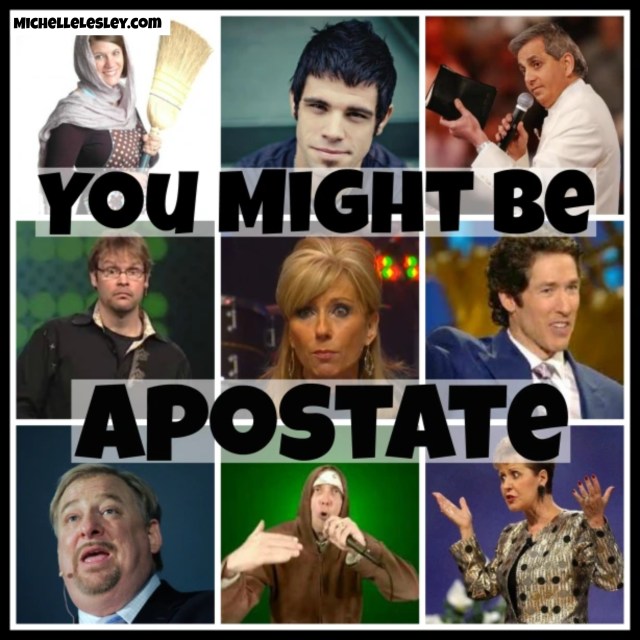
You Might Be Apostate

Comedian Jeff Foxworthy hit the big time several years ago with his “You Might Be a Redneck” one-liners. He frequently introduced the bit by saying, “I’ve found that there are rednecks all over, but sometimes people don’t know they’re rednecks. So, I came up with this little test…” and continued with such gems as:

“If you’ve ever had to carry a bucket of paint to the top of a water tower to defend your sister’s honor, you might be a redneck.”

“If your wife has ever said, ‘Honey, come get this transmission out of the tub so I can take a bath!’ you might be a redneck.”

“If you’ve ever been accused of lying through your tooth, you might be a redneck.”

It was a routine that a lot of us in the South found hilarious because we knew someone (or were someone) who fit nearly every one of Jeff’s jabs.

Like rednecks, there are apostate false teachers all over the place out there, only a lot of them (and their disciples) don’t know they’re false teachers. And the fruit of their lives and ministries is far wackier than anything a redneck has ever dreamed up. That fruit is a sign that we’d better examine the root of doctrine from which the fruit sprang.

So if any of the preachers and teachers you’re following have ever said or done the following things (or something even crazier), watch out, because they Might Be Apostate.

HoNuthaLevel

If you’re a middle aged pastor who makes embarrassing rap videos, who publicly extols the virtues of Spanx for men (even though it gives you gas) and who calls himself a Ferrari you might be apostate.

If you feature a Naked Cowboy impersonater (aka- your youth “pastor”) at your “Christian” women’s conference, you might be apostate.

If you’ve ever purposefully applied the pronoun “herself” to God, you might be apostate.

If you celebrated your 35th birthday by preaching at the “church” of your mentor, T.D. Jakes, and placing a $35,000 check in his offering wheelbarrow, you might be apostate.

If God has ever told you to go up to a stranger in the airport and ask if you can brush his hair, you might be apostate.

If you’ve ever given your congregation a sob story about needing a new $70 million Gulfstream jet, because the old one is worn out, you might be apostate.

If you think of the Holy Spirit as the “sneaky,” “silly,” “funny,” “blue genie from Aladdin,” you might be apostate.

If you’re a woman who thinks God is OK with you preaching to men despite what His word clearly says to the contrary, you might be apostate.

If you’ve ever said, regarding your church’s worship service, “I probably wouldn’t have a stripper on stage…” but leave the door open to the idea because “God told Isaiah to walk around naked for three years,” you might be apostate.

Benny Hinn at Maple Leaf Gardens on Sept. 28, 1992 photos by Tony Bock/Toronto Star and handout photo.

If you think smacking people in the face with your Nehru jacket is a ministry of the Holy Spirit, you might be apostate.

If you’ve ever typed a Facebook status in tongues, you might be apostate.

If you say you’re a trinitarian, but think the Father, Son, and Holy Ghost are three “manifestations” of God rather than three Persons, you ARE apostate.

If you think Proverbs 21:9 means you should camp out on your roof in a quest for biblical womanhood, you might be apostate.

If your senior pastor father sexually abused boys at your church and paid them off to keep them quiet and you, as the subsequent pastor, knew about it but didn’t speak up, you might be apostate.

If you officiated at your homosexual son’s “wedding,” you might be apostate.

If you’re a pastor who thinks expository preaching is “cheating” because it’s “too easy” and that “it’s not the way you grow people” AND that we shouldn’t say “the Bible says…” AND that parents who take their children to a small church instead of a mega church are “stinkin’ selfish,” AND that we shouldn’t use the Bible to convince the lost of their need for Christ, you might be apostate.

If you’re Oprah’s idea of an awesome pastor, you might be apostate.

download

If your preaching, ministry, and theology have ever been publicly rebuked by John MacArthur, Paul Washer and Steve Lawson, you might be apostate.

If you partnered with a Roman Catholic mystic with a degree in spiritual psychology to make a completely unbiblical movie about the Bible featuring ninja angels and Mary Magdalene bossing the disciples around, you might be apostate.

If you and your 80s rock star third husband stand in the pulpit and tell people to watch porn to improve their sex life, you might be apostate.

If a feature of your “worship service” is people laughing uncontrollably or barking like dogs, you might be apostate.

If you’ve ever decided to “p*ss off the religious people” on Easter Sunday by playing AC/DC’s Highway to Hell to open the service, you might be apostate.

If you’ve written a book entitled “I Am” and it’s about positive confession rather than Jehovah, you might be apostate.

If you think you have the power to control the weather by the words you speak, you might be apostate.

Joyce-Meyer-600x450

If you think that between the cross and the resurrection Jesus went to Hell and that Satan and the demons jumped up and down on His back, you might be apostate.

If the top three “pastors” you encourage people to follow on Twitter are T.D. Jakes, Rick Warren, and Joel Osteen, you might be apostate.

If a currently practicing homosexual couple wants to serve in leadership at your church and your only problem with it is that one of them isn’t yet divorced from his wife, you might be apostate.

If you’ve ever been accused of having an affair with Benny Hinn, you might be apostate.

If, a hundred years ago, your worship leaders might have been carted off to the funny farm or treated to an exorcism for conducting themselves like this, you might be apostate.

And, if you’re about to write a comment rebuking me for marking false teachers to avoid and exposing unfruitful works of darkness because Jesus would never do such a thing then you don’t know your Bible.

And you just might be apostate.