Christian women, Complementarianism

Women Teaching Men: My Thoughts on Aimee’s and Mary’s Articles

aimee mary

UPDATE: Please note, this article was written in 2016. It should not be construed to be a current endorsement of either Aimee or Mary.

My friends and readers are the best. They are so sweet and helpful when it comes to making sure I stay up to date on what’s happening out there in Evangelicaland. It’s like having a little army of really smart co-laborers who are great at research.

Last week, a couple of articles about women teaching men appeared on the Reformed complementarian women’s landscape, and several folks were kind enough to send them to me and ask for my reaction. I e-mailed the readers back with my responses, which I’ve posted below.

What is Sunday School? What Does it Appear to Be? And Who Can Teach It?
by Aimee Byrd
May 18, 2016

I have loved and respected Aimee’s work as a writer and podcaster for a while. This article was apparently written to clarify some things that had been said on a Mortification of Spin podcast.

“I didn’t catch the podcast, but I did read the article. I was disappointed with what Aimee said, because Steve’s comments [Steve Cooley’s comments in the comment section following the article] are correct. Also, if we look at the broad pattern of male headship in Scripture…

man was created first, then woman
woman was created to be helper to man
women are to submit to their husbands
women are not to serve in the office of elder or pastor
women are not to preach to men
women are not to exercise authority over/lead men in the church

…which fits better with this pattern, women teaching men in co-ed Sunday School or women not teaching men in co-ed Sunday School? I think it’s pretty clear that women not teaching men in co-ed Sunday School fits best. Why would God set this pattern of male headship in motion and then turn around and contradict it when it comes to women teaching men in Sunday School?

Furthermore, the gathering of a body of believers for studying the Bible is the gathering of the church, whether it is in someone’s home (like the first century church), a sanctuary, or a Sunday School classroom. We’re the ones who have invented all these lines of delineation between Sunday School, worship service, Christian conferences, revival meetings, etc., and then tried to go back and figure out which of these man-made distinctions 1 Timothy 2:12 applies to. When 1 Timothy was written, they didn’t have all that. The church was just the gathering of the believers for worship, study, etc. So 1 Timothy 2:12 applies to the gathered body of believers without respect to all these artificial lines we’ve drawn.”

Again, I have great respect for Aimee, but I disagree with her on this particular issue. It’s possible that the differences in our denominational viewpoints of Sunday School play a big part in this, and that if we ever had the chance to sit down and hash it out over coffee or something, we might find more common ground.

Women Teaching Men- How Far is Too Far?
by Mary Kassian
May 21, 2016

I’m not as familiar with Mary as I am with Aimee, but I’ve read and enjoyed a few of her articles. This one may have been a response to Aimee’s article above.

“Good stuff! I agree with her about 90%. I love that she brought out the part about “teaching under a man’s authority.” I wrote about that not long ago. It’s nice to hear somebody with a bigger platform say it. I hope people will listen to her!

I also love what she says about what we love versus following a set of rules. So true! Another aspect of this that I run into frequently with women who want to preach is that they’re so focused on leading they forget about Jesus’ example of humility in servanthood. We’re supposed to be focused on serving, not gaining notoriety.

My main disagreement with her would be the line she (and most others who address this issue) draws between the worship service and things like Sunday School and Christian conferences. Those are really man made lines of distinction rather than biblical ones. The “church” is the gathered body of believers for worship and biblical instruction. So whenever believers are gathered for those purposes – whether we call it Sunday School or worship service or a Christian conference, and whether it’s in a sanctuary, Sunday School classroom, or conference center – that’s the church, and the Scriptural mandate for women not to teach or hold authority over men applies.

I also think it’s interesting that in the second paragraph under “Can Women Teach Under Male Authority” she rightly points out, “The text doesn’t say, ‘A woman may teach men if…'”. But then later in the article she talks about how she feels it’s OK for her to teach men if they’re much younger than she is. Well, just like the text doesn’t say a woman can teach men if she’s doing so under male authority, it also doesn’t say it’s OK for a woman to teach men if she’s much older than they are. It just says “don’t”. Curious.”

Mary’s position on this issue is much more similar to mine. I hope to hear more from her about this in future articles.

Mailbag

The Mailbag: Can a divorced man be a pastor?

mailbag


Is it OK for pastors to be divorced?

Not just any man is qualified to be a pastor. The Bible sets forth a specific list of requirements for pastors and elders in 1 Timothy 3 and Titus 1. One of these requirements is that he must be “the husband of one wife.” Unfortunately, this phrase has sometimes been misunderstood to mean that pastors and elders must be married (which would exclude never married, divorced, and widowed men) or that pastors and elders must never have been divorced for any reason.

I pretty much agree with John MacArthur’s position in this article, which helpfully explains that the phrase “husband of one wife” actually means “a one-woman man,” not “never divorced,” or “wife required.” Unlike MacArthur, I might not say it’s “extremely rare” that it would be OK for a pastor to have a divorce in his past, maybe just “rare.”

I really think we need to look at it on a case by case basis, especially if the man was divorced for one of the two biblical exceptions: the wife’s infidelity (Matthew 5:32) or an unbelieving wife divorcing him (1 Corinthians 7:15). Although I respect an autonomous church’s right to set whatever policies it deems appropriate (as long as those policies don’t violate Scripture), I, personally, don’t think it’s right to deny a man the office due to his wife’s sin that he had no control over and may have done everything in his power to prevent.

I also think we need to look at how long ago the divorce took place and whether it happened before or after the man was saved. What about a man who was divorced 30 years ago due to one of the bibilical exceptions, but has been a godly husband to his second wife for the past 25 years? What about a man who was divorced 30 years ago, subsequently got saved, tried to reunite with his ex-wife but was rejected, married a godly woman, and has been a godly husband to her for the past 25 years? There are prohibitions against being a drunkard in the biblical qualifications, too. Would we deny a man the office, if, prior to salvation, he was a drunkard, but got saved and has been sober for 25 years? These are issues churches should work through prayerfully when considering a candidate.

A man already in the office of pastor/elder who goes through a divorce should step down for a significant period of time. If the divorce was for unbiblical reasons, he has probably disqualified himself. But even if it was for biblical reasons, he needs time to heal and to focus on helping his children. For the same reasons, I don’t think a man who has been recently divorced should be considered for the office.


If you have a question about: a well known Christian author/leader, a Bible passage, an aspect of theology, a current issue in Christianity, or how to biblically handle a family, life, or church situation, comment below (I’ll hold all questions in queue {unpublished} for a future edition of The Mailbag) or send me an e-mail or private message. If your question is chosen for publication, your anonymity will be protected.

Encouragement

God is Still Working and I’ve Got Proof

Has the world lost its collective mind, or what? From our presidential candidate options to perversion in public restrooms, to Christian business people having to risk their livelihood in order to operate in keeping with biblical principles, it seems like every time I turn around there’s some new piece of bad news smacking me in the face.

And it’s not just “out there,” either. The hits just keep on coming for the church as well. I hear almost daily from ladies who are distressed that the women of their church are being indoctrinated with false teaching in the name of “women’s Bible study.” Women who have left no stone unturned in their search for a doctrinally sound church to attend, and simply can’t find one in their area. Women who weep over their friends and loved ones held captive by the latest pop heresy.

It’s enough to discourage even the most bubbly of Pollyannas.

I wish good news got as much press as bad news, because, believe it or not, I hear from at least as many, if not more, women with encouraging stories to share about how God has been at work in their own lives, in their churches, and the in the lives of their friends and loved ones.

It always builds me up and gives me hope to hear their stories, so I thought it might encourage you, too. Take a look at what Christian women (and men!) like you are saying* about what God is doing in their lives – and what He can do in yours, too!

Wanted to share with you regarding your authors and speakers list. I sent it via e-mail to some friends. I received three positive responses back. One was already questioning [the doctrine of a particular false teacher]. She has been invited to one of [that false teacher’s] conferences. She will not be attending after reading this and will warn her friends that are attending.

[Another friend] shared with me that she feels God is calling her out of [a false doctrine church].

A pastor’s wife that thanked me for the information and said she will never be a a part of someone who embraces false doctrine.

I was thankful for your post on Priscilla Shirer and sent it to some women in our church. I had one very positive response with a request to learn more of the Scriptures.

I am thankful to be a member of a local church that is taught the Word of God through expository preaching and teaching. In fact, our pastor leads our “women’s ministry”. We are being taught theology and how to minister to one another and other women within our body and the ultimate body of Christ.

I told [the person leading the book study by a famous women’s Bible study author] that I was not signing up for the next one. I have just finished John MacArthur’s How to Study Your Bible, and I will begin reading the Bible through starting tomorrow morning. I just finished reading [the Bible] through this morning, but I am starting over again using the method he outlines in his book.

[I recently read your article] regarding Lysa TerKeurst. It made me extremely sad to read about her emergent-leaning doctrines. I’d been following P31 ministries for about two months when [I read the article]. I would appreciate any advice or direction you give me for biblically sound studies!

Here’s the view into my recycling bin. I was going to get rid of it last year, but ended up holding on to it. It’s gone now!

12227009_984483224931780_4841028828370165098_n


(From an elder at a doctrinally sound church)- I was not familiar with Beth Moore until I realized our women’s Bible group was hooked on Beth.

After bringing her un-biblical teachings to the attention of our elder board I am now charged with finding something better.Keep us in prayer as we attempt to wean the women off of Beth and onto the solid rock of the Word.

I’ve recently felt prompted to study more about sound Christian doctrine. Can you please provide a list for all your recommended Christian sound doctrine women [teachers]?

I went to the movie theater the day [Fifty Shades of Grey] came out. I’d say, on average there were 4 women to every man. They came in droves. I stood outside the theater and passed out gospel tracts. Seizing every opportunity, we must carry the gospel to them.

[As a women’s leader at my church, I got rid of] Beth Moore, Priscilla Shirer, Angela Thomas, and Lysa Terkeurst studies. My pastor is fully on board and is faithful to preach the Word each and every time we gather.

I have gotten rid of my copy of [a Christian mysticism book]. Now [female false teacher’s] book will follow.

[Several of us had to leave our former church due to false doctrine.] We all prayed [for a new, doctrinally sound church] and God answered our prayers. We have a church building and a pastor. We [recently] celebrated our church’s fourth anniversary.

My wife and I left our church of 20+ yrs. because God was gracious and truly regenerated our hearts, giving us eyes to see and ears to hear the unbiblical nature of what was happening.

I have left the last two churches I was a part of. Thankfully, we are now in a wonderful, Bible-believing, Gospel-centered, theologically/doctrinally sound church who believe discipling true Believers the way God has instructed us in the Bible is more important than how many people fill the seats.

This is just a tiny sampling of the many e-mails, comments, and private messages I’ve received from readers who are growing in Christ, serving in healthy churches, and helping others to grow in biblical truth. If you’re going through a rough time at your church, in your walk with the Lord, or are troubled by what’s going on in the world around you, rejoice with those who rejoice, and don’t be discouraged! The same God who carried these folks through their difficulties will carry you through yours.

Now it’s your turn to be an encourager.
How has God grown you in your relationship with Him, opened the eyes of a loved one to biblical truth, or made your church holier and more obedient to Scripture?


*I’ve changed or deleted a few identifying details to protect the writers’ anonymity.

Marriage

Marriage: It’s My Pity Party and I’ll Cry if I Want To ~ 7 Ways to Take Your Focus Off Yourself and Put it Back on Christ

Let’s face it, Ladies, there are days when even the best of marriages are just plain tough. Hubby’s in a bad mood and snaps at you.* There’s no money in the budget for that thing you really want to buy. You’re feeling overworked, underappreciated, and beyond stressed. It can be all too easy to haul out the party hats and confetti, hunker down in the corner, and throw yourself one big “woe is me” bash. Have you ever stopped to think about whether or not it’s biblical to feel sorry for ourselves? Believe it or not, there’s not a single passage of Scripture that says it’s OK. So what does the Bible say about how to handle those times in our marriages when we want to indulge in self pity? Let’s find out.

*(This article pertains to normal, relatively healthy, Christian marriages. In other words, not abusive marriages. If you are being abused, get yourself and your children to a safe place, and call the police, your pastor, or a loved one for help.)

Have you ever stopped to think about whether or not it’s biblical to feel sorry for ourselves? Believe it or not, there’s not a single passage of Scripture that says it’s OK. So what does the Bible say?

1.
Have the mind of Christ

But we have the mind of Christ. 1 Corinthians 2:16

take every thought captive to obey Christ. 2 Corinthians 10:5

be conformed to the image of his Son, Romans 8:29

As Christians, Christ is to be the master of everything we are, not just our words and actions, but our thoughts and feelings as well. We are to act like Jesus, talk like Jesus, think like Jesus, and even feel like Jesus. Punished and executed for sins He did not commit, “He was despised and rejected by men; a man of sorrows, and acquainted with grief.”(Isaiah 53:3) Jesus had much more reason than you or I to feel sorry for Himself, but did He? Then, should we?

As Christians, Christ is to be the master of everything we are, not just our words and actions, but our thoughts and feelings as well.

2.
Have the attitude of Christ

Have this mind among yourselves, which is yours in Christ Jesus, who, though he was in the form of God, did not count equality with God a thing to be grasped, Philippians 2:5-6

When we follow Christ, we adopt the same attitude towards others He had. Jesus was prepared for the fact that people He loved and served, even those closest to Him, would let Him down. Still, He loved them and forgave them. Your husband is a broken, sinful human being (just like you). He’s going to mess up. A lot (just like you). Being prepared for, and accepting that fact (along with a healthy understanding of how many times you’re going to let him down) can help put things into perspective.

but emptied himself, by taking the form of a servant, being born in the likeness of men. Philippians 2:7

Jesus put aside all of His rights to be served and esteemed and, instead, focused on serving others – even those who didn’t deserve it and were ungrateful. Instead of retreating into hurt the next time your husband blows it, what if you took a deep breath, put your rights aside, and did something to lovingly serve him?

Instead of retreating into hurt the next time your husband blows it, what if you took a deep breath, put your rights aside, and did something to lovingly serve him?

And being found in human form, he humbled himself by becoming obedient to the point of death, even death on a cross. Philippians 2:8

Jesus humbled Himself. He was so focused on obedience to God that He gladly gave up His life for people who hated Him. Often, our obedience only takes us to the edge of where we’re comfortable. What kind of impact would it have on your marriage if you had the same level of humility and obedience Christ had? How could that humility and obedience to Christ help ward off self pity?

Often, our obedience only takes us to the edge of where we’re comfortable. What kind of impact would it have on your marriage if you had the same level of humility and obedience Christ had?

3.
Give thanks

give thanks in all circumstances; for this is the will of God in Christ Jesus for you. 1 Thessalonians 5:18

It is not God’s will for you to feel sorry for yourself. It is God’s will for you to give thanks in all circumstances, including a lousy day in your marriage. If you can’t think of anything to be thankful for, tell that to God, and ask Him to show you things about your husband that you can thank Him for. Even if you have to start with the small things (Does he have good breath? Tie his shoes neatly? Floss semi-weekly?), start somewhere. You’ll be amazed at the way your perspective shifts from the negative to the positive as you thank God for your husband’s good qualities.

You’ll be amazed at the way your perspective shifts from the negative to the positive as you thank God for your husband’s good qualities.

4.
Be content

Not that I am speaking of being in need, for I have learned in whatever situation I am to be content. Philippians 4:11

Whatever situation. Ever read about Paul’s little “whatever situations”? You can find some of them in 2 Corinthians 11:23-28. I’m guessing you’ve never been shipwrecked or stoned, not to mention all the other things on his list, which, by the way, Paul wrote while he was in prison. Yet he said he had learned to be content. How? Paul found his contentment, not in his circumstances, but in Christ. Jerry McGuire not witstanding, your husband does not, will not, and cannot “complete you.” Only Christ can satisfy the deepest needs of your heart. When you lay hold of that, you will find true contentment. Your husband will let you down. Christ never will.

Your husband does not, will not, and cannot “complete you.” Only Christ can satisfy the deepest needs of your heart. Your husband will let you down. Christ never will.

5.
Rejoice in suffering

Not only that, but we rejoice in our sufferings, knowing that suffering produces endurance, and endurance produces character, and character produces hope, and hope does not put us to shame, because God’s love has been poured into our hearts through the Holy Spirit who has been given to us. Romans 5:2-4

God wants to do something greater in you than just make you feel better in the moment. He has long range plans to grow you in endurance, character, and hope. That’s great news, and certainly cause for joy. So instead of directing your gaze inward, look down the road to where you’re more mature in Christ, and rejoice. God is at work on your heart. (And P.S.- Rejoicing will make you feel better in the moment, too. Pitying yourself will only make you feel worse.)

God wants to do something greater in you than just make you feel better in the moment.

6.
Put yourself aside and put your husband first

Do nothing from selfish ambition or conceit, but in humility count others more significant than yourselves. Let each of you look not only to his own interests, but also to the interests of others. Philippians 2:3-4

There’s that H-word again. Humility. When I read this passage, I think back to the story of Jesus washing the disciples’ feet. The One to whom every knee will one day bow got down on His hands and knees and took on the disgusting task that normally fell to the lowest, least talented servant. If the God of the universe could put ahead of Himself these men whom He personally knit together in the womb, who would, in mere hours, deny and desert Him at the darkest time of His life, is He asking too much of us to put our husbands ahead of our hurt feelings?

7.
Change your husband by changing your behavior

Likewise, wives, be subject to your own husbands, so that even if some do not obey the word, they may be won without a word by the conduct of their wives, when they see your respectful and pure conduct. 1 Peter 3:1-2

It seems counterintuitive. “Is your husband being an ungodly jerk? Don’t nag him or pout about it; submit to him with respectful and pure conduct.” The world would call this weakness and say you’re being a doormat. Quite the contrary. If you’ve ever tried putting this passage into practice, you know just how much strength it takes to do the godly thing when everything in you wants to strike back or retreat in self pity. To realize that, regardless of how your husband acts, you are responsible to God to do what is right in His eyes. But God’s word is full of paradoxes and counterintuitives. The question is, do we believe God when He says this is the way to win our husbands to godliness, and do we trust Him enough to obey His word?

Regardless of how your husband acts, you are responsible to God to do what is right in His eyes.

Being a Christian wife pursuing growth in godliness is tough. It can seem impossible to forge ahead in obedience to Christ on those difficult days in your marriage when all you really want to do is retreat into that corner and whimper. But you have a Savior who understands your weaknesses,  loves and cares for you deeply,  and promises to give you the strength you need to do anything He calls you to.

Even the strength to take off the hat, sweep up the confetti, and say, “The party’s over.”

Wednesday's Word

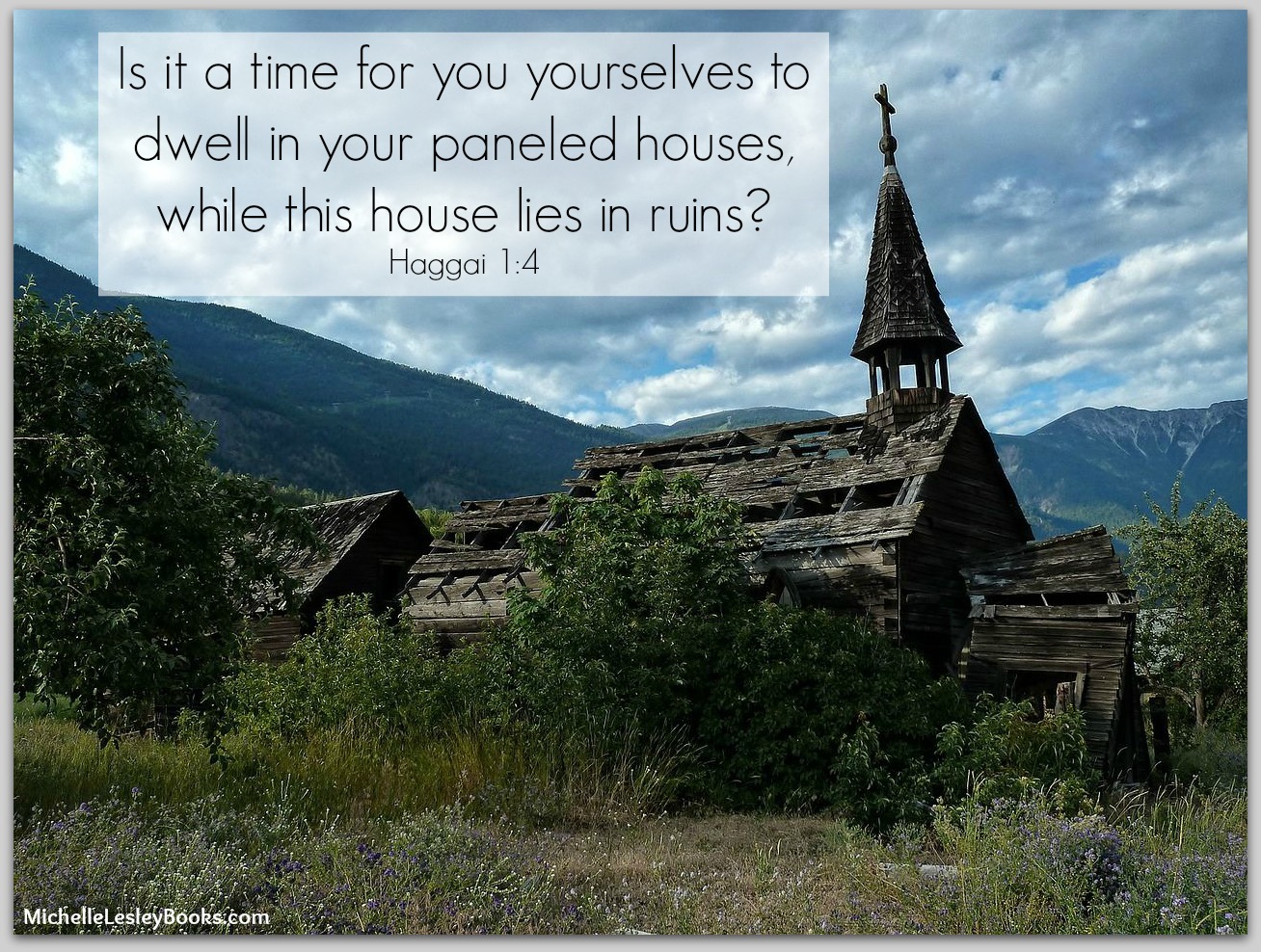
Wednesday’s Word ~ Haggai 1

haggai 1 4

Haggai 1

In the second year of Darius the king, in the sixth month, on the first day of the month, the word of the Lord came by the hand of Haggai the prophet to Zerubbabel the son of Shealtiel, governor of Judah, and to Joshua the son of Jehozadak, the high priest: “Thus says the Lord of hosts: These people say the time has not yet come to rebuild the house of the Lord.” Then the word of the Lord came by the hand of Haggai the prophet, “Is it a time for you yourselves to dwell in your paneled houses, while this house lies in ruins? Now, therefore, thus says the Lord of hosts: Consider your ways. You have sown much, and harvested little. You eat, but you never have enough; you drink, but you never have your fill. You clothe yourselves, but no one is warm. And he who earns wages does so to put them into a bag with holes.

“Thus says the Lord of hosts: Consider your ways. Go up to the hills and bring wood and build the house, that I may take pleasure in it and that I may be glorified, says the Lord. You looked for much, and behold, it came to little. And when you brought it home, I blew it away. Why? declares the Lord of hosts. Because of my house that lies in ruins, while each of you busies himself with his own house.10 Therefore the heavens above you have withheld the dew, and the earth has withheld its produce.11 And I have called for a drought on the land and the hills, on the grain, the new wine, the oil, on what the ground brings forth, on man and beast, and on all their labors.”

12 Then Zerubbabel the son of Shealtiel, and Joshua the son of Jehozadak, the high priest, with all the remnant of the people, obeyed the voice of the Lord their God, and the words of Haggai the prophet, as the Lord their God had sent him. And the people feared the Lord. 13 Then Haggai, the messenger of the Lord, spoke to the people with the Lord‘s message, “I am with you, declares the Lord.” 14 And the Lord stirred up the spirit of Zerubbabel the son of Shealtiel, governor of Judah, and the spirit of Joshua the son of Jehozadak, the high priest, and the spirit of all the remnant of the people. And they came andworked on the house of the Lord of hosts, their God, 15 on the twenty-fourth day of the month, in the sixth month, in the second year of Darius the king.

The Holy Bible, English Standard Version Copyright © 2001 by Crossway Bibles, a publishing ministry of Good News Publishers.

 Questions to Consider:

1. What is the purpose of the book of Haggai? Which genre(s) of biblical literature (prophecy, epistle, narrative, wisdom, etc.) is the book of Haggai? What is the historical backdrop for this book?

2. What was the people’s position on rebuilding the temple? (2) Did God agree with them? What did God say about the priority of rebuilding the temple? (3-4) Read Acts 7:48-50. If God doesn’t need a building to live in, why was it so important to Him, and to the people, that they rebuild the temple? What are the two reasons God gave for rebuilding the temple? (8)

3. List the negative consequences the people experienced for neglecting to rebuild the temple. (6,9,10-11) What reason did God give for sending these negative consequences (9), and what was their intended purpose? What does God mean when He says, “Consider your ways,” in verse 5? In verse 7?

4. What were the two ways the people responded to the prophecy? (12) What were the two ways God responded back to them? (13-14) How is this similar to God’s response to our repentance? How would the words “restoration” and “reconciliation” apply in both this passage and in our repentance today?

5. What does this passage teach us about prioritizing our relationship with Christ, and our obedience to His word, above all other temporal concerns and activities? What can we learn about the negative consequences of sin? Has God ever used the negative consequences of sin to get your attention and draw you to repentance? What is God’s response to our repentance and obedience?