Christian women, Church, Complementarianism, Men

Adam 3.0: Meanwhile, Back in the Garden, It’s Deja Vu All Over Again

Originally published June 26, 2014

I do not permit a woman to teach or to exercise authority over a man; rather, she is to remain quiet. For Adam was formed first, then Eve; and Adam was not deceived, but the woman was deceived and became a transgressor.

1 Timothy 2:12-14

Because it’s my passion to see Christian women become holy, passionate, obedient disciples of Jesus Christ, I’ve dealt with this passage a lot and done a lot of research on it. Scripture is crystal clear that women are not to instruct men in the Scriptures in the church in the capacity of pastor or teacher, nor are they to hold authority over men in other positions in the church. (I’ve outlined Scripture’s case for this here if you’d like to do some further study.) And, unfortunately, there are many women in the church who are disobeying this Scripture (I used to be one of them)– some out of rebellion, and some out of ignorance. But until recently, I –and every other piece of information I’ve studied on the subject– have dealt with the issue of women stepping outside their God-ordained role in the church strictly as a women’s issue.

A few days ago, a friend of mine asked for my opinion on a Q&A video produced by a well known pastor. The pastor was asked, “Is it a sin for men to listen to women speakers [female Christian conference speakers, pastors, teachers, etc.]?”

And that’s when it hit me. I’d never heard this question addressed, or even asked, before. First Timothy 2:12ff is always dealt with from the perspective of women and towards women – that this is a women’s sin issue.

But to treat this role rebellion strictly as the sin of women is to pour gasoline on the fire. If it’s a singularly women’s problem, then it naturally falls on women with a right understanding of God’s Word on the issue to deal with it, right? And if these women are the ones who have to confront and deal with this sin, even at the local church level, they’re being placed smack dab in the misappropriated role they’re trying to fight because they’re being asked to do the job of elders and pastors whose responsibility it is to maintain order and discipline in the church.

In other words, when it’s time to deal with the sin of role busting, don’t send a woman in to do a man’s job.

When it’s time to deal with the sin of role busting, don’t send a woman in to do a man’s job.

The fact that there’s even a need for an article like this, never mind that a woman is writing it, is indicative of the pervasiveness of the problem. Why do we so rarely hear pastors or other Christian men exhorting men in the church to stand on God’s Word, properly fill out their own role in the church, and also deal with the problem of female disobedience to this Scripture? Why are Christian men becoming accomplices to women’s sin by seeking out female pastors and teachers to be their spiritual leaders? I believe there are three reasons:

The fact that there’s even a need for an article like this, never mind that a woman is writing it, is indicative of the pervasiveness of the problem.

1.
Adam 3.0

Give Genesis 3–the story of the Fall–a read through the lenses of 1 Timothy 2:12. See any similarities between what happened in the Garden and what’s happening in the church?

The man is off somewhere, not fulfilling his role of spiritual guardian, leader, and protector, leaving the woman alone and vulnerable to Satan’s attack. Satan tempts the woman to sin and she succumbs. The woman then entices the man to sin, and instead of standing on God’s Word, refusing to sin, and correcting her, he actually joins her in her sin. And when God calls the man to account for this whole scenario, what does the man do? He blames the woman.

Was Eve responsible for her decision to sin? Of course. That’s why we even have 1 Timothy 2:12-14 in the Bible. But God gave the man the authority and God held the man ultimately responsible. That’s why we see passages like Romans 5:12-14 (and others) attributing the sin in the Garden to Adam rather than Eve.

While there are many faithful pastors and Christian men out there diligently laboring to be godly teachers and leaders in the church–and praise God for those men!–there is a large and increasing number of men in our churches, both pastors and laymen, who are failing to fulfill the role God has called men to in the church. Pastors who will only preach what tickles people’s ears. Men who sit in the pews refusing to teach or serve or lead or even attend faithfully.

As it was in the Garden, these Christian men are nowhere to be found as Satan creeps into the church and attacks women with this temptation. And, as God called out then, could He be calling out now, “אָדָם, – Adam- Man, where are you“?

As God called out then, could He be calling out now, “אָדָם, – Adam- Man, where are you”?

2.
Men are lazy.

I know that sounds harsh, but before all the brothers get their boxers in a bunch, please hear what I’m not saying. I’m not saying that all men are lazy or that women are never lazy or that men are lazy in every aspect of their lives. What I’m saying is that, in this particular instance of women stepping outside God’s role for them in the church, too many men are sitting back with the attitude that, hey, if somebody else is willing to do the work why not let her? Instead, women (not to mention boys and younger men) should be seeing men in the church step up and say, “I’ll study hard so I’ll be equipped to teach that class.” “I’ll preach the sermon, not my wife.” “I’ll be willing to shoulder the load God has given me instead of pushing it off on a woman.”

Women (not to mention boys and younger men) need to see men in the church step up and say, “I’ll be willing to shoulder the load God has given me instead of pushing it off on a woman.”.

3.
Men are afraid of women. 

Not afraid of them physically, but afraid of the ones who will make a scene, cause strife, split churches, get pastors fired, and generally make life hell on earth for anyone who dares to put his foot down firmly on the Word of God and say, “You’re in disobedience. You need to repent and step down.” I know these women (and, of course, there are men who do this, too). I have had plenty of them come after me, and, having a husband who’s been in ministry for over 20 years, I’ve seen plenty of them attack pastors, staff, deacons, etc., and I don’t blame men for feeling scared. But Jesus has called men to defend His Bride from all enemies, both foreign and domestic, and feeling scared doesn’t excuse them from doing what’s right and biblical. Would that godly men would look to the courage Jesus exhibited on His way to the cross. That they would look at Peter, Paul, James, and the other apostles as their example of valor, as these forebears in the faith chose flogging, hardship, jail, and martyrdom over compromising the Word of God.

Would that godly men would look to the courage Jesus exhibited at the cross. That they would look at Peter, Paul, James, and the other apostles who chose flogging, hardship, jail, and martyrdom over compromising the Word of God.

Churches don’t need pastors who are afraid to rock the boat, even if that’s what the church seems to want. Churches need a man who will stand for Christ and His Word, no matter the cost to him personally or vocationally. A pastor can’t call his people to do that in their own lives if he isn’t willing to do it in his, knowing that the God who was strong enough to save him out of the pit of Hell is strong enough to find him another job and provide for his family if it comes to that. We need pastors who are faithful to preach and carry out the Word in season and out of season, trusting Almighty God to have their backs.

Churches don’t need pastors who are afraid to rock the boat, even if that’s what the church seems to want.

God has given women a phenomenal, and much needed, role in the church. He has given men a different, yet equally phenomenal and much needed role in the church. For the local church to function in a healthy way, both men and women have to fill out our own roles correctly. And women can’t and shouldn’t have to do the job of godly men in addition to our own.

Women can’t and shouldn’t have to do the job of godly men in addition to our own.

Some might regard my tone here as stringent. Peter, Paul and the other apostles probably raised some eyebrows when they used a stringent tone, too. But when a house is burning down, the fireman doesn’t tiptoe in, hand you flowers, and politely request that you, pretty please, come with him. And that’s where we are in the church. The house is burning down around us. And, in the end, this article is not meant to be a castigation of pastors or other Christian men, but an impassioned plea from a church lady who wants to see her sisters make it out alive.

Help us. Please. Despite what some professing Christian women might say, we, and the body of Christ, desperately need our brothers to be the heroic men of God that they have the right, the calling, and the responsibility to be.

Women, and the body of Christ, desperately need our brothers to be the heroic men of God that they have the right, the calling, and the responsibility to be.

Biblical Womanhood Bible Study

Imperishable Beauty: Lesson 16- A Beautiful Proclamation in the Church

Previous Lessons: 1, 2, 3, 4, 5, 6, 7, 8, 9, 10, 11, 12, 13, 14, 15

Read These Selected Scriptures

In our last lesson, we examined how we can beautifully portray biblical womanhood in the church. Today, we’ll finish up our section on biblical womanhood in the church by looking at how godly women can beautifully proclaim the Word of God in the Body of Christ.

Questions to Consider

1. Briefly review lessons 14-15 (links above), noting the instructions God has given to and about women regarding our role in the church. What are the do’s and don’ts God has laid out for us, especially in 1 Timothy 2:12, regarding teaching and authority in the gathered Body of Believers (the church)?

2. Examine the first two passages (Titus 2 and 2 Timothy 2) of Scripture. Recalling that these books are pastoral epistles, to whom are these instructions primarily addressed? To which venue (home, marketplace, church, etc.) do these instructions primarily apply?

In the Titus 2 passage, the Holy Spirit gives instructions for which individuals (1, 7-8)/groups (2, 3, 4-5, 6, 9-10)? Examine the instructions for Titus and for each group. Are they instructed to be something (character), or do something (actions), or both? Why does God instruct Titus and these groups to be and do these things? What is the point of all this godly character and behavior? (“so that”: 5b, 8b, 10b)

Who, in the Titus 2 passage, is instructed to “teach”? (1&7, 3-4) Why do you think God singles out only the pastor and older women with the instruction to teach and train? Who is the pastor to teach? Who are older women to teach and train? (4) Using the context of these verses, what age or station in life would you infer this passage means by “older” women? “Young” women? If it is the responsibility of older women to teach and train young women, what is the responsibility of the young women?

Examine verse 3 carefully. Is this a “do” verse or a “be” verse, or both? Which instruction comes first, “be” (character) or “do” (action)? Would it be biblically accurate to say that older women without the godly character described in the first part of verse 3 should not be doing the action (teaching) in the last part of verse 3 – that godly character is a prerequisite for teaching younger women?

Examine 3b-4a: “They are to teach what is good, and so train the young women…”. Does this sound like a command, or is it optional/a suggestion? If it is a command, doesn’t that make the character instructions in 3a a command as well? Take a moment to prayerfully evaluate yourself. How are you doing on the “be” and “do” of verses 3-4?

As you continue to examine 3b-4a- is there a difference between “teaching” and “training“? Could it be biblically accurate to say that teaching is to impart knowledge, and training is to show someone how to apply that knowledge to real life situations? (For example, teaching someone the rules and regulations of basketball in a classroom-type setting, versus putting that person on a basketball court and training her to apply those rules with basketball in hand.) Which comes first in 3b-4a, teaching or training? What does 3b say older women are to teach? What do 4a-5a say older women are to train younger women to be and do? Is it possible to train Christian women “to love their husbands and children, to be self-controlled, pure, working at home, kind, and submissive to their own husbands,” without first teaching them “what is good” – what the Bible says about how to do these things and why they should do them? Is it wise to attempt to train Christian women in these things without basing them in Scripture?

Even though 2 Timothy 2:15 is primarily addressed to pastors, does it still apply to others who teach God’s Word? How should this verse inform your teaching and training of younger women? Whose approval should you be seeking when handling God’s Word? What does this verse mean when it says “Do your best” so you will have “no need to be ashamed”? What does it mean to “rightly handle the Word of Truth”?

3. Carefully read the 2 Timothy 3 passage. How does the Holy Spirit describe people’s attitudes and actions during the last days? (2-5) Considering what He says these people will do in 5-6a, are the people He’s describing in 2-5 Christians or non-Christians? Church-goers or non-church-goers? What does it mean to have the appearance of godliness, but deny its power? (5a) How do verses 8-9 describe these same people from 5a? What term might we use for people like this today? How are we to regard such people? (5b) Why are we to “avoid such people” (5b), and who are “them” (6a)? Why does verse 6 specify “weak women” instead of saying “men” or “people”? How do verses 6-7 describe these at-risk women?

If the (2 Timothy 3) weak woman, unable to arrive at a knowledge of the truth and captured by false teachers who oppose the truth, is one of the (Titus 2) young women in the church, is she going to have a truthful, biblical understanding of how and why “to love their husbands and children, to be self-controlled, pure, working at home, kind, and submissive to their own husbands”? How can the (Titus 2) older woman “rightly handle the Word of Truth” and “teach what is good” to this younger woman? What sorts of good things from Scripture would this older woman need to teach the younger woman? Have you ever seen a scenario like this in your church? How would you apply the Scriptures we’re looking at to that scenario?

4. Look at the final three passages (1 Timothy 2, 2 Timothy 1 & 3). Besides women, what is another part of the church whom women are uniquely gifted to teach? (You may wish to go back to lesson 14 (link above) and re-read the paragraph near the end of the lesson which begins with, “Verse 15 can be a little cryptic…”. ). Who were Lois and Eunice? (1:5) To which child did they teach the Scriptures? (1:2,3:15) What did he go on to do as an adult? Who are some other men from Scripture who had mothers who trained them in godliness? Describe the impact Christian women can have on the church by training children in godliness and the Word.

5. Considering all of today’s passages, which two groups of people in the church has God blessed women to proclaim the Word to? If women were not teaching other women and children in the church, would the church be healthy?


Homework

Egalitarians often cite the women listed in Romans 16 and Priscilla and Aquila’s conversation with Apollos as evidence that God is OK with women preaching or instructing men in the church. How would you answer this argument? Examine both passages. Does Romans 16 say any of the women listed taught or preached? Was Priscilla’s and Aquila’s private conversation with Apollos the same as Priscilla teaching or preaching to the gathered Body of Believers? Would Paul have commended any of these women in Romans 16 if they had disobeyed his instructions in 1 Timothy 2:12?


Suggested Memory Verse

Do your best to present yourself to God as one approved, a worker who has no need to be ashamed, rightly handling the word of truth.
2 Timothy 2:15

Biblical Womanhood Bible Study

Imperishable Beauty: Lesson 15- A Beautiful Portrayal of Biblical Womanhood in the Church

Previous Lessons: 1, 2, 3, 4, 5, 6, 7, 8, 9, 10, 11, 12, 13, 14

Read These Selected Scriptures

In lesson 14 we looked at the beauty of women’s position in the church. Today, we’ll examine how our character can beautifully portray biblical womanhood in the church.

Questions to Consider

1. Briefly review lesson 14 (link above). What did you learn about the position women occupy in the church? As you study today’s lesson think about some of the ways you can portray biblical womanhood to others from that position.

2. Carefully examine the 1 Corinthians 11 passage. (As you study this passage, it may help to keep in mind that, unless widowed, virtually every adult woman in the church would have been married. That was the cultural norm. So Paul is able to use the terms “women” and “wives” nearly interchangeably. Click on the “Read These Selected Scriptures” link above and read the footnote (c) for verse 5.)

Compare the format of this introduction (2-3) to the format of the introduction of the letters to three of the seven churches in Revelation. Describe this format noting how the word “but” acts as a pivot point for all four passages. For what does Paul commend the Corinthian church? (2) “But” in what area of church life does Paul imply the Corinthians are not “getting it”? (3) Explain what verse 3 means as it applies to the day-to-day functioning of the church both in Corinth and today. What is the authority “flow chart” for the church?

Verse 3 serves as the main idea or theme of this passage. What is the main theological point God is trying to drive home to the church?

To what event in biblical history is Paul referring in 7b-9? Compare these verses with 1 Timothy 2:12-14. Explain how the creative order (man created first, woman second / man as head, woman as helper) is the cornerstone of the authority structure (3) in the family and the church.

In 4-5 and 14-15, Paul uses two separate examples from Corinthian culture that demonstrate the differences between men and women in order to illustrate the concept of the hierarchy of authority in the church. What are those two examples? Is God commanding that Christian women today must have long hair and must cover their heads when praying? Is God commanding that Christian men today must have short hair and must never cover their heads while praying?

In Corinthian culture, one of the ways women could portray biblical womanhood in the church was to signify by wearing their veils that they embraced submitting to their husbands and to the authority structure of the church. Can you think of any similar ways women can portray biblical womanhood today?

3. Examine the 1 Timothy 2 and 1 Peter 3 passages. What is the venue or setting for the instructions in each? (You may need to look at more of each chapter.) Locate the word “but” in each of these passages (2:10, 3:4), noting the concept that comes before the word “but” and after it. Describe how women are not to adorn themselves. “But” describe how women are to adorn themselves. Are things like braids, jewelry, and clothes intrinsically sinful, or is Paul again giving cultural examples to illustrate a theological point he’s making? What is that point? What is it about the bent of women’s hearts that would cause God to give this instruction to women in the context of the home and the church, but not to give this instruction to men at all? As godly women, where is our focus to be? How does it benefit the church for us to “wear”, or portray, biblical womanhood by adorning ourselves modestly and with good works?

What similar themes do you see in these two passages and the 1 Corinthians 11 passage? How do these three passages work together to demonstrate to us how we may live out biblical womanhood in the church?

4. Locate, in the 1 Timothy 2 (10), 1 Peter 3 (6), and 1 Timothy 5 (10) passages the phrases about doing good works. How are good works a major responsibility of women in the church, and a main way we display biblical womanhood?

Explain the context of the 1 Timothy 5 passage. The passage is talking about women who are _______. But a large part of this passage talks about how these women lived and served the church prior to becoming widows. Make a two column list. On one side, list the good works of all the women (widowed, married, young widows, any believing woman, etc.) mentioned in this passage. On the other side, list some specific ways you and other women in the church can carry out these good works today.

What are the “bad works” to be avoided in this passage? How can focusing on doing good works help us to avoid the bad works?

5. Study the remaining passages (Luke, Acts, Romans, 1 Corinthians) in today’s lesson. How did the women who followed Jesus, Dorcas, Lydia, and Priscilla (Prisca) each portray biblical womanhood in the church by their character and good works? To whom did they minister? How did the church benefit from each of them robustly living out God’s plan for women in the church?


Homework

If you’d like to read more about some of the passages from today’s lesson, you might enjoy the following articles:

Rock Your Role: A Head of the Times- Head Coverings for Christian Women?

The Mailbag: Potpourri (Calvinism, Baptism, Modesty…)

Rock Your Role: Oh No She Di-int! Priscilla Didn’t Preach, Deborah Didn’t Dominate, and Esther Wasn’t an Egalitarian


Suggested Memory Verse

Nevertheless, in the Lord woman is not independent of man nor man of woman; for as woman was made from man, so man is now born of woman. And all things are from God.
1 Corinthians 11:11-12

Biblical Womanhood Bible Study

Imperishable Beauty: Lesson 14- A Beautiful Position in the Church

Previous Lessons: 1, 2, 3, 4, 5, 6, 7, 8, 9, 10, 11, 12, 13

Read These Selected Scriptures

For the past few lessons, we’ve looked at biblical womanhood in the family. Today, we’ll begin looking at biblical womanhood in the church setting, examining the beautiful position God has given women in the gathering of the Body.

Questions to Consider

1. Read Galatians 3:28 (if you have a moment, read all of chapter 3 for a fuller view of the context). What does this verse, especially in light of the remainder of chapter 3, mean? What does it mean to be “one in Christ Jesus”? How does this verse speak to the concept of unity in the church? How does this verse speak to the equal value of every person in the eyes of God? When it comes to a soul being saved, is there any difference between a woman or man, slave or freeman, Jew or Greek? Do Greeks have to repent more than Jews? Does Jesus have to work harder to save women than men?

2. Briefly review the topics of lessons 4-9 (links above). Are any of these concepts (identity in Christ, being created by God, etc.) specific to one sex, or do they apply to all people? Make two lists: “Things Christians Are” and “Things Christians Do”. List about 5-10 things Christians are (ex: forgiven, ambassadors for Christ) and things Christians do (ex: pray, show mercy). Are any of the things you listed specific to men only or women only? Considering all the things the Bible says Christians are and Christians do, what would you estimate is the percentage of things all Christians are to be and do versus the percentage of things that are only for men or only for women?

3. Examine the 1 Corinthians passage. Verse 33 is kind of the “theme verse” of 1 Corinthians 14. What is the main subject of this chapter? (Hint: See section heading here). What is the venue (home, church, marketplace, etc.) in which the instructions of chapter 14 apply? (33b) Briefly skim over the rest of chapter 14. What was the overall, “for the greater good,” reason for the instruction to women in v. 34-35? What were some other activities and people the Holy Spirit, via Paul, placed restrictions on in chapter 14? Why? What is the main priority of chapter 14? Does the instruction in 34-35 mean that women may never utter a word once they step through the doors of the church? How do you know that? What do these instructions mean, and how do they apply to women in the church today? What do these instructions teach us about our responsibility to pay attention to the preaching and teaching of the Word and learn from it? How can this passage help us to see the value and edification in discussing the Scriptures at home with our husbands?

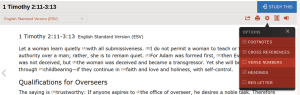
4. Go to the 1 Timothy and Titus passages by clicking on the “Read These Selected Scriptures” link at the top of today’s lesson. Recall that when the Bible was written, there were no chapter and verse numbers. (Those were added much later.) First Timothy and Titus would have read like one long, continuous letter or e-mail. Click on the “options” icon and uncheck the box next to “verse numbers”.

Now read the 1 Timothy passage, noting the flow of thought and how the end of chapter 2 is interconnected with chapter 3. What is the main idea of this passage? (OK, now click the verse numbers back on. :0)

What is the first word of verse 11? Think about women’s social status and value in Paul and Timothy’s culture, and in many cultures since that time, even today. Why does the Holy Spirit instruct pastors to “let” women learn? What does this teach us about the responsibility God places on us as women to learn His Word? Would you categorize verse 11 as a “do this” or “don’t do this” verse?

Examine verse 12. Is this mainly a “do this” or “don’t do this” verse? What two things does the Holy Spirit say women are not to do in the gathering of the church body? What does He say women are to do? Think about God’s nature and character. Does He ever give instructions arbitrarily or just to spoil our fun? Why does God give us commands and instructions, generally speaking? Are the instructions in verse 12 good for women and for the church?

Does God have to give us the reasons behind His instructions, or is “because I said so” sufficient reason for us to obey Him? Take a look at 13-14. God kindly gives not one, but two reasons for His instructions in verses 11-12. What are those two reasons? How do they fall in line with God’s design for male headship and leadership across biblical history in the hierarchical structures He has set up?

The 11-15 passage starts with a “do this” verse (11), followed by a “don’t do this” (12) “and here’s why” (13-14) section, then finishes up with another “do this” verse (15).

Verse 15 can be a little cryptic to us today because we equate the word “saved” with salvation. Does verse 15 mean that women gain salvation by having children? How do we know it doesn’t? The NASB helpfully, and more accurately, renders this word as “preserved“. We don’t feel it much today, but think about the stigma women (particularly Jewish women) carried at the time this was written simply because they were daughters of Eve. Paradise was lost and the curse of sin entered the world because of a woman, many men thought, and they viewed and treated women accordingly. Yet who was chosen to bring the Messiah into the world? And following in her footsteps, a major way godly women can “save” or “preserve” the reputation, esteem, and value of womankind is to “continue in” what 3 godly character traits? (15) Because if they continue in those three godly character traits, they will be raising up a godly seed to the Lord (even if the children they bear aren’t perfect like Mary’s child was :0)

So we’ve seen the position women are to occupy in the church, followed by the positions women aren’t to occupy, and that’s followed, in the 1 Timothy 3 and Titus 1 passages by the p_____s m__ are to o____.

According to the 1 Timothy 3 and Titus 1 passages, which positions are men to occupy in the church? What is an overseer? (Use your cross-references if necessary.) Go through these two passages circling any words or phrases that indicate that pastors, elders, and deacons are to be men. Are these positions open to all men in the church?

Examine each of the three sections (1 Timothy 3:1-7, 3:8-13, and Titus 1:5-9) individually. How could the wife of a pastor, elder, or deacon help him, or make things easier for him, to meet the biblical requirements for his office? (Ex: How could a pastor’s wife make it easier for him to be hospitable?)


Homework

If you’d like to dig deeper on some of these passages, you may enjoy reading the following articles from my Rock Your Role series:

All Things Being Equal (Galatians 3:28)

Order in His Courts: Silencing Women? (1 Corinthians 14:33b-35)

Jill in the Pulpit (1 Timothy 2:11-12)


Suggested Memory Verse

There is neither Jew nor Greek, there is neither slave nor free, there is no male and female, for you are all one in Christ Jesus.
Galatians 3:28

Mailbag, Speaking Engagements

The Mailbag: Potpourri (Joni’s testimony, “Messy”, Female seminary profs…)

Welcome to another “potpourri” edition of The Mailbag, where I give short(er) answers to several questions rather than a long answer to one question. I also like to take the opportunity in these potpourrri editions to let new readers know about my comments/e-mail/messages policy. I’m not able to respond individually to most e-mails and messages, so here are some helpful hints for getting your questions answered more quickly. Remember, the search bar can be a helpful tool!


Our church has a ministry for the homeless where once a week, lunch is provided and a Bible Study is given usually by a woman, occasionally by a man to a mixture of both men and women. Some might be saved, probably most are not. What are your thoughts in regard to this situation from a Biblical perspective?

Great question! I’ve answered it in #11 of my article Rock Your Role FAQs.


We watched a video of Joni Eareckson Tada speaking at a recent Shepherds Conference. She gave her testimony and shared the meaning of Scripture and what some Greek words were so there was teaching going on as well as testimony. I know she is thought of highly but I was wondering about her speaking and teaching to groups of men.

Joni is not someone I follow closely, though I did read her first book, Joni, when I was a teenager. John MacArthur heads up the Shepherds Conference, which is a conference for men in church leadership, particularly pastors (“shepherds”).

Just to give a little background for anyone not familiar with him, Dr. MacArthur is a staunch complementarian and is a doctrinally sound pastor, teacher, and author I am happy to recommend to my readers. He would never invite a woman to preach at ShepCon nor invite a doctrinally unsound speaker. So I trust Dr. MacArthur’s judgment and reasons for inviting her to speak – that he was not inviting her to preach.

That foundation being laid, there are instances in which it is perfectly biblically appropriate for a woman to speak in front of a co-ed Christian group or a group of Christian men, and giving her testimony – so long as she does not veer off into preaching (instructing and/or exhorting men in the Scriptures) – is one of them. I’ve written more about that, giving examples, in these articles:

Rock Your Role FAQs (#7, 14)

The Mailbag: Should women give testimonies and reports, lead prayer and worship in church?

I have not listened to the talk Joni gave at ShepCon. It is possible that I would think her explanations of Scripture crossed the line into teaching, but it is also possible I would not. I just can’t say since I haven’t listened to it. (I would not consider giving the definition of a Greek word or two to be the type of biblical instruction prohibited by 1 Timothy 2:12.)

I would be more inclined to look at Joni’s history and intentions. Did she come to ShepCon with the intent of preaching or instructing men in the Scriptures? Does she have a track record of preaching sermons or giving Bible instruction to men at conferences? If the answer to both is no and she is normally very careful to stay within the parameters of biblical womanhood, I’d be inclined to extend grace on any bobbles she made during her testimony at ShepCon. It’s a very fine line to walk, and I’m sure I would probably make a few mistakes too if I were in that situation.

Update: Thanks to reader DebbieLynne (see comments section) for the heads up that Joni actually gave her testimony at the Strange Fire Conference (2013, also spearheaded by John MacArthur), not at the Shepherds Conference. Strange Fire was co-ed rather than men only. Whether or not women were in attendance at the conference doesn’t really change my answer to the reader, but it’s good to have the facts straight.


Is it OK for women to teach pastors-in-training at seminaries?

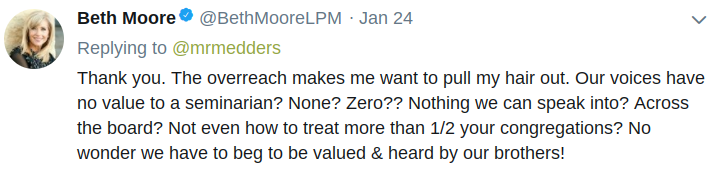
John Piper recently answered this question on an episode of Ask Pastor John. You should read his response for yourself (it’s not long), but, essentially his answer was that experienced pastor-mentors should be training up young pastors, and since it is unbiblical for women to serve as pastors themselves, they lack the experience necessary to mentor pastors-in-training. And, my word, the egalitarian world had a fit – including Beth Moore and her daughter Melissa (who helps run Beth’s ministry):

While I consider him to be a generally doctrinally sound brother in Christ, I’m not particularly a fan of John Piper, but I do want to say that I think his answer was taken wildly out of context by those pushing unbiblical agendas, that he was treated shabbily by many on social media, and that I thought his answer was very good, biblical, and just plain old made sense. Women are not qualified to serve as pastors. Why on earth would we want them training pastors? Moreover, what student wouldn’t want the most qualified and experienced professors he could get for his tuition money?

Let’s say you were the dean of the neurosurgery department at a medical school. A gentleman, totally blind from birth, comes in and applies for a position teaching surgical practicum (cutting, suturing, removing tumors, etc.). He has held positions teaching various subjects at other universities so his ability to impart information is not in question, but he has never performed surgery in his life because he’s blind. Would you hire him to train neurosurgeons to perform brain surgery?

The reason Dr. Piper’s answer caused a bit of a kerfuffle is that he limited his answer to the question he was asked. Imagine that. He was asked if women should train pastors and that’s the question he answered. The agenda-driven screaming neemies took his answer of “no” to mean that no woman should ever teach anything to anyone in any seminary anywhere ever. That is not what Dr. Piper said. He said women should not train men for the pastorate.

I would have answered the same way. However, if I were to expand on Dr. Piper’s answer, what I would further explain is that most seminaries (at least the ones I’m familiar with) do far more than simply train men for the pastorate. Take the seminary my husband attended for example, New Orleans Baptist Theological Seminary. If you’ll click on the “Academics and Admissions” tab at the top of the page and examine the various degree and non-degree programs, you’ll find that most of them are not strictly preaching programs. There are programs for women’s ministry and children’s ministry (Surely we wouldn’t say women are unqualified to teach in these areas?), college ministry, urban ministry, music ministry, missions, counseling, languages, and many more. There’s nothing wrong with women teaching things like music theory, finance, general education classes like math, history, and English, archaeology, legal issues, languages, business, etc., even in a seminary.

There are definitely some classes women shouldn’t be teaching in seminaries, but there are plenty of other classes that would be fine for them to teach.


Since we’ve become parents my husband and I have mostly attended churches that were larger and offered childcare. We were saved out of Mormonism eight years ago which has its own order of services and no childcare provided for the main service, but I don’t know what to expect from a Christian service that doesn’t offer childcare. I don’t know what will be expected of me and my family. I have a four-year-old and I worry that he will end up running around or asleep on the pew. Do we call ahead? Pack a busy bag? Are snacks alright? How do you ever get anything out of the service for yourself?

Before I answer, I want to encourage readers who are experienced church members to really let this precious sister’s question sink in and inform the way you respond to visitors and new members. Increasingly, the people who are new to your church will have very little church background. Church culture may be old hat to you, but it’s like landing on Mars to many of them. They have no idea where to go or what to do, and they don’t speak Christianese. Make sure you warmly welcome and encourage newbies and let them know that it’s OK to ask questions.

I think my article Churchmanship 101: Training Your Child to Behave in Church will help with some practical tips and expectations. You should not allow your child to run around the sanctuary during the worship service any more than you would allow him to run around a restaurant if you went out to eat, or a store if you were shopping, but I would not get overly stressed about him making a few minor noises or dropping the occasional Bible during church. If a church doesn’t offer childcare, they’re surely used to children making a little noise during the service from time to time. Sermon-time naps at four years old are not the end of the world, but you’ll want to curb those as he approaches school-age (if he can stay awake all day in school, he can stay awake for 30 minutes or an hour in church).

Until your child gets into the routine of attending worship and learns how you expect him to behave, you may not get very much out of the service. That’s just one of those parts of being a mom that we all have to accept – like stretch marks :0) But if you will be consistent and diligent as you train your child, he’ll get with the program soon enough.

When you ask if you should “call ahead”, if what you mean is calling the church office prior to Sunday and asking any questions you might have, that is a super idea! Most pastors I know would be delighted to chat on the phone or in person to welcome you to the church and help you feel at ease. That is the point at which I would ask about snacks. Different churches have different policies about food and drink in the sanctuary. I’ve never heard of one that wouldn’t allow a baby bottle, but some may not be keen on the idea of Cheerios ground into their carpet. You could also ask if they have a “cry room”. Some churches have set aside a room near the sanctuary where you can take a fussy baby or jumpy toddler. Many of them have the sermon “piped in” so you can listen until you go back into the worship service. You might also want to ask if the worship service is recorded and posted online so you can listen at home to any parts of the sermon you may have missed. Never be afraid to ask an honest and polite question.


I have been hearing the word messy a lot in reference to our lives..has this word replaced the word sin?

Well…I suppose it may have for those who are trying to sand off the sharp edges of the gospel, but the biblical term is sin, so that’s the correct word to use, despite how popular “messy”, or any other trendy word, might be.


Can you recommend any doctrinally sound female speakers for women’s events?

(I promise this is an actual question I recently received, not one I made up for promotional purposes! :0)

Yes, me. Click the “Speaking Engagements” tab at the top of this page for more information.

If I’m not really your cup of tea, or I’m too far away for your travel budget, I happily recommend any of the women listed under the “Recommended Bible Teachers” tab at the top of this page (although I’m not positive all of them do speaking engagements).


If you have a question about: a Bible passage, an aspect of theology, a current issue in Christianity, or how to biblically handle a family, life, or church situation, comment below (I’ll hold all questions in queue {unpublished} for a future edition of The Mailbag) or send me an e-mail or private message. If your question is chosen for publication, your anonymity will be protected.