Women of Genesis Bible Study

The Women of Genesis: Lesson 19- Keturah, Hagar, Sarah, Rebekah

Previous Lessons: 1, 2, 3, 4, 5, 6, 7, 8,ย 9, 10, 11, 12, 13, 14, 15, 16, 17, 18

๐Ÿ“–๐Ÿ“–๐Ÿ“–๐Ÿ“–๐Ÿ“–

Read Genesis 25

๐Ÿ“–๐Ÿ“–๐Ÿ“–๐Ÿ“–๐Ÿ“–


Questions to Consider

1. Who are the three women named in verses 1-18? What was the relationship of each to Abraham? To the Abrahamic Covenant? Based on your answers to these questions, why don’t we hear anything else about the sons of Keturah and Hagar after Genesis 25? Why does the Bible follow the story of Abraham’s lineage through Sarah (Isaac) instead?

2. Why, in terms of inheritance and the Abrahamic Covenant, would Abraham have sent the sons of Keturah and Hagar away from Isaac? (6)

3. Briefly describe Sarah’s, Keturah’s, and Hagar’s “callings” in life.ย Did Hagar and Keturah have less intrinsic value as people in God’s eyes than Sarah did simply because their roles in Old Testament history were different from hers? Does the fact that God calls different people to different roles in life mean that He values or loves people with “important” roles more? Who places or allows people to be in the roles or life circumstances they’re in? Does God view our status in life the same way people do?

4. Do you see some similarities between Sarah and Rebekah in this chapter?

๐Ÿผย What is the first similarity we see in verse 21 (compare with 11:29-30)?

๐Ÿผ๐Ÿผ Compare Isaac’s age when he married Rebekah (20) to his age when Jacob and Esau were born (26). How long did Isaac and Rebekah wait for God to open her womb? How long did Abraham and Sarah wait (compare 12:1-4ย with 21:5)?

๐Ÿผ๐Ÿผ๐Ÿผย After opening their wombs, how many sons of the Covenant did Sarah have? How sons of the Covenant did Rebekah (24) have?

๐Ÿผ๐Ÿผ๐Ÿผ๐Ÿผย How did Rebekah (23) and Sarah (17:19) find out about these Covenant sons?

5. Consider Rebekah’s possible concerns and emotional state at being barren for so long, and then bearing only two sons, when God had promised Abraham that his descendants would be “as many as the stars of heaven and as many as the innumerable grains of sand by the seashore”. How might God have used these circumstances in her life to teach her to trust Him? (22-23)

6. How do the motifs of barrenness, miraculous conception, and the one, promised, long-awaited son of the Covenant foreshadow the birth of Christ?

7. How does the story of Esau despising his birthright and Jacob redeeming it further confirm what God told Rebekah in verse 23 – that Jacob would be the son of the Abrahamic Covenant?


Homework

Think about the roles and statuses God has placed you in. Are you famous? Unknown? Do you wield a lot of power and influence, or very little? Are you wealthy, poor, or somewhere in between?

Read the Parable of the Talents. “Talents” were units of money the master entrusted to his servants to invest. What kinds of blessings, influence, resources, and abilities has God entrusted to you? Your marriage? Your singleness? Your home? The position you serve in at church? Money? Your children? Your job? Your relationships with friends?

What matters to God – how many of these things He has blessed you with, or how you steward them for His glory (see verses 21 &23)? List three ways you can faithfully make the most of the roles and statuses God has called you to for His glory.


Suggested Memory Verse

And the Lord said to her, โ€œTwo nations are in your womb,
and two peoples from within you shall be divided;
the one shall be stronger than the other,
the older shall serve the younger.โ€
Genesis 25:23

Women of Genesis Bible Study

The Women of Genesis: Lesson 18- Rebekah

Previous Lessons: 1, 2, 3, 4, 5, 6, 7, 8,ย 9, 10, 11, 12, 13, 14, 15, 16, 17

๐Ÿ“–๐Ÿ“–๐Ÿ“–๐Ÿ“–๐Ÿ“–

Read Genesis 24

๐Ÿ“–๐Ÿ“–๐Ÿ“–๐Ÿ“–๐Ÿ“–


Questions to Consider

1. Review lesson 17 (link above) and briefly set the scene for chapter 24. Who are the main characters? What events have recently transpired? Approximately how old is Isaac in chapter 24? (v.67)

2. Why didn’t Abraham want Isaac to marry a Canaanite woman? (3) Why did Abraham tell the servant notย (6,8) to take Isaac back to his native land? (7) Think in terms of the Abrahamic Covenant and Abraham’s concept of possessing the land. What might the future ramifications of possessing the Promised Land (Canaan) have been if Isaac had intermarried with a Canaanite and had descendants who were partially Canaanite? What might have happened if Isaac had gone back to Abraham’s native land and stayed there- would Abraham’s lineage still have had a physical presence (possession) in the Promised Land after he died?

3. What impact would all of the issues in #2 have had on Rebekah when she married into this family?

4. What can we learn about marriage and betrothal customs of the time from this chapter? What else can we learn about Mesopotamian culture, such as hospitality, gender roles, authority and submission, etc.?

5. How do Abraham, Isaac, the servant, Rebekah’s family, and Rebekah each demonstrate their trust in God in this chapter? How does God demonstrate His trustworthiness in each of their situations?

6. Examine Rebekah’s words and actions in this chapter and write a brief character sketch of her. What are some ways she sets a good (or bad?) example for you as a Christian woman today?

7. How does this chapter showcase God’s sovereignty over our personal lives as well as over history?


Homework

Examine the decision-making process, and list the steps the servant took, to determine whether or not Rebekah was the right choice. (12-14) Does this serve as an instruction to Christians today on how to make godly decisions? Are we to pray for a sign or for wisdom to make godly decisions? Are we to expect God to verbally tell us what to do, or depend on His fully sufficient written Word for guidance? Do you have an upcoming decision to make? My articleย Basic Training: 8 Steps to Finding Godโ€™s Will for Your Lifeย may be helpful.


Suggested Memory Verse

And they blessed Rebekah and said to her,
โ€œOur sister, may you become
thousands of ten thousands,
and may your offspring possess
the gate of those who hate him!โ€
Genesis 24:60

Mailbag

The Mailbag: Potpourri (Female missionaries, quantum physics, book recommendations…)

Welcome to another โ€œpotpourriโ€ edition ofย The Mailbag, where I give short(er) answers to several questions rather than a long answer to one question. I also like to take the opportunity in these potpourrri editions to let new readers know about my comments/e-mail/messages policy. Iโ€™m not able to respond individually to most e-mails and messages, so here are someย helpful hintsย for getting your questions answered more quickly.ย Remember, the search bar can be a helpful tool!


In the last Potpourri edition ofย The Mailbag,ย a reader asked if I could enlarge the font of my articles. I played around with several different fonts and sizes, and what you’re currently seeing is the best I can do to enlarge the font without throwing the layout of the whole page out of whack. Personally, I think it’s still too small, but I hope it has helped at least a little.


I am wanting to start a Bible study for my coworkers after work maybe once a week or every two weeks but I donโ€™t know where to start. Many of them are young women in their early twenties and either new in the faith or no faith at all. I want to start slowly so I donโ€™t overwhelm them but I have no idea the first step I should take. Do you have any resources for sound Bible studies for new believers or young women?ย 

Yes, I recommend you choose a book of the Bible, maybe a shorter one to start with, start at the beginning, and work your way through it with your ladies, teaching and discussing as you go. If you need some help in the beginning knowing what kinds of questions to ask or which issues in the text to focus on, you are more than welcome to use any of the studies I’ve written free of charge (see the “Bible Studies” tab at the top of this page), and even print them out if you like. Once you get a feel for teaching this way, I’m sure you’ll do fine on your own coming up with questions and pointing out important points in the passage.

You might want to start out with my study on Colossians since it’s fairly short and will give your group a good grounding in biblical Christology (who Jesus is, what He did, and why).

Another option might be for the group to choose a Bible reading planย (again, maybe one of the shorter ones to start off with), do the reading at home, and come together weekly to discuss the readings.

I don’t recommend “canned” book or DVD studies anymore. First of all, the overwhelming majority of them contain false doctrine. Studying the Bible itself sidesteps that problem altogether. Second, Christian women need to learn and practice the skill of picking up God’s Word and studying it for themselves. You have the unique opportunity with new Christians and non-Christians to start them off on the right foot of studying the Bible itself rather than getting them hooked on other people’s books. Below are a few more resources that might be helpful. Let me know how it goes!

Bible Study resource articles

The Mailbag: We Want Bible Study Answers

10 Simple Steps to Plain Vanilla Bible Study

Youโ€™re Not as Dumb as You Think You Are: Five Reasons to Put Down that Devotional and Pick Up the Actual Bible

10 Bookmarkable Biblical Resources for Christian Women

Rightly Dividing: 12 Doโ€™s and Donโ€™ts for Effective Bible Study

Bible Book Backgrounds: Why you need them and where to find them


What is your take on quantum physics and God?

Oh my! My take is thatย I really don’t know enough about quantum physics to speak intelligently on this. You might want to check out Answers in Genesisย or the Biblical Science Institute. The founder of BSI, Dr. Jason Lisle, is a doctrinally sound Christian who has a double-major bachelor’s degree in physics and astronomy with a minor in mathematics, and a Masterโ€™s degree and Ph.D. in astrophysics. He would be the one to ask.


Book Recommendations
I need some help from you readers on these!

Readers have written in requesting doctrinally sound recommendations of books on the following topics:

Theology books for teenagers
Neither of these are written specifically for teenagers, but they’re both written simply enough that teenagers shouldn’t have any trouble with them:
None Other by John MacArthur
Everyone’s a Theologian by R.C. Sproul

A whole Bible commentary
Here
are some you can try out for free.ย MacArthur’sย commentaries are excellent, as are Boice’s.

Explaining sex/where babies come from (8 year old level)
Clueless. My husband and I just explained it to our children verbally.

If you have a recommendation for a doctrinally sound book on any of these topics, please comment below with the title, and the author’s name and a link if possible. Thank you!


I read your blog regularly and havenโ€™t seen you write about a particular topic: Christian wives, especially mothers, working outside the home.ย 

The reader went on to answer her own question quite beautifully, I thought. I couldn’t say it any better, so here’s the rest of her e-mail:

As I have read and studied Titus 2:3-5 lately, as an older woman (62 this year), I was struck by this phrase, workers at home:

Older women likewise are to be reverent in their behavior, not malicious gossips nor enslaved to much wine, teaching what is good, so that they may encourage the young women to love their husbands, to love their children, to be sensible, pure, workers at home, kind, being subject to their own husbands, so that the word of God will not be dishonored. (emphasis mine)

Interestingly, our pastor is doing a series on evangelism. He has started out in a different place, sort of laying the groundwork. He is showing us particular passages in the Scriptures regarding practical things that Scripture says Christians can do to perhaps provide openings and help to overcome some of the unsaved personโ€™s natural enmity to the gospel. He preached on this passage because it says that women are to do/not do these things โ€œso that the word of God will not be dishonored.โ€ This has made this issue seem even more compelling to me. I know of Christian wives that are working outside the home, some against the counsel of godly people in their lives and even the wishes of their own husbands.

Lest you misunderstand me, I am not saying that a Christian woman should never work outside the home. Every Christian couple must decide together before the Lord how this looks in their own family. Obviously, a woman who has children in school all day, or grown children, or no children, has more leeway. If a husband is absolutely unable to work because of ill health, or whatever, I am sure there are some exceptions. But still the Scriptures teach that the Christian wifeโ€™s primary focus and attention is to be in her home, that the word of God will not be dishonored. I agree with what Grace to You wrote here.


Should women be missionaries?

Yes. Absolutely. In fact, we need more women – single and married – to serve as missionaries (more men, too). The only caveat is that women who serve as missionaries need to do so in a way that is in keeping with Scriptural principles of women’s roles in the church. (For example, female missionaries should not be pastoring churches on the mission field. A missionary’s job is to share the gospel with people and then disciple them in sound doctrine, and you don’t want to be teaching false doctrine through the act of preaching to men.) But there are oodles of mission opportunities that fit the bill.

It is my understanding that there is a great need for women missionaries to minister to women in countries whose cultures discourage or prohibit their women from interacting with men. A male missionary could not reach out to women in those countries, but a female missionary could be very effective.

My denomination, the Southern Baptist Convention, has a rich history of female missionaries and mission work, starting with our Women’s Missionary Union, celebrating its 130th anniversary this year. Our yearly offering for international missions is named after female missionary, Lottie Moon. Likewise, our annual North American missions offering is the Annie Armstrong offering, and my state convention collects the Georgia Barnetteย missions offering every year. You might enjoy reading about these female missionaries and others such as Amy Carmichaelย and Amy Medina.

There are many reputable missions organizations out there, but the two I’m most familiar with are the Southern Baptist Convention’s North American Mission Boardย and the International Mission Board, which, even if you’re not Southern Baptist could give you some ideas of the types of mission work out there and the countries needing missionaries.

If you’re thinking about becoming a missionary, set up an appointment with your pastor to talk it over. He can probably give you some great pointers and put you in touch with people and organizations that can help you.


If you have a question about: a Bible passage, an aspect of theology, a current issue in Christianity, or how to biblically handle a family, life, or church situation, comment below (Iโ€™ll hold all questions in queue {unpublished} for a future edition ofย The Mailbag) or send me anย e-mail or private message. If your question is chosen for publication, your anonymity will be protected.

Discernment, False Doctrine

A Naked Emperor in the Southern Baptist Convention

Think back to your childhood. Remember the story, The Emperor’s New Clothes?

Once upon a time, there lived an emperor. One day two swindlers came to his palace and told him they could weave cloth for his royal robes that was magical: to those who were foolish or unfit for their jobs, it would appear invisible. Only the wise and worthy would be able to see this fine fabric. The emperor hastily agreed to pay the “weavers” an exorbitant amount of money to make him such an amazing garment, thinking he would use it to weed out anyone unfit for royal service.

The weavers set about pretending to weave. From time to time, the emperor sent various folk to check on the progress the weavers were making, and – though in reality, none of them could see the non-existent fabric – all reported back that the garments were coming along nicely and the cloth was beautiful. But strangely enough, when the emperor himself looked in on the weavers, they held up the magnificent fabric, and he could not see it. Not wanting word to leak out that he was unfit to serve as emperor, he pretended to examine the cloth and complimented the weavers lavishly on their fine work.

Finally, the weavers informed the emperor that the garments were finished. They had the emperor strip down to his skivvies and pretended to help him on with his fine new “garments”. Word had spread among the emperor’s subjects about the magical properties of the fabric, and as the royal procession made its way through town, all shouted out praise for the emperor’s fine new clothes.

All. Except for one little boy.

“But he hasn’t got anything on!” the boy shouted.

It took the innocent honesty of a simple child to shock the emperor’s subjects back to their senses. The truth spread like wildfire, and the crowd began to cry out: “The emperor is naked!” “The emperor has no clothes on!” “He’s not wearing anything!”

But did the emperor admit to his foolishness, return to the palace, and get dressed? No. Sadly the story ends this way:

“The Emperor shivered, for he suspected they were right. But he thought, ‘This procession has got to go on.’ So he walked more proudly than ever, as his noblemen held high the train that wasn’t there at all.”ยน

And so the “emperor” of leadership in the Southern Baptist Convention and those who carry its train march proudly on, despite the cries of simple peasants and innocent little children crying at the top of our lungs, “The emperor is naked!” “There are issues that need to be addressed, here!” “Listen to us!”

You’ll note that the story doesn’t say that the emperor was a cruel man, that he overtaxed the people, oppressed them into slavery, was a warmonger, or was in any other way an evil leader. In fact, one could argue that he had good intentions of making sure the people who served at various posts in his empire were of the finest caliber.

And while there are many issues that need to be addressed in my denomination, I think this could generally be said of the leadership of the Southern Baptist Convention as well. Call me a Pollyanna, but I have no reason to believe our denominational leadership – as a whole – is evil or has anything less than the best of intentions for the SBC.

There are many good and praiseworthy things going on in SBC life. We have hundreds of doctrinally sound pastors faithfully preaching the gospel week in and week out. Discernment and biblical literacy among Southern Baptist church members is slowly but steadily growing. The SBC takes a public, biblical stand on abortion and homosexuality while many other denominations do not. Our organizational structure for funding and sending out missionaries, while sometimes flawed in its execution, is without peer. Southern Baptist Disaster Relief is one of the finest relief organizations in the world. And there’s so much more. Find a godly Kingdom effort going on somewhere, and you’ll probably find a Southern Baptist involved in it. By the grace of God, while we’re far from perfect, we’re getting a lot of things right.

But even benevolent emperors get things wrong sometimes, and, Southern Baptist leadership, your drawers are flapping in the breeze on this oneยฒ:

Sin. The public sin our leaders commit that we excuse and the public sin our leaders commit that we discipline, and the fact that there’s a discrepancy between the two.

Recently, Frank Page, president and chief executive officer of the Executive Committee of the Southern Baptist Convention (one of the top positions of SBC leadership at the national level) resigned his position due to “a morally inappropriate relationship in the recent past,” which, we are left with little choice but to assume means “adultery”. (As an aside, Christians, when confessing sin, let’s knock off the the terminological hem-hawing and call a spade a spade. “I had a six month extra-marital romantic and sexual relationship with a married woman in my church,” or whatever. You don’t have to give all the gory details or name names, but, for crying out loud, if you’re going to confess, confess- don’t finesse.)

It was right and biblical for Dr. Page to publicly confess and express sorrow over his sin as well as to resign (it would also have been right and biblical for the SBC to remove him had he refused to resign, which, undoubtedly would have happened). He sinned against God, his family, the woman and her family, his church, his co-workers, and the entire denomination. He publicly embarrassed the Southern Baptist Convention and gave unbelievers fodder for scoffing when the report of his sin made the national news. This was a case of a well known Southern Baptist leader whose public, observable sin was handled biblically by SBC leadership. I am thankful for this witness to Christians and to the world that sin is not to be swept under the rug, but that sinners are to repent, be disciplined, and then be restored to fellowship (although, in cases like this, not leadership).

But we don’t handle all cases of public sin that way. Some public sin we reward by making the sinner into a wealthy, lauded celebrity.

“Impossible!” you say?

Check the shelves at LifeWay. Select twenty average SBC churches with women’s ministries and see whose books, DVDs, and simulcasts are being used again and again. Peruse the speakers at popular SBC conferences.

You’ll find names like Beth Moore, Priscilla Shirer, Lysa TerKeurst, Christine Caine, Ann Voskamp, Sarah Young, Andy Stanley, Steven Furtick, Rick Warren, and T.D. Jakes, just to name a few.

Have they committed adultery? Voiced approval of of homosexuality? Committed theft, abused their spouses, or promoted pornography? No. But those aren’t the only types of sins the Bible prohibits.

Every single one of them teaches false doctrine, from Sarah Young’s blasphemous “channeling” of Jesus, to T.D. Jakes’ denial of the Trinity, to Christine Caine’s Word of Faith heresy, to Lysa TerKeurst’s teaching of contemplative prayer.

All of these women who do speaking engagements unashamedly and unrepentantly preach to co-ed audiences. All of these men allow women to preach to co-ed audiences from their pulpits.

All of them who join in ministry with others have yoked or affiliated themselves with false teachers. Beth Moore and Joyce Meyer. Priscilla Shirer and T.D. Jakes. Steven Furtick and Joyce Meyer and T.D. Jakes. Rick Warren and the Pope.

Scripture plainly prohibits the teaching of false doctrine. It’s a major theme of the New Testament, for goodness sake. The Bible tells us that women are not to preach to men or exercise authority over them in the gathered body of Believers. And God’s Word makes very clear that we are to have nothing to do with false teachers, especially not partnering with them in “ministry”.

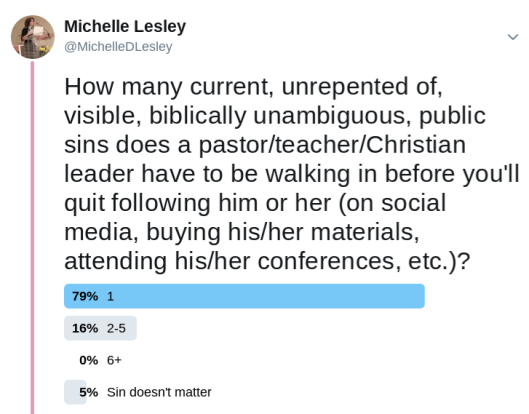
In the wake of Frank Page’s resignation, I asked this poll question on Twitter

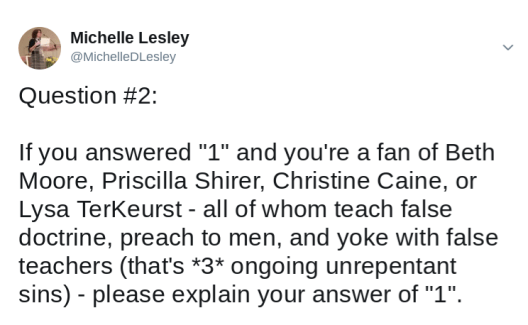
followed by this one

Why are Southern Baptists leaders so quick to – rightly and biblically – oust Frank Page for, as far as we know, one isolated sin which he publicly confessed to and repented of, and yet overlook three major – and much more publicly observable and harmful to Southern Baptists – ongoing sins from pastors and teachers who have been rebuked and refuse to repent? Why, instead of disciplining them for their sin, do those in leadership give them fat book deals, invite them to speak at all the cool conferences, fawn over them on social media, and make them into celebrities?

How many sins will it take to disqualify and discipline these people? Four? Eleven? Ninety-six? Is there any amount of sin these pastors and teachers, and those like them, can commit that will cause those in SBC leadership to pull their materials off the shelves of LifeWay, deny them a seat at the table, and urge them to repent and step down from their positions?

I’ve been a Southern Baptist from the day I was born. I’ve been taught since the cradle roll that if God’s Word says not to do something and you do it anyway, that’s a sin. If God’s Word says to do something and you don’t do it, that’s a sin. And that sin is sin in the eyes of God.

Well is it, or isn’t it, Emperor?

If sin is sin in God’s eyes, why aren’t you treating Beth Moore’s sin like Frank Page’s sin? Why are you rewarding her for her sin and disciplining him for his?

The Bible says in James 3:1:

Not many of you should become teachers, my brothers, for you know that we who teach will be judged with greater strictness.

Those who teach and lead bear more responsibility to teach sound doctrine and walk worthy because they are teaching and leading us by example.

Why are all the aforementioned pastors and teachers better examples to us in their rebellion and unrepentant sin than Frank Page was in his repentance of sin?

Why?

Southern Baptist peasants and little children see right through your foolishness on parade on this issue and we want answers. Biblical answers.

Don’t just stand there shivering, suspecting we are right, but thinking, “This procession has got to go on,” and walking more proudly than ever. Go back to the palace. Repent. Clothe yourselves with humility and obedience to Scripture, and come back and lead us rightly. Biblically.

Because the Emperor of Southern Baptist leadership has been naked for far too long.


ยนH.C. Andersen Centret (The Hans Christian Andersen Centre). The Emperor’s New ClothesAccessed April 5, 2018.

ยฒI am well aware that this is not the only problem in the SBC that needs to be addressed. It would be impossible to address every issue in one article, so this time I’ve chosen to focus on this one particular issue.
Women of Genesis Bible Study

The Women of Genesis: Lesson 17- Sarah

Previous Lessons: 1, 2, 3, 4, 5, 6, 7, 8,ย 9, 10, 11, 12, 13, 14, 15, 16

๐Ÿ“–๐Ÿ“–๐Ÿ“–๐Ÿ“–๐Ÿ“–

Read Genesis 21:22-23:20

๐Ÿ“–๐Ÿ“–๐Ÿ“–๐Ÿ“–๐Ÿ“–


Questions to Consider

1. Briefly review lesson 15 (link above) as you read 21:22-34. What happened the last time Abraham and Sarah had an encounter with Abimelech? Why did Abimelech and Phicol think God was with Abraham? (22) How had they dealt kindly (23) with Abraham and Sarah?

2. Read 22:1-19. Why, according to verse 1, did God ask Abraham to offer Isaac? How is Abraham’s sacrifice of his one and only son a type and shadow of God’s sacrifice of His one and only son? Which elements and details of this story point ahead to elements and details of the crucifixion? (Hint: check out the cross-references) See also Hebrews 11:17-19

3. How many times is Sarah mentioned in 22:1-19? Why do you think that’s the case? Do you think Sarah knew what Abraham was going to do before he did it? List a few different ways Sarah might have reacted if Abraham had told her what he was about to do. How might she have reacted upon finding out what had happened after it was all over?

4. Examine 22:20-23. Considering that familial lines, inheritance, etc., were reckoned through male offspring, why does verse 23 specifically point out that Bethuel fathered Rebekah? (Hint: check your cross-references)

5. Read chapter 23. Keeping in mind our previous lessons about Sarah, what memories of her might have come to Abraham’s mind as he was mourning her death? (1-2) What might Abraham have learned from Sarah’s life about faith, sin, and godliness?

6. How old was Isaac when Sarah died? (See Genesis 17:17 and 23:1)

7. What can we learn about Abraham’s character from his encounter with the Hittites in chapter 23?


Homework

Pretend you’re attending Sarah’s funeral. Write her eulogy. What did we learn from her life? How did her life point us ahead to Christ?


Suggested Memory Verse

Abraham said,ย โ€œGod will provide for himself the lamb for a burnt offering, my son.โ€ So they went both of them together.
Genesis 22:8