Christian women, Complementarianism, Ministry, Sin

Women Preaching: It’s Not a Secondary Doctrinal Issue

Originally published August 3, 2018

When it comes to Christianity, are the specifics of what people believe important?

I think most of us would answer a resounding “yes” to that question. Of course, the various concepts we believe are important. You can’t just believe anything you like and still be a Christian. There are certain things you must believe in order to become a Christian at all, and there are certain things you will come to believe because you are a genuinely regenerated Christian. But what are those things, and how do we know which is which?

You can’t just believe anything you like and still be a Christian.

Maybe you’ve heard the terms “essential doctrines” or “primary, secondary, and tertiary theological issues” or “first, second, and third tier levels of doctrine”? For years, theologians have been attempting to organize beliefs of the Christian faith – all drawn from the Bible, naturally – into nice neat categories in order to make things a little simpler. As someone who thrives on organization and categories, I’m grateful for their efforts. But if you begin to study this categorization of beliefs, you’ll find that we haven’t reached an across the board consensus yet.

Generally speaking, “essential”, “primary”, or “first tier” doctrines are those which you, biblically, have to believe in order to become a Christian and/or be considered a Christian. For example:

โœข Sin is a thing, and I am a sinner.

โœข God exists and is the supreme authority of the universe.

โœข Jesus was God in human flesh.

โœข Jesus rose bodily from the grave.

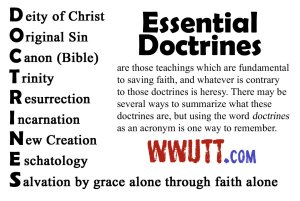
See how this works? If you don’t believe you’re a sinner, you’re not saved. If you don’t believe in the bodily resurrection of Christ, you’re not saved. Here’s how our friend, Pastor Gabriel Hughes, briefly outlines essential doctrines:

(Gabe later tweaked the acrostic a little and added an “S”, which I think is helpful.)

The vast majority of brand new Christians have only the most basic understanding of most of these tenets at the moment of salvation. But it’s not an issue of fully understanding – or else we’d all have to be theologians in order to get saved – it’s an issue of believing. Someone who is genuinely regenerated may not completely understand how the Trinity works (honestly, no one does), but when she’s introduced to the biblical idea of the Trinity, she believes it, learns more about it, and does not reject it.

There is typically agreement among most reputable theologians regarding what constitutes first tier doctrine. Scripture is clear about these things, and several of these issues were settled long ago by the church fathers in assorted church councils (Nicea, Chalcedon, etc.)

Secondary issues are routinely defined as non-salvific but still extremely biblically important, if not quite as biblically clear-cut as primary issues. Doctrines surrounding baptism (credo versus paedo, affusion versus immersion), for example, are usually cited as a secondary issue. A disagreement on a secondary issue doesn’t mean one person is saved and another isn’t, but it normally prevents close partnership in ministry activities involving these issues. For example, my Presbyterian friends and I can join together in pro-life ministry, but we would most likely not plant a church together.

Tertiary issues are non-salvific, less immediately urgent, biblical issues in which the Bible is even less clear-cut and open to wider (yet still biblical) interpretation. These are issues over which Christians can disagree and still maintain close doctrinal fellowship, even in the same church, if they’re in agreement on first and second tier doctrine. Eschatology – the order and timing of events at Jesus’ second coming – is a doctrine that’s often considered third tier. Someone can hold a different eschatological view than mine, yet, for the most part, it shouldn’t affect our ability to worship together, work together, or participate in the ordinances together in the same church.

Some theologians add a fourth category – issues of adiaphora, conscience, or Christian liberty. Usually these are issues of much less importance that the Bible either doesn’t specifically address, or doesn’t give commands about one way or the other. Individual Christians may use biblical principles to inform their consciences and decide for themselves. These would be things like whether or not to take your child trick-or-treating or deciding whether to dress formally or casually for church.

While theologians are largely in agreement about primary doctrines, there is wider spread disagreement on which doctrines are secondary and tertiary (many consider eschatology to be a second tier doctrine, for example) and whether or not there is a need for a category of adiaphora, since such issues are normally not considered to be “doctrinal” issues. In fact, there’s enough space for disagreement that pastors and theologians often wisely refrain from making concrete lists of secondary and tertiary doctrines.

But when we’re talking about the different levels of doctrine, what you won’t find is questions like these: Is murder a first, second, or third tier doctrine? What about gossip? Rape? Adultery? Lying? Gluttony? Pride?

And it’s not because these issues aren’t important or because the Bible doesn’t address them. It’s because they’re in a different category from the other issues: the category of sin. They aren’t doctrines upon which salvation hinges, they aren’t open to interpretation, and the Bible is clear that we are absolutely not to do these things.

The category of doctrine deals with beliefs. The category of sin deals with behavior.

In 2005, Dr. Albert Mohler wrote an excellent article about the different levels of doctrine entitled A Call for Theological Triage and Christian Maturity. He carefully explains the importance of each level of doctrine and what it covers in a plea to keep each level’s urgency in its proper place of significance during discussion, debate, and decision-making.

It was a helpful article to which I always refer people who have questions about tiers of doctrine, and I agree with Dr. Mohler’s thoughts in the article wholeheartedly1 …except on one point:

“In recent years, the issue of women serving as pastors has emerged as another second-order issue.”

Women serving as pastors, women preaching, women teaching men Scripture, and women exercising authority over men in the gathering of the Body is not a secondary issue. Nor is it a primary or tertiary issue. It does not belong in the category of “doctrine” in the same way baptism and eschatology do. It belongs in the category of sin in the same way murder, gossip, and adultery do. Let’s take a look at the reasons for this.

Women serving as pastors, preaching, teaching men Scripture, and exercising authority over men in the gathering of the Body is *not* a secondary issue. Nor is it a primary or tertiary issue. It is a sin.

I do not permit a woman to teach or to exercise authority over a man; rather, she is to remain quiet. 1 Timothy 2:12

(The preponderance of Scripture supports and affirms this concept, so to keep things simple, we’ll use this verse as an exemplar.)

โœข The prohibition in 1 Timothy 2:12 is a clear command against a certain behavior. And when we behave in a way God has prohibited, that is called “sin”. All of the tenets in the three levels of doctrine are affirmative statements regarding beliefs (you must believe in the resurrection of Christ, we believe in baptism by immersion, etc.). None of them are commands, in the negative, against sinful behavior (Thou shalt not murder, I do not permit a woman to teach… etc.)

โœข Secondary and tertiary doctrines can be open – to varying degrees – to biblical interpretation. Every stripe of non-heretical eschatological thought can provide you with chapter and verse passages that can, depending on the angle from which you approach the subject, be biblically plausible and scripturally supported. There is no biblical support for anything God prohibits. No one can cite a properly handled, in context Bible verse in which God says, “It’s OK to commit adultery,” or “Women are allowed to preach.” There can be multiple views on a secondary or tertiary issue that can all be considered biblical, but there can only be one view of sin that is biblical.

โœข Differing beliefs on true secondary and tertiary issues are not sin. My Presbyterian friends have a different view of baptism than I do. That doesn’t mean either of us is sinning. I may think their interpretations of the verses they believe support paedo baptism are incorrect, but they are not breaking any of God’s commands. Differing behavior (again, we see the distinction between doctrinal belief and sinful behavior) on issues of sin is sin. If someone behaves differently from God’s command about lying, she is sinning. If a woman behaves differently from God’s command in 1 Timothy 2:12, she is sinning.

โœข Differing beliefs on secondary and tertiary issues are not born of disobedience and rebellion toward God. Usually, it’s quite the opposite. When someone has studied a theological issue enough to hold a particular position on it, it’s usually because she is striving to please God and to be biblical in her beliefs. Differing behavior on issues of sin is born out of disobedience and rebellion toward God. Someone who steals has already decided in her heart that her desires are better than God’s command. A woman who knowingly holds improper authority over men in her church is doing so because she has already decided to defy God’s clear command against such.

โœข Because different beliefs on secondary and tertiary issues are not born of rebellion and are not sin, they do not require church discipline. Sin does require church discipline. If someone in your church is openly dishonoring her parents, she is sinning and should be subject to church discipline. If a woman is pursuing a career as a pastor, she is sinning and should be subject to church discipline. 

Since the publication of Dr. Mohler’s article (and perhaps as a result of others teaching the same thing) the idea of the violation of 1 Timothy 2:12 being a “secondary doctrine” has spread in a most unhelpful way, leading many Christians to treat the issue in a c’est la vie, “We can just agree to disagree on this,” manner.

No, we cannot.

The idea of the violation of 1 Timothy 2:12 being a “secondary doctrine” has spread in a most unhelpful way, leading many Christians to think “We can just agree to disagree on this.”. No, we cannot.

We would not say, “We can agree to disagree,” on lying or adultery or homosexuality or abortion, and we cannot say it about women preaching, teaching men, or holding unbiblical authority, either. We disciple and teach a sister in Christ who is unaware of what the Bible says on these matters, and if she is committing any of these sins, we begin the process of church discipline. But it would not be loving toward her, or honoring God, to allow her to continue in biblical ignorance or in willful sin.

Furthermore, the violation of 1 Timothy 2:12 brings with it dangers to the church that true secondary and tertiary issues, and even many sins, do not…

The violation of 1 Timothy 2:12 brings with it dangers to the church that true secondary and tertiary issues, and even many sins, do notโ€ฆ

She may not say it with her lips, but when a woman preaches to men in defiance of Scripture, sheโ€™s teaching false doctrine through her behavior. What is the false doctrine sheโ€™s teaching? โ€œI donโ€™t have to obey Godโ€™s Word, and neither do you. If thereโ€™s a part of the Bible you donโ€™t like, youโ€™re free to disregard it.โ€ If your pastor stood up in the pulpit on Sunday morning and said that in words, youโ€™d run him out of town on a rail, and rightly so. Neither should a woman be able to teach that same false doctrine via her actions.

Additionally, I have mentioned several times when dealing with this issue that women preaching to men is highly correlated with women teaching other forms of false doctrine. I have researched scores of women teachers. Every single one of them who unrepentantly teaches men also teaches false doctrine in some other aspect of her theology (usually progressivism, Word of Faith, or New Apostolic Reformation). In other words, if a woman teaches men, you can just about take it to the bank that she also teaches additional false doctrine. False doctrine and heresy are infecting the church – via female preachers – at an alarming rate.

We dare not simply “agree to disagree” on this.

The violation of God’s command that women are not to instruct men in the Scriptures nor hold improper authority over men is a sin like any other. It is not a doctrinal issue in the same sense that other second and third tier doctrines are. If left undisciplined, however, it can lead to first tier doctrinal issues infiltrating a church and eventually destroying it. It is detrimental to the church to label and treat any sin as a secondary doctrinal issue.

Additional Resources

Is Women Preaching a Secondary Issue? on A Word Fitly Spoken

What Are Essentials and Non-Essentials? on A Word Fitly Spoken

Christian Liberty on A Word Fitly Spoken

The importance of Primary and Secondary Doctrines on the Truth Be Known Podcast


1In the years since 2018, when this article was originally written, Dr. Mohler has said, done, and supported various biblically questionable things, leading some to question whether or not he has “gone woke”. While I don’t support his stance on those questionable things, I also don’t believe he has reached the point at which I need to warn against him (although I don’t proactively recommend him, either). To my knowledge, at this time, he is still generally doctrinally sound.

Podcast Appearances

Podcast Guest Appearance – The Biblical Mom-alogue

I had such a wonderful time chatting with Michelle Flaningan on her podcast The Biblical Mom-alogue! This episode is called False Teaching and How to Discern Biblical Truth.

On the show, we discussed how I got started in discipleship ministry, how women can develop better discernment, how to teach our children discernment, and more! Check it out!


Articles / resources mentioned or touched on in the episode:

Going Beyond Scripture: Why It’s Time to Say Goodbye to Priscilla Shirer and Going Beyond Ministries

Bible Studies

Chronological Bible reading plan (and other plans)

Choose What Is Right: A Study in Discernment (Discernment Bible study)

Searching for a new church?

Popular False Teachers & Unbiblical Trends

Recommended Bible Teachers, Authors, Etc.


Got a podcast of your own or have a podcasting friend who needs a guest? Need a speaker for a womenโ€™s conference or church event? Click the โ€œSpeaking Engagementsโ€ tab in the blue menu bar at the top of this page, drop me an e-mail, and letโ€™s chat!

Podcast Appearances

Podcast Guest Appearance – Contending for the Word

It was such a pleasure, recently, to chat with my friend Dave Jenkins on his podcast Contending for the Word, in an episode titled Exposing Priscilla Shirer’s False Teachings: A Detailed Analysis.

On the show, we evaluated a few videos of Priscilla Shirer’s teaching, and discussed how and why it’s unbiblical. Other topics included false teachers she has yoked with, the fact that she preaches to men, and whether or not she believes and teaches a heretical view of the Trinity called modalism.

Be sure to check out Dave’s website, Servants of Grace, where you’ll find an abundance of great teaching, podcasts, and materials, as well as his social media links- and give Dave a follow!


Articles / resources mentioned or touched on in the episode:

Going Beyond Scripture: Why It’s Time to Say Goodbye to Priscilla Shirer and Going Beyond Ministries

Popular False Teachers & Unbiblical Trends


Got a podcast of your own or have a podcasting friend who needs a guest? Need a speaker for a womenโ€™s conference or church event? Click the โ€œSpeaking Engagementsโ€ tab in the blue menu bar at the top of this page, drop me an e-mail, and letโ€™s chat!

Mailbag

The Mailbag: Top 10 FAQs

Originally published September 7, 2020

I get lots of great questions, and sometimes, they’re the same questions from lots of different people. So I thought today it would be fun, instead of answering just one person’s question, to answer lots of people’s questions. Here are the top 10 Mailbag questions readers most frequently ask:

1.

โ€œDo you know anything about [Christian pastor/teacher/author] or his/her materials? Is he/she doctrinally sound?โ€

The best way to find out if I’ve written anything on a particular teacher is to put her name (make sure you spell it correctly) into the search bar, which is located at the bottom of every page of the blog. You can also check the Popular False Teachers & Unbiblical Trends tab and the Recommended Bible Teachers tab (in the blue menu bar at the top of this page) to see if the teacher’s name is located there.

If you need answers on a certain teacher right away, and I haven’t written anything about her, you will need to do the research yourself, which is a skill every Christian needs to hone anyway. (You should never just take my, or anybody else’s, word for it that a particular teacher is or isn’t trustworthy.) In case you need a little help getting started, I’ve described how I do my research, complete with some quick litmus tests and shortcuts in my article Is She a False Teacher? 7 Steps to Figuring It Out on Your Own.ย 

If I haven’t written an article about a teacher you see as problematic who’s reaching a wide audience, you’re welcome to send me her name along with any links you may have to her unbiblical teaching or behavior. If I get enough questions about a particular teacher, Iโ€™ll probably write an article on her.

2.

โ€œCan you recommend a good
womenโ€™s/children’s/teens/particular topic Bible study?โ€

No. On principle, I do not recommend what I call “canned” (book, workbook, DVD, etc.) Bible studies- not even doctrinally sound ones. The church has become so utterly dependent on books and materials written by others that the majority of evangelicals have no idea how to simply pick up the Bible and study or teach straight from the text of Scripture. I may be the only one to stand against that tide, but I’m standing against it. We need to, as a general practice, cut out the middleman and get back to learning and teaching straight from the Bible itself.

If studying or teaching directly from Scripture is new to you, I would encourage you to check out the Bible Studies tab in the blue menu bar at the top of this page, which explains more about my philosophy of Bible study and provides numerous resources to help you learn how to study or teach the Bible itself.

One of the resources you’ll find is all of the Bible studies I’ve written. They are all free for individual and group use, and you are welcome to print out as many copies as you need. My studies are learn-by-doing “training wheels” that teach you: how to study/teach the Bible in a systematic way, the kinds of things you should be noticing in the text, the kinds of questions you should be asking of the text, and how the various parts of the Bible fit together to tell God’s grand story of redemption through Christ. Work through a study or two. Once you get the hang of it, you’ll be ready to unbolt those training wheels and study or teach on your own without needing to rely on anyone else’s materials any more – even mine.

Here are a few additional resources:

The Mailbag: Can you recommend a good Bible study for women/teens/kids?

The Mailbag: โ€œWe need to stop relying on canned studies,โ€ doesnโ€™t mean, โ€œWe need to rely on doctrinally sound canned studies.โ€

McBible Study and the Famine of God’s Word

3.

โ€œYou shouldnโ€™t be warning against [popular false teacher]
for [X,Y,Z] reason!โ€

Sorry, but that’s not what the Bible says. The question isn’t, “Why am I warning against them?”. The question is, “Why aren’t you?”

Answering the Opposition- Responses to the Most Frequently Raised Discernment Objections

4.

I’m trying to find a doctrinally sound church. Can you help me?

It is my delight to help my brothers and sisters find a solid church. Please check out the Searching for a new church? tab in the blue menu bar at the top of this page.

If you’re newly saved and/or coming out of the New Apostolic Reformation, prosperity gospel, New Age, Catholicism, Mormonism, etc., I would strongly recommend reading through all of the resources in the “What to look for in a church” section of that tab before beginning your search for an actual church. You need to know what makes a church doctrinally sound (or not), and those resources can help.

Notice that there are multiple church search engines at the top of that tab. If you don’t find something in your area at the first search engine, go to the next one, and keep going until you’ve exhausted all of them.

Keep in mind that doctrinally sound churches are becoming scarcer and scarcer. You may have to drive longer than you’d like to get to one. It may not meet all your preferences. You might have to try a different denomination than you’re used to. The most doctrinally sound church you can find within achievable driving distance may have a few biblical “warts” (for example: a generally solid preaching/teaching church but the women’s ministry uses materials by false teachers). It is possible that God may put you in that less than perfect church to sanctify you, or for you to help bring about biblical change.

Sometimes people e-mail me asking if I can help them find a church. Your best bet is really to use all of the resources at the “Searching for a new church” tab. I want to reassure you that, unlike Walmart, I don’t have any churches in the back store room that haven’t been stocked yet. With the exception of a handful of churches my readers have recommended that I haven’t had a chance to vet yet, everything I have is out on the shelves at that tab. :0) (I would also encourage everyone reading this – if you attend a doctrinally sound church, click the link above and see if your church is listed on at least one of the three most popular church search engines: Founders, G3, and/or Master’s Seminary church search engines. If not, talk to your pastor about submitting your church’s information to one or more of these so people can find you!)

If you’ve made a good faith effort at the “Searching…” tab and have exhausted all of the resources there, and you still can’t find a passable church within achievable driving distance, you have two options (one of which is not giving up on church and staying home): move to an area that has a solid, established church, or look into church planting.

If you’re considering moving for a church, do everything in your power to make sure that church is solid and is going to stay that way. Find out about their history. Watch their worship services online regularly for a few months. Set up a Zoom call with the pastor or elders, explain your situation, and “interview them”. Don’t be shy to ask any, and as many questions as you need to. You’re picking up your entire life and moving based on what they say. Churches are apostatizing at an alarming rate. The last thing you want to do is move somewhere for a church you thought was sound, only to have it take a turn toward sin or false doctrine six months after you get there.

Personally, I think church planting is the preferable option for at least two reasons. First, you don’t have to go through the hassle, logistics (“Will I be able to find a job in this new place?”), and emotional upheaval of leaving family and friends behind that comes with moving. Second, if you’re in an area where you can’t find a good church, neither can any of your neighbors. You could be the person God uses to bring a solid church to an area without a gospel witness. How amazing would that be? Pick up the phone or fire up your email and start contacting the church planting organizations listed. Explain your dilemma. Ask for their help. If none of the church planting organizations can help, contact the nearest doctrinally sound church, explain things to the pastor, and ask about his church planting a church in your area.

5.

The leadership at my church is kicking off a new Bible study using materials by a false teacher. What should I do?

It breaks my heart that this is, indeed, a frequently asked question. Please see my article The Mailbag: How should I approach my church leaders about a false teacher theyโ€™re introducing?.

6.

My church uses …
or
I’m looking for a new church,
and I found one that’s really sound, except they use…
Bethel / Jesus Culture / Hillsong / Elevation music
or other music from heretical sources.
What should I do?

Please see my article The Mailbag: How should I approach my church leaders about a false teacher theyโ€™re introducing?. You can find information about Bethel, et al at the Popular False Teachers & Unbiblical Trends tab in the blue menu bar at the top of this page. Some other resources that may be helpful:

Why Your Church Should Stop Playing Bethel, Hillsong, Elevation and Jesus Culture

The Mailbag: False Doctrine in Contemporary Christian Music

7.

My friend is following a false teacher. How can I help her see this? 

Here are some resources that can help:

Words with Friends: How to contend with loved ones – at A Word Fitly Spoken (many additional resources linked here)

Words With Friends by Amy Spreeman

Clinging to the Golden Calf: 7 Godly Responses When Someone Says Youโ€™re Following a False Teacher 

8.

Whaddaya mean women can’t preach to men? Of course they can!

Again, sorry, but that’s not what the Bible says. I would strongly encourage you to read all of the articles in my Rock Your Role series, which examines the Scriptures dealing with the role of women in the church. (Remember, for Christians, God’s Word is our authority, not our feelings, opinions, and preferences.) I would suggest starting with these:

Jill in the Pulpit

Oh No She Di-int! Priscilla Didnโ€™t Preach, Deborah Didnโ€™t Dominate, and Esther Wasnโ€™t an Egalitarian

Rock Your Role FAQs

The Mailbag: Counter Arguments to Egalitarianism

9.

Why isn’t Teacher X listed at your Popular False Teachers tab?
Does the fact that she’s not listed mean she’s doctrinally sound?
Why isn’t Teacher Y listed at your Recommended Bible Teachers tab? Does the fact that she’s not listed mean she’s a false teacher?

Please understand that these are not comprehensive lists of every false teacher or doctrinally sound teacher in existence. There are thousands of both, so that would be impossible. Also, don’t jump to conclusions about any teacher who’s not on the list. The absence of a particular teacher’s name on either list says nothing definitive about whether or not I would recommend that teacher.

The articles I’ve written about false teachers have mainly been in response to readers inquiring about them. In other words, if you donโ€™t see a particular teacher’s name on the list, itโ€™s probably because I havenโ€™t been asked about her, I’ve been asked about her but havenโ€™t had time to get to it yet, or for one of the reasons below.

The teachers on the recommended teachers list are those I’ve personally listened to or read at enough length that I feel comfortable endorsing them. Most of the teachers on the list trend toward being Calvinistic/Reformed and cessationist because I believe this is the most biblically correct view of Scripture, and because, in my experience, those of these persuasions are generally more discerning about associating with false teachers, and more expository in their teaching. (Of course there are some non-Calvinist/Reformed pastors and teachers who are stellar in these areas. I’ve had the privilege of knowing a few personally.)

There are a few other reasons you might not see someone’s name on either the false teachers or the recommended teachers lists:

โ€ข My articles on false teachers are nearly always about teachers: who are well known (thus the “Popular” in “Popular False Teachers”), who women in my particular audience – average American evangelical women – are most likely to follow, and whose materials are being used in those average American evangelical women’s churches. It takes multiple hours of research to vet teachers, and I have to invest those hours into the teachers who are deceiving the greatest numbers women in my audience.

โ€ข I don’t tend to write articles on teachers who are so blatantly heretical and/or are so well known for being heretical that it should be obvious (unless I feel there’s some compelling reason to do so). This is why you won’t see, for example, Kenneth Copeland, Benny Hinn, or Nadia Bolz-Weber on the false teachers list. Kenneth and Benny are fairly well known for being prosperity gospel heretics, and a 30 second Google search should make it obvious to most Christians who aren’t already familiar with her that Nadia is a liberal heretic. And, again, your average American evangelical woman isn’t following people like this, and her church isn’t using their materials.

โ€ข Normally, I don’t write about contemporary teachers who are dead, especially if they’re not particularly popular with my demographic. This is why you don’t see names like Mother Teresa or David Wilkerson on the list.

10.

I have a dire and complicated family/marriage/church situation,
can you help me?
Can you mentor/disciple me?

I deeply wish I could answer “yes” to all of these inquiries. I’m a helper. I want to help people. But I also know that in most of these situations, I’m not the right person for the job. So my answer to these inquiries has to be “no”. I cannot engage in counseling or discipling/mentoring relationships via e-mail.

The first reason for this is that my primary duty before the Lord is to care for my husband, children, and grandchildren, to manage my household, and to be a faithful church member. That takes a lot of time and energy. And if you’ve ever read my e-mail policy, you know I don’t even have time to answer most of the e-mails I receive, let alone the time that’s required to properly disciple, mentor, or counsel someone through a difficult circumstance.

But the second reason I’m not the right person for the job is that all of these are the job of the local church. It’s not right for me to get between you and your pastor when you need counsel or between you and an older sister at your church when you need to be discipled. You need someone who can walk with you, face to face, for the long haul, through these situations. Relying on me would be cheating yourself out of connecting with the person at your church who could be there for you the best and help you the most.

And, finally, especially in dire counseling situations such as abuse, extreme marital problems, or complex issues at church, I’m not familiar with the laws and resources in your area, I’m only hearing your side of the story, I’m not getting all of the details, etc. Your pastor or an older sister at church is there. They can better help you navigate the intricacies of the situation and provide you with more effective solutions than I can.


If you have a question about: a Bible passage, an aspect of theology, a current issue in Christianity, or how to biblically handle a family, life, or church situation, comment below (Iโ€™ll hold all questions in queue {unpublished} for a future edition of The Mailbag) or send me an e-mail or private message. If your question is chosen for publication, your anonymity will be protected.

Complementarianism, Rock Your Role

The Mailbag: Questions about the role of women in the church

A reader recently left a comment containing numerous questions on my article Rock Your Role: Jill in the Pulpit (1 Timothy 2:11-12). Her individual questions are in bold type below with my answers in regular type.

If you have questions about the role of women in the church, I recommend not only that article, but all of the articles in my Rock Your Role series. Jill, Rock Your Role FAQs, and The Mailbag: Counter Arguments to Egalitarianism seem to answer the questions I’m asked the most, so you may want to start with those.


some honest questions here

Thanks for asking. I hope my answers will help. I’d like to preface my answers with some biblical information I hope will be helpful to all of my readers when addressing questions and issues like this:

You did not say whether or not you are a genuinely regenerated Christian, nor was I able to infer from your questions whether or not you are. This is going to be crucial to your understanding and accepting the biblical answers I’m about to give you, because Scripture makes clear to us that people who aren’t saved do not embrace the things of God. They aren’t even able to understand them in any meaningful way.

The natural person does not accept the things of the Spirit of God, for they are folly to him, and he is not able to understand them because they are spiritually discerned.

1 Corinthians 2:14

Scripture is also clear that those who belong to Christ will obey His written Word, while those who do not belong to Christ -even if they claim to be Christians- don’t obey His written Word.

And by this we know that we have come to know him, if we keep his commandments. Whoever says โ€œI know himโ€ but does not keep his commandments is a liar, and the truth is not in him, but whoever keeps his word, in him truly the love of God is perfected. By this we may know that we are in him: whoever says he abides in him ought to walk in the same way in which he walked.

1 John 2:3-6

Sometimes when we read hard truths in the Bible, we initially struggle to accept them, but genuinely born again Christians are on a general trajectory of increasing in their love for, understanding of, and submission to God’s written Word. False converts (unsaved people who think they’re saved) and unsaved people are on the opposite trajectory and increasingly disdain, harden their hearts against, and rebel against God’s written Word.

If, in examining your own heart, you (or someone else reading this) find yourself on that second trajectory regarding this or any other biblical issue, let me offer you some resources that will help and that are much more urgent for you than the issue of the role of women in the church:

What must I do to be saved? (in the blue menu bar at the top of this page) You must repent and believe the biblical gospel.

Am I Really Saved? A First John Check-Up If you’re not really sure whether or not you’re saved, you may find it helpful to work through my Bible study on 1 John.

Searching for a new church? (in the blue menu bar at the top of this page) If you’re saved, you need to be a faithful, invested member of a doctrinally sound local church. Among many other things, that’s where you’ll learn the biblical answers to questions like the ones you’ve asked below.

As I said in the Jill article:

Godly women donโ€™t look for ways to get around Scripture.
Godly women look for ways to obey Scripture.

If you already know Christ as Savior, awesome! It’s wonderful that you’re asking questions and learning more about Scripture so you can grow in Him.

Now, let’s tackle your specific questions…


โ€”if the letter to Timothy was a letter to him and we are reading his mail, then what about the other NT letters written to the various churches? Are we also not reading their mail and what God was meaning for them to do?

I would encourage you to read that paragraph again carefully. I’ve bold-typed some of the more salient points:

First Timothy (along with 2 Timothy and Titus) is one of the pastoral epistles. It was written by Paul to young pastor Timothy as sort of a job description and operations manual for pastors, elders, and the church. So right off the bat, an important point we often miss about 1 Timothy is that it was written to a man, Timothy, a pastor, who would use this letter to train his elders (also men) and, subsequently, his congregation. That doesnโ€™t mean that 1 Timothy doesnโ€™t apply to women, or shouldnโ€™t be studied by women, or that women arenโ€™t required to obey 1 Timothy. It just means that when we open the letter of 1 Timothy, we need to understand that we, as women, are reading somebody elseโ€™s mail. Mail that pertains to us, yes, but mail thatโ€™s addressed to Timothy, and by extension, to pastors and elders today. That will help us better understand the tone and perspective of the passage.

So, you could think of it like this: the pastoral epistles (1&2 Timothy and Titus) have three “levels,” if you will, of who they’re addressed to: a) immediate: Timothy and Titus, b) by extension: all other / subsequent pastors and elders, c) with application to every church, Christian group, and individual Christian.

The other epistles, generally speaking, have two “levels” of who they’re addressed to: a) immediate: a specific church or people group of Christians (the church at Colossae, the church at Ephesus, etc.) b) by extension: all other / subsequent churches, groups of Christians, and Christian individuals.

There’s a sense in which, from Genesis through Revelation, we’re “reading somebody else’s mail,” because we were not alive when any of the books of the Bible were written, so we were not the original audience of any of Scripture. That being said, the Bible is still God’s word to us, through those original audiences. All of it, when correctly handled, applies to us in one or more ways, and we are required to obey God’s commands, instructions, laws, and teachings to New Testament Christians, no matter where in the Bible they are located.


โ€”What about women who are called to preach? Like slave Sojourner Truth and 2 quaker women called to preach against slavery in the south USA civil war times. Were they wrong? sinning? going against scripture?

I don’t know who the Quaker women are that you’ve referred to, and I’m not overly familiar Sojourner Truth or any of her “sermons,” but I think you may be conflating and confusing a few things here. Let’s see if we can untangle them.

  1. As I mentioned in my preface remarks, just because someone claims to be a Christian (or history has led us to believe they were Christians) does not mean they have actually been born again. I don’t know whether or not any of these women were truly Believers, and neither do you. Sojourner said and did some things that might cause one to wonder, and, while there could be individuals who get saved while still in Quakerism, the Quaker belief system, generally speaking, is not biblical, and therefore, not Christian.
  2. Making civil speeches against slavery (or on any other topic) is not “preaching” even if the speech maker or others called it preaching. “Preaching” is defined by Scripture alone, not by culture or common parlance. Preaching is the proclamation of God’s rightly handled, written Word for the edification of the church.
  3. If any of these women were actually preaching – proclaiming God’s Word or exhorting people from God’s Word – in a co-ed gathering, then yes, they were “wrong, sinning, and going against Scripture” because God’s written Word prohibits women from doing that as I explained at length in the Jill article. And when God’s written Word says not to do something and we do it anyway, that’s called sin.
  4. God doesn’t call women to preach or pastor. God has never called a single, solitary woman to preach. Ever. First, because God doesn’t give extra-biblical revelation like that. He tells us exactly who He has called to preach (and who He hasn’t) in 1 Timothy 2:11-3:7 and Titus 1:5-9. Second, because, even if He did give extra-biblical revelation, God is not a man that He should lie or change His mind, and He already told us in His Word that women aren’t to pastor, preach to, or teach men, or exercise authority over men in the gathering of the church body.

โ€”Paul gives โ€œcommandsโ€ about operating under patriarchy and slavery, both part of Roman society. He does not talk against either yet today we Christians abhor slavery but still support patriarchy. Why?

Because patriarchy was God’s design and command and antebellum American slavery wasn’t. I’m not totally sure exactly what you mean by Roman “patriarchy” and the “commands” Paul gave about it, which passages you’re referring to, or what all you many have in mind about patriarchy and slavery as you asked this question, so I can only give you a very general answer.

  • Instructing Christians on how to behave in a godly way when they’re in the middle of ungodly circumstances is not the same thing as God condoning or approving of those ungodly circumstances. There were many Christians who obeyed Scripture’s instructions while in concentration camps during World War II. That doesn’t mean God was in favor of concentration camps.
  • Antebellum American slavery was “man stealing” (which was a different type of slavery than that practiced during New Testament times), and is prohibited by Scripture.
  • Male headship was established by God at Creation and is continually buttressed and re-established throughout the Bible:

Look at the overall general pattern of male headship and leadership in Scripture. First human created? A man. The Patriarchs? As the word implies โ€“ all men. Priests, Levites, Scribes? Men. Heads of the twelve tribes of Israel? Men. Major and minor prophets? Men. All kings of Israel and Judah? Men. Noahic, Abrahamic, Mosaic, and Davidic Covenants? All established between God and men. Authors of Scripture? Men. The forerunner of Christ? John the Baptist โ€“ a man. Messiah? A man. All of the apostles? Men. All of the pastors, elders, and deacons of churches in the New Testament? Men. Founder and head of the church? Christ โ€“ a man. Leader and head of the family? Men. – from: The Mailbag: Counter Arguments to Egalitarianism

Anyone – including the Romans of Paul’s time – who stepped outside of God’s commands regarding patriarchy and slavery was in sin.


โ€”-in Ephesians 5:21 and following verses Paul tells 4 different groups to submit. He uses 2 different forms. For people and spouses he uses the form that means to submit as to one another. For children/slaves he uses the form that means to submit to an authority. Why werenโ€™t women included under the same one as children/slaves?

I’m sorry, but this question is impossible to answer because neither slaves nor children are mentioned in Ephesians 5:21-33 (or even in 5:1-20). If by “following verses” you meant elsewhere in Ephesians or in other places in the New Testament, you should have specified those passages so I could look at them, understand what you’re talking about, and explain them to you in context.

I also don’t know where you’re getting your information about “two different forms” (of the word “submit,” I’m assuming), so I have no way of knowing whether or not that’s accurate, and since I don’t read Greek, and I suspect you don’t either, I prefer to stick to reliable English translations rendered by experts in the biblical languages.

All I can say is, since I don’t know which passages you’re referring to, I don’t know why, allegedly, two different forms of the word submit were used. All I can tell you is – you know whether or not you’re a wife, and you know what the English word “submit” means, and if you’re married, Scripture’s instruction to you in Ephesians 5:22-33 (and elsewhere in Scripture) is to submit to your husband.

There is nowhere in Scripture where husbands are commanded to submit to their wives or that husbands and wives are to “mutually submit” to one another. Many egalitarians try to make Ephesians 5:21 say that, but that is a twisting of Scripture. Notice that verse 21 isn’t even a complete sentence. If you read verse 21 in context (i.e. – read verses 1-21) it should be obvious that Paul is addressing the church, not married couples, and that verse 21 is referring to being unselfish and putting others in the church first. (Check your cross-references on that verse. One of them is probably Philippians 2:3.) See why I keep harping on “rightly handled Scripture”?


โ€”-why do churches send women who say they are called to preach to the mission field?

Because they’re in sin. Those churches are either ignorant of Scripture’s commands about women preaching, or they’re in rebellion against those commands. Both are shameful, and both are sin.

If it is wrong here in the US for a woman to preach/pastor why is it ok in a foreign land?

It isn’t. If it’s a sin in the United States, it’s a sin in Kenya, Croatia, Uruguay, Sri Lanka, Australia, Antarctica, and everywhere else on the planet (and off the planet if God ever allows humans to live on the moon or something like that).

โ€”-why did Jesus break the rules about women? He talked with them, obeyed his mom at the party, let them learn of spiritual things, defended them, the woman at the well was the first evangelist and women were the first to see the empty tomb (all these things broke rules/laws about women and their testimonies were outlawed in that time and place) What was the point of doing this if women were going to be told they could not preach/teach and their only purpose to be wife/mom/homebodies? It does not make sense to me.

Where does the Bible say any of those things, though? Most of the things you’ve listed aren’t God’s law, they were secular law, Pharisaical law, or cultural custom, not commands of God. Jesus never broke any of God’s laws that are spelled out in the Bible. That would be sin, and we know Jesus never sinned. He wasn’t bound by man’s laws, and certainly not if they contradicted God’s Word. That’s why He and the Pharisees butted heads so often. They were trying to bind Him to their man-made laws (which often contradicted Scripture), which they sinfully equated to Scripture. By ignoring man-made laws and customs about women (while obeying God’s law about them) Jesus re-elevated the women He came into contact with to their rightful biblical place.

Let’s look:

  • “He talked with them…defended them” – There’s nothing in Scripture telling men they can’t talk to or defend women. Men talk to women all over the Bible and there are many places in Scripture where men are called upon to take up arms to defend women and children.
  • “Obeyed His mom at the party” – I assume you’re talking about the wedding at Cana. I just want to make sure we’re all understanding this correctly. From an earthly perspective, Jesus was obeying or acquiescing to His mother. However, Jesus, while fully man, was also fully God. He knew exactly what He was going to do next. Mary’s request was in line with His pre-ordained plan to turn the water into wine, and thus, in addition to the miracle, also gave Him an opportunity to set us an example of honoring His mother. Had she requested something that was not in line with His plan to turn the water into wine, He would have honored her in another way, but he would not have “obeyed” her request.
  • “Let them learn of spiritual things” – Not only does Scripture not prohibit women from learning spiritual things, women are commanded to “learn of spiritual things” from Genesis to Revelation. When Adam told Eve, “Hey, God said we can’t eat from this one tree right here,” that was a spiritual thing a woman learned. Deuteronomy 6:7 commanded the Israelites to teach God’s Word to their children, not just their sons. Ezra taught God’s law to “both men and women and all who could understand what they heard”. I also addressed this concept in the Jill article: First Timothy 2:11 (immediately before 2:12, which prohibits women from pastoring, preaching ,etc.) says “Let a woman learn quietly with all submissiveness.” God (remember, Jesus is God) commanded pastors to make sure women had the opportunity to “learn of spiritual things”.
  • “the woman at the well was the first evangelist” – Welllll, technically, no. We don’t even know for sure if she was a Believer when she went back to town and told everyone to come see Jesus. But OK, let’s go with that for a minute. Again, Scripture doesn’t prohibit women from relaying the gospel to lost people they encounter, it commands it of all Christians. (If you’re not clear on the difference between evangelism and preaching/pastoring, listen here.)
  • “women were the first to see the empty tomb…their testimonies were outlawed in that time and place” – I know a woman’s testimony in court was considered unreliable, but I’m not positive it was actually “outlawed”. But even if it was, that would have been a secular law. God’s Word doesn’t outlaw it. Yes, perhaps Jesus allowed women to be the first eyewitnesses to His resurrection in part to honor these women who had followed Him so faithfully, and to demonstrate that the testimony of women isn’t unreliable just because they’re women.

What was the point of doing this if women were going to be told they could not preach/teach and their only purpose to be wife/mom/homebodies? It does not make sense to me.

Because, as I said, Jesus elevated women to their rightful biblical place. He didn’t lower them to the wrongful, unbiblical place of modern day feminism and its rebellion against Scripture.

But really listen to what you’re saying here. I hope you didn’t mean to do this, but you just dismissively swept aside God’s high, holy, good, and biblical calling on the lives of most Christian women to be godly wives and mothers and manage their households well for the glory of God.

“Their only purpose…” Seriously? I don’t mind telling you I’m personally offended that you just insulted what I’ve dedicated my heart, soul, and life to for the past 30 years. You’re saying it doesn’t matter because I wasn’t pastoring or preaching to men. Never mind that I continually poured God’s Word into the six beautiful children He blessed us with. Never mind that I’ve gotten up every day for three decades – with no pay or vacation time, mind you, 24/7/365 – and striven to be a godly example, encouragement, and helpmeet to my husband. Never mind that I’ve taught and discipled more women and children at my church than I can count. No, all of that is worthless because I wasn’t preaching to or teaching men. That women’s teaching is only valuable if they’re teaching men. You may not have meant that, but that’s the effect of what you said. I’m not trying to be unnecessarily harsh with you, I’m trying to give you just enough of a healthy, biblical sting that you’ll realize that you’ve been influenced more by what the world values for women than what God values for women.

Godly women honor and respect the high calling and unique gifting women have to disciple other women and to raise up the next generation of godly men and women by discipling our own, and other, children. Because this is such a weighty and arduous responsibility, we consider it a blessing that God has not also burdened us with the responsibility to preach, teach the Scriptures to men, or exercise authority over men in the context of the gathering of the church. Rather, we encourage the men who have been given this responsibility, leaving godly women free and unfettered to carry out the ministry God has given us. – from: The Mailbag: Counter Arguments to Egalitarianism


I have so many more questions and seeking lots of help to find the answers. The scripture says to study to show yourself approved. I hope this applies to women too!

It absolutely does! I’m glad you’re asking questions and seeking to learn! And you’re right, as I’ve referred to throughout this article, 2 Timothy 2:15 says:

Do your best to present yourself to God as one approved, a worker who has no need to be ashamed, rightly handling the word of truth.

2 Timothy 2:15

As I said at the beginning, the best place to get your questions answered and to learn how to rightly handle Scripture is in a doctrinally sound local church. Ask a godly older woman in your church to disciple you. (Not sure what that’s all about? Listen here and here.) “Pester” your pastor (he’ll love it!). And study, study, study, directly from the text of Scripture (listen here, and check out the Bible studies tab in the blue menu bar at the top of this page).

Thanks for any insight you can give me.

You are most welcome. It is my pleasure to serve you in Christ.


If you have a question about: a Bible passage, an aspect of theology, a current issue in Christianity, or how to biblically handle a family, life, or church situation, comment below (Iโ€™ll hold all questions in queue {unpublished} for a future edition of The Mailbag) or send me an e-mail or private message. If your question is chosen for publication, your anonymity will be protected.