Christian women, Complementarianism, Ministry, Sin

Women Preaching: It’s Not a Secondary Doctrinal Issue

When it comes to Christianity, are the specifics of what people believe important?

I think most of us would answer a resounding “yes” to that question. Of course, the various concepts we believe are important. You can’t just believe anything you like and still be a Christian. There are certain things you must believe in order to become a Christian at all, and there are certain things you will come to believe because you are a genuinely regenerated Christian. But what are those things, and how do we know which is which?

You can’t just believe anything you like and still be a Christian.

Maybe you’ve heard the terms “essential doctrines” or “primary, secondary, and tertiary theological issues” or “first, second, and third tier levels of doctrine”? For years, theologians have been attempting to organize beliefs of the Christian faith – all drawn from the Bible, naturally – into nice neat categories in order to make things a little simpler. As someone who thrives on organization and categories, I’m grateful for their efforts. But if you begin to study this categorization of beliefs, you’ll find that we haven’t reached an across the board consensus yet.

Generally speaking, “essential”, “primary”, or “first tier” doctrines are those which you, biblically, have to believe in order to become a Christian and/or be considered a Christian. For example:

โœข Sin is a thing, and I am a sinner.

โœข God exists and is the supreme authority of the universe.

โœข Jesus was God in human flesh.

โœข Jesus rose bodily from the grave.

See how this works? If you don’t believe you’re a sinner, you’re not saved. If you don’t believe in the bodily resurrection of Christ, you’re not saved. Here’s how our friend, Pastor Gabriel Hughes, briefly outlines essential doctrines:

(Gabe later tweaked the acrostic a little and added an “S”, which I think is helpful.)
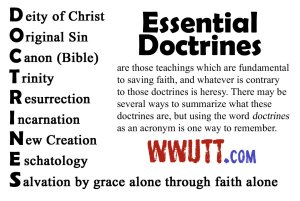
The vast majority of brand new Christians have only the most basic understanding of most of these tenets at the moment of salvation. But it’s not an issue of fully understanding – or else we’d all have to be theologians in order to get saved – it’s an issue of believing. Someone who is genuinely regenerated may not completely understand how the Trinity works (honestly, no one does), but when she’s introduced to the biblical idea of the Trinity, she believes it, learns more about it, and does not reject it.

There is typically agreement among most reputable theologians regarding what constitutes first tier doctrine. Scripture is clear about these things, and several of these issues were settled long ago by the church fathers in assorted church councils (Nicea, Chalcedon, etc.)

Secondary issues are routinely defined as non-salvific but still extremely biblically important, if not quite as biblically clear-cut as primary issues. Doctrines surrounding baptism (credo versus paedo, affusion versus immersion), for example, are usually cited as a secondary issue. A disagreement on a secondary issue doesn’t mean one person is saved and another isn’t, but it normally prevents close partnership in ministry activities involving these issues. For example, my Presbyterian friends and I can join together in pro-life ministry, but we would most likely not plant a church together.

Tertiary issues are non-salvific, less immediately urgent, biblical issues in which the Bible is even less clear-cut and open to wider (yet still biblical) interpretation. These are issues over which Christians can disagree and still maintain close doctrinal fellowship, even in the same church, if they’re in agreement on first and second tier doctrine. Eschatology – the order and timing of events at Jesus’ second coming – is a doctrine that’s often considered third tier. Someone can hold a different eschatological view than mine, yet, for the most part, it shouldn’t affect our ability to worship together, work together, or participate in the ordinances together in the same church.

Some theologians add a fourth category – issues of adiaphora, conscience, or Christian liberty. Usually these are issues of much less importance that the Bible either doesn’t specifically address, or doesn’t give commands about one way or the other. Individual Christians may use biblical principles to inform their consciences and decide for themselves. These would be things like whether or not to take your child trick-or-treating or deciding whether to dress formally or casually for church.

While theologians are largely in agreement about primary doctrines, there is wider spread disagreement on which doctrines are secondary and tertiary (many consider eschatology to be a second tier doctrine, for example) and whether or not there is a need for a category of adiaphora, since such issues are normally not considered to be “doctrinal” issues. In fact, there’s enough space for disagreement that pastors and theologians often wisely refrain from making concrete lists of secondary and tertiary doctrines.

But when we’re talking about the different levels of doctrine, what you won’t find is questions like these: Is murder a first, second, or third tier doctrine? What about gossip? Rape? Adultery? Lying? Gluttony? Pride?

And it’s not because these issues aren’t important or because the Bible doesn’t address them. It’s because they’re in a different category from the other issues: the category of sin. They aren’t doctrines upon which salvation hinges, they aren’t open to interpretation, and the Bible is clear that we are absolutely not to do these things.

The category of doctrine deals with beliefs. The category of sin deals with behavior.

In 2005, Dr. Albert Mohler wrote an excellent article about the different levels of doctrine entitled A Call for Theological Triage and Christian Maturity. He carefully explains the importance of each level of doctrine and what it covers in a plea to keep each level’s urgency in its proper place of significance during discussion, debate, and decision-making.

It was a helpful article to which I always refer people who have questions about tiers of doctrine, and I agree with Dr. Mohler’s thoughts in the article wholeheartedly1 …except on one point:

“In recent years, the issue of women serving as pastors has emerged as another second-order issue.”

Women serving as pastors, women preaching, women teaching men Scripture, and women exercising authority over men in the gathering of the Body is not a secondary issue. Nor is it a primary or tertiary issue. It does not belong in the category of “doctrine” in the same way baptism and eschatology do. It belongs in the category of sin in the same way murder, gossip, and adultery do. Let’s take a look at the reasons for this.

Women serving as pastors, preaching, teaching men Scripture, and exercising authority over men in the gathering of the Body is *not* a secondary issue. Nor is it a primary or tertiary issue. It is a sin.

I do not permit a woman to teach or to exercise authority over a man; rather, she is to remain quiet. 1 Timothy 2:12

(The preponderance of Scripture supports and affirms this concept, so to keep things simple, we’ll use this verse as an exemplar.)

โœข The prohibition in 1 Timothy 2:12 is a clear command against a certain behavior. And when we behave in a way God has prohibited, that is called “sin”. All of the tenets in the three levels of doctrine are affirmative statements regarding beliefs (you must believe in the resurrection of Christ, we believe in baptism by immersion, etc.). None of them are commands, in the negative, against sinful behavior (Thou shalt not murder, I do not permit a woman to teach… etc.)

โœข Secondary and tertiary doctrines can be open – to varying degrees – to biblical interpretation. Every stripe of non-heretical eschatological thought can provide you with chapter and verse passages that can, depending on the angle from which you approach the subject, be biblically plausible and scripturally supported. There is no biblical support for anything God prohibits. No one can cite a properly handled, in context Bible verse in which God says, “It’s OK to commit adultery,” or “Women are allowed to preach.” There can be multiple views on a secondary or tertiary issue that can all be considered biblical, but there can only be one view of sin that is biblical.

โœข Differing beliefs on true secondary and tertiary issues are not sin. My Presbyterian friends have a different view of baptism than I do. That doesn’t mean either of us is sinning. I may think their interpretations of the verses they believe support paedo baptism are incorrect, but they are not breaking any of God’s commands. Differing behavior (again, we see the distinction between doctrinal belief and sinful behavior) on issues of sin is sin. If someone behaves differently from God’s command about lying, she is sinning. If a woman behaves differently from God’s command in 1 Timothy 2:12, she is sinning.

โœข Differing beliefs on secondary and tertiary issues are not born of disobedience and rebellion toward God. Usually, it’s quite the opposite. When someone has studied a theological issue enough to hold a particular position on it, it’s usually because she is striving to please God and to be biblical in her beliefs. Differing behavior on issues of sin is born out of disobedience and rebellion toward God. Someone who steals has already decided in her heart that her desires are better than God’s command. A woman who knowingly holds improper authority over men in her church is doing so because she has already decided to defy God’s clear command against such.

โœข Because different beliefs on secondary and tertiary issues are not born of rebellion and are not sin, they do not require church discipline. Sin does require church discipline. If someone in your church is openly dishonoring her parents, she is sinning and should be subject to church discipline. If a woman is pursuing a career as a pastor, she is sinning and should be subject to church discipline. 

Since the publication of Dr. Mohler’s article (and perhaps as a result of others teaching the same thing) the idea of the violation of 1 Timothy 2:12 being a “secondary doctrine” has spread in a most unhelpful way, leading many Christians to treat the issue in a c’est la vie, “We can just agree to disagree on this,” manner.

No, we cannot.

The idea of the violation of 1 Timothy 2:12 being a “secondary doctrine” has spread in a most unhelpful way, leading many Christians to think “We can just agree to disagree on this.”. No, we cannot.

We would not say, “We can agree to disagree,” on lying or adultery or homosexuality or abortion, and we cannot say it about women preaching, teaching men, or holding unbiblical authority, either. We disciple and teach a sister in Christ who is unaware of what the Bible says on these matters, and if she is committing any of these sins, we begin the process of church discipline. But it would not be loving toward her, or honoring God, to allow her to continue in biblical ignorance or in willful sin.

Furthermore, the violation of 1 Timothy 2:12 brings with it dangers to the church that true secondary and tertiary issues, and even many sins, do not…

The violation of 1 Timothy 2:12 brings with it dangers to the church that true secondary and tertiary issues, and even many sins, do notโ€ฆ

She may not say it with her lips, but when a woman preaches to men in defiance of Scripture, sheโ€™s teaching false doctrine through her behavior. What is the false doctrine sheโ€™s teaching? โ€œI donโ€™t have to obey Godโ€™s Word, and neither do you. If thereโ€™s a part of the Bible you donโ€™t like, youโ€™re free to disregard it.โ€ If your pastor stood up in the pulpit on Sunday morning and said that in words, youโ€™d run him out of town on a rail, and rightly so. Neither should a woman be able to teach that same false doctrine via her actions.

Additionally, I have mentioned several times when dealing with this issue that women preaching to men is highly correlated with women teaching other forms of false doctrine. I have researched scores of women teachers. Every single one of them who unrepentantly teaches men also teaches false doctrine in some other aspect of her theology (usually progressivism, Word of Faith, or New Apostolic Reformation). In other words, if a woman teaches men, you can just about take it to the bank that she also teaches additional false doctrine. False doctrine and heresy are infecting the church – via female preachers – at an alarming rate.

We dare not simply “agree to disagree” on this.

The violation of God’s command that women are not to instruct men in the Scriptures nor hold improper authority over men is a sin like any other. It is not a doctrinal issue in the same sense that other second and third tier doctrines are. If left undisciplined, however, it can lead to first tier doctrinal issues infiltrating a church and eventually destroying it. It is detrimental to the church to label and treat any sin as a secondary doctrinal issue.

Additional Resources

Is Women Preaching a Secondary Issue? on A Word Fitly Spoken

What Are Essentials and Non-Essentials? on A Word Fitly Spoken

Christian Liberty on A Word Fitly Spoken

The importance of Primary and Secondary Doctrines on the Truth Be Known Podcast


1In the years since 2018, when this article was originally written, Dr. Mohler has said, done, and supported various biblically questionable things, leading some to question whether or not he has “gone woke”. While I don’t support his stance on those questionable things, I also don’t believe he has reached the point at which I need to warn against him (although I don’t proactively recommend him, either). To my knowledge, at this time, he is still generally doctrinally sound.


Share Your Testimony

Testimony Tuesday: Karen’s Story

Karen’s Story

From the Pulpit to Repentance

Several have asked me to share my journey from the pulpit to repentance. Ten years ago, my husband and I were Charismatic ministers. We served together as Associate Pastors of a church in Texas. I was on the preaching schedule with the men, monthly. Yes, I got the accolades and approval of the church, and the association we were involved with untilโ€ฆ. The grace of God reached down and pulled my husband and me both back to the Word of God and out of the fire.

Here is a snapshot of the journey, our journey. It is hard to share. In fact, I have shared our story with select few. Sure, this will bring fiery darts my way, but I really couldn’t care less. I trust that this will help open the eyes of those seeking Truth.

I met my husband in an evangelical church, he was a youth pastor at the time. Both of us were from very Biblically based churches. My husband was the son of a Baptist minister. As a student at Biola College, I remember the warning given to the students by my professor, Dr. Curtis Mitchell, against tongues and the unbiblical Charismatic movement. Truth is, I was curious as most college age young people. I found myself wondering if Dr. Mitchell knew what he was talking about.

I met my husband my sophomore year of Biola. He had a full time job and was a youth pastor. He had a ministry to teens and the kids loved him. He was everything that I prayed and asked God for. We were married one year after we met. I wish I could say we lived happily ever after. When you are on Godโ€™s team, attacks come, and they are very real. As a young couple, we found ourselves in two churches, both with serious issues.

After one year of marriage, he was offered a position as a youth pastor at the beach, one block from the ocean. It was an awesome church where we were both very happy. The youth group was growing, kids’ lives were being changed, and parents were grateful. All was well until . . . the senior pastor asked a friend of his to become the Associate Pastor. The new staff member immediately began to breed distrust between the staff. He had an agenda, to bring a copy of the Satan bible into the youth group and have the kids read it. We found ourselves in a spiritual battle that we had never anticipated. We did not want to cause a church split so my husband resigned. (We found out later that this man had a history of going from church to church and causing splits!)

Another local Baptist church contacted my husband. His youth pastor was being transferred by his full-time job, and Phil was asked to step in.

Things were going well at the new church. The youth group was thriving. Nine months in to the job, the senior pastor was asked to resign, the music directorโ€™s wife divorced him, and then the music director committed suicide. Upset, discouraged, angry at God were only some of my emotions. I wanted to quit the ministry. We both were so discouraged. It was at that point that Phil decided that he was through with the ministry. We were done!

The last two churches had taken their toll on us. We hardly read the Bible, only attended church. Our marriage was having issues and another baby was on the way. We were trying to keep ourselves together, no one knew the depth of our pain and discouragement. Looking back, I can see clearly that what happened to us was a direct attack from the enemy.

In the midst of the pain, I knew that the God was the answer. Not wanting anything more to do with the traditional church, I gravitated towards the popular charismatic movement. Some of my family had gone that direction, they seemed happy โ€“ so I thought maybe thatโ€™s what we needed.

Looking back. I now see now that it was all a trap. The discouragement with the church, the hurt, thinking that God let us down . . . we were slowly being destroyed. I got into the Charismatic movement first. I started by going to meetings, listening to TBN, talking to my family. Phil tried to warn me but being hard headed, stubborn and thinking I knew more than he did (he wasnโ€™t reading his Bible so what could he say to me????) I took the bait and had my first experience. I say “experience” because everything seemed to be an experience from that point on. To be truthful, I did feel happier, read my Bible, (substituted the KJV with the Amplified version), and was nicer to live with. He decided that because I had made some positive changes that maybe I was on to something. He jumped in with me and we started attending a Charismatic fellowship. Please note as I write from this point on, the progression . . .

Discouragement, mad at God, feeling empty, Charismatic appeals, we take the bait.

At no time did we consult Godโ€™s Word on any of the teaching we were hearing. The Bible was used in the sermons with enough truth that we bought into the lie.

We moved our family to Tulsa. Phil enrolled in Rhema but half way through the first year, he left school. We look back and see the grace of God even in that situation. In the meantime, we had become friends with another couple and she and I were convinced we were supposed to be ministers. Women ministers were all the rage, and all were serving with their husbands, so why not us? We all continued in the Word of Faith churches in Tulsa, voraciously reading every book, attending meetings. At one point, we all decided to be ordained. After applying and being interviewed, we were ordained along with many other couples.

We found a church that was growing and we got involved. We thought we could use our โ€œministry giftsโ€ there. We did become leaders in the church. I led a womanโ€™s group and together we did a weekly care group in our home. We were being destroyed emotionally as the church was spiritually abusive. It was taking its toll on everyone, including our kids. We both began to see how the Word of God was being twisted from the pulpit to say things that were not there and there was no demonstration of the love of God.

One morning, while having my quiet time, I read an article about spiritually abusive churches and the signs of a toxic, abusive environment. Everything I read we were experiencing. It was clear that we had to leave.

I went to my husband with tears streaming down my face and shared what I believed God was saying. I trusted him to make a family decision. It was the next Sunday that the pastor stood up and said to the congregation, โ€œIf you are called to this church, you are called to me.โ€ Walking out, my husband looked at me and said, โ€œWe are done.โ€ We quit the fellowship with a resignation letter and never looked back.

A job change was in the air. We both got jobs in Dallas, TX. We left Oklahoma and never looked back. Our daughter moved to Seattle and within a few years, our son did the same. We were all out of Oklahoma!

After a couple of years, we decided to go back to church but did not know where to go. Someone had invited us to attend a little Charismatic start up church and we went. We fell in love with the Filipino pastor and his dear wife. We started going and helping them. The pastor invited us to be on staff and he submitted papers for our ministerial license. (We had rescinded our other ministry certificates years earlier). We became co-associate pastors. We loved the people and we both preached one Sunday a month. Phil and I had begun our personal studies at home, using the KJV Bible. We studied the Emergent Church and saw how it was infiltrating the organization. We read John MacArthur’s book, Charismatic Chaos, and scales began to fall from our eyes. Everything that John MacArthur wrote in his book was 100% accurate. We had experienced it first hand and had lived it.

When I saw that I had not held to the faith that was once delivered to the saints, tears of repentance gushed. I cried for weeks. I had wronged the Lord. I had been duped, taken the bait of Satan, and strayed way off the track. Phil had his own similar moment with the Lord. The beautiful part of this testimony is that each of us came to the same place at the same time using the same Bible. God, in his grace, had snatched us out of the fire. We now had a decision to make. We then drafted a letter of resignation to the organization and walked away.

We were done. We had each other, we had Godโ€™s Word. We had already walked away from Word of Faith in Tulsa, and now we walked away from everything Charismatic. The circle was complete. We went into Babylon but God brought us out. We found a Biblical church where women are in their place. I have never looked back.

If you are reading this, I plead with you to think Bible, read your Bible, stop listening to Charismatic/Word of faith/Emergent church and women preachers. We tossed books, tapes, cdโ€™s, Bibles. Our library was quite large. Yes, we tossed our huge library in the trash.

Today we stand on Godโ€™s Word. I donโ€™t need to preach to be fulfilled. God has given me a national platform in a dental organization. I influence women all over the country and as God gives opportunity, I share his grace. I found my place in Christ, in my marriage, and in my church. I am 100% fulfilled being the person God has called me to be.

Today I stand heart- broken as I look across Christianity and see the deception. With tears, I am humbled and grateful for Godโ€™s grace, His forgiveness, His love, and the Truth of His Word.

We have come full circle โ€“ back to the Bible and the roots we were raised with. I pray that you too will find the Truth. Seek and Ye shall find. Here is a clue . . . Truth is in Godโ€™s Word!


Ladies, God is still at work in the hearts and lives of His people, including yours! Would you like to share a testimony of how God saved you, how He has blessed you, convicted you, taught you something from His Word, brought you out from under false doctrine, placed you in a good church or done something otherwise awesome in your life? Private/direct message me on social media, e-mail me (MichelleLesley1@yahoo.com), or comment below. Your testimony can be as brief as a few sentences or as long as 1500 words. Letโ€™s encourage one another with Godโ€™s work in our lives!

Christian women, Church, Complementarianism

Unforbidden Fruits: 3 Ways Women MUST Lead and Teach the Church

Ladies, we whine too much.

Like petulant little girls, we look at what’s off limits to us, stomp our Mary Janes on the floor and cry “Why can’t I? I want to!” instead of giddily jumping into all the opportunities God has blessed us with. Instead of being happy and thankful for what we have, our greedy little fingers stretch out to grasp what God has said we can’t have because it’s not good for us or anybody else.

God has instructed pastors – who are, in turn, to instruct us – that, in the gathered body of Believers, women are not to preach to men, instruct men in the Scriptures, or exercise authority over men. And that’s what we focus on, and whine and kick our feet about. That part – the childish rebellion and discontent with the role God has graciously placed us in – that’s on us.

But pastors, we badly need your help on this one. Many pastors do a wonderful job of rightly and biblically explaining what women are not to do (And may I take a moment to say, from the bottom of my heart, thank you. I know how difficult that can be and that you take a lot of undeserved flak for simply teaching God’s Word on this subject.), but that “no” teaching has often not been coupled with the “yes” teaching of what women must do and how they must lead in order for women, and the church, to be healthy and function properly.

The “no” teaching of what the Bible forbids has often not been coupled with the “yes” teaching of what women *must* do and how they must lead in order for women, and the church, to be healthy and function properly.

You’ve loved us well to tell us not to bite at the apple from the forbidden tree, but we also desperately need you to take us on a tour of the Garden and introduce us to the all-you-can-eat buffet of pear and peach and cherry and pecan trees that we have the privilege and the responsibility to feast on.

๐ŸŠ The Other Institution ๐ŸŠ

Did you ever notice that the “do” for women in the church comes before the “don’t”? We tend to totally skip over that enormous little word that kicks off 1 Timothy 2:11: “Let a woman learn…”. We have no idea of, nor appreciation for, how huge and groundbreaking it was for the Holy Spirit, through Paul, to proactively instruct pastors: “Hey, get these women in here, make sure they listen up, and train them properly in the Scriptures so they’ll be equipped to fortify their homes with biblical truth.”

We completely miss the fact that, though God installs men as the teachers and leaders in one of His foundational institutions – the church – He has very much made women the functional, boots on the ground, day to day, teachers and leaders by example – of His other foundational institution – the family. The church didn’t even exist for the first few millennia of human history, but the family has existed since Creation. And people who are members of families populate and lead the church. Raising and molding those people is a tremendous position and responsibility. A position and responsibility God has largely given to women.

Wives pray for our husbands’ growth in Christ. We build them up with Scripture. With a gentle and quiet spirit, we set a godly example for them as they observe our respectful and pure conduct. We encourage and help them in their leadership roles at church.

Moms pray for our children’s salvation. We pour the gospel into them at every turn. We train up our children in the way that they should go – in the nurture and admonition of the Lord – so that when they are old they do not depart from it. We teach them to love and serve and invest in the church both directly and by modeling these things for them.

And our single, widowed, and childless sisters work right alongside us in this labor, praying for church leaders and members, nurturing children at church whose parents are unsaved or unequipped to raise them biblically, encouraging and assisting brothers and sisters in Christ.

We grow and develop, nourish and support, exhort and sharpen the population of the body of Christ.

Men may lead the church, but women raise the church.

Men may lead the church, but women *raise* the church.

๐Ÿ Woman to Woman ๐Ÿ

Essential to the health of any church is the component of women training women, whether in the formal setting of a Bible study class and structured women’s ministry programs or an impromptu “let’s get together for coffee this week” discipleship discussion.

Though we receive instruction in Scripture from our pastors, elders, and teachers, there are some counseling and teaching situations it’s not appropriate for a man to address with a woman, or that a woman understands better than a man. There are issues women face that men just don’t “get” in the same way a sister in Christ does. There are insights and perspectives a woman can use to explain Scripture to another woman that a man just doesn’t have. There are times when a woman needs someone to walk through a long term emotional journey with her that requires a personal intimacy which would be inappropriate for a man to engage in with her. And in the same way men are better equipped than women to train men to be godly husbands, fathers, and church members, women are better equipped than men to train women to be godly wives, mothers, and church members.

God knew all of this back when He breathed out the words of Titus 2:3-5…

Older women likewise are to be reverent in behavior, not slanderers or slaves to much wine. They are to teach what is good, and so train the young women to love their husbands and children, to be self-controlled, pure, working at home, kind, and submissive to their own husbands, that the word of God may not be reviled.

…and, again, 1 Timothy 2:11:

Let a woman learn quietly with all submissiveness.

Women must be trained properly in the Scriptures so we can take that training and pour it into other women, teaching and sharpening them into godly women, wives, mothers, and church members.

๐Ÿ‘ Super Models ๐Ÿ‘

Women instruct our brothers and sisters in the church in biblical truth when we lead by example. When we sin against someone, we go to that person and ask forgiveness. We demonstrate the importance of meeting together with the Body by being faithful in our church and Sunday School attendance. We model servanthood by serving the church and our brothers and sisters. We paint a picture of biblical compassion by ministering to the sick and others in need. We show Christians how to carry out the Great Commission by sharing the gospel. We set an example of trusting God when others see us depending on Him through difficult situations.

And one of the most important biblical concepts women have the privilege and responsibility of teaching the church through our example is submission to authority – a lesson the church is sorely in need of these days.

Because God blessed us by creating us as women, we have an opportunity to model submission to authority in a unique way that God has chosen to deny to men.

Because God blessed us by creating us as women, we have an opportunity to model submission to authority in a unique way that God has chosen to deny to men.

As we submit to our husbands, we teach the church what it means to submit to Christ. How to walk in humility and obey Him out of love. How to put selfishness aside. To trust Him to take care of us. To deny ourselves, take up our cross daily, and follow Him.

When we submit to God’s design for leadership in the church and joyfully carry out the work He has planned for us as godly women, we teach the church to submit to God’s authority and love Him by obeying His commands. We instruct our fellow church members in respecting and submitting to the pastors and elders God has placed in spiritual authority over us.

Submission to Christ, to God’s commands, and to pastors and elders is the bedrock of a healthy church. God has graciously given women the role – and the duty – of teaching these and other biblical principles to our churches in a way that men cannot -through our example as godly women.

Remember the series of fun little nutritional books that came out several years ago called Eat This, Not That? The idea the books centered around was, “Don’t eat that unhealthy thing. Eat this similar but healthy thing instead.”

Sadly, many Christian women have only been getting half the story. “Not that” (preaching to/teaching men and exercising authority over men) is biblically correct, but it’s not biblically complete. If all you tell someone is “Don’t eat that,” without showing her the “Eat this,” part, what she needs to eat to be healthy, she’s going to starve, and the church will be malnourished as well.

Christian women need our pastors to teach us to eat the fat of the land of being properly trained in the Scriptures and drink the sweet wine of leading and instructing the church the way God gifts us and requires us to. Only then will the Body be healthy and well nourished.

Complementarianism

Seven Reasons 1 Timothy 2:12 Isn’t the Crazy Aunt We Hide in the Closet when Company Comes Over

A while back I was scrolling through my Twitter feed and happened to catch part of an interaction between two women discussing a false teacher. I couldn’t come close to the exact wording if I tried, but the gist of it was…

Discerning Christian Woman: Divangelista X is a false teacher and preaches to men.

Non-Discerning Christian(?) Woman: How can you say she shouldn’t be preaching to men? So what! She’s out there helping so many people and charitable causes! People love her! I think she’s great!

Discerning Christian Woman: Well, I’m really not as concerned about the fact that she preaches to men as I am about the false doctrine she teaches.

I didn’t butt in because neither of them was talking to me, but what I wanted to say was, “Why?” Why, Discerning Christian Woman, did you back off the completely biblically valid point that this false teacher is rebelling against Scripture by preaching to men? If you had been discussing a male false teacher who was running around on his wife, you probably would have led your argument against him with his sin of adultery, with the false doctrine he teaches relegated to a level secondary importance.

Ladies…pastors…why are we so embarrassed to stand up boldly and say that women who preach to men are in unrepentant sin and disqualified from teaching regardless of what their doctrine might be?

It’s a simple little thing called the fear of man. Or, more specifically, fear of woman. We’ve seen women whose feminist ideals are challenged. Even feminists who call themselves Christians have been known to fly into a demonic rage, bent on destroying any person, pastor, or church who dares to topple their golden “I am Woman, Hear Me Roar” calf. No one wants to be on the receiving end of that kind of vitriol.

We’re more afraid of the wrath of woman than the wrath of God.
And shame on us for that.

God doesn’t call us to be wimps, people. He calls us to stand on His Word no matter the cost. The great men and women of the faith who have gone before us have done just that, giving their lives rather than renouncing Christ, refraining from sharing the gospel, compromising the Lord’s Supper, quitting work on translating of Scripture into the language of the people.

And we’re worried that feminazis might yell at us or make trouble at church.

We need to stop blushing ashamedly at crazy Aunt 1 Timothy 2:12’s socially unacceptable brazenness and stand unapologetically firm when it comes to denouncing female teachers who preach to men. Here are seven reasons why:

1.
Women preaching to men is personal sin.

When a woman takes it upon herself to disobey Scripture by preaching to men, she is sinning. If we’re the Christians we claim to be, how can we see someone mired in sin and not want to rescue her? It is not loving to ignore someone’s sin, or worse, affirm her in it. To do so is the ultimate act of selfishness, because we’re more concerned about the the consequences for confronting her and how that will affect me than we are about her soul and her relationship with Christ. John 15:13 says, “Greater love has no one than this, that someone lay down his life for his friends.”. Sometimes laying down your life means dying to self and confronting sin out of love for someone else.

2.
Women preaching to men is public rebellion.

When a woman stands up in front of a group of men and women and unashamedly preaches to them, she is initiating a public act of aggression against Christ and His church.

I don’t care how sweet and pretty and “aw, shucks” she is – that’s what she’s doing. She is leading a rebellion against God’s clear command for all the world, and the church, to see. This is a blot on the reputation of Christ’s Bride whom He wishes to be “holy and without blemish“.  Christians are people who submit to and obey Christ, not leaders of rebellions against Him.

3.
Women preaching to men is itself false doctrine

She may not say it with her lips, but when a woman preaches to men in defiance of Scripture, she’s teaching false doctrine through her behavior. What is the false doctrine she’s teaching? “I don’t have to obey God’s Word, and neither do you. If there’s a part of the Bible you don’t like, you’re free to disregard it.” If your pastor stood up in the pulpit on Sunday morning and said that in words, you’d run him out of town on a rail, and rightly so. Neither should a woman be able to teach that same false doctrine via her actions. Call it antinomianism. Call it whatever you like. But it’s one of the oldest and most fundamental false doctrines.

4.
Women preaching to men undermines
the authority of Scripture.

Christians are “people of the Book.” We are to live under the authority of the written Word of God breathed out by the Holy Spirit. Those who truly love Christ love His Word and want to be obedient to it. When a woman preaches to men in defiance of God’s Word, she is stating with her actions that Scripture has no authority over her. That she can do whatever she wants regardless of what God has spoken. Those who follow her learn, “I am the authority in my life, not God.”

5.
Women preaching to men is God’s
judgment on the church.

My peopleโ€”infants are their oppressors,
    and women rule over them.
O my people, your guides mislead you
    and they have swallowed up the course of your paths.
Isaiah 3:12

The fact that God allows a thing to take place in no way indicates that He is pleased with it. When God allows people to persist in sin, it’s not that he’s blessing that person or church, but that He’s giving them over to sin in judgment.

And since they did not see fit to acknowledge God,
God gave them up to a debased mind to do what ought not to be done.

Romans 1:28

(To the church at Thyatira)
But I have this against you, that you tolerate that woman Jezebel, who calls herself a prophetess and is teaching and seducing my servants to practice sexual immorality and to eat food sacrificed to idols. I gave her time to repent, but she refuses to repent of her sexual immorality. Behold, I will throw her onto a sickbed, and those who commit adultery with her I will throw into great tribulation, unless they repent of her works, and I will strike her children dead. And all the churches will know that I am he who searches mind and heart,
and I will give to each of you according to your works.
Revelation 2:20-23

6.
Women preaching to men undermines
God-ordained male authority.

Jesus Christ is the head of the church. That means He gets to make the rules for it, not us. And one of His rules is that men are to be the pastors, elders, and those in authority, not women. When women try to push themselves into positions designed for men, it waters down and cheapens the beauty of male leadership the way God designed it, just as it would if men tried to push their way into the roles God has designed for women. And just as a woman would feel disenfranchised if a man tried to usurp her position as an older woman teaching younger women (Titus 2:3-5), biblical pastors perceive the threat to their God-given authority as more and more women take the pulpit.

7.
Women preaching to men is
an indicator of further false doctrine.

I have researched dozens of female teachers, and every single one of them who unrepentantly preaches to men also teaches other forms of false doctrine (usually Word of Faith {prosperity gospel} or New Apostolic Reformation). Every. single. one. If you see a woman unrepentantly preaching to men, that is God’s warning signal to you to stay away before you’re engulfed in even more false doctrine. Refusing to speak out against women preaching to men is to put fellow Christians in a gasoline-doused house of straw without a fire detector. It forces them to stop and search for the fire or examine it to see if it really is a fire – which could end up getting them killed – whereas, if they had a fire detector they would know to make an immediate exit.

First Timothy 2:12 is not the “crazy aunt” of the family of God.

Every family has that one crazy relative that you just pray will act normal for once – or that you could lock her in the closet – when company comes over. (In my family, I’m pretty sure that’s me.) First Timothy 2:12 is not the “crazy aunt” of the family of God. There’s no need to be embarrassed about putting her front and center for the world to see. She is beautiful and precious and serves an important purpose for God’s glory and our good. Let’s let her out of the closet and be proud of her.

Mailbag

The Mailbag: Women evangelizing men & women teaching at co-ed conferences

mailbag

When it comes to 1 Timothy 2:12, what about women preaching or teaching the Bible at co-ed Christian conferences, campus ministries, youth ministries, or parachurch ministries? Is that OK since theyโ€™re not preaching and teaching โ€œin the churchโ€?

Here, we need to remember what the definition of โ€œchurchโ€ is. The church is not a building, it is a body of born again believers gathered for the purpose of worship, prayer, the sacraments, and/or the study of Godโ€™s word. Those things can take place in a church building, a home (as with the first century churches in Acts), in a campus or office building, outdoors, in a conference center, in a sports arena, or anywhere else. So, when a body of believers comes together for these purposes, regardless of the building in which they meet, or whether you call it โ€œchurchโ€ or not, they are the church, and the biblical parameters about women teaching and holding authority over men applies.

What about evangelism? Can women share the gospel with men at work, among friends and family, at the store, through an outreach ministry?

Women not onlyย can share the gospel at every opportunity, the Great Commission mandates it for every Christian. However, it is important for godly women to use caution and wisdom when interacting with men in any situation, especially one that can turn out to be very personal and emotionally intimate, as with witnessing.

My counsel would be that youโ€™re generally OK if youโ€™re in a public place and itโ€™s a one time encounter (for example, witnessing to a stranger at the store). However, if weโ€™re talking about multiple encounters โ€“ for example, a male friend or co-worker who wants to continue meeting with you over time to talk about the gospel โ€“ it might be best to meet with him a couple of times (in a public area) and then โ€œhand him offโ€ to your husband, pastor, elder, brother, friend, etc., for further discussion.

There are several reasons for this.

It protects your reputation. If people see you meeting with a man on an ongoing basis (especially of one or both of you are married) they can jump to the wrong conclusion, and your reputation, and Christโ€™s, can be sullied.

It protects your virtue. Unfortunately, some men, who have no interest in the gospel, might see your eagerness to meet with them as an opportunity to take advantage of you.

It protects both of you from temptation. A personal relationship with Christ is exactly that- personal. Discussing sin, conviction, and other matters related to salvation can lead to emotional intimacy, which can then lead to physical intimacy. You donโ€™t want what started as a witnessing encounter to end up as sin.

When it comes to outreach ministries (for example, a meal for the homeless, followed by a group gospel presentation or Bible lesson), itโ€™s best for a man to lead co-ed (or male only) adult groups in anything that could be construed as preaching or teaching the Bible. Not because this is in the church setting and the situation falls directly under the parameters of 1 Timothy 2:12, but becauseโ€ฆ

โ€ฆthere are a lot of highly visible female preachers (Joyce Meyer, Paula White, Gloria Copeland, Christine Caine, etc.) out there, all of whom are in disobedience to 1 Timothy 2:12ย andย teach false doctrine (usually Word of Faith/New Apostolic Reformation).

The Bible says weโ€™re to avoid even the appearance of evil, and you donโ€™t want to appear to be one of those women if itโ€™s avoidable. Having a man lead the teaching helps distance you and your church from those types of sinful women and their bad theology, and sets a godly example for the people youโ€™re ministering to.

โ€ฆthe Great Commission is clear that weโ€™re not just to make converts, weโ€™re to make disciples. That means the ultimate goal of evangelism is to get the newly saved person plugged in to a local, biblical church. Why confuse a new Christian by having women lead out โ€œin the fieldโ€ when itโ€™s not going to be that way in the church?

โ€ฆthere are very few examples in the world of what it really means to be a man. Men are constantly emasculated on TV and in society and receive all kinds of conflicting messages regarding what real manhood is. What an impact on lost men (and women) to see an example of a godly, masculine man who leads well, fulfills his duties and responsibilities,ย andย is totally sold out to Christ. If you have someone like that, whyย wouldnโ€™tย you want him to lead?

For more questions and answers about women’s roles in the church, please see my articleย Rock Your Role FAQs. I’ve added both of these questions to that article.


If you have a question about:ย a well known Christian author/leader, a Bible passage, an aspect of theology, a current issue in Christianity, or how to biblically handle a family, life, or church situation, comment below (Iโ€™ll hold all questions in queue {unpublished} for a future edition of The Mailbag) or send me an e-mail or private message. If your question is chosen for publication, your anonymity will be protected.