Podcast Appearances

Guest Appearance – The Plumb Line Radio Show

Not long ago, I had the pleasure of appearing as a guest on The Plumb Line Radio Show with Jay Rudolph for a wonderful discussion about how to vet the teachers we listen to. What makes someone a false teacher? What are some ways to be more discerning about the teachers we listen to? And how about some practical tips to quickly weed out about 95% of the teachers you shouldn’t be following?

Listen in to these two brief interviews!

The Plumb Line, episode 717- How to Recognize False Teachers 1- Michelle Lesley

The Plumb Line, episode 718- How to Recognize False Teachers 2- Michelle Lesley

If you’re in the vicinity of Des Moines, Omaha/Lincoln, Phoenix, Pittsburgh, San Diego, New York City, Jacksonville, Chicago, or Kansas City, you can listen to The Plumb Line on your local Christian radio station. Click here to find out which radio stations carry The Plumb Line and when. If you don’t live near one of those markets, you can always follow and listen on Spotify.


Additional Resources:

Is She a False Teacher? 7 Steps to Figuring it Out on Your Own

Popular False Teachers & Unbiblical Trends

Joyce Meyer

Are Female Bloggers Violating Scripture by “Teaching” Men?

Leaving Lysa: Why You Shouldn’t Be Following Lysa TerKeurst or Proverbs 31 Ministries


Got a podcast of your own or have a podcasting friend who needs a guest? Need a speaker for a women’s conference or church event? Click the “Speaking Engagements” tab in the blue menu bar at the top of this page, drop me an e-mail, and let’s chat!

Christian women, Church, Complementarianism, Men

Adam 3.0: Meanwhile, Back in the Garden, It’s Deja Vu All Over Again

Originally published June 26, 2014

I do not permit a woman to teach or to exercise authority over a man; rather, she is to remain quiet. For Adam was formed first, then Eve; and Adam was not deceived, but the woman was deceived and became a transgressor.

1 Timothy 2:12-14

Because it’s my passion to see Christian women become holy, passionate, obedient disciples of Jesus Christ, I’ve dealt with this passage a lot and done a lot of research on it. Scripture is crystal clear that women are not to instruct men in the Scriptures in the church in the capacity of pastor or teacher, nor are they to hold authority over men in other positions in the church. (I’ve outlined Scripture’s case for this here if you’d like to do some further study.) And, unfortunately, there are many women in the church who are disobeying this Scripture (I used to be one of them)– some out of rebellion, and some out of ignorance. But until recently, I –and every other piece of information I’ve studied on the subject– have dealt with the issue of women stepping outside their God-ordained role in the church strictly as a women’s issue.

A few days ago, a friend of mine asked for my opinion on a Q&A video produced by a well known pastor. The pastor was asked, “Is it a sin for men to listen to women speakers [female Christian conference speakers, pastors, teachers, etc.]?”

And that’s when it hit me. I’d never heard this question addressed, or even asked, before. First Timothy 2:12ff is always dealt with from the perspective of women and towards women – that this is a women’s sin issue.

But to treat this role rebellion strictly as the sin of women is to pour gasoline on the fire. If it’s a singularly women’s problem, then it naturally falls on women with a right understanding of God’s Word on the issue to deal with it, right? And if these women are the ones who have to confront and deal with this sin, even at the local church level, they’re being placed smack dab in the misappropriated role they’re trying to fight because they’re being asked to do the job of elders and pastors whose responsibility it is to maintain order and discipline in the church.

In other words, when it’s time to deal with the sin of role busting, don’t send a woman in to do a man’s job.

When it’s time to deal with the sin of role busting, don’t send a woman in to do a man’s job.

The fact that there’s even a need for an article like this, never mind that a woman is writing it, is indicative of the pervasiveness of the problem. Why do we so rarely hear pastors or other Christian men exhorting men in the church to stand on God’s Word, properly fill out their own role in the church, and also deal with the problem of female disobedience to this Scripture? Why are Christian men becoming accomplices to women’s sin by seeking out female pastors and teachers to be their spiritual leaders? I believe there are three reasons:

The fact that there’s even a need for an article like this, never mind that a woman is writing it, is indicative of the pervasiveness of the problem.

1.
Adam 3.0

Give Genesis 3–the story of the Fall–a read through the lenses of 1 Timothy 2:12. See any similarities between what happened in the Garden and what’s happening in the church?

The man is off somewhere, not fulfilling his role of spiritual guardian, leader, and protector, leaving the woman alone and vulnerable to Satan’s attack. Satan tempts the woman to sin and she succumbs. The woman then entices the man to sin, and instead of standing on God’s Word, refusing to sin, and correcting her, he actually joins her in her sin. And when God calls the man to account for this whole scenario, what does the man do? He blames the woman.

Was Eve responsible for her decision to sin? Of course. That’s why we even have 1 Timothy 2:12-14 in the Bible. But God gave the man the authority and God held the man ultimately responsible. That’s why we see passages like Romans 5:12-14 (and others) attributing the sin in the Garden to Adam rather than Eve.

While there are many faithful pastors and Christian men out there diligently laboring to be godly teachers and leaders in the church–and praise God for those men!–there is a large and increasing number of men in our churches, both pastors and laymen, who are failing to fulfill the role God has called men to in the church. Pastors who will only preach what tickles people’s ears. Men who sit in the pews refusing to teach or serve or lead or even attend faithfully.

As it was in the Garden, these Christian men are nowhere to be found as Satan creeps into the church and attacks women with this temptation. And, as God called out then, could He be calling out now, “אָדָם, – Adam- Man, where are you“?

As God called out then, could He be calling out now, “אָדָם, – Adam- Man, where are you”?

2.
Men are lazy.

I know that sounds harsh, but before all the brothers get their boxers in a bunch, please hear what I’m not saying. I’m not saying that all men are lazy or that women are never lazy or that men are lazy in every aspect of their lives. What I’m saying is that, in this particular instance of women stepping outside God’s role for them in the church, too many men are sitting back with the attitude that, hey, if somebody else is willing to do the work why not let her? Instead, women (not to mention boys and younger men) should be seeing men in the church step up and say, “I’ll study hard so I’ll be equipped to teach that class.” “I’ll preach the sermon, not my wife.” “I’ll be willing to shoulder the load God has given me instead of pushing it off on a woman.”

Women (not to mention boys and younger men) need to see men in the church step up and say, “I’ll be willing to shoulder the load God has given me instead of pushing it off on a woman.”.

3.
Men are afraid of women. 

Not afraid of them physically, but afraid of the ones who will make a scene, cause strife, split churches, get pastors fired, and generally make life hell on earth for anyone who dares to put his foot down firmly on the Word of God and say, “You’re in disobedience. You need to repent and step down.” I know these women (and, of course, there are men who do this, too). I have had plenty of them come after me, and, having a husband who’s been in ministry for over 20 years, I’ve seen plenty of them attack pastors, staff, deacons, etc., and I don’t blame men for feeling scared. But Jesus has called men to defend His Bride from all enemies, both foreign and domestic, and feeling scared doesn’t excuse them from doing what’s right and biblical. Would that godly men would look to the courage Jesus exhibited on His way to the cross. That they would look at Peter, Paul, James, and the other apostles as their example of valor, as these forebears in the faith chose flogging, hardship, jail, and martyrdom over compromising the Word of God.

Would that godly men would look to the courage Jesus exhibited at the cross. That they would look at Peter, Paul, James, and the other apostles who chose flogging, hardship, jail, and martyrdom over compromising the Word of God.

Churches don’t need pastors who are afraid to rock the boat, even if that’s what the church seems to want. Churches need a man who will stand for Christ and His Word, no matter the cost to him personally or vocationally. A pastor can’t call his people to do that in their own lives if he isn’t willing to do it in his, knowing that the God who was strong enough to save him out of the pit of Hell is strong enough to find him another job and provide for his family if it comes to that. We need pastors who are faithful to preach and carry out the Word in season and out of season, trusting Almighty God to have their backs.

Churches don’t need pastors who are afraid to rock the boat, even if that’s what the church seems to want.

God has given women a phenomenal, and much needed, role in the church. He has given men a different, yet equally phenomenal and much needed role in the church. For the local church to function in a healthy way, both men and women have to fill out our own roles correctly. And women can’t and shouldn’t have to do the job of godly men in addition to our own.

Women can’t and shouldn’t have to do the job of godly men in addition to our own.

Some might regard my tone here as stringent. Peter, Paul and the other apostles probably raised some eyebrows when they used a stringent tone, too. But when a house is burning down, the fireman doesn’t tiptoe in, hand you flowers, and politely request that you, pretty please, come with him. And that’s where we are in the church. The house is burning down around us. And, in the end, this article is not meant to be a castigation of pastors or other Christian men, but an impassioned plea from a church lady who wants to see her sisters make it out alive.

Help us. Please. Despite what some professing Christian women might say, we, and the body of Christ, desperately need our brothers to be the heroic men of God that they have the right, the calling, and the responsibility to be.

Women, and the body of Christ, desperately need our brothers to be the heroic men of God that they have the right, the calling, and the responsibility to be.

Complementarianism

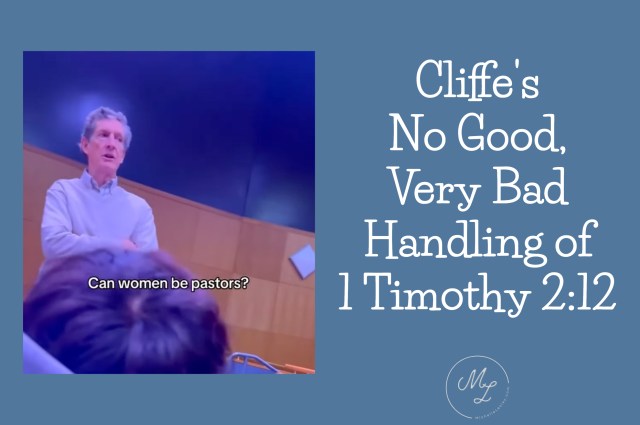
Cliffe’s No Good, Very Bad Handling of 1 Timothy 2:12

I had no idea who “Cliffe” in this video is, until I reposted it on X (thanks to Jon Root for the original) with my comments, and followers informed me that this is Cliffe Knechtle, who (along with his son, Stuart) seems to be an open air apologist with a large following on YouTube.

I’m hoping Cliffe just had a no good, very bad day on the day this was recorded and that he goes back, examines the pertinent texts more carefully (and in context), repents, and publicly corrects his errors.

Because, for someone who – I’ve been told – is a respected apologist, this is embarrassingly bad, not to mention, deceptive, even if he didn’t mean it to be.

Let this be an example of how to critically evaluate teaching according to Scripture. And, in case any of your friends and loved ones hold some of these same errant beliefs, here’s how you can help them see the truth of Scripture.

So, ladies, let this be an example to you of how to critically evaluate teaching according to Scripture. And, in case any of your friends and loved ones follow Cliffe or hold some of these same errant beliefs, let me offer a biblical corrective you can use to help them see the truth of Scripture. Open your Bible and follow along with the video. Cliffe’s words below are in bold. (I’ve also interspersed some additional helpful resources.)

“Paul writes that women are not to be pastors.”

No, “God writes…”. Paul penned it, but 1 Timothy 2:11-3:7 is God’s Word. God’s idea, not Paul’s. Paul wrote down what the Holy Spirit breathed out.

Now I’m guessing Cliffe would probably agree with me about that, and I, myself, use that kind of phraseology sometimes, too, but it’s important to remind ourselves – especially with passages of Scripture that broken, sinful human beings have made controversial, like this one – that this is God speaking, not Paul, the sinful human being dreaming this up and imposing it on the church.

“I don’t think that’s a fair translation.”

Then how come every single trustworthy translation of the Bible (and even a lot of the untrustworthy ones) translate it that way? Is Cliffe an expert in the biblical languages and knows better than all the expert Bible translation teams who translated it the way he disagrees with?

Furthermore, although it’s a true summary of what he did write, Paul didn’t write, “Women are not to be pastors.” It’s important to rightly handle and accurately quote the actual text when you’re teaching a biblical concept.

It’s important to rightly handle and accurately quote the actual text when you’re teaching a biblical concept.

“He does write, ‘I do not permit a woman to have authority over a man.'”

No, He (God) writes, “I do not allow a woman to TEACH OR exercise authority over a man…”. Again, it’s important to rightly handle and accurately quote the actual text when you’re teaching a biblical concept.

It’s also important to incorporate the entire body of text that applies to the issue you’re dealing with. In this case, that would be not just 1 Timothy 2:12, but 1 Timothy 2:11-3:7 and Titus 1:5-9. The pastoral qualifications in 1 Timothy 3 and Titus 1 are also crystal clear (“Husband of one wife,” and male pronouns throughout, anyone?) that pastors must be men.

“And yet Paul had a partner in ministry named Priscilla…”

Not in the sense that she was a pastor or taught or exercised authority over men in the gathering of the body, or he would have been the biggest hypocrite in the Bible, because that would have violated God’s breathed out Word – which Paul wrote – in 1 Timothy and Titus. Scripture nowhere characterizes Priscilla as a pastor or any sort of egalitarian “partner in ministry” to Paul that in any way violated clear, New Testament, didactic passages on the role of women in the church.

“…who taught the great preacher Apollos.”

Read the actual passage in Acts 18:24-28. It’s not like she was his seminary professor and she trained him for the pastorate. She and Aquila heard him preach an incomplete gospel and pulled him aside privately and corrected him. Once. Briefly. We have no idea how much of the correcting Priscilla herself did, but even if she did all of it, this does not violate 1 Timothy 2:11-3:7 because that passage prohibits women from pastoring, teaching, and exercising authority over men in the gathering of the Body.

In the Acts 18 passage, Priscilla was not a pastor, nor was she teaching or exercising authority in the gathering of the Body. This was a private meeting, possibly even led by her husband.

There isn’t a woman in Scripture whose actions prove that it’s biblically OK for women to pastor, preach to, or exercise authority over men in the church. Not a single one. Check out:
Oh No, She Di-int! Priscilla Didn’t Preach, Deborah Didn’t Dominate,
and Esthers Wasn’t an Egalitarian.

“So what on earth is he saying when he says, ‘I don’t allow a woman to have authority over a man’? I would argue…that he’s pointing out that in Ephesus… there was a goddess, Diana of the Ephesians, so there was massive confusion about sexual roles…”

Why would you argue that, brother? God plainly tells us His reason for prohibiting women from pastoring, teaching, or exercising authority over men in verse 12. It’s right there in verses 13-14…

For it was Adam who was first formed, and then Eve. And it was not Adam who was deceived, but the woman being deceived, fell into trespass.

1 Timothy 2:13-14

…and it has nothing to do with Ephesus, Diana, confusion about sexual roles, women abusing their freedom in Christ, or education (which he mentions later in the video). God clearly and unequivocally tells us His reasons for this command: the Creative order and the woman’s deception.

And when you replace God’s reasons in verses 13-14 with any other reason or explanation, you’re calling God a liar. You’re saying His reasons are wrong and yours are right. That you know better than God. That is a very dangerous and blasphemous statement to make.

What then? If some did not believe, does their unbelief abolish the faithfulness of God? May it never be! Rather, let God be true and every man a liar, as it is written,
“That You may be justified in Your words,
And overcome when You are judged.”

Romans 3:3-4

What does 1 Timothy 2:12 actually teach? Check out: Jill in the Pulpit?

“That’s [massive confusion about sexual roles due to the goddess, Diana of the Ephesians,]…” why he says in 1 Corinthians 11 and 14, he says, ‘I don’t allow a woman to teach a man’.”

That’s not what 1 Corinthians 11 and 14 say, that’s what 1 Timothy 2:12 says. First Corinthians 11:1-16 is about male headship and authority. It makes no mention of women teaching men. First Corinthians 14:26-40 is about keeping order in the worship service. It makes no mention of women teaching men.

Furthermore, while God may have, indirectly, been addressing some sort of “confusion about sexual roles” in 1 Corinthians 11 and 14, this sexual confusion had nothing to do with the “goddess, Diana of the Ephesians” because this is in Corinth, not Ephesus.

And again, 1 Timothy 2:12 is the verse that prohibits women from teaching men, and the reason for this prohibition is not “massive confusion about sexual roles due to the goddess, Diana of the Ephesians,” the reason is the Creative order and the woman’s deception, as verses 13-14 clearly tell us.

This kind of confusion and conflation is what happens when you depend on your memory instead of opening the Bible and reading the text, especially if it’s a passage you haven’t dealt with recently. (Trust me. I know. I’ve done it myself.)

“Some very strong Christians, whom I respect highly, disagree with me.”

That’s because what you’re saying is a completely unbiblical mangling of the text. Anyone with third grade reading comprehension skills should disagree with you.

“Paul had partners, who were women, in ministry.”

No he didn’t. Not in the egalitarian sense he’s trying to make these kids believe. (See above about Priscilla.) And if he’s referring to women besides Priscilla, there’s even less information about them in Scripture, so any pronouncement that these other women were pastors or egalitarian “partners” is not only pure conjecture, but also eisegesis of the highest order.

“If God gives a woman gifts, we’re to give women the opportunity to use those gifts.”

Certainly, within the parameters of Scripture. God, the giver of all gifts, has every right to place restrictions on how we may use those gifts. God has never gifted a woman to teach with the intent that she should use that gift to teach men in the church because that contradicts His written Word. If He did that, He would be a liar and a hypocrite and He would cease to be God. There are plenty of ways women can use the gifts of teaching and exhortation without violating God’s commands about the role of women in the church. Ask me how I know.🙂

My favorite apologetic responses to egalitarians?
The Mailbag: Counter Arguments to Egalitarianism

In fairness, we can’t see most of the audience, but notice that, of the audience members we can see, no one seems to have a Bible in his or her hands in order to be a good Berean and check out what Cliffe is saying against Scripture. And it doesn’t look like anyone is raising a hand to ask him any questions, either. (Hopefully, those things happened after the end of the video.)

Don’t just believe what you’re told. Go to God’s Word, be a good Berean, and check it out. And help your friends and loved ones to do likewise.

Don’t just believe what you’re told. Go to God’s Word, be a good Berean, and check it out. And help your friends and loved ones to do likewise.

Mailbag

The Mailbag: Top 10 FAQs

Originally published September 7, 2020

I get lots of great questions, and sometimes, they’re the same questions from lots of different people. So I thought today it would be fun, instead of answering just one person’s question, to answer lots of people’s questions. Here are the top 10 Mailbag questions readers most frequently ask:

1.

“Do you know anything about [Christian pastor/teacher/author] or his/her materials? Is he/she doctrinally sound?”

The best way to find out if I’ve written anything on a particular teacher is to put her name (make sure you spell it correctly) into the search bar, which is located at the bottom of every page of the blog. You can also check the Popular False Teachers & Unbiblical Trends tab and the Recommended Bible Teachers tab (in the blue menu bar at the top of this page) to see if the teacher’s name is located there.

If you need answers on a certain teacher right away, and I haven’t written anything about her, you will need to do the research yourself, which is a skill every Christian needs to hone anyway. (You should never just take my, or anybody else’s, word for it that a particular teacher is or isn’t trustworthy.) In case you need a little help getting started, I’ve described how I do my research, complete with some quick litmus tests and shortcuts in my article Is She a False Teacher? 7 Steps to Figuring It Out on Your Own

If I haven’t written an article about a teacher you see as problematic who’s reaching a wide audience, you’re welcome to send me her name along with any links you may have to her unbiblical teaching or behavior. If I get enough questions about a particular teacher, I’ll probably write an article on her.

2.

“Can you recommend a good
women’s/children’s/teens/particular topic Bible study?”

No. On principle, I do not recommend what I call “canned” (book, workbook, DVD, etc.) Bible studies- not even doctrinally sound ones. The church has become so utterly dependent on books and materials written by others that the majority of evangelicals have no idea how to simply pick up the Bible and study or teach straight from the text of Scripture. I may be the only one to stand against that tide, but I’m standing against it. We need to, as a general practice, cut out the middleman and get back to learning and teaching straight from the Bible itself.

If studying or teaching directly from Scripture is new to you, I would encourage you to check out the Bible Studies tab in the blue menu bar at the top of this page, which explains more about my philosophy of Bible study and provides numerous resources to help you learn how to study or teach the Bible itself.

One of the resources you’ll find is all of the Bible studies I’ve written. They are all free for individual and group use, and you are welcome to print out as many copies as you need. My studies are learn-by-doing “training wheels” that teach you: how to study/teach the Bible in a systematic way, the kinds of things you should be noticing in the text, the kinds of questions you should be asking of the text, and how the various parts of the Bible fit together to tell God’s grand story of redemption through Christ. Work through a study or two. Once you get the hang of it, you’ll be ready to unbolt those training wheels and study or teach on your own without needing to rely on anyone else’s materials any more – even mine.

Here are a few additional resources:

The Mailbag: Can you recommend a good Bible study for women/teens/kids?

The Mailbag: “We need to stop relying on canned studies,” doesn’t mean, “We need to rely on doctrinally sound canned studies.”

McBible Study and the Famine of God’s Word

3.

“You shouldn’t be warning against [popular false teacher]
for [X,Y,Z] reason!”

Sorry, but that’s not what the Bible says. The question isn’t, “Why am I warning against them?”. The question is, “Why aren’t you?”

Answering the Opposition- Responses to the Most Frequently Raised Discernment Objections

4.

I’m trying to find a doctrinally sound church. Can you help me?

It is my delight to help my brothers and sisters find a solid church. Please check out the Searching for a new church? tab in the blue menu bar at the top of this page.

If you’re newly saved and/or coming out of the New Apostolic Reformation, prosperity gospel, New Age, Catholicism, Mormonism, etc., I would strongly recommend reading through all of the resources in the “What to look for in a church” section of that tab before beginning your search for an actual church. You need to know what makes a church doctrinally sound (or not), and those resources can help.

Notice that there are multiple church search engines at the top of that tab. If you don’t find something in your area at the first search engine, go to the next one, and keep going until you’ve exhausted all of them.

Keep in mind that doctrinally sound churches are becoming scarcer and scarcer. You may have to drive longer than you’d like to get to one. It may not meet all your preferences. You might have to try a different denomination than you’re used to. The most doctrinally sound church you can find within achievable driving distance may have a few biblical “warts” (for example: a generally solid preaching/teaching church but the women’s ministry uses materials by false teachers). It is possible that God may put you in that less than perfect church to sanctify you, or for you to help bring about biblical change.

Sometimes people e-mail me asking if I can help them find a church. Your best bet is really to use all of the resources at the “Searching for a new church” tab. I want to reassure you that, unlike Walmart, I don’t have any churches in the back store room that haven’t been stocked yet. With the exception of a handful of churches my readers have recommended that I haven’t had a chance to vet yet, everything I have is out on the shelves at that tab. :0) (I would also encourage everyone reading this – if you attend a doctrinally sound church, click the link above and see if your church is listed on at least one of the three most popular church search engines: Founders, G3, and/or Master’s Seminary church search engines. If not, talk to your pastor about submitting your church’s information to one or more of these so people can find you!)

If you’ve made a good faith effort at the “Searching…” tab and have exhausted all of the resources there, and you still can’t find a passable church within achievable driving distance, you have two options (one of which is not giving up on church and staying home): move to an area that has a solid, established church, or look into church planting.

If you’re considering moving for a church, do everything in your power to make sure that church is solid and is going to stay that way. Find out about their history. Watch their worship services online regularly for a few months. Set up a Zoom call with the pastor or elders, explain your situation, and “interview them”. Don’t be shy to ask any, and as many questions as you need to. You’re picking up your entire life and moving based on what they say. Churches are apostatizing at an alarming rate. The last thing you want to do is move somewhere for a church you thought was sound, only to have it take a turn toward sin or false doctrine six months after you get there.

Personally, I think church planting is the preferable option for at least two reasons. First, you don’t have to go through the hassle, logistics (“Will I be able to find a job in this new place?”), and emotional upheaval of leaving family and friends behind that comes with moving. Second, if you’re in an area where you can’t find a good church, neither can any of your neighbors. You could be the person God uses to bring a solid church to an area without a gospel witness. How amazing would that be? Pick up the phone or fire up your email and start contacting the church planting organizations listed. Explain your dilemma. Ask for their help. If none of the church planting organizations can help, contact the nearest doctrinally sound church, explain things to the pastor, and ask about his church planting a church in your area.

5.

The leadership at my church is kicking off a new Bible study using materials by a false teacher. What should I do?

It breaks my heart that this is, indeed, a frequently asked question. Please see my article The Mailbag: How should I approach my church leaders about a false teacher they’re introducing?.

6.

My church uses …
or
I’m looking for a new church,
and I found one that’s really sound, except they use…
Bethel / Jesus Culture / Hillsong / Elevation music
or other music from heretical sources.
What should I do?

Please see my article The Mailbag: How should I approach my church leaders about a false teacher they’re introducing?. You can find information about Bethel, et al at the Popular False Teachers & Unbiblical Trends tab in the blue menu bar at the top of this page. Some other resources that may be helpful:

Why Your Church Should Stop Playing Bethel, Hillsong, Elevation and Jesus Culture

The Mailbag: False Doctrine in Contemporary Christian Music

7.

My friend is following a false teacher. How can I help her see this? 

Here are some resources that can help:

Words with Friends: How to contend with loved ones – at A Word Fitly Spoken (many additional resources linked here)

Words With Friends by Amy Spreeman

Clinging to the Golden Calf: 7 Godly Responses When Someone Says You’re Following a False Teacher 

8.

Whaddaya mean women can’t preach to men? Of course they can!

Again, sorry, but that’s not what the Bible says. I would strongly encourage you to read all of the articles in my Rock Your Role series, which examines the Scriptures dealing with the role of women in the church. (Remember, for Christians, God’s Word is our authority, not our feelings, opinions, and preferences.) I would suggest starting with these:

Jill in the Pulpit

Oh No She Di-int! Priscilla Didn’t Preach, Deborah Didn’t Dominate, and Esther Wasn’t an Egalitarian

Rock Your Role FAQs

The Mailbag: Counter Arguments to Egalitarianism

9.

Why isn’t Teacher X listed at your Popular False Teachers tab?
Does the fact that she’s not listed mean she’s doctrinally sound?
Why isn’t Teacher Y listed at your Recommended Bible Teachers tab? Does the fact that she’s not listed mean she’s a false teacher?

Please understand that these are not comprehensive lists of every false teacher or doctrinally sound teacher in existence. There are thousands of both, so that would be impossible. Also, don’t jump to conclusions about any teacher who’s not on the list. The absence of a particular teacher’s name on either list says nothing definitive about whether or not I would recommend that teacher.

The articles I’ve written about false teachers have mainly been in response to readers inquiring about them. In other words, if you don’t see a particular teacher’s name on the list, it’s probably because I haven’t been asked about her, I’ve been asked about her but haven’t had time to get to it yet, or for one of the reasons below.

The teachers on the recommended teachers list are those I’ve personally listened to or read at enough length that I feel comfortable endorsing them. Most of the teachers on the list trend toward being Calvinistic/Reformed and cessationist because I believe this is the most biblically correct view of Scripture, and because, in my experience, those of these persuasions are generally more discerning about associating with false teachers, and more expository in their teaching. (Of course there are some non-Calvinist/Reformed pastors and teachers who are stellar in these areas. I’ve had the privilege of knowing a few personally.)

There are a few other reasons you might not see someone’s name on either the false teachers or the recommended teachers lists:

• My articles on false teachers are nearly always about teachers: who are well known (thus the “Popular” in “Popular False Teachers”), who women in my particular audience – average American evangelical women – are most likely to follow, and whose materials are being used in those average American evangelical women’s churches. It takes multiple hours of research to vet teachers, and I have to invest those hours into the teachers who are deceiving the greatest numbers women in my audience.

• I don’t tend to write articles on teachers who are so blatantly heretical and/or are so well known for being heretical that it should be obvious (unless I feel there’s some compelling reason to do so). This is why you won’t see, for example, Kenneth Copeland, Benny Hinn, or Nadia Bolz-Weber on the false teachers list. Kenneth and Benny are fairly well known for being prosperity gospel heretics, and a 30 second Google search should make it obvious to most Christians who aren’t already familiar with her that Nadia is a liberal heretic. And, again, your average American evangelical woman isn’t following people like this, and her church isn’t using their materials.

• Normally, I don’t write about contemporary teachers who are dead, especially if they’re not particularly popular with my demographic. This is why you don’t see names like Mother Teresa or David Wilkerson on the list.

10.

I have a dire and complicated family/marriage/church situation,
can you help me?
Can you mentor/disciple me?

I deeply wish I could answer “yes” to all of these inquiries. I’m a helper. I want to help people. But I also know that in most of these situations, I’m not the right person for the job. So my answer to these inquiries has to be “no”. I cannot engage in counseling or discipling/mentoring relationships via e-mail.

The first reason for this is that my primary duty before the Lord is to care for my husband, children, and grandchildren, to manage my household, and to be a faithful church member. That takes a lot of time and energy. And if you’ve ever read my e-mail policy, you know I don’t even have time to answer most of the e-mails I receive, let alone the time that’s required to properly disciple, mentor, or counsel someone through a difficult circumstance.

But the second reason I’m not the right person for the job is that all of these are the job of the local church. It’s not right for me to get between you and your pastor when you need counsel or between you and an older sister at your church when you need to be discipled. You need someone who can walk with you, face to face, for the long haul, through these situations. Relying on me would be cheating yourself out of connecting with the person at your church who could be there for you the best and help you the most.

And, finally, especially in dire counseling situations such as abuse, extreme marital problems, or complex issues at church, I’m not familiar with the laws and resources in your area, I’m only hearing your side of the story, I’m not getting all of the details, etc. Your pastor or an older sister at church is there. They can better help you navigate the intricacies of the situation and provide you with more effective solutions than I can.


If you have a question about: a Bible passage, an aspect of theology, a current issue in Christianity, or how to biblically handle a family, life, or church situation, comment below (I’ll hold all questions in queue {unpublished} for a future edition of The Mailbag) or send me an e-mail or private message. If your question is chosen for publication, your anonymity will be protected.


Mailbag

The Mailbag: Potpourri (Book reviews, statues, and conscience issues… Women giving pro-life talks in church)

Welcome to another “potpourri” edition of The Mailbag, where I give short(er) answers to several questions rather than a long answer to one question.

I like to take the opportunity in these potpourri editions to let new readers know about my comments/e-mail/messages policy. I’m not able to respond individually to most e-mails and messages, so here are some helpful hints for getting your questions answered more quickly. Remember, the search bar (at the very bottom of each page) can be a helpful tool!

Or maybe I answered your question already? Check out my article The Mailbag: Top 10 FAQs to see if your question has been answered and to get some helpful resources.


I occasionally help launch books by Christian authors. I recently signed on to promote a Christian historical fiction book, and I’m supposed to write an Amazon review about it. But I am in a dilemma. At the end of the book, one of the characters is miraculously healed from a gunshot wound and claims he heard god tell him that he [“god”] did it for the main character, who doesn’t believe in god. (Notice I’m not capitalizing “god” because I don’t believe God speaks to us audibly or in dreams.)

When I agreed to promote this book I had no idea this would be in it. Now I am feeling really conflicted. I can’t in good conscience recommend this book but I don’t want to write a negative review on Amazon. Thoughts?

(For readers who may not understand this sister’s dilemma, she is referring to the unbiblical idea of extra-biblical revelation.)

This is a great question, and it’s really awesome that you’re trying to think this through biblically.

What jumps out at me from your comment is that this is bothering your conscience to the point that: a) you’ve used the phrase, “I can’t, in good conscience…” and b) you purposefully didn’t capitalize “God”*. If you think this book is promoting a false god, it’s no wonder it’s bothering your conscience.

* The word “god,” uncapitalized, means “false god” or “idol”.

Romans 14:22b-23 says: Blessed is the one who has no reason to pass judgment on himself for what he approves. But whoever has doubts is condemned if he eats, because the eating is not from faith. For whatever does not proceed from faith is sin.

and James 4:17 says: So whoever knows the right thing to do and fails to do it, for him it is sin.

You should not sin against your conscience by reviewing and promoting this book as though there’s nothing wrong with it, and I think you would agree that option is off the table.

So what are your other options? I’m not sure exactly how this works, so I’m just throwing out a couple of ideas here:

  • Write an honest review praising the good parts of the book but explaining the biblical problems with the scene you mentioned, and agree to promote the book with that caveat included.
  • Write the aforementioned honest review but don’t promote the book at all.
  • Explain the problems with the scene to the author, tell her you’re willing (if you are) to do either of the above, and let her decide what she wants you to do.
  • Explain the problems to the author and tell her you can’t write a review or promote the book.

Personally, I think one of the first two options would make a greater impact for biblical truth on a larger number of people if you feel you can do it without sinning against your conscience. But you have to decide what’s right for your own walk with the Lord first.

I understand your concern about wanting to keep your word when you agreed to do something, but you have to keep in mind that – whether she realizes it or not – this was an unfair agreement on the author’s part. It’s like buying a car. She sold you a car giving you the impression it worked right and when you got it home you discovered it didn’t have a carburetor or whatever (I don’t know – I’m not good with car stuff). That nullifies your end of the agreement to buy the car.

Use biblical wisdom, pray about it, and don’t sin against your conscience.

In case it might help, here’s a critical review I wrote a while back: Redeeming Love: Rants, Raves, and Reviews


I have a statue of Joseph and Mary holding baby Jesus. It’s in a corner year round in my living room. As a former Catholic, I’m questioning myself if I should even have it at all??

As with the reader above, I think the fact that you’re starting to question this is an indication that it’s bothering your conscience. I would point you to the same Scriptures and counsel you not to sin against your conscience as I counseled the reader in the question above.

Some Christians consider any material representation of Christ to be a violation of the second Commandment. Personally, I don’t believe the context or cross-references of the second Commandment support this view. I’ve explained why, here. However, this is an issue you’ll want to study for yourself and be convinced of, one way or the other, by rightly handled, in context Scripture.

But, assuming there’s no second Commandment issue for you, and you’re not worshiping, venerating, or praying to the statue, or using it as some sort of “aid” to help you worship God – all of which all Christians would agree violate the first two Commandments against idolatry – and it’s just sitting there gathering dust in the corner like an umbrella stand or a fern, this is an issue of conscience.

I would suggest praying about it and discussing it with your husband (if you’re married) and then your pastor. You may also want to prayerfully consider…

Why do I still have the statue?

How do I feel about getting rid of it, and why?

What is the proactively good, biblical reason to keep this statue? (You might want to think of it like this: Would you recommend to your best friend that she buy and display a statue like yours? Why or why not?)

If it bothers your conscience and you can’t think of any good, biblical reason to keep it, get rid of it.

And get an umbrella stand or a fern.


Is it against 1 Timothy 2 for a woman to speak, not teach, during a Sunday morning worship service? She is not speaking as to teach or preach or pastor, but simply speaking on a topic to a congregation of men and women about her experiences as the head of a pregnancy resource center on Sanctity of Life Sunday. You say that this is unbiblical?

If she’s just giving a brief, personal testimony as a small part of the worship service, and the pastor will go on to preach his full sermon later in the service, that’s probably OK. (I’ve addressed women giving personal testimonies during the worship service here, #14.)

If her “testimony” is taking the place of the sermon, yes, it’s unbiblical, but not in the way you’re thinking. Someone giving a talk on an informational topic or her personal experiences that takes the place of the sermon is not so much a 1 Timothy 2:12, “women preaching/teaching to men” issue as it is a 2 Timothy 4:1-2 “pastors, preach the Word” issue.

Personal testimonies, speeches on non-biblical topics, panel discussions, interviews, etc. (from anyone, male or female), should not take the place of the preaching of the Word in the worship gathering. Additionally, due to the ignorance of the world and the majority of professing Christians who fail to distinguish between personal testimonies, TED talks, and preaching, a woman giving a personal testimony that takes the place of the sermon appears to most people as though she is preaching the sermon. We’re to avoid even the appearance of evil, so that’s another biblical reason not to do it.

May I make a suggestion? If your church is in need of someone to teach about the wickedness of abortion, contact an abolitionist organization such as Abolitionists Rising or Free the States. Because the abolition movement is church-based, they can put you in touch with a biblically qualified, doctrinally sound man (usually a pastor or elder) to come to your church and preach on the biblical reasons we should fight for the total eradication of abortion. We need to be convicted by Scripture on this issue, not swayed by an emotional response to someone’s subjective personal experiences.


If you have a question about: a Bible passage, an aspect of theology, a current issue in Christianity, or how to biblically handle a family, life, or church situation, comment below (I’ll hold all questions in queue {unpublished} for a future edition of The Mailbag) or send me an e-mail or private message. If your question is chosen for publication, your anonymity will be protected.