Random Ramblings Ruminations Resources

Random Ramblings, Ruminations, and Resources

Great balls of fire, the world has gone ya ya and we haven’t had a 4R sinceย last July.ย Goodness. Well, we’ll fix that faster than a Costco shopper on a pallet of toilet paper.

Let’s jump into someย Random Ramblings, Ruminations, and Resources, shall we?

Photo Credit

M-m-m-my Corona(virus)

The other day I asked on Facebook if y’all wanted an article about Christians and the Coronavirus or something else. The overwhelming response was, “Something else!ย Anythingย else!” It seems many of us have reached out saturation point when it comes to hearing about the virus:
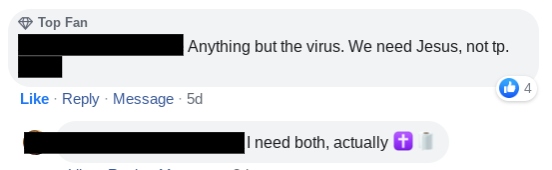
But there were a few hardy souls who wanted to hear a Christian perspective on how we and our churches should be reacting to all the ramifications of quarantines, social distancing, and church closures. So here are a few brief thoughts I had:

๐Ÿ˜ทWash your hands like your life depends on it, because it might. Instead of singing a song while you’re washing your hands, recite your memory verses. Or if you’re in a public restroom, share the gospel with the poor sap ladyย who’s washing her hands in the sink next to you. You know she’s going to be there a while- captive audience!

๐Ÿ˜ทYou shouldn’t have to be told to cover your mouth when you cough or sneeze. You should already be doing it. That is basic home training and basic loving and serving your neighbor.

๐Ÿ˜ทStay home if at all possible (I thought this was just called “being normal, but it turns out I’m an introvert. Or a hermit.). The sooner this thing stops spreading, the sooner we can all get back to church, work, and normal life (which, for me, is staying home if at all possible – it’s the circle of life. Or something.).

๐Ÿ˜ทChristians are not hoarders. Christians are sharers. It’s one thing to lay in a reasonable supply. It’s a whole ‘nother animal to buy into the mindset that purchasing huge amounts of supplies will somehow magically ward off harm. It won’t. That’s superstition. It is failing to trust God to provide for you. Do business with God and discern whether or not you’ve been hoarding. If you have, repent, and make like Zacchaeus and give it away to people who need it.ย 

๐Ÿ˜ทIf you have a godly pastor, he has probably agonized over whether or not to cancel worship service or modify your church’s regular activities. It doesn’t matter what decision he makes, somebodyย is going to be unhappy about it and give him an earful. Don’t be that person. Give him some love and encouragement (from a safe social distance). He probably needs it now more than usual. And on that same note, whatever decision he makes, just roll with it for the time being, OK? We’re all playing this thing by ear right now, including your pastor. Don’t make me go all Hebrews 13:17 on y’all.

๐Ÿ˜ทIf you think nothing of skipping church for frivolous reasons, it’s hypocritical to complain now about your church’s services being canceled or modified for a much more important reason. (I’m not talking about First Amendment stuff here, I’m talking about your heart.)

๐Ÿ˜ท”Online church” can be a blessing in an emergency situation like this, but this virus is going to pass and things are going to get back to normal. Do notย fall into the fleshly mindset of, “Online church worked out just fine during the crisis, so I’ll just keep doing that instead of physically going back to church.” Uh uh. That’s spiritually lazy, and it’s sinfully forsaking the assembly. For Christians, Church is Not Optional, and that’s Non-Negotiable.

๐Ÿ˜ทHave you ever stopped to think that this whole quarantine and limiting of meeting sizes thing could be God giving us a dry run of what it’s going to be like when real persecution comes, our church buildings are shuttered for good, and we have to meet in small groups in secret? That’s already real life for many of our brothers and sisters across the world. Maybe we should quit complaining and use this as a drill.

๐Ÿ˜ทWhere are Benny Hinn, Todd White, Bethel, and the rest of the faith healing crowd in all this? Time to put up or shut up.

๐Ÿ˜ทTake reasonable precautions, but look for opportunities to help others and to share the gospel. Let your faith in God be greater than your fear of illness.

That’s pretty much my take on the whole shebang. If you haven’t had enough of all things Coronavirus, here are some more good resources:

Coronavirus Articlesย at The Cripplegate

Coronavirus and the Christian Faith on The Sword and the Trowel Podcast

The Coronavirus Pandemic – Bringing Hope to Those in Fear on Voice of Reason Radio

Q&A Corona Virus, Saturday Podcast, the Bible Project? at When We Understand the Text

Wisdom, Not Worry on Relatable with Allie Beth Stuckey

Kudos to one of my followers, Camille, who has been hard at work curating the best Coronavirus memes on the web, part 1 and part 2. (This is meant to be lighthearted and funny. If you only do serious, please don’t click.)

Get Your Worship On

This kind of goes along with my TBT article from yesterday, Godโ€™s Not Like โ€œWhatever, Dude,โ€ About The Way Heโ€™s Approached in Worship. (Also meant to be lighthearted and funny, so please don’t click if that’s not your bag.). And some of you youngsters wonder why us old codgers like hymns so much!

The Real Deal, or the Fake Heal?

I was reading Acts 3, the story of Peter and John healing the lame beggar, and it struck me how starkly different this account is from the chicanery of New Apostolic Reformation “faith healers” today…

๐Ÿ’ฅPeter and John didn’t have a “healing ministry”, they had a “preaching the gospel ministry.”

๐Ÿ’ฅThe lame beggar didn’t show up at “church” (i.e. the temple) to be healed, and didn’t seek Peter and John out for healing.

๐Ÿ’ฅThe lame beggar asked them for money rather than them asking him for money.

๐Ÿ’ฅPeter and John had no silver, no gold, no Rolexes, no mansions, no private jetsโ€ฆ

๐Ÿ’ฅPeter said, โ€œ…what I have, I give to you.โ€ The beggar was not asked to โ€œsow a seedโ€ into Peter and Johnโ€™s ministry.

๐Ÿ’ฅFaith isnโ€™t mentioned once prior to the healing. Peter didnโ€™t tell the beggar that if he just had enough faith, God would heal him.

๐Ÿ’ฅNo faith or money was required. The beggar played no part in โ€œearningโ€ his healing with his own good works. God healed him for His own glory.

๐Ÿ’ฅThe beggar was healed from a lifelong, obvious, eyewitnessed disability, and his healing was immediate and permanent.

๐Ÿ’ฅPeter downplays both himself and the miracle and points to the Miracle Worker, Jesus.

๐Ÿ’ฅPeter uses the opportunity of the gathered crowd to preach the gospel.

๐Ÿ’ฅThe gospel Peter preached was not, โ€œCome to Jesus for miracles,โ€ but โ€œJesus came to you, and you killed Him. Repent.โ€

๐Ÿ’ฅPeter didnโ€™t make crazy prophecies that didnโ€™t come true. He pointed to the prophets of Scripture, and their prophecies fulfilled in Christ.

NAR preachers and faith healers want us to think theyโ€™re just like the apostles – even calling themselves “apostles” – but their words and actions donโ€™t match up with what the apostles said and did.

They Aren’t Heretics Because You Disagree with Them

Of course not. So I’m not going to call Jared Wilson – who I have no reason to believe is anything other than a good, solid brother in Christ – a heretic because I disagree with the thrust of his article,ย They Aren’t Heretics Because You Disagree with Them. But, with genuine respect, I am going to call him “perhaps under educated” and “possibly somewhat lacking in experience” when it comes to the depth of the seemingly bottomless pit of false teaching and heresy out there.

Or perhaps our experiences are just different. Perhaps, in his world, there are throngs of people running around calling Presbyterians heretics because they believe in paedo-baptism. Or who cry “Heretic!” on anyone with a different eschatalogical view from their own.

That’s not the world I – and I would guess, most Christians – live in. In my world, the people who get called heretics and false teachers have generally earned the label by their biblically demonstrable false teaching and sinful behavior. There might be a few Baptists calling Presbyterians heretics and vice versa, but in my experience they are the rare exception, not the rule Jared’s article – putting the best possible construction on it – seems to be trying to address. And I get the feeling I swim in these particular waters much more frequently than he does.
I would certainly agree with Jared that the aforementioned types of issues are not matters of heresy, they are secondary issues on which Christians in good standing can disagree. But he lumps in some other issues (the role of women, extra-biblical revelation, yoking in ministry with “people who teach wacky things”) we cannot “agree to disagree” on because they are sin or false teaching that undermine the authority of Scripture, the sufficiency of Scripture, and the spiritual health of the church.

Jared has made the same categorization error regarding “secondary issues” that I believe Al Mohler made in his article on “theological triage” (which Jared links to in his article) – namely, that issues of sin (disobedience to clear Scripture) are not the same thing as secondary theological issues. Sin belongs all in its own category: sin. (I discussed this categorization error at length in my article Women Preaching: It’s Not a Secondary Doctrinal Issue.)

Jared uses no Scripture used to back up his opinions, making them no more valid than the โ€œopinionsโ€ he critiques. He cites the Baptist Faith and Message (the statement of faith of the Southern Baptist Convention), but the BFM is not Scripture, and we are Christians first, Baptists second. We are Bible first, BFM second. So anywhere the BFM might contradict Scripture, go beyond Scripture, or not rise to the level of Scripture (and it does not rise to the level of Scripture regarding the role of women in the church, restricting only the office of pastor, but not the function of preaching), it is moot and useless.

Does Jared not recall that Scripture says, “A little leaven leavens the whole lump.”? And that we are to “cleanse out the old leaven…and celebrate with the unleavened bread of sincerity and truth“? Yet the thrust of his article seems to be akin to saying, โ€œDonโ€™t worry about that little misshapen mole on your arm. Itโ€™s just your arm having a ‘different view’ of skin. Only rampant, stage 4 cancer should be called cancer and treated.โ€ That is not a biblical approach to false teaching.

How would Jared have advised Old Testament people who had a โ€œdifferent viewโ€ of worshiping household gods alongside God? Or offering strange fire in worship? Or syncretism and idol worship taking place inside the house of God? Or marrying and divorcing foreign wives? Or, in the New Testament, Ananias and Saphira? Or those who forbid marriage and certain foods? None of these are soteriological heresies, and yet look how strenuously God dealt with each situation. Most involved the death of the perpetrators.

As much as many Christians would like us all to get along and play nice with anyone and everyone who names the name of Christ, we cannot do that and still be faithful and obedient to the Word of God that tells us to contend for for the faith and silence false teachers. False teaching, even non-soteriological false teaching, is a big deal to God, and it should be to us, too.
Discernment, Sermons

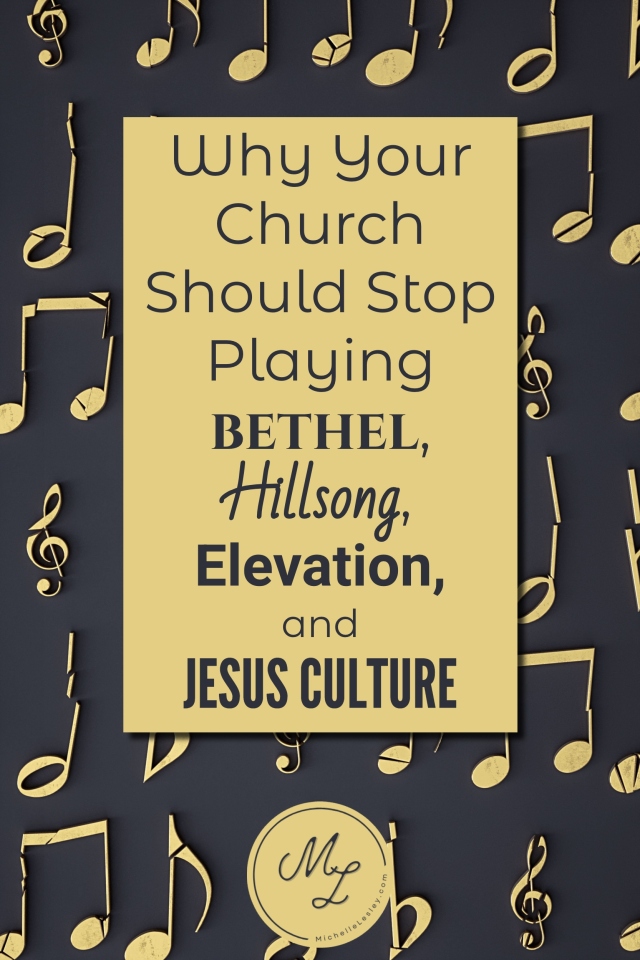
Why Your Church Should Stop Playing Bethel, Hillsong, Elevation, and Jesus Culture

If you prefer listening to reading, check out our A Word Fitly Spoken podcast episode, Discord: Why Your Church Should Reject Bethel Hillsong and Elevation Music, based on this article.


While this article deals primarily with Bethel, Hillsong, Elevation, and Jesus Culture, they are by no means the only heretical music sources to be avoided. Phil Wickham, for example, is just as prolific as these groups and his music is used by just as many churches. With his strong ties to Bethel, he should be included under the umbrella of Bethel as you consider the remainder of this article. There are numerous other unbiblical musicians who should be avoided for these same (and other) reasons. You can find a sampling of them in my article The Mailbag: False Doctrine in Contemporary Christian Music.


Justin Peters and Todd Friel discuss the theological problems with Bethel, Jesus Culture, Hillsong, and Elevation music and why your church shouldn’t use their music in this video interview: Why Your Church Shouldn’t Play Bethel and Hillsong Music.

Is it wrong to sing songs from Bethel if they are theologically correct? In this episode of Redeeming Truth, Pastors Costi Hinn, Dale Thackrah, and Kyle Swanson provide insight into the dangers of supporting ministries like Bethel [and Hillsong, Jesus Culture and Elevation Music], that have a false understanding of who Christ is.

If you are looking for theologically accurate worship music to listen to or sing in your church, they have put together a Spotify worship playlist that you can listen to. Costi has also written an excellent companion article on his blog: Should Your Church Sing Jesus Culture & Bethel Music?

Excerpted from my article The Mailbag: False Doctrine in Contemporary Christian Music

“Itโ€™s imperative for churches to be discerning about the CCM they use in worship. If Jane Churchmember hears a CCM song in church and likes it, sheโ€™s likely to Google the song (probably right there in church- Iโ€™ve done it!), find out who sings it, and begin following that artist. Worship pastors who use CCM have a responsibility to vet the artists who perform the songs they select for the worship service to make sure theyโ€™re not sending Jane into the arms of a heretic. Additionally, music costs money, and you donโ€™t want your churchโ€™s offerings supporting false doctrine.

Now, every time I address the subject of being discerning about worship music and that churches should not use worship music from heretical sources (such as Bethel, Hillsong, and Elevation) someone whoโ€™s defending using music from these heretical sources [will say]:

Well, [insert name of hymn writer here] wrote lots of perfectly biblical hymns, but he had some theological problems too, and youโ€™re not recommending we get rid of all of his hymns.

Well, first of all, maybe we should more closely examine the theology of some of our most prolific hymnists and stop using their music because of what they believed. Quick โ€“ off the top of your head, name the three we should start withโ€ฆ

โ€ฆAnd thatโ€™s what separates the errant hymnist from Bethel, et al. Most Christians, even those who prefer hymns over CCM, could probably not name three people who wrote hymns, let alone tell you anything about their theology. But if you ask the average Christian to name three top Christian artists, she could rattle them off in a second.

Most hymn writers have been dead for up to hundreds of years. They donโ€™t have Facebook pages you can follow, nobodyโ€™s playing their stuff on KLOVE, theyโ€™re not on tour to promote their latest album, they donโ€™t have thousands of followers worldwide, and their music is in the public domain, so your church isnโ€™t financially supporting them or their work. If you wanted to follow their errant theology, youโ€™d have to hit the books to research and study it. Contemporary musiciansโ€™ theology is only a click away on YouTube, social media, live streamed concerts and conferences, and on their web sites. Nobody is following dead hymnistsโ€™ false doctrine, but hordes are following contemporary musiciansโ€™ heresy.”


Excerpted from my articles on Bethel, Hillsong, and Elevation:

If you came here looking for a critique of individual [Bethel, Hillsong, or Elevation] songs, thatโ€™s not really what this is about. Everything connected to [these “pastors”] โ€“ [the “churches,” the music companies] (as entities and all individual songs), all [“church” and music] personnel, materials, programs, and events โ€“ are all fruit of the poisonous tree [of the false teacher who heads everything up]. No, you cannot biblically pick and choose songs from [any of these organizations] that donโ€™t seem to overtly violate Scripture. The Bible never tells us to โ€œchew up the meat and spit out the bones.โ€ It says:

I appeal to you, brothers, to watch out for those who cause divisions and create obstacles contrary to the doctrine that you have been taught; avoid them. For such persons do not serve our Lord Christ, but their own appetites, and by smooth talk and flattery they deceive the hearts of the naive. Romans 16:17-18

โ€œWatch outโ€ for false teachers. โ€œAvoid them.โ€ That includes everything about them: all their materials, books, events, music, social media, etc. Would the God who breathed out these words of Scripture be pleased if we ourselves, or our churches, use materials by people who โ€œdo not serve our Lord Christโ€?

Excerpted from my article The Mailbag: Potpourri (…Solid churches with heretical music…)

“We have been searching for a doctrinally sound church in the area we moved to, and unfortunately it has not been easy! The few that we have found still use Hillsong, Bethel or Elevation music. I usually cross a church off the list quickly if they sing from those artists. But like I said, now I am finding even doctrinally sound churches are throwing some of those songs in. Do you have any insight to this dilemma?”

for pastors and ministers of music: This is yet one more reason it is detrimental to your church to use music from Bethel, Jesus Culture, Hillsong, Elevation, any musician connected these groups (such as Phil Wickham, who’s very prolific and has strong ties to Bethel), or any other musician who isnโ€™t doctrinally sound (after you have thoroughly vetted him/her/them.) regardless of how biblical the lyrics of any particular song of theirs that youโ€™re using might be. You could potentially be turning away solid, mature, discerning Believers who might otherwise be interested in joining your church. The woman who sent in this question is not the first to ask me something like this โ€“ not by a long shot. This issue is increasingly of concern to Christians looking for a solid church. (For that reason, I do not list churches – even Reformed or seemingly otherwise doctrinally sound churches – on my Reader Recommended Churches list who use music from heretical sources like these.)

When a visitor walks into your sanctuary for the first time, your worship service is the โ€œfaceโ€ of your church to her. What kind of a first impression are you making? When you use music by doctrinally unsound musicians, it does not say, โ€œWeโ€™re really a doctrinally sound church โ€“ honest! We only use songs from these groups whose lyrics are biblical.โ€. It says, โ€œThis church has leaders who arenโ€™t discerning,โ€ or โ€œIf this church uses music by these heretical groups, what other doctrinal problems does it have?โ€. Why put that stumbling block out there when there is plenty of music available with biblical lyrics written/performed by doctrinally sound musicians?

And there’s another stumbling block that using this type of music puts in front of weaker brothers and sisters that you may not have realized. I have heard from a number of Christians whom God graciously saved and rescued out of the pit of “churches” similar to Bethel, Hillsong, and Elevation. They tell me that when they walk into what they think is a doctrinally sound church and hear music from these and other heretical sources, it triggers a form of spiritual PTSD. It’s traumatizing to them. They immediately become fearful that your church is mere steps from turning into one of these types of “churches.” Will they grow out of that reflexive reaction? Yes, some day, as God continues to sanctify them. In the meantime, do you want the music at your church to cause them unnecessary anxiety? I hope not.

Even for Christians who have not come out of “churches” like these but are knowledgeable about their heretical theology, using these songs in your worship service is putting a stumbling block in front of them, too. Take me, for example. I’ve studied these groups. I’ve seen their heresy and the damage they do to both the Kingdom and to the individuals who follow them. And because of that, I’ve zealously spoken out against them. If I visit your church and an Elevation song suddenly flashes up on the screen, my ability to worship is completely derailed in grief that your church would use a song from that source – especially if you know about their theology and are well acquainted with music from doctrinally sound sources that you could have used instead. I cannot sin against my conscience by singing those songs. Consider me a “weaker brother” if you like, but do you care more about me as your sister in Christ, or your “right” to use music from these sources? What about Paul’s posture in 1 Corinthians 8:9-13?

But take care that this right of yours does not somehow become a stumbling block to the weak. For if anyone sees you who have knowledge eating in an idol’s temple, will he not be encouraged, if his conscience is weak, to eat food offered to idols? And so by your knowledge this weak person is destroyed, the brother for whom Christ died. Thus, sinning against your brothers and wounding their conscience when it is weak, you sin against Christ. Therefore, if food makes my brother stumble, I will never eat meat, lest I make my brother stumble.

If this was true in Paul’s personal life, shouldn’t it surely be true of our worship services? If you wouldn’t put a Christmas tree or portrayals of Jesus in your sanctuary because it might offend a brother in Christ, why would you use worship music that causes offense to your brothers and sisters?

Finally, what is the proactively good reason for intentionally choosing music from a heretical source? In other words, when you’re selecting music for the worship service, why would you choose, say, a Hillsong song about God’s glory, or Psalm 23, or the crucifixion, when you could just as easily choose a song from a doctrinally sound source about any of those things – a source that isn’t a stumbling block to anyone, won’t give anyone the wrong impression about your church, won’t lead anyone to follow a heretical “church,” and won’t use your church’s offerings to support a heretical “church”? What makes the Hillsong song you’re choosing better than the song from the doctrinally sound source? It doesn’t seem to me that there’s a good enough reason to use songs from these sources that outweighs all the good, biblical reasons not to use them.

There is simply no good reason for a doctrinally sound church to use music from heretical sources like these.

There is simply no good reason for a doctrinally sound church to use music from heretical sources like Bethel, Jesus Culture, Hillsong, and Elevation.


Additional Resources

Stop Singing Hillsong, Bethel, Jesus Culture, and Elevation by Scott Aniol

The Mailbag: โ€œI Speak Jesus,โ€ Charity Gayle, and How to Vet Christian Music

Why I Donโ€™t Sing the Songs of Hillsong and Jesus Culture by Dan Cogan

Why Fundamental Baptist Churches Must Avoid Bethel Music by Spencer Smith

Bethel Church (Redding, CA)/Bethel Music/Jesus Culture

Hillsong/Brian & Bobbie Houston

Elevation/Elevation Music

The Mailbag: What Is the New Apostolic Reformation?

The Mailbag: Should Christians Listen to Reckless Love?

God’s Not Like, “Whatever, Dude,” About How He’s Approached in Worship

The Mailbag: False Doctrine in Contemporary Christian Music

Hillsong’s Theology of Music and Worship

Let’s Talk About the Worship Music at the [Charlie Kirk] Memorial Service… with Dawn Hill

Mailbag, Top 10

Top 10 Mailbag Articles of 2019

I always enjoy the annual “year in review” articles and TV shows that run in abundance in late December, so I thought I’d contribute my own. Several Mailbag articles were among this year’s most popular, so I decided to make two separate lists. Check out myย top 10 non-Mailbag articles of 2019 tomorrow. Here are my ten most popular Mailbag blog articles from 2019:

Vaxxers, Anti-Vaxxers, and the Health of the Body

To vaccinate, or not to vaccinate? Itโ€™s a tough issue to discuss these days.ย 


Do You Recommend Angie Smith (โ€œSeamlessโ€)?

Wife of Todd Smith of the Christian music group, Selah, Angie started out as a blogger, then blossomed into a Christian author and speaker. Her best known book to date is a womenโ€™s study: Seamless: Understanding the Bible as One Complete Story


Potpourri (Todd Friel on Rick Warren, Enneagram, Should I stay or should I go?โ€ฆ)

Todd says Rick isn’t a heretic?…Sharply, yet gently, rebuking false teachers…What is an Enneagram?…Books vs. interactions…Should I leave my women’s Bible study group?


BSF (Bible Study Fellowship)

While I totally support the idea of delving deeply into the Scriptures with other women, there are a few of aspects of BSF that concern me…ย 


Should My Church Participate in Operation Christmas Childโ€™s Shoebox Ministry?

Should my church participate in Operation Christmas Child? What are some other good international ministries my church could participate in instead?


Do you recommend these teachers/authors? Volume 1

Jennifer Kennedy Dean, Lisa Harper, Karen Kingsbury, Rebekah Lyons, Raechel Myers, Shauna Niequist, Jennifer Rothschild, Susie Shellenberger, Sheila Walsh, Amanda Bible Williams

(After today, I’ll be retiring this article. Thanks to Project Breakdown, I have completed updated, individual articles on each of these teachers which you may access at the Popular False Teachers and Unbiblical Trends tab at the top of this page, or by entering the teacher’s name in the search bar.)


Should Christians listen to โ€œReckless Loveโ€?

Remember, everything we do should be governed byย Scripture, not our opinions and preferences, or whether we happen to like a particular song or not…


Questions about the Open Letter to Beth Moore

Since the publication of the Open Letter to Beth Moore, several questions have arisen that Iโ€™d like to address…


Do you recommend these teachers/authors? Volume 3

Jill Briscoe, Lauren Chandler, Tony Evans, Rachel Hollis, Chrystal Evans Hurst, Brenda Leavenworth, Leslie Ludy, Bianca Olthoff, Wellspring Group, Jen Wilkin


Do you recommend these teachers/authors? Volume 2

Jennie Allen, Lisa Bevere, Rachel Held Evans, Heather Lindsey, Ann Graham Lotz, Kelly Minter, Nancy Leigh (DeMoss) Wolgemuth

(Project Breakdown begins on this list next!)


If you have a question about: a Bible passage, an aspect of theology, a current issue in Christianity, or how to biblically handle a family, life, or church situation, comment below (Iโ€™ll hold all questions in queue {unpublished} for a future edition ofย The Mailbag) or send me anย e-mail or private message. If your question is chosen for publication, your anonymity will be protected.

Answering a Fool, Mailbag

The Mailbag: Answering a Fool #3


Answer a fool according to his folly,
lest he be wise in his own eyes.
Proverbs 26:5

There’s a lot of foolishness masquerading as Christianity these days. Occasionally, I get e-mails and messages showcasing this type of foolishness. It needs to be biblically corrected so these folks can stop “being wise in their own eyes,” repent, and believe and practice the truth of Scripture. From time to time, I’ll be sharing those e-mails in The Mailbagย with a biblical corrective, not only so the e-mail writer can be admonished by Scripture, but to provide you with Scriptures and reasoning you can use if you’re ever confronted with this kind of foolishness.


(This reader’s blog comment {in blue},
responding to this article, is reprinted in full.)

You are a liar and devils tool. There is no role for corporate discernment. God doesnโ€™t need you to defend His flock from false teachers, when did God become powerless or when did His flock become unintelligent or indiscernible? How come itโ€™s OKY you who can discern? And just remember the same standard which you use to judge others, God will use to judge you.

Allllllllllrighty then. Let’s break this down.

You are a liar and devils [sic] tool.ย 

A liar is someone who intentionally deceives other people or says something she knows is not true. I have done neither. If there is something in my article that is incorrect, I assure you it was an innocent and unintentional mistake. If you could kindly specify exactly what you think I have gotten wrong with the evidence or rightly handled Scripture to back up your assertion, I will gladly correct my mistake.

As for being the “devil’s tool,” could you please explain how someone who points out biblical error and points people to the truth of Scripture is being used by the devil? The devil is the one who twists and misuses Scripture in order to lead people into error. Was Jesus the “devil’s tool” when He publicly pointed out and biblically corrected the unscriptural teachings of the scribes and Pharisees? How about Peter,ย Paul,ย John,ย Jude, and others whom God the Holy Spirit inspired to write the Scriptures that rebuke false teachers and false doctrine? Were these men the “devil’s tool” too?

When you accuse the brethren (me) without biblical cause or evidence, and in the face of Scripture that proves your accusations to be unfounded, what you’re doing is called slander and unbiblical judgment, and you are the one who is being used as a tool of the devil.

There is no role for corporate discernment.

I honestly have no idea what this means. “Corporate” means “a large company or group.” In Christian circles, when we use the term “corporate,” we usually mean the gathering of the church body. I’m an individual, not a group, so I really don’t have a clue as to how this statement applies to me.

Furthermore where does the Bible say or teach this? If you’re going to make a biblical assertion, you need to back it up with rightly handled, in context Scripture. There’s tons of New Testament evidence that God does want the church as a bodyย and individual Christians to practice discernment, but I don’t know which verses to provide you with to refute your point, because I don’t know what your point is.

God doesnโ€™t need you to defend His flock from false teachers,

God doesn’t “need” anybody. He doesn’t “need” you to rebuke me either. Did you consider that before you wrote your comment? Why didn’t you just remain silent and trust Him to convict me of whatever sin you think I’ve committed? Or is it that it’s OK for you to call someone on the carpet for what you perceive to be violations of Scripture, but it’s not OK for me to do so? Hypocrisy, much?

As I clearly stated in the very first paragraph of the article (which I’m assuming you read since you commented on it), people have written to me askingย whether or not certain teachers are doctrinally sound. The articles I’ve written areย answers to these readers’ questions.

Titus 2:3 says:

Older women likewise are to be reverent in behavior, not slanderers or slaves to much wine. They are to teach what is good,

Teaching women the truth of God’s Word about false teachers, discernment, or any other biblical issue is good. Some other passages you might want to consider:

I appeal to you, brothers, to watch out for those who cause divisions and create obstacles contrary to the doctrine that you have been taught; avoid them. For such persons do not serve our Lord Christ, but their own appetites, and by smooth talk and flattery they deceive the hearts of the naive.
Romans 16:17-18

Here’s Paul, under the inspiration of the Holy Spirit, warning fellow Christians to “watch out for” and “avoid” false teachers. You know what else Paul said? “Imitate me.

Beloved, although I was very eager to write to you about our common salvation, I found it necessary to write appealing to you to contend for the faith that was once for all delivered to the saints. For certain people have crept in unnoticed who long ago were designated for this condemnation, ungodly people, who pervert the grace of our God into sensuality and deny our only Master and Lord, Jesus Christ…save others by snatching them out of the fire;
Jude 3-4,23a

Jude, under the inspiration of the Holy Spirit, exhorts the church to fight for the purity of biblical doctrine and to save those who are vulnerable to false doctrine, “snatching them out of the fire.”

โ€œSo you, son of man, I have made a watchman for the house of Israel. Whenever you hear a word from my mouth, you shall give them warning from me. If I say to the wicked, O wicked one, you shall surely die, and you do not speak to warn the wicked to turn from his way, that wicked person shall die in his iniquity, but his blood I will require at your hand. But if you warn the wicked to turn from his way, and he does not turn from his way, that person shall die in his iniquity, but you will have delivered your soul.
Ezekiel 33:7-9

God commands Ezekiel to warn people away from their sin and says He will hold Ezekiel responsible if he fails to warn them.

But I guess God didn’t “need” Paul or Jude or Ezekiel or any of the people in the congregations they were writing or speaking to or, by extension, Christians today, “to defend His flock from false teachers,” right?

So whoever knows the right thing to do and fails to do it, for him it is sin.
James 4:17

It’s clear from Scripture that warning people away from sin and false doctrine is “the right thing to do.” You’re asking me to stop doing the right thing. It would be a sin for me to stop, and it’s a sin for you to demand that I stop. And now thatย you know that warning people away from false teachers is the right thing to do, that means if you fail to do so, that’s sin for you.

So the real question here is not, “Why amย I warning others about false teachers,” but “Why aren’tย you?”.

when did God become powerless or when did His flock become unintelligent or indiscernible?

OK, so following your logic, why does every single book of the New Testament (except Philemon) address the issue of false doctrine or false teachers? Why did God have so many of the Old Testament prophets rebuke the false prophets of their day – false prophets who, much like today’s false teachers, would say “thus saith the Lord” and then tell the people things God had not said, or things that were in direct contradiction to what God had said? Was He so powerless that these New Testament writers had to write books and letters (“blog articles,” if you will) warning against false doctrine and false teachers and these Old Testament prophets had to publicly denounce the false prophets?

When did His flock become unintelligent or undiscerning? Let’s dispense with “unintelligent” because that has nothing to do with being discerning. Some of the most intelligent people in evangelicalism with strings of academic letters behind their names are some of the most undiscerning Christians out there – seminary presidents and professors, denominational heads, CEOs of Christian retail outlets. And there are people who have very little in the way of intelligence or education who are very discerning.

When did God’s people become undiscerning? In Genesis 3, when a serpentine false teacher, “a liar and a tool of the devil,” walked up to Eve, twisted God’s Word and said, “Did God reallyย say…?”. And lack of discernment has been a pervasive problem ever since.

How come itโ€™s OKY [sic] you who can discern? (I think you mean “only”?)

It’s NOTย only I who can discern. Praise God, there areย lots of Christians out there who are discerning. The people who have written asking me about these false teachers are discerning (because they want help understanding whether or not they’re being taught sound doctrine). There are other writers and teachers doing the good and hard work of teaching discernment. Pastors, elders, deacons, Bible teachers, church members, podcasters, authors, parachurch ministries. They are out there warning fellow Christians against false teachers in their venues just like I am in my venue, and I thank God that they are! I wish every pastor and local church were so diligent about teaching discernment that I wouldn’t have to write discernment articles any more.

But the vast majority of them aren’t. In fact, the vast majority are throwing the doors of the sheep pen wide open to the wolves in sheep’s clothing and welcoming them in. And until that changes,ย somebody has to warn those vulnerable sheep. Like I said before, why aren’t you helping to warn them?

And just remember the same standard which you use to judge others, God will use to judge you.

The standard I use to biblically judge the observable behavior and teaching of evangelical teachers is Scripture, and that’s the standard God will judge me (and everyone else) by. I am totally OK with that because I am doing my best to be obedient to Scripture, and when I’m disobedient to Scripture I repent.

Can you say the same? What standard do you use for judging me and others? Let’s just put the opening and closing lines of your comment together:

You are a liar and devils tool.
And just remember the same standard which you use to judge others, God will use to judge you.

What standard are you using?

I’d like to leave you with a few passages of Scripture to consider:

“I tell you, on the day of judgment people will give account for every careless word they speak, for by your words you will be justified, and by your words you will be condemned.โ€
Matthew 12:36-37

Judge not, that you be not judged. For with the judgment you pronounce you will be judged, and with the measure you use it will be measured to you. Why do you see the speck that is in your brother’s eye, but do not notice the log that is in your own eye? Or how can you say to your brother, โ€˜Let me take the speck out of your eye,โ€™ when there is the log in your own eye? You hypocrite, first take the log out of your own eye, and then you will see clearly to take the speck out of your brother’s eye.
Matthew 7:1-5

O Lord, who shall sojourn in your tent?
Who shall dwell on your holy hill?
He who walks blamelessly and does what is right
and speaks truth in his heart;
who does not slander with his tongue
and does no evil to his neighbor,
nor takes up a reproach against his friend;
in whose eyes a vile person is despised,
but who honors those who fear the Lord;
who swears to his own hurt and does not change;
who does not put out his money at interest
and does not take a bribe against the innocent.
He who does these things shall never be moved.
Psalm 15


If you have a question about: a Bible passage, an aspect of theology, a current issue in Christianity, or how to biblically handle a family, life, or church situation, comment below (Iโ€™ll hold all questions in queue {unpublished} for a future edition ofย The Mailbag) or send me anย e-mail or private message. If your question is chosen for publication, your anonymity will be protected.

False Teachers

Rebekah Lyons and Q-Conference/Q-Ideas

If you are considering commenting or sending me an e-mail objecting to the fact that I warn against certain teachers, please click here and read this article first. Your objection is most likely answered here. I won’t be publishing comments or answering emails that are answered by this article.


This article is kept continuously updated as needed.

I get lots of questions about particular authors, pastors, and Bible teachers, and whether or not I recommend them. Some of the best known can be found above at my Popular False Teachers tab. The teacher below is someone I’ve been asked about recently, so I’ve done a quick check (this is brief research, not exhaustive) on her.

Generally speaking, in order for me to recommend a teacher, speaker, or author, he or she has to meet three criteria:

a)ย A female teacher cannot currently and unrepentantly preach to or teach men in violation of 1 Timothy 2:12. A male teacher or pastor cannot allow women to carry out this violation of Scripture in his ministry. The pastor or teacher cannot currently and unrepentantly be living in any other sin (for example, cohabiting with her boyfriend or living as a homosexual).

b) The pastor or teacher cannot currently and unrepentantly be partnering with or frequently appearing with false teachers.ย This is a violation of Scripture.

c) The pastor or teacher cannot currently and unrepentantly be teaching false doctrine.

I am not very familiar with most of the teachers I’m asked about (there are so many out there!) and have not had the opportunity to examine their writings or hear them speak, so most of the “quick checking” I do involves items a and b (although in order to partner with false teachers (b) it is reasonable to assume their doctrine is acceptable to the false teacher and that they are not teaching anything that would conflict with the false teacher’s doctrine).ย Partnering with false teachers and women preaching to men are each sufficient biblical reasons not to follow a pastor, teacher, or author, or use his/her materials.

Just to be clear, “not recommended” is a spectrum. On one end of this spectrum are people like Nancy Leigh DeMoss Wolgemuth and Kay Arthur. These are people I would not label as false teachers because their doctrine is generally sound, but because of some red flags I’m seeing with them, you won’t find me proactively endorsing them or suggesting them as a good resource, either. There are better people you could be listening to. On the other end of the spectrum are people like Joyce Meyer and Rachel Held Evans- complete heretics whose teachings, if believed, might lead you to an eternity in Hell. Most of the teachers I review fall somewhere in the middle of this spectrum (leaning toward the latter).

If you’d like to check out some pastors and teachers I heartily recommend, click theย Recommended Bible Teachers tab at the top of this page.


Rebekah Lyons
Not Recommended

Rebekah and her husband Gabe (who previously helped co-found the Catalyst conference, which has featured false teachers such as Beth Moore and Christine Caine) are the founders of โ€œQ,โ€ an organization which attempts to join Christians with secular cultural and governmental leaders as well as other non-Christians, including Muslims, in order to make a Christian impact on culture through โ€œThe 7 Channels of Cultural Influence.โ€ These โ€œ7 Channelsโ€ are identical to the seven mountains found in the Seven Mountain Mandate of the New Apostolic Reformationโ€™s false teaching ofย Dominionism. Scripture does not tell us toย partner with non-Christians to impact culture, in fact, it explicitly tells us not to. Furthermore, Q states “Our long-term goal is to see the Christian faith become increasingly attractive, credible and influential in the church, our communities and the next generation.” Although this goal might be realized by those who claim the name of Christ but whose hearts are far from Him, this line of thinking is patently unbiblical and therefore practically unattainable withinย biblicalย Christianity.

Since the first publication of this article in 2016, Rebekah and Q-ideas have scrubbed from their websites and social media platforms much of the material I originally linked to, including:

  • A link to a talk given by a Muslim at Q entitled “How Can Christians and Muslims Work Together?” original link
  • A video of Rebekah and IF:Gathering founder Jennie Allen at Q discussing and promoting unbiblical ideas regarding the role of women in the church. original link
    In the original article, I commented on this video: “Youโ€™ll notice that Gabe commends IF for not ‘getting into doctrine’ when it comes to womenโ€™s roles in the church, and virtually no Scripture is cited in the entire talk, only opinions.”
  • A link to a talk given at Q Denver 2016 entitled “My Struggle with Gender Dysphoria,”by Melinda Selmys, a Catholic blogger and author who โ€œencourages faith communities to provide trans people with the social, emotional, and spiritual support that they need in order to heal.โ€ original link
  • A link to the transcript of one of Rebekah’s speeches at IF:Gathering entitled “Confessions for the Church” original link
    In the original article, I commented on this speech: “[The speech] is Ann Voskamp-esque sloppy theology at best, emergent at worst.”

I would like to believe that these materials have been scrubbed because Rebekah and Gabe have repented of these unbiblical teachings and have begun to teach sound doctrine, but the evidence of their continued false teaching, ties to false teachers, and unequal yoking with unbelievers belies that notion.

Featured speakers at Q have included false teachers Bianca Olthoff, Lisa Bevere,ย Lysa Terkeurst, Ann Voskamp, and New Apostolic Reformation leader, Phyllis Tickle, all of whom were allowed to preach to Q’s co-ed audience. (And, of course, Rebekah herself always speaks at Q and consequently preaches to men.) If you look through the videos at this link, you will notice that nearly all of them are under two minutes long (many under one minute), making it impossible to properly critique the substance of what the speaker taught, and leaving one to wonder if these particular snippets were chosen because they were innocuous enough not to offend the majority of Christian viewers.

One video at the Q-ideas web site features Kadi Cole saying that what we believe about women leading in the church is moot, we just need to look at what they’re gifted to do, and that we need to stay culturally relevant by elevating women to unbiblical positions of leadership in the church. Q 2019 included a talk entitled “Can AI be Intimate?” and touched on the idea of sex with robots. Also included at various Q conferences have been talks on the Pope, gender dysphoria, race and “privilege” (including “Confessing America’s Sins of Racism,” “America’s Racist Origins,” and “Are You a White Supremacist?“), “Ending the Death Penalty,” a variety of social justice issues, and included at least one practicing homosexual, Miriam Ben-Shalom, who was “the first openly gay person to be re-instated to the military after being discharged under the policy excluding gay individuals from serving,” and who considers it part of her calling to “educate” Christians on how to relate to homosexuals.ย Again, most of these video clips are under two minutes long (unless you want to pay for a subscription to the website), so it is impossible to fairly critique the content of the teaching.

(Note: If you wish to further research Q, please be aware that if you Google “Q Conference” you might get some hits for a “gay Christian” conference. This is an entirely different organization from the Q Conference that Rebekah and Gabe run. Be sure you’re looking at the right organization.)

Rebekah has appeared at, and is heavily involved with, IF: Gathering. An endorsement by Jennie Allen, founder of IF, appears on the home page of Rebekah’s website.

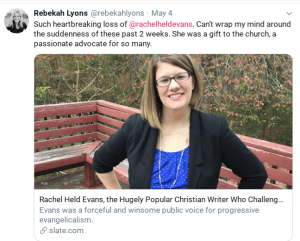
Rebekah called called Rachel Held Evans death “a heartbreaking loss,” and said of her: “She was a gift to the church, a passionate advocate for so many.” If you’re at all familiar with RHE, you know that the people she “advocated” for were female preachers, pro-abortionists, “gay Christians,” mystics, false teachers and just about anyone else who stood diametrically opposed to Scripture and biblical Christianity, while attacking doctrinally sound Christians.

Rebekah also invited Rachel Held Evans and Shauna Niequist to a “Q Focus: Women & Calling” event and participated in a panel discussion with them.

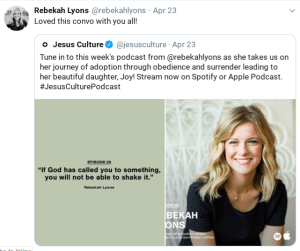
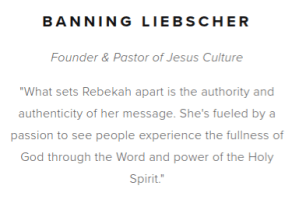
Rebekah preached the Sunday morning sermon (co-ed audience) atย Bethel’s Jesus Cultureย church“, and has appeared on the Jesus Culture podcast. An endorsement from Banning Liebscher, founder/”pastor” of Jesus Culture appears on the home page of Rebekah’s website. Rebekah has also preached the Sunday morning sermon at Bethel itself.

The few citations in this article only scratch the surface of Rebekah’s multiple relationships with false teachers and the false teaching that takes place at Q Conferences and on the Q-ideas website.

Rebekah does offer several free teaching series through her website which I would encourage you to vet if you need to critique her actual teaching. However, considering the way Q’s YouTube channel and website present only a snippet of their tamest teachings while the more in depth or controversial teachings are behind a paywall, take into account the possibility that Rebekah’s free teachings may be less theologically problematic than those you have to pay for.

But, with Rebekah so deeply saturated in ministry partnerships with some of the worst of the worst false teachers, yoking with unbelievers, promoting unbiblical teaching through Q, and preaching to men, do you really need to vet her materials to know that you and your church shouldn’t be associating with her in any way – especially using her teaching materials?