Holidays (Other), Reformation Day

A RefHERmation Day Study

Originally published October 31, 2018

Reformation Day is Friday, October 31.

This article is excerpted from my Bible study
Imperishable Beauty: A Study of Biblical Womanhood.

What better way to celebrate Reformation Day and biblical womanhood than to combine the two? Today, we’re going to take a look at some women in Reformation history and in biblical history who exemplified biblical womanhood by influencing others toward godliness.

Choose any of the women below and read their stories (click on their names). Then consider the following questions:

1. In what ways did this woman exemplify biblical womanhood in her culture, context, circumstances, family situation, or church?

2. Which godly character traits or Fruit of the Spirit were especially obvious in her life, words, and actions?

3. Which Scripture passages come to mind as you read this woman’s story? In what ways did she live these Scriptures out (or fail to live them out)?

4. Are there any instances of sin in this woman’s story? If so, how can you learn from what she did wrong and avoid this sin in your own life?

5. How does this woman set a godly example that you can apply to your own life?

6. In what ways did this woman point someone to Jesus, serve the Kingdom, or help God’s people?

Women of the Bible

Esther

Ruth

Abigail

Deborah and Jael

Miriam

Mary

Priscilla

Lydia

Dorcas

Women of the Reformation

Catherine dโ€™Bourbon

Jeanne Dโ€™Albret

Marguerite de Navarre

Katharina Schutz Zell

Anna Adlischweiler

Anna Reinhard

Katharina von Bora Luther

Marriage

Marriage: It’s My Pity Party and I’ll Cry if I Want To ~ 7 Ways to Take Your Focus Off Yourself and Put it Back on Christ

Originally published May 19, 2016

Letโ€™s face it, Ladies, there are days when even the best of marriages are just plain tough. Hubbyโ€™s in a bad mood and snaps at you.* Thereโ€™s no money in the budget for that thing you really want to buy. Youโ€™re feeling overworked, underappreciated, and beyond stressed. It can be all too easy to haul out the party hats and confetti, hunker down in the corner, and throw yourself one big โ€œwoe is meโ€ bash. Have you ever stopped to think about whether or not itโ€™s biblical to feel sorry for ourselves? Believe it or not, thereโ€™s not a single passage of Scripture that says itโ€™s OK. So what does the Bible say about how to handle those times in our marriages when we want to indulge in self pity? Letโ€™s find out.

*(This article pertains to normal, relatively healthy, Christian marriages. In other words, not abusive marriages. If you are being abused, get yourself and your children to a safe place, and call the police, your pastor, or a loved one for help.)

Have you ever stopped to think about whether or not itโ€™s biblical to feel sorry for ourselves? Believe it or not, thereโ€™s not a single passage of Scripture that says itโ€™s OK. So what does the Bible say?

1.
Have the mind of Christ

But we have the mind of Christ. 1 Corinthians 2:16

take every thought captive to obey Christ. 2 Corinthians 10:5

be conformed to the image of his Son, Romans 8:29

As Christians, Christ is to be the master of everything we are, not just our words and actions, but our thoughts and feelings as well. We are to act like Jesus, talk like Jesus, think like Jesus, and even feel like Jesus. Punished and executed for sins He did not commit, โ€œHe was despised and rejected by men; a man of sorrows, and acquainted with grief.โ€(Isaiah 53:3) Jesus had much more reason than you or I to feel sorry for Himself, but did He? Then, should we?

As Christians, Christ is to be the master of everything we are, not just our words and actions, but our thoughts and feelings as well.

2.
Have the attitude of Christ

Have this mind among yourselves, which is yours in Christ Jesus, who, though he was in the form of God, did not count equality with God a thing to be grasped, Philippians 2:5-6

When we follow Christ, we adopt the same attitude towards others He had. Jesus was prepared for the fact that people He loved and served, even those closest to Him, would let Him down. Still, He loved them and forgave them. Your husband is a broken, sinful human being (just like you). Heโ€™s going to mess up. A lot (just like you). Being prepared for, and accepting that fact (along with a healthy understanding of how many times youโ€™re going to let him down) can help put things into perspective.

but emptied himself, by taking the form of a servant, being born in the likeness of men. Philippians 2:7

Jesus put aside all of His rights to be served and esteemed and, instead, focused on serving others – even those who didnโ€™t deserve it and were ungrateful. Instead of retreating into hurt the next time your husband blows it, what if you took a deep breath, put your rights aside, and did something to lovingly serve him?

Instead of retreating into hurt the next time your husband blows it, what if you took a deep breath, put your rights aside, and did something to lovingly serve him?

And being found in human form, he humbled himself by becoming obedient to the point of death, even death on a cross. Philippians 2:8

Jesus humbled Himself. He was so focused on obedience to God that He gladly gave up His life for people who hated Him. Often, our obedience only takes us to the edge of where weโ€™re comfortable. What kind of impact would it have on your marriage if you had the same level of humility and obedience Christ had? How could that humility and obedience to Christ help ward off self pity?

Often, our obedience only takes us to the edge of where weโ€™re comfortable. What kind of impact would it have on your marriage if you had the same level of humility and obedience Christ had?

3.
Give thanks

give thanks in all circumstances; for this is the will of God in Christ Jesus for you. 1 Thessalonians 5:18

It is not Godโ€™s will for you to feel sorry for yourself. It is Godโ€™s will for you to give thanks in all circumstances, including a lousy day in your marriage. If you canโ€™t think of anything to be thankful for, tell that to God, and ask Him to show you things about your husband that you can thank Him for. Even if you have to start with the small things (Does he have good breath? Tie his shoes neatly? Floss semi-weekly?), start somewhere. Youโ€™ll be amazed at the way your perspective shifts from the negative to the positive as you thank God for your husbandโ€™s good qualities.

Youโ€™ll be amazed at the way your perspective shifts from the negative to the positive as you thank God for your husbandโ€™s good qualities.

4.
Be content

Not that I am speaking of being in need, for I have learned in whatever situation I am to be content. Philippians 4:11

Whatever situation. Ever read about Paulโ€™s little โ€œwhatever situationsโ€? You can find some of them in 2 Corinthians 11:23-28. Iโ€™m guessing youโ€™ve never been shipwrecked or stoned, not to mention all the other things on his list, which, by the way, Paul wrote while he was in prison. Yet he said he had learned to be content. How? Paul found his contentment, not in his circumstances, but in Christ. Jerry McGuire not witstanding, your husband does not, will not, and cannot โ€œcomplete you.โ€ Only Christ can satisfy the deepest needs of your heart. When you lay hold of that, you will find true contentment. Your husband will let you down. Christ never will.

Your husband does not, will not, and cannot โ€œcomplete you.โ€ Only Christ can satisfy the deepest needs of your heart. Your husband will let you down. Christ never will.

5.
Rejoice in suffering

Not only that, but we rejoice in our sufferings, knowing that suffering produces endurance, and endurance produces character, and character produces hope, and hope does not put us to shame, because Godโ€™s love has been poured into our hearts through the Holy Spirit who has been given to us. Romans 5:2-4

God wants to do something greater in you than just make you feel better in the moment. He has long range plans to grow you in endurance, character, and hope. Thatโ€™s great news, and certainly cause for joy. So instead of directing your gaze inward, look down the road to where youโ€™re more mature in Christ, and rejoice. God is at work on your heart. (And P.S.- Rejoicing will make you feel better in the moment, too. Pitying yourself will only make you feel worse.)

God wants to do something greater in you than just make you feel better in the moment.

6.
Put yourself aside and put your husband first

Do nothing from selfish ambition or conceit, but in humility count others more significant than yourselves. Let each of you look not only to his own interests, but also to the interests of others. Philippians 2:3-4

Thereโ€™s that H-word again. Humility. When I read this passage, I think back to the story of Jesus washing the disciplesโ€™ feet. The One to whom every knee will one day bow got down on His hands and knees and took on the disgusting task that normally fell to the lowest, least talented servant. If the God of the universe could put ahead of Himself these men whom He personally knit together in the womb, who would, in mere hours, deny and desert Him at the darkest time of His life, is He asking too much of us to put our husbands ahead of our hurt feelings?

7.
Change your husband by changing your behavior

Likewise, wives, be subject to your own husbands, so that even if some do not obey the word, they may be won without a word by the conduct of their wives, when they see your respectful and pure conduct. 1 Peter 3:1-2

It seems counterintuitive. โ€œIs your husband being an ungodly jerk? Donโ€™t nag him or pout about it; submit to him with respectful and pure conduct.โ€ The world would call this weakness and say youโ€™re being a doormat. Quite the contrary. If youโ€™ve ever tried putting this passage into practice, you know just how much strength it takes to do the godly thing when everything in you wants to strike back or retreat in self pity. To realize that, regardless of how your husband acts, you are responsible to God to do what is right in His eyes. But Godโ€™s word is full of paradoxes and counterintuitives. The question is, do we believe God when He says this is the way to win our husbands to godliness, and do we trust Him enough to obey His word?

Regardless of how your husband acts, you are responsible to God to do what is right in His eyes.

Being a Christian wife pursuing growth in godliness is tough. It can seem impossible to forge ahead in obedience to Christ on those difficult days in your marriage when all you really want to do is retreat into that corner and whimper. But you have a Savior who understands your weaknesses,  loves and cares for you deeply,  and promises to give you the strength you need to do anything He calls you to.

Even the strength to take off the hat, sweep up the confetti, and say, โ€œThe partyโ€™s over.”

Holidays (Other), Parenting

Beautiful Motherhood: A Mother’s Day Bible Study

As we look ahead to Mother’s Day,
let’s check out what the Bible has to say about mothering.
This is lesson 12 of my topical Bible study:

Imperishable Beauty- A Study of Biblical Womanhood.

Read These Selected Scriptures

Questions to Consider

1. What are some attributes or character traits of a godly mother from Proverbs 31 that we can emulate? In todayโ€™s lesson, rather than attributes to emulate, weโ€™ll be focusing on Godโ€™s instructions to obey for mothers. We’ll examine how we’re to regard motherhood and our children, how we’re to train our children in godliness, how we’re to discipline our children out of ungodliness, and the example we’re to set for our children. Some of these instructions can also apply to childless women in their relationships with their spiritual children (i.e. younger women or children they disciple) and others. As you read over todayโ€™s passages, explain how childless women might apply some of these Scriptures.

2. Examine the first three passages (Psalm 127-Titus 2) together. What do these passages say about how we are to regard motherhood and our children? What should the attitude of our hearts be? In what sense are children a reward? How do we know that Psalm 127:3 does not mean that if you act in a way that pleases the Lord He will reward your good behavior with children? What does this verse mean? Is loving your children (Titus 2:4) simply a feeling of affection toward them? If so, why would young women need to be trained to love their children? When you finish today’s lesson, come back to Titus 2:4 and give a fully-orbed biblical definition of what it means to love your children.

3. Examine the next five passages (Proverbs 22-Ephesians 6) together. Why does God want us to train our children in godliness? Explain the phrase “in the way he should go” (Proverbs 22:6). How does the gospel figure in to training your child? Look carefully at the three Old Testament passages. At what age should we begin training our children in godliness and the Scriptures and how long should this training continue? Is Proverbs 22:6 an iron-clad guarantee or promise from God that if we raise our children in a godly home they will definitely get saved and turn out to be godly adults? Why not? (Scroll down to the Deuteronomy 21 passage if you need help.)

To whom are the Colossians and Ephesians verses addressed? Does this mean they don’t apply to mothers or that it’s OK for mothers to provoke their children, but not fathers? If they apply to both parents, why are they addressed to fathers? How are we not to deal with our children according to these verses? What does it mean to provoke your children? Why are we not to provoke them (Colossians), and how are we to deal with them instead (Ephesians)? Compare Ephesians 6:4b to the Old Testament verses in this section. How are they similar?

3. Examine the next three passages (Proverbs 29-Deuteronomy 21) together. What is the purpose of godly discipline? What are the biblical definitions of the words “discipline” and “reproof”? Are discipline, reproof, and training the same as punishment? Why or why not? What are some of the consequences of disciplining your child? The consequences of refusing to discipline your child? According to Proverbs 13:24, what motivates someone to discipline her child? What motivates someone to refuse to discipline her child? Are “love” and “hate” simply emotional feelings in this verse or an attitude, posture, or orientation of mindset toward the child? Look closely at Deuteronomy 21:20. Is this passage most likely talking about a very young child or an older child/teenager? According to the Deuteronomy 21 passage, does godly discipline always result in an obedient son or daughter, or can there be exceptions to the rule?

Why is it important to both train your child in godly ways and discipline him out of ungodly ways? Explain how this fits into the “put off the ungodly, put on the godlymodel of biblical sanctification.

4. Examine the last five passages (Deuteronomy 21-Matthew 10) together. What do these passages teach us about the godly example we need to set for our children?

Sometimes we see implicit instructions to parents in passages that explicitly teach children how to treat and regard their parents. For example, if there were a verse that said, “Children, love your parents,” we could learn from that verse that we need to act in a way (lovable) that makes it easier for our children to obey that Scripture. Considering this concept, look at the Exodus 20 and Proverbs 1 passages. If your children are to honor you, in what manner should you behave? What should your teaching be like if your children are not to forsake it and to consider it a “graceful garland” and a “pendant”?

What is the context of Ezekiel 16? To whom is the parent/child metaphor in this  passage addressed? Explain the phrase “like mother, like daughter”. Why is it important to set a good example for our children with our own behavior, and why was this a good metaphor for God to use in addressing Israel’s unfaithfulness to Him?

Examine the Deuteronomy 21 and Matthew 10 passages together. What is to be a mother’s highest priority – her relationship with her child, even the life of her child, or her love for, obedience to, and loyalty to Christ? Do you love Christ more than your child? If you had to choose between your child and Christ, who would you choose? What message does it send to our children when we show and tell them that we love Christ more than we love them? How can you demonstrate to your child that your highest love and loyalty is reserved for Christ?


Homework

Examine each of the instructions in Deuteronomy 6:6-9. Make a list of practical ways your family could put each of these instructions into practice and discuss it with your husband. Together, pick one of these practices and implement it with your children this week.


Suggested Memory Verse

Complementarianism

Throwback Thursday ~ Putting on the “You Can!” of Complementarianism

Originally published October 18, 2019

It never really hit me until I started teaching the book of 1 Timothy how many instructions in the pastoral epistles pertain to women, and how weighty those instructions are. The pastoral epistles are the โ€œpolicy and procedure manualsโ€ for the church, and, far from relegating the ministry of women to nothing more than crafts and tea parties while the men do all the โ€œimportantโ€ stuff, you come away with the impression that a healthy, well-balanced church actually depends on godly women working hard to carry out the ministries that God has uniquely created and gifted us to fulfill, alongside men fulfilling their own ministries.

These epistles donโ€™t view โ€œwomanโ€™s workโ€ around the house of God as trivial or menial, but as a high and holy calling. Vital. Necessary. Honorable.

But is that the lofty perspective of the biblical role of women that the local complementarian church is conveying to its female and male members? Are we, especially those of us in womenโ€™s ministry, proactively teaching that the calling of motherhood or the task of discipling other women or serving those in need is qualitatively just as imperative and noble as the calling of pastor or elder?

Intentionally or not, the egalitarian movement has maneuvered biblical complementarians into constantly playing defense. Their offensive squad keeps moving the ball forward by offering women a no holds barred buffet of powerful and prestigious ministry positions. Our defensive line correctly and biblically pushes back with, โ€œNo, the Bible says women are not to โ€˜teach or to exercise authority over a manโ€™  in the church setting.โ€ But often, only two or three members of our offensive squad are dressed out to play, and they never get off the bench and into the game. And as any football fan knows, you have to have a good defense and a good offense if youโ€™re playing to win.

Egalitarians offer women โ€œyou can,โ€ but all too often all we complementarians have offered godly women yearning to serve is, โ€œyou canโ€™t.โ€ Where is the big, beautiful, biblical showcase of complementarian โ€œyou canโ€?

Not long ago, I was teaching a group of ladies the biblical process of putting off the old self and putting on the new self in Ephesians 4:20-32. We explored how interesting it was that every โ€œdonโ€™tโ€ in the passage was coupled with a โ€œdo.โ€ We donโ€™t just put off lying, we put on proactive truth-telling instead, and so on. Nature abhors a vacuum in the physical realm, and it would seem this is true in the spiritual realm as well. When we subtract the ungodly, we must replace it with the godly. If we donโ€™t, something will rush in to fill the void thatโ€™s been created, and that “something” isnโ€™t usually biblical or fruitful. 

So how can we shift the perspective in our churches from โ€œyou canโ€™tโ€ to โ€œyou can,โ€ and create an atmosphere, not merely of โ€œput off,โ€ but also โ€œput onโ€? How can we get our offensive team suited up, on the field, and moving the ball toward the goalpost while at the same time retaining a strong defense?

We can, so to speak, make complementarianism great again. 

As I studied 1 Timothy 5, I was struck by Paulโ€™s description of women who are โ€œtruly widows.โ€ These are women who have spent their lives being busy and intentional about the work of the Lord in their homes and in the church. They adorned themselves with the good works proper for women who profess godliness, and they were honored and revered for it by the church. I didnโ€™t come away from this passage with the feeling that these women were frustrated, oppressed, or seen as โ€œlesserโ€ by the church because they werenโ€™t allowed to teach or exercise authority over men. I came away from this passage thinking, โ€œThose women were awesome. Thatโ€™s the kind of woman I want to be.โ€

What would the climate in our churches look like if womenโ€™s ministries and the church at large recaptured that same reverential posture and purposefulness toward biblical womanhood? If, instead of teaching the biblical role of women strictly as, โ€œYou canโ€™t eat the fruit from this apple tree,โ€ we followed that admonition with a grand tour of the Garden, focusing on the delicious fruit of the pear tree, the cherry tree that needs a good pruning, the fig tree just waiting for the right woman to come along, harvest its fruit, and make some preserves, the banana tree that needs an expert in fertilizers, and the orange tree dying for someone to water it?

In my experience, what happens in churches of that climate is that – just like the godly widows of 1 Timothy 5 – women are so busy and fulfilled tending the other trees of the Garden, that they have neither the time nor the desire to go apple picking. 

May our churches strengthen themselves and grow to more robust spiritual health by proactively encouraging Christian women to joyfully throw ourselves into the godly โ€œgood works which God prepared beforehand, that we should walk in themโ€ – the biblical โ€œyou canโ€ of complementarianism.


Additional Resources

Rock Your Role: Jill in the Pulpit

Let Me Count the Ways: 75 Ways Women Can Biblically Minister to Others

Unforbidden Fruits: 3 Ways Women MUST Lead and Teach the Church

Servanthood

The Servanthood Survey

Christian women

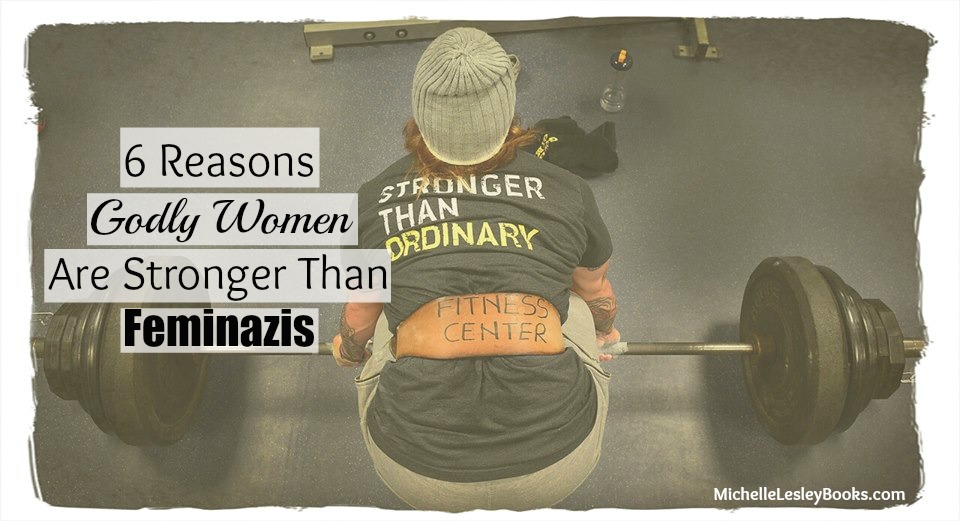
Throwback Thursday ~ 6 Reasons Godly Women are Stronger Than Feminazis

Originally published June 12, 2015

feminazis

Gloria Steinem. Bra burning. The ERA. “I Am Woman Hear Me Roar.” Maybe you remember them, or have at least heard of them. That was the heyday of feminism. It was going to be a new era of strong, powerful women. And they’re still fighting the battle today. Never let a man get the upper hand. Sacrifice whatever you have to for a successful career. And Christian women who submit to their husbands or choose to stay home with their children are sneered at or dismissed as weak, barefoot and pregnant ignoramuses.

But as any woman brave enough to follow in the footsteps of Christ can tell you, it ain’t necessarily so. Secular feminists will never understand the kind of strength it takes to strive towards godly womanhood.1

1. Only the strongest of women can voluntarily relinquish the right to be in control.

It’s easy (at least for decisive, type A control-freaks like me) to walk into a room assess a situation, lay down the law, and expect your instructions to be carried out. It’s much harder to step back and hand off the decision-making to your husband, or to offer your input and stand aside and watch when he decides not to follow it. But God expects us to follow in the footsteps of our Savior, who voluntarily surrendered control of His very life to the men who took it from Him.

2. It takes a strong woman to trust God enough to put her life and her children’s lives into her husband’s hands.

Let’s just get real here for a minute. It can be hard to trust God sometimes. Even though we know He is perfect and has our best interests at heart, we can’t see Him or touch Him. We can’t ask Him a question and get an audible yes or no answer.

It can be even harder to trust our husbands. Even though we can see, hear, touch, and talk to them, we know all too well that they’re fallible. Sometimes they have their own interests at heart. Sometimes they mean well and still make the wrong decisions.

But God tells us to trust Him. Even when it’s hard. Even when we don’t understand what’s going on. Even when we think we could lead better than our husbands. We trust God enough to obey His word even when.

3. It takes tremendous strength to control our mouths.

James tells us “no human being can tame the tongue,” and all who have tried know how true that statement is. Still, God expects godly women to control our speech. We’re not to nag and be quarrelsome. We’re to speak wisely and kindly. Sometimes, we’re not to speak at all, but let our actions do the talking. The strength to bite your tongue or think before you speak? It’s a daily trial by fire for Christian women.

4. Godly women have to be incredibly strong to deal with the heartaches that come our way.

John once said, “I have no greater joy than to hear that my children are walking in the truth.” (3 John 4). While he was talking about his spiritual “children,” godly wives and mothers have that same joy when our husbands, children and loved ones are walking in the truth of the gospel. And unspeakable agony when they are not. We not only have to cope with the regular griefs of life that everyone experiences, we also must deal with the pain of those closest to us who rebel against Christ and His word, all the while trusting God and walking in His ways.

5. We must develop the godly strength it takes to stand against the culture.

It’s easy to do the godly thing when everybody’s rooting for you, but in a society that is openly hostile to biblical womanhood, we often (sadly, even in the church) find ourselves fighting our way upstream like so many spawning salmon. Many times, we are seen as – and called – doormats, uneducated, gullible, traitors to the cause of women’s rights. We must rely on the strength God has promised us to stand for godliness in the face of opposition.

6. Only strong, godly women can joyfully deny self and serve rather than being served.

In a “because you’re worth it” world, putting our own desires aside to serve our husbands, children, and others is utterly incomprehensible to many, and, often, even to ourselves. The flesh rears its ugly head again and again, demanding to have its every wish fulfilled by the very people God put us here to serve. It takes a mighty woman of God to do battle with that enemy, send it packing, humble herself, and tend to the needs of others. But we have been bought by the blood of a Savior who declared that He “came not to be served but to serve,” and we conform to His wishes, not our own.

They can push and nag and argue and boss and control. They can be soldiers, construction workers, CEOs, and President. They can wear the pants in their families and have cowed husbands. But the shrillest of feminazis will never know the strength it takes to be a godly woman, because what they’re attempting is miniscule compared to the high standard God calls His daughters to. And any fleshly strength they can conjure up couldn’t in a million eternities touch the supernatural, mighty, rushing force that is the power of the Holy Spirit which God promises to His own, enabling us to say, “I can do all things through him who strengthens me.”

God doesn’t call us to have dominance over men, He calls us to become like a man, the God-man, Jesus Christ. And in our feebleness and brokenness, He gives us the power to attempt that feat of greatness for His glory. That, my sisters, is where real strength lies.


1As always in my articles which mention biblical submission in marriage, my standard caveat: Please understand that this article applies to the vast majority of reasonably healthy marriages. Biblical submission has nothing to do with allowing yourself to be abused. If you are being abused please get yourself and your children somewhere safe immediately and call your pastor, the police, and/or anyone else who can help.