I do it all the time, Mother, and I’ve decided something-
it’s not a sin.
I heard this line several years ago on a popular sitcom, spoken by an adult daughter to her Christian mother about a behavior the Bible unambiguously calls a sin. I mean, it’s right smack dab in the middle of the Big 10; “thou shalt not” and everything.
It’s one thing to say, “I know it’s a sin, but I don’t care. I’m going to do it anyway,” but how depraved is the world when they think they – in God’s place – are the ones who get to define what sin is? And what’s even worse is that the church has begun to adopt this audacious depravity as well, whether approving of sin by fiat or by simply ignoring God’s word and letting sin slide without rebuke.
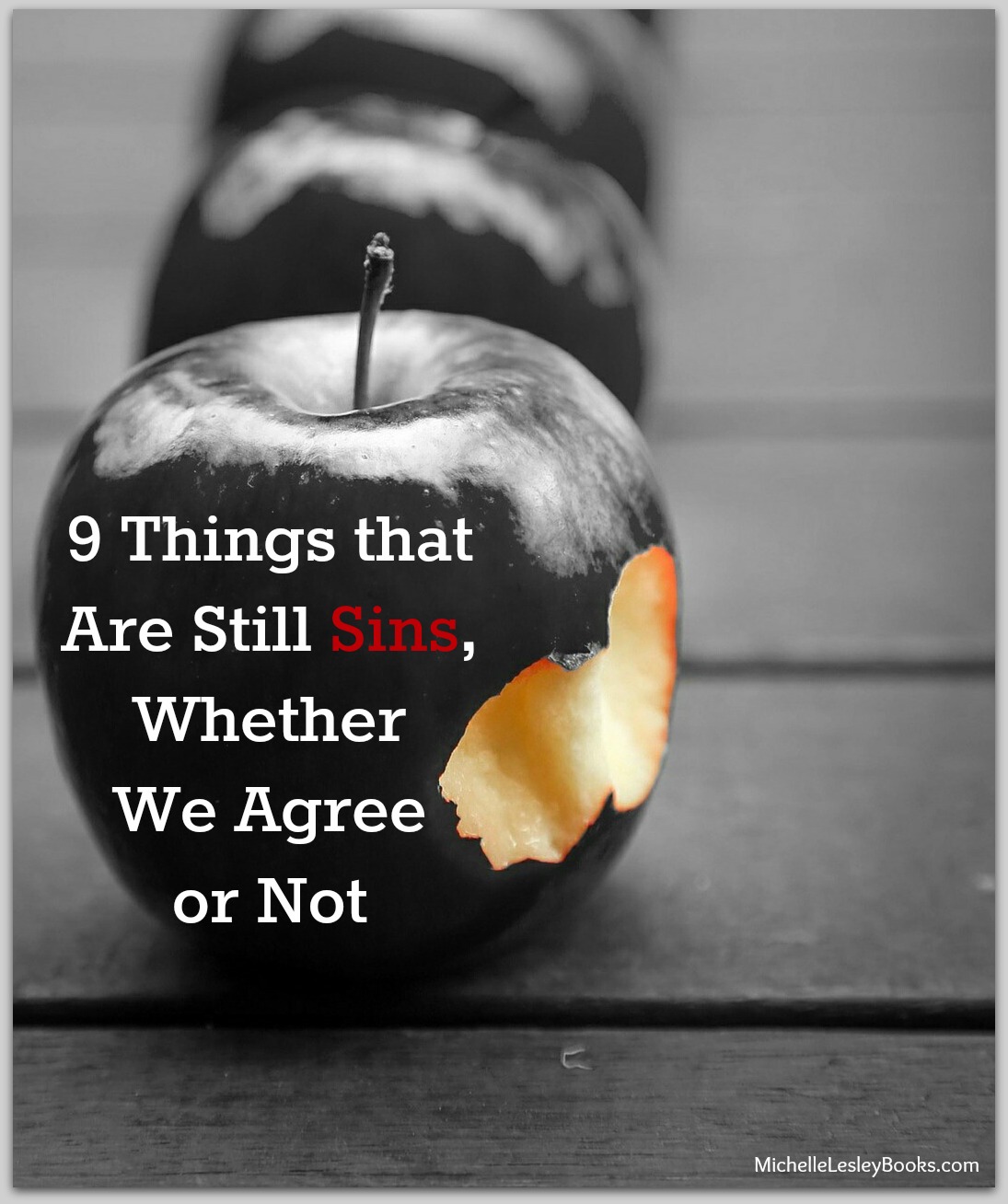
When it comes to what’s a sin and what’s not, God made up His mind a long time ago. And He’s not changing it, regardless of what you or I or Joe Politician or Jane Celebrity might think. Maybe we all need a remedial course in hamartiology, so let’s start with the basics. These things are all still sins whether the world and the church agree with God or not:
1. Homosexuality
Let’s just get it out of the way right up front. I don’t care how many celebrity “pastors” and “Christian” authors twist God’s word to say otherwise, or how many people declare themselves to be (unrepentant, practicing) “gay Christians,” or how many homosexuals declare that God made them that way, God’s word is clear: homosexual lust and behavior are sins.
2. Abortion
Abortion is the taking of an innocent human life. We don’t murder people because they’re small or sick or inconvenient or will hinder our sucess. God didn’t say, “You shall not murder, except when…” He said, “You shall not murder.” Period.
3. Extra-Marital (Heterosexual) Sex
Adultery, fornication, whatever form it might take, if you’re not legally married to the person you’re engaging in sexual activity – up to and including actual intercourse – with, you’re sinning.
4. Cohabitation
See #3. And don’t try to whitewash it by saying you’re living together but not sleeping together. A) The Bible says we’re to flee temptation, not move in with it, and B) we’re supposed to avoid every form of evil, even the appearance of it. If you call yourself a Christian and you’re shacking up, you’re living in sin (that’s why they call it “living in sin”). Repent and move out or marry up.
5. Divorce
Yep, still a sin, except in two cases: unfaithfulness or an unsaved spouse leaving a saved spouse. In those two cases the spouse who was wronged is not sinning and is free to marry again.
6. Swearing
The air is saturated with it. Foul language coming from our TVs, music, movies, social media, and the people we’re around all day. But expletives have no place in the vocabulary of a Christian. Is your potty mouth on Saturday the same one you praise God with on Sunday?
7. Taking God’s Name in Vain
It’s gotten to the point where we think so little of casually punctuating our sentences with, “Oh my G-d,” or using the name of Jesus as an exclamation that pastors are even doing so from the pulpit these days. God’s name is high and holy and should be spoken only reverently and worshipfully. How can we look people in the eye and call them to repentance and faith in a Person whose name we use as a cuss word?
8. Gluttony
We have almost completely amputated gluttony from the spiritual realm by cordoning it off as merely a physical or medical issue. We’ve renamed it “overeating,” but that doesn’t change the fact that it’s a sin. God created good food for us to enjoy, but just as with all the other good gifts He gives us, He expects us to exercise Spirit-enabled self control when we receive it.
9. Female Usurpation
God makes it abundantly clear in His word that women are not to instruct men in the Scriptures or hold authority over them in the church. Women sin when they pastor churches, preach sermons in church, teach men in Sunday School classes, and hold other positions of authority over men in the church. Men, however, bear the primarily responsibility for this when they sin by failing to rebuke usurping women, or when women feel they have no other choice but to take on male responsibilities in the church because men are shirking their own duties before God.
We don’t get to decide what sin is. That’s God’s job. And all of us – whether we’ve committed one of these nine sins or not – are guilty of sinning against Him. That’s the bad news.
But, in Christianity, we never give the bad news without following it up with the good news. And, oh what wonderfully good news it is: forgiveness. Jesus paid for our sin at Calvary so that if we will only turn from it and trust Him, He will forgive us for all nine of these sins and countless others.
If we confess our sins, he is faithful and just to forgive us our sins and to cleanse us from all unrighteousness. 1 John 1:9
Forgiving (or refusing to forgive) others as it relates to our salvation is such an important issue. I’m so glad you asked!
Let’s break this question down a bit.
Can you lose your salvation?
The first thing we need to tackle is whether or not someone whom Christ has genuinely saved can lose her salvation – for unforgiveness or any other reason. And the answer to that question is no.
Why? The short answer is that if God saves someone, and that person can subsequently “unsave” herself, that makes her more powerful than God, which, as we know, can’t happen. You can’t save yourself, and you can’t unsave yourself. Salvation is all of God.
You can’t save yourself, and you can’t unsave yourself. Salvation is all of God.
When God saves you, you are His new creation in Christ. You can’t “uncreate” your new spiritual life any more than you can “uncreate” your body, or a tree, or a planet. You can kill or do damage to those things, but you cannot reverse God’s creative process. To use another example, oh so relevant to today, God created you female. You can mutilate your body til kingdom come trying to appear male, but that will not change the fact that at your genetic level – the very essence of your being – you are female. And you can’t undo that because God created you that way, and you’re not more powerful than God. If you can’t even change God’s creation of your physical body, how in the world can you change God’s creation of your spiritual being?
The moment God saves you, He forgives all your sins, past, present, and future, and robes you in the righteousness of Christ.
In addition to the fact that you can’t uncreate the new creature God has created you to be, you need to remember that the moment God saves you, He forgives all your sins, past, present, and future, and robes you in the righteousness of Christ. That swear word you’re going to say next week? Already forgiven. That lie you’re going to tell five years from now? Already forgiven. And if you decide to commit the sin of refusing to forgive someone, that sin has already been forgiven too. (So since all our sins are already forgiven, we can just commit as much sin as we want and we don’t have to worry about it, right? Wrong.) We still need to confess those sins to God and be cleansed from them because they disrupt our fellowship with God, but in His accounting office, that sin debt has already been marked “paid in full”.
Furthermore, Jesus tells us plainly that if He’s got you, He’s got you:
My sheep hear my voice, and I know them, and they follow me. I give them eternal life, and they will never perish, and no one will snatch them out of my hand. My Father, who has given them to me, is greater than all, and no one is able to snatch them out of the Father’s hand. I and the Father are one.”
No one. That includes you and your sin. The power of your sin is not greater than God’s power to forgive that sin.
The power of your sin is not greater than God’s power to forgive that sin.
They will never perish. To say that a person about which Jesus Himself has said, “I give them eternal life,” can lose her salvation is to call Jesus a liar. He says that person “will never perish.” End of story.
Still not convinced that someone whom Christ has genuinely saved can’t lose her salvation? Try these passages on for size.
Now the reason it can look to us like someone can lose her salvation comes from two places: experience and misunderstanding the Bible.
The reason it can look to us like someone can lose her salvation comes from two places: experience and misunderstanding the Bible.
Experience: It’s happened plenty of times in the past, but in the last few weeks, we’ve seen two high profile evangelicals “walk away from the faith,”: Joshua Harris and Marty Sampson. Maybe you know someone personally – a friend, a loved one, even a pastor – who gave every appearance of being a Christian and then suddenly left Christianity, and the church, behind.
How does this compute when the Bible teaches that genuinely born again Christians cannot lose their salvation? Well, we need to remember something else the Bible teaches that’s very important:
Not everyone who claims to be a Christian actually is one.
Some people consciously know they’re not really saved and are just trying to pull the wool over the eyes of others. But many (my guess is “most” – these days there’s not a lot of social cachet in calling yourself a Christian) are deceived into believing they’re saved. Maybe they heard some sort of unbiblical gospel presentation and have put their faith in a decision they made in response. Maybe they just assume they’re saved because they’re good church-going people and their church doesn’t teach them otherwise. Who knows? It could be a lot of things. But we know for sure that there are many people who call themselves Christians and believe they are Christians who aren’t. Why? Because the Bible says so:
“Not everyone who says to me, ‘Lord, Lord,’ will enter the kingdom of heaven, but the one who does the will of my Father who is in heaven. On that day many will say to me, ‘Lord, Lord, did we not prophesy in your name, and cast out demons in your name, and do many mighty works in your name?’ And then will I declare to them, ‘I never knew you; depart from me, you workers of lawlessness.’ Matthew 7:21-23
“Many will say”…False converts are common, not few and far between. And it’s not just your average Joe or Jane in the pew, either. People who “prophesy…cast out demons…do mighty works” under the auspices of Christianity? They’re pastors, elders, deacons, Bible study teachers, seminary professors, “Christian” authors, evangelical celebrities. And Christ does not know them, because they don’t know Him. They talk the talk, and might even look like they walk the walk, but they’ve never truly believed the biblical gospel, repented of their sin, and trusted the Jesus of Scripture to save them. First John 2:18-19 puts it this way:
Children, it is the last hour, and as you have heard that antichrist is coming, so now many antichrists have come. Therefore we know that it is the last hour. They went out from us, but they were not of us; for if they had been of us, they would have continued with us.
People whom Jesus has genuinely saved may fall into sin for a season, but they do not fall away from the faith. Those who leave the faith were never part of it in the first place, despite appearances or their claims to the contrary. It might be difficult, but this is one of those occasions when we have to believe what Scripture says over what we can see.
Those who leave the faith were never part of it in the first place, despite appearances or their claims to the contrary.
Jesus also tells us in the parable of the sower that there will be be “rocky ground” folks who will appear to be Christians, but because they have no root, they “endure for a while, and when tribulation or persecution arises on account of the word, immediately they fall away.” Jesus follows up this parable with the parable of the wheat and tares which further drives home His point that there will be impostors in the visible church.
So even though we observe people who appear to be Christians “falling away from the faith,” through unforgiveness or any other sin, we know that what’s really happening is that a lost person got tired of pretending to be saved and went back to being a lost person. Second Peter 2:22 puts it this way:
What the true proverb says has happened to them: “The dog returns to its own vomit, and the sow, after washing herself, returns to wallow in the mire.”
If Christ has never fundamentally changed your spiritual nature from dog or pig into a new creature in Christ, you’re still a dog or a pig. And even if you manage to clean up on the outside you’ll eventually return to the vomit of being a dog and the mud of being a pig because that’s your nature.
Misunderstood Scripture There are passages in the Bible that, when misunderstood, when taken out of their immediate context, or when taken out of the overall context of Scripture can seem to teach that a person can lose her salvation. But as we’ve seen, there are way too many rightly handled, in context passages of Scripture that refute that idea.
Can you lose your salvation by refusing to forgive someone?
You mentioned in your original question that you believe unforgiveness can cause someone to lose her salvation because, “It is so clear in so many ways in Scripture, even parables that Jesus told.” But, you did not mention any of the Scriptures you think teach this. My guess is that one of the Scriptures you’re thinking of is Matthew 6:14-15:
For if you forgive others their trespasses, your heavenly Father will also forgive you, but if you do not forgive others their trespasses, neither will your Father forgive your trespasses.
In context, we can see that these two verses come at the end of the Lord’s Prayer. In verse 12, Jesus has just taught us to pray that God would “forgive us our debts, as we also have forgiven our debtors,” and He’s giving us a little addendum on this in 14-15.
Remember, even though all our sins from birth to death were forgiven at the moment of our salvation, we still need to confess our sins in prayer and ask God to cleanse us from our wrongdoing to bring us back into right fellowship with Him. But if you’re willfully in the middle of committing the sin of unforgiveness against someone, you’re still actively sinning. You haven’t turned from that sin in order to be cleansed. You’re essentially rolling around in the mud and asking God to cleanse you while you have no intention of getting out of the mud. How is that supposed to work? It doesn’t make any sense. If you want to get cleaned up (“forgiven”), you have to get out of the mud (stop committing the sin of unforgiveness – “forgive”). Otherwise, you’re asking God to restore the fellowship you’re still actively damaging with your sin.
Another passage you might be thinking of is the parable of the unforgiving servant. The takeaway from this passage is not that God will rescind the salvation of Christians who commit the sin of unforgiveness. This passage doesn’t say that and we already know that idea conflicts with what Scripture teaches about the security of the Believer.
The takeaway from this passage is that God has forgiven us a sin debt that is incomprehensible. Knowing and having experienced that forgiveness, how could we not forgive some paltry little sin another human commits against us? First John 4:19 says, “We love because He first loved us,” and the way He loved us was to forgive us our sin. So we also forgive because He first forgave us. And if we can giddily and unrepentantly harbor unforgiveness in our hearts against someone else, we’d better start testing ourselves against Scripture to see if we’re really in the faith. Because that kind of unforgiveness is not the fruit of a redeemed life, it’s the fruit of someone who’s unsaved.
No, a genuinely regenerated Christian cannot lose her salvation by committing the sin of unforgiveness. But if she is genuinely regenerated, she will repent of that sin and forgive.
A genuinely regenerated Christian cannot lose her salvation by committing the sin of unforgiveness. But if she *is* genuinely regenerated, she will repent of that sin and forgive.
If you have a question about: a Bible passage, an aspect of theology, a current issue in Christianity, or how to biblically handle a family, life, or church situation, comment below (I’ll hold all questions in queue {unpublished} for a future edition of The Mailbag) or send me an e-mail or private message. If your question is chosen for publication, your anonymity will be protected.
A couple of months ago, I “beta tested” a new feature here at the blog, which I alliteratively titled Random Ramblings, Ruminations, and Resources. People seemed to like it … or … at least the majority of readers didn’t seem to hate it too much. So I decided to bring it back every once in a while when I’m feelin’ it.
I’m feelin’ it today. Buckle up, Buttercup.
I’m Sorry…
I need to kick things off with an apology. God has graciously seen fit to convict me that my tone has been too harsh in some of my articles recently, particularly in the first part of this article. If you’ve ever been offended or hurt by the tone of that or any of my other articles or remarks I’ve made on social media, I wanted to say I’m sorry and to humbly ask your forgiveness.
And even if you weren’t offended or hurt, I know where my heart was as I was writing that article and the tweet it was based on, and I know it wasn’t right. I failed to exercise self-control and selfishly spewed my emotions in a way that was designed only to vent my own frustration and get it out of my system (which was pretty hypocritical since I was writing that we shouldn’t be slaves to our feelings!). I wasn’t even thinking about how a new Christian, someone going through a difficult time, or someone weak in the faith might have taken the tone in which I was saying those things. Romans 15:1 says:
We who are strong have an obligation to bear with the failings of the weak, and not to please ourselves.
Well, I don’t consider myself all that strong, but I guess each of us is stronger in the faith or in a stronger position of life circumstances than somebody. And for those who are weaker in the faith than I am, or walking through a time of pain or discouragement, I did the exact opposite of what this verse says to do. I pleased myself at your expense, and that’s not what someone who serves you in the name of Christ is supposed to do. So, again, my deepest apologies and I hope you’ll be able to forgive me.
If you’re so inclined, I would like to ask you to pray for me about this. Tone is an extremely difficult and confusing sea to navigate, at least for me (that’s one of the many areas in which I’m weak). It is important to speak biblical truth firmly, unequivocally, and unapologetically, but some Christians see that, in and of itself, as being harsh. It’s also important to demonstrate gentleness, kindness, and compassion, but other Christians see that as being wishy-washy or not standing firm on Scripture. I have written articles to which some have responded that I was too harsh and others have responded that I wasn’t harsh enough – to the same article! Add to that the fact that Jesus, Paul, and others in Scripture sometimes used phraseology that we would consider very harsh today…..but yet Paul says, “Imitate me as I imitate Christ.” And, add to that that there are different expectations in the evangelical mind of how women are to address things versus how men are to address things, and you can see what a fine and perplexing line it can be to walk. But I really, really want to get it right in God’s eyes, because I want to please Him.
I can’t promise my tone will never offend you again. That would be foolish. I have over 11,000 blog subscribers and over 10,000 social media followers. Everything I write is going to offend somebody, even if I don’t mean it to. Also, I know my heart, so I know I’m going to sin again by being selfish and uncontrolled. Furthermore, I can’t attempt to please everyone. That’s not only an exercise in futility, it’s unbiblical. What I can tell you is that I will do my best to think more about how I’m coming across, edit more to keep my own words, approach, and personality from becoming a stumbling block, and pray more as I write, asking God to grow me in wisdom and self-control, in order to honor, and be pleasing to, Him.
About five years ago, I wrote an article called Sacrificing Truth on the Altar of Tone. While it’s incumbent on us as readers and listeners to be able to put tone aside in order to discern whether or not what the speaker or writer is saying is true, it is also incumbent upon those of us who speak and write not to burden our hearers and readers with the necessity of doing so.
Thanks so much for your prayers as I pursue obedience to Christ in this area of my life. You are such a blessing to me, and I love and appreciate each of you.
Fill it Filled to the Rim
Didja hear? I’m doing a women’s conference with the ever-awesome Amy Spreeman at the end of March. It’s free, including a couple of meals, and it’s in Princeton, Illinois.
(In case you were wondering, that’s not where Princeton University, former home of Jonathan Edwards, is located. That’s in Princeton, New Jersey. I know this because I was wondering about it, too, and had to look it up.)
If you’re still trying to make up your mind about whether or not to come, lemme help you: come. And you need to hurry up and register too. Last week the event planners said they were already at 83% capacity (one of them must have been a math major!).
Here’s all the info. Be sure to check out the app and other links for resources on accommodations.
Illinois is too far away? Being from Louisiana, I get that. Look, plan your own conference, and I’ll come to you. “Impossible!” you say, “I go to a tiny church with an even tinier budget!”. Get together with a couple of sister churches to share expenses. Do a bake sale or a garage sale or crowdfunding. Take up a love offering and/or sell tickets at a modest fee. If you’re at all able, offer a doctrinally sound conference option to the women of your church and community. Christ’s ewe lambs are hungry for truth.
UPDATE: As I go to press, this conference is at capacity (“sold out”). If the organizers are able to open up any more spots, I’ll let you know. Also, if you’ve already registered and end up not being able to attend, please contact Princeton Bible Church and let them know so they can give your spot to someone else.
Unless God leads me differently, it’s currently my plan to write an article about this, but I wanted to take the time to give it plenty of thought and prayer. In the meantime, I commend to you this stellar article by Tom Ascol: Southern Baptists, Sexual Abuse, and a Far More Serious Problem. It covers a couple of points that I had already rough drafted into my own article before I read his. (So, when you read mine later, just know – it’s not plagiarism, it’s two like-minded Christians drawing the same conclusions.)
This also seems an appropriate time to share this vlog with you explaining how I decide which kinds of evangelical current events to write about, and when, and which I don’t, and why:
And Speaking of Scandals…
This has been in the hopper waiting for me to write about it since the last high profile pastor “fell from grace” (I actually can’t stand that expression. If you’re saved, you’re “in grace” and you can’t fall from it, and if you’re not saved, you’re not “in grace” so you can’t fall from it. It makes no biblical sense. But, I digress…). And, with the recent news of Harvest Bible Chapel firing James MacDonaldafter years and years of spiritual and financial abuses, I was reminded of it again.
There’s a dynamic that happens on social media that you see nearly every time something like this happens. A Christian celebrity falls and other Christians re-post the news story and/or comment about it. In the circles I run in, the comments are usually
biblically appropriate (“This is so sad,” “We need to pray for his family,” etc.). But there will always be someone who will comment to the effect of: “Why is everybody commenting and re-posting about this event? How can it possibly be fruitful or necessary to share this information?” It’s not that people are commenting unkindly, but that people are sharing this information at all that bothers this person.
There’s probably an extent to which this person is right, and you can share or not share as your conscience dictates, and I’ll admit that there have been times when an event has been so over-shared that I grew weary of the dead horse being beaten. But God has very good purposes in sinful events coming to light. And He demonstrates this Himself in Scripture.
God could have omitted from Scripture every sin, failure, and foible committed by every Bible character, and we would never have heard about them. But He graciously pulls back the veil and lets us see some of them. Why? For His glory and our good. And the same could be said about the public availability of information about the sins of today’s high-profile Christians:
💡 These stories, both in the Bible and in yesterday’s newspaper, allow us to learn, and develop a holy fear of the consequences of sin without having to go through it ourselves. “Stay home from the war and seduce my neighbor’s wife? Um, no thanks. Look how that turned out for David. I’ll just avoid that altogether.”
💡 These stories emphasize to those in leadership that they must walk circumspectly because the world, and the church, are watching them. There is a heavy price to pay for setting a bad example.
💡 These stories are a call to pray for everyone involved in the situation. You cannot pray about what you do not know about.
💡 When churches and other Christian organizations properly handle a sinful situation, it is a testimony to the world that the church is not“full of hypocrites” – that there are Christians who strive for holiness and obedience to God. It sets us apart from the world, and from “CINOs” (Christians In Name Only).
💡 When the high-profile Christian repents and submits to church discipline, it paints a picture for the watching world of the way sin is supposed to be dealt with by the individual, and the way God and the church deal with sin in grace, mercy, forgiveness, and restoration. It can be a testimony of the gospel.
On “Dating” your Daughter…
There are a lot of great, godly dads out there. I love hearing them talk about leading their families in worship, talking about their love, hopes and dreams for their kids, and seeing them spend time with their children doing special activities. All of those things are absolutely awesome, and more dads should be doing them.
So maybe it’s just me (it wouldn’t be the first time), but it’s a bit disquieting when I hear men label spending time with their little girls as “daddy-daughter date night” and doing things like bringing them flowers and candy, ringing the doorbell to “pick them up” for the date, dressing up as if for the prom, etc.
Listen, it’s nota sin, and the guys I know and love who do these things are doing them for all the right reasons. And, if they want to keep on using the “dating” terminology and motif, more power to them – they won’t hear a peep from me and I will still have the utmost respect for them as godly men and godly fathers.
But if I could just throw out some food for thought…
♥ There is a difference between a father’s role and fatherly love and a (potential) husband’s role and romantic love. Are we blurring the lines and confusing our daughters when Dad mimics boyfriend? Could we, instead, make sure those lines are clearly defined and teach our daughters (and sons) the beauty and goodness of the two different roles and types of love?
♥ We want our children to be safe from predators. If we introduce and normalize the idea that it’s good and godly for an adult man to engage in behaviors with a child that are usually associated with romantic love, is it possible that we could unwittingly be making it harder for our daughters to recognize when a predator is attempting to groom them?
♥ If we have both sons and daughters, how is this affecting our sons? Are they getting the impression that their sisters are more special and loved by Dad than they are?
♥ How is this affecting the relationship between mother and daughter? Is Dad showing as much attention to Mom as he is to daughter? Is there potential for any undercurrent of rivalry or jealousy for Dad’s attention to develop between Mom and daughter? Could the daughter come to see herself as being on equal footing with Mom instead of submissive to her authority?
♥ Why is the “dating” terminology and motif necessary? Is there a biblical or practical reason why simply spending time with your daughter – whether it’s at home or even on a special outing to a restaurant, movie, etc. – without calling it a “date” or acting like it’s a “date” isn’t good enough?
♥ If the purpose of “dating” your daughter is to demonstrate how her future husband should treat her, what happens when she grows up, gets married, and her good and godly husband is just kind of inept when it comes to “date night”? Have we not created an opportunity for her to unfairly compare him to Dad, find him lacking, and resent him?
♥ If the purpose of “dating” your daughter is to demonstrate how a husband should treat his wife, couldn’t we be confusing our children by putting Dad in the role of the daughter’s “husband”? “I’m not his wife, I’m his daughter,” she could think, “so why is he acting like my ‘husband’?” Would it not make more sense to model for our children how a husband is to treat his wife by Dad treating his actual wife in a godly way?
Children are very impressionable and – if you remember back to your own childhood – highly susceptible to misunderstanding things and believing things that aren’t accurate. I’m just wondering if maybe we need to think through this whole “daddy-daughter date night” thing a bit more deeply.
1. Briefly summarize, in your own words, Joseph’s story and how Jacob and his family came to live in Egypt, reviewing previous lessons (links above) if necessary.
2. Compare 47:27 with Jeremiah 29:4-7 and these New Testament passages. Think about the concept of God’s people living among pagans, displaced from their Promised Land, and waiting for the day when they can enter and possess it. Describe how this concept fleshes itself out in each of these passages. What is the Christian’s “Promised Land“? How does God want His people to live during the time of their exile? In the Genesis and Jeremiah passages, are there any general principles for godly living that you can apply to your life in “exile” on this earth today?
3. Examine 47:29-31 and 49:29-32. Where did Jacob (Israel) want to be buried? Why was it so important to him not to be buried in Egypt but to be buried in Canaan? Consider family/tribal bonds, the Abrahamic Covenant, and God’s promise to Jacob in 46:4 as you answer.
4. Explain 48:5-6 as it pertains to the establishment of twelve tribes of Israel (49:28, 49:1-27). What group do Israel’s twelve sons point ahead to in the New Testament?
5. Compare Jacob’s blessing of Ephraim and Manasseh (48:8-20) to Isaac’s blessing of Jacob and Esau. What are the similarities? The differences?
6. Consider Jacob’s blessing of Ephraim, Manasseh, and each of his sons. (48:15-49:28) What was the significance of the patriarchal blessing of the sons? Was it prophecy? Good wishes for a bountiful posterity? Instructions for the future? Information on the inheritance? Examine the cross references for each of the people Jacob blessed. How did his predictions for the future come true for each?
7. Which of the twelve tribes of Israel was Jesus descended from? Examine 49:9-12 as well as the cross-references. What do these verses call to mind about Jesus?
8. Revisit your answers to question #2. What was the result of Jacob’s and Joseph’s godly living while in “exile”? What sort of impact did these men have on the Egyptians? (50:2-3,6-7,9-11)
9. Examine 50:15-21. How is this a picture of the permanence of God’s forgiveness and of salvation? What was Joseph’s reaction (50:17) when he realized his brothers didn’t trust his forgiveness?
10. Compare Joseph’s request about his remains (50:24-25) to Jacob’s (47:29-31, 49:29-32). What were the similarities? The differences? How did Joseph’s request demonstrate his faith that God would keep His promises of the Abrahamic Covenant and serve as an introduction to Exodus? Where did both Jacob’s and Joseph’s remains eventually end up?
Homework
Compare 50:20 to Romans 8:26-30 and James 1:2-4. How does God’s ability to “make a silk purse out of a sow’s ear” demonstrate His sovereignty? What are some of the ways God can bless and grow us during times of difficulty? How can these passages inform our prayer lives when God allows or causes difficult circumstances in our lives? Write out a prayer that lines up with these passages that you can pray the next time you face a trial or tribulation.
Suggested Memory Verse
As for you, you meant evil against me, but God meant it for good, to bring it about that many people should be kept alive, as they are today. Genesis 50:20
Human beings are capable of egregious depravity toward one another. The atrocities of war. Horrifying crimes. The cruelty of torture and persecution. All in an attempt to fill a wicked heart’s insatiable lust for evil, power, money, or the approval of a god.
And no one knew more about that than Jesus.
Jesus was born into a tumultuous and oppressive world. Long gone were the golden days of David and Solomon when Israel was a self-governing nation at the peak of power and opulence. In Jesus’ time, subjugation and sorrow were the order of the day as God’s people writhed under the iron boot of the Roman Empire.
Even from Jesus’ birth narrative, we catch a glimpse of the terrorism running roughshod over his homeland. The first event Matthew relates to us about Jesus’ life is what is often called “the massacre of the innocents.”
Herod the Great, in a yet another paranoid frenzy to protect his throne, had his soldiers march through the streets of Bethlehem and the surrounding area and slaughter every baby boy under the age of three. Infants, ripped from their mothers’ arms, only to have their skulls savagely crushed. Toddlers at play, run through with the sword.
Luke tells us that Jesus’ relatives resided in Bethlehem, so it’s probable that this heinous event directly impacted His family. Perhaps He lost a cousin he would have played with as a child, or a nephew He might have apprenticed alongside in Joseph’s workshop.
Jesus was also no stranger to crucifixion. It was a common occurrence in His day, and victims of crucifixion were made a public spectacle to serve as a warning to any that dared disturb the tenuous peace of Pax Romana. It is likely He witnessed crucifixions on occasion and might even have been acquainted with someone who was crucified.
We know Jesus was well acquainted with one casualty of brutality. Jesus’ beloved cousin John – who had baptized Him, about whom Jesus declared there was no one greater – was imprisoned by Herod Antipas to appease his ill-gotten wife, and subsequently executed, his head on a platter a present for a dancing girl.
All this misery at the hands of the Romans is to say nothing of the of the scorn, rejection, and persecution Jesus experienced from His own people. “A prophet is not without honor,” He said, “except in his hometown and among his relatives and in his own household.”
And in the end, Jesus was personally subjected to unparalleled agony from an alliance between those in His household of Israel and His Roman enemies. Betrayed by a close friend. Slandered, falsely accused, and convicted by Jewish leaders. Flayed, mocked, and spat upon by soldiers. Scorned and reviled by the crowds. Coronated with a crown of thorns and nailed to a cross by the decree of Pilate.
Jesus lived a life despised and rejected by men; a man of sorrows and acquainted with grief.
If anyone had cause to hate someone who had hurt Him or those He loved – an individual, a people group, a religion’s adherents, a nationality, a race – it was Jesus.
And yet time and again Jesus’ example and mandate to those who would follow Him was not to hate, take revenge, or curse the enemy, but to love and forgive.
It is spiritually dishonest to claim to be a follower of Christ while nourishing and cherishing hatred in your heart against an enemy. Here are just a few of the reasons God gives us in His Word:
1. You can’t love Jesus with a heart full of rebellion
“You have heard that it was said, ‘You shall love your neighbor and hate your enemy.’But I say to you, Love your enemies and pray for those who persecute you,so that you may be sons of your Father who is in heaven.” Matthew 5:43-45a
“But I say to you who hear, Love your enemies, do good to those who hate you, bless those who curse you, pray for those who abuse you…But love your enemies, and do good, and lend, expecting nothing in return, and your reward will be great, and you will be sons of the Most High, for he is kind to the ungrateful and the evil. Be merciful, even as your Father is merciful.” Luke 6:27,35-36
Christ instructs us love our enemies. This isn’t an option or a suggestion. It is a direct order from our Commander in Chief. Who has the right to say he is a loyal soldier of the King while knowingly standing in rebellion against His command?
Who has the right to say he is a loyal soldier of the King while knowingly standing in rebellion against His command?
2. You can’t love Jesus with a heart that hates His creation
So God created man in his own image, in the image of God he created him; male and female he created them. Genesis 1:27
Your enemy was created in the image of God, and intimately and intricately formed by His hands in the womb – just like you were. To hate another image bearer is to hate what God lovingly created, blessed, and said is good.
3. You can’t love Jesus with a heart that denies the sin He saved you from
Or do you not know that the unrighteous will not inherit the kingdom of God? Do not be deceived: neither the sexually immoral, nor idolaters, nor adulterers, nor men who practice homosexuality, nor thieves, nor the greedy, nor drunkards, nor revilers, nor swindlers will inherit the kingdom of God. And such were some of you. But you were washed, you were sanctified, you were justified in the name of the Lord Jesus Christ and by the Spirit of our God. 1 Corinthians 6:9-11
The dirt you were saved out of wasn’t any cleaner than the dirt your enemy currently wallows in. You used to be just like him. And it was only the grace and mercy of God that snatched you up out of that dirt, washed you off, and saved you. You don’t have any bragging rights. You’re not any better than he is. You’re just a sinner God rescued.
4. You can’t love Jesus with a heart full of unforgiveness
…and forgive us our debts, as we also have forgiven our debtors…For if you forgive others their trespasses, your heavenly Father will also forgive you, but if you do not forgive others their trespasses, neither will your Father forgive your trespasses. Matthew 6:12,14-15
‘You wicked servant! I forgave you all that debt because you pleaded with me. And should not you have had mercy on your fellow servant, as I had mercy on you?’ And in anger his master delivered him to the jailers, until he should pay all his debt. So also my heavenly Father will do to every one of you, if you do not forgive your brother from your heart.” Matthew 18:32b-35
Your enemy – that person you hate and refuse to forgive because he hurt you – has sinned infinitely more against a holy and righteous God than he could ever sin against you. And yet God is still willing to forgive him. Who do you think you are to deny him your forgiveness if your Master is willing to forgive him? Are you above God?
5. You can’t love Jesus with a heart full of rotten fruit
But the fruit of the Spirit is love, joy, peace, patience, kindness, goodness, faithfulness, gentleness, self-control; against such things there is no law. Galatians 5:22-23
The things in this list characterize the person who is indwelt by the Holy Spirit, a.k.a., a Christian. Hatred isn’t on the list. The heart that is full of love, joy, peace, patience, kindness, goodness, faithfulness, gentleness, and self-control leaves no room for hatred, and indeed is antithetical to hatred.
6. You can’t love Jesus with a heart full of lies and murder
Whoever says he is in the light and hates his brother is still in darkness…But whoever hates his brother is in the darkness and walks in the darkness, and does not know where he is going, because the darkness has blinded his eyes.
Everyone who hates his brother is a murderer, and you know that no murderer has eternal life abiding in him.
If anyone says, “I love God,” and hates his brother, he is a liar; for he who does not love his brother whom he has seen cannot love God whom he has not seen. 1 John 2:9,11; 3:15; 4:20
Hatred is so out of place in the heart of a Christian that God says you’re still lost if hatred characterizes your life. Hating shows the world a picture of an unsaved person, not a saved person. It is not a truthful testimony that you are a new creation in Christ.
7. You can’t love Jesus with a heart that won’t follow His example
And Jesus said, “Father, forgive them, for they know not what they do.” Luke 23:34
For while we were still weak, at the right time Christ died for the ungodly. For one will scarcely die for a righteous person—though perhaps for a good person one would dare even to die— but God shows his love for us in that while we were still sinners, Christ died for us. Romans 5:6-8
Jesus didn’t just tell us to love, forgive, and extend mercy to our enemies. He practiced what He preached. In the middle of His agony and suffering, He forgave. Jesus gave every drop of His blood, every beat of His heart, and absorbed every ounce of God’s wrath for people who hated Him. His enemies. People He had every human and divine right to annihilate for what they had done to him. Including you and me. If we aren’t willing to follow His example and lay down our lives that our enemies might be saved, we have no part in Christ.
Jesus gave every drop of His blood, every beat of His heart, and absorbed every ounce of God’s wrath for people who hated Him.
You can do it as Christ’s nail-scarred hands draw you close to His riven side and carry you from the bondage of hatred to the freedom of forgiving.
Let all bitterness and wrath and anger and clamor and slander be put away from you, along with all malice. Be kind to one another, tenderhearted, forgiving one another, as God in Christ forgave you. Ephesians 4:31-32
Because you can’t love Jesus with a heart full of hate.







 If you’re still trying to make up your mind about whether or not to come, lemme help you: come. And you need to hurry up and register too. Last week the event planners said they were already at 83% capacity (one of them must have been a math major!).
 So maybe it’s just me (it wouldn’t be the first time), but it’s a bit disquieting when I hear men label spending time with their little girls as “daddy-daughter date night” and doing things like bringing them flowers and candy, ringing the doorbell to “pick them up” for the date, dressing up as if for the prom, etc.