Discernment

The Mailbag: Do You Recommend Angie Smith (“Seamless”)?

If you are considering commenting or sending me an e-mail objecting to the fact that I warn against false teachers, please click here and read this article first. Your objection is most likely answered here. I won’t be publishing comments or answering emails that are answered by this article.

I get lots of questions about particular authors, pastors, and Bible teachers, and whether or not I recommend them. Some of the best known can be found above at my Popular False Teachers tab.

Generally speaking, in order for me to recommend a teacher, speaker, or author, he or she has to meet three criteria:

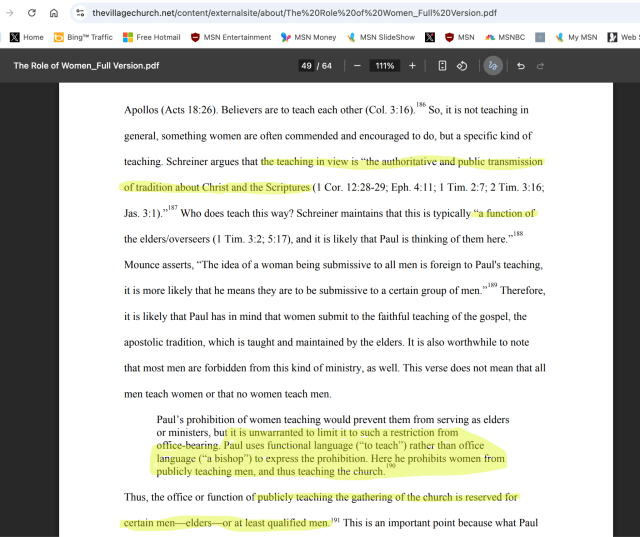
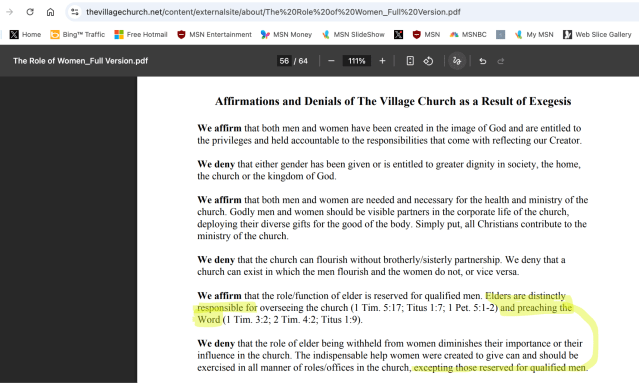
a) A female teacher cannot currently and unrepentantly preach to or teach men in violation of 1 Timothy 2:12. A male teacher or pastor cannot allow women to carry out this violation of Scripture in his ministry. The pastor or teacher cannot currently and unrepentantly be living in any other sin (for example, cohabiting with her boyfriend or living as a homosexual).

b) The pastor or teacher cannot currently and unrepentantly be partnering with or frequently appearing with false teachers. This is a violation of Scripture.

c) The pastor or teacher cannot currently and unrepentantly be teaching false doctrine.

Just to be clear, “not recommended” is a spectrum. On one end of this spectrum are people like Nancy Leigh DeMoss Wolgemuth and Kay Arthur. These are people I would not label as false teachers because their doctrine is generally sound, but because of some red flags I’m seeing with them, you won’t find me proactively endorsing them or suggesting them as a good resource, either. There are better people you could be listening to. On the other end of the spectrum are people like Joyce Meyer and Rachel Held Evans- complete heretics whose teachings, if believed, might lead you to an eternity in Hell. Most of the teachers I review fall somewhere in the middle of this spectrum (leaning toward the latter).


Angie Smith– Not recommended. Wife of Todd Smith of the Christian music group, Selah, Angie started out as a blogger, then blossomed into a Christian author and speaker. Her best known book to date is a women’s study: Seamless: Understanding the Bible as One Complete Story. 

While all of Angie’s currently scheduled speaking engagements appear to be for women’s events, she has preached at least one Sunday morning sermon (to a congregation of men and women)- at Cross Point Church.

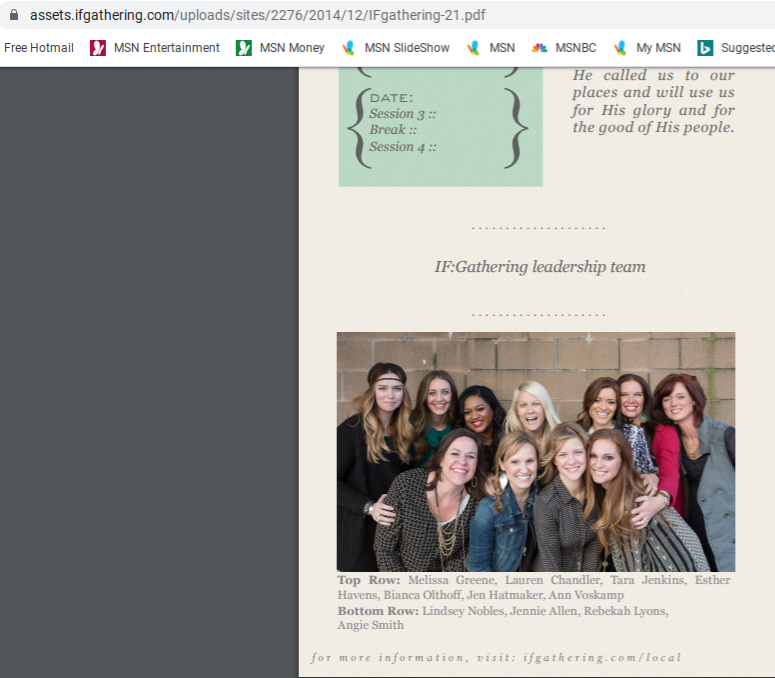
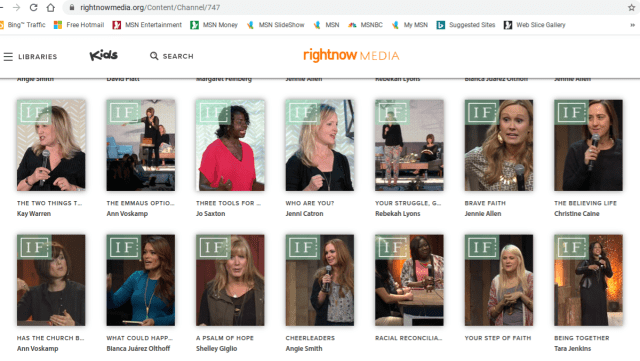
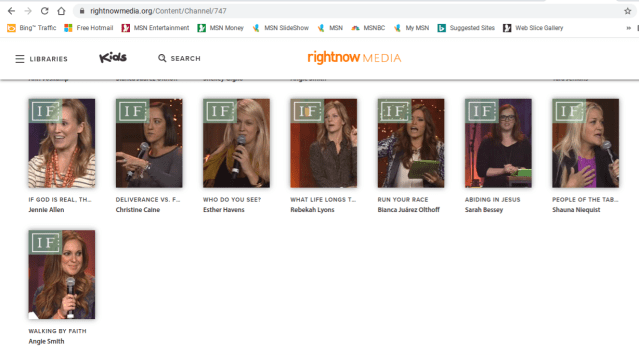
Angie is on the leadership team of Jennie Allen’s IF:Gathering conference (along with false teachers Jen Hatmaker, Ann VoskampRebekah Lyons, Bianca Olthoff, and Christine Caine), has been a featured speaker at IF several times, and is scheduled to speak again at IF:Gathering 2019. Angie’s first speaking engagement of 2019 is at a Methodist “church” at which nearly all the ministerial staff are women, including the senior and associate “pastors”. She’s speaking at three Women of Joy conferences alongside false teachers Sheila Walsh and Lisa Harper. Angie partnered with Lysa TerKeurst to offer an online version of her study, Seamless, through the Proverbs 31 website. Angie partnered with Christine Caine for the Women of Faith Conference, and has appeared on Priscilla Shirer’s The Chat.

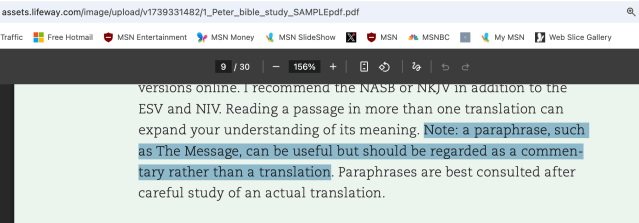
It’s humorously played up, but Angie’s devotion to Beth Moore is a bit over the top. She calls herself “a little bit of a crazy stalker fan supporter of Beth Moore” and says her “favorite Bible teachers are Beth Moore and Priscilla Shirer,” adding, “Iโ€™m pretty sure they will both have special chairs very near to Jesus in heaven,” and “I have a little area of my house devoted to Beth Moore. Okay, thatโ€™s a lie too, but if it wasnโ€™t idol worship, I probably would. At least a little candle or something? framed pictures? A life-sized cardboard cutout? Such a delicate balance between admiration and a restraining orderโ€ฆ”

Space doesn’t permit me to list all the times Angie has partnered with false teachers nor all the false teachers she has partnered with. As I’ve previously mentioned, not only does surrounding yourself with false teachers influence your doctrine, it is impossible to be endorsed by so many false teachers unless your doctrine is acceptable to them, and they do not put up with sound doctrine.

Mailbag

The Mailbag: Potpourri (Soul Ties, SBC Communion, Women in children’s ministry, Heretical book disposal)

Welcome to another โ€œpotpourriโ€ edition of The Mailbag, where I give short(er) answers to several questions rather than a long answer to one question. I also like to take the opportunity in these potpourrri editions to let new readers know about my comments/e-mail/messages policy. Iโ€™m not able to respond individually to most e-mails and messages, so here are some helpful hints for getting your questions answered more quickly. Remember, the search bar can be a helpful tool!


I was wondering what your views were on โ€œungodly soul tiesโ€, in reference to past relationships? If I was in a previous relationship with someone who I was involved with physically, mentally, spiritually and emotionally, how would I loose myself from that?

The concept of “soul ties” is not biblical. It is not mentioned or even hinted at in the Bible. Proponents of this heretical doctrine, as you can see in this article, Basic Introduction to Soul Ties,ยน will try to convince you that soul ties are biblical by taking all manner of Bible verses out of context and stretching and twisting them like Silly Putty to try get them to mean what they want them to mean. All you have to do is look up the verses they cite, and read them in context to see that none of these passages say that one person’s soul can be literally bound to another person’s soul.

I find it especially laughable that many of the verses they cite in support of soul ties are the “one flesh” verses, such as Ephesians 5:31 (which is actually a quote of Genesis 2:24). Don’t you think that if God, the creator of language, meant to convey in these verses that two people’s souls were tied together, that He would have said “one soul” instead of “one flesh“? Or that He would have clearly said: “In this type of close relationship, the two people’s souls are bound together.”? This is God we’re talking about, here. He’s perfectly capable of explaining Himself clearly. He knows what words mean, and He never makes a mistake and chooses the wrong word. And yet, time and time again in Scripture, He uses the words “one flesh” to describe the intimacy of marriage and sexuality, and He never, anywhere in Scripture, even suggests that the souls of two people are bound together under any circumstances.

Soul ties are just one more piece of false doctrine usually taught by those in the heretical New Apostolic Reformation camp. (When I Googled “soul ties”, articles by Kris Vallotton {Bethel}, Terri Savelle Foy, and Paula White – all among the worst of the worst of the NAR and prosperity preaching – were on the first page of results. That should tell you something.) There is no way your spirit can be tied or bound to someone else’s spirit.

I’m not sure what you mean by being involved with someone “mentally” and “spiritually”, but I’m assuming you don’t mean that you were in Mensa together or that you had long talks about theology and frequently prayed together. Those might be fond memories that make you wistful, but no mental or spiritual activity you participate in with someone else binds your soul to his or is something you need to be “loosed” from.

What you need to do is read your Bible, understand what it says about sin, and if you sinned in any way in this relationship (for example, sex outside of wedlock, putting your love for this person ahead of your love for the Lord, being influenced by this person to lie, etc.) you need toย repent, not “be loosed” (because you’re not bound to this person, and because repentance from sin is the biblicalย way of thinking about this situation). You may also need to avoid spending time with or talking to this person for a while. And if you’re really having trouble getting over the relationship, you might want to seek counsel from a doctrinally sound pastor (one who understands that soul ties are unbiblical) or an ACBC certified Biblical Counselor.

That’s truly all there is to it. The spirit-realm mumbo jumbo of “soul ties” is a bunch of mystical malarkey. Your spirit isn’t tied to anyone else’s spirit, you’re just sad that the relationship is over, having difficulty moving on with your life, and, perhaps missing the person. And it’s OK if that sounds earthly and pedestrian. Because it is. But if Christ is your Savior, you can trust Him to carry you through it.

Here are some resources you might find helpful:

What does the Bible say about soul ties? at Got Questions

Soul Ties? I at Fighting for the Faith (starts around 34:14)

Soul Ties? II at Fighting for the Faith

ยนJust in case it isn’t abundantly obvious, this is a heretical New Apostolic Reformation article/website, and I certainly don’t recommend it.

We recently moved and have been attending a Southern Baptist church. They have not had communion for over two months. Isn’t it the norm to have communion at least once a month? 

Also there is no women’s ministry that I can be involved with which is very disappointing to me. I would even be willing to teach/lead a women’s study but since we are new to this church we are still waiting and learning our place. We hesitate to make ourselves known as possibly unsubmissive or question why they do things the way they do.

Why no communion or women’s Bible study? Your thoughts would be enlightening.

These are such great questions because they help me, as a Southern Baptist, think about the way we do things and how those practices might be perceived by visitors or new members.

Communion/Lord’s Supper:ย Every Southern Baptist church is autonomous, so each church has its own policy or practice about how often the Lord’s Supper is observed. There are some SBC churches who hold the Lord’s Supper every week and probably others who hold it only once or twice a year, although I don’t personally know of any who hold it that infrequently.

In my experience, most Southern Baptist churches observe the Lord’s Supper several times a year, usually on a schedule like the first Sunday of the month, once a quarter, or every “fifth Sunday” (in months that have five Sundays). In addition to these scheduled observances, many churches also observe the Lord’s Supper at their Christmas Eve, Good Friday, or Easter service.

Women’s Ministry:ย I understand your disappointment in the lack of women’s ministry at the church. I would be somewhat disappointed too. There could be a variety of reasons for this. Maybe they had a women’s ministry that veered off into error or personality conflicts, so the pastor put it on hiatus for a while. Maybe no one stepped up to volunteer to lead it. Or, maybe the pastor wants everyone’s focus to be on the worship service and Sunday School with no distractions. But even if there isn’t a formal women’s ministry, you can still invite women over to your home, go out for coffee or dinner together, or study God’s word and pray together with a few others. I found this article –ย Ministry to Women When Thereโ€™s No โ€œWomenโ€™s Ministryโ€ย – really helpful.

Asking Questions: I would encourage you and your husband to set up an appointment with the pastor and ask away! It is certainly not unsubmissive to sit in his office and politely say, “We’re new here and we were just wondering about…” Most pastors I know would love for potential members to do this. (In fact at my church, once a month my pastor holds a sort of “orientation”/Q&A class for potential members during the Sunday School hour.) You need to know where he and the church stand on various doctrinal issues and practices so you won’t be unpleasantly surprised after you’re already members. This is especially important if you’re new to being a Southern Baptist as well as being new to the church. If the pastor in any way discourages you from asking genuine, courteous questions or sees your questions as a threat to his authority, that’s a red flag telling you that you should not join this church.


In the past I purchased books and โ€œstudiesโ€ by authors I now know are false teachers- an embarrassing amount of them really. I am wondering now what do with all of them…I donโ€™t feel I am mature enough in my walk with Christ yet to read any of them and test them against Scripture myself, but I also donโ€™t feel like passing them on to someone else is right either. Just wondering your thoughts on this.

You’re correct, you should not pass on books containing false doctrine to others, donate them to libraries (especially church libraries), Goodwill, or thrift stores, or sell them in a garage sale. The only scenario I can think of in which passing along a book authored by a false teacher would be OK is if it is to someone you know is a mature, doctrinally sound Christian who needs it for research purposes or to write a review of it warning people away from it.

I would also suggest that you not simply throw throw the books in the trash or recycling unless you render them unreadable (ex: scribbling on or tearing up the pages) first. People have been known to take “freebies” out of the trash.

Here are two ways I’ve handled heretical books I’ve been given:

1. Keep them for research purposes. (If you think you might be tempted to read them and you don’t feel like you’re spiritually mature enough to handle that yet, maybe box them up and put them in storage for a later date.) You might want to mark them in some sort of way – in case you lose the book and someone else finds it or something like that – indicating that the book is false doctrine. My friend, Pastor Nate Pickowicz, has an awesome stamp for his “research only” books:

2. Burn them. I know it reeks of Nazism and censorship by wild-eyed preachers of yesteryear, but it’s biblical, it keeps false doctrine out of the hands of others, and these books can actually have a positive use for kindling if you have a fireplace or chiminea. (Please use all fire safety precautions. Also, it is not necessary to burn the books publicly.)


Is it Biblical for a woman to be in charge of the childrenโ€™s ministry? Especially one who is not doctrinally sound?

It isn’t biblical for anyone who’s unrepentantly and unteachably doctrinally unsound to be in charge of anything in the church.

If it’s a case like Apollos, in which the person in question simply doesn’t know any better, but changes her ways and embraces sound doctrine when corrected, that’s cause for giving glory to God. (Also, she might need more training in the Scriptures before she resumes her position of service.)

But if it’s a case in which the person persists in teaching false doctrine or acting sinfully, that’s cause for church discipline. And if she steadfastly refuses to repent despite biblical rebuke, she needs to be disfellowshipped from membership in the church. Of course, it should go without saying (unfortunately, it doesn’t these days) that people who aren’t church members and/or aren’t saved should not be given any position of service or leadership in the church.

It could be OK for a doctrinally sound woman to be in charge of the children’s ministry, depending what you mean by “in charge”, and depending on whether or not she can do so without violating Scripture:

1. She should not be considered as, or bear the professional title of, “pastor”. It is unbiblical for a woman to be a pastor, and if she’s not a pastor, then bearing the professional title of “pastor” is lying.

2. In her leadership duties, she should not teach adult men (for example, men who teach children’s Sunday School classes, if she oversees children’s Sunday School) the Scriptures or exercise authority over them.

3. The pastor, or an appropriate elder, should vet and approve any curricula and materials, guest speakers, activities, etc., she wishes to use.

If a pastor or elder oversees her leadership so that she is acting under his authority and at his direction, and she is not violating Scripture by preaching to men, teaching men Scripture, or exercising authority over men, I don’t see why it would be a problem for a woman to lead the children’s ministry. In fact, Christian women and churches who handle this properly could be a superb example and model for other Christian women and churches.


If you have a question about: a Bible passage, an aspect of theology, a current issue in Christianity, or how to biblically handle a family, life, or church situation, comment below (Iโ€™ll hold all questions in queue {unpublished} for a future edition of The Mailbag) or send me an e-mail or private message. If your question is chosen for publication, your anonymity will be protected.

Discernment, Mailbag

The Mailbag: Potpourri (Replacement Theology, Spiritual Gifts Test, Books by false teachers…)

Welcome to another “potpourri” edition of The Mailbag, where I give short(er) answers to several questions rather than a long answer to one question. I also like to take the opportunity in these potpourrri editions to let new readers know about my comments/e-mail/messages policy. Iโ€™m not able to respond individually to most e-mails and messages, so here are some helpful hints for getting your questions answered more quickly. Remember, the search bar can be a helpful tool!


Can you explain what replacement theology is?

I can, but there are pastors and theologians way smarter than I am who have done a much better job of it than I could. I reached out to my friend Pastor Gabe “WWUTT” Hughes for some help and he addressed the question in this episode of the When We Understand the Text podcast (starting at about 1:30):

WWUTT 565 Q&A Replaced Protesting Eligibility?

You may also find the following resources helpful:

The Church and Israel: The Issue at Ligonier

What is replacement theology / supersessionism? at Got Questions

What is replacement theology? at CARM

Supersessionism at Theopedia


I want to get more involved in serving my church. Can you recommend a spiritual gifts survey web site so I can find out what my spiritual gifts are and how I should be serving?


If you have a question about: a Bible passage, an aspect of theology, a current issue in Christianity, or how to biblically handle a family, life, or church situation, comment below (Iโ€™ll hold all questions in queue {unpublished} for a future edition of The Mailbag) or send me an e-mail or private message. If your question is chosen for publication, your anonymity will be protected.

Discernment, Mailbag

The Mailbag: Should I attend the “Bible” study to correct false doctrine?

Iโ€™ve been invited to join a ladiesโ€™ Bible study class thatโ€™s using a book by a well-known author and speaker. The woman who wrote the book is a false teacher. Should I accept the invitation and join the class in hopes of correcting the false doctrine that will be taught?

To join or not to join. I’ve been in the same situation myself, and I know many of my readers have as well. It can be a difficult decision to make. The Bible does say to avoid false teachers, but it also says they should be rebuked, and that older women are to โ€œteach what is good, and so train the young women…that the word of God may not be reviled.โ€

My counsel to those who have expressed concern to me over studies by Beth Moore, Priscilla Shirer, Lysa TerKeurst, etc. taking place in their churches is to pray that God would give them wisdom as to whether they should attend the study and biblically refute all the false doctrine that comes up (the rebuking/training perspective) or whether they should decline to attend the study (the avoiding perspective), giving anyone who asks a biblical explanation as to why you wonโ€™t be participating (also, kind of rebuking/training). There are a lot of things to take into consideration as you begin working through Scripture and prayer to reach a decision.

First, where is your pastor in all of this? Why is he allowing a study to take place that uses materials authored by a false teacher? Maybe he is familiar with the authorโ€™s materials and approves of them (in which case you have a bigger issue than whether or not to attend this particular class). But maybe heโ€™s a discerning-leaning guy whoโ€™s just not aware that this author teaches false doctrine.

Most pastors are extremely busy. They either donโ€™t have the time or donโ€™t know they need to make the time to vet the authors of the studies their church is using (I’m not excusing this state of affairs, I’m just saying- this is the reality we’re dealing with). And many of them simply assume that if the book comes from LifeWay (or another trusted Christian retailer), it must be OK. So, before making a decision about whether or not to attend the class, go to where the buck stops and humbly, patiently, and kindly find out where your pastor is about the issue. He might just pleasantly surprise you and cancel the class or insist that a doctrinally sound study be used instead, and your problem will be solved.

Next, if youโ€™re married, what does your husband have to say about it? There may be a logistical conflict – he prefers you not to be out that late at night alone for safety reasons, your child has to be picked up from soccer at the time the class meets, etc. – that will immediately solve your dilemma, or there may be some other reason he doesnโ€™t want you to attend the class. Since itโ€™s not sinful to decline attending the class, if your husband says no, you need to respect his decision and decline to join. (You also need to discuss with your husband the issue of approaching the pastor about the study. He might prefer to be the one to talk to him, or he might prefer the two of you talk to the pastor together, rather than you approaching the pastor on your own.)

But even if your husband leaves the decision up to you, ask for his counsel and perspective. Simply by virtue of being a man, a person with his own unique thought processes, and someone who knows you well, he can add invaluable insight that can help you reach a wise decision. This was certainly the case for me when I was faced with this situation. I was leaning toward declining to attend the study, but my husband gave me a whole new perspective and encouraged me to get involved in order to be a corrective influence and godly example to the other ladies. And he was right!

If youโ€™ve talked to your pastor and your husband and the dilemma is still before you, there are several things you need to think, pray, and study through as youโ€™re working toward a decision:

โ˜™Are you biblically knowledgeable enough to recognize and properly refute false doctrine? (It might help to get the perspective of your pastor, your husband, or a mature believer who knows you well and who will be honest with you.)

โ˜™Do you have the extra time to study and make notes ahead of time so you’ll be prepared to refute, with Scripture, during class?

โ˜™Is the study so replete with false doctrine that you’ll have to constantly be speaking up and people will just be annoyed and tune you out?

โ˜™Does your conscience prevent you from financially supporting the false teacher by buying her book for the study?

โ˜™Would it make a bigger impact on this particular group of ladies for you to attend and refute or to decline to attend with explanation? (Consider your influence on them, your reputation for sound doctrine among them, the dynamics of the group, etc.)

โ˜™What will be the repercussions of your actions (whether you decide to attend or decline) on the church at large? How might your family and/or your pastor be affected?

โ˜™Are you spiritually and emotionally prepared for the harsh backlash you will probably receive for refuting? Can you stand firm in the face of that, or will you cave?

โ˜™Are you in the โ€œcage stageโ€ of discernment with a โ€œmow โ€˜em down!โ€ disposition to match, or do you have the self-control required to follow the instruction of 2 Timothy 2:24-26: to be patient, kind, and not quarrelsome? Do you understand that the goal of discernment is to humbly rescue captives, not to prove how right and knowledgeable you are?

โ˜™Think outside the box. Is there another way to handle this situation besides attending/refuting and declining to attend? What about you (or a spiritually mature woman in your church- someone who is able to teach) offering to teach an alternative class that studies a book of the Bible?

Thereโ€™s no one size fits all answer to this question. Either of these options (or another) could be biblically wise depending on the people and situations involved. Talk to your husband and your pastor. Examine what Godโ€™s word says about false teachers. Pray for wisdom. Follow your biblically-informed conscience.


If you have a question about: a Bible passage, an aspect of theology, a current issue in Christianity, or how to biblically handle a family, life, or church situation, comment below (Iโ€™ll hold all questions in queue {unpublished} for a future edition of The Mailbag) or send me an e-mail or private message. If your question is chosen for publication, your anonymity will be protected.

Mailbag

The Mailbag: How should I approach my church leaders about a false teacher they’re introducing?

How do I approach my women’s ministry leader, elders, minister of music, or pastor about the false teacher whose materials our church is using, whose music our church is singing, whose conference our church members are attending, etc.?

I’ve received this same basic question from scads of readers over the past few weeks. It’s alarming when your women’s ministry leader picks a Lysa TerKeurst book for the next women’s “Bible” study, or the elders promote Steven Furtick’s latest conference, or you keep seeing songs from Hillsong, Elevation, and Bethel in the order of service each week. You love your church and don’t want to see people deceived, but you also know that people don’t often respond well to hearing that the Christian celebrity they’re enamored with is a false teacher. What to do? How can we alert our leaders to the theological problems with a popular Christian personality?

1. Pray
I’m gonna beat this drum ’til the cows come home, because this is a concept we have got to get through our heads. God knows and loves your leaders and your church infinitely more than you do, and He is far more able to do something about the situation than you are, because He is able to change your leaders’ hearts and minds and open their eyes (which is usually what’s needed). You are not. Furthermore, He wants you to depend on Him to handle things rather than depending on evidence, your own persuasiveness, etc. You should already be praying regularly for your church and its leadership. When a situation like this comes up, pray long, hard, and continuously.

2. Remember why you’re approaching your leadership.
If you’re going at this from a “they’re wrong, I’m right” perspective or some sort of desire to “win” at this conflict, you need to repent. This isn’t about you. This is about the supremacy of God’s Word, the purity of His Bride, and the exaltation of His reputation. This is about loving your church so much that you’re willing to risk rejection and humiliation so that they won’t be deceived.

3. Memorize and meditate on these verses and use them as your guide when approaching anyone about false teachers/doctrine:

And the Lord’s servant must not be quarrelsome but kind to everyone, able to teach, patiently enduring evil, correcting his opponents with gentleness. God may perhaps grant them repentance leading to a knowledge of the truth, and they may come to their senses and escape from the snare of the devil, after being captured by him to do his will.

2 Timothy 2:24-26

Remember, you’re the Lord’s servant, not some hot shot discernment Big Man on Campus.

Remember, you’re the Lord’s servant, not some hot shot discernment Big Man on Campus.

Are you quarrelsome? Kind? Able to teach? Patient enough to endure evil? Able to correct with gentleness? That’s a good checklist for your heart and abilities.

Who’s going to grant repentance to the person you’re dealing with so she might come to a knowledge of the truth? You? Nope. God is.

Who’s the bad guy here? Is it the person you’re approaching? No. It’s the devil. He’s holding that person prisoner to deception. You’re not approaching an enemy to conquer. You’re rescuing a captive with spiritual Stockholm Syndrome.

You’re not approaching an enemy to conquer. You’re rescuing a captive with spiritual Stockholm Syndrome.

4. Approach

a) Who should approach this leader?
Are you the best person for the job? Are there other willing and discerning church members who might be able to handle the situation better than you can? Sometimes you’re the only person for the job. In that case, ladies, remember your role in the church and at home. If you’re married, be sure you’re submitting to your husband’s leadership in this situation.

If the person you’re approaching is the (female) leader of the women’s ministry, Bible study class, conference coordinator, etc., it might be best if you go to her alone or with another discerning sister. It is usually best to approach this person first before going over her head to the elders or pastor. You want to win your sister over to the truth, if possible, not simply force her to change things because a superior tells her she has to.

If the person who needs to be approached is male, it might be best for your husband (or another discerning brother) to meet with him, or for you and your husband to meet with him together, with your husband taking the lead and you in a supporting role. Again, it’s usually best to approach the lower level leader, if any, before going over his head.

b) How should you approach this leader?
In humility, love, and all the other characteristics from the 2 Timothy 2 passage. And keep a few other things in mind too:

First, give the person the benefit of the doubt that she’s got good motives. She probably thinks the study she’s selected would help the women of your church or that the conference would lead them closer to the Lord. It’s usually not the case that the person is consciously trying to introduce anti-biblical material.

Second, keep ignorance at the forefront of your mind. Most people in the church today – even pastors – are completely unaware of the extent of false doctrine, or even what false doctrine is, or that the majority of the most popular Christian celebrities are false teachers. They think if you can buy it at LifeWay or if it calls itself Christian and sprinkles a few Bible verses around, it must be biblical Christianity. You must initially approach people with the mindset that they’re trying to do something good, but they they simply aren’t aware of the false doctrine that’s out there or that the person they’re introducing to the church is a false teacher. (This is where “able to teach” and “correcting with gentleness” come in).

Next, put yourself in the other person’s shoes and keep in mind that it’s hard to hear that a Christian celebrity you love is a false teacher. Give the person time to sort out all this new, and sometimes overwhelming, information.

Finally, be prepared for backlash. No matter how kind, gentle, and objective you are, the person may feel personally attacked and lash out at you. Don’t lash back. Turn the other cheek. Go the extra mile.

c) With what should you approach this leader?
The Bible and credible evidence. For every charge you bring against this false teacher, you need to bring credible audio, video, or print evidence of the teacher’s own words or actions and the Bible passages she is violating. (You can find this kind of evidence on many teachers at the Popular False Teachers & Unbiblical Trends tab in the blue menu bar at the top of this page.) Don’t bring opinions, histrionics, unsubstantiated rumors, or out of context remarks by the false teacher. Bring solid, objective, incontrovertible evidence.

Don’t overwhelm the person you’re approaching with reams of material to read or long videos to watch. She might see how time consuming it will be and give up before going through any of it. Keep things concise.

Don’t attempt to address every wrong word, action, or teaching ever perpetrated by the false teacher. Go with a few of the most attention-grabbing, glaring, violations of Scripture.

Make sure your evidence is up to date. Focus on the false teacher’s most recent violations of Scripture, not something from 20 years ago that she has repented of (in which case you shouldn’t be bringing a charge) or backed away from. Recent evidence is also more compelling.

d) How should you leave things?
Reassure the person of your love for her and for the church. Ask if she has any questions, and make sure she has your contact information and knows she’s welcome to get in touch if she has questions or needs more information. If she’s open to it, make some suggestions of doctrinally sound materials, conferences, etc., that could be used instead. Don’t expect an immediate resolution to the situation. Give the person some time to think and pray things through and to go over the evidence you’ve provided. It might be appropriate to ask if you can touch base with her again in a few days.

Doing all of these things is not a magic formula that will guarantee the results you’re hoping for. In fact, going by the e-mails and messages I’ve received, I would estimate that about 95% of the time, you’ll be ignored or vilified as a hater or divisive.

Do it anyway. God may have placed you in that church to help it correct its course or to serve as a biblical warning to them. And, who knows? You might just rescue somebody.


Additional Resources:

How to talk to your church leaders about false teachers at A Word Fitly Spoken

Answering the Opposition- Responses to the Most Frequently Raised Discernment Objections

Is She a False Teacher? 7 Steps to Figuring it Out on Your Own

If you need to talk to a friend because she’s following a false teacher, the same basic steps and principles in the article and all of the resources above apply, but if you’d like to look at this as more of a friend to friend issue than a church member to leadership issue, you might like to give this episode of A Word Fitly Spoken a listen: Words with Friends: How to contend with loved ones.

If your minister of music (“worship leader”) is using music from heretical sources for the worship service, again, all of the same basic steps, principles, and resources above apply. You may find my article Why Your Church Should Stop Playing Bethel, Hillsong, Elevation, and Jesusย Culture to be a helpful resource to share with him.

If the leadership at your church persists in promoting or using materials by false teachers and/or castigates you for objecting, the situation may become so untenable that you need to leave and find a new, doctrinally sound church. If so, check out the Searching for a new church? tab in the blue menu bar at the top of this page to find a doctrinally sound church near you and to learn the best way to leave your current church.


If you have a question about: a well known Christian author/leader, a Bible passage, an aspect of theology, a current issue in Christianity, or how to biblically handle a family, life, or church situation, comment below (Iโ€™ll hold all questions in queue {unpublished} for a future edition of The Mailbag) or send me an e-mail or private message. If your question is chosen for publication, your anonymity will be protected.