Discernment

Jen Wilkin

If you are considering commenting or sending me an e-mail objecting to the fact that I warn against certain teachers, please click here and read this article first. Your objection is most likely answered here. I won’t be publishing comments or answering emails that are answered by this article.


This article is kept continuously updated as needed.

I get lots of questions about particular authors, pastors, and Bible teachers, and whether or not I recommend them. Some of the best known can be found above at my Popular False Teachers tab. The teacher below is someone I’ve been asked about recently, so I’ve done a quick check (this is brief research, not exhaustive) on her.

Generally speaking, in order for me to recommend a teacher, speaker, or author, he or she has to meet three criteria:

a) A female teacher cannot currently and unrepentantly preach to or teach men in violation of 1 Timothy 2:12. A male teacher or pastor cannot allow women to carry out this violation of Scripture in his ministry. The pastor or teacher cannot currently and unrepentantly be living in any other sin (for example, cohabiting with her boyfriend or living as a homosexual).

b) The pastor or teacher cannot currently and unrepentantly be partnering with or frequently appearing with false teachers. This is a violation of Scripture.

c) The pastor or teacher cannot currently and unrepentantly be teaching false doctrine.

I am not very familiar with most of the teachers I’m asked about (there are so many out there!) and have not had the opportunity to examine their writings or hear them speak, so most of the “quick checking” I do involves items a and b (although in order to partner with false teachers (b) it is reasonable to assume their doctrine is acceptable to the false teacher and that they are not teaching anything that would conflict with the false teacher’s doctrine). Partnering with false teachers and women preaching to men are each sufficient biblical reasons not to follow a pastor, teacher, or author, or use his/her materials.

Just to be clear, “not recommended” is a spectrum. On one end of this spectrum are people like Nancy Leigh DeMoss Wolgemuth and Kay Arthur. These are people I would not label as false teachers because their doctrine is generally sound, but because of some red flags I’m seeing with them, you won’t find me proactively endorsing them or suggesting them as a good resource, either. There are better people you could be listening to. On the other end of the spectrum are people like Joyce Meyer and Rachel Held Evans- complete heretics whose teachings, if believed, might lead you to an eternity in Hell. Most of the teachers I review fall somewhere in the middle of this spectrum (leaning toward the latter).

If you’d like to check out some pastors and teachers I heartily recommend, click the Recommended Bible Teachers tab at the top of this page.


Jen Wilkin
Not Recommended

Jen is a womenโ€™s Bible study author, blogger, and conference speaker, and until 2023, when she left to focus on her own ministry, was on staff at The Village Church as the Executive Director of Next Gen Ministries (TVC’s ministry to “children and students ages 0โ€“18”).

Link / Screenshot

Jenโ€™s older books and Bible study materials have a reputation for being generally doctrinally sound. Iโ€™ve published a review of Jenโ€™s book, Women of the Wordand here is one readerโ€™s take on her book 1 Peter: A Living Hope in Christ:

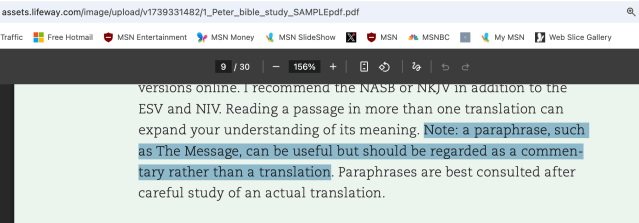
โ€œโ€ฆin the foreword Jen wrote, โ€˜a paraphrase, such as the NLT orย The Message,* can be useful but should be regarded as a commentary rather than a translation.โ€™ However, aside from that, I have found no other problems with the book at all. It is an eight week long study of 1 Peter based on the method of Bible study that she writes about inย Women of the Word. My favorite thing about this study is that it causes us to focus on what the text is telling us about God. I love how Jen Wilkin is teaching women to study the Bible properly. I wish she would be more discerning about who and what she endorses though. There are so few women who bring us solid teaching and discernment.โ€

*Please see “February 2026 Update” at the end of this article. Jen Wilkin herself brought to my attention that in later editions of this book, she removed her reference to the NLT from this sentence. She did not explain why, but my guess would be (and she has thus far not corrected me) that she removed “the NLT” because The New Living Translation is considered to be a translation, and Jen mistakenly referred to it as a “paraphrase”.

The reader’s concern (and mine, too) in mentioning this quote, however, is not that Jen mistakenly called the NLT a paraphrase, but that Jen recommended The Message as an acceptable paraphrase. You need only to click on the link above to see why this is concerning.

Also in the past, Jen limited her speaking engagements and teaching to audiences of women, which is the biblical parameter for Christian women teachers. And although her website speaking engagement request form says she is a โ€œteacher who helps womenโ€ฆโ€ she has been increasingly preaching to and instructing men in recent years.

For example, Jen’s former staff position as TVC’s “Executive Director” of children’s and student ministries, depending on the exact nature of her job responsibilities, probably (I am making a reasonable inference, as TVC’s website does not explicitly say) required her to teach Scripture to, or exercise improper authority over young men in the student ministry (which includes students through age 18) and men who teach or volunteer in the student ministry. The title “Executive Director” makes it sound as though she was over the entire ministry and everyone in that ministry was under her purview.

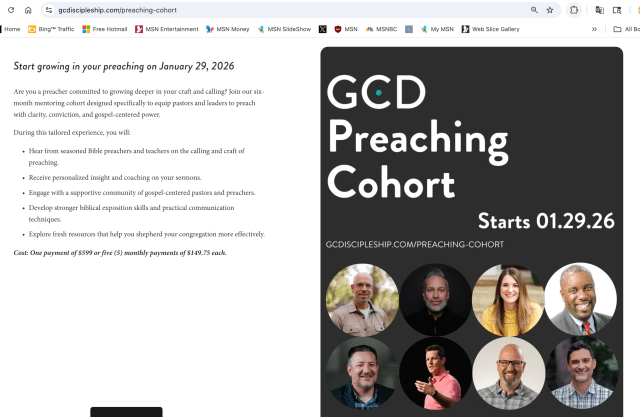
A more recent example demonstrating Jen’s increasing rebellion against Scripture regarding the role of women in the church is the Gospel Centered Discipleship “Preaching Cohort” in which Jen is a “Coach”. She (along with the other coaches) is described as a “seasoned Bible preacher and teacher,” and will be coaching pastors “on the calling and craft of preaching”.

In the past, there have also been questions about exactly where Jen stood on the biblical role of women in the church. She presented herself -and still does- as a complementarian, stating clearly that women are not to hold the office of pastor. What she did not make clear in the past, but what has become abundantly clear in recent years, is that she is (or has developed into) what’s often called a “soft” or “narrow” complementarian. This is the belief that women can do anything men can do in the gathering of the church body except hold the office of “senior pastor” – women can preach the Sunday sermon, hold any other office in the church (for many that includes the office of elder, “associate pastor,” etc.), exercise authority over men in the church, and so on. This is unbiblical. And what’s dangerous here is that Jen doesn’t call herself a “soft/narrow” complementarian, she just calls herself a complementarian, leading Christians who haven’t kept up with her to think she holds a biblical position and practice of the role of women, when she, in fact, does not.

As an example of Jen’s murkiness on the role of women, in the video* below (~32:05), she says:

“We need [women’s] visible leadership. How visible? As visible as your church’s complementarianism allows.”

This remark is at best, unhelpful, and at worst, opens the door for women and pastors to rebel against Scripture. The biblical answer to this question (aside from the fact that the church should be far more focused on servanthood than leadership) is: Women may serve in any position in the church that does not require them to preach to, teach Scripture to, or exercise authority over men, and which does not violate any other principles of Scripture.

Whatever position on the role of women Jen may have held in the past, she is now a “soft/narrow complementarian,” which is, in reality, a functional egalitarian.

In addition to the aforementioned preaching cohort in which Jen instructs pastors, she has spoken at several co-ed conferences in recent years. Give the first 15 minutes of the video below a listen*. Despite the fact that Jen’s very first remark is that she is not teaching the Bible in this session for pastors and church planters, she almost immediately goes on to quote and allude to the opening chapters of Genesis (and later in the video, other passages) and teach on them. I would challenge you to listen to what she says and ask yourself, “If I heard a pastor give this type of instruction, would I consider it a sermon/Bible lesson?” I think most of us could easily answer, “yes”. *(Unfortunately, the full length video of Jen’s complete teaching session has been removed from the internet. The video below is an excerpt of the full length video.)

(This is also the teaching session in which Jen made her infamous remarks about menstruation helping women to understand the gospel differently from men, which is not only a private and potentially uncomfortable subject to address in public – especially for an audience of men – it’s a patently ridiculous teaching. Menstruation teaches us nothing about the gospel. The two subjects are completely unrelated. Also, aside from Jen, I’ve never heard a single woman say her period helped her better understand the shedding of Christ’s blood.)

In another instance of preaching to a co-ed audience, Jen has been featured as a speaker multiple times at The Gospel Coalition’s national conference* at least as far back as 2017. (In the opening seconds of this 2017 TGC conference session, Why Itโ€™s Good that God Is Different from Us, Jen acknowledges and welcomes the men in her audience.) TGC, as many have noted, has been on a woke / social justice trajectory for years. Jen has been featured on TGC’s site numerous times.

*Jen has also been a featured speaker at TGC’s women’s conference (TGCW), not to be confused with TGC’s national conference, which is co-ed.

Again, one of the reasons it’s especially problematic for Jen to be teaching men, or to even to seem to be teaching men, is that she openly and unashamedly wears the label of complementarian. Boldly proclaiming complementarianism while teaching men muddies the waters and confuses the women who follow her as to what the Bible truly teaches about the role of women in the church. Are there times when it is technically not a violation of Scripture for a woman to speak with men in the audience? Yes (see #7 here). But weigh the impact Jen has on the church by speaking to men against the counter-evangelicultural impact someone of her stature could have by flagrantly refusing to teach men. Which would cause more people to sit up and take notice, set a better example for Christian women, and have a more biblical influence on the church?

Another concern about Jen is that she seems to be increasingly associating and appearing with false or problematic teachers.

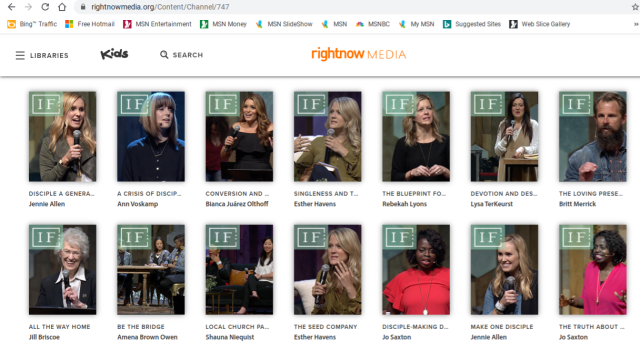
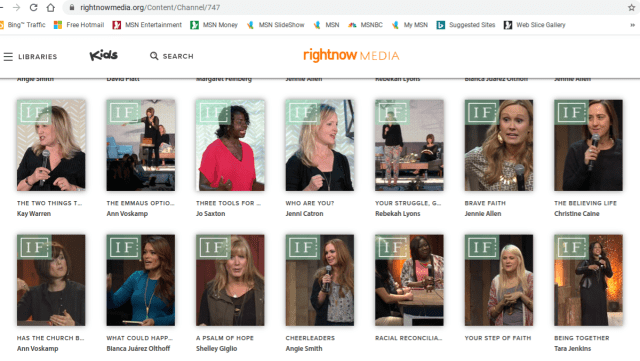
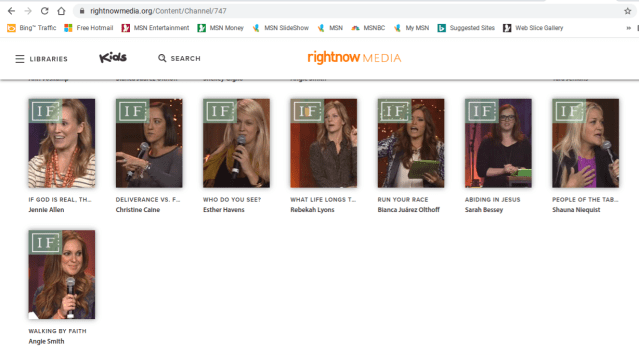
In 2013, Jen wrote a blog post entitled, The Next Beth Moore in which she spoke glowingly of Beth Moore, her teaching, and one of her books. She has also had several friendly and/or affirming interactions with Beth on X, and has pointed women to Beth’s writing. Jen has appeared on the IF: Gathering podcast with Jennie Allen (to discuss and promote Women of the Word), and has written a devotional for Lysa TerKeurstโ€™s Proverbs 31 blog.

(Screenshots: 1, 2, 3 {page 1}, 4 {page 2})

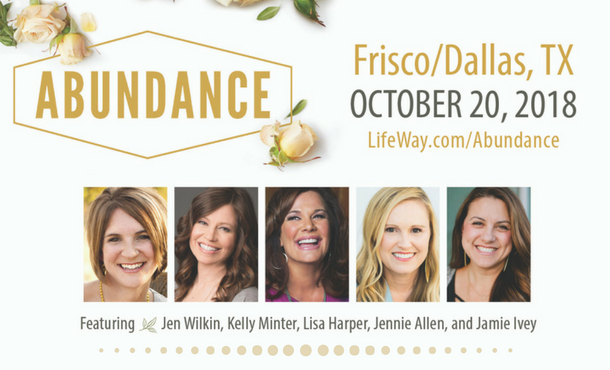
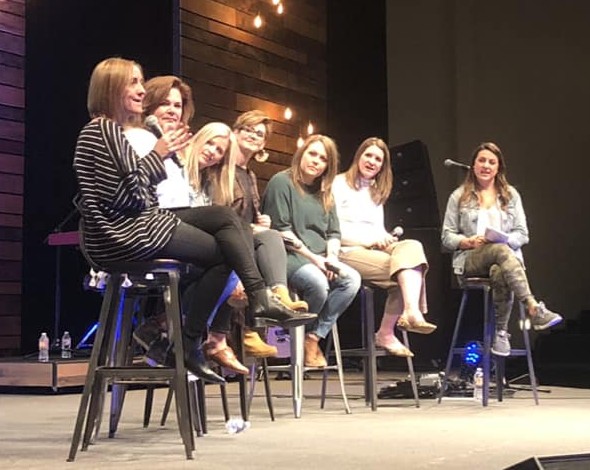
During LifeWay’s 2018 Abundance conferences, Jen appeared alongside Lisa Harper, Raechel Myers, Amanda Bible Williams, Christine Caine, Jennie Allen, Kelly Minter, Whitney Capps (of Lysa TerKeurst’s Proverbs 31 Ministries), and others.

L-R: Christine Caine, Lisa Harper, Raechel Myers, Whitney Capps, Amanda Bible Williams, Jen Wilkin, Jamie Ivey

In August 2020, Jen appeared at LifeWay Women Live with Beth Moore, Priscilla Shirer, Jackie Hill Perry, Kelly Minter, Angie Smith, Jennifer Rothschild and Kristi McLelland.

LifeWay Women Live 2020 Speakers

Several years ago, Jen was added to LifeWay Women’s stable of Women’s “Bible” study authors including many of the aforementioned teachers and others. In addition to my normal concerns about someone yoking with false teachers (i.e. the Bible says not to, and disobeying God’s Word is a sin), I’m guessing LifeWay Women may have initially signed Jen in order to use her – that is, her reputation for being a doctrinally sound teacher and a complementarian – to lend credibility to the false teachers they promote. And, of course, Jen’s previously perceived good reputation has suffered by being associated with these false teachers.

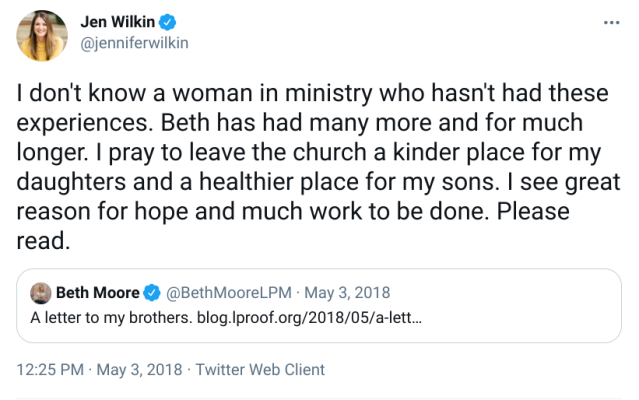
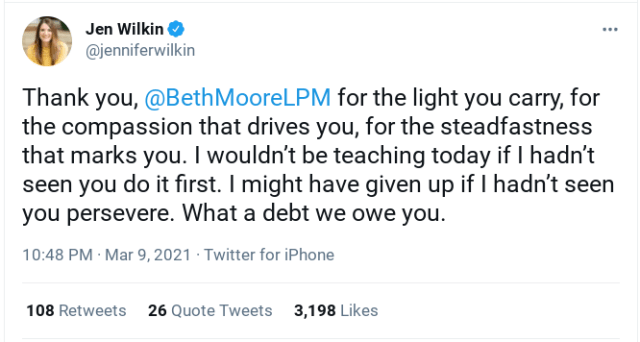
In March 2021, when Beth Moore cut ties with the Southern Baptist Convention, Jen offered this glowing farewell…

In a strange irony, in the midst of unbiblically partnering with these false teachers, in her session, The Gospel and The Future of Bible-Centered Discipleship at the 2018 Southern Baptist Convention Pre-Conference (also to a co-ed audience), Jen teaches the following…

[Biblical literacy] guards against false teaching…Basic comprehension-level mastery of the text guards against false teaching. (~30:12)

You know what our [discipleship] formula has been for the last 20 years? [We’ve said], ‘We’re going to keep making [the level of biblical teaching] lower and lower’…It is our high calling, in the face of a biblical literacy crisis, to raise the bar in an age of low expectations. (~43:40…44:39)

And yet, Jen’s level of “mastery of the text” – to the point that she is instructing people in the text and teaching them how to improve discipleship – has not sufficiently guarded her against partnering with women who are largely responsible for the bulk of false teaching aimed at women today, who don’t teach “basic comprehension-level mastery of the text,” and who have continued to lower the bar and perpetuate low expectations for biblical literacy. Jen has associated with, talked to, and listened to the teaching of these women far more than I have, I’m certain. How does she not see this?

Finally, in the same way that the influence Steven Furtick has on Lysa TerKeurst as her pastor is worrisome, Iโ€™ve seen some things over the years with Jenโ€™s pastor, Matt Chandler, and his wife, Lauren Chandler (with whom Jen has appeared at conferences; screenshot), that have given me pause.

As a member of The Village Church, Jen is pastored by Matt, and as a ministry leader there (though no longer a staff member), she works under his direction and influence. Over the past few years, Matt has publicly praised or affirmed false teachers like Ann VoskampBeth Moore, and Jesus Culture. He has raised some questions about the extent of his continuationism with His notorious “pirate ship prophecy“. He allows Bethel and Israel Houghton (Joel Osteenโ€™s former worship leader) music to be used for worship at his church. Matt allows his wife, a worship leader at TVC, to select this music, and to yoke with and be influenced by numerous false teachers. Matt and Lauren and their associations with false teachers have undoubtedly influenced Jen. Additionally, Matt’s character and personal integrity were sullied in 2022 when he had to take a leave of absence after admitting to an “inappropriate” texting relationship with another woman.

(Screenshots: 1, 2, 3. 4)

In summary, I would urge you not to follow Jen Wilkin, attend her conferences, or use her materials due to her trajectory of increasingly unbiblical teaching and behavior.


Additional Resources:

Articles on Jen Wilkin by Elizabeth Prata

Talk Back: Jen Wilkin and The Gospel Coalition at A Word Fitly Spoken

TGCW24- Mark and Avoid

Prior to February 14, 2026, this small section appeared in the above indicated area of this article:

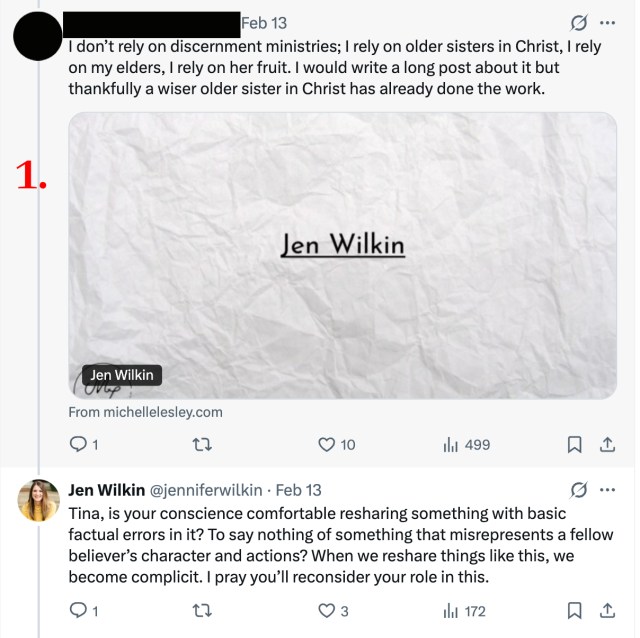
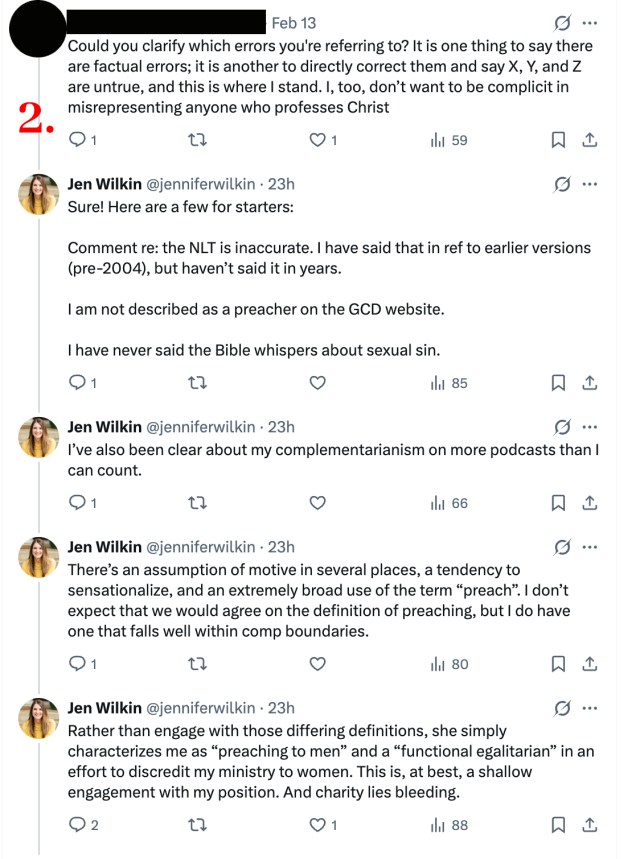
On February 13-14 Jen Wilkin and I had an exchange on X in which she said, โ€œI have never said the Bible whispers about sexual sin.โ€ (see image 2 below)

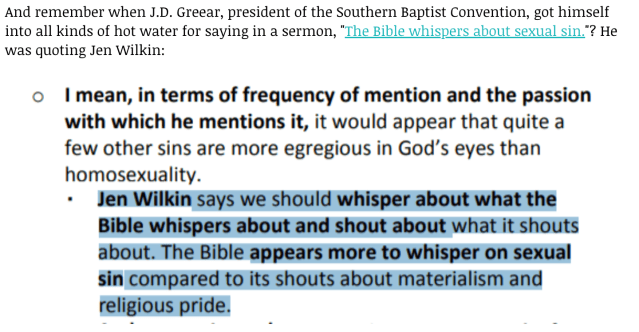
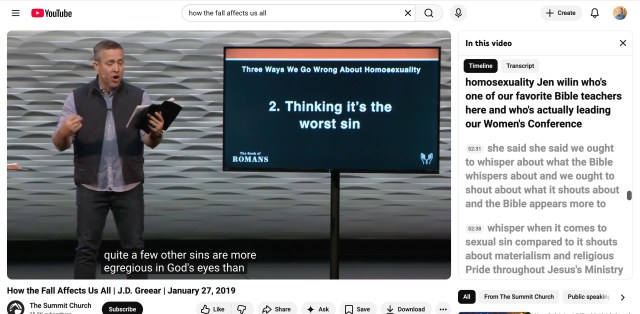
I looked into it, and Jen appears to be correct. Here’s what J.D. said:

The first part of J.D.’s statement, “We ought to whisper about what the Bible whispers about and we ought to shout about what it shouts about,” was a quote of Jen. J.D. then added his own opinion, “…and the Bible appears more to whisper when it comes to sexual sin…” to the end of the quote of Jen, making it sound like the entire quote was something she said.

I apologize – to Jen and to my readers – for making this mistake, and ask your forgiveness. I hope my character speaks for itself when I assure you that this was simply a misunderstanding of an unclear statement. It was not a fabrication, nor was it done maliciously. But I am still sorry for making the mistake and for any negative consequences it resulted in for Jen or anyone else.

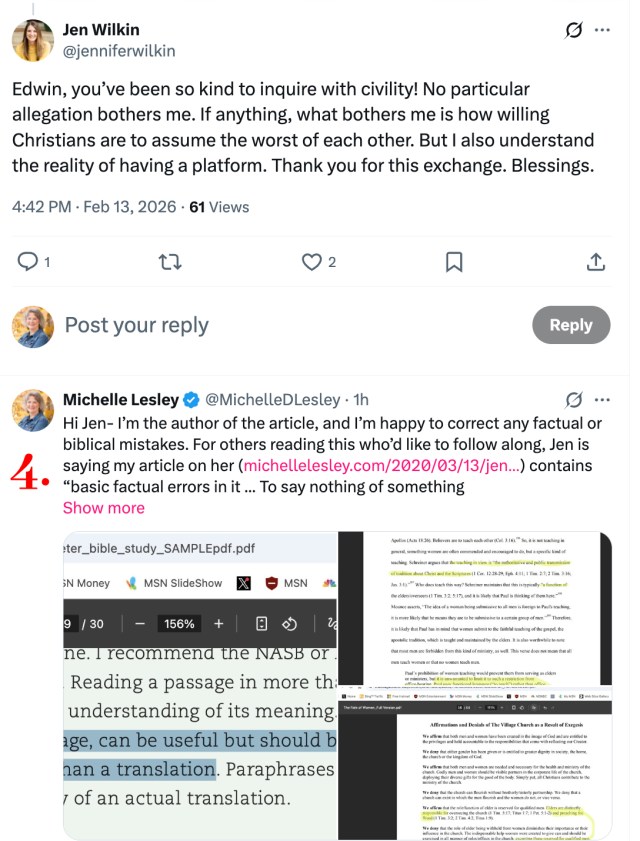
This point, however, was not the only thing Jen took issue with about this article, as you can see from the images in the slideshow above. Here is the original exchange. My response to Jen’s allegations is below in article format for ease of reading:

Hi Jen- Iโ€™m the author of the article, and Iโ€™m happy to correct any factual or biblical mistakes. For others reading this whoโ€™d like to follow along, Jen is saying my article on her contains โ€œbasic factual errors in it … To say nothing of something that misrepresents a fellow believerโ€™s character and actionsโ€.

I apologize for the length of this answer, but I wanted to address all of your concerns clearly, accurately, biblically, and citing sources:

โ€œComment re: the NLT is inaccurate. I have said that in ref to earlier versions (pre-2004), but havenโ€™t said it in years.โ€

First, this is a quote from an email I received from a reader commenting on your book 1 Peter: A Living Hope in Christ. I introduced the quote by saying, โ€œJenโ€™s older books and Bible study materials have a reputation for being generally doctrinally sound.โ€ (I also linked to a positive review on my blog of your book Women of the Word in which I actually recommended [at that time] that my readers buy themselves a copy of it. The readerโ€™s quote begins:

โ€œโ€ฆin the foreword Jen wrote, โ€˜a paraphrase, such as the NLT or The Message, can be useful but should be regarded as a commentary rather than a translation.โ€™…โ€

I checked the most recent version of your book (2024 edition; sample on Amazon), of 1 Peter: A Living Hope in Christ, and youโ€™re correct, youโ€™ve removed the part about the NLT. The quote now says, โ€œa paraphrase, such as The Message, can be useful but should be regarded as a commentary rather than a translation.โ€.ย 

My guess is that you removed โ€œthe NLT [New Living Translation]โ€ because itโ€™s considered a translation, not a paraphrase. Is that correct? If not, please feel free to explain. Iโ€™m glad to add a note to the article saying that youโ€™ve removed the phrase โ€œthe NLTโ€ from that sentence in later editions, and if you have a link to an article or other material that explains why you removed it, Iโ€™ll be happy to add that link as well.

So just to clarify here, the quote from your book (in which you mistakenly called the NLT a โ€œparaphraseโ€) actually is accurate. You are the one who changed it in later editions, presumably to correct your error. So this is not, in fact, a โ€œfactual errorโ€. The readerโ€™s quote was accurate.

However, the primary concern here is not that you mistakenly called the NLT a โ€œparaphraseโ€ instead of a translation (if thatโ€™s why you removed the part about the NLT), or even that you recommended the NLT. The primary concern is that you recommended – and, apparently, STILL recommend- The Message, one of the worst, most grossly inaccurate โ€œparaphrasesโ€ out there, written by Eugene Peterson, who, along with mangling the text of Scripture, wrote a cover endorsement for the heresy-laden book, โ€œThe Shack,โ€ and said he would officiate a same sex wedding.

But you still cite The Message as an acceptable paraphrase to use. So that part is factually correct.


Your next concern was: โ€œI am not described as a preacher on the GCD website.โ€

Here, youโ€™re misquoting me and either misunderstanding or misrepresenting what the article actually says (so youโ€™re the one guilty of a โ€œbasic factual errorโ€ in this case).

The article contains a screenshot of the GCD (Gospel Centered Discipleship) web page picturing you and describing the event, and quotes directly from that web page. This is the actual quote from my article:

โ€œ…the Gospel Centered Discipleship โ€œPreaching Cohortโ€ in which Jen is a โ€œCoachโ€. She (along with the other coaches) is described as a โ€œseasoned Bible preacher and teacher,โ€ and will be coaching pastors โ€œon the calling and craft of preachingโ€.

The point of these two sentences is that you will be instructing pastors on how to be better pastors/preachers, when this is unbiblical and you have no place doing so. Neither of these sentences says that GCD called you, specifically, a โ€œpreacherโ€. (Additionally, albeit tangentially: just from a logical perspective, why would GCD engage someone who isnโ€™t a pastor and isnโ€™t qualified to be a pastor to instruct pastors about being better pastors? Thatโ€™s like a hospital hiring someone who isnโ€™t a doctor and isnโ€™t qualified to be a doctor to instruct doctors about being better doctors.)


Finally, you said, โ€œI have never said the Bible whispers about sexual sin.โ€

In this instance, youโ€™re correct. Hereโ€™s what I said in the article: โ€œAnd remember when J.D. Greear, president of the Southern Baptist Convention, got himself into all kinds of hot water for saying in a sermon, โ€œThe Bible whispers about sexual sin.โ€œ? He was quoting Jen Wilkinโ€ฆโ€ 

My statement was based on a misunderstanding of JDโ€™s quote in the video of his sermon. He was quoting you when he said, โ€œWe ought to whisper about what the Bible whispers about and we ought to shout about what it shouts about,โ€ but then added HIS OWN thought to the end of that quote, and HE stated his opinion that โ€œthe Bible appears more to whisper when it comes to sexual sin compared to it shouts about materialism and religious Prideโ€.

I apologize for getting that wrong. Iโ€™ll be glad to remove that small section entirely. Iโ€™ll make a note in the article, and explain publicly on social media, how I got that wrong, along with a public apology to you, both in the article and on my other social media platforms. Iโ€™m very sorry for my mistake there.


โ€œIโ€™ve also been clear about my complementarianism on more podcasts than I can count.โ€

Yes, youโ€™ve said youโ€™re a complementarian, but as I accurately explained in the article, youโ€™re not using the original definition of โ€œcomplementarianโ€. Youโ€™re using the current, twisted definition of complementarian, i.e. women can do anything in the church that men can do except hold the office of pastor. Thatโ€™s what used to be called โ€œsoft complementarianismโ€ or โ€œnarrow complementarianismโ€ and it is functional egalitarianism. Iโ€™m not the one in โ€œfactual errorโ€ here.

Calling yourself a โ€œcomplementarianโ€ and using that twisted definition is -whether you intend it to be or not, and Iโ€™m assuming โ€œnotโ€- deceptive and misleading. Itโ€™s similar (Iโ€™m using this strictly as an analogy, not accusing you of heresy) to Mormons saying, โ€œWe believe in Jesus,โ€ when the Mormon version of Jesus is very different from what Scripture says about Jesus.

Furthermore, as a Southern Baptist, Iโ€™m sure youโ€™ve heard (as have I), our leadership say regarding women preaching to men, โ€œThe function IS the office,โ€ meaning that a woman functioning in the role of pastor -i.e. preaching- is usurping the office of pastor, as Dr. Albert Molher explains here in refutation of the definition of โ€œcomplementarianismโ€ you espouse, namely, that โ€œa woman ought to be able to doโ€ฆor authorized to do everything a non-ordained man can do.โ€


โ€œThereโ€™s an assumption of motive in several places, a tendency to sensationalizeโ€ฆโ€

This is your personal, subjective opinion, not a โ€œfactual errorโ€.ย 

Youโ€™ll need to specifically quote at least one of these โ€œseveral placesโ€. And I would remind you that what you characterize as โ€œassumption of motiveโ€ the Bible would likely characterize as, โ€œout of the abundance of the heart, the mouth speaksโ€ (Luke 6:45) and/or โ€œYou will know them by their fruitโ€ (Matthew 7:16,20). But until you cite a specific โ€œassumption of motive/tendency to sensationalizeโ€ we canโ€™t know for sure, I canโ€™t apologize if something is, in fact, an unbiblical โ€œassumption of motive,โ€ or โ€œsensationalism,โ€ and this is an unsubstantiated accusation.ย 


โ€œan extremely broad use of the term โ€œpreachโ€

No broader than the Bibleโ€™s definition. The actual prohibition in 1 Timothy 2:12, as Iโ€™m sure you know, is against women โ€œteachingโ€ men. Preaching is just one form of teaching.ย 


โ€œI donโ€™t expect that we would agree on the definition of preaching, but I do have one that falls well within comp boundaries.โ€

As evidenced by the fact that you preach to men, your definition of preaching falls well within the aforementioned current twisting of โ€œcomplementarianโ€ boundaries: functional egalitarianism, which unbiblically allows women to preach to men.ย 

There is no definition of women preaching to men that falls within traditional complementarian boundaries because traditional complementarianism – which simply describes what the Bible says about the role of women in the church- does not allow women to preach to men.


โ€œRather than engage with those differing definitions,โ€

I did โ€œengage with those differing definitionsโ€. I compared your so-called โ€œcomplementarianโ€ definition of preaching to men – i.e. โ€œitโ€™s OK for women to preach to menโ€ – to Scripture. Scripture forbids this. Engagement over.


โ€œshe simply characterizes me as โ€˜preaching to menโ€™โ€ย 

I didn’t “characterize” you as preaching to men, I flat out stated a fact: You preach to men. Thereโ€™s plenty of evidence of it in the article. If youโ€™re going to preach to men why not just proudly and unashamedly say so and clearly enumerate your reasons for doing so, rather than preaching to men and then going around and saying, โ€œIโ€™m not really preaching to men, Iโ€™m really a complementarian.โ€? If itโ€™s OK for you to preach to men, you should be able to easily back up that assertion with clear, rightly handled (2 Timothy 2:15), in context Scripture.


โ€œand a โ€˜functional egalitarianโ€™โ€ย 

You are. When you function like an egalitarian by preaching to men, youโ€™re a functional egalitarian.


โ€œin an effort to discredit my ministry to women.โ€

Your โ€œministry to womenโ€ should be discredited because youโ€™re teaching them to disobey Scripture. Every time you stand up and preach to men, your behavior is teaching women (and men) that if they come to a command of Scripture they donโ€™t like (like 1 Timothy 2:12), theyโ€™re free to ignore it and disobey it. That teaching is false doctrine and a defiance of Scripture, and should, therefore, be discredited (and thatโ€™s only one of the points in the article – Iโ€™ve cited many other reasons why your ministry should be discredited).


โ€œThis is, at best, a shallow engagement with my position.โ€

No it isnโ€™t. Your position is in direct conflict with the plain and clear teaching of Scripture. Concisely demonstrating that (and linking to two other articles refuting your position and explaining at length what the Bible says about the role of women in the church) is not โ€œshallow engagementโ€.


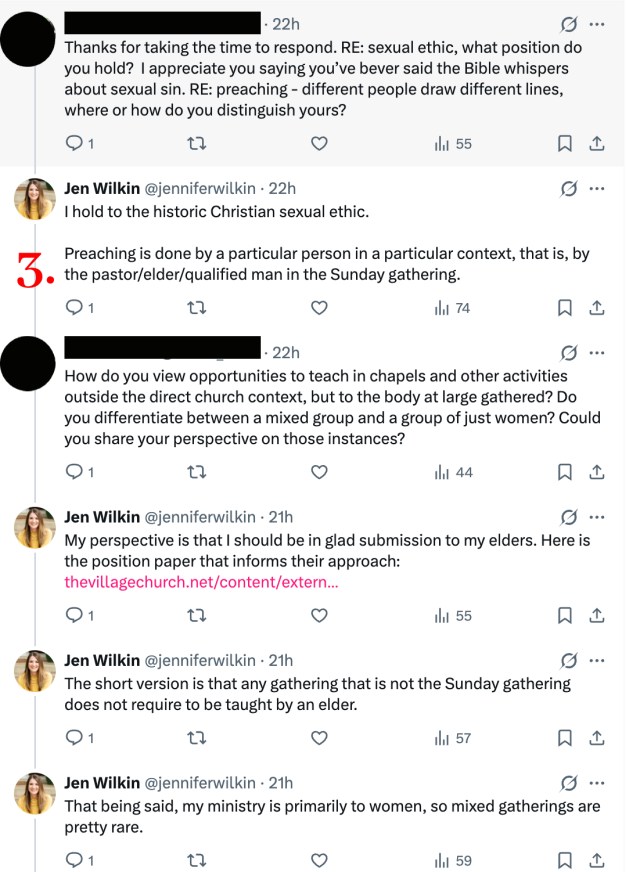
โ€œPreaching is done by a particular person in a particular context, that is, by the pastor/elder/qualified man in the Sunday gathering.โ€

Where does the Bible specifically say that, rightly handled and in context? Chapter and verse, please.


โ€œMy perspective is that I should be in glad submission to my elders. Here is the position paper that informs their approach:โ€

Christians are first and foremost to be in glad submission to Scripture, because Scripture is infallible and perfect, and elders – as your pastor, Matt Chandler, has amply demonstrated over the last several years – are not.

So if your elders are not upholding what Scripture teaches, and you are submitting to them, both you and your elders are in disobedience to Scripture, which is the standard for Christians.

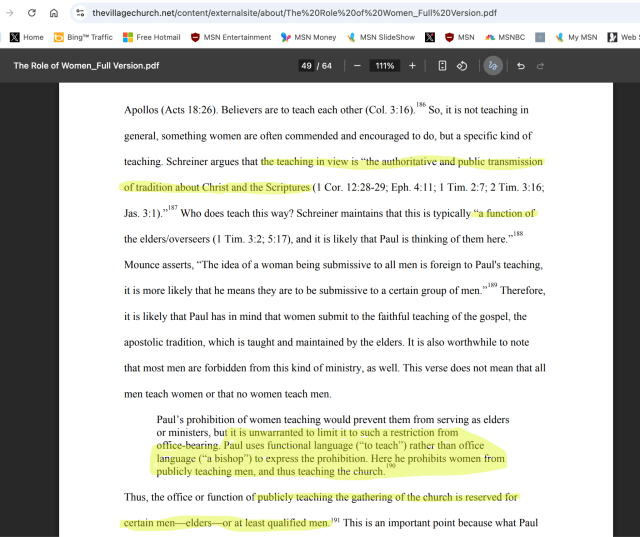
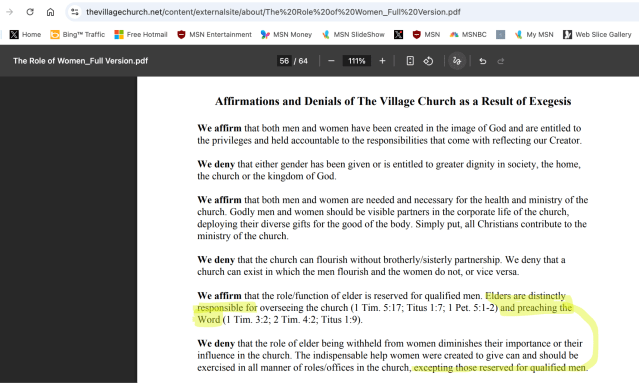
Nevertheless, in the document you cited, your own elders say this:

So your own elders say that publicly preaching the Word to the gathering of the church is restricted to men.

We often have to clarify to Believers and unbelievers alike that the โ€œchurchโ€ is not the building we meet in, itโ€™s the people – Christians. So whenever Christians are gathered for the purpose of worship, instruction in the Scriptures, etc., it is a gathering of the church, and the prohibition of women teaching men applies.

But, in any event, the document makes clear on p. 55 that this is the position of โ€œthe role of women at The Village Church.โ€ My article doesnโ€™t deal with you preaching at TVC, but at other gatherings of the church outside TVC, so TVCโ€™s policy for TVC is irrelevant to those events.


โ€œThe short version [of the TVC document] is that any gathering that is not the Sunday gathering does not require to be taught by an elder.โ€

I didnโ€™t see that statement or any statement similar to that in the document, but I may have missed it. What page is that on? 


โ€œThat being said, my ministry is primarily to women, so mixed gatherings are pretty rare.โ€

1. โ€œRareโ€ does not equal โ€œnot sinfulโ€. You still need to repent of preaching to men and stop doing it.

2. It doesnโ€™t look โ€œrareโ€ considering all of the instances Iโ€™ve cited in the article (and including any instances I may have missed and havenโ€™t included).

3. It isnโ€™t โ€œrare,โ€ as though you used to preach to men and no longer do. This is something youโ€™re continuing to do and currently doing. The GCD Cohort in which youโ€™ll be unbiblically instructing pastors started less than three weeks ago.


So, to summarize, you found one actual error of fact in this entire, lengthy article (which I apologized for and will gladly delete and explain to my audience). The remainder of the article – dealing with far more than youโ€™ve brought up here – is correct and is not โ€œbasic factual errorsโ€ or a โ€œmisrepresentationโ€ of your โ€œcharacter and actionsโ€.

And by implying that the article, overall, consists of โ€œbasic factual errorsโ€ and โ€œmisrepresents [your] character and actions,โ€ you have actually misrepresented my character and actions.

But all of that aside, whatโ€™s more important here is you. I care about you, and I hate to see you going down the same road that so many of your Lifeway Women compatriots – like Beth Moore, Lysa TerKeurst, Priscilla Shirer, etc. – have gone. 

I have taken a moment to pray for you, and, in love, I urge you to repent of the sins of preaching to men, yoking with false teachers, and the other things Iโ€™ve cited in the article, for the glory of God, for the good of your own soul before Christ, and for the biblical discipleship of your followers.

Discernment

The Mailbag: Do You Recommend Angie Smith (“Seamless”)?

If you are considering commenting or sending me an e-mail objecting to the fact that I warn against false teachers, please click here and read this article first. Your objection is most likely answered here. I won’t be publishing comments or answering emails that are answered by this article.

I get lots of questions about particular authors, pastors, and Bible teachers, and whether or not I recommend them. Some of the best known can be found above at my Popular False Teachers tab.

Generally speaking, in order for me to recommend a teacher, speaker, or author, he or she has to meet three criteria:

a) A female teacher cannot currently and unrepentantly preach to or teach men in violation of 1 Timothy 2:12. A male teacher or pastor cannot allow women to carry out this violation of Scripture in his ministry. The pastor or teacher cannot currently and unrepentantly be living in any other sin (for example, cohabiting with her boyfriend or living as a homosexual).

b) The pastor or teacher cannot currently and unrepentantly be partnering with or frequently appearing with false teachers. This is a violation of Scripture.

c) The pastor or teacher cannot currently and unrepentantly be teaching false doctrine.

Just to be clear, “not recommended” is a spectrum. On one end of this spectrum are people like Nancy Leigh DeMoss Wolgemuth and Kay Arthur. These are people I would not label as false teachers because their doctrine is generally sound, but because of some red flags I’m seeing with them, you won’t find me proactively endorsing them or suggesting them as a good resource, either. There are better people you could be listening to. On the other end of the spectrum are people like Joyce Meyer and Rachel Held Evans- complete heretics whose teachings, if believed, might lead you to an eternity in Hell. Most of the teachers I review fall somewhere in the middle of this spectrum (leaning toward the latter).


Angie Smith– Not recommended. Wife of Todd Smith of the Christian music group, Selah, Angie started out as a blogger, then blossomed into a Christian author and speaker. Her best known book to date is a women’s study: Seamless: Understanding the Bible as One Complete Story. 

While all of Angie’s currently scheduled speaking engagements appear to be for women’s events, she has preached at least one Sunday morning sermon (to a congregation of men and women)- at Cross Point Church.

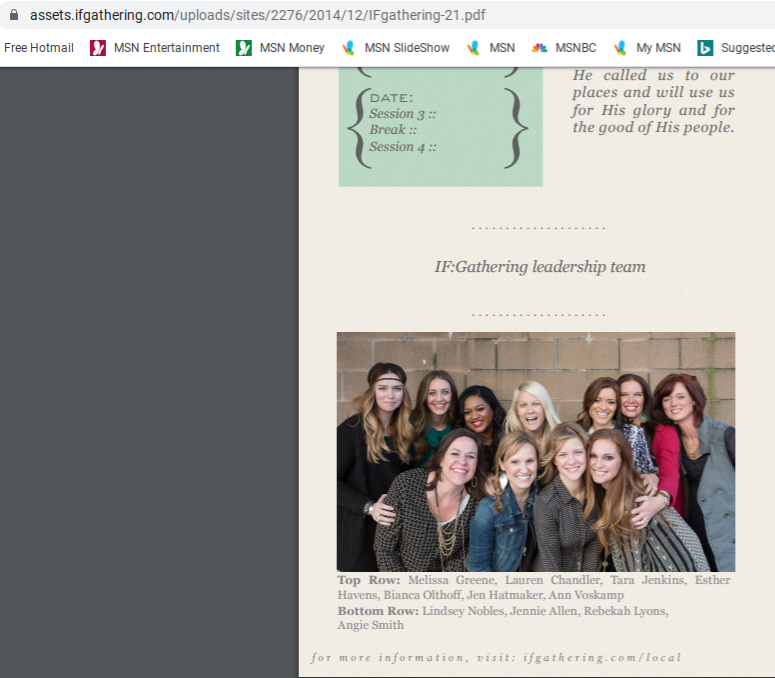
Angie is on the leadership team of Jennie Allen’s IF:Gathering conference (along with false teachers Jen Hatmaker, Ann VoskampRebekah Lyons, Bianca Olthoff, and Christine Caine), has been a featured speaker at IF several times, and is scheduled to speak again at IF:Gathering 2019. Angie’s first speaking engagement of 2019 is at a Methodist “church” at which nearly all the ministerial staff are women, including the senior and associate “pastors”. She’s speaking at three Women of Joy conferences alongside false teachers Sheila Walsh and Lisa Harper. Angie partnered with Lysa TerKeurst to offer an online version of her study, Seamless, through the Proverbs 31 website. Angie partnered with Christine Caine for the Women of Faith Conference, and has appeared on Priscilla Shirer’s The Chat.

It’s humorously played up, but Angie’s devotion to Beth Moore is a bit over the top. She calls herself “a little bit of a crazy stalker fan supporter of Beth Moore” and says her “favorite Bible teachers are Beth Moore and Priscilla Shirer,” adding, “Iโ€™m pretty sure they will both have special chairs very near to Jesus in heaven,” and “I have a little area of my house devoted to Beth Moore. Okay, thatโ€™s a lie too, but if it wasnโ€™t idol worship, I probably would. At least a little candle or something? framed pictures? A life-sized cardboard cutout? Such a delicate balance between admiration and a restraining orderโ€ฆ”

Space doesn’t permit me to list all the times Angie has partnered with false teachers nor all the false teachers she has partnered with. As I’ve previously mentioned, not only does surrounding yourself with false teachers influence your doctrine, it is impossible to be endorsed by so many false teachers unless your doctrine is acceptable to them, and they do not put up with sound doctrine.

Mailbag

The Mailbag: Potpourri (Soul Ties, SBC Communion, Women in children’s ministry, Heretical book disposal)

Welcome to another โ€œpotpourriโ€ edition of The Mailbag, where I give short(er) answers to several questions rather than a long answer to one question. I also like to take the opportunity in these potpourrri editions to let new readers know about my comments/e-mail/messages policy. Iโ€™m not able to respond individually to most e-mails and messages, so here are some helpful hints for getting your questions answered more quickly. Remember, the search bar can be a helpful tool!


I was wondering what your views were on โ€œungodly soul tiesโ€, in reference to past relationships? If I was in a previous relationship with someone who I was involved with physically, mentally, spiritually and emotionally, how would I loose myself from that?

The concept of “soul ties” is not biblical. It is not mentioned or even hinted at in the Bible. Proponents of this heretical doctrine, as you can see in this article, Basic Introduction to Soul Ties,ยน will try to convince you that soul ties are biblical by taking all manner of Bible verses out of context and stretching and twisting them like Silly Putty to try get them to mean what they want them to mean. All you have to do is look up the verses they cite, and read them in context to see that none of these passages say that one person’s soul can be literally bound to another person’s soul.

I find it especially laughable that many of the verses they cite in support of soul ties are the “one flesh” verses, such as Ephesians 5:31 (which is actually a quote of Genesis 2:24). Don’t you think that if God, the creator of language, meant to convey in these verses that two people’s souls were tied together, that He would have said “one soul” instead of “one flesh“? Or that He would have clearly said: “In this type of close relationship, the two people’s souls are bound together.”? This is God we’re talking about, here. He’s perfectly capable of explaining Himself clearly. He knows what words mean, and He never makes a mistake and chooses the wrong word. And yet, time and time again in Scripture, He uses the words “one flesh” to describe the intimacy of marriage and sexuality, and He never, anywhere in Scripture, even suggests that the souls of two people are bound together under any circumstances.

Soul ties are just one more piece of false doctrine usually taught by those in the heretical New Apostolic Reformation camp. (When I Googled “soul ties”, articles by Kris Vallotton {Bethel}, Terri Savelle Foy, and Paula White – all among the worst of the worst of the NAR and prosperity preaching – were on the first page of results. That should tell you something.) There is no way your spirit can be tied or bound to someone else’s spirit.

I’m not sure what you mean by being involved with someone “mentally” and “spiritually”, but I’m assuming you don’t mean that you were in Mensa together or that you had long talks about theology and frequently prayed together. Those might be fond memories that make you wistful, but no mental or spiritual activity you participate in with someone else binds your soul to his or is something you need to be “loosed” from.

What you need to do is read your Bible, understand what it says about sin, and if you sinned in any way in this relationship (for example, sex outside of wedlock, putting your love for this person ahead of your love for the Lord, being influenced by this person to lie, etc.) you need toย repent, not “be loosed” (because you’re not bound to this person, and because repentance from sin is the biblicalย way of thinking about this situation). You may also need to avoid spending time with or talking to this person for a while. And if you’re really having trouble getting over the relationship, you might want to seek counsel from a doctrinally sound pastor (one who understands that soul ties are unbiblical) or an ACBC certified Biblical Counselor.

That’s truly all there is to it. The spirit-realm mumbo jumbo of “soul ties” is a bunch of mystical malarkey. Your spirit isn’t tied to anyone else’s spirit, you’re just sad that the relationship is over, having difficulty moving on with your life, and, perhaps missing the person. And it’s OK if that sounds earthly and pedestrian. Because it is. But if Christ is your Savior, you can trust Him to carry you through it.

Here are some resources you might find helpful:

What does the Bible say about soul ties? at Got Questions

Soul Ties? I at Fighting for the Faith (starts around 34:14)

Soul Ties? II at Fighting for the Faith

ยนJust in case it isn’t abundantly obvious, this is a heretical New Apostolic Reformation article/website, and I certainly don’t recommend it.

We recently moved and have been attending a Southern Baptist church. They have not had communion for over two months. Isn’t it the norm to have communion at least once a month? 

Also there is no women’s ministry that I can be involved with which is very disappointing to me. I would even be willing to teach/lead a women’s study but since we are new to this church we are still waiting and learning our place. We hesitate to make ourselves known as possibly unsubmissive or question why they do things the way they do.

Why no communion or women’s Bible study? Your thoughts would be enlightening.

These are such great questions because they help me, as a Southern Baptist, think about the way we do things and how those practices might be perceived by visitors or new members.

Communion/Lord’s Supper:ย Every Southern Baptist church is autonomous, so each church has its own policy or practice about how often the Lord’s Supper is observed. There are some SBC churches who hold the Lord’s Supper every week and probably others who hold it only once or twice a year, although I don’t personally know of any who hold it that infrequently.

In my experience, most Southern Baptist churches observe the Lord’s Supper several times a year, usually on a schedule like the first Sunday of the month, once a quarter, or every “fifth Sunday” (in months that have five Sundays). In addition to these scheduled observances, many churches also observe the Lord’s Supper at their Christmas Eve, Good Friday, or Easter service.

Women’s Ministry:ย I understand your disappointment in the lack of women’s ministry at the church. I would be somewhat disappointed too. There could be a variety of reasons for this. Maybe they had a women’s ministry that veered off into error or personality conflicts, so the pastor put it on hiatus for a while. Maybe no one stepped up to volunteer to lead it. Or, maybe the pastor wants everyone’s focus to be on the worship service and Sunday School with no distractions. But even if there isn’t a formal women’s ministry, you can still invite women over to your home, go out for coffee or dinner together, or study God’s word and pray together with a few others. I found this article –ย Ministry to Women When Thereโ€™s No โ€œWomenโ€™s Ministryโ€ย – really helpful.

Asking Questions: I would encourage you and your husband to set up an appointment with the pastor and ask away! It is certainly not unsubmissive to sit in his office and politely say, “We’re new here and we were just wondering about…” Most pastors I know would love for potential members to do this. (In fact at my church, once a month my pastor holds a sort of “orientation”/Q&A class for potential members during the Sunday School hour.) You need to know where he and the church stand on various doctrinal issues and practices so you won’t be unpleasantly surprised after you’re already members. This is especially important if you’re new to being a Southern Baptist as well as being new to the church. If the pastor in any way discourages you from asking genuine, courteous questions or sees your questions as a threat to his authority, that’s a red flag telling you that you should not join this church.


In the past I purchased books and โ€œstudiesโ€ by authors I now know are false teachers- an embarrassing amount of them really. I am wondering now what do with all of them…I donโ€™t feel I am mature enough in my walk with Christ yet to read any of them and test them against Scripture myself, but I also donโ€™t feel like passing them on to someone else is right either. Just wondering your thoughts on this.

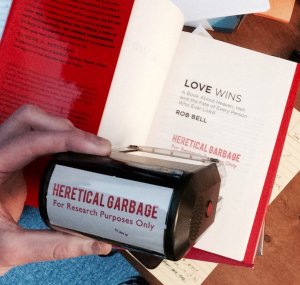
You’re correct, you should not pass on books containing false doctrine to others, donate them to libraries (especially church libraries), Goodwill, or thrift stores, or sell them in a garage sale. The only scenario I can think of in which passing along a book authored by a false teacher would be OK is if it is to someone you know is a mature, doctrinally sound Christian who needs it for research purposes or to write a review of it warning people away from it.

I would also suggest that you not simply throw throw the books in the trash or recycling unless you render them unreadable (ex: scribbling on or tearing up the pages) first. People have been known to take “freebies” out of the trash.

Here are two ways I’ve handled heretical books I’ve been given:

1. Keep them for research purposes. (If you think you might be tempted to read them and you don’t feel like you’re spiritually mature enough to handle that yet, maybe box them up and put them in storage for a later date.) You might want to mark them in some sort of way – in case you lose the book and someone else finds it or something like that – indicating that the book is false doctrine. My friend, Pastor Nate Pickowicz, has an awesome stamp for his “research only” books:

2. Burn them. I know it reeks of Nazism and censorship by wild-eyed preachers of yesteryear, but it’s biblical, it keeps false doctrine out of the hands of others, and these books can actually have a positive use for kindling if you have a fireplace or chiminea. (Please use all fire safety precautions. Also, it is not necessary to burn the books publicly.)


Is it Biblical for a woman to be in charge of the childrenโ€™s ministry? Especially one who is not doctrinally sound?

It isn’t biblical for anyone who’s unrepentantly and unteachably doctrinally unsound to be in charge of anything in the church.

If it’s a case like Apollos, in which the person in question simply doesn’t know any better, but changes her ways and embraces sound doctrine when corrected, that’s cause for giving glory to God. (Also, she might need more training in the Scriptures before she resumes her position of service.)

But if it’s a case in which the person persists in teaching false doctrine or acting sinfully, that’s cause for church discipline. And if she steadfastly refuses to repent despite biblical rebuke, she needs to be disfellowshipped from membership in the church. Of course, it should go without saying (unfortunately, it doesn’t these days) that people who aren’t church members and/or aren’t saved should not be given any position of service or leadership in the church.

It could be OK for a doctrinally sound woman to be in charge of the children’s ministry, depending what you mean by “in charge”, and depending on whether or not she can do so without violating Scripture:

1. She should not be considered as, or bear the professional title of, “pastor”. It is unbiblical for a woman to be a pastor, and if she’s not a pastor, then bearing the professional title of “pastor” is lying.

2. In her leadership duties, she should not teach adult men (for example, men who teach children’s Sunday School classes, if she oversees children’s Sunday School) the Scriptures or exercise authority over them.

3. The pastor, or an appropriate elder, should vet and approve any curricula and materials, guest speakers, activities, etc., she wishes to use.

If a pastor or elder oversees her leadership so that she is acting under his authority and at his direction, and she is not violating Scripture by preaching to men, teaching men Scripture, or exercising authority over men, I don’t see why it would be a problem for a woman to lead the children’s ministry. In fact, Christian women and churches who handle this properly could be a superb example and model for other Christian women and churches.


If you have a question about: a Bible passage, an aspect of theology, a current issue in Christianity, or how to biblically handle a family, life, or church situation, comment below (Iโ€™ll hold all questions in queue {unpublished} for a future edition of The Mailbag) or send me an e-mail or private message. If your question is chosen for publication, your anonymity will be protected.

Discernment, Mailbag

The Mailbag: Potpourri (Replacement Theology, Spiritual Gifts Test, Books by false teachers…)

Welcome to another “potpourri” edition of The Mailbag, where I give short(er) answers to several questions rather than a long answer to one question. I also like to take the opportunity in these potpourrri editions to let new readers know about my comments/e-mail/messages policy. Iโ€™m not able to respond individually to most e-mails and messages, so here are some helpful hints for getting your questions answered more quickly. Remember, the search bar can be a helpful tool!


Can you explain what replacement theology is?

I can, but there are pastors and theologians way smarter than I am who have done a much better job of it than I could. I reached out to my friend Pastor Gabe “WWUTT” Hughes for some help and he addressed the question in this episode of the When We Understand the Text podcast (starting at about 1:30):

WWUTT 565 Q&A Replaced Protesting Eligibility?

You may also find the following resources helpful:

The Church and Israel: The Issue at Ligonier

What is replacement theology / supersessionism? at Got Questions

What is replacement theology? at CARM

Supersessionism at Theopedia


I want to get more involved in serving my church. Can you recommend a spiritual gifts survey web site so I can find out what my spiritual gifts are and how I should be serving?


If you have a question about: a Bible passage, an aspect of theology, a current issue in Christianity, or how to biblically handle a family, life, or church situation, comment below (Iโ€™ll hold all questions in queue {unpublished} for a future edition of The Mailbag) or send me an e-mail or private message. If your question is chosen for publication, your anonymity will be protected.

Discernment, Mailbag

The Mailbag: Should I attend the “Bible” study to correct false doctrine?

Iโ€™ve been invited to join a ladiesโ€™ Bible study class thatโ€™s using a book by a well-known author and speaker. The woman who wrote the book is a false teacher. Should I accept the invitation and join the class in hopes of correcting the false doctrine that will be taught?

To join or not to join. I’ve been in the same situation myself, and I know many of my readers have as well. It can be a difficult decision to make. The Bible does say to avoid false teachers, but it also says they should be rebuked, and that older women are to โ€œteach what is good, and so train the young women…that the word of God may not be reviled.โ€

My counsel to those who have expressed concern to me over studies by Beth Moore, Priscilla Shirer, Lysa TerKeurst, etc. taking place in their churches is to pray that God would give them wisdom as to whether they should attend the study and biblically refute all the false doctrine that comes up (the rebuking/training perspective) or whether they should decline to attend the study (the avoiding perspective), giving anyone who asks a biblical explanation as to why you wonโ€™t be participating (also, kind of rebuking/training). There are a lot of things to take into consideration as you begin working through Scripture and prayer to reach a decision.

First, where is your pastor in all of this? Why is he allowing a study to take place that uses materials authored by a false teacher? Maybe he is familiar with the authorโ€™s materials and approves of them (in which case you have a bigger issue than whether or not to attend this particular class). But maybe heโ€™s a discerning-leaning guy whoโ€™s just not aware that this author teaches false doctrine.

Most pastors are extremely busy. They either donโ€™t have the time or donโ€™t know they need to make the time to vet the authors of the studies their church is using (I’m not excusing this state of affairs, I’m just saying- this is the reality we’re dealing with). And many of them simply assume that if the book comes from LifeWay (or another trusted Christian retailer), it must be OK. So, before making a decision about whether or not to attend the class, go to where the buck stops and humbly, patiently, and kindly find out where your pastor is about the issue. He might just pleasantly surprise you and cancel the class or insist that a doctrinally sound study be used instead, and your problem will be solved.

Next, if youโ€™re married, what does your husband have to say about it? There may be a logistical conflict – he prefers you not to be out that late at night alone for safety reasons, your child has to be picked up from soccer at the time the class meets, etc. – that will immediately solve your dilemma, or there may be some other reason he doesnโ€™t want you to attend the class. Since itโ€™s not sinful to decline attending the class, if your husband says no, you need to respect his decision and decline to join. (You also need to discuss with your husband the issue of approaching the pastor about the study. He might prefer to be the one to talk to him, or he might prefer the two of you talk to the pastor together, rather than you approaching the pastor on your own.)

But even if your husband leaves the decision up to you, ask for his counsel and perspective. Simply by virtue of being a man, a person with his own unique thought processes, and someone who knows you well, he can add invaluable insight that can help you reach a wise decision. This was certainly the case for me when I was faced with this situation. I was leaning toward declining to attend the study, but my husband gave me a whole new perspective and encouraged me to get involved in order to be a corrective influence and godly example to the other ladies. And he was right!

If youโ€™ve talked to your pastor and your husband and the dilemma is still before you, there are several things you need to think, pray, and study through as youโ€™re working toward a decision:

โ˜™Are you biblically knowledgeable enough to recognize and properly refute false doctrine? (It might help to get the perspective of your pastor, your husband, or a mature believer who knows you well and who will be honest with you.)

โ˜™Do you have the extra time to study and make notes ahead of time so you’ll be prepared to refute, with Scripture, during class?

โ˜™Is the study so replete with false doctrine that you’ll have to constantly be speaking up and people will just be annoyed and tune you out?

โ˜™Does your conscience prevent you from financially supporting the false teacher by buying her book for the study?

โ˜™Would it make a bigger impact on this particular group of ladies for you to attend and refute or to decline to attend with explanation? (Consider your influence on them, your reputation for sound doctrine among them, the dynamics of the group, etc.)

โ˜™What will be the repercussions of your actions (whether you decide to attend or decline) on the church at large? How might your family and/or your pastor be affected?

โ˜™Are you spiritually and emotionally prepared for the harsh backlash you will probably receive for refuting? Can you stand firm in the face of that, or will you cave?

โ˜™Are you in the โ€œcage stageโ€ of discernment with a โ€œmow โ€˜em down!โ€ disposition to match, or do you have the self-control required to follow the instruction of 2 Timothy 2:24-26: to be patient, kind, and not quarrelsome? Do you understand that the goal of discernment is to humbly rescue captives, not to prove how right and knowledgeable you are?

โ˜™Think outside the box. Is there another way to handle this situation besides attending/refuting and declining to attend? What about you (or a spiritually mature woman in your church- someone who is able to teach) offering to teach an alternative class that studies a book of the Bible?

Thereโ€™s no one size fits all answer to this question. Either of these options (or another) could be biblically wise depending on the people and situations involved. Talk to your husband and your pastor. Examine what Godโ€™s word says about false teachers. Pray for wisdom. Follow your biblically-informed conscience.


If you have a question about: a Bible passage, an aspect of theology, a current issue in Christianity, or how to biblically handle a family, life, or church situation, comment below (Iโ€™ll hold all questions in queue {unpublished} for a future edition of The Mailbag) or send me an e-mail or private message. If your question is chosen for publication, your anonymity will be protected.