Ezekiel Bible Study

Ezekiel ~ Lesson 3


Previous Lessons: 1, 2

Read Ezekiel 3:16-5:17

Questions to Consider

1. Review your notes from last week’s lesson and be reminded of the things that transpired in 1:1-3:15 that lead into, and set the stage for, this week’s passage. According to 3:16, how long after the events of 1:1-3:15 do the events of 3:16ff take place?

2. Read 3:16-21. What was the purpose of a (literal) watchman in Ezekiel’s day? Explain God’s charge to Ezekiel in this passage. Who was he to warn, and what was he to warn them about? What would be the consequences for Ezekiel for not warning the people as God commanded? What would be the result for him if he did obey God’s command to warn them?

Are there any general principles we can draw from this passage about our responsibility to share the gospel with the lost? What about confronting sin in a fellow Christian or warning the church against false teachers? Are the consequences Ezekiel faced for warning/not warning the same for Christians warning/not warning against sin and unbelief? Which New Testament Scriptures can you think of that would seem to be in line with, or would indicate a difference from, 3:16-21 for Christians?

What does this passage teach us about God’s perspective on sin and repentance?

3. Read 3:22-27.

What does 3:23 refer back to (hint- use your cross-references)? How did it benefit Ezekiel (in ch.1 and ch.3) to experience God’s glory right before God called him to do something difficult? How does immersing ourselves in the glory of God through His Word, prayer, and worship prepare us to do the difficult things He calls us to do?

What did God do to Ezekiel in 3:26-27? If Ezekiel was supposed to speak God’s word to the people, why would God make him mute? Why might God withhold His word or His truths from people? (3:26-27)

4. Read Ezekiel 4:1-5:17*.

If you’re unfamiliar with the Old Testament battle concept of siege and what siegeworks would have looked like, do some research as you consider chapter 4 (especially 4:1-3). It will give you a better understanding of the illustrations God was asking Ezekiel to set up and carry out in this passage. Sketch out or visualize what Ezekiel’s little diorama in 4:1-3 would have looked like. What did the iron wall and Ezekiel turning his face toward it represent?

Explain the message God is conveying to His people in 4:4-8. Using cross-references, commentaries, your Bible’s study notes, etc., what do the 390 years and 40 years represent? How does Ezekiel symbolically “bearing the punishment” and “laying down” his life for his people’s sin point toward Christ literally bearing the punishment and laying down His life for His people’s sin?

What part of the siege was God warning about in 4:9-17? What did the illustration of the bread mean? (4:16-17) Explain the concept of “uncleanness” for the Israelites and how horrifying and humiliating this part of God’s judgment should have been to them. Compare Ezekiel’s aversion to uncleanness to Peter’s. How is the concept of uncleanness an illustration of the holiness of God and His aversion to sin?

What was God’s message to the people in 5:1-4? (5:10b,12)

How did Israel’s sin compare to the sin of the pagan nations around them? (5:5-7) Make a list of the words and phrases in 5:5-17 that impress upon you just how deadly serious God is about sin and how intense is His wrath against sinners. When you finish making your list, read back through it and consider this wrath that God poured out on Christ on the cross as well as His mercy and grace in salvation toward you, a sinner.

As we continue on in Ezekiel, we will see other instances of God instructing Ezekiel to communicate His message through illustrations, dioramas, or a dramatic presentation rather than through a sermon or other direct verbalization. Why might this be God’s preferred method of communication with His people in these instances?


Homework

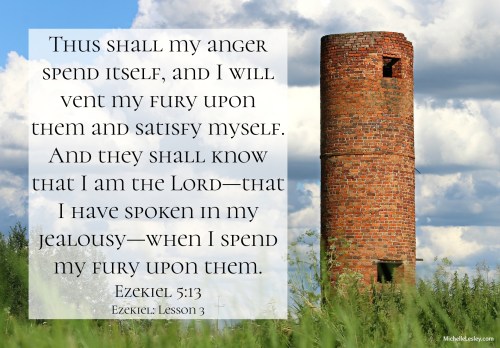
*(Homework is usually optional, but I’d really like you to do this one.) Ezekiel 5:13 is the first of 72 times in the book of Ezekiel that we will see the phrase (or some variant of it), “And they shall know that I am the Lord.” As we study through Ezekiel, keep a running list of each time you see this phrase, and write down who will know that He is the Lord, what will cause them to know He is the Lord, and why God wants them to know He is the Lord.

• Are you familiar with Ezekiel 4:9 Bread? Explain why their use of this Scripture is out of context for marketing their bread. Did God tell Ezekiel to make his bread from a combination of grains “to ensure unrivaled honest nutrition and pure, delicious flavors”? Think about the context of chapter 4 as you answer. Are you sinning if you eat this bread just because you happen to like it?


Suggested Memory Verse
 

Ezekiel Bible Study

Ezekiel ~ Lesson 2

Welcome, ladies! I’m so glad you’re here! I have received a lot of questions about the study that were answered in last week’s introductory lesson. Please do not skip Lesson 1 (link below). Not only will it answer any questions you may have about the study itself, but if you want to study Ezekiel properly, you must do the background work contained in Lesson 1.


Previous Lessons: 1

Read Ezekiel 1:1-3:15

Questions to Consider

1. Review your notes from last week’s introductory lesson. What are some things to keep in mind as you begin to study the text of Ezekiel today? Drawing from your notes and 1:1-3, imagine you’re a playwright and write the setting for the “script” of Ezekiel. Which phrases in verses 1 and 3 connect us to 2 Timothy 3:16?

2. Read 1:4-28. Does this passage remind you of any other biblical passages? Which ones, and why? Read through all of the cross-references and footnotes in this passage as well as any study Bible notes or commentaries you like on this passage in order to gain as good an understanding of it as you can. Why do prophetic visions of Heaven and the spiritual realm (apocalyptic passages) always seem so hard to understand? Is it OK if we read these passages and, despite our best efforts, don’t completely grasp all of the symbolism? Do you think Ezekiel understood everything he was shown?

What does 1:28b say that the main idea of 1:4-28a is? What was Ezekiel’s response to seeing the glory of God? (1:28b) How did being overwhelmed by God’s glory put Ezekiel in the right frame of mind and heart to receive and proclaim the message God subsequently gave him? (1:28b-2:2)

3. Read chapters 2-3.

Using your concordance, search the term “son of man“. Ignoring false results (ex: “son of Manasseh”), what are the main ways this term is used? How many times is Ezekiel called “son of man”? What other major Bible character is called the Son of Man? What is the difference between the reference to Ezekiel as “son of man” and Christ’s title “the Son of Man“?

To whom is God sending Ezekiel (2:3, 3:11), and why (2:4,7, 3:4,11)? How will Israel respond?(3:7) How would the pagans have responded if God had sent Ezekiel to them instead? (3:4-7) Explain the shame it should bring to God’s people – in Ezekiel’s day and today – when lost people respond to the preaching of God’s Word in repentance and faith, and those who claim to be His people do not.

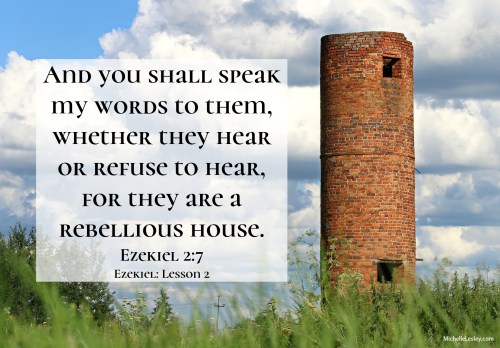
Compare God’s charge to Ezekiel to speak His word to His people “whether they hear or refuse to hear” to God’s charge to pastors to preach the Word to His people “in season and out of season” in 2 Timothy 4:1-2.

Explain the metaphor of Ezekiel eating the scroll in 2:8-3:3. How does this apply to us as Christians today?

Why was it bad for Israel to be “hard headed” but good for Ezekiel to be “hard headed”? (3:7-9) Explain why a pastor, or any Christian, needs to be “hard headed” (yet soft-hearted) when dealing with Believers (or false converts) who are disobedient to God’s Word.


Homework

•If you’re artistic, illustrate part or all of the scene in 1:4-28.

•Are you familiar with the “heavenly tourism” books like Heaven Is for Real or 90 Minutes in Heaven that were popular a few years back? Read some of the descriptions of “Heaven” found in these books and compare them with Ezekiel’s, Daniel’s, and Revelation’s descriptions of heavenly scenes. How do they compare?

•From what I can tell, this church has horribly unbiblical theology, so don’t follow them or their beliefs, but I loved their choir’s rendition of Ezekiel Saw the Wheel. Listen carefully to the lyrics (or Google them). How closely do they match up to Ezekiel 1:4-28 and/or other passages of Scripture?


Suggested Memory Verse

Ezekiel Bible Study

Ezekiel ~ Lesson 1- Introduction

Welcome to our new study: Ezekiel!

What is God’s perspective on sin?  What is His posture toward His people when they persist in sin…and when they repent? What was it like to be a prophet of (mostly) doom and gloom? For the next few months we’ll work our way through the book of Ezekiel, learning about the holiness of God and what it’s like to stand on God’s Word even when “God’s people” don’t want to hear it. You might be surprised to find out just how relevant this Old Testament book is to Christians today!

The image in the title pic for this study alludes to Ezekiel 33:7:

So you, son of man, I have made a watchman for the house of Israel. Whenever you hear a word from my mouth, you shall give them warning from me.

In Ezekiel’s day a watchman would be stationed in a watchtower in an area with good visibility so he could see if an enemy was approaching the city. The watchman needed good eyes and the ability to distinguish an enemy from an ally. If he spotted an enemy, he was to alert everyone to the impending threat and the need to mount a defense. God appointed Ezekiel a spiritual “watchman” to His people, Israel. The book of Ezekiel is God’s warning to His people – through the prophet Ezekiel – that the enemy of sin is overtaking them.

Parts of the book of Ezekiel can be a little challenging. Your comprehension will be challenged. Your patience might even be challenged. But it’s good to stretch ourselves and choose books that help us to develop discipline in our study of the Word, rather than always choosing the shorter or “easier” books of Scripture. I have complete confidence that you’re up for the challenge and that God will grow you in the grace and knowledge of Christ as you apply yourself to His Word.

Ezekiel is one of the longer books of Scripture, weighing in at 48 chapters. This means that instead of studying approximately one chapter per week in depth (as we usually do in my studies of shorter books), we will be covering at least two chapters (often more) per week with a broader perspective.

As I mentioned in this recent article on study resources, you might – particularly for this book of the Bible – want to invest in a good study Bible or at least check out some of the online resources that can help if you have questions while you’re studying.


If you’re new to using my Bible studies, just a few housekeeping items and helpful hints:

The studies I’ve written (you can find all of them at the Bible Studies tab in the blue menu bar at the top of this page) are like “training wheels”. They’re designed to teach you how to study the Bible for yourself and what kinds of questions to ask of the text so that, when you get the hang of it, you won’t have to depend on other people’s books and materials – even mine – any more. To that end, I do not provide answers for the study questions in the studies I’ve written.

My studies are meant to be extremely flexible and self-paced so that you can use them in the way that works best for you. You can do an entire lesson in one day or work on the questions over the course of the week (or longer). You do not need to feel obligated to answer all (or any) of the questions. If the Holy Spirit parks you on one question for several days, enjoy digging deep into that one aspect of the lesson. If He shows you something I haven’t written a question about that captures your attention, dive in and study it! Those are ways the Holy Spirit speaks to us through His Word. This is your time to commune with the Lord, not a school assignment or work project you are beholden to complete in a certain way by a certain deadline.

I will post a new lesson on the blog every Wednesday, so there is nothing to sign up for or commit to. Simply stop by the blog each week, or subscribe to the blog via e-mail to have the lessons delivered to your inbox.

I use hyperlinks liberallyThe Scriptures for each lesson will be linked at the beginning of the lesson and in the lesson questions. As you’re reading the lesson, whenever you see a word in a different color text, click on it, and it will take you to a Scripture, article, or other resource that will help as you study.

All of the studies I’ve written are suitable for groups or individuals. You are welcome to use them as a Sunday school or Bible study class curriculum (for free) with proper attribution.

You are also welcome to print out any of my Bible studies (or any article I’ve written) for free and make as many copies as you’d like, again, with proper attribution. I’ve explained more about that in this article (3rd section).


Introduction to Ezekiel

Before we begin studying a book of the Bible, it’s very important that we understand some things about that book. We need to know…

Who the author was and anything we might be able to find out about him or his background.

Who the audience of the book is: Jews or Gentiles? Old Testament Israelites or New Testament Christians? This will help us understand the author’s purpose and approach to what he’s writing.

What kind of biblical literature we’re looking at. We approach books of history differently than books of wisdom, books of wisdom differently than books of prophecy, etc.

What the purpose of the book is. Was it written to encourage? Rebuke? Warn?

What the historical backdrop is for the book. Is Israel at war? At peace? In exile? Under a bad king? Good king? Understanding the historical events surrounding a piece of writing help us understand what was written and why it was written.

When the book was written. Where does the book fall on the timeline of biblical history? This is especially important for Old Testament books which are not always arranged in chronological order.

So this week, before we start studying the actual text of the book of Ezekiel, we need to lay the foundation to understanding the book by finding the answers to these questions.

Read the following overviews of the book of Ezekiel, taking notes on anything that might aid your understanding of the book, and answer the questions below:

Bible Introductions: Ezekiel at Grace to You

Overview of the Book of Ezekiel at Reformed Answers

Summary of the Book of Ezekiel at Got Questions

1. Who wrote the book of Ezekiel? How do we know this?

2. Approximately when was Ezekiel written? What is the geographical setting of the book of Ezekiel? Here are some maps (scroll down to “Ezekiel”) that may be helpful as you study through the book of Ezekiel.

3. Who is the original, intended audience of the book of Ezekiel? Describe the historical setting (historic events, politics, sociology of the time, etc.) of Ezekiel.

4. Which genre of biblical literature is the book of Ezekiel: law, history, wisdom, poetry, narrative, epistles, or prophecy/apocalyptic? What does this tell us about the approach we should take when studying this book versus our approach to books of other genres?

5. What is the theme or purpose of the book of Ezekiel?

6. What are some of the major topics of instruction or exhortation in the book of Ezekiel? How do these topics relate to the theme of Ezekiel?

7. What are some ways Ezekiel points to and connects to Jesus?

8. What else did you learn about Ezekiel or the setting of this book that might help you understand the text of the book better?

Take some time in prayer this week to begin preparing your heart for this study. Ask God to give you wisdom and understanding for the text and a greater appreciation for his attributes of wrath and mercy as we study Ezekiel together.

Uncategorized

The Word on Wednesdays

Hi ladies! I hope you enjoyed our most recent Bible study, Living Stones: A Study of 1&2 Peter which we recently wrapped up.

I’m going to be taking a break on Wednesdays getting ready for our new study. I hope you’ll enjoy it and that it will edify you as you seek to grow in Christ and His Word. (The picture above does not mean we will be studying James. :0)

So, if you haven’t quite finished with the Living Stones study, you can use this time to finish up, and I’ll also be posting some articles from the archives that I think you’ll find helpful as we make our way toward our next study. Here is this week’s article:

Watching and Warning with Ezekiel

Through the Bible in 2014 ~ Week 36 ~ Aug. 31- Sep. 6
Ezekiel 16-34
Watching and Warning with Ezekiel

Well, Ezekiel is still prophesying (and he’ll still be prophesying until Saturday :0) God is still sending out the same message through him. Again and again, God chastises His people, trying to shake some sense into them so they will repent and turn back to Him… Continue Reading


Wednesday's Word

Wednesday’s Word ~ Ezekiel 18

For further study on the book of Ezekiel, try my study, Ezekiel.

ez 18 23

Ezekiel 18

The word of the Lord came to me: “What do you mean by repeating this proverb concerning the land of Israel, ‘The fathers have eaten sour grapes, and the children’s teeth are set on edge’? As I live, declares the Lord God, this proverb shall no more be used by you in Israel. Behold, all souls are mine; the soul of the father as well as the soul of the son is mine: the soul who sins shall die.

“If a man is righteous and does what is just and right— if he does not eat upon the mountains or lift up his eyes to the idols of the house of Israel, does not defile his neighbor’s wife or approach a woman in her time of menstrual impurity, does not oppress anyone, but restores to the debtor his pledge, commits no robbery, gives his bread to the hungry and covers the naked with a garment, does not lend at interest or take any profit, withholds his hand from injustice, executes true justice between man and man, walks in my statutes, and keeps my rules by acting faithfully—he is righteous; he shall surely live, declares the Lord God.

10 “If he fathers a son who is violent, a shedder of blood, who does any of these things 11 (though he himself did none of these things), who even eats upon the mountains, defiles his neighbor’s wife, 12 oppresses the poor and needy, commits robbery, does not restore the pledge, lifts up his eyes to the idols, commits abomination, 13 lends at interest, and takes profit; shall he then live? He shall not live. He has done all these abominations; he shall surely die; his blood shall be upon himself.

14 “Now suppose this man fathers a son who sees all the sins that his father has done; he sees, and does not do likewise: 15 he does not eat upon the mountains or lift up his eyes to the idols of the house of Israel, does not defile his neighbor’s wife, 16 does not oppress anyone, exacts no pledge, commits no robbery, but gives his bread to the hungry and covers the naked with a garment, 17 withholds his hand from iniquity, takes no interest or profit, obeys my rules, and walks in my statutes; he shall not die for his father’s iniquity; he shall surely live. 18 As for his father, because he practiced extortion, robbed his brother, and did what is not good among his people, behold, he shall die for his iniquity.

19 “Yet you say, ‘Why should not the son suffer for the iniquity of the father?’ When the son has done what is just and right, and has been careful to observe all my statutes, he shall surely live. 20 The soul who sins shall die. The son shall not suffer for the iniquity of the father, nor the father suffer for the iniquity of the son. The righteousness of the righteous shall be upon himself, and the wickedness of the wicked shall be upon himself.

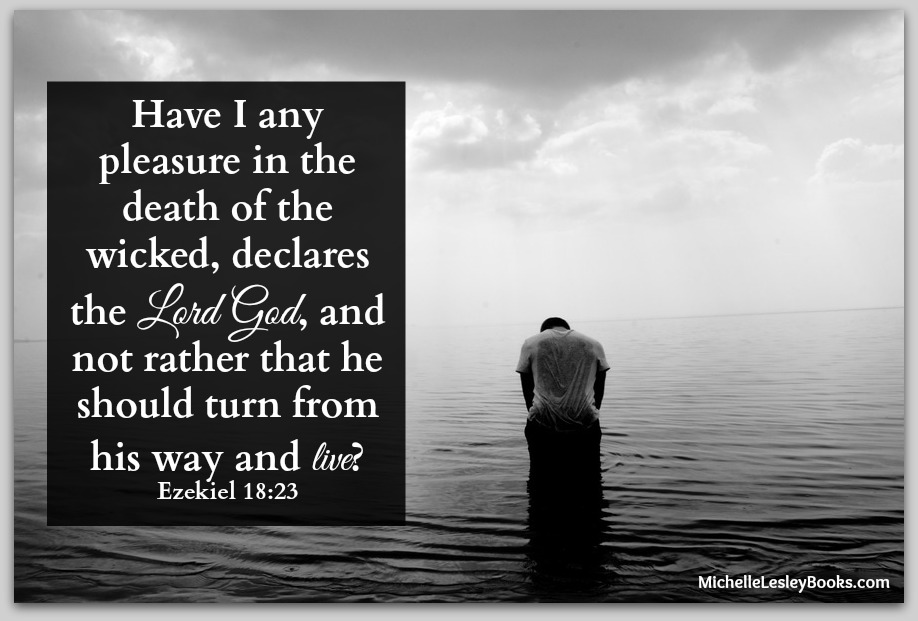
21 “But if a wicked person turns away from all his sins that he has committed and keeps all my statutes and does what is just and right, he shall surely live; he shall not die. 22 None of the transgressions that he has committed shall be remembered against him; for the righteousness that he has done he shall live. 23 Have I any pleasure in the death of the wicked, declares the Lord God, and not rather that he should turn from his way and live? 24 But when a righteous person turns away from his righteousness and does injustice and does the same abominations that the wicked person does, shall he live? None of the righteous deeds that he has done shall be remembered; for the treachery of which he is guilty and the sin he has committed, for them he shall die.

25 “Yet you say, ‘The way of the Lord is not just.’ Hear now, O house of Israel: Is my way not just? Is it not your ways that are not just? 26 When a righteous person turns away from his righteousness and does injustice, he shall die for it; for the injustice that he has done he shall die. 27 Again, when a wicked person turns away from the wickedness he has committed and does what is just and right, he shall save his life.28 Because he considered and turned away from all the transgressions that he had committed, he shall surely live; he shall not die. 29 Yet the house of Israel says, ‘The way of the Lord is not just.’ O house of Israel, are my ways not just? Is it not your ways that are not just?

30 “Therefore I will judge you, O house of Israel, every one according to his ways, declares the Lord God. Repent and turn from all your transgressions, lest iniquity be your ruin. 31 Cast away from you all the transgressions that you have committed, and make yourselves a new heart and a new spirit! Why will you die, O house of Israel? 32 For I have no pleasure in the death of anyone, declares the Lord God; so turn, and live.”


The Holy Bible, English Standard Version Copyright © 2001 by Crossway Bibles, a publishing ministry of Good News Publishers.


Questions to Consider:

1. What is the book of Ezekiel about? Which genre (history, poetry, wisdom, etc.) is the book of Ezekiel? What is the overall theme of chapter 18?

2. How do verses 5-9 describe a righteous man? What kind of heart would such a man have to have in order to consistently live this way? (9)

3. Who is the “he” in verses 11 and 12 referring to? Is this man to be punished for the sins of his son? (13) If the sinful man (14) fathers a righteous son (14-17) is the righteous son to be punished for his father’s sin? (17-18) Which verse(s) in this chapter sum up the principle of individual responsibility for sin? How does this chapter refute the false teaching of generational curses?

4. What can we learn about repentance from verses 21-32? In which does God take delight, pouring out His wrath on the wicked or pouring out His forgiveness on the repentant? (23, 32) How does this passage compare to 2 Peter 3:9?

5. Consider this chapter in light of the gospel. Is any person truly righteous? Where does the Christian’s righteousness come from? How does the New Testament describe Jesus, the righteous Son, being punished for our sin? What effect does this have on verse 4 (“the soul who sins shall die”)?