Complementarianism

Throwback Thursday ~ Putting on the “You Can!” of Complementarianism

Originally published October 18, 2019

It never really hit me until I started teaching the book of 1 Timothy how many instructions in the pastoral epistles pertain to women, and how weighty those instructions are. The pastoral epistles are the โ€œpolicy and procedure manualsโ€ for the church, and, far from relegating the ministry of women to nothing more than crafts and tea parties while the men do all the โ€œimportantโ€ stuff, you come away with the impression that a healthy, well-balanced church actually depends on godly women working hard to carry out the ministries that God has uniquely created and gifted us to fulfill, alongside men fulfilling their own ministries.

These epistles donโ€™t view โ€œwomanโ€™s workโ€ around the house of God as trivial or menial, but as a high and holy calling. Vital. Necessary. Honorable.

But is that the lofty perspective of the biblical role of women that the local complementarian church is conveying to its female and male members? Are we, especially those of us in womenโ€™s ministry, proactively teaching that the calling of motherhood or the task of discipling other women or serving those in need is qualitatively just as imperative and noble as the calling of pastor or elder?

Intentionally or not, the egalitarian movement has maneuvered biblical complementarians into constantly playing defense. Their offensive squad keeps moving the ball forward by offering women a no holds barred buffet of powerful and prestigious ministry positions. Our defensive line correctly and biblically pushes back with, โ€œNo, the Bible says women are not to โ€˜teach or to exercise authority over a manโ€™  in the church setting.โ€ But often, only two or three members of our offensive squad are dressed out to play, and they never get off the bench and into the game. And as any football fan knows, you have to have a good defense and a good offense if youโ€™re playing to win.

Egalitarians offer women โ€œyou can,โ€ but all too often all we complementarians have offered godly women yearning to serve is, โ€œyou canโ€™t.โ€ Where is the big, beautiful, biblical showcase of complementarian โ€œyou canโ€?

Not long ago, I was teaching a group of ladies the biblical process of putting off the old self and putting on the new self in Ephesians 4:20-32. We explored how interesting it was that every โ€œdonโ€™tโ€ in the passage was coupled with a โ€œdo.โ€ We donโ€™t just put off lying, we put on proactive truth-telling instead, and so on. Nature abhors a vacuum in the physical realm, and it would seem this is true in the spiritual realm as well. When we subtract the ungodly, we must replace it with the godly. If we donโ€™t, something will rush in to fill the void thatโ€™s been created, and that “something” isnโ€™t usually biblical or fruitful. 

So how can we shift the perspective in our churches from โ€œyou canโ€™tโ€ to โ€œyou can,โ€ and create an atmosphere, not merely of โ€œput off,โ€ but also โ€œput onโ€? How can we get our offensive team suited up, on the field, and moving the ball toward the goalpost while at the same time retaining a strong defense?

We can, so to speak, make complementarianism great again. 

As I studied 1 Timothy 5, I was struck by Paulโ€™s description of women who are โ€œtruly widows.โ€ These are women who have spent their lives being busy and intentional about the work of the Lord in their homes and in the church. They adorned themselves with the good works proper for women who profess godliness, and they were honored and revered for it by the church. I didnโ€™t come away from this passage with the feeling that these women were frustrated, oppressed, or seen as โ€œlesserโ€ by the church because they werenโ€™t allowed to teach or exercise authority over men. I came away from this passage thinking, โ€œThose women were awesome. Thatโ€™s the kind of woman I want to be.โ€

What would the climate in our churches look like if womenโ€™s ministries and the church at large recaptured that same reverential posture and purposefulness toward biblical womanhood? If, instead of teaching the biblical role of women strictly as, โ€œYou canโ€™t eat the fruit from this apple tree,โ€ we followed that admonition with a grand tour of the Garden, focusing on the delicious fruit of the pear tree, the cherry tree that needs a good pruning, the fig tree just waiting for the right woman to come along, harvest its fruit, and make some preserves, the banana tree that needs an expert in fertilizers, and the orange tree dying for someone to water it?

In my experience, what happens in churches of that climate is that – just like the godly widows of 1 Timothy 5 – women are so busy and fulfilled tending the other trees of the Garden, that they have neither the time nor the desire to go apple picking. 

May our churches strengthen themselves and grow to more robust spiritual health by proactively encouraging Christian women to joyfully throw ourselves into the godly โ€œgood works which God prepared beforehand, that we should walk in themโ€ – the biblical โ€œyou canโ€ of complementarianism.


Additional Resources

Rock Your Role: Jill in the Pulpit

Let Me Count the Ways: 75 Ways Women Can Biblically Minister to Others

Unforbidden Fruits: 3 Ways Women MUST Lead and Teach the Church

Servanthood

The Servanthood Survey

Complementarianism

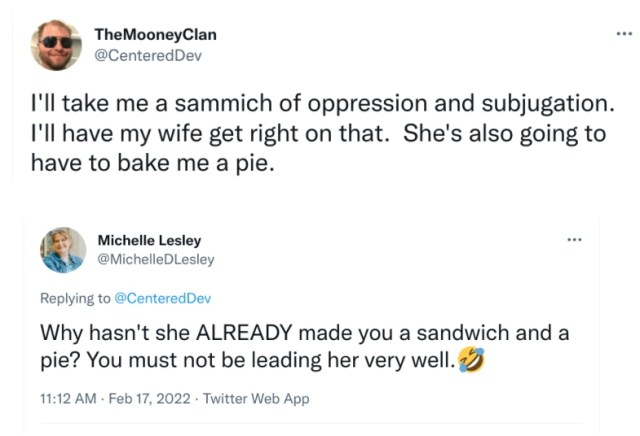
Sammiches of Oppression and Subjugation

Obviously, there are many, many serious issues in the church and world today, and if youโ€™ve followed the blog for any length of time, you know I have a good track record of dealing with those issues on a regular basis in a serious way: Bible study…the gospel…sin…obedience to Scripture…discernment…and so on.

But sometimes, as human beings, we just need a momentary break from the serious to be silly and laugh. Ecclesiastes 3:4 says that just as there is a time to weep, there is an equally valid, and righteous, and good time to laugh. Sometimes I talk to Christians who seem to believe that weโ€™re supposed to have our sense of humor amputated when we get saved, and thatโ€™s just not true. Proverbs 17:22 says:

A merry heart doeth good like a medicine: but a broken spirit drieth the bones. Proverbs 17:22

We need to laugh. We need moments of of refreshing.

If you disagree with any of that, or you just don’t like, or are easily offended by humor for whatever reason, this would be a good time to stop reading and go do something you enjoy, or tackle that “to do” list, or whatever. You’ve been warned. No complainies.

In case you’ve somehow managed to avoid them, there are feminists out there who can’t wrap their tiny little closed minds around the fact that godly women actually find joy in loving and serving our husbands and families. They seem to think – out loud, vociferously, and frequently, particularly on social media – that the only reason a woman might do such a thing is because she’s been brainwashed, downtrodden, or forced to.

So, I did a thing on Twitter the other day, and I thought it might give you a smile…

Everything – I mean, everything – has to be caveated and explained to death these days (are y’all as sick of that as I am?)…

I kid you not, somebody asked me what my motive was for saying, “I *are* one,” instead of, “I *am* one.” Humor, my friend. Humor.

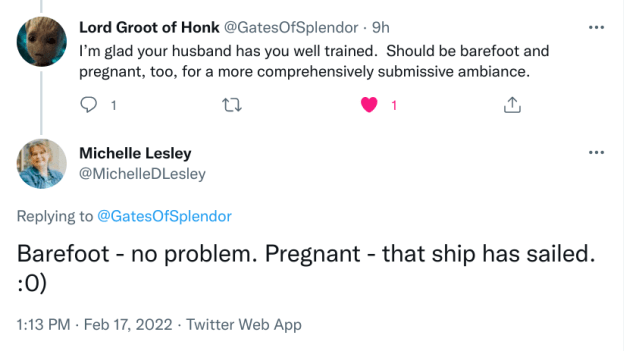
Of course, then everybody had to get in on the act. Back off, people. Can’t you tell I’m a humor professional?

Men. They’re just lost without a helper.

Leslie is usually so on the ball with these sorts of things. It’s not like her to leave out an ingredient.

I started to say, “That heifer is out of the barn,” but I’m sure that’s sexist…to somebody.

These men will never learn…

That’s right, just keep on wallowing in your wrongy-wrongness of manhood.

Yes, three slices. That’s why you’re still aspiring, honey.

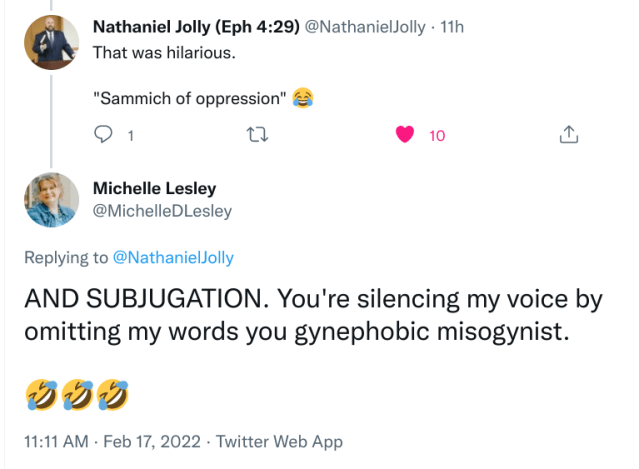
Everybody’s a comedian. But since he’s a MAN, I’ll let him have the last word, as is fitting.

Now get in the kitchen and make your man a sammich of oppression and subjugation, ladies. (My husband said it was OK for me to say that. :0)

Complementarianism, Podcast Appearances

Podcast Guest Appearance – Servants of Grace

Before all the hubbub of the holidays, I had the pleasure of sitting down for a chat with Dave Jenkins of the Servants of Grace podcast.

Listen in (or watch and listen above) as we delve into the issue of women pastors and why this is such a blight on the modern day church, how the church can support women and foster Titus 2 relationships, and more!

Be sure to check out all of the materials, podcasts, and other contributors at the Servants of Grace website, and find their social media links so you can give them a follow. Also, go subscribe to the Servants of Grace YouTube channel so you’ll never miss an episode, or add it to your queue on your favorite podcast platform.

Articles / resources mentioned or touched on in the episode:

Bible Studies

Speaking Engagements

Rock Your Role: Jill in the Pulpit

Let Me Count the Ways: 75 Ways Women Can Biblically Minister to Others

The Servanthood Survey

A Word Fitly Spoken Podcast

Contact & Social Media

Searhing for a new church?


Got a podcast of your own or have a podcasting friend who needs a guest? Need a speaker for a womenโ€™s conference or church event? Click the โ€œSpeaking Engagementsโ€ tab in the blue menu bar at the top of this page, drop me an e-mail, and letโ€™s chat!

Church, Complementarianism, Worship

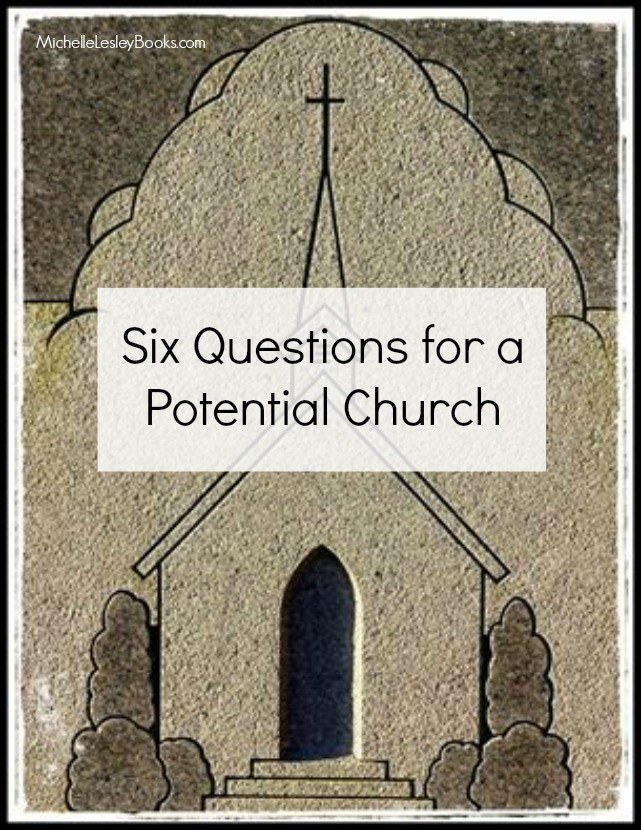
Throwback Thursday ~ Six Questions for a Potential Church

Originally published March 27, 2015

church questions1

Have you ever had to look for a new church? Even with recommendations from godly friends, it can be hard to know which churches and pastors are doctrinally sound, and, of those doctrinally sound churches (because you certainly don’t want to go to one that isn’t doctrinally sound), which ones would be a good fit for your family.

There are lots of great articles out there with good, probing questions you should ask about the theology and doctrine of a church you’re considering. (I would recommend this one, this one, and this one. Also, make sure you understand these doctrinal issues and that the church you’re considering lines up with Scripture on these issues.) However, there are times when the answers to these types of questions don’t give you the whole picture of what is actually going on in a church on a day to day basis. In other words, sorry to say, a church can give you all the right answers on paper (or on their web site), but their practices don’t mirror those answers. Additionally, there are some non-doctrinal issues that are important to know about that questions about soteriology, baptism, biblical inerrancy, etc., won’t give you the answers to.

My husband and I are currently looking for a new church for our family. Since we are Southern Baptist and somewhat familiar with the handful of Southern Baptist churches we’re looking at, we already know the answers to the most important questions (the inspiration of Scripture, the divinity of Christ, the way of salvation, etc.) But I want to zoom in a little more on the finer points of belief and practices of these churches, so here are some questions I might ask the pastor of the church we would potentially join.

1.
Which Christian authors have had the biggest impact on your life, beliefs, and ministry?

When I ask this question (and look over the pastor’s shoulder at the titles on his bookshelf), I’m listening for the names of authors and pastors, living or dead, that I know are committed to sound biblical doctrine. If I hear a name like Joyce Meyer, TD Jakes, Andy Stanley, Steven Furtick, Perry Noble, Rick Warren, Beth Moore, or any Word of Faith or New Apostolic Reformation personality, I’m going back to ask more probing doctrinal questions. If I hear multiple names like those, I’m outta there.

2.
Are you/this church complementarian or egalitarian?

Now you may not be familiar with those terms but any Christian pastor should be. It is a current issue in evangelicalism, and it’s part of his job to stay abreast of such things. I’m not looking for a pastor to be an expert on this topic, but he should be familiar with the terms and have a working understanding of the issues at play as well as the applicable Scriptures, and he should embrace and practice complementarianism as the biblical position.

Because I have been given the right “on paper” answer to this question in the past only to find out later that the church’s practices didn’t match up with its profession, I will probably ask the follow up question: “In what positions of leadership are women currently serving? Do any of them hold authority over men or instruct men in the Scriptures?” If I hear that women are (or would be allowed to in the future) teaching co-ed adult Sunday School classes, giving instruction during the worship service, serving on committees in which they hold biblically inappropriate authority over men, etc., that’s problematic.

3.
Can you give me some examples, from any time during your career as a pastor, of church
discipline issues that have arisen and
how you have handled them?

I’m looking for three things here. First, what does this pastor think constitutes a church discipline issue? If he thinks it’s necessary to discipline a female church member for wearing pants instead of a skirt, that’s an issue, because he’s disciplining someone who’s not sinning. If he doesn’t think it’s necessary to discipline church members who are unmarried yet cohabiting, that’s an issue because he’s not disciplining people who are sinning. Church discipline should only be exercised over unrepentant sinful behavior.

Second, is he afraid to exercise church discipline? Generally speaking, someone who has been a pastor for many years and has never handled a church discipline issue is either woefully ignorant of the biblical requirement of a pastor to rebuke those in sin, or he is afraid to rock the boat because he might get fired. Both of these are huge red flags.

Third, how does he exercise church discipline? Does he follow the steps outlined in Matthew 18 and other Scriptures with a heart to see the church member repent and be reconciled to Christ and the church body? Is he harsh and condemning? Is he firm enough in his resolve to carry all the way through to disfellowshipping a church member if necessary?

4.
How much oversight do you (or an
associate pastor or elder) have over the
women’s ministry at this church?

With this question, I’m trying to find out how much the pastor knows about what’s actually going on inside the women’s ministry (if they have one) and how much responsibility he takes to make sure all teaching and activities are in line with Scripture. Does he research and approve all teaching materials before a women’s Bible study commences? Does a women’s ministry director have complete autonomy over all materials and activities? Are all of the women in leadership positions in the women’s ministry godly and spiritually mature? Would any of the women’s ministry leadership raise a stink if someone showed them from Scripture that a Bible teacher whose materials they use or a women’s ministry activity they enjoy is unbiblical?

5.
Does the music ministry at this church follow a
minister of music model or a concert model?

There’s nothing wrong with Christian concerts per se, but my husband and I feel strongly (notice, I did not say “the Bible says”) that the worship service is not the place for one. We believe that a minister of music, preferably one who is ordained to the ministry, should lead and take responsibility for the church’s worship in a pastoral role. He should be trained in the Scriptures, preferably at seminary, in order to rightly handle and apply them to the music portion of the worship service and other music programs. He should also be trained in music theory and conducting so that he is able to lead in the practical aspects of music.

By contrast, we do not believe that making the music portion of the service like a concert, in which a band gets up and plays in a dark room with a laser light show and a smoke machine and the congregation can sing along if they want to, if they happen to know the songs, and if they are able to follow the ad libbing of the lead singer, is conducive to worship. We believe this tends to make the worship band into entertainers and the congregation into spectators, whereas the minister of music model fosters an atmosphere of “we’re all pulling together to do the work of worship as a unified body.”

This is not about contemporary music versus hymns, it is about one worship model versus another. It is our conviction (again, not a biblical mandate, but our strongly held conviction) after more than two decades in music ministry ourselves, that the minister of music model – regardless of the genre of worship music used – is the one most conducive to strong, biblical congregational worship. So this is something we’re going to want to know about, even though it is not necessarily a doctrinal issue.

6.
Do you preach topically or expositorily or both?

Topical preaching is when the pastor selects a topic to preach on (parenting, money, etc.) and uses biblical passages that apply to that topic to form his sermon. Pastors who preach expositorily usually preach through a book of the Bible from beginning to end before moving on to the next book.

Both are valid forms of preaching as long as God’s word is rightly handled and applied. However, it has been my experience that pastors who preach exclusively topically have more of a tendency to lift Bible verses out of their context in order to make them fit the topic they’re preaching. This is usually not as much of an issue for pastors who preach expositorily because they are simply preaching the Word, verse by verse, in its context.

Additionally, expository preaching gives church members a better understanding of Scripture and how it fits together, and exposes them more thoroughly to a wider range of biblical truth than exclusively topical preaching does. Therefore, I am looking for a pastor whose preaching style leans mostly towards expository, but who isn’t afraid to preach topically if he believes the church needs instruction on a certain topic.

So, those are some of the questions I’m thinking about asking. What questions would you ask when considering a new church?


For more resources on finding a new church, or what to look for in a church, click the Searching for a new church? tab in the blue menu bar at the top of this page.

Podcast Appearances

Interview with Doreen Virtue on Beth Moore

It was such a pleasure to once again appear on my friend Doreen Virtue’s videocast. We had a warm time of fellowship around the Word discussing Beth Moore, false doctrine, the sufficiency of Scripture, the role of women in the church, and more.

I encourage you to check out Doreen’s website, and follow her on social media. Doreen is most active on Instagram, but you can also catch her on Facebook. Be sure to subscribe to Doreen’s YouTube channel so you won’t miss any of her videos. I also highly recommend Doreen’s book, Deceived No More.

Articles / resources mentioned or touched on in the videocast:

Basic Training: The Bible Is Sufficient

Living Proof You Should Follow Beth (No) Moore

Rock Your Role: Jill in the Pulpit

The Mailbag: Counter Arguments to Egalitarianism

Rock Your Role: Oh No She Di-int! Priscilla Didnโ€™t Preach, Deborah Didnโ€™t Dominate, and Esther Wasnโ€™t an Egalitarian

Rock Your Role FAQs

A Word Fitly Spoken Podcast

The Mailbag (This isn’t a newsletter, but a weekly {Mondays} blog article.)

Popular False Teachers & Unbiblical Trends

Recommended Bible Teachers

Bible Studies

Speaking Engagements


Got a podcast of your own or have a podcasting friend who needs a guest? Need a speaker for a womenโ€™s conference or church event? Click the Speaking Engagements tab in the blue menu bar at the top of this page, drop me an e-mail, and letโ€™s chat!