Guest Posts, Sanctification

Guest Post: God Is Not an Experience

If your theology pretty much matches up with mine (as outlined in the “Welcome” and “Statement of Faith” tabs) and you’d like to contribute a guest post, drop me an e-mail at MichelleLesley1@yahoo.com,
and let’s chat about it.
rachel williams god experience

God Is Not an Experience
by Rachel Williams


Lysa TerKeurst recently posted this on social media: “I want to stop thinking of reading my Bible as an item on my Christian checklist & really experience God instead.” It was splashed across a pretty picture of a stylish woman sitting on a bench reading her Bible, and within a matter of hours, dozens of women I know had shared the picture with a remarks like, “amen,” “me, too,” and, “my heart’s desire.”

lysa t

Sisters, God is not an experience.

Disney World is an experience. Child birth is an experience. Living through a natural disaster is an experience. But God is not an experience.

God is holy. God is righteous. God is Creator, loving, personal, immutable, perfect, just. But He is not an amusement park ride waiting for us to hop on and try.

In Scripture, the word “experience” is used only in concrete fashion; it ties into things that people actually taste, touch, see, hear, or smell. It is a word used to describe people’s lives here on earth, and it has nothing to do with their relationships with God, unless it is describing judgment. “Experiencing” God is not a scriptural idea, at all. But let’s go ahead and look at how people “experienced” God in the Bible:

When the prophets of Baal “experienced” God on Mt. Carmel in I Kings 18, it was in the form of fire from heaven. They reacted by falling on their faces in fear. When Job “experienced” God in Job 38-41, his response was to retract all of his previously spoken words (and there were a lot of them), and repent in dust and ashes (Job 42:6). When Isaiah “experienced” God in a vision of the throne room of Heaven, he responded by saying, “Woe is me, for I am ruined! Because I am a man of unclean lips, and I live among a people of unclean lips; For my eyes have seen the King, the Lord of hosts” (Isaiah 6:5). Isaiah was convinced he was going to drop dead because he had seen God in a vision.

Oh, I hear you arguing that I’m using “Old Testament God” examples. So what about Jesus?

In Acts, when Saul is on the road to Damascus, and Jesus appears to him to convert him, his reaction is to fall to the ground in fear (Acts 9:4). When Jesus is having dinner with Mary, Martha, and Lazarus, Mary falls at His feet and washes them with costly perfume and her hair (John 12). At the death of Jesus, a Roman soldier became very frightened and recognized who Jesus really was – the Son of God (Matthew 27: 54). In Revelation, toward the end of his vision, John sees Jesus, and John, who had walked with Jesus as His most beloved disciple and knew Him incredibly well, falls down at the feet of the angel showing him the vision.

People fell to their faces when they “experienced” Jesus, too, especially near to and after His death.

God Himself says in Isaiah, “And there is no other God besides Me, a righteous God and a Savior; There is none except Me. Turn to Me and be saved, all the ends of the earth; For I am God, and there is no other. I have sworn by Myself, the word has gone forth from My mouth in righteousness and will not turn back, that to Me every knee will bow” (Isaiah 45:21-23).

I question whether anyone truly wants to experience God. The Bible says no one can see Him face to face and live. I imagine what they really mean is that they want to hear from God, but Hebrews 1:1-2 tells us that, “In the past God spoke to our forefathers through the prophets at many times and in various ways, but in these last days he has spoken to us by his Son.”

God only speaks to us through His scriptures now, He does not speak to us audibly. If you want to know God, you actually need to read your Bible; you need to study the Scriptures, which is the exact opposite of what Mrs. TerKeurst was suggesting in her cute little meme. Second Timothy 3:16-17 promises that “all Scripture is God-breathed and is useful for teaching, rebuking, correcting and training in righteousness, so that the man (woman) of God may be thoroughly equipped for every good work.” Where do we find the Truth of God? In His Word.

Knowing God is simply a matter of knowing His Word. Reading His Word tells you His thoughts, gives you guidance, and explains His plans for you (Matthew 28: 19-20 is His plan for every believer, by the way). There is no “experience” that you are missing out on when you choose to read your Bible, pray, and read your Bible some more.

Sisters, reading your Bible? That is experiencing God.


Additional Resources:

Leaving Lysa: Why You Shouldn’t Be Following Lysa TerKeurst or Proverbs 31 Ministries

Weak Women and the Idolatry of Personal Experience


Discernment, False Teachers

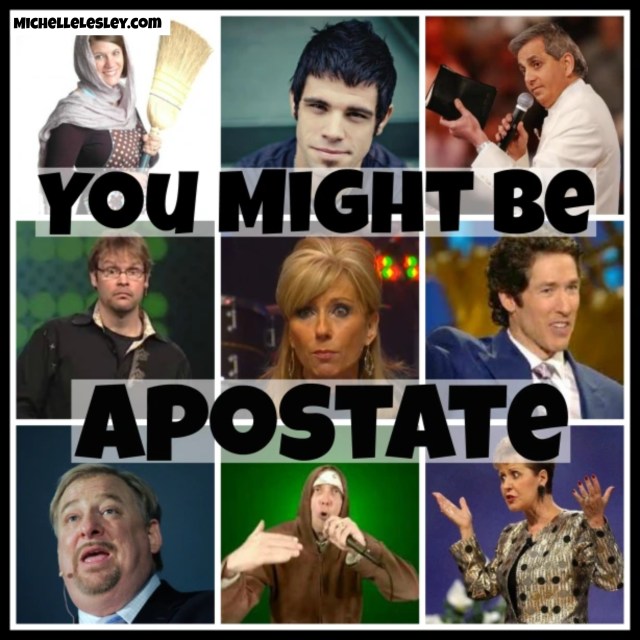
You Might Be Apostate

Comedian Jeff Foxworthy hit the big time several years ago with his “You Might Be a Redneck” one-liners. He frequently introduced the bit by saying, “I’ve found that there are rednecks all over, but sometimes people don’t know they’re rednecks. So, I came up with this little test…” and continued with such gems as:

“If you’ve ever had to carry a bucket of paint to the top of a water tower to defend your sister’s honor, you might be a redneck.”

“If your wife has ever said, ‘Honey, come get this transmission out of the tub so I can take a bath!’ you might be a redneck.”

“If you’ve ever been accused of lying through your tooth, you might be a redneck.”

It was a routine that a lot of us in the South found hilarious because we knew someone (or were someone) who fit nearly every one of Jeff’s jabs.

Like rednecks, there are apostate false teachers all over the place out there, only a lot of them (and their disciples) don’t know they’re false teachers. And the fruit of their lives and ministries is far wackier than anything a redneck has ever dreamed up. That fruit is a sign that we’d better examine the root of doctrine from which the fruit sprang.

So if any of the preachers and teachers you’re following have ever said or done the following things (or something even crazier), watch out, because they Might Be Apostate.

HoNuthaLevel

If you’re a middle aged pastor who makes embarrassing rap videos, who publicly extols the virtues of Spanx for men (even though it gives you gas) and who calls himself a Ferrari you might be apostate.

If you feature a Naked Cowboy impersonater (aka- your youth “pastor”) at your “Christian” women’s conference, you might be apostate.

If you’ve ever purposefully applied the pronoun “herself” to God, you might be apostate.

If you celebrated your 35th birthday by preaching at the “church” of your mentor, T.D. Jakes, and placing a $35,000 check in his offering wheelbarrow, you might be apostate.

If God has ever told you to go up to a stranger in the airport and ask if you can brush his hair, you might be apostate.

If you’ve ever given your congregation a sob story about needing a new $70 million Gulfstream jet, because the old one is worn out, you might be apostate.

If you think of the Holy Spirit as the “sneaky,” “silly,” “funny,” “blue genie from Aladdin,” you might be apostate.

If you’re a woman who thinks God is OK with you preaching to men despite what His word clearly says to the contrary, you might be apostate.

If you’ve ever said, regarding your church’s worship service, “I probably wouldn’t have a stripper on stage…” but leave the door open to the idea because “God told Isaiah to walk around naked for three years,” you might be apostate.

Benny Hinn at Maple Leaf Gardens on Sept. 28, 1992 photos by Tony Bock/Toronto Star and handout photo.

If you think smacking people in the face with your Nehru jacket is a ministry of the Holy Spirit, you might be apostate.

If you’ve ever typed a Facebook status in tongues, you might be apostate.

If you say you’re a trinitarian, but think the Father, Son, and Holy Ghost are three “manifestations” of God rather than three Persons, you ARE apostate.

If you think Proverbs 21:9 means you should camp out on your roof in a quest for biblical womanhood, you might be apostate.

If your senior pastor father sexually abused boys at your church and paid them off to keep them quiet and you, as the subsequent pastor, knew about it but didn’t speak up, you might be apostate.

If you officiated at your homosexual son’s “wedding,” you might be apostate.

If you’re a pastor who thinks expository preaching is “cheating” because it’s “too easy” and that “it’s not the way you grow people” AND that we shouldn’t say “the Bible says…” AND that parents who take their children to a small church instead of a mega church are “stinkin’ selfish,” AND that we shouldn’t use the Bible to convince the lost of their need for Christ, you might be apostate.

If you’re Oprah’s idea of an awesome pastor, you might be apostate.

download

If your preaching, ministry, and theology have ever been publicly rebuked by John MacArthur, Paul Washer and Steve Lawson, you might be apostate.

If you partnered with a Roman Catholic mystic with a degree in spiritual psychology to make a completely unbiblical movie about the Bible featuring ninja angels and Mary Magdalene bossing the disciples around, you might be apostate.

If you and your 80s rock star third husband stand in the pulpit and tell people to watch porn to improve their sex life, you might be apostate.

If a feature of your “worship service” is people laughing uncontrollably or barking like dogs, you might be apostate.

If you’ve ever decided to “p*ss off the religious people” on Easter Sunday by playing AC/DC’s Highway to Hell to open the service, you might be apostate.

If you’ve written a book entitled “I Am” and it’s about positive confession rather than Jehovah, you might be apostate.

If you think you have the power to control the weather by the words you speak, you might be apostate.

Joyce-Meyer-600x450

If you think that between the cross and the resurrection Jesus went to Hell and that Satan and the demons jumped up and down on His back, you might be apostate.

If the top three “pastors” you encourage people to follow on Twitter are T.D. Jakes, Rick Warren, and Joel Osteen, you might be apostate.

If a currently practicing homosexual couple wants to serve in leadership at your church and your only problem with it is that one of them isn’t yet divorced from his wife, you might be apostate.

If you’ve ever been accused of having an affair with Benny Hinn, you might be apostate.

If, a hundred years ago, your worship leaders might have been carted off to the funny farm or treated to an exorcism for conducting themselves like this, you might be apostate.

And, if you’re about to write a comment rebuking me for marking false teachers to avoid and exposing unfruitful works of darkness because Jesus would never do such a thing then you don’t know your Bible.

And you just might be apostate.

Mailbag

The Mailbag: What Are DNA Discipleship Groups?

mailbag


Do you have any information on DNA (Discover, Nurture, Act) groups?

DNA groups are an accountability partner discipleship program for church members developed by Soma, a nationwide network of Reformed, gospel-centered churches. The groups usually consist of three women or three men. Groups normally meet weekly for ninety minutes to discuss the events of life and how Scripture and the gospel apply, what they’ve been learning in their personal Bible study time, and any incidents requiring repentance. The groups study Scripture together and pray with, and for, one another.

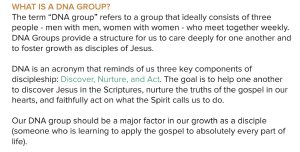
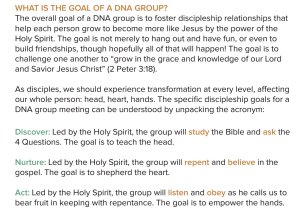
You can download and read the DNA program manual here. A couple of excerpts that help explain the program:

Screenshot_2016-05-28-22-19-55_kindlephoto-13502875

Screenshot_2016-05-28-22-16-33_kindlephoto-13561799

The DNA group concept seems like a doctrinally solid discipleship program. It demonstrates intentionality in building disciples. It is centered on the gospel, Scripture, prayer, and repentance. It encourages church members to sharpen one another and bear one another’s burdens.

A few minor things jumped out at me that I think it would be helpful for Soma to tweak and clarify just a bit.

  • Several times, the phrase “listen to the Holy Spirit,” or something similar, is used. At first, this concerned me because this is the type of language used in contemplative prayer and New Apostolic Reformation false doctrine. Reading the document in context, however, it is clear that this is not what Soma is referring to, but, rather, being led by the Holy Spirit and hearing Him speak through Scripture.
  • “Pubs” (in addition to other venues) are mentioned a couple of times as meeting places for DNA groups. I’m not aware of any definition of the word “pub” other than “bar.” If “pub” is a new slang word for coffee house, or something, it would be helpful to clarify that. If by “pub” they actually mean a bar, I would personally not endorse a discipleship group (or any individual Christian or group of Christians) meeting in a bar.
  • Evangelism is presented as “telling your story with Jesus as the hero.” It can sometimes be helpful when evangelizing to share your story of salvation, and the manual describes a way to do this which is biblically correct (emphasis on your sin and your need for a Savior, etc.). However, I think Scripture bears out that a law/gospel presentation is the primary way the gospel should be proclaimed and that “our story” should mainly be used as a supplement or addendum. That being said, every Christian should be able to verbally and cogently explain how she was saved, and the manual does show the biblical way to do this.
  • One of the steps in forming a DNA group is to “read and discuss The Story of God Summary.” The Story of God Summary (included in the manual) is basically an overview of the narrative of Scripture from Creation through the establishment of the church, and the promise of Christ’s return. I understand it would be impossible to read the entire Bible and discuss it in one or two sessions as a step in setting up a DNA group (thus, the summary), but I’m uncomfortable with the fact that – while the summary is biblically accurate – no actual Scripture is cited. I think it would be beneficial to add in some acutal passages of Scripture to flesh out the main points of the summary.

Overall, from what I’ve seen “on paper” this looks like a discipleship model that I would have no trouble recommending. I would encourage anyone interested to read the manual for further details.


If you have a question about: a well known Christian author/leader, a Bible passage, an aspect of theology, a current issue in Christianity, or how to biblically handle a family, life, or church situation, comment below (I’ll hold all questions in queue {unpublished} for a future edition of The Mailbag) or send me an e-mail or private message. If your question is chosen for publication, your anonymity will be protected.

Christian women, Church, Discernment

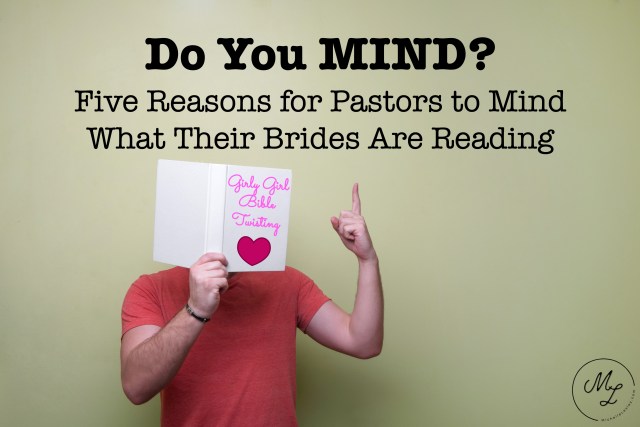
Do You MIND? : Five Reasons for Pastors to Mind What Their Brides Are Reading

A while back, my husband and I were driving down the road on the way to the store discussing various aspects of ministry. At some point the conversation turned to a pastor with whom we were both vaguely familiar. Neither of us knew much about him, so we decided to look him up on Facebook to see if we could get a better handle on where he was coming from, theologically. Aside from a couple of mildly iffy posts that it wasn’t a stretch to extend the benefit of the doubt about, it didn’t seem as though there were any major doctrinal red flags. He just seemed like your average, Bible believing pastor who needed to brush up a little on his discernment. (Hey, who doesn’t, right?)

I was actually more interested in the pastor’s wife and what kind of ministries she was involved in that I might also like, so I clicked over to her page. I was pretty disappointed by what I saw. She had posted materials from several major false teachers- the female equivalents of people from Joel Osteen all the way down to Benny Hinn.

I remarked to my husband that I thought there might be some concerns about this pastor’s theology if he was OK with his wife following and sharing materials from high profile false teachers. And my husband gently reminded me that wasn’t necessarily the case:

“He probably doesn’t even know those women are false teachers.”

My husband went on to say that he wouldn’t have known that people like Beth Moore and Joyce Meyer are false teachers if I hadn’t done the research and filled him in. Not because he doesn’t care whether or not I read sound doctrine, but because pastors and Christian men in general don’t often pick up and read books written for Christian women to examine the theology we’re feeding on.

Until the last few decades, they haven’t always needed to. If your wife went shopping and came home with a book from LifeWay, it never crossed your mind to question whether or not it was biblical. It was LifeWay for heaven’s sake. LifeWay is run by pastors and theologians with years of experience and doctoral degrees from seminary. Of course it was biblical.

Well not any more, it isn’t. The majority (and that’s not an exaggeration) of the “Bible” studies and other materials marketed to Christian women by Christian retailers are authored by false teachers.

what rose reads_kindlephoto-19662398

Pastors, on behalf of Christian women everywhere, I plead with you: check out the theology of the authors and bloggers (including me) your wife is reading and the Christian personalities she follows and shares on social media. Please thoroughly vet the materials your Sunday School/small group/Bible study classes and women’s ministry are using. Find out about the speakers headlining the women’s conference or simulcast your ladies are attending. Make sure guest speakers appearing at your church’s women’s event teach sound doctrine.

Why?

It’s not my place to instruct you (and I’m sure you already know, anyway) in what the Scriptures say about being the spiritual leader of your family, responsible for its theological health or your obligations as a pastor to guard your church against false doctrine. I’ll leave that to godly men, fellow pastors, theologians, etc. What I’d like to do is to offer you some practical insights (in no particular order) from the pink side of the pew that you might find to be helpful tools as you think about and pray through how to handle vetting the teachers your wife or church ladies follow:

1. Your wife’s decision to follow false teachers could cost you a job. There are women out there like me who are familiar with the “twisted sisters” your wife is sharing on social media. If I could wrongly make assumptions about the theology of the aforementioned pastor based solely on his wife’s Facebook activity (because wives can be a reflection of their husbands’ spiritual leadership), others could do the same – maybe even those on a pulpit search committee – and that could impact your search for a pastoral position.

2. You don’t want to shoot yourself in the foot. A pastor’s wife can have a huge influence on her church. She is often the one teaching the women’s Bible study or heading up the women’s ministry, and even if she doesn’t, her input on curricula, guest speakers for women’s events, etc., is usually seen by the women of your church as carrying the weight of your approval or preferences. If you’re up in the pulpit preaching sound doctrine every week while your wife or women’s leader is importing false doctrine into the women’s ministry, it’s like bailing water out of a boat with a hole in the hull.

3. Your wife or (women’s ministry leader) may be chasing off spiritually healthy church members. (If you’ve stuck with me thus far, what follows is unlikely to describe your wife, but I’m going to go ahead and throw it out there for awareness’ sake.) I have heard the following prototypical scenario from dozens of Christian women (and experienced it myself):

“My pastor’s wife is in charge of our church’s women’s ministry, and is a big Beth Moore fan. We only do Beth Moore studies in our small groups, and last year our church hosted a Beth Moore simulcast. I participated in a couple of the studies, but they just seemed “off” biblically, so I started doing some research.

I discovered Beth Moore was teaching false doctrine, partnering with false teachers, and doing other unbiblical things. I went to the pastor’s wife and very kindly, humbly, and patiently showed her the scriptural evidence of Beth Moore’s false teaching. I couldn’t believe it when she flew into a rage, screamed at me, and accused me of trying to create disunity in the church! My husband and I tried to talk to the pastor about it, but he seemed completely unaware of what goes on in the women’s ministry or any problems with Beth Moore, and backed up his wife. We are now looking for a new church.”

This is not an exaggeration or isolated case. I don’t know what it is about Beth Moore’s disciples, but they (especially the ones who are pastors’ wives) seem to be some of the most vicious defenders of false teachers out there. And if your wife or women’s ministry leader acts like this it could cost you godly, spiritually mature church members.

4. Your children’s spiritual lives are at stake, both at home and at church. As with any dad who works long hours, your wife probably has more of an influence in the moment to moment aspects of your children’s lives than you do, even when it comes to training them in godliness. If her spiritual diet consists of false teaching, that’s what is being imparted to your children on a daily basis.

The same goes for the children at your church. The majority of children’s Sunday School teachers and children’s ministry workers are women. The false doctrine these women consume today will be taught to the children of your church on Sunday.

5. When women are spiritually healthy, the whole family benefits. Statistically, women make up about 60% of church attenders, and, of course, 50% of a marriage. That is an enormous influence on your own family and your church family. You want those women spiritually healthy. It’s not only biblical and good for them personally, but everyone they influence and interact with benefits.

When women are taught sound doctrine, they grow to Christlike maturity. They exhibit the fruit of the Spirit. They want to share the gospel. They walk in humility, patience, love, repentance, forgiveness, and biblical submission. They encourage their husbands toward godliness. And you know what else they do?

They teach other women to do the same. They train up children who are godly. They’re self-replicating.

Spiritually healthy, mature, godly women make your life easier, more peaceful, and more of a joy, both at home and at church, because they’re working with you, not against you.

But your wife and the women of your church are not going to get the pure milk of the Word they need to grow in Christlikeness from the pantheon of divangelistas lining the shelves of your local Christian bookstore. And most of those precious ladies you shepherd are completely unaware of that fact. So they need your help, Pastor. Your bride, and the Bride, desperately need you to mind what they’re reading.

Christian women, Complementarianism

Women Teaching Men: My Thoughts on Aimee’s and Mary’s Articles

aimee mary

UPDATE: Please note, this article was written in 2016. It should not be construed to be a current endorsement of either Aimee or Mary.

My friends and readers are the best. They are so sweet and helpful when it comes to making sure I stay up to date on what’s happening out there in Evangelicaland. It’s like having a little army of really smart co-laborers who are great at research.

Last week, a couple of articles about women teaching men appeared on the Reformed complementarian women’s landscape, and several folks were kind enough to send them to me and ask for my reaction. I e-mailed the readers back with my responses, which I’ve posted below.

What is Sunday School? What Does it Appear to Be? And Who Can Teach It?
by Aimee Byrd
May 18, 2016

I have loved and respected Aimee’s work as a writer and podcaster for a while. This article was apparently written to clarify some things that had been said on a Mortification of Spin podcast.

“I didn’t catch the podcast, but I did read the article. I was disappointed with what Aimee said, because Steve’s comments [Steve Cooley’s comments in the comment section following the article] are correct. Also, if we look at the broad pattern of male headship in Scripture…

man was created first, then woman
woman was created to be helper to man
women are to submit to their husbands
women are not to serve in the office of elder or pastor
women are not to preach to men
women are not to exercise authority over/lead men in the church

…which fits better with this pattern, women teaching men in co-ed Sunday School or women not teaching men in co-ed Sunday School? I think it’s pretty clear that women not teaching men in co-ed Sunday School fits best. Why would God set this pattern of male headship in motion and then turn around and contradict it when it comes to women teaching men in Sunday School?

Furthermore, the gathering of a body of believers for studying the Bible is the gathering of the church, whether it is in someone’s home (like the first century church), a sanctuary, or a Sunday School classroom. We’re the ones who have invented all these lines of delineation between Sunday School, worship service, Christian conferences, revival meetings, etc., and then tried to go back and figure out which of these man-made distinctions 1 Timothy 2:12 applies to. When 1 Timothy was written, they didn’t have all that. The church was just the gathering of the believers for worship, study, etc. So 1 Timothy 2:12 applies to the gathered body of believers without respect to all these artificial lines we’ve drawn.”

Again, I have great respect for Aimee, but I disagree with her on this particular issue. It’s possible that the differences in our denominational viewpoints of Sunday School play a big part in this, and that if we ever had the chance to sit down and hash it out over coffee or something, we might find more common ground.

Women Teaching Men- How Far is Too Far?
by Mary Kassian
May 21, 2016

I’m not as familiar with Mary as I am with Aimee, but I’ve read and enjoyed a few of her articles. This one may have been a response to Aimee’s article above.

“Good stuff! I agree with her about 90%. I love that she brought out the part about “teaching under a man’s authority.” I wrote about that not long ago. It’s nice to hear somebody with a bigger platform say it. I hope people will listen to her!

I also love what she says about what we love versus following a set of rules. So true! Another aspect of this that I run into frequently with women who want to preach is that they’re so focused on leading they forget about Jesus’ example of humility in servanthood. We’re supposed to be focused on serving, not gaining notoriety.

My main disagreement with her would be the line she (and most others who address this issue) draws between the worship service and things like Sunday School and Christian conferences. Those are really man made lines of distinction rather than biblical ones. The “church” is the gathered body of believers for worship and biblical instruction. So whenever believers are gathered for those purposes – whether we call it Sunday School or worship service or a Christian conference, and whether it’s in a sanctuary, Sunday School classroom, or conference center – that’s the church, and the Scriptural mandate for women not to teach or hold authority over men applies.

I also think it’s interesting that in the second paragraph under “Can Women Teach Under Male Authority” she rightly points out, “The text doesn’t say, ‘A woman may teach men if…'”. But then later in the article she talks about how she feels it’s OK for her to teach men if they’re much younger than she is. Well, just like the text doesn’t say a woman can teach men if she’s doing so under male authority, it also doesn’t say it’s OK for a woman to teach men if she’s much older than they are. It just says “don’t”. Curious.”

Mary’s position on this issue is much more similar to mine. I hope to hear more from her about this in future articles.