We have raised our five year old to know that Santa Claus isn’t real. Now that he’s getting old enough to have conversations with his little friends, how do we explain to him what to say to them when they talk about believing in Santa? I don’t want him to crush their dreams but I also don’t want to teach him to perpetuate the lie for his friends.
This is a great question, and one my husband and I also had to address with our own children, since we raised them to know that Santa Claus isn’t real.
Before I tackle your question, I’d like to address Christian parents who tell their children Santa Claus is real, that he is the one who brings their presents, etc.:
I’m sure you have the best of intentions and only want to make Christmas fun for your children, but when you tell them these things about Santa Claus, you are lying.
Santa Claus isn’t real. If you tell your children he is, or that he is the one who brings their presents, or that he knows whether they’ve been naughty or nice, you’re lying. The Bible says that lying is a sin, period. There’s no exception for jolly old elves who pass out toys (or for tooth fairies or Easter bunnies, either, for that matter). And not only is lying a sin, it is extraordinarily hypocritical to lie to your children about Santa Claus and then turn around later and punish them when they lie about something. Lying to your children about Santa Claus teaches them that it’s OK to lie (i.e. sin) when you want to or when it would be to your advantage. Excerpted from: The Mailbag: What should we tell our kids (and grandkids) about Santa Claus?
And this reader has raised another ripple effect of your sin of lying. You’ve now put your brothers and sisters in Christ in the difficult position of figuring out how not to blow your cover when their child (who knows the truth) interacts with yours. Do they teach their child to take part in your lie, or do they risk their child telling the truth, disappointing your child and possibly angering you? And think about the pressure on a five year old child to try to keep something like that a secret, knowing someone will be disappointed if he doesn’t. You’ve created a no-win situation for people you are supposed to self-sacrificially love, encourage, and edify.
We did our best to thread the needle by teaching our children to stay out of it. Every year, we reminded our kids – before family gatherings, play dates, etc. – that some kids believe Santa is real. If a friend inquired, “What did you ask Santa for this year?”, our kids could reply, “I asked my parents for a bike.” If any of their friends asked them if Santa was real, we told our kids to tell their friends to ask their parents.
You might want to give something like that a try, or maybe you can come up with a different solution that’s helpful to the situation. Don’t fret about it, though. Most kids learn the truth about Santa between ages 5 to 10, and most of them learn it from their friends. If you have a friend who freaks out at you because your five year old told the truth about something, it could be time to reevaluate that friendship, or at least the level of intimacy of that friendship. (And if it’s a family member, well…this, too, shall pass.)
If you have a friend who freaks out at you because your five year old told the truth about something, it could be time to reevaluate that friendship
However you teach your child to handle the situation, be sure you’re not conveying the idea that we cover up the sin (the lie that Santa is real) of others. We tried to go at it from the angle of our kids telling the other kids, “That’s a topic that should stay between you and your parents.” It’s pretty much the same way we later handled the situation of what to do if your friends ask you where babies come from (“You need to ask your parents about that.”)
Also keep in mind that, even though it may feel like you’re the Grinch if your child spills the beans about Santa, you’re not, despite the fact that others may treat you that way. If you’re humbly doing what is right in God’s eyes and the other person is doing what is wrong, you’re not the problem in that situation.
Even though it may feel like you’re the Grinch if your child spills the beans about Santa, you’re not. If you’re humbly doing what is right in God’s eyes and the other person is doing what is wrong, you’re not the problem.
If you have a question about: a Bible passage, an aspect of theology, a current issue in Christianity, or how to biblically handle a family, life, or church situation, comment below (I’ll hold all questions in queue {unpublished} for a future edition of The Mailbag) or send me an e-mail or private message. If your question is chosen for publication, your anonymity will be protected.
Christmastime can be so much fun when you have children. Many of us remember the excitement of Santa, the Christmas tree, and presents from our own childhood. They’re happy memories, and we want to recreate those for our children.
But as Christian parents, our first priority isn’t fun, it’s obedience to Scripture. Yet, is there a way to make Christmas merry for our children while still upholding God’s Word? Is Santa patently unbiblical?
No, he doesn’t have to be, as long as he keeps his sleigh parked inside the parameters of Scripture. Let’s take a look at some of the ways Santa can be unscripturally naughty, and how godly parents can keep him nice and biblical.
Santa Claus isn’t real. If you tell your children he is, or that he is the one who brings their presents, or that he knows whether they’ve been naughty or nice, you’re lying. The Bible says that lying is a sin, period. There’s no exception for jolly old elves who pass out toys (or for tooth fairies or Easter bunnies, either, for that matter). And not only is lying a sin, it is extraordinarily hypocritical to lie to your children about Santa Claus and then turn around later and punish them when they lie about something. Lying to your children about Santa Claus teaches them that it’s OK to lie (i.e. sin) when you want to or when it would be to your advantage.
The Bible says that lying is a sin, period. There’s no exception for jolly old elves who pass out toys (or for tooth fairies or Easter bunnies, either, for that matter).
Don’t lie to your children about Santa Claus. Tell them the truth: he’s a fun, fictional character that we can enjoy reading stories and singing songs about, just like Goldilocks or Superman or Old MacDonald. As for the presents, maybe you’d like to handle it similarly to the way my husband and I did with our children. When they were very small, my husband or I would don a Santa hat on Christmas Eve and say something like: “You know how you like to play pretend? Well, mommies and daddies like to play pretend, too, especially at Christmas! Now it’s time for you to go to bed so we can pretend to be Santa Claus.”
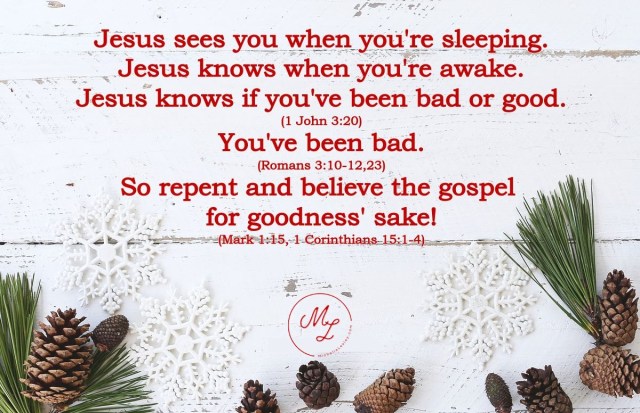
Santa Claus isn’t omniscient.
He sees you when you’re sleeping He knows when you’re awake He knows if you’ve been bad or good So be good, for goodness’ sake!¹
Uh uh. No way. Omniscience is an incommunicable attribute of God. He is the only One who has the power to see and know all things, and it is an insult and an affront to Him to even suggest that a mere mortal – let alone a fictional character – has the same power and knowledge that He has. In reverence and awe for God’s preeminence, we should never ascribe to others the things that belong to God alone.
Teach your children about the attributes of God. When you read your children stories about Santa Claus or hear Santa Claus Is Comin’ to Town on the radio, it’s a perfect opportunity to teach them about God’s omniscience and power. “Did y’all just hear that? That song said Santa Claus can see you and knows how you’re behaving. Is that true? Who is the only One who always sees you, cares for you, and knows what you’re doing and thinking? Can anybody else besides God do that?”
Santa Claus teaches works righteousness. In St. Nick’s economy, good behavior earns a reward (presents). Bad behavior earns punishment (coal). If you’ve ever shared the gospel with anybody, that will probably sound familiar. Most lost people think that’s what Christianity is. If you’re a “good person” God is happy with you and you’ll go to Heaven. Hell is the punishment for “bad people”: Hitler, murderers, and rapists. This is not what the Bible teaches, either about salvation, or about why children should obey their parents.
Teach your children the gospel. Again, this whole “naughty or nice” part of the Santa Claus narrative is a perfect gospel-teaching opportunity. Take advantage of it! Ask your child to be “nice” for one whole day. At bed time, take a few minutes to talk about the times she messed up and was “naughty” when she was supposed to be trying to be “nice.” Nobody can be nice and obedient all the time, no matter how hard we try. We are all naughty – sinners with coal black hearts deserving the punishment of Hell. Jesus came and lived a life of perfect “niceness” (obedience), died on the cross to take the punishment for our naughtiness, was buried, and rose again. He did that, not because we earned it with good behavior, but because of His mercy and grace. And then He gave us the greatest gift ever. A gift we naughty people don’t deserve: salvation and eternal life in Heaven. And it is because of our love and gratitude to Christ for saving us that we obey Him, not so that He will give us what we want. Indeed, the Bible tells us that the more obedient to Christ we are, the more persecution we will face.
Santa Claus doesn’t automatically have to be on the Christian parent’s naughty list. There are lots of ways to enjoy the fun of Santa and even turn him into an opportunity to teach your child biblical truth, all while being obedient to Scripture. But if Santa makes you biblically uncomfortable in some way, then by all means, don’t go against your conscience. Whichever way you decide – after prayer, study of the Scriptures, and discussing it with your spouse – do not judge other Christian parents by your personal convictions about Santa Claus.
Any advice for grandparents about Santa? Our son wants our grandchildren to believe in Santa. How do we respond to a grandchild who asks of the reality of Santa? I will not lie, but I want to keep peace with my son.
Thank you for being a godly grandma!
I think the solution to this dilemma is going to start with being a godly mom. Is your son a Believer? If so, you might want to show him all of the information above and talk to him about any Scriptures he’s violating. Let’s pray that will be convicting to him and he’ll decide to handle Santa in a godly way with your grandchildren.
But if he’s not convinced, or if he’s not a Believer, talk to him about your convictions about not lying to his children. Explain the difficult position he’s putting you in. He’s essentially asking you to choose between pleasing him by sinning (lying) or pleasing God by not sinning.
If he still won’t relent, the only solution I can see that keeps you from sinning yet doesn’t go against your son’s wishes is to put it back on him. When your grandchild comes to you and asks, “Grandma, is Santa Claus real?” you reply, “That’s a great question, but I think you should ask your mom and dad about that. How about some hot chocolate?”.
Your son made this bed. You shouldn’t have to lie in it.
¹Santa Claus Is Comin’ to Town. John Frederick Coots and Haven Gillespie, 1934.
If you have a question about: a Bible passage, an aspect of theology, a current issue in Christianity, or how to biblically handle a family, life, or church situation, comment below (I’ll hold all questions in queue {unpublished} for a future edition of The Mailbag) or send me an e-mail or private message. If your question is chosen for publication, your anonymity will be protected.
Do you know of any Biblically sound books that will help teach a 3 yr old how to have a grateful heart? My daughter is trying to cultivate that in my 3 yr old grandson.
Awww, how sweet! What a blessing that he has a godly mommy and Grammy (or Mimi or Mamaw or…).
My youngest child is 18 so I’m not familiar with whatever is currently popular and available, although I’m sure there are some good, doctrinally sound children’s books out there. (Readers, if you have any suggestions, let this sister know in the comments.)
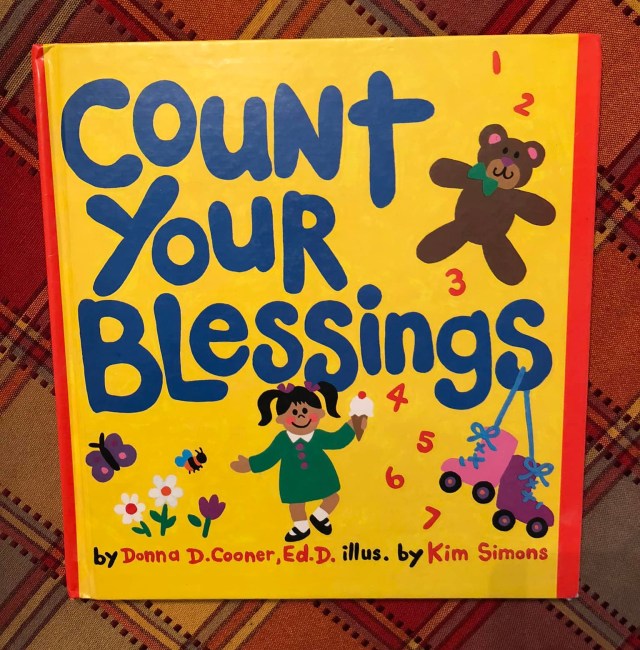
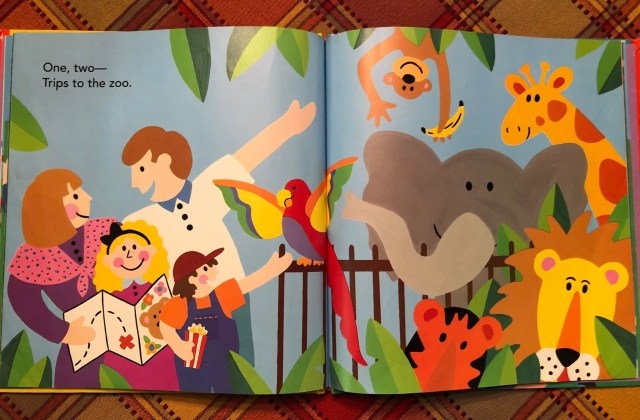
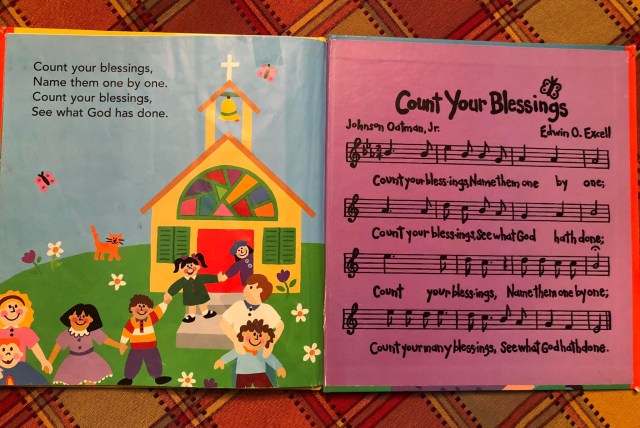
But if you’ll indulge me a trip down memory lane to wallow in sentimentality for just a moment, this was my daughter’s favorite book when she was a toddler (and all her little brothers loved it too!). It combines counting skills, thankfulness, and a hymn – pretty great, if you ask me!
Count Your Blessings by Donna D. Cooner, 1995
Now, it’s just sitting in my closet waiting for my grandchildren to enjoy it…❤
If you decide to buy some toddler books on gratitude, I would just caution you to vet the authors of any book you’re considering just like you would vet the author of a book for adults. There are many false teachers – Priscilla Shirer, Sarah Young, and Sheila Walsh just to name a few off the top of my head – who have branched out into writing children’s books.
But honestly, I think this is a great opportunity for you and your daughter to start teaching your grandson the Bible, Scripture memory, and prayer as it relates to being grateful to God.
This is a great opportunity to start teaching your child the Bible, Scripture memory, and prayer as it relates to being grateful to God.
Read some stories about people in the Bible who were thankful – the thankful leper, Zacchaeus, Noah, Daniel, rebuilding the temple…really any story in which God acts, provides, or protects and people thank Him for it – and ask a few simple questions.
What did the main character in the story need or ask God for? What did God do?
What did the main character say or do when God acted, provided, or protected?
Has God ever acted, provided for, or protected you like that? How can we tell Him thank you?
Grab your concordance and look up some words and phrases like “give thanks“. Find a simple verse(s), talk about what it means, and practice saying it together. You might be surprised at just how quickly he can memorize those verses! The Bible verse memes in my article Top 10 Bible Verses on Giving Thanks are perfect for printing out or copying to your phone or tablet for this.
Another way to reinforce giving thanks to God is through music. You may find something helpful at Seeds Kids Worship, or just create your own playlist on your favorite music platform.
One way I helped my children remember to be thankful (and let me tell you, it didn’t just help my children!) was with a simple little game I called The Gratitude Game. It’s kind of like playing “I Spy.” Just look out the window when you’re driving around in the car, or look around as you’re taking a walk, and take turns thanking God for what you see: “Thank You, God, for making birds.” “Thank You for ice cream.” “Thank You for police officers who help us.”
Be sure to model thankfulness, too. When you or your daughter say bedtime prayers or the blessing before meals with your grandson, be sure to spend some time thanking God for things and acknowledging Him as provider, protector, the Giver of blessings, and so on. Remark thankfully on various things throughout the day: “I’m so thankful God gave us a warm day to play outside,” “Thank you, God, for sending the ice cream truck our way!” Also make sure you’re showing gratitude to people. Set the example for your grandson of saying “Thank you,” sending thank you notes or gifts, and demonstrating appreciation for others.
Books can be fun and helpful, and I hope you find a good one for your little sweetie, but you can’t beat stories and activities that center on Scripture itself.
When it comes to teaching your little ones gratitude, you can’t beat stories and activities that center on Scripture itself.
If you have a question about: a Bible passage, an aspect of theology, a current issue in Christianity, or how to biblically handle a family, life, or church situation, comment below (I’ll hold all questions in queue {unpublished} for a future edition of The Mailbag) or send me an e-mail or private message. If your question is chosen for publication, your anonymity will be protected.
Or maybe I answered your question already? Check out my article The Mailbag: Top 10 FAQs to see if your question has been answered and to get some helpful resources.
My oldest daughter is turning 12 this week, and I see a lot of heart issues in her that I would like to help her with. She is a triplet, and also has three younger siblings, and I think she feels like she doesn’t get as much attention from me because of the neediness of the other children, which has turned into bitterness and disrespectful attitudes in her. Is there a book that you know of that I could take her through that would help us both with these things? Really, anything directed at her age discussing how to be a godly older sister. I want to be a good mom for her, raising her to be a kind and loving older sister, but I feel like I am failing.
Being a mom is pretty challenging, and we all have moments and seasons when we feel like we’re failing. Ask the best, most godly mom you know, and I’m sure she’ll agree. Sometimes, it’s because we have failed, which means we need to repent – to God and to our children – and obey Him. But often, we take those feelings of failure upon ourselves when we’re truly doing our best, and/or when the situation is unavoidable or isn’t our fault.
Let me give you a few resources that may help…
First, you’ll want to get your own heart and mind in order – according to Scripture – about your feelings of failure. Check out my article: Guilt and Shame- Burden or Blessing?
Your daughter is the perfect age for the two of you to study the Bible together. If she’s not yet a Believer, you’ll want to explain the gospel to her. If she is a Believer, study through a book of the Bible together. The Bible is a book, it’s directed at her age, and it addresses all of the things you’ve mentioned both textually and transformatively. (If I may be a little blunt: your daughter needs godly parenting from the best people for the job – you and your husband – and either salvation or sanctification by the Holy Spirit more than she needs to read a book written by someone else.) If you’d like, the two of you might also enjoy working through my Bible study Imperishable Beauty: A Study of Biblical Womanhood. Studying Scripture together will also help address the issue of her feeling like she’s not getting enough attention from you.
And don’t forget to pray for your daughter on your own, with your husband, and with her. Prayer is also transformative. It will help you, your husband, and your daughter get on the same page with God.
Finally, let your church be the resource for you that God wants it to be. This is a textbook Titus 2:3-5 situation. Find a godly older woman in your church or in your family, and ask for her help and guidance. If you don’t know anyone like that, set up an appointment with your pastor for counsel and ask him to point you in the direction of a godly older woman who can disciple you through this.
Although doctrinally sound books can sometimes be helpful, the means and methods God has prescribed in Scripture – the Word, prayer, and the church – should always be our “Plan A”.
I’m 19 years of age and I’m currently at war with my parents because I told them I wanted to start wearing pants. They believe my salvation is not real because I’m going against Deuteronomy 22:5…..And it has made me so confused about my stand with God. Am I really sinning against God or am I misunderstanding something?
I think there’s definitely some misunderstanding and some sin going on here, but maybe not like you might be thinking. Let’s sort it out according to Scripture.
In and of itself, it is not a sin for a Christian woman to wear modest women’s pants. If your parents genuinely think you’re not saved solely because you want to wear modest women’s pants, then they are misunderstanding Deuteronomy 22:5 (and possibly the New Testament concept of Christians being under the covenant of grace rather than the Mosaic covenant). I’ve explained all of this in detail in my article The Mailbag: May Christian Women Wear Pants?.
However there aresins being committed in this situation that you may not have considered. If you’re “at war” with your parents about this or any other issue of adiaphora/Christian liberty, you’re probably committing the sins of pride, dishonoring/disobeying your parents, failing to live at peace with them so far as you’re able, and failing to bear with their weakness in this area. (Your parents may also be committing some of these sins as well as provoking you to anger, but you can only control whether or not you’re sinning, and how you react to their sins.) I would encourage you to study the Scriptures I’ve linked here, ask God to humble you and help you understand whether or not you’ve sinned in any of these areas, and, if you have, repent – to God and to your parents.
Now, there is one more dynamic at play here: It doesn’t sound like you’re married, so are you still living under your parents’ roof and/or financial support (e.g. You live in a dorm or apartment they’re paying for, they’re paying for your education, etc.) or are you living on your own and supporting yourself? Those are two different kettles of fish.
Your parents have the right to make the rules for their house, and they have the right to decide what they will and won’t support financially, even if those rules and conditions seem wrong, ridiculous, or unfair to you. At nineteen, you are an adult, and you have the right to decide whether you want to live under those rules in their house, and whether you want to abide by the conditions under which they will financially support you. It’s just a question of which is more important to you at this point in your life – housing and financial support or wearing pants. If you want to live at their house and/or receive their money, you need to humble yourself and abide by their rules without complaining. If you want to wear pants, you need to move out and pay your own way.
A few final thoughts:
If you’re still living at home or receiving financial support from your parents, you can lovingly and humbly ask if they might be open to the compromise of you wearing split skirts or palazzo pants / skirts. Go into this conversation prepared to graciously accept an answer of “no”.
Give 1 Peter 3:1-6 a good study. This passage is not about the parent-child relationship, but about Christian wives softening their unsaved husbands’ hearts to the gospel by their godly, submissive behavior. Are there any principles you can glean from this passage that can be applied to your relationship with your parents as you submit to their authority in their home and under their financial support?
When you do move out and support yourself, you’re free to wear modest women’s pants whenever you like, but Scripture doesn’t allow us to exercise our Christian liberties in ways that unnecessarily offend others. In other words, when you go visit your parents, put on a skirt.
I am curious as to why Kenneth Copeland and Rhema Bible College [founded by Kenneth Hagin] are NOT on your list of false teachers. Thank you for your ministry but I believe these are important ones to highlight as well.
I agree, the two Kenneths are/were rank heretics, and Rhema “Bible” College knows nothing of the Bible. No one should have anything to do with any of them.
Here’s why they (and a number of other blatant heretics) are not listed at my Popular False Teachers & Unbiblical Trends tab (in the blue menu bar at the top of this page). Let’s start with an excerpt from that page that perhaps you didn’t see:
Please understand that this isnot a comprehensive list of every false teacher inexistence (there are thousands of them, so that would be impossible)… I provide information here largely in answer to questions from my readers. In other words, if you don’t see it, it’s either because I haven’t been asked about it, or I haven’t had time to get to it yet. The names you see are simply some of the most well-known teachers my readers have inquired about.
Generally speaking, my audience consists mostly of Christian women in passable to vibrantly doctrinally sound churches. They’re not asking me if the Kenneths are false teachers; they can watch or listen to five minutes of either of those guys and know.
Women who are so undiscerning that they’re following these guys are almost certainly not saved (and aren’t following me). What they need is to repent and believe the gospel, or they’re neither going to understand why, nor believe that the Kenneths are heretics, and, like the pigs and dogs they are, spiritually speaking, they’re going to turn and attack me for trying to convince them
There are tens of thousands of false teachers out there. I am one person with a husband, family, church responsibilities, friends, a podcast, speaking engagements, and other topics I have to blog about. I have to spend my time, not on the obvious false teachers, but on the more subtle ones my readers are actually asking about.
I have also attempted to help out readers who don’t find the false teacher they’re looking for on the list (again, from my Popular False Teachers & Unbiblical Trends page):
In this article, you’ll not only learn how to research teachers for yourself (a skill every Christian should develop), you’ll also find a list of trustworthy discernment ministries who may have the information you’re looking for.
If you have a question about: a Bible passage, an aspect of theology, a current issue in Christianity, or how to biblically handle a family, life, or church situation, comment below (I’ll hold all questions in queue {unpublished} for a future edition of The Mailbag) or send me an e-mail or private message. If your question is chosen for publication, your anonymity will be protected.
Note from Michelle: Ladies, if you’ve been around the blog for a while, you might remember Testimony Tuesday which featured testimonies from my readers. I never wanted Testimony Tuesday to go away, I just stopped receiving testimonies from y’all. Let’s reignite Testimony Tuesday under its new name, By the Word of Their Testimony. See my end note for how to share your story.
Holli Solenberger’s Story: Priscilla Shirer and Letting Go
Aside from leaving my last church, this ranks a close second to the hardest I’ve had to submit to the Lord’s pruning out of my life.
I first saw Priscilla Shirer in the movie War Room. I was at a former church a few years ago – when War Room was in theatres. The ladies’ small group at that church was going together, and with everything going on, I felt I needed that community, so I went.
What resonated in my heart during that movie – I was not prepared for. You know how a movie changes your perspective, or speaks to a part of your life that is needed? This was my reaction. It was so strong, that it served almost like a catalyst – very similar to when you hear a new song and you love it so much, you want to find more by that same singer? I had to find out more about Priscilla.
I was really surprised to find out she was the daughter of Tony Evans – who (at the time) I thought was Biblical, so that association made me think, “surely she is solid too – she was in a Christian movie – I have to find her teachings!” So, I searched on YouTube, and found more – and that was it for me. She spoke to my heart, she’s a momma of boys like me, she was relatable, funny, and seemed genuine. On so many points, I was an instant fan.
I dove down into finding many of her teachings and watched them back to back. If it spoke to my heart, it got a green light – period. She talked about Jesus, and God, and Christianity, so I thought she was okay.
I NEVER EVER bothered to check out what she was teaching with what the Bible says. Ever.
As I have pled with others to be discerning, I speak from true repentance – because I have never been discerning as God says to be. I chose to accept what people said as truth – without seeing what the Bible says. I loosely and wrongly allowed things people said into my beliefs (the fancy word is theology) without reading what God thought about their beliefs. And I have no excuse. It’s all there in the Bible. But if what somebody said sounded good, I didn’t look in God’s Word.
And to be blunt… looking back… I really believe I didn’t look because I didn’t want to. I felt good and knew – I believe at least subconsciously – if I looked, and was convicted if God says differently, I’d have to let go what made me feel that way. I know I am not the only one to do this. I’ve met thousands of people that – like me – chose to be misled into what the Bible says are myths and fables (which is what it mentions any truth apart from God’s truth).
I really believe I didn’t look because I didn’t want to. I felt good and knew – I believe at least subconsciously – if I looked, and was convicted if God says differently, I’d have to let go what made me feel that way.
I talk a lot about letting go of things and people that were precious to me. I still love many of them. But I know they aren’t good for me, so because God requires in His Word to choose – you can’t have both, you can’t have one foot in things He says are wrong, and the other in things He says are ok – that is SO painful. SO painful to let go of. To submit to Him. This is what I mean when I talk about living with open palms. It means being willing to let go of anything God says is not okay – even if your heart doesn’t want to.
Well…one day, in the middle of my youngest son’s hardest time (so far) in his little life, I heard Priscilla was going to be speaking at her father’s church – about 30 minutes away from me. I cleared my calendar, got dressed, and went to see her. There was a worship/singing part, followed by her speaking. I was so enthused to see the woman I felt God used in my life in person, I don’t even remember what she talked about.
When she was done, I waited for nearly an hour to speak with her one on one for just a few minutes. She saw me waiting and kept telling me to hold on and hold on, so I did. And when she got to me, I just lost it. I cried and cried – I knew whatever I said had to be to the point, because many others were waiting still. As the tears fell, she started crying too, as I told her, “I want to thank you for God using you in my life! I’ve been through so much and I saw you in War Room and ever since I have watched your teachings and I’m so grateful for you being used by Him in so many ways!” We hugged then, a tight but quick hug, then took a selfie.
Priscilla and Holli
Fast forward to the past few months…God didn’t just lead me to leave my last church! He led me to give up so, so much more – including Priscilla. This has been just as painful. When things speak into our pain, in deep ways – oh my, my, my. That is just heartbreaking to open our clenched fists and submit…to….God. I only speak about my own convictions, and I share openly – knowing many will be hateful to me, hurtful, talk about me, treat me harshly, because they would rather live with their fists tightly closed. They aren’t ready.
And there is nothing I can do to change that. I am only a vessel. It is God’s sovereignty that chooses if – or when – others are convicted, like I was. I share – knowing the repercussions – for the very few that the Lord will, as He has me in His kindness and mercy, give ears to hear – and a soft heart towards Him and His Word. And hopefully open their palms too.
This is one of many things that God has brought about, that’s about Priscilla – but I submit to you that though there are many God calls us to let go of, for the false things are everywhere, there is but one Standard that we hold everything and everyone up to – God’s Word.
I pray this helps you not only with Priscilla but to see through this example written about, why being a Berean is so important.
Ladies, God is still at work in the hearts and lives of His people, including yours! Would you like to share (anonymously, if you like) a testimony of how God saved you, how He has blessed you, convicted you, taught you something from His Word, brought you out from under false doctrine, placed you in a good church or done something otherwise awesome in your life? Drop me an email, and I’ll send you the particulars for sharing your story. Let’s encourage one another with God’s work in our lives!