

A Few Good Men, Again!: 10 Doctrinally Sound Male Teachers


Welcome to another “potpourri” edition of The Mailbag, where I give short(er) answers to several questions rather than a long answer to one question. I also like to take the opportunity in these potpourri editions to let new readers know about my comments/e-mail/messages policy. I’m not able to respond individually to most e-mails and messages, so here are some helpful hints for getting your questions answered more quickly. Remember, the search bar can be a helpful tool!

I need guidance in approaching the worship director of the church I started attending 6 months ago (haven’t joined yet) due to his frequent use of Bethel/Jesus Culture/Hillsong/Elevation Church music. I stand there in silence most of the worship time because I just don’t feel comfortable singing those songs. I don’t want to meet with him and be that person who is critical and legalistic but I feel convicted that someone needs to. Should I go talk to the pastor first (we have somewhat of a relationship since I’ve met with him a couple times and agree with his theology)?
It’s awesome that you are discerning enough to know that music from these heretical and New Apostolic Reformation organizations shouldn’t be used by any church. I encourage you to keep having those “powers of discernment trained by constant practice” of distinguishing good from evil (Hebrews 5:14).
I also want to encourage you that inquiring about the theology of a church or its music – especially as someone who is deciding whether or not to join that church – is not being “critical and legalistic”. That is what scoffers say about discernment issues, but it is not the biblical way of viewing “contending for the faith”. Do not allow ungodly people with their unbiblical personal opinions to deter you or even make you feel bad for doing what is right and good and godly.
I agree with you that someone needs to address the issue of the music. It is possible that’s why God put you into this church at this time – to pray for the church, the minister of music, and the pastor about this, and to lovingly explain the issues.
Since I’m not personally involved in the situation, I can’t offer any advice as to whether to approach the minister of music or the pastor first. I would suggest you pray and ask God to give you the wisdom to know which one of them to speak to first, and trust Him to direct your paths. You might want to consider which of these men you feel will be more receptive to what you have to say. If you go to the minister of music first and he brushes you off, I would encourage you to go to the pastor next. I think both of their responses will help you decide whether or not you want to join this church.
Here are some resources that may help:
The Mailbag: How should I approach my church leaders about a false teacher they’re introducing?
Hillsong’s Theology of Music and Worship
The Mailbag: Should Christians listen to “Reckless Love”?
Popular False Teachers (further information on Hillsong, Bethel, Jesus Culture, Steven Furtick)
A popular Christian apologist I follow says that the prohibition against women preaching, teaching Scripture to men, and holding authority over men in the church in 1 Timothy 2:12 is translated incorrectly.
I do not permit a woman to teach or to exercise authority over a man; rather, she is to remain quiet.
He says it should not be translated as “woman” and “man” “but as “wife” and “husband”, and that he believes Bible translators mainly translate it as man woman due to tradition (i.e. men have historically been the pastors and teachers in the church).
This is why linguists – professional experts in the biblical languages – are hired to translate Scripture, not apologists.
Bible translators (of reliable translations) are true to the text, not church tradition or personal convictions. Furthermore, when translators are working on the text, it is not a lone individual who writes down what he thinks the Greek words say and that’s the Bible you end up reading. There are teams of translators, linguists, editors, and even computer experts who work on the text. They check, and double check, each other’s work. So even if one translator was translating according to tradition or opinion, it would be caught by others and not allowed to slip through the cracks.
All of the most reliable English translations translate the words as “man” and “woman”, not “husband” and “wife”.
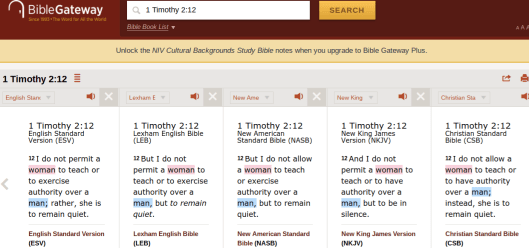
And just for kicks, I checked this verse in about a dozen of the less reliable translations, and every single one of them translates it “man” and “woman”. Even versions that got other parts of verse 12 incorrect still use “man” and “woman.” For goodness sake, even The Message and The Passion “Translation” possibly the two worst English versions of the Bible (They’re not even translations. The Message is a paraphrase, written by someone who endorsed the heresy-laden book The Shack and has made statements affirming homosexuality. And Passion is the new New Apostolic Reformation version of the Bible, based, supposedly, on new revelation directly from God.) both say “man” and “woman”. And the NAR is totally OK with female preachers, so you know they’re not using “man” and “woman” due to tradition.
So we’ve got one apologist who’s of the opinion that it should be “husband” and “wife” against scads of translators who are experts in their fields and whack job NAR “translators” who approve of female pastors, who all use “man” and “woman”. You would think someone out of all of those people would have translated it “husband” and “wife” if that was the correct translation. It’s telling that even “translators” who push the egalitarian agenda won’t go so far as to change it to “husband” and “wife”. I think the apologist is somewhat out of his depth here.
A few more quotes from said apologist:
“Verse 11 and following is directed at women in the context of their relationship with a man to whom they are supposed to be entirely submissive. That is a marriage relationship…1 Timothy 2 talks about the relationship between husband and wife; it’s chapter 3 that talks about church leadership.”
No, verse 11 is not directed at women. Neither are any of the other verses in chapter two or the rest of the book. First Timothy is a pastoral epistle. It was directed at Timothy by the Holy Spirit via Paul as sort of a “policy and procedure manual” for the church. This passage is not talking to women about their marriages, it is talking to pastors and elders about how to run the church. Verses 11-12 are talking about the role and behavior of women (all women, not just wives) in the church setting. They are not to instruct men in the Scriptures or exercise authority over men. That definitely “talks about church leadership” by excluding women from leadership roles that place them in authority over, or instructing, men.
And keep in mind that when 1 Timothy was written, there were no chapter and verse markings. The text was one continuous flow. If you begin reading in 2:11 and go through 3:13 (try reading it here, adjusting the settings to remover chapter and verse markings), I believe there’s a strong case to be made that 2:11-15 is actually the introduction to the qualifications for pastors, elders, and deacons. The passage (2:11-3:13) starts by stating who is disqualified from those positions and why (2:11-15) and then moves on to who is qualified and how (3:1-13).
Furthermore, if you’ll take a look at verses 8-10 of chapter two, which immediately precede the verses in question (11-12) and provide context, you’ll see more instructions to both men and women. Are only husbands to pray? Are only wives to dress modestly and respectably and adorn themselves with good works? What about single men and women, divorced men and women, widows and widowers?
No other place in Scripture teaches that all women should be under the authority of all men in the church. If this passage is to be interpreted the traditional way, this makes a new and unusual pattern of submission.
And this passage (1 Timothy 2:12) doesn’t teach that either. The statement that women are not to have authority over men doesn’t flip around to mean that all men are in authority over all women. That’s fallacious logic, silly reasoning, and patently unbiblical. The text says what it says and that’s it. You can’t turn it inside out and make an inference from an incorrect converse. That’s being a poor workman and mishandling Scripture.
It’s abundantly clear that “man” and “woman” are the correct translation in 1 Timothy 2:12. If anyone is being more loyal to an agenda than to the text here, it’s the apologist, not the translators.
Rock Your Role: Jill in the Pulpit (1 Timothy 2:11-12)
I Know Greek, So That Verse Is Wrong!
What do you recommend as daily devotionals for children, ages 2 and 10? I am looking to start daily Bible time with the kids before we start school.
I don’t recommend “canned” Bible studies and devotionals, but rather teaching straight from Scripture itself. I’ve explained this more, including a few suggestions for teaching your children, in my article The Mailbag: Can you recommend a good Bible study for women/teens/kids?
If you’re looking at a 5-10 minute time frame, you might want to work your way through Proverbs one verse at a time, or possibly some of the shorter Psalms. I usually set aside a 30 minute block of time and read through a book with my boys one chapter a day, asking questions and explaining things along the way. If you’d like, feel free to use any of my studies at the “Bible Studies” tab at the top of this page, selecting and simplifying the questions you feel are most appropriate for your children.
How can I subscribe to your blog via e-mail?
If you’re on a computer, there’s a little box in the left sidebar where you can enter your e-mail address:
I don’t know if your phone is the same as mine or not, but here’s what the e-mail sign-up on my phone looks like:
I was wondering if you had a list of recommended books for women. I’m trying to offer an alternative to an NAR book that has nice ideas and some good thoughts but also strays into Spiritual Formation and, of course, really off-base hermeneutics.
I don’t really know of any off-hand along those lines that I would recommend. The problem with “Christian” books for women by women is that most of them contain false doctrine. A couple of suggestions:
1. The Bible. If you’re looking for a book with nice ideas and good thoughts, Psalms might be a good place to start. Getting grounded in God’s Word and digging deep into Scripture itself is the best way to guard your ladies against the false doctrine you’re describing.
2. There’s no reason women can’t read books authored by men. If you already have a particular doctrinally sound book in mind that was authored by a man, go right ahead and use that one. I would recommend any of the male authors under my “Recommended Bible Teachers” tab (as well as any of the female authors listed there). You might also find the kind of book you’re looking for at GTY or Ligonier.
If you have a question about: a Bible passage, an aspect of theology, a current issue in Christianity, or how to biblically handle a family, life, or church situation, comment below (I’ll hold all questions in queue {unpublished} for a future edition of The Mailbag) or send me an e-mail or private message. If your question is chosen for publication, your anonymity will be protected.
I’ve written a book. Will you please read and review it or give me some feedback on it?
Every time I receive this e-mail from an author, I just want to reach through the screen and hug her. I’ve been in her shoes.
When my book, Jacob: Journaling the Journey, was in print I, too, had to write to bloggers and Christian newspapers and magazines asking them to write a review of my book. It’s a good way to introduce potential readers to your work and encourage them to buy a copy or twenty.
I never liked soliciting reviews for two reasons: First, it’s kind of like asking a boy out on a date – it’s an awkward and weird feeling that you’re essentially saying, “Do you like me enough to say ‘yes’ to me?”. Then, there’s the agonizing wait to see whether or not you’re going to be rejected. Second, I always felt like I was asking the person to invest an enormous amount of time and work, and all I was able to give her in return was my thanks and a copy of my book. It felt like asking someone for a huge favor that I’d never be able to repay.
So my heart goes out to those fledgling authors who are having to cold call bloggers for reviews. It ranks right up there with having a tooth pulled.
Now that the shoe is on the other foot and people are asking me to write reviews of their books, I have a much different perspective. Far from feeling like authors are asking me for a humongous favor, it would be my joy to serve and encourage each and every one of them by writing up shining and supportive reviews for all.
Unfortunately, for a number of reasons, I find that I can’t:
📖 There aren’t enough hours in the day to read and review, in a timely manner, all of the books I receive inquiries about. And, I can’t bring myself to say “yes” to some authors and “no” to others.
📖 I’ll just be perfectly transparent with y’all, I’m very undisciplined right now when it comes to book reading. I study my Bible. I read lots of articles. But for some strange reason, I’m not reading many books – even books of my own choosing – at this season of my life. I can’t really figure it out because I’ve lived my whole life with my nose in a book, but…there it is.
📖 Writing a book review (especially when you have a relationship with the author) is kind of like a friend showing you her new baby and saying, “Isn’t she cute?”. Fortunately, I happen to think all babies are cute, but…with books, not so much. And the last thing I want to have to do is tell a friend, or even a stranger, that her book has a face only a mother could love. I’m an author. I know what it’s like to hear that. It’s no bueno.
Every once in a blue moon, I’ll write a brief recommendation of a book I’ve picked up of my own volition and taken my sweet time reading because I think it’s something my readers would enjoy or benefit from. I can do that without the pressure of a deadline or worrying about hurting an author’s feelings.
Also, I try to compensate for the fact that I don’t write book reviews myself by publishing reviews written by guest posters. If you would like to write a book review as a guest poster, or if you’re an author who has a blog-less friend ready to write a review but needing a platform to post it on, drop me an e-mail and let’s chat about it.
While I’m honored and humbled that anybody out there might want my opinion on her book, and I dearly wish I could write a review for everyone who asks, I’m afraid that – with rare exceptions for people I’m extremely close to or who have served as mentors to me – for this season of my life, the answer has to be an across the board “no”.
If you have a question about: a Bible passage, an aspect of theology, a current issue in Christianity, or how to biblically handle a family, life, or church situation, comment below (I’ll hold all questions in queue {unpublished} for a future edition of The Mailbag) or send me an e-mail or private message. If your question is chosen for publication, your anonymity will be protected.
If your theology pretty much matches up with mine (as outlined in the “Welcome” and “Statement of Faith” tabs) and you’d like to contribute a guest post, drop me an e-mail at MichelleLesley1@yahoo.com,
and let’s chat about it.
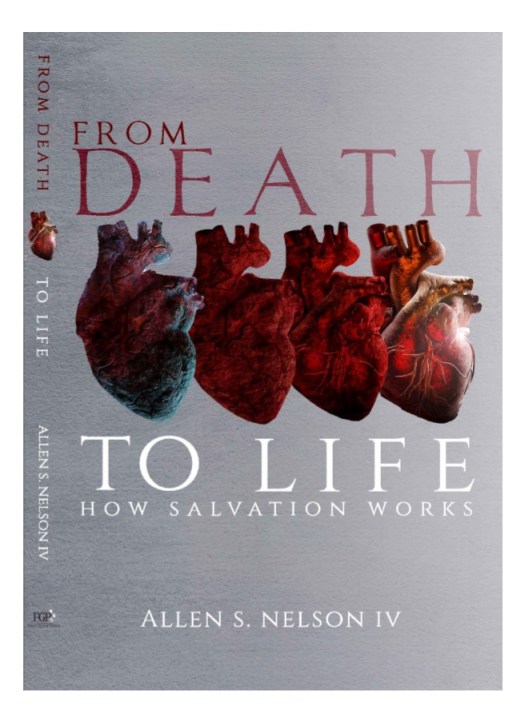 photo credit: Stephen J. Melniszyn
The most agonizing, frustrating experience in my ministry to women is the woman who claims to be “saved” but gives no evidence of it. No interest in talking about Jesus, no interest in holiness, reading the Bible, going to church, serving God’s people. She has a salvation testimony (often dramatic and self-glorifying) that is superficial, shallow, and devoid of any real repentance for her sin. I suspect she’s a false convert. And I find it exceptionally difficult to talk to false converts.
In From Death to Life, Pastor Allen Nelson confronts the disaster of false conversions, linking them to a false understanding of salvation: what it is, what it does, and how it works. He writes, “Ask fifteen people what it takes to be saved and it’s not out of the realm of possibility that you’ll get twenty different answers.” (Loc 173)¹
He makes the bold statement that “there is no spiritual life in many who claim to be Christians in America.” (Loc 247) He calls them the “walking dead”.
How does that happen? What would cause a person to wrongly believe he or she is a Christian? He lays some of the responsibility at the feet of churches that use methods such as external manipulation, diluted gospel presentations, the altar call, and the sinner’s prayer to lead the walking dead to their false professions of faith and their false assurances of salvation. He blisters easy-believism practices that, even if well-intentioned, have done damage to churches more influenced by a fallen culture than by God’s own Word.
So how does salvation work? The author has narrowed the answer down to five main points:
1. The gospel must be proclaimed.
2. God must move.
3. The sinner must respond in faith and repentance.
4. God justifies the sinner.
5. The sinner grows in the Lord over a lifetime.
Pastor Nelson not only unpacks, but folds, hangs up, and neatly puts away each of these main points in a few short chapters. In doing so, he poses and then answers questions such as, “What is the true gospel?”, “What is biblical repentance?”, “What is saving faith?”, and “What exactly is justification?” His answers are delivered in a direct, engaging, accessible style with plenty of biblical illustrations and scriptural references. No theological dictionary needed.
The book includes “how–to’s” but doesn’t read like a “how–to” manual. The tone is pastoral, sometimes comfortable, sometimes convicting, but never harsh. At times, the reading felt like sitting over coffee with Pastor Nelson, asking questions about various evangelistic situations, and receiving useful advice on how to respond.
A destitute woman in a homeless shelter, eyes pallid, needle tracks running down her arms, naturally incites my heart instinct to put my arms around her, tell her Jesus loves her, and give her some money. But Pastor Nelson reminds us:
“People need to hear more than “Jesus loves you,” What they need to hear today is what they’ve always needed: to know that they are sinners, that they need a Savior, that Jesus is that Savior, and until and unless they come to Him in faith, they will justly spend an eternity facing the punishment of their sins.” (Loc 2413)
He points out that it is vital that we all (not just the “trained professionals”) know what to say when the time comes to share the gospel of Christ. And while there is no formula, it is essential that the facts of the gospel are understood. The book helpfully guides the reader in a biblical understanding of how salvation happens and presents realistic examples of responses that can be used with unbelievers/false converts in evangelistic conversations.
The chapter “Plant, Water, Trust God, Repeat” is a compelling warning to stick to a biblical approach to evangelizing the lost. (Throughout the book he gives examples of unbiblical approaches.) In this encouraging chapter, he discusses applying how salvation works in real life scenarios, acknowledging that it is not always easy. He doesn’t present himself as a superhero evangelist.
This is a serious book, but the author can also be funny. I got a laugh out of his response to the command to “ask Jesus into your heart”. His tone, however, is utterly serious when discussing repentance:
“God doesn’t beg people to repent so they can be the star player on His team. He demands repentance. He owes mankind nothing. What a fearful and insolent game we play by making repentance an optional feature to becoming a Christian, refusing to properly define it in hopes of sneaking people into the kingdom, or by flat out dismissing it altogether.” (Loc 1164)
He spends a good bit of time parked on repentance, emphasizing that biblical repentance is necessary for any person to become a Christian. He asserts, “Remorse does not equal repentance” and goes on to give what he calls the bare necessities of repentance.
Is it possible to know if a person has actually been converted? In the chapter on sanctification, the author acknowledges that while we can’t see the heart, we can use the discernment God gives us to see evidence of true conversion. He provides a practical alliteration method to assist in discerning whether or not the gospel has actually taken root in a person’s heart and the changes we would expect to see in a truly converted person.
He warns the church against haphazardly affirming people as Christians without exercising grace-filled discernment:
“Often, we claim that the problem in our churches is that too many people are immature believers when the real problem is that many we call immature, actually have no life in Christ at all. They aren’t growing because they aren’t living.” (Loc 1878)
The sanctification chapter, my favorite, thrust me to a fresh examination of my own life using his alliteration template. What evidence of salvation would others see in me? What would they discern as my motivation for life? There is plenty of self-application for the reader.
The book has three appendices. Appendix 1: The Sinner’s Prayer, Appendix 2: Acts 2 is Not an Altar Call, Appendix 3: Putting “Baptist” Back in Your Church. In these appendices, the author makes some “say whaaaat?!?” observations that will rock your world if your church endorses these practices.
This is a short book. Although the print version is only 200 pages, there is nothing shallow about the content. The reader will step into a deep pool. Did I know how salvation works before I read the book? Yes. Have I been guilty of using unbiblical methods to try to bring about a conversion? Yes. I finished the book with an unanticipated, heart wrenching reorientation to the gospel as the power of God unto salvation. I bet I’m not the only reader who closed the book and repented.
I began by saying I find it exceptionally difficult to talk to false converts. What do you say to someone who believes she is saved when it is clear that she is not? Pastor Nelson is immeasurably supportive in reinforcing that “we must proclaim the gospel. Without it, people will go to hell. It’s as simple as that.” (Loc 441)
The book left me feeling hopeful, energized, looking forward to my next evangelistic encounter. God saves sinners. God saves sinners. And he uses sinners like me to do so.
Pastor Nelson writes, “Every single one of us is charged with sharing the gospel with those God providentially places in our life.” What a calling, what a staggering privilege. God could sovereignly call His own to Himself without us, but He has chosen to work through us. This book will certainly help us in our evangelism. I recommend it for everyone.
¹Katy reviewed the Kindle edition of the book and used Kindle location numbers rather than page numbers.
Allen “Cuatro” Nelson, IV, author of From Death to Life, is the pastor of Perryville Second Baptist Church in Perryville, Arkansas, and co-host of The Rural Church Podcast. Contact Him directly via Twitter to receive a free study guide with your order of From Death to Life or a discount on bulk orders. You can also order from Amazon.
Katy can’t remember when she became a Christian but is assured that, by the grace of God alone, she is a Christian. She ministers to women in her OPC church, in homeless shelters, in a prison, and sometimes at the grocery store. She is an executive with a United States health care corporation and enjoys her work, although she would rather be reading. You can find Katy on Twitter at @KatyvonBora.
Welcome to another “potpourri” edition of The Mailbag, where I give short(er) answers to several questions rather than a long answer to one question. I also like to take the opportunity in these potpourrri editions to let new readers know about my comments/e-mail/messages policy. I’m not able to respond individually to most e-mails and messages, so here are some helpful hints for getting your questions answered more quickly. Remember, the search bar can be a helpful tool!
In the last Potpourri edition of The Mailbag, a reader asked if I could enlarge the font of my articles. I played around with several different fonts and sizes, and what you’re currently seeing is the best I can do to enlarge the font without throwing the layout of the whole page out of whack. Personally, I think it’s still too small, but I hope it has helped at least a little.
I am wanting to start a Bible study for my coworkers after work maybe once a week or every two weeks but I don’t know where to start. Many of them are young women in their early twenties and either new in the faith or no faith at all. I want to start slowly so I don’t overwhelm them but I have no idea the first step I should take. Do you have any resources for sound Bible studies for new believers or young women?
Yes, I recommend you choose a book of the Bible, maybe a shorter one to start with, start at the beginning, and work your way through it with your ladies, teaching and discussing as you go. If you need some help in the beginning knowing what kinds of questions to ask or which issues in the text to focus on, you are more than welcome to use any of the studies I’ve written free of charge (see the “Bible Studies” tab at the top of this page), and even print them out if you like. Once you get a feel for teaching this way, I’m sure you’ll do fine on your own coming up with questions and pointing out important points in the passage.
You might want to start out with my study on Colossians since it’s fairly short and will give your group a good grounding in biblical Christology (who Jesus is, what He did, and why).
Another option might be for the group to choose a Bible reading plan (again, maybe one of the shorter ones to start off with), do the reading at home, and come together weekly to discuss the readings.
I don’t recommend “canned” book or DVD studies anymore. First of all, the overwhelming majority of them contain false doctrine. Studying the Bible itself sidesteps that problem altogether. Second, Christian women need to learn and practice the skill of picking up God’s Word and studying it for themselves. You have the unique opportunity with new Christians and non-Christians to start them off on the right foot of studying the Bible itself rather than getting them hooked on other people’s books. Below are a few more resources that might be helpful. Let me know how it goes!
The Mailbag: We Want Bible Study Answers
10 Simple Steps to Plain Vanilla Bible Study
10 Bookmarkable Biblical Resources for Christian Women
Rightly Dividing: 12 Do’s and Don’ts for Effective Bible Study
Bible Book Backgrounds: Why you need them and where to find them
What is your take on quantum physics and God?
Oh my! My take is that I really don’t know enough about quantum physics to speak intelligently on this. You might want to check out Answers in Genesis or the Biblical Science Institute. The founder of BSI, Dr. Jason Lisle, is a doctrinally sound Christian who has a double-major bachelor’s degree in physics and astronomy with a minor in mathematics, and a Master’s degree and Ph.D. in astrophysics. He would be the one to ask.
Book Recommendations
I need some help from you readers on these!
Readers have written in requesting doctrinally sound recommendations of books on the following topics:
Theology books for teenagers
Neither of these are written specifically for teenagers, but they’re both written simply enough that teenagers shouldn’t have any trouble with them:
None Other by John MacArthur
Everyone’s a Theologian by R.C. Sproul
A whole Bible commentary
Here are some you can try out for free. MacArthur’s commentaries are excellent, as are Boice’s.
Explaining sex/where babies come from (8 year old level)
Clueless. My husband and I just explained it to our children verbally.
If you have a recommendation for a doctrinally sound book on any of these topics, please comment below with the title, and the author’s name and a link if possible. Thank you!
I read your blog regularly and haven’t seen you write about a particular topic: Christian wives, especially mothers, working outside the home.
The reader went on to answer her own question quite beautifully, I thought. I couldn’t say it any better, so here’s the rest of her e-mail:
As I have read and studied Titus 2:3-5 lately, as an older woman (62 this year), I was struck by this phrase, workers at home:
Older women likewise are to be reverent in their behavior, not malicious gossips nor enslaved to much wine, teaching what is good, so that they may encourage the young women to love their husbands, to love their children, to be sensible, pure, workers at home, kind, being subject to their own husbands, so that the word of God will not be dishonored. (emphasis mine)
Interestingly, our pastor is doing a series on evangelism. He has started out in a different place, sort of laying the groundwork. He is showing us particular passages in the Scriptures regarding practical things that Scripture says Christians can do to perhaps provide openings and help to overcome some of the unsaved person’s natural enmity to the gospel. He preached on this passage because it says that women are to do/not do these things “so that the word of God will not be dishonored.” This has made this issue seem even more compelling to me. I know of Christian wives that are working outside the home, some against the counsel of godly people in their lives and even the wishes of their own husbands.
Lest you misunderstand me, I am not saying that a Christian woman should never work outside the home. Every Christian couple must decide together before the Lord how this looks in their own family. Obviously, a woman who has children in school all day, or grown children, or no children, has more leeway. If a husband is absolutely unable to work because of ill health, or whatever, I am sure there are some exceptions. But still the Scriptures teach that the Christian wife’s primary focus and attention is to be in her home, that the word of God will not be dishonored. I agree with what Grace to You wrote here.
Should women be missionaries?
Yes. Absolutely. In fact, we need more women – single and married – to serve as missionaries (more men, too). The only caveat is that women who serve as missionaries need to do so in a way that is in keeping with Scriptural principles of women’s roles in the church. (For example, female missionaries should not be pastoring churches on the mission field. A missionary’s job is to share the gospel with people and then disciple them in sound doctrine, and you don’t want to be teaching false doctrine through the act of preaching to men.) But there are oodles of mission opportunities that fit the bill.
It is my understanding that there is a great need for women missionaries to minister to women in countries whose cultures discourage or prohibit their women from interacting with men. A male missionary could not reach out to women in those countries, but a female missionary could be very effective.
My denomination, the Southern Baptist Convention, has a rich history of female missionaries and mission work, starting with our Women’s Missionary Union, celebrating its 130th anniversary this year. Our yearly offering for international missions is named after female missionary, Lottie Moon. Likewise, our annual North American missions offering is the Annie Armstrong offering, and my state convention collects the Georgia Barnette missions offering every year. You might enjoy reading about these female missionaries and others such as Amy Carmichael and Amy Medina.
There are many reputable missions organizations out there, but the two I’m most familiar with are the Southern Baptist Convention’s North American Mission Board and the International Mission Board, which, even if you’re not Southern Baptist could give you some ideas of the types of mission work out there and the countries needing missionaries.
If you’re thinking about becoming a missionary, set up an appointment with your pastor to talk it over. He can probably give you some great pointers and put you in touch with people and organizations that can help you.
If you have a question about: a Bible passage, an aspect of theology, a current issue in Christianity, or how to biblically handle a family, life, or church situation, comment below (I’ll hold all questions in queue {unpublished} for a future edition of The Mailbag) or send me an e-mail or private message. If your question is chosen for publication, your anonymity will be protected.
