Bible, Old Testament

6 Reasons You Need to Stay Hitched to the Old Testament

Oops, he did it again. Only it wasn’t an “oops”, it was quite intentional.

In a recent sermon, Andy Stanley declared that the modern church needs to “unhitch” the gospel from the Old Testament. He attempted to draw a parallel between James’ pronouncement in Acts 15 that Gentiles did not have to convert to Judaism prior to becoming Christians with the difficulty some non-Christians today have with some of the gory, hard to understand, or otherwise distasteful (to them) passages of the Old Testament (for example: God’s various commands to Israel to utterly destroy all people in certain nations). The apostles cut out the requirement for circumcision to make things easier for Gentiles who wanted to come to Christ, he reasons, so the 21st century church should basically divorce itself from the Old Testament to make it easier for lost people who have a problem with certain Old Testament passages to come to Christ.

There’s only about a million problems with this line of thinking, and, honestly, the more I investigate what Stanley said and his subsequent explanations of why he said it and what he meant, the angrier it makes me. That a man with a master’s degree from a decent seminary, who’s a pastor of several churches, a best-selling “Christian” author, and a leadership and church growth guru to thousands of pastors across the globe should say, or even believe, such things is reprehensible. If he were generally doctrinally sound and this was the first “iffy” thing he had ever said, I’d be inclined to extend grace and give him the benefit of the doubt. But this is somebody with every theological advantage who shouldย know better, yetย still has been on a trajectory of attempting to deconstruct the New Testament church for quite some time now. (For more on Andy Stanley’s aberrant theology, click the “Popular False Teachers” tab at the top of this page.)

So, for the sake of my own blood pressure, I’m just going to throw out a few of the most embarrassingly obvious errors here, and letย better people than Iย handle the blow-by-blow.

1. Andy Stanley is not an apostle personally commissioned by Christ to set up the New Testament church. James and those other guys mentioned in Acts? Theyย were. Andy doesn’t have the authority to change New Testament ecclesiology, which is permanently and inextricably hitched to the Old Testament.

2. Acts is generally aย descriptive book, not aย prescriptive one. While there are certain principles we can learn from Acts and follow, it’s a history of the establishment of the first century church, not a step by step list of instructions to implement in today’s church. If there were a church today that was insisting Gentiles become Jews before they could become Christians, Acts 15 would be applicable. But I don’t know of any churches like that, do you?

3. The two church scenarios Andy is trying to make analogous aren’t. No church I know ofย requires unbelievers to understand, agree with, or even have readย whatever Old Testament passages Andy thinks are problematic prior to becoming a Christian.

Furthermore, how many lost people are actually out there saying, “I recognize I’m a sinner in need of a Savior. Iย want to repent of my sin and place my faith in Christ for salvation, but I just can’t, because of 1 Samuel 15:2-3.”? People who bring up Old Testament passages like that when confronted with the gospel are presenting excuses for rejecting the gospel, not looking for ways to embrace it.

4. Shoving difficult passages of Scripture into the broom closet is not how God has instructed the church to handle His holy Word. We’re to be “a worker who has no need to be ashamed, rightly handling the word of truth.” (2 Timothy 2:15b) We don’t get rid of challenging passages, we dive into them, study them, and explain them to others.

The Old Testament is absolutely essential to New Testament Christianity, and a rich blessing to the church, individual Christians,ย and lost people, besides. Here areย six reasons you and your church shouldย stay hitched to the Old Testament.

1.
God says so

All Scripture is breathed out by God and profitable for teaching, for reproof, for correction, and for training in righteousness, that the man of God may be complete, equipped for every good work. 2 Timothy 3:16-17

That should be the end of any discussion of ditching any part of Scripture for any reason. God could not have been clearer. “All Scripture” meansย all Scripture, from Genesis 1:1 to Revelation 22:21. And every single verse of Scripture isย profitable.ย Even the genealogies. Even the inventories. Even the Levitical law. There is stuff in every single verse of the Bible that is useful and beneficial to us. God says so (and He says so in the New Testament, by the way).

2.
You need the Old Testament
to understand the New Testament

Can you come to a saving knowledge of Christ by reading only the New Testament? Yes. But it’s kind of like saying, “I know American history,” when you’ve only studied the years 1900 to the present. The New Testament was birthed out of the Old Testament. The gospel is the culmination of Old Testament doctrine. Jesus Himself is the ultimate fulfillment of every Old Testament prophecy and covenant.

And then there are all the New Testament details that need explaining. Who are these Jews and how did they come to be God’s people? Why do they have such a problem with Gentiles? What are these laws the Pharisees keep talking about? If Jesus is the “second Adam”, who was the first Adam? What on earth is circumcision anyway? And…Hebrews? What’s that all about?

3.
The Old Testament teaches how weย CAN’T be saved

Therefore the Law has become our tutor to lead us to Christ, so that we may be justified by faith. Galatians 3:24 (NASB)

and howย from childhood you have been acquainted withย the sacred writings,ย which are able to make you wise for salvation
through faith in Christ Jesus. 2 Timothy 3:15

How was the Old Testament Law our tutor to lead us to Christ? How was it able to make Timothy wise for salvation through faith in Christ Jesus? It shows us the futility of thinking we can keep the law to earn righteousness. It shows us that right standing with Godย always comes by repentance and faith, not works. How many times have you shared the gospel with someone only to hear her say some variation of, “I’m OK with God and I’m going to Heaven because I’m a good person.”? Really? Take a stroll through the Old Testament, and watch how “good” God’s chosen people were. He spelled everything out for them, sent them prophets to tell them exactly what He wanted them to do, performed amazing miracles right before their eyes, and theyย still couldn’t be “good people.” And you, a pagan, think you can do better?

Remember the old saying, “You can lead a horse to water, but you can’t make him drink.”? Some smarty pants came up with the rejoinder, “Yes, but youย can feed him salt.” The Old Testament is our salt. Its lessons in the futility of trying to be good makes us thirsty for the Living Water we find in the New Testament.

4.
The Old Testament vividly shows us
God’s wrath against our sin

I’m not saying the Old Testamentย onlyย shows us God’s wrath against sin, because it also shows us His compassion, mercy, and love. I’m also not saying the New Testament doesn’t show us God’s wrath. It does, but in a different way than the Old Testament does. In the New Testament, the main ways we see God’s wrath against sin is when it’s poured out on Christ at the cross, and the wrath of God that’s yet to come as it’s described in Revelation.

When it comes to God’s wrath against me, personally, for my individual sin, those demonstrations of God’s wrath can feel a little detached sometimes. But in the Old Testament, I see, in vivid detail, the horrific plagues God rained down on Pharaoh for his sin. I see the ground open up and swallow Korah for his rebellion. I see God immolating Nadab and Abihu for offering illegal worship. I see the once mighty and majestic Nebuchadnezzar forced out into the wilderness to live like an animal because he took God’s glory for himself. And when I know that God doesn’t changeย – that His wrath towards my sin as a lost person burns just as hot as it did toward those Old Testament rebels – well, it can hit a lot closer to home and convince me of my need toย run to the cross and throw myself on the mercy of Christ.

5.
The Old Testament teaches by example

The largest portion of the Old Testament is history and biography. Most of the New Testament is didactic. The New Testament gives us the subject matter we need to learn. The Old Testament puts flesh and blood on it and shows us what it’s like for real, flawed people just like you and me to walk it out. In the New Testament, we learn “by grace are you saved through faith.” In the Old Testament, we see just how God accomplished that in the life of Noah, who found grace in the eyes of the Lord. In the New Testament we learn what it means to repent. In the Old Testament, we walk with David through the loss of his child and his grief over his sin with Bathsheba. In the New Testament, we learn that the godly will face persecution. In the Old Testament, we stand next to Shadrach, Meshach, and Abednego refusing to bow to an idol, even if it means being burned alive. The New Testament gives the facts of the matter. The Old Testament says, “For example…”.

6.
The Old Testament is a warning to the church

People are people. God’s people of the Old Testament are not significantly different from God’s people today. We’re all made in the image of God. We’re all tempted by similar things.

If you begin studying the Old Testament, you can’t help but notice some of the same themes running through the story of God’s people back then that run through our story today. Idolatry. Ecumenism. Doing what’s right in our own eyes. Going through the motions ofย religious activity without true repentance and faith. Depending on our own power and resources rather than depending on God. False prophets. Persecution and derision of those who stand firmly on God’s Word by those who claim to be His people. Fickle hearts and tickled ears. Oh sure, we might be a little more sophisticated and subtle about it, but, as Solomon put it:

What has been is what will be, and what has been done is what will be done, and there is nothing new under the sun. Ecclesiastes 1:9

And because the Old Testament shows us more direct interpersonal interaction between God and His people, we get to see exactly how God feels about all of those things. We hear what He has to say about it. We see how He responds to it. And, if we’re wise, we take heed to those warnings, humble ourselves, and grow in our fear of the Lord and our desire to please Him with holy living and clean worship.


I could give far more than a mere six reasons why the Old Testament is so vital, a precious blessing, and such a spiritual treasure trove. It tells us where we, and the world around us, came from. It shows us the beauty and precision of worship. It extols the charm of Creation. It displays God’s power, grace, trustworthiness, mercy, justice, His plan for mankind, and all of His other attributes. And so much more.

Are there some passages in the Old Testament that are hard to understand or accept at first blush? Sure. But they’re not keeping anybody from coming to Christ. People reject Christianity, not because of difficult Old (or New) Testament Scriptures, but because they love their sin more than Jesus. And that’s no reason to unhitch anything or anyone from the beauty, the joy, and the benefits of the Old Testament.

How has the Old Testament been profitable in your walk with the Lord?
Discernment, False Doctrine

A Naked Emperor in the Southern Baptist Convention

Think back to your childhood. Remember the story, The Emperor’s New Clothes?

Once upon a time, there lived an emperor. One day two swindlers came to his palace and told him they could weave cloth for his royal robes that was magical: to those who were foolish or unfit for their jobs, it would appear invisible. Only the wise and worthy would be able to see this fine fabric. The emperor hastily agreed to pay the “weavers” an exorbitant amount of money to make him such an amazing garment, thinking he would use it to weed out anyone unfit for royal service.

The weavers set about pretending to weave. From time to time, the emperor sent various folk to check on the progress the weavers were making, and – though in reality, none of them could see the non-existent fabric – all reported back that the garments were coming along nicely and the cloth was beautiful. But strangely enough, when the emperor himself looked in on the weavers, they held up the magnificent fabric, and he could not see it. Not wanting word to leak out that he was unfit to serve as emperor, he pretended to examine the cloth and complimented the weavers lavishly on their fine work.

Finally, the weavers informed the emperor that the garments were finished. They had the emperor strip down to his skivvies and pretended to help him on with his fine new “garments”. Word had spread among the emperor’s subjects about the magical properties of the fabric, and as the royal procession made its way through town, all shouted out praise for the emperor’s fine new clothes.

All. Except for one little boy.

“But he hasn’t got anything on!” the boy shouted.

It took the innocent honesty of a simple child to shock the emperor’s subjects back to their senses. The truth spread like wildfire, and the crowd began to cry out: “The emperor is naked!” “The emperor has no clothes on!” “He’s not wearing anything!”

But did the emperor admit to his foolishness, return to the palace, and get dressed? No. Sadly the story ends this way:

“The Emperor shivered, for he suspected they were right. But he thought, ‘This procession has got to go on.’ So he walked more proudly than ever, as his noblemen held high the train that wasn’t there at all.”ยน

And so the “emperor” of leadership in the Southern Baptist Convention and those who carry its train march proudly on, despite the cries of simple peasants and innocent little children crying at the top of our lungs, “The emperor is naked!” “There are issues that need to be addressed, here!” “Listen to us!”

You’ll note that the story doesn’t say that the emperor was a cruel man, that he overtaxed the people, oppressed them into slavery, was a warmonger, or was in any other way an evil leader. In fact, one could argue that he had good intentions of making sure the people who served at various posts in his empire were of the finest caliber.

And while there are many issues that need to be addressed in my denomination, I think this could generally be said of the leadership of the Southern Baptist Convention as well. Call me a Pollyanna, but I have no reason to believe our denominational leadership – as a whole – is evil or has anything less than the best of intentions for the SBC.

There are many good and praiseworthy things going on in SBC life. We have hundreds of doctrinally sound pastors faithfully preaching the gospel week in and week out. Discernment and biblical literacy among Southern Baptist church members is slowly but steadily growing. The SBC takes a public, biblical stand on abortion and homosexuality while many other denominations do not. Our organizational structure for funding and sending out missionaries, while sometimes flawed in its execution, is without peer. Southern Baptist Disaster Relief is one of the finest relief organizations in the world. And there’s so much more. Find a godly Kingdom effort going on somewhere, and you’ll probably find a Southern Baptist involved in it. By the grace of God, while we’re far from perfect, we’re getting a lot of things right.

But even benevolent emperors get things wrong sometimes, and, Southern Baptist leadership, your drawers are flapping in the breeze on this oneยฒ:

Sin. The public sin our leaders commit that we excuse and the public sin our leaders commit that we discipline, and the fact that there’s a discrepancy between the two.

Recently, Frank Page, president and chief executive officer of the Executive Committee of the Southern Baptist Convention (one of the top positions of SBC leadership at the national level) resigned his position due to “a morally inappropriate relationship in the recent past,” which, we are left with little choice but to assume means “adultery”. (As an aside, Christians, when confessing sin, let’s knock off the the terminological hem-hawing and call a spade a spade. “I had a six month extra-marital romantic and sexual relationship with a married woman in my church,” or whatever. You don’t have to give all the gory details or name names, but, for crying out loud, if you’re going to confess, confess- don’t finesse.)

It was right and biblical for Dr. Page to publicly confess and express sorrow over his sin as well as to resign (it would also have been right and biblical for the SBC to remove him had he refused to resign, which, undoubtedly would have happened). He sinned against God, his family, the woman and her family, his church, his co-workers, and the entire denomination. He publicly embarrassed the Southern Baptist Convention and gave unbelievers fodder for scoffing when the report of his sin made the national news. This was a case of a well known Southern Baptist leader whose public, observable sin was handled biblically by SBC leadership. I am thankful for this witness to Christians and to the world that sin is not to be swept under the rug, but that sinners are to repent, be disciplined, and then be restored to fellowship (although, in cases like this, not leadership).

But we don’t handle all cases of public sin that way. Some public sin we reward by making the sinner into a wealthy, lauded celebrity.

“Impossible!” you say?

Check the shelves at LifeWay. Select twenty average SBC churches with women’s ministries and see whose books, DVDs, and simulcasts are being used again and again. Peruse the speakers at popular SBC conferences.

You’ll find names like Beth Moore, Priscilla Shirer, Lysa TerKeurst, Christine Caine, Ann Voskamp, Sarah Young, Andy Stanley, Steven Furtick, Rick Warren, and T.D. Jakes, just to name a few.

Have they committed adultery? Voiced approval of of homosexuality? Committed theft, abused their spouses, or promoted pornography? No. But those aren’t the only types of sins the Bible prohibits.

Every single one of them teaches false doctrine, from Sarah Young’s blasphemous “channeling” of Jesus, to T.D. Jakes’ denial of the Trinity, to Christine Caine’s Word of Faith heresy, to Lysa TerKeurst’s teaching of contemplative prayer.

All of these women who do speaking engagements unashamedly and unrepentantly preach to co-ed audiences. All of these men allow women to preach to co-ed audiences from their pulpits.

All of them who join in ministry with others have yoked or affiliated themselves with false teachers. Beth Moore and Joyce Meyer. Priscilla Shirer and T.D. Jakes. Steven Furtick and Joyce Meyer and T.D. Jakes. Rick Warren and the Pope.

Scripture plainly prohibits the teaching of false doctrine. It’s a major theme of the New Testament, for goodness sake. The Bible tells us that women are not to preach to men or exercise authority over them in the gathered body of Believers. And God’s Word makes very clear that we are to have nothing to do with false teachers, especially not partnering with them in “ministry”.

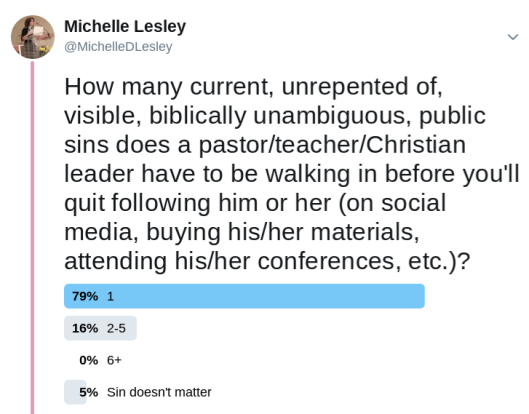
In the wake of Frank Page’s resignation, I asked this poll question on Twitter

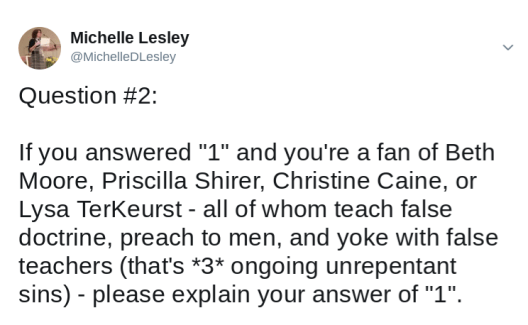
followed by this one

Why are Southern Baptists leaders so quick to – rightly and biblically – oust Frank Page for, as far as we know, one isolated sin which he publicly confessed to and repented of, and yet overlook three major – and much more publicly observable and harmful to Southern Baptists – ongoing sins from pastors and teachers who have been rebuked and refuse to repent? Why, instead of disciplining them for their sin, do those in leadership give them fat book deals, invite them to speak at all the cool conferences, fawn over them on social media, and make them into celebrities?

How many sins will it take to disqualify and discipline these people? Four? Eleven? Ninety-six? Is there any amount of sin these pastors and teachers, and those like them, can commit that will cause those in SBC leadership to pull their materials off the shelves of LifeWay, deny them a seat at the table, and urge them to repent and step down from their positions?

I’ve been a Southern Baptist from the day I was born. I’ve been taught since the cradle roll that if God’s Word says not to do something and you do it anyway, that’s a sin. If God’s Word says to do something and you don’t do it, that’s a sin. And that sin is sin in the eyes of God.

Well is it, or isn’t it, Emperor?

If sin is sin in God’s eyes, why aren’t you treating Beth Moore’s sin like Frank Page’s sin? Why are you rewarding her for her sin and disciplining him for his?

The Bible says in James 3:1:

Not many of you should become teachers, my brothers, for you know that we who teach will be judged with greater strictness.

Those who teach and lead bear more responsibility to teach sound doctrine and walk worthy because they are teaching and leading us by example.

Why are all the aforementioned pastors and teachers better examples to us in their rebellion and unrepentant sin than Frank Page was in his repentance of sin?

Why?

Southern Baptist peasants and little children see right through your foolishness on parade on this issue and we want answers. Biblical answers.

Don’t just stand there shivering, suspecting we are right, but thinking, “This procession has got to go on,” and walking more proudly than ever. Go back to the palace. Repent. Clothe yourselves with humility and obedience to Scripture, and come back and lead us rightly. Biblically.

Because the Emperor of Southern Baptist leadership has been naked for far too long.


ยนH.C. Andersen Centret (The Hans Christian Andersen Centre). The Emperor’s New ClothesAccessed April 5, 2018.

ยฒI am well aware that this is not the only problem in the SBC that needs to be addressed. It would be impossible to address every issue in one article, so this time I’ve chosen to focus on this one particular issue.
Mailbag

The Mailbag: Potpourri (Orange Curriculum, Jesus went to hell?, 1 Tim. 2:12 only for Ephesus?…)

Welcome to another โ€œpotpourriโ€ edition ofย The Mailbag, where I give short(er) answers to several questions rather than a long answer to one question. I also like to take the opportunity in these potpourrri editions to let new readers know about my comments/e-mail/messages policy. Iโ€™m not able to respond individually to most e-mails and messages, so here are someย helpful hintsย for getting your questions answered more quickly.ย Remember, the search bar can be a helpful tool!


In the Apostles Creed, there is a section that states Christ descended into hell and was resurrected. Isnโ€™t that what Joyce Meyer teaches? What about the part about the “holy catholic church: the communion of the saints”? Is that talking about Catholicism and the mass?

These are very common questions (I threw in the second part about Catholicism and the mass, since that’s also commonly asked.), and it’s good to ask, because if you’re confused, other people probably are, too.

The Apostles’ Creed says:

I believe in God, the Father Almighty,
the Creator of heaven and earth,
and in Jesus Christ, His only Son, our Lord:
Who was conceived of the Holy Spirit,
born of the Virgin Mary,
suffered under Pontius Pilate,
was crucified, died, and was buried.
He descended into hell.
The third day He arose again from the dead.
He ascended into heaven
and sits at the right hand of God the Father Almighty,
whence He shall come to judge the living and the dead.
I believe in the Holy Spirit, the holy catholic church,
theย communion of saints,
the forgiveness of sins,
the resurrection of the body,
and life everlasting.
Amen.

It’s a beautiful, basic reiteration of the gospel which many churches and ministries use as part of their official statement of faith. Some churches even recite the Apostles’ Creed during their worship services.

The earliest written record of the creed is from AD 390, in Greek, so you can imagine that some of the terminology used had different connotations back then than those terms have in 21st century America.

Providentially, my friend, Pastor Gabe Hughes, was also recently asked this same question and addressed it both on his podcast and in a WWUTT video, so I’m going to let him do the “heavy lifting” of Scripture and history in the resources below and just give you the short and sweet version:

๐Ÿ“œย You’re quite right in saying that Joyce Meyer teaches that Jesus went to hell between His death on the cross and His resurrection. The Bible doesn’t say this anywhere, and this is a heretical teaching. Just one of the multiple reasons no Christian should follow Joyce Meyer.

๐Ÿ“œย The word “hell” in the Apostles’ creed is based on a mistranslation or confusing translation. The literal meaning of the phrase is that he descended into theย grave or was buried.

๐Ÿ“œย You might have noticed that the word “catholic” in the creed starts with a lowercase “c” rather than a capital “C”. The noun “catholic” with a lowercase “c” simply means the universal church – all genuinely regenerated Believers across the globe, past, present, and future. Roman Catholicism is (or at least by rules of grammar is supposed to be) denoted by a capital “C”.

๐Ÿ“œย “Communion” in the creed does not refer to the Roman Catholic mass or even to the Protestant Lord’s Supper. A clearer word to us today would be “fellowship” or “unity”. The sense is that Believers commune with on another.ย 

Some churches have modernized and clarified the creed by replacing these phrases with “He descended into the grave” or “He descended to the dead” and “the holy Christian church.”

Additional Resources:

WWUTT Podcast #645– Gabe expands on the above video at the 30:15 mark

The Apostlesโ€™ Creed: Its History and Origins at Faithlife Blog


I was wondering if you could post your articles in a larger font. I have an old computer that messes up when I try to make the font bigger. My old eyes are a real struggle.

At first, I thought I was the only one having this problem, but I’ve gotten this question a couple of times, so I know it’s not just my own aging eyes :0)

I’m going to play around with the font a little bit and see if I can find one that’s bigger. Just a few things to understand as I’m working on it: WordPress gives me a limited number of fonts to choose from, and the sizes of those fonts are pre-set. In other words, I can’t set it to 12 point or 18 point, I can only choose from tiny, small, normal, large, and huge. (Right now it’s set on “normal” if you can believe that. “Tiny” is virtually invisible.)

Additionally, when I change the font size, it doesn’t just change the size of the font in the body of my articles, it also changes the size of things like the tags (to the immediate upper left of every article), the sidebar (far left of the page), and the tab titles (top of the page), which, as you can see, are already much larger than the font in the article body. When the font of those texts gets larger, it throws the layout of the whole page out of whack. You might not notice it on a desktop computer with a large monitor, but it can be problematic for people who are viewing the blog on a phone or tablet.

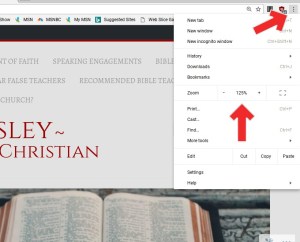
Like I said, I’ll play around with it and see what I can do, but if I’m not able to enlarge the font, there are two workarounds that may help:

1. The reader said she’s unable to change her screen magnification, but it works for me and might work for others. Here’s what it looks like on my computer. Maybe yours is similar:

2. If worse comes to worst, you can highlight and copy the body of the article, paste it into your word processing program, and enlarge the font accordingly.


I have been leading a womenโ€™s small group at our church for a couple of years now. My husband and I have decided to leave the church because, even after confronting leadership about the direction the church is being led doctrinally, they continue to espouse unsound doctrine. What do you think is a wise way to tell the ladies I will no longer be teaching? Do I tell them we are leaving? If so, do I tell them why? What do you think you would do?

It’s hard to say exactly what I would do because every situation and every church is different. But I can tell you that the first thing I would do is talk it through with my husband and ask his advice. There have been many times when he has had very good ideas about how to address (or not address) certain issues, and he will sometimes bring out an aspect of the situation that I hadn’t thought of before. I would encourage you to do that first, and also to make sure you’re submitting to your husband in whatever ways might be applicable in this situation.

My inclination is to advise you to take the “the less said, the better” route with regard to the whole class. (There may be other venues, such as you and your husband meeting with the elder board, in which you’ll need to clearly spell out all the problems, but let’s just focus on the class right now.)

I would probably wait until the end of the very last class and say something generic, like, “I’ve really enjoyed leading this class, but I wanted to let you know I won’t be teaching any more. I encourage you to continue studying God’s Word and growing in Christ. Class dismissed.” Then, go home fairly quickly.

The next level is going to be women coming up to you individually and asking why you won’t be teaching any more. Unless she’s a very close friend, I’d still keep it pretty generic: “We love our brothers and sisters at this church, but we’re finding we disagree with some of the doctrine that’s being taught here, and we’ll be going to a new church.”

For very close friends, you might wish to disclose more about the doctrinal problems, but do so wisely, making sure your focus is on doctrine, not on personal conflicts with the pastor or others. You don’t want people jumping to the wrong conclusion about why you’re leaving.

I really would not talk to people about leaving other than discreetly informing those who need to know. If you give details or talk about it a lot there could be an ugly blow up, and most people will make wrong assumptions about why you’re leaving.


Do you have any information on the Orange Curriculum for children’s Sunday School?

The main thing I know about the Orange Curriculum (or Orange Strategy) is that it is put out by Andy Stanley’s “church”. That’s enough for me to warn people to stay far, far away from it. Andy Stanley is a Scripture-twisting false teacher. You don’t want your children being taught by him or his disciples.

My friend Amy Spreeman over at Berean Research was asked the same question by a reader. I refer you to her article,ย Parents: If your church is โ€œTurning Orangeโ€ฆโ€ย for more details.


How would you respond to someoneโ€™s who says that [1 Timothy 2:12] was meant only for that time and culture?

It’s one of the most common arguments made by people who are looking for an acceptable way to rebel against God’s clear command, “I do not permit a woman to teach or to exercise authority over a man; rather, she is to remain quiet.” I have never had a woman who was humbly seeking to deny herself and obey Scripture make this argument, only those who stubbornly want to have their own way despite what the Bible says, yet simultaneously want to cloak themselves in the appearance of obeying Scripture.

God gave us His exact reasons for this command in verses 13 and 14 (almost as if He somehow knew this argument was coming!), and those reasons weren’t restricted to the women in the first century Ephesian church. The first reason was the Creative order – Adam was formed first, then Eve. The second reason is that Eve was deceived. Both of those reasons are universal (applying to all women and churches everywhere regardless of era or culture). It makes no sense that these two reasons related to Eve would apply only to first century Ephesus any more than it would make sense for them to apply only to tenth century Damascus or seventeenth century Paris.

Next, examine the context of 1 Timothy 2. There are all sorts of instructions to the church in that chapter. Was the instruction to pray for governmental leaders (1-2) limited to the first century Ephesian church? Were only the men of the first century Ephesian church to pray without quarreling (8)? Was modesty (9-10) only required of women in the first century Ephesian church? Then why pick out this one instruction in verse 12 and claim it was limited to that time and culture?

Finally, look at the overall general pattern of male headship and leadership in Scripture. First human created? A man. The Patriarchs? As the word implies – all men. Priests, Levites, Scribes? Men. Heads of the twelve tribes of Israel? Men. Major and minor prophets? Men. All kings of Israel and Judah? Men. Noahic, Abrahamic, Mosaic, and Davidic Covenants? All established between God and men. Authors of Scripture? Men. The forerunner of Christ? John the Baptist – a man. Messiah? A man. All of the apostles? Men. All of the pastors, elders, and deacons of churches in the New Testament? Men. Founder and head of the church? Christ – a man. Leader and head of the family? Men. Now which fits better with this pattern, women preaching to, teaching, and exercising authority over men in the church, or womenย notย preaching to, teaching, and exercising authority over men in the church?

But the truth is, you can have all the biblical evidence in the world, and it’s not going to convince someone who’s in rebellion against Scripture because self is reigning on the throne of her heart. She’s not concerned withย actuallyย obeying God’s Word, she just wants to be able toย claimย that Scripture supports whatย she wants to do, either to look good to others or to attempt to drown out the Holy Spirit’s conviction of her sin.

Additional Resources:

Jill in the Pulpitย 

Ten Things You Should Know About 1 Timothy 2:11-15 and the Relationship Between Men and Women in the Local Churchย atย The Council on Biblical Manhood and Womanhoodย (CBMW) This is a refutation of the most common egalitarian arguments against the plain meaning of 1 Timothy 2:11-15.


If you have a question about: a Bible passage, an aspect of theology, a current issue in Christianity, or how to biblically handle a family, life, or church situation, comment below (Iโ€™ll hold all questions in queue {unpublished} for a future edition ofย The Mailbag) or send me anย e-mail or private message. If your question is chosen for publication, your anonymity will be protected.

Discernment, False Teachers

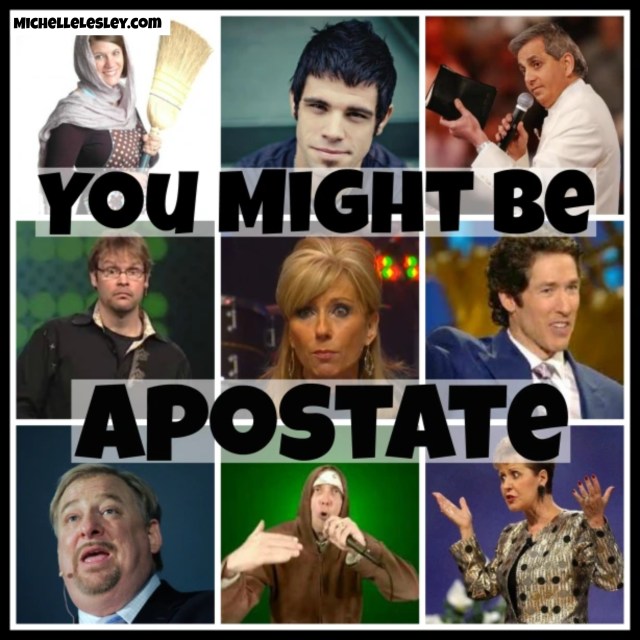
You Might Be Apostate

Comedian Jeff Foxworthy hit the big time several years ago with his “You Might Be a Redneck” one-liners. He frequently introduced the bit by saying, “I’ve found that there are rednecks all over, but sometimes people don’t know they’re rednecks. So, I came up with this little test…” and continued with such gems as:

“If you’ve ever had to carry a bucket of paint to the top of a water tower to defend your sister’s honor, you might be a redneck.”

“If your wife has ever said, ‘Honey, come get this transmission out of the tub so I can take a bath!’ you might be a redneck.”

“If you’ve ever been accused of lying through your tooth, you might be a redneck.”

It was a routine that a lot of us in the South found hilarious because we knew someone (or were someone) who fit nearly every one of Jeff’s jabs.

Like rednecks, there are apostate false teachers all over the place out there, only a lot of them (and their disciples) don’t know they’re false teachers. And the fruit of their lives and ministries is far wackier than anything a redneck has ever dreamed up. That fruit is a sign that we’d better examine the root of doctrine from which the fruit sprang.

So if any of the preachers and teachers you’re following have ever said or done the following things (or something even crazier), watch out, because they Might Be Apostate.

HoNuthaLevel

If you’re a middle aged pastor who makes embarrassing rap videos, who publicly extols the virtues of Spanx for men (even though it gives you gas) and who calls himself a Ferrari you might be apostate.

If you feature a Naked Cowboy impersonater (aka- your youth “pastor”) at your “Christian” women’s conference, you might be apostate.

If you’ve ever purposefully applied the pronoun “herself” to God, you might be apostate.

If you celebrated your 35th birthday by preaching at the “church” of your mentor, T.D. Jakes, and placing a $35,000 check in his offering wheelbarrow, you might be apostate.

If God has ever told you to go up to a stranger in the airport and ask if you can brush his hair, you might be apostate.

If you’ve ever given your congregation a sob story about needing a new $70 million Gulfstream jet, because the old one is worn out, you might be apostate.

If you think of the Holy Spirit as the “sneaky,” “silly,” “funny,” “blue genie from Aladdin,” you might be apostate.

If you’re a woman who thinks God is OK with you preaching to men despite what His word clearly says to the contrary, you might be apostate.

If you’ve ever said, regarding your church’s worship service, “I probably wouldn’t have a stripper on stage…” but leave the door open to the idea because “God told Isaiah to walk around naked for three years,” you might be apostate.

Benny Hinn at Maple Leaf Gardens on Sept. 28, 1992 photos by Tony Bock/Toronto Star and handout photo.

If you think smacking people in the face with your Nehru jacket is a ministry of the Holy Spirit, you might be apostate.

If you’ve ever typed a Facebook status in tongues, you might be apostate.

If you say you’re a trinitarian, but think the Father, Son, and Holy Ghost are three “manifestations” of God rather than three Persons, you ARE apostate.

If you think Proverbs 21:9 means you should camp out on your roof in a quest for biblical womanhood, you might be apostate.

If your senior pastor father sexually abused boys at your church and paid them off to keep them quiet and you, as the subsequent pastor, knew about it but didn’t speak up, you might be apostate.

If you officiated at your homosexual son’s “wedding,” you might be apostate.

If you’re a pastor who thinks expository preaching is “cheating” because it’s “too easy” and that “it’s not the way you grow people” AND that we shouldn’t say “the Bible says…” AND that parents who take their children to a small church instead of a mega church are “stinkin’ selfish,” AND that we shouldn’t use the Bible to convince the lost of their need for Christ, you might be apostate.

If you’re Oprah’s idea of an awesome pastor, you might be apostate.

download

If your preaching, ministry, and theology have ever been publicly rebuked by John MacArthur, Paul Washer and Steve Lawson, you might be apostate.

If you partnered with a Roman Catholic mystic with a degree in spiritual psychology to make a completely unbiblical movie about the Bible featuring ninja angels and Mary Magdalene bossing the disciples around, you might be apostate.

If you and your 80s rock star third husband stand in the pulpit and tell people to watch porn to improve their sex life, you might be apostate.

If a feature of your “worship service” is people laughing uncontrollably or barking like dogs, you might be apostate.

If you’ve ever decided to “p*ss off the religious people” on Easter Sunday by playing AC/DC’s Highway to Hell to open the service, you might be apostate.

If you’ve written a book entitled “I Am” and it’s about positive confession rather than Jehovah, you might be apostate.

If you think you have the power to control the weather by the words you speak, you might be apostate.

Joyce-Meyer-600x450

If you think that between the cross and the resurrection Jesus went to Hell and that Satan and the demons jumped up and down on His back, you might be apostate.

If the top three “pastors” you encourage people to follow on Twitter are T.D. Jakes, Rick Warren, and Joel Osteen, you might be apostate.

If a currently practicing homosexual couple wants to serve in leadership at your church and your only problem with it is that one of them isn’t yet divorced from his wife, you might be apostate.

If you’ve ever been accused of having an affair with Benny Hinn, you might be apostate.

If, a hundred years ago, your worship leaders might have been carted off to the funny farm or treated to an exorcism for conducting themselves like this, you might be apostate.

And, if you’re about to write a comment rebuking me for marking false teachers to avoid and exposing unfruitful works of darkness because Jesus would never do such a thing then you don’t know your Bible.

And you just might be apostate.

Calvinism/Arminianism, Celebrity Pastors, Cessationism/Continuationism, Church, Complementarianism, Homosexuality

Keep On Keeping Up: 5 Issues Christians Need Guidance About from Our Pastors ~ Part 1

14333566699421

Read Part 2 of this article, “Keep On Keeping Up: 6 More Issues Christians Need Guidance About From Our Pastors” here.

"Ignorance? Of Benny Hinn? A man in Brownโ€™s position claiming ignorance of Benny Hinn would be tantamount to an Olympic swimmer claiming ignorance of Michael Phelps or for a high level employee of Microsoft claiming ignorance of Bill Gates."
“Ignorance? Of Benny Hinn? A man in Brownโ€™s position claiming ignorance of Benny Hinn would be tantamount to an Olympic swimmer claiming ignorance of Michael Phelps or for a high level employee of Microsoft claiming ignorance of Bill Gates.”

Last week, I read a great article by Justin Peters entitled “Ignorance Is Not An Option.”ย In the article, Dr. Peters addresses a recent incident in which “charismatic theologian, author, and radio host Dr. Michael Brown” claimed not to know about the reputation and heresy of Benny Hinn, one of the most notorious false teachers in the Word of Faith movement. I know about him. You probably know about him. How could someone in Dr. Brown’s position not know at least the basics about Benny Hinn and why no Christian should endorse him?

It got me thinking- “ignorance is not an option” applies to far more than this one, isolated incident. We church members desperately need our pastors to keep up with at least the basics of current trends and thought in evangelicalism, and in theology and doctrine.

Why? There is a tsunami of materials, ideas, and personalities out there, and church members- even though we should seek to keep abreast, ourselves -need help sorting through it all. What’s biblical? What’s not? Also, pastors need to be informed about who and what they endorse (even tacitly), lest they encourage their church members to follow a person or doctrine that is not in line with God’s word.

So, what, specifically, are some of those current trends that we folks in the pew need our pastors to keep up with? Here are a few, along with some great resources to spare pastors some leg work:

Celebrity Pastors and Christian Authors: Do you know who Joyce Meyer, Matt Chandler, Rick Warren, Joel Osteen, John Piper, John MacArthur, Andy Stanley, Steven Furtick, Beth Moore, Mark Driscoll, Tony Campolo, David Platt, and Rachel Held Evans are (just to name a few)?

Do you know why your people should or shouldn’t be listening to/reading them? What about any controversies surrounding them?ย Do you have a general awareness of whether they have a track record of, and are currently teaching, sound doctrine or false doctrine?

Church members may not know the answers to these questions, but they’re walking into Christian bookstores and buying their books, re-tweeting them, and listening to their podcasts. If a church member comes and asks you about one of these pastors/authors, what will your recommendation be? We church members need our pastors not to go by the pastor/author’s popularity, whether what they write or say sounds pleasing to the ear, how many books they’ve sold, that their stuff is sold at a store you think is trustworthy, or how big their church is. Whether we know it or not, we need your deciding factor to be:ย Does what they teach consistently match up with God’s word (in context)?

*Resources:
Fighting for the Faith: Listen regularly, or make good use of the search box. Chris Rosebrough has analyzed the teaching of nearly all of the people in the list above as well as many others.
Apprising Ministries: While I sometimes feel Ken Silva’s tone is too sharp, his posts are saturated with links to articles and videos of questionable teachers (plus tons of other resources) that you can check out for yourself.

Complementarianism vs. Egalitarianism:ย In a nutshell, complementarianism is the view that God’s roles for men and women in marriage and in the leadership of the church are different, yet equally important. Wives are to submit to their husbands, and husbands are to lovingly lead their wives and children. The roles of pastor and elder are reserved to men, and women are not to teach the Bible to men or hold authority over men in the church.

Egalitarianism basically says that there are no gender restrictions on any positions in the church, including that of pastor, and that husbands and wives are to be “mutually submissive” to one another, removing any distinctive definition of headship.

The church, and women, especially, have been heavily influenced by culture on this issue, but what does God’s word say about it?

Resources:
Complementarianism vs. Egalitarianism- Which View Is Biblicaly Correct?ย by GotQuestions.org
The Council on Biblical Manhood and Womanhood

Cessationism vs. Continuationism:ย Didย the “miracle” or “sign” gifts such as speaking in tongues/other languages, healing, visions, direct revelation from God, raising the dead, etc., come to an end with the closing of the canon or death of of the last apostle, or do these gifts continue in the same way today?

Resources:ย 
Strange Fireย Conference audio from John MacArthur
Continuationism and Cessationism: An Interview With Dr. Wayne Grudem- Part 1ย and Part 2ย by Tim Challies

Calvinism vs. Arminianism:ย  I don’t think I could boil down the tenets of Calvinism or Arminianism to a brief paragraph in any sort of way that wouldn’t have people on both sides hot under the collar. This has been a strenuously debated topic, particularly for Southern Baptists, for the last several years.

So, let me just say, and I’m sure everyone on both sides can agree, it is extremely important to know whatย the Bible saysย about our sin nature, free will, election and predestination, and whether or not a person can lose his salvation. These are weighty issues with eternal consequences that shouldn’t be dealt with lightly or in a way that seeks to reinforce our own opinions at the expense of what God’s word says.

Resources:ย 
Calvinismย and Arminianism by Theopedia.com

Homosexuality In the Church:ย Homosexuality is certainly not the only sin out there, but it’s the sin that’s the hottest topic right now. Do you know the Scriptures that address homosexuality? Do you know how to answer the canard: “Christians say that homosexuality is against God’s law, yet they eat shellfish and wear garments of mixed fabrics, which is also against God’s law,”? What would you tell a church member who thinks it’s not loving to call homosexuals to repent of their sin and trust Christ or that godly “love” means we should validate their sin? Do you know how to help Christians who are former homosexuals deal with temptation to their old sins? Is it biblical to allow unrepentant, practicing homosexuals to serve in leadership positions in the church? Things like this may be going on in your own denomination, so it’s important for church members to be trained in what God’s word actually says.

Resources:ย 
Homosexuality by CARM.org
How Can We Help Christians Who Are Struggling with Homosexual Desires? by John Piper
Homosexuality and the Modern Church by Robert Gagnon and Tony Reinke

*The resources given are obviously not an exhaustive list. For the most part, they are resources I have used myself, found to be helpful, and trust to be generally doctrinally sound. There are many other wonderful resources out there, but, naturally, our most important resource is to compare all things to God’s word in context.

ย 

Read Part 2 of this article, “Keep On Keeping Up: 6 More Issues Christians Need Guidance About From Our Pastors”ย here.