Obedience, Sanctification

Throwback Thursday ~ Order My Steps

Originally published November 4, 2010

Whatever I command you, you shall be careful to do; you shall not add to nor take away from it. Deuteronomy 12:32

Remember long division? Some of us probably remember it fondly. For others, it was a nightmare of ghoulish proportions. Likely, most of us can still remember how to do it.

Ever tried to teach it to an eight year old?

That was my life last week.

If you think about it, it’s really not that any of the steps in long division are that hard. You have to know your times tables and you have to know how to subtract. That’s pretty much it as far as mathematical operations go. The tough part is working step by step and getting all the steps in the right order. One number out of place, one step out of order, and the whole thing falls apart.

And then, so does your eight year old.

The Old Testament is the story of long division. God told His people what to do, how to do it, and in what order to do it…

Bring Me the firstfruits, then you can use what is left.

Marriage first, then sex.

Work six days, then rest.

Put Me first in everything.

He spelled it all out for them, even carved it in stone, and still, they couldn’t get it. Many times, the majority of them gave up even trying and openly rebelled. For others, initially desiring to be obedient, striving became the order of the day. They added layers and layers of rules on top of the ones God had given to protect themselves from even coming close to breaking God’s original commands. And somewhere along the way, they lost the heart of God, and began to worship rule-keeping. Their steps were out of order at the deepest and most basic level, and things fell apart for them. Often. And badly.

But don’t judge the Israelites harshly. We do exactly the same thing. Some of us rebel. Some of us strive. And both ways are equally displeasing to God.

Because the first step in coming to God is to realize and admit that we can’t get it right. God never intended that we should be saved and in right standing with Him by keeping His Law and doing good deeds. Galatians 3:24 tells us that the whole purpose of the Law was to show us that we can’t keep it, and to lead us to throw ourselves upon the mercy of God for forgiveness and salvation.

Does God desire our obedience? Of course. But not as a way to garner His favor or to outweigh the bad things we’ve done. Because it’s not our outward behavior itself that pleases Him, it’s a heart that’s wholly His. He desires that we obey out of a heart of love and gratitude to Him for saving us.

Love Him first, then obedience will be a natural outflow.

Just take it one step at a time.

Ruth Bible Study

Ruth: Lesson 2

Previous Lessons: 1

Ruth 1

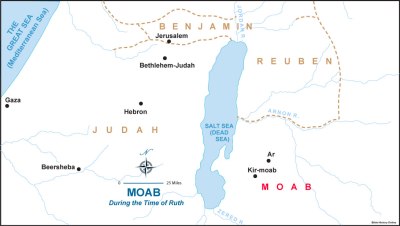
Photo courtesy of bible-history.com

In the days when the judges ruled there was a famine in the land, and a man of Bethlehem in Judah went to sojourn in the country of Moab, he and his wife and his two sons. 2 The name of the man was Elimelech and the name of his wife Naomi, and the names of his two sons were Mahlon and Chilion. They were Ephrathites from Bethlehem in Judah. They went into the country of Moab and remained there. 3 But Elimelech, the husband of Naomi, died, and she was left with her two sons. 4 These took Moabite wives; the name of the one was Orpah and the name of the other Ruth. They lived there about ten years, 5 and both Mahlon and Chilion died, so that the woman was left without her two sons and her husband.

6 Then she arose with her daughters-in-law to return from the country of Moab, for she had heard in the fields of Moab that the Lord had visited his people and given them food. 7 So she set out from the place where she was with her two daughters-in-law, and they went on the way to return to the land of Judah. 8 But Naomi said to her two daughters-in-law, โ€œGo, return each of you to her mother’s house. May the Lord deal kindly with you, as you have dealt with the dead and with me. 9 The Lord grant that you may find rest, each of you in the house of her husband!โ€ Then she kissed them, and they lifted up their voices and wept. 10 And they said to her, โ€œNo, we will return with you to your people.โ€ 11 But Naomi said, โ€œTurn back, my daughters; why will you go with me? Have I yet sons in my womb that they may become your husbands? 12 Turn back, my daughters; go your way, for I am too old to have a husband. If I should say I have hope, even if I should have a husband this night and should bear sons, 13 would you therefore wait till they were grown? Would you therefore refrain from marrying? No, my daughters, for it is exceedingly bitter to me for your sake that the hand of the Lord has gone out against me.โ€ 14 Then they lifted up their voices and wept again. And Orpah kissed her mother-in-law, but Ruth clung to her.

15 And she said, โ€œSee, your sister-in-law has gone back to her people and to her gods; return after your sister-in-law.โ€ 16 But Ruth said, โ€œDo not urge me to leave you or to return from following you. For where you go I will go, and where you lodge I will lodge. Your people shall be my people, and your God my God. 17 Where you die I will die, and there will I be buried. May the Lord do so to me and more also if anything but death parts me from you.โ€ 18 And when Naomi saw that she was determined to go with her, she said no more.

19 So the two of them went on until they came to Bethlehem. And when they came to Bethlehem, the whole town was stirred because of them. And the women said, โ€œIs this Naomi?โ€ 20 She said to them, โ€œDo not call me Naomi; call me Mara, for the Almighty has dealt very bitterly with me. 21 I went away full, and the Lord has brought me back empty. Why call me Naomi, when the Lord has testified against me and the Almighty has brought calamity upon me?โ€

22 So Naomi returned, and Ruth the Moabite her daughter-in-law with her, who returned from the country of Moab. And they came to Bethlehem at the beginning of barley harvest.


The Holy Bible, English Standard Version. ESVยฎ Permanent Text Editionยฎ (2016). Copyright ยฉ 2001 by Crossway Bibles, a publishing ministry of Good News Publishers.


Questions to Consider

1. ย Briefly review the background and setting of the book of Ruth from lesson 1 (link above).

2. What does verse 1 tell us about the period of Israel’s history in which the events of the book of Ruth take place? As we learned in lesson 1, Jairย was most likely judging Israel at this time. What else does verse 1 tell us was happening in Israel as the story opens?

3. Describe the sequence of events in verses 1-5 in your own words. Who are each of the people in this passage, and how are they related to one another? What is an Ephrathite?

4. On the map, trace Naomi’s family’s journey to and from Moab. What does the Old Testament tell us about Moab and the Moabites? Were they enemies or allies of Israel? Were they worshipers of God or of idols? What had happened the last time Israel joined with Moab? Did God want His people mingling with the Moabites?

5. Compare Naomi and Ruth’s journey (6) from the pagan land of Moab back to Israel, the Promised Land of God’s people, with the prodigal son’s journey from the pig pen back to his father’s house. How can both of these stories symbolize passing from death in sin to life in Christ?

6. In verses 8-13, what is Naomi’s main concern for Ruth and Orpah? Considering the culture and socio-economic status of women at that time, was this a valid concern? But considering the fact that Ruth and Orpah would be returning to a life of idolatry (15) if they stayed in Moab, why didn’t Naomi concern herself more with their spiritual state and urge them to come back to Bethlehem with her? Is it possible Ruth was already a believer and didn’t want to stay in a land of idolatry? Could this have been one of the things on Ruth’s mind in verses 16-17? (Note Ruth’s mention of “God” in 16 and her invoking of “the Lord” in her vow in 17).

7. Look at the footnotes on verse 20. What do the names “Naomi” and “Mara” mean? Describe Naomi’s outlook and attitude in verses 20-21. The Bible tells us to give thanks in all circumstances. Naomi had certainly been through some sad and difficult times, but she had many things to be thankful for. What were some of those things?ย What impact might it have had on the women of Bethlehem (19) if Naomi had testified to God’s love, care, and faithfulness in her adversity instead of spewing bitterness?

8. Which of God’s attributes do we see displayed in this chapter? Point to examples in the text of God’s sovereignty, provision, guidance, and other attributes you see.


Homework

Like Naomi, sometimes we can get so wrapped up in our own problems and suffering that we don’t think about what our attitude, words, and demeanor are saying to others about God. Think about a difficult time you’ve experienced in the past (or may be experiencing now). How did you talk about it to others? With bitterness and complaints? What were some things you could have been thankful to God for in that situation? What impact might it have had on those around you if you had testified to God’s love, care and faithfulness instead? Might your testimony about God’s goodness during your suffering have led to an opportunity to share the gospel with someone?

Discernment, False Doctrine, False Teachers, New Apostolic Reformation, Podcast Appearances

Echo Zoe Radio Guest Appearance: The New Apostolic Reformation

logo


Last week, I once again had the pleasure of sitting down and chatting with my friend Andy Olsonย as his guest on the Echo Zoe Radioย podcast.

Click here to listen in

as we talk about the New Apostolic Reformation– their beliefs, and how NAR false doctrine can creep into your church. And don’t forget to subscribe to the podcast and follow Echo Zoe on Facebook and Twitter!


Got a podcast of your own or have a podcasting friend who needs a guest? Click the “Speaking Engagements” tab at the top of this page, drop me an e-mail, and let’s chat!

Mailbag

The Mailbag: Should Christians drink alcohol?

I wanted to know what is your stance on drinking alcohol? Meaning drinking not to get drunk but having wine with dinner etc.

Great question, but just to tweak it a little, let’s look at the Bible’s stance on drinking alcohol. I don’t want readers to base their beliefs about alcohol usage (or anything else) on my opinions, but on what the Bible says about it.

The Bible does not prohibit Christians from drinking alcohol, only from drunkenness. Christians are not required to partake of alcohol, but may do so in moderation if they like, so long as their use of alcohol does not violate any other Scriptural principles, such as:

Evangelism
Would your drinking alcohol in some way hurt your witness to lost people? If a lost person came to your house and saw alcohol in the fridge, or saw you buying alcohol at the store, or drinking alcohol in a restaurant, would it inhibit your ability to share the gospel with that person due to her perceptions about people who drink alcohol? Could you hand a person a tract with one hand while holding a bottle of beer in the other?

Love for the brotherhood
Do you love your brothers and sisters in Christ enough to deny yourself alcohol if that would set a better example for them, if it would confuse them or cause them to violate their own consciences, or if it would be more conducive to your discipleship of them? There are many people who have had such bad experiences associated with alcohol that your drinking would destroy their trust in, and respect for, you. There are new Christians who aren’t yet mature enough to understand that seeing you – a godly person they look up to – take a drink doesn’t mean that any and all drinking is OK for Christians. Read what Paul had to say about eating meat offered to idols and apply these principles to your consumption of alcohol.

Flaunting Liberty
I occasionally see Christians post pictures of bottles of alcohol, intentionally posed pictures of themselves drinking, and so forth, on social media, and I have to wonder – especially for those who are well aware that this is a difficult issue for many Christians – why? Is it to throw their liberty in the face of other Christians whose consciences prevent them from drinking? Is it to prove a point? Is it a result of being puffed upย with the knowledge that they have the liberty to drink?ย Is it to dare onlookers to take them to task in order to excoriate the person with the Scriptures regarding liberty and alcohol? None of these are godly attitudes.

Authority
Has your husband, employer, school, government, or anyone else in rightful authority over you asked you not to drink? We are to submit to those God has placed in authority over us.

Ambassadorship
Would your drinking in any way tarnish the reputation of Christ, your church, or Christianity as a whole? God is jealous for His holy name, and we are commissioned to represent Him well.

Self Control
One of the fruits of the Spirit is self control. Obviously, if you’re drunk, you’re not really in control of yourself, but there’s another aspect of drinking which requires self control. Are you able to deny yourself your right to have a drink when spiritual concerns, such as the ones mentioned above, outweigh your liberty to imbibe?

Drinking alcohol is a far deeper question than just “Can I or can’t I?” The question we should be asking about drinking (and all other activities) is: “Will doing this further the cause of Christ in my life and the lives of others?”.

Additional Resources:

What does the Bible say about drinking? at Got Questions

Do Not be Drunk with Wine, Part 3 by John MacArthur

Christians and Alcohol by Tim Challies


If you have a question about: a Bible passage, an aspect of theology, a current issue in Christianity, or how to biblically handle a family, life, or church situation, comment below (Iโ€™ll hold all questions in queue {unpublished} for a future edition of The Mailbag) or send me an e-mail or private message. If your question is chosen for publication, your anonymity will be protected.

Basic Training, Bible

Basic Training: The Bible Is Sufficient

For more in the Basic Training series, click here.

God said to me…/I heard God say…

Listen for God’s voice…

God spoke to me in a dream…

God gave me a vision of…

We hear things like this non-stop these days in pop-evangelicalism. And it’s not just in the whack job Word of Faith or New Apostolic Reformation movements, or in Charismatic churches, either. These words are coming out of the mouths of regular, every day Baptists and Methodists and Lutherans and Presbyterians, too. It’s largely due to the infiltration of Word of Faith and New Apostolic Reformation false doctrine into our churches via a) “Bible studies” from false teachers like Beth Moore, Joyce Meyer, Priscilla Shirer, Christine Caine, Lysa TerKeurst and others and b) individual church members who feed on a steady diet of “Christian” television such as TBN, CBN, Daystar, and GodTV. Christians are getting the false idea that they need to hear, or should be hearing, God speak to them instead of trusting in the sufficiency of God’s word.

The theological term for “God spoke to me/showed me in a dream/etc.” is extra-biblical revelation– words or revelations, supposedly directly from God, that happen outside the pages of the Bible. I’d like to share with you six reasons God’s word is sufficient, and extra-biblcal revelation is both unbiblical and unnecessary.

1. Extra-biblical revelation is not the method God has established for communicating with us.
Maybe you and I would prefer it if God would just talk to us and tell us, one on one, in no uncertain terms, what He wants us to do. But that’s not the way that God prefers to communicate with New Testament Christians this side of a closed canon. God chooses to communicate with us through His written word. He says:

All Scripture is breathed out by God and profitable for teaching, for reproof, for correction, and for training in righteousness, that the man of God may be complete, equipped for every good work. 2 Timothy 3:16-17

Long ago, at many times and in many ways, God spoke to our fathers by the prophets, but in these last days he has spoken to us by his Son, whom he appointed the heir of all things, through whom also he created the world. Hebrews 1:1-2

Let’s bear in mind, it is God Himself who breathed out these words. These verses are God speaking to us, and He says Scripture is enough to make us complete and mature, and to equip us for everything He has for us to do.

When we insist on “hearing God speak” outside of Scripture, we’re essentially saying, “God, I reject Your way and demand you do things my way instead.” Remember, God set up this whole Christianity thing, and He gets to make the rules, not us.

2. What makes you so sure it’s God who’s speaking to you?
Just because you have a feeling, an urge, or an intense experience doesn’t mean that was God speaking to you. Maybe it was Satan. Maybe it was your own wicked heart. Maybe it was a temptation to sin. Maybe it was just an old memory resurfacing. How can you know, objectively (not based on your feelings, the intensity of the experience, etc.), beyond a shadow of a doubt, that it was actually God speaking to you? And if you can’t know for sure it was God, why would you put your trust in whatever “He said” to you?

As Christians, we can irrefutably know God is speaking to us when we read His word because we know He is the author of Scripture.

3. Extra-biblical revelation is redundant and unnecessary.
Even those (most of them, anyway) who believe God still talks to people will tell you that God will never say something to you that contradicts His written Word. So why not just bypass the whole “God spoke to me” thing and go straight to the Bible? Or as Puritan John Owen put it:

As God Himself has told us in His written Word, the Bible is sufficient instruction for every situation in our lives. We don’t need God to speak to us verbally. He has already spoken. Why aren’t we satisfied with that?

4. Insisting on extra-biblical revelation demonstrates a lack of trust in God and His ways.
James 1:5 says:

If any of you lacks wisdom, let him ask God, who gives generously to all without reproach, and it will be given him.

And where do we get wisdom to handle the situations and decisions of life? Not from a voice from Heaven saying “do this” or “do that,” but from Scripture:

The unfolding of your words gives light; it imparts understanding to the simple. Psalm 119:130

Let my cry come before you, O Lord; give me understanding according to your word! Psalm 119:169

The law of the Lord is perfect, reviving the soul; the testimony of the Lord is sure, making wise the simple; Psalm 19:7

and how from childhood you have been acquainted with the sacred writings, which are able to make you wise for salvation through faith in Christ Jesus. 2 Timothy 3:15

We don’t need God to tell us what decision to make, we want Him to, because that’s easier than doing the hard work of digging into Scripture, studying the biblical principles that apply to our situation, making the best and most godly decision we can, and trusting God for the outcome. But that’s exactly what God wants us to do:

Trust in the Lord with all your heart, and do not lean on your own understanding. In all your ways acknowledge him, and he will make straight your paths. Proverbs 3:5-6

When we honor and trust God by looking to His written word for the Holy Spirit’s guidance, He has promised to give us wisdom to make godly decisions and make our paths straight.

5. What about being led by the Holy Spirit?
For some reason people often draw a distinction between being “led” by the Holy Spirit and studying the Scriptures He breathed out, as though they’re two different things. Studying, believing, and obeying the words the Holy Spirit inspired is being led by the Spirit.

6. Extra-biblical revelation sets up a class system within Christianity.
Why do some people “hear” from God and others don’t? The reason implied by the Christian leaders (or even your fellow church members) – who make sure you know they’ve personally heard from God – is that people God speaks to are, spiritually, a cut above. Special. More faithful. More favored by God than you are. It’s like a carrot dangling in front of a horse. It keeps you buying their books, attending their conferences, following them on social media, hoping against hope that one day you’ll become one of the spiritual elite.

But how does the idea that others are “hearing God speak” affect a Christian who isn’t hearing from God? She starts thinking maybe God isn’t pleased with her. Maybe she’s sinning against God in some way. Maybe she’s not being faithful enough, praying enough, giving enough. Maybe God doesn’t love her. Maybe she’s not even saved. It turns her into a second class citizen of God’s Kingdom and causes her to covet something she doesn’t have and God never promised her.

None of this is biblical. There are no first tier and second tier Christians. A lot of the people God actually spoke to in Scripture were hardly paragons of spiritual awesomeness: BalaamSaul, and Moses, just to name a few. And God measures “spiritual awesomeness” not in strutting your closeness to Him before others, but in humility, servanthood, and crucifying self.

Ladies, God’s written Word is sufficient for our every need. We can trust that the words of Scripture are directly from the lips of God Himself. No one can say that with any certainty about extra-biblical revelation. Trust God to direct your paths and give you biblical wisdom to make godly decisions as you grow in the knowledge and understanding of His word.


Additional Resources

God Doesnโ€™t Whisper! With Jim Osman at A Word Fitly Spoken

Thatโ€™s Enough! The Sufficiency of Scripture at A Word Fitly Spoken

Isnโ€™t the Gospel enough? (The Sufficiency of Scripture) at A Word Fitly Spoken

How Does the Holy Spirit Lead Us? at A Word Fitly Spoken

Basic Training: 8 Steps to Finding Godโ€™s Will for Your Life

Where is it written that God doesn’t speak audibly any more? at Naomi’s Table

God Told Me: The Pentecostalization of Evangelical Theology of Revelation at G3 Ministries

Listening to God Without Getting All Weird About It by David Appelt

How God Speaks To Us Today by Tim Challies