Bible Study, Mailbag

The Mailbag: We Want Bible Study Answers


Why don’t you provide the answers to the questions you ask in your Bible studies?

If you’ve been around the blog for any length of time you’ve noticed (I hope) that Wednesday is Bible study day. We’ve been through several books, including Jonah, Colossians, Ezra, and our current study of Ruth. We’ve done two topical studies: one on the Ten Commandments (Exodus 20:1-17) and one on assurance (1 John). And there are 66+ (every book of the Bible and then some) one lesson stand-alone studies. If you’re looking for a Bible study for group or personal use, they’re all here, and they’re all free (all I ask is that you don’t plagiarize).

The format I’ve developed for my studies is to present the biblical text, provide several study questions, and finish off with a homework assignment- action you can take to apply one of the truths of the passage to your own life.

But I intentionally refrain from providing a list of answers to the study questions. Why?

Because the purpose of my Bible studies is not for you to get the “right answers.” My goal is to demonstrate for you the kinds of questions you should be asking of any passage of Scripture you approach. The purpose is to teach you (or your small group) how to study the Bible on your own so you won’t need to depend on a “canned” study written by somebody else, even me. I’m trying to work myself out of a job. You know- teach a woman to fish rather than giving her a fish.

In my own private study time as well as in Sunday School classes and other small group Bible studies, I’ve found that diving into the text and studying it for myself – or with my group – is far more meaningful and memorable than looking at the passage through the eyes of a third party. Approaching Scripture without a “middle man” lends itself to an intimacy with God that just isn’t there otherwise. It’s the difference between a private, behind closed doors, conversation with your husband and a conversation with your husband while out on a double date with friends. You get that “double date conversation” every Sunday when your pastor preaches, but God is a personal God, and you need some time alone with Him during the week.

But I’m afraid that if I study on my own, I’ll get something wrong! What if I misunderstand Scripture and end up believing false doctrine?

Bible study is a skill. And just like every other new skill you learn, you’re probably going to make some mistakes when you’re first starting out. When you first learned to read, you pronounced some words incorrectly. When you were learning to ride a bike, you fell down a few times. But you didn’t let those mistakes stop you. You kept practicing until you learned the skill. Bible study is the same way. You probably will make some mistakes along the way. But God has provided a lot of “training wheels” to help you out:

His Goodness and Trustworthiness
God is a good God. He wants you to study His word, get to know Him, and grow in Christ. It would be evil and cruel of God to tell you this, and then lead you – His child, who wants to draw near to Him through the study of His word – into false doctrine. And God is not evil and cruel. He is good, He is a God of truth, and His word is truth. Trust Him as you open His word to study.

What father among you, if his son asks for a fish, will instead of a fish give him a serpent; or if he asks for an egg, will give him a scorpion? If you then, who are evil, know how to give good gifts to your children, how much more will the heavenly Father give the Holy Spirit to those who ask him!”
Luke 11:11-13

The sum of your word is truth, and every one of your righteous rules endures forever.
Psalm 119:160

Sanctify them in the truth; your word is truth.
John 17:17

The Holy Spirit
If you are a genuinely regenerated Believer, you are indwelt by the Holy Spirit, the author of Scripture. Because God does not contradict Himself and He does not lie, the Holy Spirit indwelling you will not lead you to believe what is contrary to the words of Scripture He inspired. Ask Him to give you wisdom and understanding as you study.

And I tell you, ask, and it will be given to you; seek, and you will find; knock, and it will be opened to you. For everyone who asks receives, and the one who seeks finds, and to the one who knocks it will be opened. What father among you, if his son asks for a fish, will instead of a fish give him a serpent; or if he asks for an egg, will give him a scorpion? If you then, who are evil, know how to give good gifts to your children, how much more will the heavenly Father give the Holy Spirit to those who ask him!”
Luke 11:9-13

When the Spirit of truth comes, he will guide you into all the truth, for he will not speak on his own authority, but whatever he hears he will speak, and he will declare to you the things that are to come. He will glorify me, for he will take what is mine and declare it to you.
John 16:13-14

Tools
God has blessed us with a number of helps for learning how to study His word, from instructions on handling the text to commentaries, Bible dictionaries, Bible atlases, and the like. Many are online and available for free. I’ve included some of those here (be sure to scroll down). And don’t forget your (doctrinally sound) pastor, elders, and Sunday School teachers as invaluable resources. I’ve never met one who wouldn’t be delighted to help someone understand a passage of Scripture.

“Easter Eggs“
If you’ve worked through any of my studies, you’ve probably noticed that, if you read carefully, I do provide answers to some of the study questions.

Hyperlinks– If you see a hyperlink in a question, try answering the question on your own first. Then, click the link. It will take you either to related Scriptures that will help you answer the question or to an article or resource you can read for more information.

Follow Up Questions– Each study “question” is usually a series of questions. Try to answer them one at a time. But, if you’ll notice, I sometimes provide the answer to one question in a subsequent question. For example (from Ezra, Lesson 11):

What was Israel’s hope? Compare Israel’s hope for God’s mercy and forgiveness of sin in response to true repentance with 1 John 1:9.

God loves you and wants you to dive into the treasure chest of His word. Trust Him. Use the resources He has provided. And if you fall off your bike in the process, pick yourself up, dust yourself off, and keep practicing.


Additional Resources

Bible Study resource articles

Bible Studies by Michelle Lesley

10 Simple Steps to Plain Vanilla Bible Study

You’re Not as Dumb as You Think You Are: Five Reasons to Put Down that Devotional and Pick Up the Actual Bible

10 Bookmarkable Biblical Resources for Christian Women

Rightly Dividing: 12 Do’s and Don’ts for Effective Bible Study


If you have a question about: a Bible passage, an aspect of theology, a current issue in Christianity, or how to biblically handle a family, life, or church situation, comment below (I’ll hold all questions in queue {unpublished} for a future edition of The Mailbag) or send me an e-mail or private message. If your question is chosen for publication, your anonymity will be protected.
Speaking Engagements

Report Back: Cape Cod

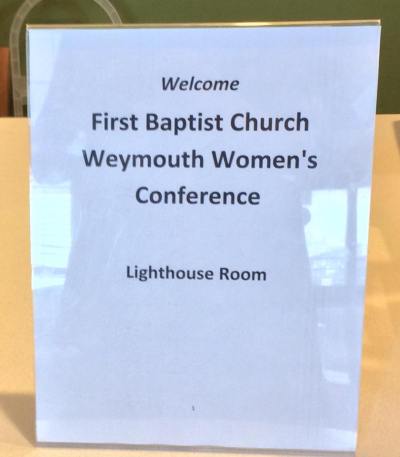
Last weekend, I had the privilege of speaking at a Christian women’s conference in Cape Cod, Massachusetts. It was a wonderful time of fellowship with a lovely group of godly women, and, since many have asked about it and prayed for me, I wanted to share a little about the trip.

I arrived in Boston Thursday evening and was met by Maria, one of the women’s ministry leaders. She and her husband were kind enough to open their home to me the first night of my trip.

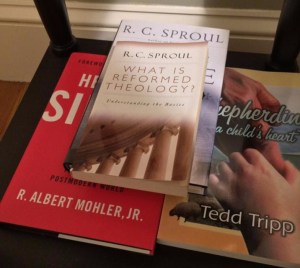
You know you’re in a good host home
when you find these on the night table!

Friday morning I finally got to meet my precious Twitter friend, DebbieLynne, in person. DebbieLynne is actually the one who recommended me as speaker for this conference. Thanks, Deb! (If you don’t already follow her blog, The Outspoken Tulip, check it out!)

This is what it looks like when, instead of “cheese,”

you say, “Everybody say ‘false teachers’!”
to a couple of discernment divas.

Friday afternoon, we arrived at the hotel in Cape Cod and got settled in. Then the women’s ministry leaders took me out for a lovely dinner. When I travel, I always like to try whatever dish that area is best known for, so, of course I ordered some clam chowder. It was great!

When this restaurant says a “cup” of soup,
that’s exactly what they mean!

After dinner, we went back to the hotel, and I taught the first of four sessions on the topic of suffering: Christ, the Suffering Servant.

Something pretty amazing happened Saturday after the morning session on The Theology of Suffering. I was standing near the exit door as closing announcements were being made, and a hotel worker (I’ll call her “Linda”) opened the door a few inches and motioned for me to come out into the hall with her. Linda asked me what who this group was and what was going on, so I explained that it was a group of ladies from a nearby church who had come to the hotel for a conference.

Linda then began to pour out her heart to me, that, in addition to her father’s recent death, her daughter’s medical problems, and her own health issues, she had been struggling with alcoholism. She felt too shy to go to a group recovery meeting and wanted to know if there were someone in our group who could help her one on one. I stepped back into the conference room and retrieved Julie, the pastor’s wife, hoping she might have some resources that could help Linda.

After hearing Linda’s story, Julie stepped back into the conference room and retrieved Maureen. Guess what? Maureen and her husband have a long standing ministry of one on one discipleship for people with substance abuse problems! We were able to pray and share the gospel with Linda and get her connected to Maureen for follow up.

Oh, and that talk I’d just been giving on the theology of suffering? My closing point was that one of God’s good purposes for suffering is that suffering can cause lost people to cry out to God for salvation. Lost people like Linda.

I was overwhelmed by God’s sovereignty in this situation. These ladies could have chosen a different weekend or a different hotel for this conference. Maureen could have skipped the conference. Linda could have called in sick that day or been too shy to stick her head in the door. My talk could have been about some other topic. But God kindly pulled back the veil a little and let us see how He orchestrated all of these things to bring the gospel to a suffering soul who needed Jesus.

Saturday afternoon, Maria and Julia graciously took me on a drive to see the sights around Cape Cod. Even though it was rainy, windy, and cold, the view from the coast was beautiful, as you can see.


I also got to see Nobska Lighthouse, which was constructed in 1876…

…and the oldest Episcopal church in Cape Cod, Church of the Messiah.

The church was founded in 1852,
with this stone structure being built in 1889.


Some people collect stamps.
I collect pictures of the steeples of churches I’ve visited. 

Unfortunately, this “church” now touts itself as “inclusive” (read: homosexuality affirming), committed to “environmental justice,” and is led by the “Reverend” Deborah.

After another awesome seafood dinner (I LOVE SEAFOOD!), we returned to the hotel, where I taught session 3 of the conference: Rejoicing in God’s Promises During Suffering.

Sunday morning was a sweet time of worship and fellowship, and the final session of the conference: The Christian’s Response to Suffering.

After a quick check out from the hotel, it was back to the airport in Boston for the ride home.

What a lovely weekend! When I’m teaching a group of ladies, I can always tell whether or not they sit under a good pastor, and this group certainly does. If you live in the Boston area and are looking for a good church, I could not recommend First Baptist Church, Weymouth, more highly.

If your church is ever in need of a speaker for a women’s event, I’d love to come share with your ladies as well. Click here for more information.


Sanctification, Throwback Thursday

Throwback Thursday ~ Going to Pot

When the wine ran out, the mother of Jesus said to Him, “They have no wine.” Now there were six stone waterpots set there for the Jewish custom of purification, containing twenty or thirty gallons each. Jesus said to them, “Fill the waterpots with water.” So they filled them up to the brim. And He said to them, “Draw some out now and take it to the headwaiter.” So they took it to him. When the headwaiter tasted the water which had become wine, and did not know where it came from (but the servants who had drawn the water knew), the headwaiter called the bridegroom, and said to him, “Every man serves the good wine first, and when the people have drunk freely, then he serves the poorer wine; but you have kept the good wine until now.”
John 2:3-10

Much has been said, and many words written, about Jesus’ first miracle– the turning of the water into wine at the wedding of Cana. Why was this first miracle a miracle that put Jesus in the position of a caterer? Why not a healing? What did the disciples think? Was it really wine or just grape juice? And so on.

But I don’t believe I’ve ever heard anybody look at this account from the perspective of the waterpots.

What was it about those waterpots that made Jesus decide to use them? People used the water in them for washing their hands and possibly their dishes. They were common. Utilitarian. Probably not very clean. Why didn’t Jesus call for golden pitchers or silver goblets for the fine wine He was making?

The waterpots were close to Jesus.

The wedding Jesus was attending was in a small town, in an average home. It was likely that the hosts didn’t even own goblets or pitchers made of silver or gold. If they did, they certainly didn’t own enough large ones to hold all the wine Jesus was about to make. Gold and silver containers would have been far away in a palace or a wealthy home. The waterpots were close to Him, ready and available.

The waterpots had a great capacity for being filled.


We’re talking 120-180 gallons here. Your bathtub holds about 60 gallons when completely filled, so this would have been the equivalent of two to three completely full bathtubs of wine. Pitchers and goblets wouldn’t cut it.

The waterpots were willing to get dirty so others could get clean.

(Ok, so I realize I’m anthropomorphizing, but just go with me for a minute.) Those waterpots stood there year after year providing clean water for dirty people. They didn’t consider themselves too good to be used for handwashing. They didn’t pick and choose how or when they were used. They just stood there and fulfilled their purpose thanklessly, without complaint that they were being used or getting dirty. They were willing to take on a humble task, and Jesus took them and did a great work through them.

The waterpots were usable.


When Jesus told the servants to fill the waterpots with water, no one said, “Oh no, that’s the good china! You can’t use those!” The waterpots themselves were accustomed to being used. That’s what they were made for.

The waterpots also didn’t put up a fuss when Jesus wanted to use them for a new purpose. They didn’t say, “We’re too old to change,” or “We’ve been doing this for years. Who are You to tell us to do somethng new?” They were at their Master’s bidding.

What about us? Sometimes we want God to do great things through us like He did with the waterpots, but we don’t want to be like the waterpots. We want to be gold pitchers or silver goblets. We want to be special, not humble. Pretty, not getting dirty. Served, not serving. Our way, not His way.

Are you close to Jesus?

Do you, through prayer and study of the Word, have a great capacity for being filled?

Are you willing to get dirty so others can be cleansed by the gospel?

Are you usable?

Maybe “going to pot” isn’t such a bad thing after all.

Ruth Bible Study

Ruth: Lesson 4

Previous Lessons: 1, 2, 3

Ruth 3

Then Naomi her mother-in-law said to her, “My daughter, should I not seek rest for you, that it may be well with you? 2 Is not Boaz our relative, with whose young women you were? See, he is winnowing barley tonight at the threshing floor. 3 Wash therefore and anoint yourself, and put on your cloak and go down to the threshing floor, but do not make yourself known to the man until he has finished eating and drinking. 4 But when he lies down, observe the place where he lies. Then go and uncover his feet and lie down, and he will tell you what to do.” 5 And she replied, “All that you say I will do.”

6 So she went down to the threshing floor and did just as her mother-in-law had commanded her. 7 And when Boaz had eaten and drunk, and his heart was merry, he went to lie down at the end of the heap of grain. Then she came softly and uncovered his feet and lay down. 8 At midnight the man was startled and turned over, and behold, a woman lay at his feet! 9 He said, “Who are you?” And she answered, “I am Ruth, your servant. Spread your wings over your servant, for you are a redeemer.” 10 And he said, “May you be blessed by the Lord, my daughter. You have made this last kindness greater than the first in that you have not gone after young men, whether poor or rich. 11 And now, my daughter, do not fear. I will do for you all that you ask, for all my fellow townsmen know that you are a worthy woman. 12 And now it is true that I am a redeemer. Yet there is a redeemer nearer than I. 13 Remain tonight, and in the morning, if he will redeem you, good; let him do it. But if he is not willing to redeem you, then, as the Lord lives, I will redeem you. Lie down until the morning.”

14 So she lay at his feet until the morning, but arose before one could recognize another. And he said, “Let it not be known that the woman came to the threshing floor.” 15 And he said, “Bring the garment you are wearing and hold it out.” So she held it, and he measured out six measures of barley and put it on her. Then she went into the city. 16 And when she came to her mother-in-law, she said, “How did you fare, my daughter?” Then she told her all that the man had done for her, 17 saying, “These six measures of barley he gave to me, for he said to me, ‘You must not go back empty-handed to your mother-in-law.’” 18 She replied, “Wait, my daughter, until you learn how the matter turns out, for the man will not rest but will settle the matter today.”


The Holy Bible, English Standard Version. ESV® Permanent Text Edition® (2016). Copyright © 2001 by Crossway Bibles, a publishing ministry of Good News Publishers.


Questions to Consider

1. What did Naomi mean when she said she wanted to “seek rest” for Ruth?

2. In order to understand what is about to transpire between Ruth and Boaz in Ruth 3 and 4, it’s important to familiarize yourself with Deuteronomy 25:5-10, God’s instructions for levirate marriage. What was the purpose of levirate marriage? Why is it significant that Boaz was a relative of Naomi’s? (2) How was he related to her family? What did it mean that Boaz was a “redeemer,” and that there was a nearer redeemer than he? (9, 12-13)

3. Naomi’s instructions to Ruth (1-8) may seem a little odd, even inappropriate, to our Christian way of thinking. This is why it’s important, when studying God’s word, to understand, as best we can, the culture and customs of the audience of the book we’re studying. Read this commentary on Ruth 3:2-4. Were Ruth’s actions in any way immoral or inappropriate, biblically, or in her culture? What did Ruth mean when she said, “Spread your wings over your servant”? What was Ruth trying to convey to Boaz by her words and actions?

4. What are some ways Ruth demonstrates submission and humility in this passage? Compare Ruth’s demeanor with 1 Peter 3:4. How does Ruth model a “gentle and quiet spirit”?

5. Examine Naomi’s wisdom and counsel to Ruth in this chapter. How does Naomi exemplify the older “Titus 2 Woman“? How does Ruth exemplify the younger “Titus 2 Woman”?

6. If Boaz is a type (symbol, foreshadowing) of Christ, who does Ruth symbolize? Did Ruth have anything to offer Boaz that would make this marriage materially beneficial to him? When we come to Christ as sinners, do we have anything to offer Him that would make us “worthy” of saving? Compare Ruth’s humility and dependence on the good graces of Boaz to redeem her to our humility and dependence on God’s grace and mercy to redeem us. Compare verses 13b-14 to Ephesians 2:1,4-6. If Ruth represents us as sinners, what does her lying down for the night and rising at dawn symbolize?


Homework

Boaz points us to Christ as our redeemer. Look up the word “redeem” in a Bible dictionary and study these verses. What does it mean for Christ to “redeem” us- that He is our “Redeemer”?

Evangelism, Parenting

Untethered: Reaching the Millennial Generation

The odds are stacked against you, Mom and Dad. Statistics claim that a whopping 60 to 80 percent of evangelical kids will “backslide.” Even in the Bible Belt.

What is going on? Why are Christian losses growing while Christian converts are decreasing?

Untethered dares to find the answer to these questions by going to the very source. Join Todd Friel as he visits Bible Belt universities and talks to students who claim to be Christians. Their responses will shock you.

But Untethered will not leave you hopeless. Untethered will help you know what you can do to ensure your child does not become another statistic.

There is nothing more horrifying for Christian parents than to read their child’s religious Facebook status as: NONE. You do not need to be one of those parents. Untethered will help you to that end.

Untethered is a must have resource for anyone who works with young people: parents, pastors, teachers, and student ministers. Order your copy today from Wretched Radio.