Mailbag

The Mailbag: Men attending women’s Bible study class at nursing home

Note from Michelle:
This is a question some friends and I were recently discussing on Twitter,ย 
not one sent in by a reader. A few minor details have been slightly altered.

A female relative of mine teaches a women’s Bible study at a Catholic nursing home (my relative is a Protestant Christian). Sometimes, a male resident or two – none of whom are saved – will wander in and attend her class. Occasionally, one of them attempts to correct her according to Catholic doctrine. Even though she’s not technically teaching “in the church” (1 Timothy 2:12) she’s uncomfortable with men attending the class, as well as with having to biblically correct their unscriptural Catholic doctrine. On the other hand, she shares the gospel every time she teaches, and she doesn’t want to turn away anyone who might receive the good news and be saved. What should she do?

I love it when Christians think deeply about issues like this. It is encouraging to interact with godly people who want to be obedient to Christ, and it pushes me to desire to obey Him better myself.

Foreword:

Just to lay a quick foundation for my answer to this question, it needs to be understood that people who currently believe and practice Catholic doctrine as it is written in Catholic documents are not saved. There are numerous unbiblical beliefs Catholics hold to (which I will not go into right now because that’s beyond the scope of this article) but for the purposes of understanding my answer, in a nutshell, the Catholic religion does not teach salvation by grace alone through faith alone in Christ alone (in fact, Catholicismย anathematizesย {condemns to Hell} anyone who teaches this), works must be included in the salvation process. If you believe your own good works play any part in earning your salvation, you are not saved. Salvation is all of Christ, and Christ alone.

โœขโœขโœขโœขโœข

I am assuming that whoever invited this teacher to teach a Bible study in the nursing home knows that she is Protestant and will be teaching Protestant (biblical) doctrine. I am also assuming that the person who invited her to teach is OK with this. I would not advise someone to give the appearance of teaching in compliance with Catholic doctrine and then surreptitiously “sneaking in” Protestant doctrine. That’s deceitful and dishonest, and it would be understandable for the Catholic residents to be correcting her.

โœขโœขโœขโœขโœข

If you’re unclear as to why having men in her Bible study class is a dilemma for the female teacher, I’d encourage you to read these two articles before moving on to my answer:

Jill in the Pulpit

Rock Your Role FAQs (this article expands on my brief comments below)


Here are my thoughts on the issue:

1. If the people attending the study are Catholic, then the female teacher is evangelizing the lost outside of the church, not discipling (teaching) Believers whoย are the church, unless some of those attending the study have gotten saved (the question indicates none of the male “drop ins” are saved). Evangelism falls under the “do” of the Great Commission, not the “don’t” of 1 Timothy 2:12. (see #11)

2. We always have to keep the definition of “church” in mind when we’re talking about women teaching or holding authority over men “in the church.” The gathered body of Believers is the church, not the building in which they meet. The mere fact that a group meets in a nursing home, house, park, community center, or other edifice that isn’t a church building doesn’t automatically mean a woman is free to teach men (see #7). It doesn’t automatically mean she can’t teach them either.

3. If the male attendees are being disruptive and introducing false doctrine, the teacher is well within her biblical rights and wisdom to say that this a women’s only group and exclude the men. (The same would apply to excluding any women who behave the same way.)

4. If, at some point, genuinely regenerated men begin attending the class because they want to be taught the Bible, praise God! The best case scenario would be for the teacher to go to her pastor, explain the dilemma, and have him ask one of the associate pastors, elders, or another appropriate male church member to volunteer to teach the men.


If you have a question about: a Bible passage, an aspect of theology, a current issue in Christianity, or how to biblically handle a family, life, or church situation, comment below (Iโ€™ll hold all questions in queue {unpublished} for a future edition ofย The Mailbag) or send me anย e-mail or private message. If your question is chosen for publication, your anonymity will be protected.

Discernment

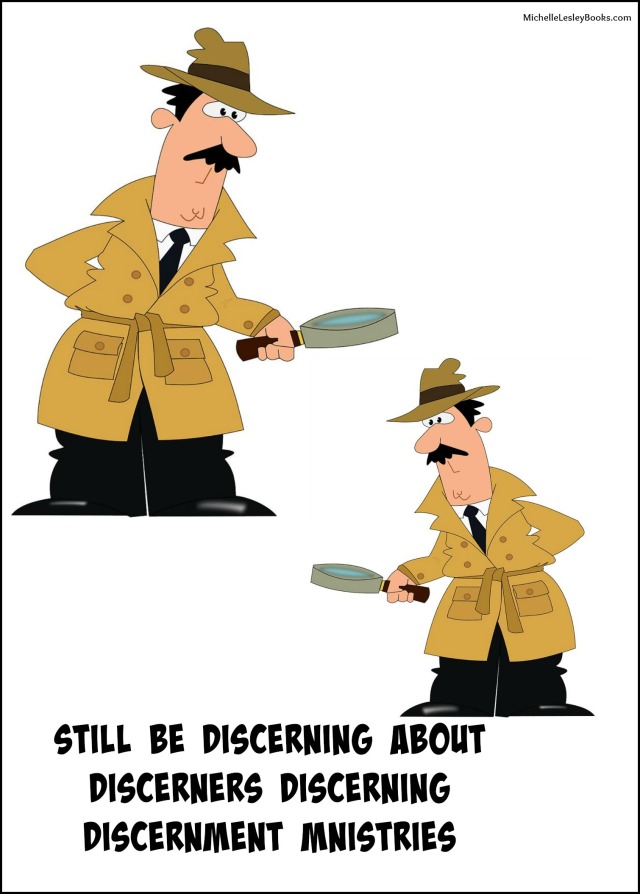
Throwback Thursday ~ Still Be Discerning about Discerners Discerning Discernment Ministries

discerners discerning discernment

Recently, one of my favorite blogs, ParkingSpace23ย (a fantastic, doctrinally sound blog I’d encourage everyone to subscribe to), published an excellent article by John Chester called Still Be Discerning about Discernment Ministries. It’s all about John’s thoughts on discernment blogs and podcasts and why he has chosen to swear off of them.

John seems like a thoughtful guy and he handled what can be a touchy subject evenly, calmly, scripturally, and with grace. As someone who frequently writes on discernment topics, it gave me some good food for thought and an opportunity to biblically examine both my writing and reading/listening habits. It’s a great article, I was thankful for it, and I agree with a lot of his points.

But while John has decided not to partake of discernment blogs and podcasts, I still find discernment ministry to be an important aspect of this blog as well as my personal spiritual “diet”. Does that mean I think John, or any other Christian, is wrong for not wanting to regularly read or listen to discernment material? Absolutely not! But I’d like to present a bit of a different perspective regarding the value of discernment ministry.

In the first few paragraphs of his article, John draws a distinction between two different types of discernment ministries- a disctinction which I think is both astute and important. John differentiates between what I would call “propositional” discernment sites like CARM, and, if I’m understanding him correctly, mine – which generally post single, position paper-type articles on a given false teacher or false doctrine – and what I would call “daily news” discernment ministries such as Berean Research and Fighting for the Faith – which report on the shenanigans du jour of false teachers and apostate churches.

John’s position is that the propositional discernment ministries [PDM] can be helpful when needed, but he is not fond of the daily news discernment ministries [DNDM]. I think both can be beneficial, assuming they’re done biblically. Take a look at John’s points and my counterpoints, and then you can prayerfully decide whether or not it would be profitable for your sanctification to include discernment media as part of your spiritual fare.

John’s point: “[DNDMs] often spend much time dissecting sermons or blog posts that someone with even a rudimentary sense of discernment would have stopped listening to or reading within the first few phrases.”

Michelle’s counterpoint: “Someone with even a rudimentary sense of discernment” is the crucial phrase here. Perhaps John is blessed to pastor a body of believers who are good bereans and most of the Christians he knows are discerning. I hope that’s the case. It shouldย be the case that every believer has “a rudimentary sense of discernment” and immediately rejects false doctrine when she hears it. Nothing would bring me more joy.

But, sadly, that’s not the case. In fact, in my experience, the exact opposite is true, especially among Christian women. The vast majority of Christians are very undiscerning when it comes to false teachers and false doctrine. Often, people lack discernment because they’re false converts. But because most churches don’t proactively teach discernment, there are also plenty of genuninely born again believers who take at face value that anything which wears the label of “Christian,” is sold at a Christian retailer, or is proclaimed by a Christian celebrity is biblical and trustworthy.

I know, because I used to be one of those undiscerning Christians who hadn’t been taught any better by my church. Sure, I could pick out charlatans like Benny Hinn or Todd Bentley, and I probably would have described people like Kenneth Copeland and Jesse Duplantis as “wrong” or “that’s not what Baptists believe” without really knowing why. But the Beth Moore Bible studies that every church I’ve ever been a member of has pushed on its female membership? I had no idea she was teaching false doctrine, especially since my own church was endorsing her books.

It wasn’t until I Providentially “stumbled across” Todd Friel’s TV program,ย Wretched, one night several years ago that I began to understand what false doctrine was, why it was wrong, biblically, and how it could hurt me and the church. And it wasn’t until I discovered Chris Rosebrough’s Fighting for the Faith that I learned how to compare everything to Scripture – to listen to sermons with a discerning ear and read Christian books with a discerning mind. Todd and Chris taught me the discernment no church ever bothered to mention to me. And from the myriad of discerning Christians I’ve known, heard from, and read about, people like me are the rule, not the exception.

It’s not right that the church isn’t teaching Christians how to be discerning. I think every biblically responsible discernment ministry would agree that it is the church’s job, not a discernment ministry’s, to teach Christians to be bereans. But that’s not happening. And I thank God for those ministries who are standing in the gap- who have helped thousands of Christians like me.

John’s point: “[DNDMs] are unbiblical. What I mean is that there seems to me to be no biblical model or mandate for this kind of ‘ministry’.โ€

Michelle’s counterpoint: John may hold more closely to the regulative principle than I do, which would, understandably, account for my difference in perspective from this point. We do a lotย of things, both in church and in parachurch ministry, that there’s no specific biblical model or mandate for. There’s no biblical model or mandate for vacation Bible school or crisis pregnancy ministry or handing out gospel tracts or even writing for a Christian blog. Yet these, and many other ministries, can carry the gospel to the lost (I’ve heard of many people who have read/listened to DNDMs, realized they were false converts, and have become believers.) and edify the saved – just like discernment ministries can. And there’s certainly a biblical mandate for that.

John’s point:ย “Did Jesus ever engage in a point by point take down of a particular Phariseeโ€™s teaching that is recorded in Scripture? How much do we know about the Nicolaitans…in Revelation 2:15?… Or… the Colossian heresy…in Colossians 2:8?”

Michelle’s counterpoint: Jesus didn’t do sermon reviews (that we know of) the same way Chris Rosebrough does. But He did publicly enumerate and correct many of the Pharisees’ false teachings in Matthew 23. He publicly clarified Scripture and corrected unbiblical beliefs and false teachings – “You have heard it said…but I say to you…” – in the Sermon on the Mount. He publicly warned people against the false teaching of the scribes, Pharisees, and Sadducees. And every time those scribes, Pharisees, and Sadducees confronted Him with questions or after a miracle, He set them straight for the whole crowd to hear.

As to the Nicolaitan and Colossian heresies, Colossians and Revelation 2 were addressed to particular churches. Just because weย may not know much about these heresies doesn’t mean the Ephesian and Colossian churches weren’t thoroughly familiar with them. Perhaps that’s why John and Paul didn’t elaborate- because their intended audiences were already knowledgeable about those heresies. And perhaps the reason they might have been familiar with those heresies is that they were constantly being warned about them. Every book in the New Testament (except Philemon) warns against false teaching or false teachers.

Not so with the church today. Christians are not only notย being warned about the heresies and false teachers running rampant in evangelicalism, undiscerning pastors are actually embracing false teachers, inviting them to speak at their churches, simulcasting their conferences, sharing their social media posts, and ordering their materials for the church’s small groups. And the church at large is so biblically illiterate that Christians have no idea they’re being fed false doctrine.

John’s point: “Curiously many discernment mavens will quote 1 Peter 3:15 as a text that supports what they do. But to be blunt, it doesnโ€™t, not by a long shot…. This is about being ready to proclaim Christ to those who would persecute you.”

Michelle’s agreement: I could not agree with this point more. This verse isn’t about discernment. (I usually hear this verse more frequently in support of apologetics ministries, and it isn’t about apologetics, either.) It’s about evangelism.

One of the main features of today’s false doctrine is the twisting of Scripture and ripping it out of context. How can we who do discernment work rebuke false teachers for taking Scripture out of context and then turn right around and do the same to justify our own ministries? We knowย better. Specks and logs, anyone?

There are plenty of other passages of Scripture (such as the ones I’ve cited above and others) that speak of the importance of warning against false teachers and removing false doctrine from the church. We should not be using a verse that has nothing to do with discernment to justify discernment ministry.

John’s point: “Donโ€™t get me started on the lack of gentleness and respect [from 1 Peter 3:15] that permeates many of these blogs and podcasts.”

Michelle’s agreement/counterpoint: John is right, here. Some of the discernment ministries that (incorrectly) claim the first part of 1 Peter 3:15 as justification for their ministry are not following the second part of the verse which says to “do so with gentleness and respect”. There are discernment ministries whose articles I absolutely will not share or link to because their snideness and name calling are so over the top it overshadows the valid point they’re trying to make, sometimes even damaging their own credibility.

At the same time, we do see instances of Jesus using harsh language and calling false teachers names, and Paul, Elijah, and others couldn’t always be characterized as gentle or respectful.

The thing is, their cultural context was a little different from ours, and these are descriptive passages, not prescriptive. Sometimes different cultures call for different approaches. Additionally, one woman’s “gentle and respectful” is another woman’s “harsh and unkind.” I’ve written discernment articles that were characterized as hateful by some Christians and too nice toward the false teacher by others- both about the same article!

Although I fail miserably at it – often – I try to use 2 Timothy 2:24-26 as my guideline when I write:

And the Lord’s servant must not be quarrelsome but kind to everyone, able to teach, patiently enduring evil, correcting his opponents with gentleness. God may perhaps grant them repentance leading to a knowledge of the truth, and they may come to their senses and escape from the snare of the devil, after being captured by him to do his will.

It not only reminds me of howย to contend for the faith (not quarrelsome, kind, patient, gentle), it reminds me whoย I’m contending for (those being held captive by Satan’s snare of false doctrine), and whyย I’m contending (that they might repent, know the truth, come to their senses, and escape captivity).

John’s point: “[DNDMs] are unhealthy…’you are what you eat’…A diet of constant critical speech and reading is naturally going to produce a critical spirit.”

Michelle’s agreement: This is absolutely true. I don’t know whether it makes me over-critical or not, but when I OD on discernment media it certainly makes me feel angry, frustrated, depressed, and that there’s no hope for the church. It takes my eyes off Christ and the very real salvific and sanctifying work He is still doing in churches across across the globe, and causes me to focus on the monster of false doctrine instead.

It’s exceedingly important that we not go overboard on discernment or any other single aspect of theology or or spiritual life. In order to be spiritually healthy, we mustย have a balance of allย the good things: discernment, Bible study, prayer, evangelism, fellowship, worship, service, etc. When I find myself spending too much time in Discernment Land, I know it’s time to step back and readjust my focus.

John’s point: “They are not very helpful…I donโ€™t think very many Christians, especially the kind who read theological blogs, are going to be taken in by [blatantly obvious false teachers].”

Michelle’s agreement/counterpoint: I’ve already shared my thoughts on the helpfulness of discernment ministries for Christians who are not discerning, but, if I’m understanding him correctly, I think what John is saying here is that Christians who are alreadyย discerning aren’t going to be taken in by false teachers, and, therefore, have little need for regular consumption of discernment media. I generally agree with that. I still subscribe to a few DNDMs and peruse their daily headlines, not because I need to learn discernment, but because I like to know what’s going on in the church, just like people skim section A of the newspaper because they like to know what’s going on in the world.

I might add, though, that just because someone is the type of person who reads theological blogs doesn’t mean he’s on top of things, discernment-wise. Thom Rainer writesย a theological blog (and books, and has a seminary Ph.D), yet persists in allowing false doctrine onto the shelves of LifeWay despite the many rebukes he has received from pastors, seminarians, lay people, and, yes, discernment media. Not long ago, I took a class via video from a conservative Southern Baptist seminary president who positively (albeit in passing) cited Beth Moore and Rick Warren in one of the sessions. And these are just two isolated examples. There are many more.

John’s point: “[DNDMs] often have significant blindspots…In their rush to expose the errors of others, often discernment bloggers/podcasters can overlook real problems with themselves or with their theological allies, especially in the areas of tone and conduct.”

Michelle’s agreement: This is so true. There’s no way I could disagree with this, because I have been guilty of it myself far too often. I would only add that this is not a problem specific to discernment ministry. Every ministry has blind spots because every Christian has blind spots. We’re all guilty of hypocrisy, myopia, failure, and sin. And, because we’re believers, when a brother or sister points out our sin, we repent, we receive God’s wonderful, cleansing, restorative grace, mercy, and forgiveness, and we move forward in obedience to Him and His word.

John closes out his insightful article with this thought:

I am not saying that you must swear off โ€œdiscernmentโ€ blogs and podcasts, but I am saying I did, for the reasons above along with others, and I think I am better off for it. I would challenge you to consider what I have written and to think deeply about your spiritual diet.ย I am exhorting you to be discerning about discernment ministries.

I am not saying you mustย partake of discernment blogs and podcasts. But I am saying I do, for the reasons above along with others, and I think I am better off for it. I would challenge you to consider what John and I have written and to think deeply about your spiritual diet. I am exhorting you to think about it, study about it, pray about it, and discern what God would have you do about consuming discernment media.


Women of Genesis Bible Study

The Women of Genesis: Lesson 7

Previous Lessons: 1, 2, 3, 4, 5, 6

๐Ÿ“–๐Ÿ“–๐Ÿ“–๐Ÿ“–๐Ÿ“–

Read Genesis 6-9

๐Ÿ“–๐Ÿ“–๐Ÿ“–๐Ÿ“–๐Ÿ“–


Questions to Consider

1. Genesis 4:26b says, “At that time people beganย to call upon the name of theย Lord.” Compare this statement to the spiritual condition of mankind inย Genesis 6. Why did God decide to destroy the earth? (6:5-7,11-13)

2. Compare the depravity of mankind with the uprightness of Noah. Who validated Noah’s righteousness? (6:8-9) How do chapters 6-9 describe Noah’s righteousness? How did Noah demonstrate righteousness before, during, and after the flood? In God’s eyes, is righteousness outward (behavior) only, inward (heart condition) only, or both?

3. Review question 7 from lesson 6 (link above). At this point in Old Testament history (Genesis 6), had God given the Law? If not, how could He hold mankind responsible for breaking His Law – being “wicked,” “evil,” and “corrupt” – to the point of killing everyone and destroying the earth and still be a just God? What does this tell us about how seriously God views sin?

4. Compare God’s wrath for sin poured out on the earth in Genesis 6-9 to His wrath for sin poured out on Christ at the cross. How does Noah’s salvation from God’s wrath toward sin by being in the ark point ahead to our salvation from God’s wrath toward sin if we are “in” the cross? What is the type and shadow significance of God (rather than Noah) closing and sealing the door of the ark when His work of saving Noah was finished? (7:16) Do you see any other types and shadows in Genesis 6-9?

5. Examine 6:5-7, 8:21, and 9:11. An unbeliever might look at these passages and think that God realized He made a mistake by creating man, attempted to correct that mistake with the flood, and then regretfully realized that the flood was overkill. The unbeliever might even question God’s sovereignty and omniscience: “Didn’t God alreadyย know that man would become so sinful? Why create humans in the first place?” How would you answer these challenges to God’s nature and character?

6. Genesis 9:8-17 is the text of the Noahic (no-WAY-ick) Covenant. What does God promise in this covenant? What is the sign of this covenant? Is the Noahic Covenant bilateral (if people do X, then God will do Y) or unilateral (God says, “I will do X.”)

7. Compare God’s instructions to Noah for His “re-Creation” (9:1-7) with God’s instructions to Adam and Eve for His Creation. What are some similarities? Differences?

8. The Holy Spirit has spent nearly four chapters emphasizing Noah’s righteousness contrasted with the depravity of the rest of mankind. Yet 9:20-27 demonstrate that Noah and his sons were still quite capable of sin. How does this confirm that we inherited our sin nature from Adam and that even the most righteous man on earth is sinful and imperfect?


Homework

If you’d like to do more research on Noah’s story, Answers in Genesis has some great resources on their Noah page.

For even more on Noah and the flood, visit theย Ark Encounter in Williamstown, Kentucky.


Suggested Memory Verse

When the bow is in the clouds, I will see it and remember the everlasting covenant between God and every living creature of all flesh that is on the earth.
Genesis 9:16

Uncategorized

Upcoming Events: Let’s Meet and Greet! (Maybe this week?)

I’m headed out for the G3 Conference tomorrow, so I thought I’d rerun this article. I still want to do an informal “Hey, y’all, I’m standing in the lobby right now, come on by!” type of meet and greet at the conference center, but I’ll need to figure out where and when once I get there, so stay glued to my Facebook or Twitter for the details. Hope to see you there!


It’s always so much fun for me when I can get out on the road and meet some of my online brothers and sisters face to face. Here are a couple of upcoming events where we might be able to do just that!

January 18-20, 2018
G3 Conference
Atlanta, Georgia

For almost a year, I’ve been desperately hoping to attend the 2018ย G3 Conference, but travel expenses plus the cost of the conference put that event out of my reach. Recently, I won complimentary tickets to G3 in aย Wretched Radioย contest, which will allow a good friend to travel with me and split expenses. What a blessing! I amย THERE!

The biggest reason I had been wanting to attend this conference is the theme: discipleship. Since my ministry centers around women’s discipleship, I see this as sort of an “in service” training event. An opportunity to sit under fabulous teachers like Steve Lawson, Phil Johnson, Justin Peters, Martha Peace (and many more!) and learn how to serve you, my dear readers, as well as the ladies of my own church, better.

I’m hoping to do a very informal, low key, meet and greet time for my readers at the conference venue (The Georgia International Conference Center) either before or between sessions on one of the three conference days. I probably won’t be able to give much advance notice on the blog, so be sure to follow me on Facebook or Twitterย for the time and place.

I’ve only been to Atlanta once, briefly, so if you live in the area and have any travel, traffic, hotel, or restaurant advice or if there are any discounts you know of that would be helpful, I’m all ears! Please comment below or e-mail me at MichelleLesley1@yahoo.com. (We will be driving in, not flying.)

If my ministry has blessed you and you’d like to be a blessing in return by helping to defray the costs of my trip, your generosity would be much appreciated. Please click here or on the “Financial Support” tab at the top of this page.

Hope to see you at G3!

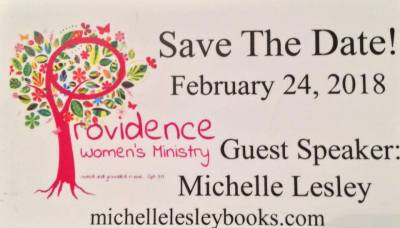
(Save the Date card courtesy of Providence Baptist Church)

February 24, 2018
Providence Baptist Church Women’s Conference
Arlington, Tennessee

Sorry guys, this one is just for the ladies!

Ladies, Providence Baptist Church of Bartlettย would like to invite you to attend their Women’s Ministry Spring Gathering where I’ll be speaking on the authority and sufficiency of Scripture in the morning and afternoon sessions:

Saturday, February 24, 2018
9:00 a.m. – 2:00 p.m.
Providence Baptist Church of Bartlett

Tickets are $15 for members of PBC, $20 for for non-members. A catered lunch is included in the cost of your ticket. Space is limited, so call (901-937-5115) or e-mail (info@pbcbartlett.org) the church today for further details.

I’m looking forward to meeting the ladies of Providence Baptist, and you too!

Sometime
Somewhere in YOUR Area

I’d love to come meet and speak to the ladies of your area, too! Putting together a women’s conference, banquet, or other event for 2018 and need a doctrinally sound speaker? I’ve got several slots left on my calendar. Check out theย Speaking Engagementsย tab at the top of this page for more info. Hopefully, I’ll be seeing you soon!

Mailbag

The Mailbag: Potpourri (Soul Ties, SBC Communion, Women in children’s ministry, Heretical book disposal)

Welcome to another โ€œpotpourriโ€ edition of The Mailbag, where I give short(er) answers to several questions rather than a long answer to one question. I also like to take the opportunity in these potpourrri editions to let new readers know about my comments/e-mail/messages policy. Iโ€™m not able to respond individually to most e-mails and messages, so here are some helpful hints for getting your questions answered more quickly. Remember, the search bar can be a helpful tool!


I was wondering what your views were on โ€œungodly soul tiesโ€, in reference to past relationships? If I was in a previous relationship with someone who I was involved with physically, mentally, spiritually and emotionally, how would I loose myself from that?

The concept of “soul ties” is not biblical. It is not mentioned or even hinted at in the Bible. Proponents of this heretical doctrine, as you can see in this article, Basic Introduction to Soul Ties,ยน will try to convince you that soul ties are biblical by taking all manner of Bible verses out of context and stretching and twisting them like Silly Putty to try get them to mean what they want them to mean. All you have to do is look up the verses they cite, and read them in context to see that none of these passages say that one person’s soul can be literally bound to another person’s soul.

I find it especially laughable that many of the verses they cite in support of soul ties are the “one flesh” verses, such as Ephesians 5:31 (which is actually a quote of Genesis 2:24). Don’t you think that if God, the creator of language, meant to convey in these verses that two people’s souls were tied together, that He would have said “one soul” instead of “one flesh“? Or that He would have clearly said: “In this type of close relationship, the two people’s souls are bound together.”? This is God we’re talking about, here. He’s perfectly capable of explaining Himself clearly. He knows what words mean, and He never makes a mistake and chooses the wrong word. And yet, time and time again in Scripture, He uses the words “one flesh” to describe the intimacy of marriage and sexuality, and He never, anywhere in Scripture, even suggests that the souls of two people are bound together under any circumstances.

Soul ties are just one more piece of false doctrine usually taught by those in the heretical New Apostolic Reformation camp. (When I Googled “soul ties”, articles by Kris Vallotton {Bethel}, Terri Savelle Foy, and Paula White – all among the worst of the worst of the NAR and prosperity preaching – were on the first page of results. That should tell you something.) There is no way your spirit can be tied or bound to someone else’s spirit.

I’m not sure what you mean by being involved with someone “mentally” and “spiritually”, but I’m assuming you don’t mean that you were in Mensa together or that you had long talks about theology and frequently prayed together. Those might be fond memories that make you wistful, but no mental or spiritual activity you participate in with someone else binds your soul to his or is something you need to be “loosed” from.

What you need to do is read your Bible, understand what it says about sin, and if you sinned in any way in this relationship (for example, sex outside of wedlock, putting your love for this person ahead of your love for the Lord, being influenced by this person to lie, etc.) you need toย repent, not “be loosed” (because you’re not bound to this person, and because repentance from sin is the biblicalย way of thinking about this situation). You may also need to avoid spending time with or talking to this person for a while. And if you’re really having trouble getting over the relationship, you might want to seek counsel from a doctrinally sound pastor (one who understands that soul ties are unbiblical) or an ACBC certified Biblical Counselor.

That’s truly all there is to it. The spirit-realm mumbo jumbo of “soul ties” is a bunch of mystical malarkey. Your spirit isn’t tied to anyone else’s spirit, you’re just sad that the relationship is over, having difficulty moving on with your life, and, perhaps missing the person. And it’s OK if that sounds earthly and pedestrian. Because it is. But if Christ is your Savior, you can trust Him to carry you through it.

Here are some resources you might find helpful:

What does the Bible say about soul ties? at Got Questions

Soul Ties? I at Fighting for the Faith (starts around 34:14)

Soul Ties? II at Fighting for the Faith

ยนJust in case it isn’t abundantly obvious, this is a heretical New Apostolic Reformation article/website, and I certainly don’t recommend it.

We recently moved and have been attending a Southern Baptist church. They have not had communion for over two months. Isn’t it the norm to have communion at least once a month? 

Also there is no women’s ministry that I can be involved with which is very disappointing to me. I would even be willing to teach/lead a women’s study but since we are new to this church we are still waiting and learning our place. We hesitate to make ourselves known as possibly unsubmissive or question why they do things the way they do.

Why no communion or women’s Bible study? Your thoughts would be enlightening.

These are such great questions because they help me, as a Southern Baptist, think about the way we do things and how those practices might be perceived by visitors or new members.

Communion/Lord’s Supper:ย Every Southern Baptist church is autonomous, so each church has its own policy or practice about how often the Lord’s Supper is observed. There are some SBC churches who hold the Lord’s Supper every week and probably others who hold it only once or twice a year, although I don’t personally know of any who hold it that infrequently.

In my experience, most Southern Baptist churches observe the Lord’s Supper several times a year, usually on a schedule like the first Sunday of the month, once a quarter, or every “fifth Sunday” (in months that have five Sundays). In addition to these scheduled observances, many churches also observe the Lord’s Supper at their Christmas Eve, Good Friday, or Easter service.

Women’s Ministry:ย I understand your disappointment in the lack of women’s ministry at the church. I would be somewhat disappointed too. There could be a variety of reasons for this. Maybe they had a women’s ministry that veered off into error or personality conflicts, so the pastor put it on hiatus for a while. Maybe no one stepped up to volunteer to lead it. Or, maybe the pastor wants everyone’s focus to be on the worship service and Sunday School with no distractions. But even if there isn’t a formal women’s ministry, you can still invite women over to your home, go out for coffee or dinner together, or study God’s word and pray together with a few others. I found this article –ย Ministry to Women When Thereโ€™s No โ€œWomenโ€™s Ministryโ€ย – really helpful.

Asking Questions: I would encourage you and your husband to set up an appointment with the pastor and ask away! It is certainly not unsubmissive to sit in his office and politely say, “We’re new here and we were just wondering about…” Most pastors I know would love for potential members to do this. (In fact at my church, once a month my pastor holds a sort of “orientation”/Q&A class for potential members during the Sunday School hour.) You need to know where he and the church stand on various doctrinal issues and practices so you won’t be unpleasantly surprised after you’re already members. This is especially important if you’re new to being a Southern Baptist as well as being new to the church. If the pastor in any way discourages you from asking genuine, courteous questions or sees your questions as a threat to his authority, that’s a red flag telling you that you should not join this church.


In the past I purchased books and โ€œstudiesโ€ by authors I now know are false teachers- an embarrassing amount of them really. I am wondering now what do with all of them…I donโ€™t feel I am mature enough in my walk with Christ yet to read any of them and test them against Scripture myself, but I also donโ€™t feel like passing them on to someone else is right either. Just wondering your thoughts on this.

You’re correct, you should not pass on books containing false doctrine to others, donate them to libraries (especially church libraries), Goodwill, or thrift stores, or sell them in a garage sale. The only scenario I can think of in which passing along a book authored by a false teacher would be OK is if it is to someone you know is a mature, doctrinally sound Christian who needs it for research purposes or to write a review of it warning people away from it.

I would also suggest that you not simply throw throw the books in the trash or recycling unless you render them unreadable (ex: scribbling on or tearing up the pages) first. People have been known to take “freebies” out of the trash.

Here are two ways I’ve handled heretical books I’ve been given:

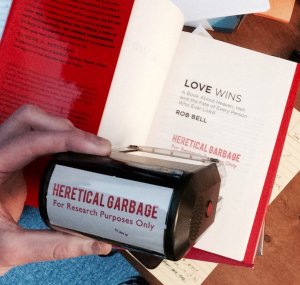
1. Keep them for research purposes. (If you think you might be tempted to read them and you don’t feel like you’re spiritually mature enough to handle that yet, maybe box them up and put them in storage for a later date.) You might want to mark them in some sort of way – in case you lose the book and someone else finds it or something like that – indicating that the book is false doctrine. My friend, Pastor Nate Pickowicz, has an awesome stamp for his “research only” books:

2. Burn them. I know it reeks of Nazism and censorship by wild-eyed preachers of yesteryear, but it’s biblical, it keeps false doctrine out of the hands of others, and these books can actually have a positive use for kindling if you have a fireplace or chiminea. (Please use all fire safety precautions. Also, it is not necessary to burn the books publicly.)


Is it Biblical for a woman to be in charge of the childrenโ€™s ministry? Especially one who is not doctrinally sound?

It isn’t biblical for anyone who’s unrepentantly and unteachably doctrinally unsound to be in charge of anything in the church.

If it’s a case like Apollos, in which the person in question simply doesn’t know any better, but changes her ways and embraces sound doctrine when corrected, that’s cause for giving glory to God. (Also, she might need more training in the Scriptures before she resumes her position of service.)

But if it’s a case in which the person persists in teaching false doctrine or acting sinfully, that’s cause for church discipline. And if she steadfastly refuses to repent despite biblical rebuke, she needs to be disfellowshipped from membership in the church. Of course, it should go without saying (unfortunately, it doesn’t these days) that people who aren’t church members and/or aren’t saved should not be given any position of service or leadership in the church.

It could be OK for a doctrinally sound woman to be in charge of the children’s ministry, depending what you mean by “in charge”, and depending on whether or not she can do so without violating Scripture:

1. She should not be considered as, or bear the professional title of, “pastor”. It is unbiblical for a woman to be a pastor, and if she’s not a pastor, then bearing the professional title of “pastor” is lying.

2. In her leadership duties, she should not teach adult men (for example, men who teach children’s Sunday School classes, if she oversees children’s Sunday School) the Scriptures or exercise authority over them.

3. The pastor, or an appropriate elder, should vet and approve any curricula and materials, guest speakers, activities, etc., she wishes to use.

If a pastor or elder oversees her leadership so that she is acting under his authority and at his direction, and she is not violating Scripture by preaching to men, teaching men Scripture, or exercising authority over men, I don’t see why it would be a problem for a woman to lead the children’s ministry. In fact, Christian women and churches who handle this properly could be a superb example and model for other Christian women and churches.


If you have a question about: a Bible passage, an aspect of theology, a current issue in Christianity, or how to biblically handle a family, life, or church situation, comment below (Iโ€™ll hold all questions in queue {unpublished} for a future edition of The Mailbag) or send me an e-mail or private message. If your question is chosen for publication, your anonymity will be protected.