Discernment

Kelly Minter

If you are considering commenting or sending me an e-mail objecting to the fact that I warn against certain teachers, please click here and read this article first. Your objection is most likely answered here. I won’t be publishing comments or answering emails that are answered by this article.


This article is kept continuously updated as needed.

I get lots of questions about particular authors, pastors, and Bible teachers, and whether or not I recommend them. Some of the best known can be found above at my Popular False Teachers tab. The teacher below is someone I’ve been asked about recently, so I’ve done a quick check (this is brief research, not exhaustive) on her.

Generally speaking, in order for me to recommend a teacher, speaker, or author, he or she has to meet three criteria:

a) A female teacher cannot currently and unrepentantly preach to or teach men in violation of 1 Timothy 2:12. A male teacher or pastor cannot allow women to carry out this violation of Scripture in his ministry. The pastor or teacher cannot currently and unrepentantly be living in any other sin (for example, cohabiting with her boyfriend or living as a homosexual).

b) The pastor or teacher cannot currently and unrepentantly be partnering with or frequently appearing with false teachers. This is a violation of Scripture.

c) The pastor or teacher cannot currently and unrepentantly be teaching false doctrine.

I am not very familiar with most of the teachers I’m asked about (there are so many out there!) and have not had the opportunity to examine their writings or hear them speak, so most of the “quick checking” I do involves items a and b (although in order to partner with false teachers (b) it is reasonable to assume their doctrine is acceptable to the false teacher and that they are not teaching anything that would conflict with the false teacher’s doctrine). Partnering with false teachers and women preaching to men are each sufficient biblical reasons not to follow a pastor, teacher, or author, or use his/her materials.

Just to be clear, “not recommended” is a spectrum. On one end of this spectrum are people like Nancy Leigh DeMoss Wolgemuth and Kay Arthur. These are people I would not label as false teachers because their doctrine is generally sound, but because of some red flags I’m seeing with them, you won’t find me proactively endorsing them or suggesting them as a good resource, either. There are better people you could be listening to. On the other end of the spectrum are people like Joyce Meyer and Rachel Held Evans- complete heretics whose teachings, if believed, might lead you to an eternity in Hell. Most of the teachers I review fall somewhere in the middle of this spectrum (leaning toward the latter).

If you’d like to check out some pastors and teachers I heartily recommend, click the Recommended Bible Teachers tab at the top of this page.


Kelly Minter
Not Recommended

The โ€œaboutโ€ page of Kelly Minter’s web site used to describe false teacher, Beth Moore, as โ€œone of [Kelly’s] favorite bible [sic] study teachers.โ€ Kelly also said, โ€œBethโ€™s teachings were much of what God used in my earlier life to teach and transform meโ€ฆโ€.  (This information has been removed from Kelly’s website since the original publication of my article on her in 2016.)

And, indeed the most glaring theological problem with Kelly is that she considers Beth Moore to be “one of my spiritual mothers.”
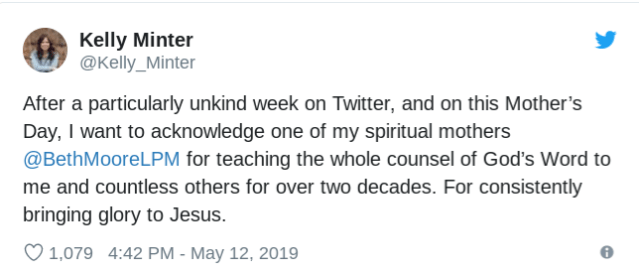
The “particularly unkind week on Twitter” Kelly is referring to is doctrinally sound Christians biblically rebuking Beth Moore for coyly announcing that she would be preaching the Sunday morning sermon at her home church on Mother’s Day 2019. Where Beth Moore…

  • preaches to men in violation of Scripture
  • consistently allegorizes, mishandles, and takes Scripture out of context
  • partners with demonstrably false teachers and heretics
  • is on a trajectory toward affirming homosexuality
  • not only refuses biblical correction in all these areas but publicly taunts, insults, and name-calls those who rebuke her…

…Kelly thinks Beth has taught her “the whole counsel of God,” “brings glory to Jesus,” and is worthy of being her “spiritual mother.” If Kelly thinks these things, she is at the very least so undiscerning, or so unknowledgeable of the many Scriptures that condemn these things, or she knows that Scripture condemns these things but disregards Scripture in favor of her love for Beth, that she should not be teaching anyone, but should be sitting in a good local church under the teaching of a solid pastor so she can learn Scripture and sound doctrine.
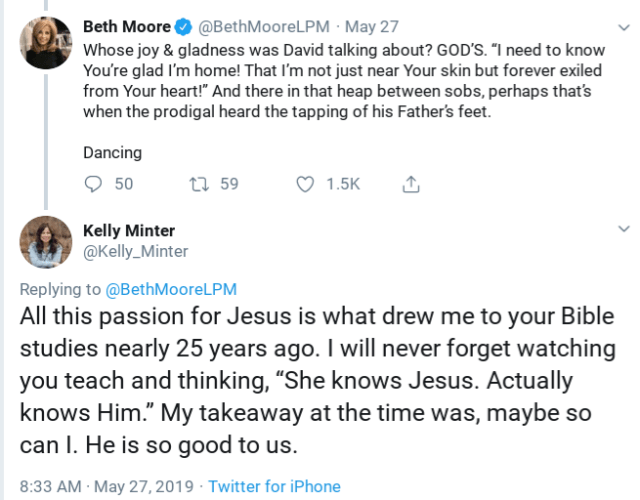
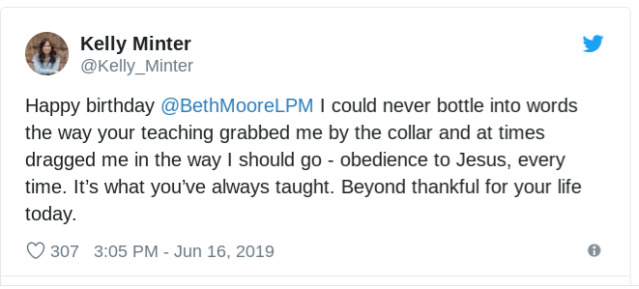
More of Kelly honoring Beth:

If Kelly has such a fundamental misunderstanding of biblical obedience that she thinks Beth Moore – who defies Scripture in a myriad of ways – has taught her (“and countless others”) to obey Jesus, do you think she is qualified to teach the Bible to you or the women of your church, either in person or through the use of her materials?

Beth Moore is also fond of Kelly, (“I LOVE HER, I LOVE HER, I LOVE HER, I LOVE HER!!”) and has featured three of Kelly’s Bible studies during her summer Bible study series on her LPM blog: No Other Gods, Ruth and Nehemiah.

Since Beth Moore preaches to men, it is not surprising that we would find Kelly has preached to men as well. While it is commendable that Kelly doesn’t seem to preach to men often, and the FAQ page for her “Cultivate” conferences specifically says that these conferences are for women, it is troubling that she has preached in a Sunday worship service as recently as 2019 and that the woman she considers her mentor has no qualms about preaching to men.

Kelly seems to have unbiblical ideas about how people should study the Bible. In this video she recommends that people who want to understand the Bible need to get a study (in addition to her own, she recommends Beth Moore and Priscilla Shirer) and โ€œif you feel comfortableโ€ get involved in a church to study โ€œin communityโ€. The biblical model for being taught Scripture is to join a church โ€“ this is not optional โ€“ and be taught the Word by the pastor, elders, and teachers. Doctrinally sound studies can sometimes be helpful, but they are supplementary to church instruction, not the primary source of instruction.

Kelly maintains friendly relationships and/or ministry partnerships with a plethora of false and problematic teachers. Here, Kelly recommends not only Beth Moore and Priscilla Shirer, but also Jen Hatmaker, Jennie Allen, Jennifer Rothschild, Lisa Harper, and Margaret Feinberg. Kelly has guest blogged for Priscilla Shirer, and is an admirer of Christine Caine. Kelly has been featured on Angie Smith’s blog, is a fan of Catholic mystic, Henri Nouwen, and was included in The Faithful, a book of collected Bible studies by Kelly, Priscilla Shirer, Beth Moore, Jennifer Rothschild, and Lisa Harper. Kelly will be partnering with Lysa TerKeurst at a conference in October 2019, with Christine Caine at a LifeWay women’s leadership forum in November 2019, and with Beth Moore, Priscilla Shirer, Jackie Hill Perry, and Jennifer Rothschild at LifeWay Women Live in 2020 (Kelly also appeared at the 2019 LifeWay Women Live with Christine Caine, Lysa TerKeurst, Lisa Harper.) Kelly has partnered with these and other false/problematic teachers at various other events, but I don’t wish to belabor the point. Kelly has little discernment and is disobeying Scripture’s admonition not to partner with false teachers.

When a women’s Bible study teacher is willing to preach to men and shows such a dearth of discernment, she is not someone you or the women of your church should follow or receive teaching from.

Answering a Fool, Mailbag

The Mailbag: Answering a Fool #3


Answer a fool according to his folly,
lest he be wise in his own eyes.
Proverbs 26:5

There’s a lot of foolishness masquerading as Christianity these days. Occasionally, I get e-mails and messages showcasing this type of foolishness. It needs to be biblically corrected so these folks can stop “being wise in their own eyes,” repent, and believe and practice the truth of Scripture. From time to time, I’ll be sharing those e-mails in The Mailbagย with a biblical corrective, not only so the e-mail writer can be admonished by Scripture, but to provide you with Scriptures and reasoning you can use if you’re ever confronted with this kind of foolishness.


(This reader’s blog comment {in blue},
responding to this article, is reprinted in full.)

You are a liar and devils tool. There is no role for corporate discernment. God doesnโ€™t need you to defend His flock from false teachers, when did God become powerless or when did His flock become unintelligent or indiscernible? How come itโ€™s OKY you who can discern? And just remember the same standard which you use to judge others, God will use to judge you.

Allllllllllrighty then. Let’s break this down.

You are a liar and devils [sic] tool.ย 

A liar is someone who intentionally deceives other people or says something she knows is not true. I have done neither. If there is something in my article that is incorrect, I assure you it was an innocent and unintentional mistake. If you could kindly specify exactly what you think I have gotten wrong with the evidence or rightly handled Scripture to back up your assertion, I will gladly correct my mistake.

As for being the “devil’s tool,” could you please explain how someone who points out biblical error and points people to the truth of Scripture is being used by the devil? The devil is the one who twists and misuses Scripture in order to lead people into error. Was Jesus the “devil’s tool” when He publicly pointed out and biblically corrected the unscriptural teachings of the scribes and Pharisees? How about Peter,ย Paul,ย John,ย Jude, and others whom God the Holy Spirit inspired to write the Scriptures that rebuke false teachers and false doctrine? Were these men the “devil’s tool” too?

When you accuse the brethren (me) without biblical cause or evidence, and in the face of Scripture that proves your accusations to be unfounded, what you’re doing is called slander and unbiblical judgment, and you are the one who is being used as a tool of the devil.

There is no role for corporate discernment.

I honestly have no idea what this means. “Corporate” means “a large company or group.” In Christian circles, when we use the term “corporate,” we usually mean the gathering of the church body. I’m an individual, not a group, so I really don’t have a clue as to how this statement applies to me.

Furthermore where does the Bible say or teach this? If you’re going to make a biblical assertion, you need to back it up with rightly handled, in context Scripture. There’s tons of New Testament evidence that God does want the church as a bodyย and individual Christians to practice discernment, but I don’t know which verses to provide you with to refute your point, because I don’t know what your point is.

God doesnโ€™t need you to defend His flock from false teachers,

God doesn’t “need” anybody. He doesn’t “need” you to rebuke me either. Did you consider that before you wrote your comment? Why didn’t you just remain silent and trust Him to convict me of whatever sin you think I’ve committed? Or is it that it’s OK for you to call someone on the carpet for what you perceive to be violations of Scripture, but it’s not OK for me to do so? Hypocrisy, much?

As I clearly stated in the very first paragraph of the article (which I’m assuming you read since you commented on it), people have written to me askingย whether or not certain teachers are doctrinally sound. The articles I’ve written areย answers to these readers’ questions.

Titus 2:3 says:

Older women likewise are to be reverent in behavior, not slanderers or slaves to much wine. They are to teach what is good,

Teaching women the truth of God’s Word about false teachers, discernment, or any other biblical issue is good. Some other passages you might want to consider:

I appeal to you, brothers, to watch out for those who cause divisions and create obstacles contrary to the doctrine that you have been taught; avoid them. For such persons do not serve our Lord Christ, but their own appetites, and by smooth talk and flattery they deceive the hearts of the naive.
Romans 16:17-18

Here’s Paul, under the inspiration of the Holy Spirit, warning fellow Christians to “watch out for” and “avoid” false teachers. You know what else Paul said? “Imitate me.

Beloved, although I was very eager to write to you about our common salvation, I found it necessary to write appealing to you to contend for the faith that was once for all delivered to the saints. For certain people have crept in unnoticed who long ago were designated for this condemnation, ungodly people, who pervert the grace of our God into sensuality and deny our only Master and Lord, Jesus Christ…save others by snatching them out of the fire;
Jude 3-4,23a

Jude, under the inspiration of the Holy Spirit, exhorts the church to fight for the purity of biblical doctrine and to save those who are vulnerable to false doctrine, “snatching them out of the fire.”

โ€œSo you, son of man, I have made a watchman for the house of Israel. Whenever you hear a word from my mouth, you shall give them warning from me. If I say to the wicked, O wicked one, you shall surely die, and you do not speak to warn the wicked to turn from his way, that wicked person shall die in his iniquity, but his blood I will require at your hand. But if you warn the wicked to turn from his way, and he does not turn from his way, that person shall die in his iniquity, but you will have delivered your soul.
Ezekiel 33:7-9

God commands Ezekiel to warn people away from their sin and says He will hold Ezekiel responsible if he fails to warn them.

But I guess God didn’t “need” Paul or Jude or Ezekiel or any of the people in the congregations they were writing or speaking to or, by extension, Christians today, “to defend His flock from false teachers,” right?

So whoever knows the right thing to do and fails to do it, for him it is sin.
James 4:17

It’s clear from Scripture that warning people away from sin and false doctrine is “the right thing to do.” You’re asking me to stop doing the right thing. It would be a sin for me to stop, and it’s a sin for you to demand that I stop. And now thatย you know that warning people away from false teachers is the right thing to do, that means if you fail to do so, that’s sin for you.

So the real question here is not, “Why amย I warning others about false teachers,” but “Why aren’tย you?”.

when did God become powerless or when did His flock become unintelligent or indiscernible?

OK, so following your logic, why does every single book of the New Testament (except Philemon) address the issue of false doctrine or false teachers? Why did God have so many of the Old Testament prophets rebuke the false prophets of their day – false prophets who, much like today’s false teachers, would say “thus saith the Lord” and then tell the people things God had not said, or things that were in direct contradiction to what God had said? Was He so powerless that these New Testament writers had to write books and letters (“blog articles,” if you will) warning against false doctrine and false teachers and these Old Testament prophets had to publicly denounce the false prophets?

When did His flock become unintelligent or undiscerning? Let’s dispense with “unintelligent” because that has nothing to do with being discerning. Some of the most intelligent people in evangelicalism with strings of academic letters behind their names are some of the most undiscerning Christians out there – seminary presidents and professors, denominational heads, CEOs of Christian retail outlets. And there are people who have very little in the way of intelligence or education who are very discerning.

When did God’s people become undiscerning? In Genesis 3, when a serpentine false teacher, “a liar and a tool of the devil,” walked up to Eve, twisted God’s Word and said, “Did God reallyย say…?”. And lack of discernment has been a pervasive problem ever since.

How come itโ€™s OKY [sic] you who can discern? (I think you mean “only”?)

It’s NOTย only I who can discern. Praise God, there areย lots of Christians out there who are discerning. The people who have written asking me about these false teachers are discerning (because they want help understanding whether or not they’re being taught sound doctrine). There are other writers and teachers doing the good and hard work of teaching discernment. Pastors, elders, deacons, Bible teachers, church members, podcasters, authors, parachurch ministries. They are out there warning fellow Christians against false teachers in their venues just like I am in my venue, and I thank God that they are! I wish every pastor and local church were so diligent about teaching discernment that I wouldn’t have to write discernment articles any more.

But the vast majority of them aren’t. In fact, the vast majority are throwing the doors of the sheep pen wide open to the wolves in sheep’s clothing and welcoming them in. And until that changes,ย somebody has to warn those vulnerable sheep. Like I said before, why aren’t you helping to warn them?

And just remember the same standard which you use to judge others, God will use to judge you.

The standard I use to biblically judge the observable behavior and teaching of evangelical teachers is Scripture, and that’s the standard God will judge me (and everyone else) by. I am totally OK with that because I am doing my best to be obedient to Scripture, and when I’m disobedient to Scripture I repent.

Can you say the same? What standard do you use for judging me and others? Let’s just put the opening and closing lines of your comment together:

You are a liar and devils tool.
And just remember the same standard which you use to judge others, God will use to judge you.

What standard are you using?

I’d like to leave you with a few passages of Scripture to consider:

“I tell you, on the day of judgment people will give account for every careless word they speak, for by your words you will be justified, and by your words you will be condemned.โ€
Matthew 12:36-37

Judge not, that you be not judged. For with the judgment you pronounce you will be judged, and with the measure you use it will be measured to you. Why do you see the speck that is in your brother’s eye, but do not notice the log that is in your own eye? Or how can you say to your brother, โ€˜Let me take the speck out of your eye,โ€™ when there is the log in your own eye? You hypocrite, first take the log out of your own eye, and then you will see clearly to take the speck out of your brother’s eye.
Matthew 7:1-5

O Lord, who shall sojourn in your tent?
Who shall dwell on your holy hill?
He who walks blamelessly and does what is right
and speaks truth in his heart;
who does not slander with his tongue
and does no evil to his neighbor,
nor takes up a reproach against his friend;
in whose eyes a vile person is despised,
but who honors those who fear the Lord;
who swears to his own hurt and does not change;
who does not put out his money at interest
and does not take a bribe against the innocent.
He who does these things shall never be moved.
Psalm 15


If you have a question about: a Bible passage, an aspect of theology, a current issue in Christianity, or how to biblically handle a family, life, or church situation, comment below (Iโ€™ll hold all questions in queue {unpublished} for a future edition ofย The Mailbag) or send me anย e-mail or private message. If your question is chosen for publication, your anonymity will be protected.

False Teachers

Sharon Hodde Miller

If you are considering commenting or sending me an e-mail objecting to the fact that I warn against certain teachers, please click here and read this article first. Your objection is most likely answered here. I won’t be publishing comments or answering emails that are answered by this article.


This article is kept continuously updated as needed.

I get lots of questions about particular authors, pastors, and Bible teachers, and whether or not I recommend them. Some of the best known can be found above at my Popular False Teachers tab. The teacher below is someone I’ve been asked about recently, so I’ve done a quick check (this is brief research, not exhaustive) on her.

Generally speaking, in order for me to recommend a teacher, speaker, or author, he or she has to meet three criteria:

a)ย A female teacher cannot currently and unrepentantly preach to or teach men in violation of 1 Timothy 2:12. A male teacher or pastor cannot allow women to carry out this violation of Scripture in his ministry. The pastor or teacher cannot currently and unrepentantly be living in any other sin (for example, cohabiting with her boyfriend or living as a homosexual).

b) The pastor or teacher cannot currently and unrepentantly be partnering with or frequently appearing with false teachers.ย This is a violation of Scripture.

c) The pastor or teacher cannot currently and unrepentantly be teaching false doctrine.

I am not very familiar with most of the teachers I’m asked about (there are so many out there!) and have not had the opportunity to examine their writings or hear them speak, so most of the “quick checking” I do involves items a and b (although in order to partner with false teachers (b) it is reasonable to assume their doctrine is acceptable to the false teacher and that they are not teaching anything that would conflict with the false teacher’s doctrine).ย Partnering with false teachers and women preaching to men are each sufficient biblical reasons not to follow a pastor, teacher, or author, or use his/her materials.

Just to be clear, “not recommended” is a spectrum. On one end of this spectrum are people like Nancy Leigh DeMoss Wolgemuth and Kay Arthur. These are people I would not label as false teachers because their doctrine is generally sound, but because of some red flags I’m seeing with them, you won’t find me proactively endorsing them or suggesting them as a good resource, either. There are better people you could be listening to. On the other end of the spectrum are people like Joyce Meyer and Rachel Held Evans- complete heretics whose teachings, if believed, might lead you to an eternity in Hell. Most of the teachers I review fall somewhere in the middle of this spectrum (leaning toward the latter).

If you’d like to check out some pastors and teachers I heartily recommend, click theย Recommended Bible Teachers tab at the top of this page.


Sharon Hodde Miller
Not Recommended

Sharon Hodde Millerย is the “teaching pastor” of Bright City Church in Durham, North Carolina, where she regularly preaches during the Sunday morning worship service.

Sharon also holds a Ph.D. from Trinity Evangelical Divinity School in “women and calling”. She has authored two books and is a regular contributor toย Christine Caine’s Propel Womenย and Raechel Myers’ She Reads Truth. She has also contributed toย Ann Voskamp’s blog.

As I researched Sharon, I noticed something about her biographical information that usually appears in articles in which she is quoted, on websites, etc. While nearly all of these bios proudly present her as pursuing or holding a Ph.D. right off the bat, I don’t recall having seen an article or website in the dozens I looked at that also proudly presents her as a “pastor.” One reason for that is that some of the articles I looked at were published before Sharon and her husband planted Bright City Church in September 2018, which I believe is the first place she has served as a “pastor,” so one would not expect to see her listed as a “pastor” in these bios. However, in the year since she started “pastoring,” as of today, her bio on her own website, at She Reads Truth, her Twitter profile, the cover of her second book (released August 2019), and recent articles refer to her as “leading” (not “pastoring”) BCC “with her husband.” Sharon’s Facebook profile and Baker Books (which, again, released Sharon’s second book last week) call her a “pastor’s wife.” Is it possible that things have just been busy over the last year and Sharon just hasn’t had time to update some of these bios? Of course. We all get busy and forget or don’t have time to tend to details like that. But it does seem curious that someone who is heralded as having a Ph.D. in “women and calling”ย isn’t equally heralded as a female “pastor.” Why not be up front about it somewhere besides BCC’s website?

Sharon is friends with, under the influence of, and endorsed by Beth Moore. The two frequently interact on Twitter.

In her early years of ministry, Sharon spent a year working for Lysa TerKeurst’s Proverbs 31 Ministries, and considers that experience one way “God has equipped me on my journey.”

Sharon’s first book, Free of Me, was endorsed by false teachers Ann Voskamp, Christine Caine, Lysa TerKeurst, and Jennie Allen, (also, disturbingly, by J.D. Greear, who is currently president of the Southern Baptist Convention and a personal friend of Sharon’s). Sharon’s second book, Nice, was endorsed byย Lysa TerKeurst, Bianca Olthoff, and female “pastor” Andi Andrew.

Sharon considered Rachel Held Evans a friend and wrote a tribute to her after her death saying “the church lost a powerful voice,” “her convictions were rooted in a genuine love for people,” “She advocated for those on the margins,” “that is why so many of us loved her,” and “I learned so much from [Rachel].” Rachel also promoted Sharon three times on her own blog.

Sharon has shown sympathy for and alliance with “woke” racialist Kyle James Howard for publicly slandering doctrinally sound pastor, Josh Buice.

Sharon has had numerous friendly interactions on Twitter with advocate of homosexuality, Jonathan Merritt. He calls her a friend.

In a 2016 Washington Post article, The high cost of popular evangelical Jen Hatmakerโ€™s gay marriage comments, Sharon comments positively on Jen Hatmaker, calling her a “trailblazer” and saying,

“[Miller] believes Hatmaker represents a wave of evangelical women ‘who are not content to silo their faith,’ or to publicly support only the things that every Christian agrees on. ‘I happen to think thatโ€™s a good thing.'”

Sharon maintains a friendship with Jen on Twitter, and also recommended Jen’s blog (as well as Ann Voskamp’s and feminist/”preacher” Sarah Bessey’s) in her article Why I Am Thankful for Bloggers, a list of bloggers she is “thankful for,” “blessed by,” “God is using them,” and that these are “writers who influence me.”

Sharing her thoughts about IF: Gathering’s emphasis on social justice, Sharon was quoted in the Sojourners article Evangelical Women Look Beyond Bible Study to New Causes:

โ€œThis was about expanding our vision outside of ourselves,โ€ said Sharon Hodde Miller, a doctoral student at Trinity Evangelical Divinity School who is studying women in seminary. โ€œIt could play out in a variety of different ways but encompassed social justice, racial reconciliation, poverty, or thinking about the neighbor next door who is a widow.โ€

Sharon also wrote a blog article endorsingย IF: Gathering and encouraging her readers to attend, follow IF on social media, etc. About the leadership team of IF – which included Rebekah Lyons,ย Ann Voskamp,ย Jen Hatmaker,ย Lauren Chandler,ย Angie Smith,ย Bianca Olthoff, and Christine Caine –ย Sharon wrote:

“This leadership team gives me the tinglesโ€“itโ€™s like the Holy Spirit A-Team.”

The fact that Sharon is a female “pastor” ought to be more than enough evidence that those looking for a doctrinally sound teacher should steer clear of her and her materials, but the seemingly endless list of her ministry partnerships with false teachers belabors the point. Sharon is not someone Christians concerned about sound biblical doctrine should follow or receive teaching from.

Prayer Bible Study

Sweet Hour of Prayer: Lesson 1- Introduction

Welcome to our new study, Sweet Hour of Prayer: Learning to Pray from the People of Scripture!

“Lord, teach us to pray,” the disciples implored Jesus. Sometimes, no matter how close we are to Christ, we can feel unsure and awkward in prayer. Am I doing it right? Using the correct words? Asking within God’s will?

Over the next several weeks we’ll take a look at the topic of prayer through the example left to us by our brothers and sisters from the Old and New Testament. As we study it is my hope that your “hour of prayer” will become sweeter and sweeter.

You may wish to review my philosophy of Bible study at the “Bible studies” tab at the top of this page. My studies are designed to teach you how to study the Bible for yourself, which is why I don’t provide answers to the questions in the lessons.

My studies are also designed to be very flexible. You may answer all, any, or none of the questions in each lesson. All of my studies are self paced, so take as long or as short of a time in the passage and with the questions as you like. If, as you’re studying the text, the Holy Spirit leads you to focus on an aspect of the passage I haven’t addressed in the questions, awesome! Park yourself there and learn what He wants you to learn. These lessons are meant to be a tool for you to use as you see fit during your personal study time, not a school project where points are taken off if you don’t complete it the way the teacher wants.

As with all of my studies and articles, I use hyperlinks liberallyThe main Scripture for each lesson will be linked at the beginning of the lesson, and there will be additional links in the lesson questions. Whenever you see a word in red, click on it, and it will take you to a Scripture, article, or other resource that will help as you study.


Introduction to Sweet Hour of Prayer

Part of my philosophy of Bible study is that our main “diet” should be systematic, expositional study of the text. In other words: pick a book of the Bible, start at the beginning, and study it through to the end. Then, pick another book and start again. This method of studying helps us understand passages in their context and correctly apply them to our lives, and helps us avoid eisegesis, taking passages out of context, and incorrectly applying them.

However, there is a place for the study of a biblical topic such as peace, sin, the family, God’s wrath, or biblical womanhood. For example: if you’re struggling to trust God because of a sudden circumstance in your life, you don’t have time to study through every book of the Bible to learn what the Bible says about trusting God. You may need to spend some time in focused study on passages from various books that deal specifically with the topic of trusting God, and that’s OK. My goal with this study is not only that you learn what the Bible has to say about the topic of prayer, but also to demonstrate how to do a topical study properly so you can do topical studies on your own when the need arises.

Normally, in the introductory lesson to my studies, we take a look at the author of the book of the Bible we’re studying, the audience he wrote it to, the historical setting of the book, and other “backstory” issues. But because this is a topical study, and we’ll be examining passages from various books of the Bible, we’ll have to briefly address those issues as needed in each lesson.

So in the introduction to this study, I’d like to address two items in your “backstory.”

Salvation

If you’re not saved, this study isn’t going to be very helpful to you, because prayer is about talking to Someone we are in right relationship with, and if you aren’t saved, you aren’t in right relationship with God.

This week, before we tackle prayer, I’d like everyone – even if you know beyond a shadow of a doubt that you’re saved – to work through the Scriptures in my article Basic Training: The Gospel. Do you understand the biblical gospel? Have you truly repented of your sin and trusted Christ as Savior? Spend some time alone with God examining your heart and life against these Scriptures. If you’re unsure whether or not you’re genuinely saved, I would encourage you to put this study aside and work through my study Am I Really Saved?: A First John Check Up first. You can’t approach God in prayer if you don’t belong to God.

Expectations and Presuppositions

What do you expect out of this study? What kinds of ideas or preconceived notions are you carrying into this study? Take some time to answer the following questions.

1. When you hear the word “prayer,” what do you think of?

2. Without looking in your Bible, jot down five or ten things you think the Bible teaches about prayer.

3. What does your church teach about prayer? Does your church hold regular prayer meetings? Is there someone in your church that you look up to as a good example of how to pray?

4. What Scriptures come to mind when you think about prayer?

5. Why are you interested in a study about prayer, and what do you hope to get out of this study?

6. What are the strengths and weaknesses of your prayer life? What are some things you’d like to improve about your prayer life?

Take some time in prayer this week to begin preparing your heart for this study. If there’s a specific issue you struggle with when it comes to prayer, ask God to teach you the truth of His Word about that issue and strengthen your prayer life in that area. Write down your prayer and review it when the study is over to see how God answered you through the study of His Word. I’m excited to have you join me in this journey of discovering what God’s Word has to say about prayer!

Sweet hour of prayer! sweet hour of prayer!
That calls me from a world of care,
And bids me at my Fatherโ€™s throne
Make all my wants and wishes known.
In seasons of distress and grief,
My soul has often found relief
And oft escaped the tempterโ€™s snare
By thy return, sweet hour of prayer!

Sweet hour of prayer! sweet hour of prayer!
The joys I feel, the bliss I share,
Of those whose anxious spirits burn
With strong desires for thy return!
With such I hasten to the place
Where God my Savior shows His face,
And gladly take my station there,
And wait for thee, sweet hour of prayer!

Sweet hour of prayer! sweet hour of prayer!
Thy wings shall my petition bear
To Him whose truth and faithfulness
Engage the waiting soul to bless.
And since He bids me seek His face,
Believe His Word and trust His grace,
Iโ€™ll cast on Him my every care,
And wait for thee, sweet hour of prayer!

Sweet hour of prayer! sweet hour of prayer!
May I thy consolation share,
Till, from Mount Pisgahโ€™s lofty height,
I view my home and take my flight:
This robe of flesh Iโ€™ll drop and rise
To seize the everlasting prize;
And shout, while passing through the air,
Farewell, farewell, sweet hour of prayer!
William Walford 1845

Favorite Finds

Favorite Finds ~ August 27, 2019

Oh my! We haven’t had a Favorite Finds article in far too long! Here are a few of my favorite recent online findsโ€ฆ

Image result for cbmwItโ€™s a frequent accusation about Scriptureโ€™s treatment of women. But is it really what the Bible says? Does the Old Testament actually sanction rape by mandating that a woman marry the man who forcibly raped her? CBMWย examines this fascinating biblical conundrum (which isn’t really a conundrum at all once you study it carefully) in Did Old Testament Law Force a Woman to Marry Her Rapist?


Love broccoli or hate it, I think you’re really going to enjoy this little parable about salvation from our friend Allen Nelson over at the Things Above Us blog. Allen’s article, Brittany the Broccoli Hater, talks about the spiritual transformation that has to take place to turn us from “broccoli haters” to “broccoli lovers.” (And if you like this article, be sure to check out the reviews of his books, From Death to Life and Before the Throne.)


Image result for grace to youHere’s something fun and informative over at Grace to You– an article series: Frequently Abused Verses. What Is the Eye of a Needle? Can We Really Do All Things Through Christ? On Whose Door Is Christ Knocking? This series straightens out the confusion over commonly mishandled or perplexing passages. (To read the remainder of the articles in the series, you will need to enter “Frequently Abused Verses” in the GTY search bar.)


Autism, Awareness, Puzzle, Heart, Love, AutisticTry to imagine what it’s like to attend worship service and other church functions if you have Autism Spectrum Disorder. Helpfully explaining his own experiences, David Delgado gives practical tips to people with ASD on preparing for and navigating church events, as well as advice for Christians wishing to better serve those with ASD in their own churches in his article Doing Church with Autism Spectrum Disorder.


The aptly named David Wesleyย gives us a lovely medley of a capella hymns and worship songs down through the ages. Those of you who are around my age will have fond (or terrible) flashbacks of youth camp at David’s 1969 offering. :0) He lost me somewhere in the neighborhood of 2010, but I believe there’s at least one Hillsong song, and probably some other doctrinally unsound artists, around that time period. So, if you don’t already know that you and your church shouldn’t be using Hillsong, Bethel Music, Jesus Culture, Elevation Worship music or music by anybody else who’s doctrinally unsound, let me just take this opportunity to say, don’t.