Welcome to another “potpourri” edition of The Mailbag, where I give short(er) answers to several questions rather than a long answer to one question. I also like to take the opportunity in these potpourri editions to let new readers know about my comments/e-mail/messages policy. I’m not able to respond individually to most e-mails and messages, so here are some helpful hints for getting your questions answered more quickly. Remember, the search bar (at the very bottom of each page) can be a helpful tool!
In these potpourri editions of The Mailbag, I’d also like to address the three questions I’m most commonly asked:
“Do you know anything about [Christian pastor/teacher/author] or his/her materials? Is he/she doctrinally sound?”
Try these links:
Popular False Teachers / Recommended Bible Teachers / search bar
Is She a False Teacher? 7 Steps to Figuring It Out on Your Own
(Do keep bringing me names, though. If I get enough questions about a particular teacher, I’ll probably write an article on her.)
“Can you recommend a good women’s Bible study?”
No. Here’s why:
The Mailbag: Can you recommend a good Bible study for women/teens/kids?
The Mailbag: “We need to stop relying on canned studies,” doesn’t mean, “We need to rely on doctrinally sound canned studies.”.
“You shouldn’t be warning against [popular false teacher] for [X,Y,Z] reason!”
Answering the Opposition- Responses to the Most Frequently Raised Discernment Objections
I know this is going to sound silly or troll-like, but I’m serious! I have a habit of praying a quick prayer when thoughts cross my mind, like “God, please help Aunt Pam to feel better from her cold today,” or “Lord, thank You for providing that salary bonus I needed.” Sometimes those same kinds of thoughts and prayers cross my mind when I’m using the bathroom. Is that wrong? Should I wait until I get out of the bathroom to think that little prayer? What about what Deuteronomy 23:14 says about using the bathroom, “that God may not see anything indecent among you and turn away from you”?
I don’t think that’s a silly or troll-like question at all, and I’ll bet there are bunches of Christians out there who do the exact same thing and now, after reading this question, are wondering the exact same thing.
First Thessalonians 5:17 instructs us to “pray without ceasing,” which means our hearts are to be constantly oriented toward prayer even though we’re not consciously praying every moment of the day. (Kind of like your compass’ needle always points north even if it’s just sitting in a drawer not being used.) For most Christians, that means we’re intermittently speaking to God, just like you described, throughout the day as things happen, as random thoughts cross our minds, as we see various things. And this becomes such a habit (a good one!) that it doesn’t occur to us to think about where we are or what we’re doing as we utter those prayers in our hearts. Honestly, I think that mindset of reflexive prayer is pleasing to God, because it embodies what it means to pray without ceasing.
Deuteronomy 23:12-14 is part of the Old Testament ceremonial law regarding, in this particular case, the way Israel was to set up camp. When you give the law a good, thorough reading, you’ll notice that the underlying principle of most of the laws is that Israel is to be set apart and holy – different – from the pagan nations surrounding them. And He gives them laws to this effect that touch every aspect of their lives so that, at every turn, throughout the course of their day, there are little reminders, through the law, to “Be holy for I am holy.” This law is just one more of those little reminders: Don’t act like animals like the pagan nations around you, Israel, and just potty willy nilly in the street or the front yard or wherever you take a notion to. Step it up and keep your camp to a higher standard, because God is with you and you are His people.
The Deuteronomy passage is not about offending God by relieving yourself. God has seen every single time every person on the planet has ever relieved himself/herself, because God is omnipresent. If that were offensive to Him, He would not have designed your body to work that way.
Although I don’t think “bathroom time” should be the only time you pray, I don’t see anything in Scripture indicating that God considers it offensive for you to reflexively pray even though you happen to be in the bathroom at that moment. However, if it offends your sensibilities, wait until you get out of the bathroom and then pray.
Would you read 1 Tim 3 1-7 to read women can’t be “overseers/leaders/official” as in they can’t be “Children pastors” or “Women Pastors” in the church with those actual titles or even as directors? The verses only say men and state guidelines on how to choose. I’ve noticed some red flags in my church with a woman Worship Leader, which I don’t agree with since she sometimes teaches in between songs, but they are also giving women the pastor title, but only for children and women.
If I’m understanding correctly, you’re asking:
- Is it biblical for women to hold a position of leadership over the women’s ministry or children’s ministry of a church?
- Is it biblical for a woman to be the worship leader of a church?
- If so, is it biblical to give those women leaders the title of, for example: “Pastor of Women’s Ministry” or “Children’s Pastor”?
Here are the fast and dirty answers. Below are a couple of links where I’ve discussed these issues in more detail.
Assuming the woman is doctrinally sound, has a godly character, her husband (if she’s married) is on board, and she’s otherwise qualified for the job, it’s fine for a woman to lead women or children in the church as long as the position she holds (which will vary from church to church) doesn’t require her to preach to or teach Scripture to men, or hold unbiblical authority over men.
No, it is not biblical for a woman to be the worship leader of a church. This is supposed to be a pastoral position.
No, churches should not give any woman on staff the title of “Pastor,” even if she isn’t violating Scripture in her position. Because Scripture doesn’t permit women to be pastors it is misleading and confusing, and will probably give people the impression that she is violating Scripture and that that’s OK. Neither should the converse be true – churches should not have women on staff in any capacity that violates Scripture (preaching to/teaching men, holding authority over men) and try to conceal that fact by giving her a title (instead of “pastor”) like “minister,” “facilitator,” “coach,” “associate,” “director,” etc.
Rock Your Role: Jill in the Pulpit
Rock Your Role FAQs (see #16, 21)
We have been searching for a doctrinally sound church in the area we moved to, and unfortunately it has not been easy! The few that we have found still use a Hillsong, Bethel or Elevation music. I usually cross a church off the list quickly if they sing from those artists. But like I said, now I am finding even doctrinally sound churches are throwing some of those songs in. Do you have any insight to this dilemma?
It can be really difficult to find a doctrinally sound church these days. Unfortunately even some churches that are fairly solid use music from these groups. The first thing I would recommend is that you check out the Searching for a new church? tab in the blue menu bar at the top of this page, just to make sure you haven’t overlooked any doctrinally sound churches in your area. There are lots of church search engines there and other resources that might help.
My counsel would be to find the most doctrinally sound church you possibly can (following your husband’s leadership, of course, if you’re married, {and assuming, in this particular case, that he’s saved}), attend for a while to get a feel for whether or not it’s a fit for your family, and set up an appointment with the pastor to ask any questions you might have (check out the articles under “What to look for in a church” at the “Searching…” tab for suggestions of questions you may want to ask). (I would recommend the appointment with the pastor regardless of how perfect the church seems.)
If the church uses Bethel, etc. music, this would be the time to gently and lovingly address it with the pastor, but let him know that this is a reason you’re a bit reticent about joining the church so he’ll understand the seriousness of the problem. I would approach the subject giving him the benefit of the doubt that he simply doesn’t know the problems with these groups (the vast majority of pastors are ignorant of things like this – they shouldn’t be, but it is what it is).
If he seems open, you might want to ask if you can send him some information. (You can find links on all three groups at the “Popular False Teachers & Unbiblical Trends” tab. Pick the 2 or 3 most convincing links for each group and send those rather than sending him the link to that tab. For someone who’s ignorant in the area of discernment, opening up that tab would be information overload, and he’ll tune it out.) If he says yes, send the links and then touch base with him again in a couple of weeks to get his reaction.
The only other counsel I would offer you is to remember that no church is perfect, and God may put you into a particular church to help it with those imperfections.
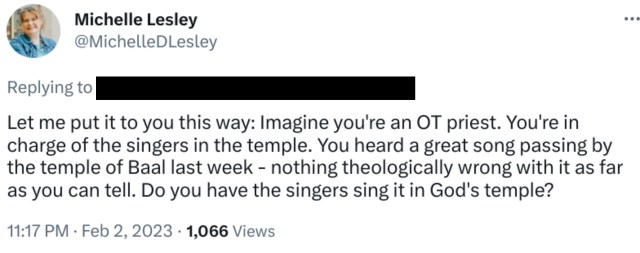
I would now like to take a moment to highlight this reader’s question for pastors and ministers of music. This is yet one more reason it is detrimental to your church to use music from Bethel, Jesus Culture, Hillsong, Elevation, any musician connected these groups (such as Phil Wickham who’s very prolific and has strong ties to Bethel), or any other musician who isn’t doctrinally sound (after you have thoroughly vetted him/her/them.) regardless of how biblical the lyrics of any particular song of theirs that you’re using might be. You could potentially be turning away solid, mature, discerning Believers who might otherwise be interested in joining your church. The woman who sent in this question is not the first to ask me something like this – not by a long shot. This issue is increasingly of concern to Christians looking for a solid church. (For that reason, I do not list churches – even Reformed or seemingly otherwise doctrinally sound churches – on my Reader Recommended Churches list, who use music from heretical sources like these.)
When a visitor walks into your sanctuary for the first time, your worship service is the “face” of your church to her. What kind of a first impression are you making? When you use music by doctrinally unsound musicians, it does not say, “We’re really a doctrinally sound church – honest! We only use songs from these groups whose lyrics are biblical.”. It says, “This church has leaders who aren’t discerning,” or “If this church uses music by these heretical groups, what other doctrinal problems does it have?”. Why put that stumbling block out there when there is plenty of music available with biblical lyrics written/performed by doctrinally sound musicians?
And there’s another stumbling block that using this type of music puts in front of weaker brothers and sisters that you may not have realized. I have heard from a number of Christians whom God graciously saved and rescued out of the pit of “churches” similar to Bethel, Hillsong, and Elevation. They tell me that when they walk into what they think is a doctrinally sound church and hear music from these and other heretical sources, it triggers a form of spiritual PTSD. It’s traumatizing to them. They immediately become fearful that your church is mere steps from turning into one of these types of “churches.” Will they grow out of that reflexive reaction? Yes, someday, as God continues to sanctify them. In the meantime, do you want the music at your church to cause them unnecessary anxiety? I hope not.
Even for Christians who have not come out of “churches” like these but are knowledgeable about their heretical theology, using these songs in your worship service is putting a stumbling block in front of them, too. Take me, for example. I’ve studied these groups. I’ve seen their heresy and the damage they do to both the Kingdom and to the individuals who follow them. And because of that, I’ve zealously spoken out against them. If I visit your church and an Elevation song suddenly flashes up on the screen, my ability to worship is completely derailed in grief that your church would use a song from that source – especially if you know about their theology and are well acquainted with music from doctrinally sound sources that you could have used instead. I cannot sin against my conscience by singing those songs. Consider me a “weaker brother” if you like, but do you care more about me as your sister in Christ, or your “right” to use music from these sources? What about Paul’s posture in 1 Corinthians 8:9-13?
But take care that this right of yours does not somehow become a stumbling block to the weak. For if anyone sees you who have knowledge eating in an idol’s temple, will he not be encouraged, if his conscience is weak, to eat food offered to idols? And so by your knowledge this weak person is destroyed, the brother for whom Christ died. Thus, sinning against your brothers and wounding their conscience when it is weak, you sin against Christ. Therefore, if food makes my brother stumble, I will never eat meat, lest I make my brother stumble.
If this was true in Paul’s personal life, shouldn’t it surely be true of our worship services? If you wouldn’t put a Christmas tree or portrayals of Jesus in your sanctuary because it might offend a brother in Christ, why would you use worship music that causes offense to your brothers and sisters?
Finally, what is the proactively good reason for intentionally choosing music from a heretical source? In other words, when you’re selecting music for the worship service, why would you choose, say, a Hillsong song about God’s glory, or Psalm 23, or the crucifixion, when you could just as easily choose a song from a doctrinally sound source about any of those things – a source that isn’t a stumbling block to anyone, won’t give anyone the wrong impression about your church, won’t lead anyone to follow a heretical “church,” and won’t use your church’s offerings to support a heretical “church”? What makes the Hillsong song you’re choosing better than the song from the doctrinally sound source? It doesn’t seem to me that there’s a good enough reason to use songs from these sources that outweighs all the good, biblical reasons not to use them.
There is simply no good reason for a doctrinally sound church to use music from heretical sources like these.
The Mailbag: False Doctrine in Contemporary Christian Music
Why Our Church No Longer Plays Bethel or Hillsong Music (or Elevation or Jesus Culture), and Neither Should Yours
Hillsong’s Theology of Music and Worship
The Mailbag: Should Christians listen to “Reckless Love”?
Hello there. I read your blog about Priscilla Shirer being a false teacher. Read some parts of your blog. Found your recommended preachers with sound doctrine. I don’t know what denomination you’re in. But I just wanted to ask if you believe if we can lose our salvation?
Hi there! I’m a Reformed Southern Baptist. You can read more about my denomination and my beliefs at the Statement of Faith tab and the Welcome tab (both in the blue menu bar at the top of this page.
No, I do not believe genuinely regenerated Christians can lose their salvation because that’s not what the Bible teaches. I discussed this at length, including the relevant Scriptures, in my article The Mailbag: Can unforgiveness cause you to you lose your salvation?.
If you have a question about: a Bible passage, an aspect of theology, a current issue in Christianity, or how to biblically handle a family, life, or church situation, comment below (I’ll hold all questions in queue {unpublished} for a future edition of The Mailbag) or send me an e-mail or private message. If your question is chosen for publication, your anonymity will be protected.