Sermons, Worship

Sermon: Biblical Worship

It’s not often you get to hear a great sermon out of Leviticus, so I wanted to share this one with you, preached by my friend Laramie Minga, Pastor of Worship and Discipleship at Woodlawn Baptist Church, Baton Rouge, Louisiana.

If you’re a new Christian or maybe you’re just coming out of an unbiblical “church” and you’re not quite sure what biblical worship in a doctrinally sound church is supposed to look like, this sermon will help. And even if you are in a solid church with biblical worship, Laramie’s sermon will be an encouragement to you. The worship pastor at your own church might even enjoy giving it a listen.

The text for the sermon is Leviticus 10:1-11.

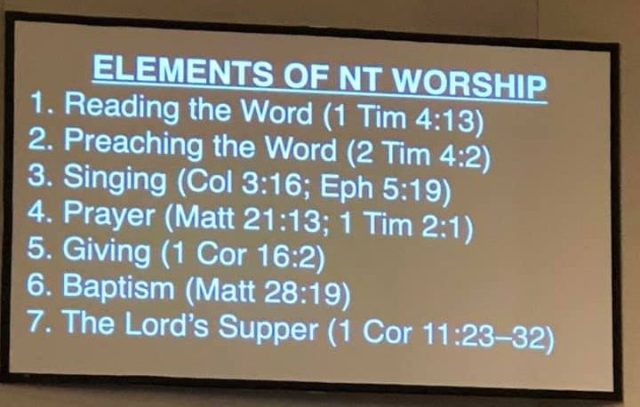
Here’s the visual for the elements of worship around the 37:34 mark:

I hope you’ll enjoy this great teaching from God’s Word as much as I did!

Sermons

We Must Obey God Rather Than Men

Sometimes the evangelical news stories du jour aren’t worth keeping up with. Sometimes they are. I think this one is worth examining, because it’s one that can help us look at a similar situation we might be in ourselves through a biblical lens – even if we, or our pastor, ends up making a different, yet biblical, decision.

As you may know, the governor of the state of California has issued an edict stating that, due to the Coronavirus, churches may not meet indoors in person (there are also prohibitions on businesses and other gatherings).

Grace Community Church in Sun Valley, California (pastored by John MacArthur), released a statement on July 24 entitled:

Christ, Not Caesar, Is the Head of the Church,

which respectfully and biblically explained why GCC would not be abiding by the governor’s restrictions on churches. (By the way, if you read the statement between July 24, and July 31, you might want to read it again. An addendum has been attached, and there is now a signatory page.)

I would like to ask you to read it as an exercise in apologetics. Examine the Scriptures presented. Are they handled rightly and in context? Objectively consider the arguments made. Do they make sense, and are they logical (even if you don’t agree with them)? How would you present a biblical case for another church to make a different godly decision? Which Scriptures and objective, logical arguments would you use to make your case?

One of the phenomenal ways God has uniquely wired women, generally speaking, is the emotional passion He has knit into us. We tend to feel things deeply and strongly. We bring compassion and zeal and kindness and bravery to situations in which they are desperately needed in special ways that God has only equipped women for. But with this beautiful gift He has given us comes the challenge to harness it and use it only in the situations it’s appropriate for. Not in situations such as making a dispassionate, objective, logical, reasoned apologetic argument. Allowing our passions and emotions to run wild in that situation would be using the wrong tool for the job.

I don’t know about you, but I need practice at that. Practice at letting thinking, not feelings, take the lead. And so, the particular issue of meeting/not meeting aside, I found GCC’s statement very helpful in that regard. It’s a good example of how to make a biblical, well-reasoned argument.

On Sunday, July 26, GCC did, in fact, meet together for worship, and Dr. MacArthur preached the following sermon, which I highly recommend:

We Must Obey God Rather Than Men


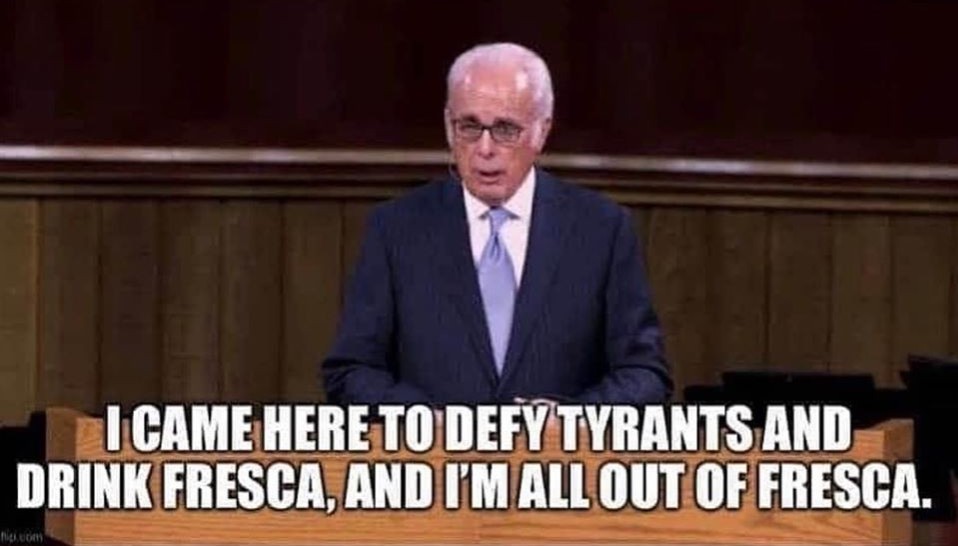
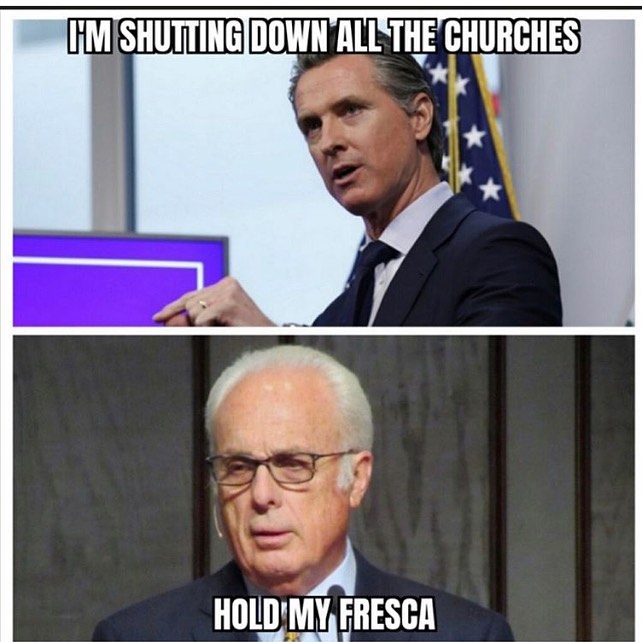
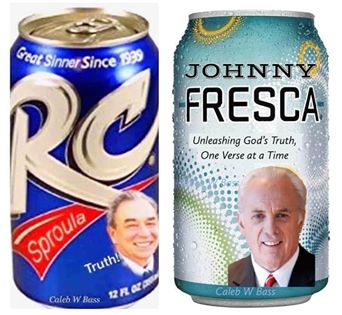
I was remarking to someone the other day that this will probably forever hereafter be known as the “Fresca Sermon” (you’ll see why when you watch it). If you don’t follow me on social media, here are a few of the funnier Fresca memes I came across (if you can’t handle humor, please look away):


Discernment, Doctrinally Sound Teachers, False Doctrine, False Teachers, New Apostolic Reformation, Sermons

Justin Peters: The Modern Prophets and Faith Healers Utterly Destroyed by COVID-19


Last week, Justin Peters released this excellent teaching video demonstrating how the COVID-19 virus totally debunks the claims of these heretical charlatans. Prophets and miraculous healers, they are not. Invest the time to watch it, and consider sharing it (kindly and lovingly, of course) with those you know who are enamored with this kind of “Christianity.”

Discernment, Sermons

Why Your Church Should Stop Playing Bethel, Hillsong, Elevation, and Jesus Culture

If you prefer listening to reading, check out our A Word Fitly Spoken podcast episode, Discord: Why Your Church Should Reject Bethel Hillsong and Elevation Music, based on this article.


While this article deals primarily with Bethel, Hillsong, Elevation, and Jesus Culture, they are by no means the only heretical music sources to be avoided. Phil Wickham, for example, is just as prolific as these groups and his music is used by just as many churches. With his strong ties to Bethel, he should be included under the umbrella of Bethel as you consider the remainder of this article. There are numerous other unbiblical musicians who should be avoided for these same (and other) reasons. You can find a sampling of them in my article The Mailbag: False Doctrine in Contemporary Christian Music.


Justin Peters and Todd Friel discuss the theological problems with Bethel, Jesus Culture, Hillsong, and Elevation music and why your church shouldn’t use their music in this video interview: Why Your Church Shouldn’t Play Bethel and Hillsong Music.

Is it wrong to sing songs from Bethel if they are theologically correct? In this episode of Redeeming Truth, Pastors Costi Hinn, Dale Thackrah, and Kyle Swanson provide insight into the dangers of supporting ministries like Bethel [and Hillsong, Jesus Culture and Elevation Music], that have a false understanding of who Christ is.

If you are looking for theologically accurate worship music to listen to or sing in your church, they have put together a Spotify worship playlist that you can listen to. Costi has also written an excellent companion article on his blog: Should Your Church Sing Jesus Culture & Bethel Music?

Excerpted from my article The Mailbag: False Doctrine in Contemporary Christian Music

“Itโ€™s imperative for churches to be discerning about the CCM they use in worship. If Jane Churchmember hears a CCM song in church and likes it, sheโ€™s likely to Google the song (probably right there in church- Iโ€™ve done it!), find out who sings it, and begin following that artist. Worship pastors who use CCM have a responsibility to vet the artists who perform the songs they select for the worship service to make sure theyโ€™re not sending Jane into the arms of a heretic. Additionally, music costs money, and you donโ€™t want your churchโ€™s offerings supporting false doctrine.

Now, every time I address the subject of being discerning about worship music and that churches should not use worship music from heretical sources (such as Bethel, Hillsong, and Elevation) someone whoโ€™s defending using music from these heretical sources [will say]:

Well, [insert name of hymn writer here] wrote lots of perfectly biblical hymns, but he had some theological problems too, and youโ€™re not recommending we get rid of all of his hymns.

Well, first of all, maybe we should more closely examine the theology of some of our most prolific hymnists and stop using their music because of what they believed. Quick โ€“ off the top of your head, name the three we should start withโ€ฆ

โ€ฆAnd thatโ€™s what separates the errant hymnist from Bethel, et al. Most Christians, even those who prefer hymns over CCM, could probably not name three people who wrote hymns, let alone tell you anything about their theology. But if you ask the average Christian to name three top Christian artists, she could rattle them off in a second.

Most hymn writers have been dead for up to hundreds of years. They donโ€™t have Facebook pages you can follow, nobodyโ€™s playing their stuff on KLOVE, theyโ€™re not on tour to promote their latest album, they donโ€™t have thousands of followers worldwide, and their music is in the public domain, so your church isnโ€™t financially supporting them or their work. If you wanted to follow their errant theology, youโ€™d have to hit the books to research and study it. Contemporary musiciansโ€™ theology is only a click away on YouTube, social media, live streamed concerts and conferences, and on their web sites. Nobody is following dead hymnistsโ€™ false doctrine, but hordes are following contemporary musiciansโ€™ heresy.”


Excerpted from my articles on Bethel, Hillsong, and Elevation:

If you came here looking for a critique of individual [Bethel, Hillsong, or Elevation] songs, thatโ€™s not really what this is about. Everything connected to [these “pastors”] โ€“ [the “churches,” the music companies] (as entities and all individual songs), all [“church” and music] personnel, materials, programs, and events โ€“ are all fruit of the poisonous tree [of the false teacher who heads everything up]. No, you cannot biblically pick and choose songs from [any of these organizations] that donโ€™t seem to overtly violate Scripture. The Bible never tells us to โ€œchew up the meat and spit out the bones.โ€ It says:

I appeal to you, brothers, to watch out for those who cause divisions and create obstacles contrary to the doctrine that you have been taught; avoid them. For such persons do not serve our Lord Christ, but their own appetites, and by smooth talk and flattery they deceive the hearts of the naive. Romans 16:17-18

โ€œWatch outโ€ for false teachers. โ€œAvoid them.โ€ That includes everything about them: all their materials, books, events, music, social media, etc. Would the God who breathed out these words of Scripture be pleased if we ourselves, or our churches, use materials by people who โ€œdo not serve our Lord Christโ€?

Excerpted from my article The Mailbag: Potpourri (…Solid churches with heretical music…)

“We have been searching for a doctrinally sound church in the area we moved to, and unfortunately it has not been easy! The few that we have found still use Hillsong, Bethel or Elevation music. I usually cross a church off the list quickly if they sing from those artists. But like I said, now I am finding even doctrinally sound churches are throwing some of those songs in. Do you have any insight to this dilemma?”

for pastors and ministers of music: This is yet one more reason it is detrimental to your church to use music from Bethel, Jesus Culture, Hillsong, Elevation, any musician connected these groups (such as Phil Wickham, who’s very prolific and has strong ties to Bethel), or any other musician who isnโ€™t doctrinally sound (after you have thoroughly vetted him/her/them.) regardless of how biblical the lyrics of any particular song of theirs that youโ€™re using might be. You could potentially be turning away solid, mature, discerning Believers who might otherwise be interested in joining your church. The woman who sent in this question is not the first to ask me something like this โ€“ not by a long shot. This issue is increasingly of concern to Christians looking for a solid church. (For that reason, I do not list churches – even Reformed or seemingly otherwise doctrinally sound churches – on my Reader Recommended Churches list who use music from heretical sources like these.)

When a visitor walks into your sanctuary for the first time, your worship service is the โ€œfaceโ€ of your church to her. What kind of a first impression are you making? When you use music by doctrinally unsound musicians, it does not say, โ€œWeโ€™re really a doctrinally sound church โ€“ honest! We only use songs from these groups whose lyrics are biblical.โ€. It says, โ€œThis church has leaders who arenโ€™t discerning,โ€ or โ€œIf this church uses music by these heretical groups, what other doctrinal problems does it have?โ€. Why put that stumbling block out there when there is plenty of music available with biblical lyrics written/performed by doctrinally sound musicians?

And there’s another stumbling block that using this type of music puts in front of weaker brothers and sisters that you may not have realized. I have heard from a number of Christians whom God graciously saved and rescued out of the pit of “churches” similar to Bethel, Hillsong, and Elevation. They tell me that when they walk into what they think is a doctrinally sound church and hear music from these and other heretical sources, it triggers a form of spiritual PTSD. It’s traumatizing to them. They immediately become fearful that your church is mere steps from turning into one of these types of “churches.” Will they grow out of that reflexive reaction? Yes, some day, as God continues to sanctify them. In the meantime, do you want the music at your church to cause them unnecessary anxiety? I hope not.

Even for Christians who have not come out of “churches” like these but are knowledgeable about their heretical theology, using these songs in your worship service is putting a stumbling block in front of them, too. Take me, for example. I’ve studied these groups. I’ve seen their heresy and the damage they do to both the Kingdom and to the individuals who follow them. And because of that, I’ve zealously spoken out against them. If I visit your church and an Elevation song suddenly flashes up on the screen, my ability to worship is completely derailed in grief that your church would use a song from that source – especially if you know about their theology and are well acquainted with music from doctrinally sound sources that you could have used instead. I cannot sin against my conscience by singing those songs. Consider me a “weaker brother” if you like, but do you care more about me as your sister in Christ, or your “right” to use music from these sources? What about Paul’s posture in 1 Corinthians 8:9-13?

But take care that this right of yours does not somehow become a stumbling block to the weak. For if anyone sees you who have knowledge eating in an idol’s temple, will he not be encouraged, if his conscience is weak, to eat food offered to idols? And so by your knowledge this weak person is destroyed, the brother for whom Christ died. Thus, sinning against your brothers and wounding their conscience when it is weak, you sin against Christ. Therefore, if food makes my brother stumble, I will never eat meat, lest I make my brother stumble.

If this was true in Paul’s personal life, shouldn’t it surely be true of our worship services? If you wouldn’t put a Christmas tree or portrayals of Jesus in your sanctuary because it might offend a brother in Christ, why would you use worship music that causes offense to your brothers and sisters?

Finally, what is the proactively good reason for intentionally choosing music from a heretical source? In other words, when you’re selecting music for the worship service, why would you choose, say, a Hillsong song about God’s glory, or Psalm 23, or the crucifixion, when you could just as easily choose a song from a doctrinally sound source about any of those things – a source that isn’t a stumbling block to anyone, won’t give anyone the wrong impression about your church, won’t lead anyone to follow a heretical “church,” and won’t use your church’s offerings to support a heretical “church”? What makes the Hillsong song you’re choosing better than the song from the doctrinally sound source? It doesn’t seem to me that there’s a good enough reason to use songs from these sources that outweighs all the good, biblical reasons not to use them.

There is simply no good reason for a doctrinally sound church to use music from heretical sources like these.

There is simply no good reason for a doctrinally sound church to use music from heretical sources like Bethel, Jesus Culture, Hillsong, and Elevation.


Additional Resources

Stop Singing Hillsong, Bethel, Jesus Culture, and Elevation by Scott Aniol

The Mailbag: โ€œI Speak Jesus,โ€ Charity Gayle, and How to Vet Christianย Music

Why I Donโ€™t Sing the Songs of Hillsong and Jesus Culture by Dan Cogan

Why Fundamental Baptist Churches Must Avoid Bethel Music by Spencer Smith

Bethel Church (Redding, CA)/Bethel Music/Jesus Culture

Hillsong/Brian & Bobbie Houston

Elevation/Elevation Music

The Mailbag: What Is the New Apostolic Reformation?

The Mailbag: Should Christians Listen to Reckless Love?

God’s Not Like, “Whatever, Dude,” About How He’s Approached in Worship

The Mailbag: False Doctrine in Contemporary Christian Music

Hillsong’s Theology of Music and Worship

Basic Training, Bible Study, Sermons

Basic Training: Bible Studies and Sermons

For more in the Basic Training series, click here.

When I started theย Basic Training series, I thought I’d be writing about foundational theological concepts and practices in Christianity. You know, likeย baptism orย the sufficiency of Scripture. It never occurred to me that I might someday need to explain something so basic that most lost people could define it as well as (sometimes better than) many professed Christian leaders.

But the more “Bible” studies and sermons I take in, the more I think a remedial course in exactly what those things are supposed to consist of might be very beneficial to the church at large, and an unfortunate necessity for many pastors, teachers, and Christian celebrities.

I could be way off base here, but I’d almost bet that if you went up to ten random people on the street and asked them what a Bible study class is supposed to do, at least nine out of ten of them would answer, “Study the Bible.” If you asked those same people what a sermon is, you might get more varied answers, “It’s when the preacher explains what the Bible says,” or “It’s a pastor telling you how to be a good person,” (remember these are random, probably unsaved, people) or “A sermon tells you about God.” But I’m guessing none of them would answer, “It’s when a preacher gives a stand up comedy routine,” or “A sermon is mostly stories about the preacher, his family, and other people,” or “A sermon is when you watch a movie and then the preacher adds a few remarks at the end about what you can learn about God or life from the movie.”

Yet, that’s pretty much where way too many churches are these days.

So let’s take a look at what Bible studies and sermons are and aren’t supposed to be.

It’s All About The Bible

This is supposed to be a “duh” moment for Christians, pastors, teachers, and churches. If someone is teaching a Bible study or a pastor is preaching a sermon, the first thing he should reach for is his Bible. He is to be preaching or teaching God’s written Word. It’s right there in black and white in 2 Timothy 4:1-2:

I charge you in the presence of God and of Christ Jesus, who is to judge the living and the dead, and by his appearing and his kingdom: preach the word; be ready in season and out of season; reprove, rebuke, and exhort, with complete patience and teaching.

That’s a very solemn and weighty charge to pastors. In today’s vernacular, it’s almost like placing your right hand on the Bible, raising your right hand, and saying, “As God is my witness, I swear to God I will ______.” (and actually understanding the gravity of that and meaning it). God is witnessing this charge to you pastor – you’d better take seriously your duty to preach His Word.

And notice, there are only two times when a pastor is supposed to preach the Word: in season and out of season. When his people want to hear it and when they don’t. When he feels like it and when he doesn’t. When he’ll be persecuted and when he won’t. When it’s easy and when it’s hard. When it’s a pleasant, encouraging passage, and when it’s a passage that offends people. Pastors, and, by extension teachers, are to preach and teach the written Word of God in every sermon and teaching opportunity. Always.

It’s Not About the Preacher/Teacher/Author

There are a lot of awesome pastors, teachers, and authors out there who labor faithfully to rightly teach God’s Word to His people. I am unspeakably grateful to them and for them.

But let’s face it, there are also a lot of narcissistic gas bags out there who use the pulpit and the pages to pump up their already over-inflated egos by endlessly blathering on and on about themselves, their families, their friends, and their experiences. You can tell by the ratio of personal stories to Scripture who they love best and are most interested in.

I’ve read books and heard sermons that I walked away from thinking, “I know more about that pastor or author, his family, his trips, the charity work he does, and who his important friends are than I do about God and His Word.” (I’ll tell you this, he’s received his reward.)

Pastors, teachers, authors aren’t to preach themselves, they’re to preach the Word.

It’s Not About Gimmicks and Entertainment

A sermon series based on movies. A pastor riding a motorcycle into church. Ziplining during the sermon. Rock concerts and light shows. Raffles and giveaways of cars and other big ticket items. The pastor and his wife promoting a sermon series on sex. On the news. From a bed. On the roof of the church.

Pastors and teachers aren’t charged to entertain people or get them in the doors of the church and keep them there by any means necessary. Pastors and teachers are charged – with God as their witness – to faithfully preach and teach His written Word. Jesus said shepherds who love Him will feed His sheep, not entertain them.

Newsflash – the world isn’t going to find that interesting enough to get out of bed for on Sunday morning. Newsflash – That’s fine. The gathering of the church isn’t for the world. The gathering of the church is for the church – the people who have been saved out of the world and into the body of Christ – to give them an opportunity to worship the Savior they love with their brothers and sisters, to disciple them in God’s Word, and to equip them with God’s Word to go out and share the gospel with the world.

It’s Not About You, Either

The flip side of “it’s all about the Bible” is, it’s not about you. What does that mean? The sermon or the Bible study lesson should not teach us to look down in narcissistic navel-gazing, it should teach us to look up at God, who He is, what He has done, and what He says in His written Word.

Over the years, I’ve had the discouraging duty of reviewing various women’s “Bible” studies. Though some have been better than others, the theme running through the majority of them is “it’s all about you” – your feelings, your hurts, your ego, your opinions, your personal experiences. It’s evident in the way authors insert long stories about their own lives and base their ideas, agendas, and assertions on those personal experiences rather than on Scripture. It’s evident in the questions the reader is supposed to answer at the end of each lesson: “Have you ever experienced _____?” “How does ____ make you feel?” “If you could ____, how would you do it?” “What do you think others’ opinion of you is?”

Good Bible studies give you rightly handled, in context Scripture until it’s coming out of your ears, and then they ask questions like, “What are the attributes of God listed in this passage?” “Verse 3 talks about lying. What are some other verses that talk about lying, and how can we tell from these verses how God views lying and why?” “How does this passage point us to Christ?”

Is there a need for introspection during Bible studies and sermons? Sometimes. But the focus is not you and your feelings and experiences. The focus is on reflecting on the glory of God in the passage you’ve just heard, repenting of the sin the passage you’ve just read has convicted you about, obeying the command in the passage you’ve just heard, and things like that. It’s Bible-focused, driven, and governed, not me-focused, driven, and governed.

Context, Context, Context

It’s not just important to preach and teach the Bible, it’s important to handle the text of the Bible correctly and in context.

You’ve probably heard the old joke about the guy who wants God to tell him what he should do with his life. So he opens up the Bible to a random spot, closes his eyes, puts his finger down on the page, and looks at the verse he’s pointing at. It’s a New Testament verse: “Judas went and hanged himself.” “Hmm,” he thinks, “that doesn’t make much sense.” He shuts his Bible and tries the process again. This time, it’s an Old Testament verse, “Go and do thou likewise.”

We laugh at the silliness of this little story, but it hits frighteningly close to home for far too many pastors and teachers.

Perhaps you’ve read a devotional that quotes a Bible verse (or maybe even just part of a verse) at the top of the page. The author then goes on to teach on that verse or tell a personal story. When you look up the verse and read a little more of the chapter it’s in, you discover it has nothing to do with the author’s story or doesn’t mean what the author was teaching.

Or maybe you’ve sat in a church service where the pastor reads a verse or two at the beginning of the sermon and then basically closes his Bible and shares personal thoughts and stories for the rest of the sermon time that have nothing to do with the verses he read at the beginning. Or a sermon in which the pastor hopscotches all over the Bible (often using a myriad of translations) reading a verse here, half a verse there, in an effort to prove his homespun thesis or support the agenda he’s crafted.

Yes, technically, there’s Bible in all of those teachings, but none of those methods handle Scripture properly or in context. That’s called eisegesis, and it basically means reading your own ideas into the text of Scripture, or twisting Scripture to get it to say what you want it to mean.

The proper method of teaching Scripture is exegesis. Exegesis is taking a passage of Scripture in context, and โ€œleading outโ€ of it- teaching what the passage means. That’s nearly always going to require reading several verses from the passage to catch the reader or listener up on what’s going on in the story she’s just parachuted into.

Good pastors and teachers read and teach the biblical text in an organized way. When you sit down to study, say, a history book, you start at the beginning of the book and you work your way through to the end. You donโ€™t start by reading two paragraphs out of the middle of chapter 7, then move on to the last three sentences of chapter 49, then the first half of chapter 1. Thatโ€™s how people preach, teach, and โ€œstudyโ€ the Bible sometimes, and itโ€™s just as crazy to read the Bible that way as it would be to study a history book, or math book, or science book that way, or even to read a novel or a magazine using that helter-skelter method.

Expository vs. Topical

This section is a brief, modified excerpt from my article The Mailbag: Expository or Topical Preaching: Which is better?.

For readers who might not be familiar with the terms, expository preaching and teaching is basically when a pastor preaches (or a teacher teaches) through books of the Bible from beginning to end carefully explaining what each passage means. (Ezra is an example of an expository Bible study.)

Topical preaching can have a couple of different meanings depending on who youโ€™re talking to and what she understands the term to mean. Some people understand โ€œtopical preachingโ€ to mean a sermon series, usually in a seeker driven church, that centers around something in pop culture. (For example, popular movies or the Olympics.) Normally, these sermons are very shallow, biblically โ€“ sometimes nothing more than a pep talk or self-help tips. This type of preaching and teaching is unbiblical, and if it makes up the bulk of the teaching at your church, Iโ€™d recommend finding a new church.

There is, however, a biblical form of topical preaching and teaching that can be very helpful, occasionally. If a doctrinally sound pastor sees an issue in the church that needs to be addressed, or a biblical topic to explore, there is nothing wrong with his taking a break from preaching through a certain book (or when heโ€™s between books) to teach on this issue from the pulpit. (Imperishable Beauty: A Study of Biblical Womanhood is an example of a biblical, topical Bible study.)

In my opinion, the majority of a pastorโ€™s preaching and a Bible study’s teaching should be expository with occasional breaks for (biblical) topical preaching and teaching as needed. There are a variety of reasons for this (more in the linked article):

โ€ข Expository preaching models for the congregation the proper, systematic way they should study the Bible at home.

โ€ข Expository preaching helps a pastor better preach the whole counsel of God.

โ€ข Expository preaching pushes pastors to tackle hard and unfamiliar passages as they come up in the text.

โ€ข Expository preaching should keep the Old Testament and certain books of the Bible from being neglected as much as they usually are.

โ€ข Expository preaching gives the congregation a better grip on the overall story arc of the Bible and the culture of the period being studied.

Expository and topical preaching are both helpful in their own ways, but the most important thing is that the pastor is โ€œrightly handling the word of truth.โ€


There’s a lot of lousy preaching and teaching out there these days, but if you’ll look for good, solid biblical preaching and teaching (check the Recommended Bible Teachers and Bible Studies tabs above for ideas) God can use it mightily in your spiritual life to grow you to greater Christlikeness.