Christian women, Complementarianism, Holidays (Other)

The Mother of All Rebellions: Having a Woman Preach on Mother’s Day

Originally published May 10, 2019
When you gaze out across the landscape of the visible church through an earthly, superficial lens, you’ve got to scratch your head and wonder, “Has evangelicalism lost its ever-lovin’ mind?”.

And the answer is to take off those inch-deep dollar store glasses, fire up the electron microscope of Scripture, look long and deep into God’s Word, and reply to yourself, “Of course it has, silly rabbit. What did you expect?”. The Bible is perfectly clear about these things and why they happen.

Exhibit A: The trend in recent years to invite a woman to preach the Sunday morning sermon in church, to the whole congregation (including men) just because it’s Mother’s Day. Not a brief personal testimony,ย the sermon. This isn’t anything brand new. Lisa Harper has done it at Max Lucado’s church. Christine Caine has done it.ย Lisa Bevere has done it. Lysa TerKeurst has done it. Priscilla Shirer has done it. And a host of other famous and unfamous women at famous and unfamous churches have been doing it for years, even at churches that normally obey Scripture and don’t let women preach.

This year (2019), Beth Moore has caused quite the stir by hiding in plain sight the fact that she will be preaching the sermondoing Mother’s Day” this coming Sunday, presumably at the Tomball, Texas, campus of the church she attends (founded and pastored by her son-in-law Curtis Jones1) Bayou City Fellowship:
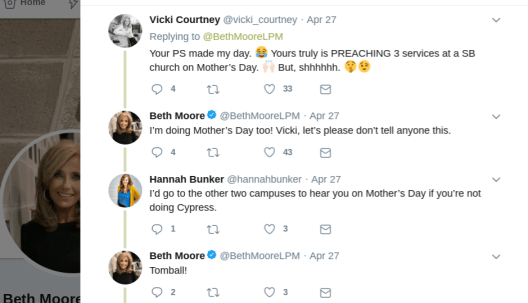
I say “hiding in plain sight” because she has given enough of an impression here that she is preaching the sermon to test the waters and see what the reaction will be, but has worded her tweet vaguely enough that if she meets too much resistance she can still decide to back out of preaching, give a brief word of biblically appropriate Mother’s Day greeting or encouragement to the ladies at another point during the service, and come back and claim with wide-eyed innocence that that’s what she meant all along by saying she was “doing” Mother’s Day. (Someone asked Beth point blank, in a subsequent tweet if Beth’s tweet meant that she would be preaching the Sunday service and Beth did not answer her. If she’s not, why not just say so? And if she is and isn’t ashamed of it, why not just say so?)

I say “presumably” at BCF-Tomball because, even though she publicizes specific details about time and place with other speaking engagements, she has not mentioned (at least not anywhere I can find as of the time I’m writing this) the specific church she’s preaching at on Sunday, and the church hasn’t mentioned on their website that she’ll be the guest preacher. Additionally, unlike other speaking engagements Beth does, this speaking engagement is not listed on the calendar of events at her website and she hasn’t mentioned it (other than the tweet above) on social media. With all this “open secrecy” I will be surprised if the video or audio of her sermon is posted on YouTube and/or the church website.

Why all this cloak and dagger about the highest profile woman in the Southern Baptist Convention2, possibly in the entirety of evangelicalism, preaching the Mother’s Day sermon?

Because she knows it’s unbiblical. Because we know it’s unbiblical. And it doesn’t take an electron microscope to see it. It’s right there, in black and white, jumping off the pages of Scripture:

I do not permit a woman to teach or to exercise authority over a man; rather, she is to remain quiet. 1 Timothy 2:12

It couldn’t be more clear. And for pastors who ought to know better to either fall prey to or intentionally perpetuate the serpentine seduction of “Did God really say you can’t preach?”, using Mother’s Day as an excuse to induce a woman to sin by having her deliver the sermon is a slap in the face – to God, to the church, and to women.

Using Mother’s Day as an excuse to induce a woman to sin by having her deliver the sermon is a slap in the face – to God, to the church, and to women.

What do his actions say to God? “I don’t like Your way and I won’t submit to it. I don’t trust that Your way is right regardless of what the world says. I’ll do what’s right in my own eyes.” It’s the lesson his church learns from his actions as well.

But why is inviting a woman to preach an affront to Christian women? Take a stroll down to verse 15 of 1 Timothy 2:

Yet she will be saved through childbearingโ€”if they continue in faith and love and holiness, with self-control.

Not only does the pastor who invites a woman to preach adulterate the role God has set aside specifically for men, he also denigrates one of the good and holy roles God has specifically and intentionally set aside for women: the role of literal, and spiritual, mother.

Eve shattered God’s perfect, unique design for women by allowing herself to be seduced into rebellion. But are we daughters of Eve forever doomed to bear the shame and guilt of her sin, never to have a role in building the Kingdom? Pariahs, to be shunned and shut out of God’s plan? No, praise God! Through the cross, the good works Christ has ordained for Christian women to do – including mothering our own children and being spiritual mothers to our daughters in the faith – redeem the prestige of women. Mothering, in every sense in which God intended it, raises the role of women back to its rightful place in God’s plan.

And we don’t need men – especially men who are supposed to be rightly leading God’s people – to come along and entice us to mess that all up again.

But that’s exactly what’s happening.

When a pastor invites a woman to sin by taking over the pulpit, he drags her and the women of his church right back to post-Fall Eden. He trashes the rank and repute of our God-given high and holy role of mother and implicitly says Being a woman isn’t good enough. You have to steal the role of men to be valued and esteemed. 

When a pastor invites a woman to sin by taking over the pulpit, he implicitly says, “Being a woman isn’t good enough. You have to steal the role of men to be valued and esteemed.”

Ladies, he’s wrong.

We don’t need to be second rate imitations of men in order to “count”. We need to be first rate, full throttle, take it to the limit women of God. God loves us and values us so much more than to give men a special and amazing role and leave us without an equally special and amazing, yet totally distinct, role. The God who spoke the universe into existence and planned out an unparalleled purpose for every single plant, animal, bacterium, and every other atom of the cosmos, did not leave the queen of His creation roleless. He did not bring us into being only to toddle along after the Hairy Ones trying to copy their every move. How unloving of God, and devaluing to women, would that be? Why would you want to act like a man when God blessed you with the gift of being a woman?

If, by God’s good Providence, you’ve “stumbled across” this article and you’re a woman who has been invited to preach, I plead with you: don’t buy the lie. Say no. Your Savior has a whole treasure chest of good works for you to do as a woman. You are worth infinitely more to Him as the woman He created you to be than you are to the world, or a worldly church, as a cheap knock-off of a man.

The practice of denigrating women, devaluing our God-given role, disobeying God, and darkening the understanding of the church by inviting women to sinfully take the pulpit must stop in the house of God.

Let us be the mothers our own children need, raising up a godly seed unto the Lord. Let us be the spiritual mothers longed for by younger women in the faith, daughters orphaned by Christian women who have abandoned them to take on the role of men. The practice of denigrating women, devaluing our God-given role, disobeying God, and darkening the understanding of the church by inviting women to sinfully take the pulpit must stop in the house of God and be replaced by strong godly women, unafraid and unashamed to flourish in the precious role our Lord has blessed us with.

Especially on Mother’s Day.


Updates to this article:

1Curtis Jones (Beth Moore’s son-in-law) resigned his pastorate at BCF in July 2020.

2Beth Moore has left the Southern Baptist Convention and is now attending an Anglican church where – surprise, surprise – she preaches from time to time.


Additional Resources:

Beth Moore vs. Owen Strahan on WWUTT Podcast
(Related links):
โ€ขMichelle Lesley’s Twitter thread on Beth’s Sunday sermon preaching
โ€ขBeth Moore’s Twitter response to Midwestern Seminary professor Owen
Strahan’s article on biblical complementarianism

โ€ขDivine Order in a Chaotic Age: On Women Preaching by Owen Strahan

Why Asking Women to Preach Is Spiritual Abuse by Josh Buice

Church, Holidays (Other), Worship

7 Ways to Honor Mothers During Your Mother’s Day Worship Service

Originally published May 7, 2021

Mother’s Day is just around the corner.

It’s nice to have a day set aside to recognize moms, be thankful for them, and appreciate them for all their hard work and everything they’ve done for us.

And if there’s anywhere motherhood should be honored, it’s in the church. Over and over, the Bible teaches us that motherhood is a high calling. A sacred trust. A solemn responsibility. No woman should ever be made to feel that she’s “just” a wife and mother. That’s the world’s perspective, not God’s.

So, pastors and women’s ministry leaders, how can the church best honor moms during the Mother’s Day worship service? Here are seven ways…

How can the church best honor moms during the Mother’s Day worship service? Here are seven ways…

1.
Don’t

2.
No, seriously…don’t.

Yes, you read that right. Don’t make the sermon, songs, and prayers all about motherhood, and don’t do the typical “honoring of the mothers” hoo-hah that has become traditional in many churches during the Sunday worship service that coincides with Mother’s Day:

  • “Will all of our mothers please stand?” Congregation applauds. Sometimes a flower or other small gift is handed out to all the mothers standing.
  • Honoring of the youngest mother, or mother with the youngest baby present (“newest mother”) with a flower, gift, or corsage
  • Honoring of the oldest mother (strangely, I’ve never seen the mother with the oldest child present honored) with a flower, gift, or corsage
  • Honoring of the mother with the most children (or most children present) with a flower, gift, or corsage

Why? Because, though it might not be visible on the surface, when you do this, you open a Pandora’s Box of thoughts and emotions. And not all of those are godly or happy thoughts and emotions.

When you take people’s focus off worshiping God and put it on honoring people, what they’re going to be thinking about is their feelings toward the people being honored, and their feelings about themselves:

“That woman is the meanest old biddy in the church. She shouldn’t be getting honored for anything.”

“I have more children than she does, but some of mine live out of state. It’s not fair that she gets the corsage just because she guilted all of her kids – who don’t even go to church – into showing up today.”

“Us single women never get honored for anything.”

“I’d give anything to have a baby. Why them and not me, Lord?”

“This is excruciatingly embarrassing. Thanks for reminding me and the entire congregation that the reason I’m the youngest mother here is because I sinfully gave up my virginity at 14.”

Keep people focused on Jesus during the worship service. That’s where their focus is supposed to be anyway, and as an added bonus, you’ll avoid stirring up all of those often-ungodly thoughts and feelings.

3.
And especially don’t…

…do this thing that some churches have started doing of honoring all women on Mother’s Day. You think what you’re doing is preventing anybody’s feelings from getting hurt, but in many cases, you’re just pouring salt in the wound:

“Sorry you’ve been going through the agony of infertility for ten years. Here’s a piece of Christian kitsch for a consolation prize.”

“Here’s a carnation to highlight the fact that not only do you not have children, you’re in your forties and are still waiting for Mr. Right.”

“So you’re getting puked on, and pulled at, and you’re dealing with colic and temper tantrums and potty training every day, and your family budget is decimated and you’re operating on about three hours of sleep a night and you can’t even get five minutes alone in the bathroom? We’re going to take the woman sitting next to you who put her career first, has power, prestige, and position in the world, plenty of money in the bank, and all the “me time” she wants, and we’re going to honor her the same way we’re honoring you.”

That’s not how kind and loving churches mean it to come across, of course, but that’s how it can feel to the women being “honored,” nonetheless.

About thirty or so years ago, some well meaning person in kids’ sports came up with the idea of every team – win or lose, and every kid on every team- super jock or perpetual ball-dropper, getting a trophy at the end of the season so nobody’s feelings would get hurt.

It didn’t work. Those kids knew which teams had won the most games and lost the most games. They knew who the best players were and who always got sent out into deep, deep, deep right field (like I did). They knew who had earned the trophies and who had not. And when everybody got a trophy at the end of the season, it was a meaningless prize for the winners and feelings of shame for an undeserved award for the losers.

The women in your church know it’s Mother’s Day – a day for honoring mothers. And they know whether or not they are mothers and whether or not they’ve “earned,” so to speak, or qualified, for the honor you’re giving them.

If you really don’t want to hurt the feelings of women who aren’t mothers, keep everybody’s focus on Christ and His Word instead of on Mother’s Day.

If you really don’t want to hurt anyone’s feelings, keep everybody’s focus on Christ and His Word instead of on Mother’s Day.

4.
And along those same lines, don’t…

…reinforce narcissistic navel-gazing – the “it’s all about me and my feelings of worth / loss / sadness / fulfillment” that they’re already being fed by the truckload by the world and by pop-women’s “Bible” study.

Many women are already living life being led around by their noses by their feelings. They wear their feelings on their sleeves. They’re easily offended. They lash out at anyone who even inadvertently hurts their feelings. They demand that the sharp corners of the world be padded so their feelings won’t be hurt.

And if you’re doing the “honor all women” thing on Mother’s Day, I know you don’t mean to, but you’re subtly reinforcing that outlook and coddling any feelings of bitterness, discontentment, resentment, entitlement, and anger that are silently flying around the room. (“Please don’t freak out because the mothers all got a flower and you didn’t. Here, you can have a flower too.”)

Yes, the pain in the heart of a woman who has lost a child, has wayward children, has lost a mother, had an abusive mother, has been unable to conceive, or desperately wants to be married is deep and real. And it is absolutely and inarguably incumbent upon us as compassionate, caring, kind, and merciful followers of Christ to weep with those who weep in the midst of suffering.

But God also requires us to draw upon His strength, look past our own pain, and rejoice with those who rejoice. Just as it is good and right to comfort a friend whoโ€™s infertile or grieve with parents who have miscarried, it is also good and right for that friend and those parents to rejoice on Motherโ€™s Day and Fatherโ€™s Day with those whom God has chosen to bless with children, or to celebrate with loved ones who have just announced a pregnancy. We take the focus off ourselves and put it on others, just like Jesus did.1

If you really want to honor all the women in your church, counter the worldliness, fleshliness, and selfishness many of them are imbibing. Teach them – all year round – that God’s Word is their authority, not their feelings. Drill down on the golden rule. Show them how to put others first. Help them learn how to weep with those who weep and rejoice with those who rejoice.

5.
Don’t neglect…

…the ministry of the Word. What all Christians – mothers and non-mothers alike – need during the worship service is to have God’s Word proclaimed to them.

Now I know that some pastors will immediately respond, “But I’m going to be preaching the Word. I’m preaching on Naomi and Ruth / Mary / Hannah / Proverbs 31, etc.” And if you’re rightly dividing and expositing whatever that passage is, I’m not knocking that, but you’re the exception, not the rule.

Just some food for thought between you and the Lord as you consider your sermon on the Sunday of Mother’s Day…

  • Are you really rightly handling the Word, or is this basically a Hallmark homily or a sentimental eulogizing of mothers?
  • Are all of the Mother’s Day awards, songs, videos, testimonies, and so on cutting down on the sermon time so that you don’t have time to properly proclaim the Word?
  • Are you so focused on motherhood that you’re leaving out of the proclamation of God’s Word anyone who’s not a mother – men, children, childless couples, singles?
  • If your ladies aren’t yet well schooled in not being led by their feelings, and/or you’re of a mind not to hurt anyone’s feelings, is your motherhood-focused sermon going to hurt the feelings of women who aren’t mothers (and are you going to get an earful about it on Monday morning)?
  • Are your Mother’s Day and Father’s Day sermons accidentally falling into the pattern many have noted in recent years: mothers can do no wrong, and fathers can do no right, mothers are “saints,” and fathers are “sinners”?
  • If you’re typically an expository preacher and a motherhood-focused sermon deviates from the book you’re currently preaching through, are you deviating because God is leading you to do so? Or is this deviation being led by the calendar? Or by the thought that the women of your church will pitch a fit if you don’t focus on motherhood during the Mother’s Day sermon?
  • Do you realize that many doctrinally sound mothers prefer that you keep right on preaching through whatever book you’re currently in because they’re enjoying it and God is using it to grow them? I’m one of them, and I’ve heard from many others like me: “I don’t want to hear how great I am. I want to hear how great Christ is.”

I don’t want to hear how great I am. I want to hear how great Christ is.

6.
Don’t overlook…

…the fact that there are lots of ways and times you can honor and encourage mothers besides during the Mother’s Day worship service.

  • When you’re preaching through a book and come to a passage about mothering, go ahead lift up what the Word says about mothering. (That might sound a little contradictory to what I’ve already said, but preaching about motherhood on October 9 or July 31 is a lot less emotionally triggering than it is on Mother’s Day. Plus, there’s a good chance the passage isn’t exclusively about motherhood.)
  • Have a Mother’s Day potluck or picnic – everyone invited, of course – after the service where the dads and kids do all the set up, cooking, and clean up. (And have one for Father’s Day, too, with moms and kids serving!)
  • Host a parents’ night out from time to time to give moms a break and give husbands and wives some quality time together.
  • Make sure you’ve got Titus 2:3-5 going on, in some form, in your church. Young women need spiritual moms to lean on and to train them.
  • Make a baby cry/nursing room (with sermon piped in) and a nursery available during the worship service for those who want them, and offer children’s classes or child care whenever adult classes are offered. Also, don’t make being on the nursery rotation a requirement for moms to leave their children in the nursery.

    I know these ideas won’t be popular with some churches, but hear me out: as a young, stay at home mom with lots of small children, some weeks the only time I made it out of the house and got to talk to other adults was Sundays and Wednesdays at church. The churches I belonged to that offered a nursery and the other aforementioned amenities served, honored, appreciated, and loved me well by doing so. I needed that brief time of undistracted respite in God’s Word with God’s people to rest, recharge, and keep from losing my mind.

A quick “Happy Mother’s Day to all you moms out there!” from the pastor is no big deal, but, generally speaking, keep the focus on God during the worship service, and have fun honoring Mom some other time.

7.
And most importantly, don’t forget…

…God. A worship service isn’t (nor should it be) like any other gathering of people. At any other gathering of people, people are in charge, and people are the focus. People decide the reason for the gathering, the theme of the gathering, who or what the gathering is to center on, who’s going to run things, which materials are or aren’t appropriate for the gathering, which activities are going to take place during the gathering, and what’s going to please or displease the people who are gathering.

Not so with a worship service. God dictates all of those components and parameters in His Word, and we obediently carry them out.

The reason for the worship service is to honor God – not mothers or any others – and worship Him.

The theme of the worship service is worshiping God.

The worship service is to center on God.

The men God has appointed to the offices of pastor and elders are to run things during the worship service.

The only appropriate materials for the worship service are God’s Word and materials that focus our worship on God and His Word.

The activities that are to take place during the worship service – the proclamation of the Word, prayer, praise, singing, and giving offerings – are prescribed by God in His Word and directed to God.

And the worship service isn’t about what’s pleasing or displeasing to the people in attendance, it’s about what’s pleasing to God.

Should mothers be appreciated, even honored, by the church? Sure! But not during the time we’ve specifically set aside to honor God. And really, shouldn’t mothers and motherhood be appreciated and honored much more than one hour a year?

Happy Mother’s Day to all you moms out there!

Let’s hear from you, readers.
What’s a great way to honor moms and motherhood that keeps the
focus of the worship service on God, where it’s supposed to be?


1Excerpted from my article Safe Spaces and Wearing Our Hearts on Our Sleeves: 6 Ways to Follow Jesusโ€™ Example of Handling Hurt

Holidays (Other), Mailbag, Parenting

The Mailbag: Mother’s Day Potpourri

Originally published May 3, 2021

Welcome to another โ€œpotpourriโ€ edition of The Mailbag, where I give short(er) answers to several questions rather than a long answer to one question.

I like to take the opportunity in these potpourri editions to let new readers know about my comments/e-mail/messages policy. Iโ€™m not able to respond individually to most e-mails and messages, so here are some helpful hints for getting your questions answered more quickly. Remember, the search bar (at the very bottom of each page) can be a helpful tool!

Or maybe I answered your question already? Check out my article The Mailbag: Top 10 FAQs to see if your question has been answered and to get some helpful resources.


This week on the blog, in anticipation of Mother’s Day, it’s all about the mamas. Here’s a roundup of Mailbag articles and other resources on motherhood and parenting…


How can I raise my daughters to be godly women?

Avoiding the Creepers: Six Ways to Raise a Biblically Strong Woman


How can I raise my sons to be godly men?

Six Ways to Raise a Godly Man


Am I violating Scripture’s prohibition on women teaching men by teaching my sons the Bible at home?

Rock Your Role FAQs (#12)


Can you recommend a good Bible study for teen girls?
Can you recommend a devotional I can do with my kids?
How can I teach my kids the Bible?

The Mailbag: Potpourri (Kidsโ€™ devotionals, The Chosen- Season 2, Methodist apostasy) (section 1)

The Mailbag: Can you recommend a good Bible study for women/teens/kids?

The Mailbag: Potpourri (NBCS, Homeschool resources, Piperโ€ฆ) (section 3)

12 Techniques for Raising Bible-Saturated Kids

Homemade Catechism: 11 Scriptures for Real Life Parenting Situations


Which children’s Bible do you recommend?

The Mailbag: Childrenโ€™s Bible Recommendations


How can I know if my disabled (or very young) child is saved?

The Mailbag: Salvation and the Mentally Challenged


My young child says she is saved and wants to be baptized. How can I know if she’s really saved and ready for baptism?

A Review of Justin Petersโ€™ โ€œDo Not Hinder Themโ€


I’m thinking about homeschooling, but I don’t know where to start. Help!

Homeschool Resources


As a stay-at-home / homeschooling mom of boys, how can I make sure they’re getting the male leadership and influence they need during the day while my husband is at work?

The Mailbag: Potpourri (Christian romance novelist, home schooling sons, Spanish resourcesโ€ฆ) (section 2)


What is your position on birth control or having a planned family size? 

The Mailbag: Christian Women Working, Using Birth Control, and Limiting Family Size

The Mailbag: Should I Risk Another Pregnancy?


Should I cover myself and my baby while breastfeeding for the sake of modesty?

The Mailbag: Should Christian women cover up while breastfeeding?


How can I teach my children about modesty?

Modesty- Part 3 at A Word Fitly Spoken (We suggest you listen to all three parts in order as they build on one another)


Is spanking biblical or abusive?

The Mailbag: Potpourri (Spanking, Women teaching men, Working a homosexual โ€œweddingโ€โ€ฆ) (section 1)


Can I get some guidance on training my children to behave in church?

Thatโ€™s (Church) Life! โ€“ How to โ€œDo Churchโ€ โ€“ Part 1 at A Word Fitly Spoken

Churchmanship 101: Training Your Child to Behave in Church 

The Mailbag: Potpourri (Joniโ€™s testimony, โ€œMessyโ€, Female seminary profsโ€ฆ) (section 4)

Yes Sir! Thatโ€™s My Baby!


How do I deal with my unsaved parents who are an ungodly influence on my children?

The Mailbag: Grandparents an Ungodly Influence on My Kids


Biblical advice / information on parenting in general?

Do You Trust God with Your Kids?: 8 Ways to Parent Your Children Like God โ€œParentsโ€ You

Parenting: What a Child Wants, What a Child Needs

Parenting Without Shame

The 10 Commandments of Parenting


If you have a question about: a Bible passage, an aspect of theology, a current issue in Christianity, or how to biblically handle a family, life, or church situation, comment below (Iโ€™ll hold all questions in queue {unpublished} for a future edition of The Mailbag) or send me an e-mail or private message. If your question is chosen for publication, your anonymity will be protected.

Holidays (Other)

Help me celebrate another year of the Lord’s blessings!

1969: Man landed on the moon…Woodstock…Sesame Street debuted on TV…John MacArthur began his pastorate at Grace Community Church…and I was born.

All of those events of 1969 turn 56 this year – and on Sunday (April 27) so do I! And I’d like to ask you to help me celebrate by considering partnering financially with me in ministry.

I love serving the women of the body of Christ through this blog. From writing about current issues in the church that you have questions about, to researching false teachers, to helping you find a new church, to the 20 Bible studies I’ve written, and so much more, there is no way Iโ€™d rather spend my โ€œleftoverโ€ time and energy after serving my family and my church.

I donโ€™t draw a salary from this ministry, charge membership fees, or sell merchandise. All of my materials on the blog are available to you and your church at no charge, and I like that just fine and dandy. That being said, my family lives frugally, primarily on my husband’s modest income, and we incur financial needs from time to time.

If you, your family, or your church have been blessed by my work and youโ€™d like to be a blessing to me and my family in return on an ongoing, occasional, or one time basis, there are two ways you can do that:

As it says on my Speaking Engagements page…

As a Proverbs 31 woman and stay at home wife and mom, I try to โ€œlook well to the ways of my household.โ€ Unfortunately, I know nothing about wool, flax, or weaving, so speaking engagements are the โ€œwool, flax, and weavingโ€ that help contribute to providing for my family by way of equitable speaking fees.

Other than occasional free will donations from followers, speaking engagements provide the only income I earn from this ministry. I kind of think of it as my part time dream job.

So how about hiring me? The women of your church and surrounding area get a wonderful weekend of doctrinally sound fellowship, encouragement, and edification around the Word. I get the joy of sharing with them. Your church or parachurch organization gets to bless and support my family. It’s a win-win-win!

First time planning an event? Never fear! I’ve got lots of tips and helpful hints to help make things easier.

Click here for more information about booking me for your event.

If you’d like to make a financial donation, please click on the PayPal, Patreon, or Cash App link below.

Anything from โ€œGo buy a gallon of milkโ€ to โ€œGo buy a houseโ€ will be much appreciated and well stewarded by my husband and me. We ask only that you meet your own familyโ€™s and churchโ€™s needs first before considering making a gift to us.

I would be most grateful for any amount you’d like to contribute, but in celebration of my fifty-sixth birthday, how about some fun amounts like…

  • $56 (for my age)
  • $27 or $427.69 (for my birthday, April 27)
  • $19.69 or $1,969 (for the year I was born)
  • $25 or $33 or $71 (or whatever age you think I look – I promise I won’t be offended! :0)

Here’s how to donate…

Click here.

Click โ€œsendโ€.
Enter my e-mail address:
MichelleLesley1@yahoo.com

Selectย 
Sending to Friends and Familyย ”
option

(If you select โ€œGoods and Services,โ€ PayPal will deduct a fee, and I will not receive your whole gift.)

Click Here

Click Here

My cashtag is:
$MichelleLesley1

(Normally, I send a thank you note to donors, but Cash App does not provide any contact information and only lets me respond to donors with an emoji. Please know that I am deeply thankful for your kindness and generosity and promise to steward your gift well.)


If you would like to donate but you’re uncomfortable giving electronically and would prefer to send a check, my suggestion would be to ask a friend or loved one who is comfortable with electronic transactions to make your donation for you via one of the apps above, and then reimburse that person with cash or a check. I’m sorry that’s kind of a hassle, but I’m sure you understand that in the world we live in, I can’t give out my mailing address to strangers on the internet.

Thank you so much for your kindness and generosity!

Easter, Holidays (Other), Suffering

Christ- the Suffering Servant

Originally published April 14, 2017


Who has believed what he has heard from us?
And to whom has the arm of the Lord been revealed?
2 For he grew up before him like a young plant,
and like a root out of dry ground;
he had no form or majesty that we should look at him,
and no beauty that we should desire him.
3 He was despised and rejected by men,
a man of sorrows and acquainted with grief;
and as one from whom men hide their faces
he was despised, and we esteemed him not.
4 Surely he has borne our griefs
and carried our sorrows;
yet we esteemed him stricken,
smitten by God, and afflicted.
5 But he was pierced for our transgressions;
he was crushed for our iniquities;
upon him was the chastisement that brought us peace,
and with his wounds we are healed.
6 All we like sheep have gone astray;
we have turnedโ€”every oneโ€”to his own way;
and the Lord has laid on him
the iniquity of us all.
7 He was oppressed, and he was afflicted,
yet he opened not his mouth;
like a lamb that is led to the slaughter,
and like a sheep that before its shearers is silent,
so he opened not his mouth.
8 By oppression and judgment he was taken away;
and as for his generation, who considered
that he was cut off out of the land of the living,
stricken for the transgression of my people?
9 And they made his grave with the wicked
and with a rich man in his death,
although he had done no violence,
and there was no deceit in his mouth.
10 Yet it was the will of the Lord to crush him;
he has put him to grief;
when his soul makes an offering for guilt,
he shall see his offspring; he shall prolong his days;
the will of the Lord shall prosper in his hand.
11 Out of the anguish of his soul he shall see and be satisfied;
by his knowledge shall the righteous one, my servant,
make many to be accounted righteous,
and he shall bear their iniquities.
12 Therefore I will divide him a portion with the many,
and he shall divide the spoil with the strong,
because he poured out his soul to death
and was numbered with the transgressors;
yet he bore the sin of many,
and makes intercession for the transgressors.

Isaiah 53:1-12

Surely he has borne our griefs and carried our sorrows; yet we esteemed him stricken, smitten by God, and afflicted. Isaiah 53:4

What a beautiful passage describing Christโ€™s suffering for us.ย Usually, when we think about suffering, we think about suffering weโ€™ve personally experienced, things loved ones have been through, newsworthy events from around the globe, and natural disasters.ย And, as normal human beings in a broken, sinful world, thatโ€™s what we tend to do- we think of people, topics, and circumstances in light of our experiences with them or how they affect us. But as Christians,ย it’s imperative that, when we think of suffering, we look first to Christ, the Suffering Servant, and see all other suffering in light of His suffering.

Certainly, Isaiah 53 doesnโ€™t cover every aspect or incident of Christโ€™s suffering, but letโ€™s take a look at a few of these verses that prophesy – over 700 years before He was ever born – about the suffering of Christ.

Letโ€™s take a look at a few of these verses that prophesy – over 700 years before He was ever born – about the suffering of Christ.

Christ suffered physically
Most have read the Bibleโ€™s account of the crucifixion. But in the same way a verbal description of abortion doesnโ€™t really capture the horror of the act the way a video can, our English words used in Isaiah 53 canโ€™t adequately express the extreme physical suffering Christ endured on the cross. The cross was such an agonizing experience we had to invent a new word for that kind of suffering: excruciating. Ex– out of, cruciare– the crucifixion. Suffering drawn out of the cross.

The cross was such an agonizing experience we had to invent a new word for that kind of suffering: excruciating. Suffering drawn out of the cross.

So, how did Christ suffer physically?

Verse 5 says He was pierced, crushed, chastised, and wounded. Letโ€™s take a closer look at those words:

Pierced– The Hebrew word means: โ€œto wound (fatally), bore throughโ€ We see this with the crown of thorns that “bore through” Jesusโ€™ head and the nails that pierced His hands and feet.

Crushed– The Hebrew means: โ€œto be broken, shattered, beat to piecesโ€ Interestingly, it can also mean โ€œcontriteโ€- He was contrite for our iniquities.

Chastisement– The Hebrew means: โ€œdisciplineโ€ as you would discipline a naughty child

Wounds/stripes– The Hebrew means: โ€œa welt, blueness, bruise, hurtโ€

The flogging. The thorns. The pummeling He took from the soldiers. And carrying the cross to Calvary after all of that. Nails through His wrists, nails through His feet, the agony of trying to breathe, and, finally, the spear through His side. Jesusโ€™ physical body took some of the worst abuse thatโ€™s ever been doled out by professional torturers.

Christ suffered emotionally
Jesus was a human being, just like you and me. That means he had feelings and emotions just like you and I do, and people and circumstances hurt Him just like they hurt us.

He was a man of sorrows and acquainted with grief. Jesus had loved ones die and friends betray Him and turn their backs on Him. He wasnโ€™t immune to the hurts of life.

We esteemed him stricken, smitten by God, and afflicted. Stricken, smitten, afflicted- those arenโ€™t words we use very often. What do they mean? Stricken is to reach out and touch someone. Itโ€™s the same idea as God striking someone down or striking someone with leprosy. Smitten by God– same idea, but with more of a judgment or punishment angle: โ€œsmite, chastise, send judgment upon, punish, destroy.โ€ To be afflicted is to be โ€œoppressed, humiliated, be bowed down.โ€

This phrase in verse 4 carries the idea that people thought Jesus had done something(s) that so displeased God that that Godโ€™s punitive hand of judgment was upon His life. Of course, that wasn’t true. Yet, there were people who thought of Him that way and treated Him that way- at the cross, certainly, but also, to some extent, during His life.

And yes, that grieved Him as the God who loved and wanted to save these people, but, on the human side, well, we all know how it feels to be misunderstood and misrepresented. Christ felt those slings and arrows of the heart.

We all know how it feels to be misunderstood and misrepresented. Christ felt those slings and arrows of the heart.

Christ suffered spiritually
When I say Christ โ€œsuffered spirituallyโ€ I want to be clear that I do not mean anything ever happened to Christ that marred His sinless perfection or in any way diminished His deity. What I mean is that He suffered due to fallen manโ€™s sinfulness regarding theological or spiritual issues. For example:

He was despised and rejected by men…he was despised, and we esteemed him not. We see this constantly in the gospels. The Pharisees were always trying to trick Jesus and trap Him with difficult questions. They repeatedly accused Him of โ€œworkingโ€ on the Sabbath by healing people, picking grain and eating it, and so on. They plotted against Him. They tried to stone Him. Even at the end, when He was on the cross, Scripture says โ€œthey hurled insults at Him.โ€

And why? These arenโ€™t just playground bullies picking on a random kid for no reason. They had a reason. And those insults the chief priests and scribes and elders hurled at Jesus in Matthew 27:42-43 sum up that reason pretty neatly:

He saved others; he cannot save himself. He is the King of Israel; let him come down now from the cross, and we will believe in him. He trusts in God; let God deliver him now, if he desires him. For he said, โ€˜I am the Son of God.โ€™

Jesus was God. He was their Messiah. Yet these men didnโ€™t want to humble themselves and admit it and bow the knee to Him. They looked Jesus in the eye – the God who loved them, created them, and breathed the breath of life into them – and said: We will not have this King reign over us! They despised and rejected the core of who Jesus was: Savior, King, Son of God.

They looked Jesus in the eye – the God who loved them, created them, and breathed the breath of life into them – and said: We will not have this King reign over us!

But Jesus suffered in other spiritual ways, too…

The Lord has laid on him the iniquity of us all.
[He was] stricken for the transgression of my people
His soul makes an offering for guilt
He shall bear their iniquities
He bore the sin of many

Christ carried our sin. He himself bore our sins in his body on the treeโ€ฆ (1 Peter 2:24). Thereโ€™s no way we could begin to fathom what it was like for Christ to carry every single sin of billions of people in His body. But He didnโ€™t just have the weight of that sin on His shoulders, He also propitiated Godโ€™s wrath toward every single one of those sins. God poured out the cup of His wrath for our sin and Jesus drank every last drop of it.

God poured out the cup of His wrath for our sin and Jesus drank every last drop of it.

Jesus suffered tremendously. How did He respond to all that suffering?

Christโ€™s Response to Suffering
Hebrews 2:17 tells us: Therefore he had to be made like his brothers in every respect.

One of the ways Jesus was made like us, His brothers, was that He suffered. He suffered physically, He suffered emotionally, and He suffered โ€œspiritually,โ€ just like we do. In fact, He suffered far more in each of these respects than any of us ever have or ever will.

But whatโ€™s even more amazing to me than the actual extent of Jesusโ€™ suffering was the fact that He endured all of it, from the moment of His birth to the moment of His death without ever sinning. Not even once. Not even in His thoughts or the attitude of His heart.

He endured all of it, from the moment of His birth to the moment of His death without ever sinning. Not even once. Not even in His thoughts or the attitude of His heart.

Thatโ€™s huge. Think of the suffering youโ€™ve experienced in your life and how you responded to it. Iโ€™ve retaliated against people who have hurt me, or at least harbored bitterness against them. During times of calamity, Iโ€™ve yelled at God, Iโ€™ve questioned His love for me, Iโ€™ve not trusted Him, Iโ€™ve been angry at Him.

But Jesus never had a sinful response to suffering. How did He respond?

He was oppressed, and he was afflicted, yet he opened not his mouth; like a lamb that is led to the slaughter, and like a sheep that before its shearers is silent, so he opened not his mouth.

When he was reviled, he did not revile in return; when he suffered, he did not threaten, but continued entrusting himself to him who judges justly. 1 Peter 2:23

In some cases, Jesus just didnโ€™t respond at all to the person or situation causing the suffering. He communed with God instead. Jesus knew that He was in Godโ€™s hands and God would mete out judgment at the proper time.

But this is the same Jesus who instructed us to โ€œLove your enemies and pray for those who persecute you,โ€ turn the other cheek, go the extra mile, give your cloak as well as your tunic. And Jesus certainly embodied these responses to those who caused Him suffering.

Let’s look at Jesusโ€™ response to Pilate in John 18:33-38. But before we do, bear in mind that Jesus has the power to call down any number of angels to destroy Pilate, the courtyard where Heโ€™s about to be flogged, Calvary, Jerusalem, the whole world, if He wants to, in order to avoid the suffering Heโ€™s about to endure, and Jesus is fully aware of that. But watch how He responds to Pilate:

So Pilate entered his headquarters again and called Jesus and said to him, โ€œAre you the King of the Jews?โ€ Jesus answered, โ€œDo you say this of your own accord, or did others say it to you about me?โ€ Pilate answered, โ€œAm I a Jew? Your own nation and the chief priests have delivered you over to me. What have you done?โ€ Jesus answered, โ€œMy kingdom is not of this world. If my kingdom were of this world, my servants would have been fighting, that I might not be delivered over to the Jews. But my kingdom is not from the world.โ€ Then Pilate said to him, โ€œSo you are a king?โ€ Jesus answered, โ€œYou say that I am a king. For this purpose I was born and for this purpose I have come into the worldโ€”to bear witness to the truth. Everyone who is of the truth listens to my voice.โ€ Pilate said to him, โ€œWhat is truth?โ€ After he had said this, he went back outside to the Jews and told them, โ€œI find no guilt in him.

Jesus took the time to, essentially, share the gospel with this horrid man, whose next move was to have Jesus taken out and beaten to a bloody pulp. Jesus not only refused to retaliate against Pilate, He blessed him with the gospel instead.

When Jesus was on the cross, how did He respond to those who had crucified Him and those who were mocking and insulting Him? Did He yell back? Tell them they were all going to burn in Hell? No, He prayed for them: Father forgive them, for they know not what they do.

Every time Jesus suffered, He responded to it in exactly the right, godly way. He trusted Himself, the situation, and everyone involved to God, He loved His enemies, and He said or did whatever would best proclaim the gospel or glorify God in that situation.

It’s difficult to wrap our minds around all of the ways Jesus suffered, and more difficult still to comprehend that He never responded sinfully to His suffering. But perhaps the most baffling aspect of Jesus’ suffering is that He willingly chose to endure it all for rebellious, thankless, undeserving sinners like you and me. To serve us. To purchase the salvation we could never earn. To live the life we could not live. To die the death we could not die. And to conquer the grave that, for us, was unconquerable.

Perhaps the most baffling aspect of Jesus’ suffering is that He willingly chose to endure it all for rebellious, thankless, undeserving sinners like you and me.

All hail King Jesus- the Suffering Servant.