Church, Sermons

What the Bible Says About Church Membership

“The Bible doesn’t say Christians have to join a church.”

Are you sure about that? Because most people who say that don’t seem to know their Bibles very well. They’d probably know a lot more about what the Bible does and doesn’t say about joining a church if they were joined to a solid local church.

If you’ve been around the blog for a while, you’ve probably heard me say:

Christian, you need to be a faithful, invested member of a doctrinally sound local church.

You might have noticed that, often, my first instruction to a new Christian or a sister seeking counsel is to find a doctrinally sound church to join.

One of my most shared resources is the Searching for a new church? tab in the blue menu bar at the top of this page.

Maybe you’ve even explored some of my materials explaining how crucial church membership and faithful attendance are, such as…

Six Ways Not to Forsake the Assembly

7 Reasons Church is Not Optional and Non-Negotiable for Christians

A Word Fitly Spoken Podcast: Is This Church for You? with Michelle Lesley and Amy Spreeman

…just to name a few

But just why is church membership so important? What does the Bible really teach about church membership?

Today, I’m going to turn things over to my pastor, Dr. Lewis Richerson, to explain. Below is an excellent three part sermon series he preached earlier this year on church membership. I found it very helpful and interesting, and I hope you will, too.


Is Joining a Church Biblical?


Church Membership as Covenant


Meaningful Church Membership

Abuse, Church, Sin, Southern Baptist/SBC

Preventative Measures: 6 Steps SBC Churches Can Take to Prevent Sexual Abuse

Originally published February 22, 2019

The state I live in is heavily Catholic and Southern Baptist. For many years, journalists and others have been delving into the gobsmacking number – thousands – of pedophile and sexually abusive Catholic clergy across the globe, and, in recent months, my own local paper has been tackling the issue as it pertains to priests and other Catholic leaders in our area who have been revealed as abusers. So I was kind of prepared for the Southern Baptist Convention to be the next entity to be investigated. My guess is that either Presbyterians or Mormons will be next.

It’s absolutely appropriate that the news media conducted this kind of investigation into the SBC. What’s not appropriate is that SBC leadership appeared not to be ready for it because – at least from my perspective as the average person in the pew – it’s not something the Convention has a history of policing itself on in any appreciable way. SBC leadership should have been ready and eager to fling the doors wide open and transparently welcome any sort of investigation by the media, demonstrating whatever progress has been made in dealing with perverts in our pulpits. Instead, they seemed to be caught virtually unprepared despite the fact that the signs of the times should have indicated to them that this was coming.

In my opinion, the Houston Chronicle did an excellent job of exposing the problems with abuse in the SBC in its three-part series of articles, even taking the time to explain the crucial point of church autonomy, which sets SBC churches apart from the governing structure of Catholicism and other organizations, and which has, in many cases enabled abusers to move from church to church undetected. SBC leaders who have explained that they have no authority to force churches to participate in any sort of registry of abusers and the credibly accused are correct (but couldn’t it be voluntary?). SBC leadership, unfortunately, has no such authority over individual churches. Each church has to set its own standards and methods for preventing abuse. So what can individual, autonomous churches do to prevent abuse?

1.
Preach the Gospel

That might sound pretty basic, but it’s one of the basics we desperately need to get back to. We need to be churches who hammer on the gospel – the wretchedness of sin, the supreme holiness of God, the cross, the tomb, the resurrection, grace, mercy, repentance, forgiveness – week in and week out. Not only is that…well…it’s just what any biblical church is supposed to do, but my guess is that the vast majority of the perpetrators in these abuse cases are not actually Christians – despite what they may claim or what office they might hold – they are false converts because a lot of churches they’ve been part of have neglected their duty to preach the gospel.

Too many SBC churches teach an easy – “Just repeat this quick little prayer, and boom, you’re in!” – believism that unrepentant sinners hang their eternal hats on as a “Get out of Hell, Free!” card. They’ve never found themselves filthy and undone before an unfathomably holy God because they’ve never been confronted by that God or that characterization of their sin in the preaching and teaching of their churches. Could some of these perpetrators be genuinely regenerated Christians? It’s possible, but not likely. By and large, true Christians are not out there abusing others – it’s the false converts.

2.
Meaningful Membership

Some churches have done away with formal membership altogether. Everybody’s welcome, come and go whenever you want, if you want, no requirements, no accountability. That’s not biblical, nor is it how the church has handled membership over the course of church history.

Traditionally there have been three main ways to join a SBC church: a newly saved person makes a public profession of his faith to the church body and is baptized into membership, or membership can be transferred from one church to another. You can transfer your membership by promise of letter (your previous church sends a letter to your current church recommending or not recommending that you be accepted for membership) or by statement (when obtaining a letter from a previous church isn’t possible, this is an “honor system” personal testimony that you are a baptized Believer).

Promise of letter in particular is a decent and biblical system that needs to be upheld, adhered to, and taken gravely seriously rather than just waving every Tom, Dick, and Harry through the wide open doors of the church. And in the case of new church members and new staff members (new staff members have to transfer their membership, too), it could help curb abuse if both the sending and receiving churches would look upon it as far more than a mere formality.

One of the very valid problems the Chronicle articles cite is that sending churches (the churches the abusers came from) did not inform subsequent churches of the problems with the abuser. They silently foisted people they knew were dangerous onto unsuspecting congregations. If sending churches would respond honestly to inquiries from receiving churches (the churches the abusers are going to) about their former staff and members, and if receiving churches would ask probing, personal questions rather than sending out perfunctory form letters, that would be a good start to making more headway on preventing abuse.

Furthermore…

Meaningful membership makes it harder for people to anonymously breeze in to the church, abuse, and slip out before anybody realizes what’s going on.

There are sexual abusers out there who find and attend churches with loosey-goosey membership policies for the express purpose of cultivating a pool of victims. They know these churches are blindly and ignorantly trusting, so they show up for a couple of weeks, talk a good game, and promptly volunteer to work in the nursery or with the youth. If your church has a firm membership policy, required membership class, requires members to sign a church covenant, only allows church members (not just anybody who wants to or seems talented) to serve in any office, task, role, or capacity – and only after they have been members for a specified amount of time (ex: must have been a faithful member for at least six months to teach, serve on a committee, etc.), that sort of abuser isn’t going to waste his time or chance being caught by attending your church.

3.
Church Discipline

One of the failings of far too many SBC (and other) churches is sweeping sin under the rug and refusing to biblically exercise church discipline before it’s too late and calamity strikes. Church discipline isn’t just for the “big” sins like a pastor who commits adultery. Church discipline is for all observable, unrepentant, biblically defined sin. If we have verifiable knowledge that a brother or sister in our church is sinning, we have the obligation not to please ourselves by turning a blind eye and avoiding a confrontation, but to lovingly go to that person and plead with her, for her own restoration and reconciliation to Christ, to repent and walk blamelessly. Often (hopefully), that first step in the church discipline process precludes the need for the remaining two.

Churches that consistently, lovingly, and biblically practice church discipline help prevent abuse in four ways…

First of all, nobody wakes up one morning and decides to start sexually abusing others. There are always “smaller” sins leading up to abuse – obscene comments, dirty jokes, leering, pornography, inappropriate touching in public. If we would address those “smaller” sins when we see them happening, we might just prevent the potential abuser from continually hardening his heart by getting away with sin, bring the gospel to bear on his life, and keep him from becoming an abuser in the first place. He might actually get saved, which is one of the goals of church discipline.

Second, if a church cultivates an atmosphere of practicing church discipline, unrepentant abusers aren’t going to hang around long. They don’t want to be caught.

Third, if a church ends up having to go through all the steps of church discipline with an unrepentant potential abuser, the last step – bringing this person before the church to remove him from membership – is public. Church members are made aware of the problems with this person so they can avoid being victimized by him and the procedure of removing the potential abuser from church membership goes into the church records. When he then goes to a new church, that receiving church should inquire of the sending church about him (see “Meaningful Membership” above). The sending church can then provide the record of his removal so the receiving church will be aware of the problems with this person.

Fourth, if we practice church discipline on the “smaller” sins with an unrepentant abuser, he is likely to be removed from membership in the church before he gets to the point of abusing someone.

Another aspect of church discipline is tightening up the rolls and removing members who are dead (no, I’m not kidding), have moved away, have stopped attending, or are no longer members in good standing for other reasons. This may not prevent someone from abusing, but at least if he does abuse, the media won’t be able to report that he’s (still) a member of your church, thus tarnishing your church’s, and possibly God’s, good name.

4.
Take Biblical Requirements for Leadership Seriously

It’s not like the Bible doesn’t tell us what kind of man should be a pastor, elder, or deacon. It’s right there, in black and white, twice, in 1 Timothy 3 and Titus 1. And yet there are churches who barely give those requirements a glance in favor of “more important” qualities they want in a pastor: Does he have at least a master’s degree from seminary? Is he a certain age? Does he rub elbows with Christian celebrities? Does he have a track record of successful building programs, fundraising, and attracting lots of new members? Is he charismatic and a dynamic speaker? None of those things are inherently bad unless they take precedence over the biblical qualifications.

But when churches are hiring men as pastors, youth directors, etc., whom they knowย have been in prison for abuse, as theย Chronicle articles cited, we have to think some other factor is more important to those churches than the biblical requirements. Because someone who has been accused, tried, convicted, and imprisoned by worldly courts for sexual abuse is no longer “above reproach” – the very first requirement in both passages (and Titus mentions itย twice for emphasis) – he is not “respectable”, and he is notย “well thought of by outsiders”. The very existence of theย Chronicle’s articles proves that. It boggles the mind that something like this has to be said to professing Christians who are supposedly spiritually mature and biblically knowledgeable enough to be on the pastor search committees for their churches, but…

People who have criminal records as sex abusers are permanently disqualified from professional ministry because they no longer meet these biblical requirements.

(And just as an aside, if your church has a “no hire” policy for men who have ever been divorced for any reason but yet you’ll hire a convicted sexual abuser…well…I’m just at a loss for words at that level of hypocrisy. OK, maybe one word: repent.)

But, “forgiveness for repentant sinners!” I can hear compassionate Christians cry out. Absolutely. Absolutely. I have a loved one who was radically and genuinely saved while he was in prison for child molestation. God can and does save sexual abusers, and those forgiven Christians need a church home just like everybody else does. We lovingly welcome into membership repentant sinners who are transparent with the church about their previous sin and who volunteer to be kept accountable. But we do not put them back into the position of pastor, elder, deacon, etc., first because they are biblically disqualified, and second, because it is not loving to that person nor to the rest of the church to allow him access to facets of church life that would tempt him back into sin. And it is putting God to the test to intentionally put such a person into a tempting situation as some sort of way of “proving” that God has really saved this person. We would not make a convicted embezzler the church treasurer and we should not be putting sexual abusers in positions that would tempt or allow them to abuse again – even volunteer positions. That doesn’t mean we doubt their salvation or the work God has done in their hearts, that means we recognize that Satan is cruel and crafty and we humbly admit that we still succumb to temptations to sin. It’s not holding a grudge or unforgiveness, it’s exercising biblical wisdom.

5.
Stop Being Afraid

When we allow the fear of man to determine our actions instead of the fear of God, we are in grave spiritual error.

Peter and the apostles stood up to the authorities who threatened and imprisoned them, insisted on obeying God’s Word, boldly declared, “We must obey God rather than men,” took their licks like men, went away rejoicingย that they had been counted worthy to suffer dishonor for the Name, and kept right on trucking in obedience to God. How far have we fallen when we won’t even address a brother’s sin with him because we’re afraid of confrontation? When we cover up a predator’s behavior and unleash him on others because we’re afraid of a defamation lawsuit? When we must obey men rather than God because we’re more afraid of the earthly consequences than spiritual consequences – because we don’t trust God to take care of us or His church?

Brothers and sisters, this must not be.

How far have we fallen when we cover up a predator’s behavior and unleash him on others because we’re afraid of a lawsuit?

Should we act wisely? Of course. Make sure we’re obeying the law and not hurting anyone as far as we’re able? Certainly. Get some legal advice? Absolutely. But when the rubber meets the road of choosing what’s right in God’s eyes versus what’s safe or comfortable in our own eyes, we choose what’s right in God’s eyes every time and we trust Him with the outcome. The God who parts seas, cools furnaces, and raises the dead is powerful enough to handle court cases and the ire of sinful men. Let us say with the Psalms and the Proverbs:

The fear of man lays a snare, but whoever trusts in the Lord is safe.
Proverbs 29:25

…in God I trust; I shall not be afraid. What can man do to me?
Psalm 56:11

The Lord is on my side; I will not fear. What can man do to me?
Psalm 118:6

Trust in the Lord with all your heart, and do not lean on your own understanding. In all your ways acknowledge him, and he will make straight your paths. Be not wise in your own eyes; fear the Lord, and turn away from evil.
Proverbs 3:5-7

6.
Practical Wisdom

Do the practical stuff. God has given us brains, experience, resources, and promises us wisdom. We would be failing to honor Him if we did not make use of all of those blessings in order to protect our churches from predators.

Perform criminal background checks on all staff members and on anyone who works with children, the disabled, or vulnerable adults regardless of how well you know them or how trustworthy you think they are.

Check references on every employee from the pastor to the janitor. Do it thoroughly and diligently, not flippantly.

Put accountability measures in place such as requiring at least two adults to be present in children’s and youth activities and classes at all times. No teen or adult – including the pastor, youth pastor or any other staff member – should ever be alone with a child on church property or at church functions.

Hold training sessions for the whole church on your church’s security measures, and how to report suspicious behavior and suspected abuse. Specifically address parents on the issue of trusting other adults in the church. Time after time, we hear that children are victimized because parents have left their child alone with a pastor or other Christian adult assuming that person was trustworthy. Teach them instead to assume that any adult – regardless of his title or position – who seeks to be alone with a child is untrustworthy.

Explore the services of organizations like Ministry Safe and others who can help you make your church a safer place. Pick the brains of sister churches who have put precautions in place for helpful suggestions and resources.

In the aftermath of bombshell news of abuse, the most common line of reasoning is, “How can we fix this? What can we do?”. Thoughts turn to practical solutions. That’s not wrong. In fact, it’s very, very right. We should make every effort to put pragmatic safeguards in place. But we can’t focus on the practical and tangible and leave out the spiritual. Because abuse is a spiritual issue way before it’s a safety issue.

We can’t focus on the practical and tangible and leave out the spiritual. Because abuse is a spiritual issue way before it’s a safety issue.

And if we get the spiritual part of it right from the get go, we drastically reduce the chances that we’ll have to fall back on practical safety measures. An ounce of prevention is worth a pound of cure, and a church striving to uphold the highest Scriptural standards of holiness will find itself fortified with tons of both.


Christian women, Church, Southern Baptist/SBC

Is the SBC’s Tent Big Enough for ALL Marginalized Christian Women?

Originally published June 22, 2018

It started with Paige Patterson’s gobsmackingly horrible and unbiblical advice to an abused wife to return to her husband. Then it was the lurid remarks he made about a teenage girl, with which he regaled a congregation during a sermon. Next came the allegations of his mishandling of two separate sexual assault cases at two different seminaries.

In response to all this turmoil, Beth Moore added to the conversation some vague stories of various unnamed men in Christian circles who had, in her perception, condescended to her or otherwise not treated her as an equal, leaving the impression that there is widespread, systemic misogyny within modern evangelicalism. Jen Wilkin, from a more biblical – yet, troublingly, similarly vague – perspective, joined the chorus, and has been afforded a wider audience for the “they can’t be pastors, natch, but we need more women in church leadership” platform she has been advancing for the past several years. (Which leadership positions or roles? We’re still waiting for Jen to specify.)

And the icing on the cake was SBC pastor, Dwight McKissic, publicly declaring that the way to “heal” all of these woes against Christian women and “right historic patterns of wrong against women” is to elect Beth Moore as president of the Southern Baptist Convention.

So this nebulous idea has been introduced that Christian women are getting the short end of the stick across the board in evangelicalism (specifically in the SBC) and that the way to fix things – all the way from genuine abuse and rape on one end of the spectrum to women whose feelings have been hurt because they’re not seen as equal to pastors on the other end – is to make sure, somehow, that women’s voices are heard and validated.

That’s a pretty “big tent” idea. And if it’s going to be a big tent, there’s room under there for everybody, right? To be consistent, compassionate, and fair, wouldn’t these folks have to make space for the voices of, and give influential positions to, any Christian woman who feels she’s been diminished? Let’s find out.

Allow me to introduce you to a group of Christian women who have been silenced and brushed aside for years, often by the very same people who are now hypocritically crying out that women need to be heard in order to keep them from being marginalized.

I give you discerning, doctrinally sound, often Reformed, Christian women.

We are women who have been subjected to insults, and accusations of heresy and hatred of the lost, because we hold to the doctrines of grace. We are women who have been attacked by pastors, pastors’ wives, women’s ministry leaders, and fellow church members for pointing out the false doctrine of popular women’s “Bible” study materials and merely asking to properly be taught the Word of God in our own churches. We are women who have been shouted down or ruled “out of order” at denominational meetings for asking that our Christian retailers stop selling materials containing false teaching. We are women who have been forced out of our own churches for taking a biblical stand against women preaching to, teaching, or exercising authority over men in the church. We are women who have been called haters, legalistic, divisive, threats to unity, jealous, and all other manner of slander simply for holding to Scripture and refusing to budge from it.

All this mistreatment of women at the hands of Christian celebrities, denominational leaders, pastors and other church leadership, and fellow church members.

Do we qualify as marginalized? We’ve been hurt, and in many cases, sinned against outright. No church discipline. No redress or recourse. Nobody wants to make sure we have a voice or a place of power – quite the opposite, in fact. A lot of us saw our own pastors hand-wringingly share Beth Moore’s detailing of her grievances against Christian men even as they pushed us and our biblical concerns aside.

Everybody feels sorry for Beth Moore. Who will cry for us?

We don’t want much, just a return to what’s biblical.

We want sound doctrine in the church and solid preaching in the pulpit.

We want this nonsense about a female SBC President – especially a false teacher like Beth Moore – to stop. Not only is it not biblical, it’s a patronizing toss of a trinket or pat on the head attempting to dry the tears of fussy little girls, and it won’t work to solve any of the real problems that are going on.

We want false doctrine off the shelves of LifeWay, and for LifeWay, the ERLC, and others in leadership to stop organizing and promoting conferences and other events headlined by people they have already been informed (yea, as seminary trained pastors and leaders, should know without having to be told) are false teachers. Among the many things Jen Wilkin has rightly said is that we need to promote biblical and theological literacy among Christian women. When you go on a diet, the first thing you do is go through your kitchen and throw out all the junk food. You’ll never start eating healthy if you have an endless supply of candy bars in the pantry. The only way to begin to properly train women in Scripture and theology  is by “putting off” false doctrine in order to “put on” sound doctrine.

We want LifeWay to demonstrate that it actually cares about the spiritual health of women by putting its money where its mouth is. Ridding the shelves of false doctrine and the event docket of false teachers is going to cost LifeWay a lot of revenue. Women who want their itching ears scratched will quickly find another source of false teaching to pour their cash into. There’s not a lot of money to be made in encouraging women to study straight from their Bibles, sit faithfully under the teaching of a doctrinally sound pastor, and humbly serve the local church. Are Christian women worth it to you, LifeWay?

We want a strong doctrine of sin and church discipline to be understood and taught by our pastors and denominational leaders. The fact of the matter is that a woman who has been genuinely sinned against by a man who has abused her is in a different category from a woman whose feelings are hurt because she’s been told she can’t teach a co-ed adult Sunday School class. The first woman needs compassionate brothers and sisters in Christ to come alongside her and walk with her as God begins to heal her body and her heart. The abuser needs to be prosecuted to the full and appropriate extent of the law as well as to be placed under church discipline. The second woman is either in sin and rebellion (in which case she may need to be placed under church discipline) or she just hasn’t been taught God’s Word properly and someone needs to disciple her in that area. To put these two women underneath the same “big tent” just because they’ve both experienced some sort of hurt diminishes and confuses their situations and the solutions that would be biblically appropriate for each.

We want pastors and leaders to herald, praise, and validate the biblical role of women in the church. Women should not be taught only the things we cannot do in the church, we must also be taught what we must do in the church – what only women are uniquely and ontologically gifted by God to do. Women need to hear – particularly from the mouths of pastors and denominational leaders – the vital necessity of women discipling other women, women training the church’s children in the Scriptures, women serving in hospitality and mercy ministries, women properly using their administrative gifts, and so much more. Train us to teach. Equip us to serve. Encourage us to use our gifts in obedience to Scripture and for the glory of God.

We want men – from the heads of our denominations to the newly saved sinner in the pew – to step up and be godly men. We desperately need you to biblically and fearlessly lead the church. Don’t be afraid to stand up and put your foot down squarely on Scripture. Even if it makes you unpopular. Even if it rocks the boat at church. Even if people leave and never come back. As godly women, we can’t do our job if you’re not doing yours.

So how about it, brothers and sisters who are crying out for Christian women to be heard? Do doctrinally sound women get a seat at the table? Do we get to be heard? Will anything be done to correct the mistreatment we’ve received?

Do doctrinally sound women get a seat at the table? Do we get to be heard? Will anything be done to correct the mistreatment we’ve received?

Or are there only certain women you want to hear from? Women who fit the popular social narrative. Women the world and most of the church will applaud you for listening to. Solutions that do more to glorify people than to glorify God.

Just how big is that tent…really?

Church, Southern Baptist/SBC

10 Things I Wish Southern Baptists Knew About Southern Baptists

Originally published June 26, 2015

Some things have changed in the SBC, at LifeWay, the ERLC, etc., since this article was originally written in 2015 (see footnotes), however the bulk of what is mentioned here is still relevant. It also helps us see just how longstanding and pernicious many of these problems are.

Earlier this week, Russell Moore, president of the Southern Baptist Convention’s Ethics and Religious Liberty Commission3 published a nifty little article called “10 Things I Wish Everyone Knew About Southern Baptists“. Although I disagree with Dr. Moore on a number of things, I thought the article was pretty good, overall.

But it got me thinking. Yes, there is a lot of ignorance about Southern Baptists out there among those who aren’t part of our denomination. However, there’s also a lot of ignorance inside the SBC about what’s really going on in our denomination, our doctrine, practices, leadership, and so on. These are ten SBC realities I wish the average Southern Baptist church member were more aware of.

1. LifeWay sells lies and heresy, and they don’t want you to know.
Now I’m not saying everything they sell is lies and heresy. I’ve bought lots of good doctrinally sound materials from them over the years. However, the fact remains that they continue to sell books and materials from false teachers like T.D. Jakes, Sarah Young, and Andy Stanley on their shelves. They will order books by false teachers like Joyce Meyer and Joel Osteen for you if you just ask at the counter.ยน They continued to sell The Boy Who Came Back from Heaven (a book recounting Alex Malarkey’s supposed trip to Heaven after a car accident) for nearly a year even after Alex, his mother, Beth, and respected SBC pastor, speaker, and author Justin Peters repeatedly told LifeWay leadership that the story was a lie. Emails and phone calls about heretical materials at LifeWay are either ignored or the caller placated (I know this from first hand experience). Questions from the floor at the Southern Baptist Convention about LifeWay carrying false doctrine are quashed.

This entity of your denomination which purports to love and serve the Lord Jesus Christ is selling lies about Him to make a fast buck, and they need to stop.

2. There are plenty of apostate Southern Baptist churches, and we have no mechanism in place for kicking them out of the SBC.
This is a verbatim quote from the FAQ section (5th question from the top) of the SBC’s web site:ยฒ

“According to our constitution, if a church no longer makes a bona fide contribution to the Convention’s work, or if it acts to ‘affirm, approve, or endorse homosexual behavior,’ it no longer complies with the Constitution of the Southern Baptist Convention and is not permitted to send messengers to the annual meeting. These, however, are the only explicitly stated instances in which the SBC has the prerogative to take action.”

What does that mean? As long as your church doesn’t affirm homosexuality and gives to the Cooperative Program, you’re in. Never mind if your pastor twists God’s word until it’s unrecognizable. Or lets women and false teachers get behind the pulpit like Steven Furtick does. Or plays AC/DC’s “Highway to Hell” on Easter Sunday and says he probably wouldn’t have strippers on stage like Perry Noble does. Or any of the other ridiculous and blasphemous shenanigans so many of the seeker sensitive types in our denomination pull. Nope, as long as you give your money and stand on the right side of homosexuality, you’re good to go.

3. Beth Moore is a false teacher.
That’s right, the queen of SBC3 women’s Bible study, divangelista Beth Moore, does not rightly handle God’s word, partners with false teachers, and violates Scripture by preaching to men, among other things. And Priscilla Shirer is right there with her.

4. Having a small church isn’t a sin and it doesn’t necessarily mean your pastor (or your church) isn’t trying hard enough.
The average church size in America is 186 members, and 94% of church goers attend a church of 500 or fewer people, yet the constant drumbeat of SBC leadership is “bigger is better.” Countless articles harangue exhausted pastors about breaking the 200 or 250 or 300 member attendance “barrier.”

Listen, if your pastor is faithfully preaching and rightly handling God’s word and your church members are serving one another and carrying out the Great Commission in their daily lives, that’s what counts in God’s eyes, not how many butts are in a pew.

5. The Bible doesn’t require you to tithe, and neither should your church.
The tithe is part of the Old Testament law that Christians today are no longer bound by because we are under the covenant of grace, not the Mosaic covenant. Christians are to gladly give the amount we determine in our own hearts to give out of love for our Savior and a desire to serve Him- not under compulsion from someone else.

6. The “sinner’s prayer” won’t save you.
If you think you’re saved because you parroted a prayer someone led you in when you were five but your life shows no love of Christ and no evidence that you belong to Him, then your faith is in the prayer you prayed, not in Christ, and you are not saved. The evidence that you’re a Christian is that you love the Lord, and are growing in holiness, not that you once repeated a prayer (or that you were baptized, attend church regularly, are a “good person,” etc.) Examine yourself to see if you’re really in the faith.

7. Your church probably has a significant number of lost people in it.
Jesus Himself said, there are few who find eternal life and that there are many who call Him “Lord” whom He does not know and will turn away on the Day of Judgment. This is why it is absolutely imperative that pastors, Sunday School teachers, and all other church leaders know the gospel inside out and teach it incessantly, even to people who claim to know Christ.

8. Lots of Southern Baptist churches violate 1 Timothy 2:12ff.
We do fairly well at not permitting women to serve as pastors, but beyond that there are plenty of churches and pastors who sin by allowing women to serve in positions in the church that are restricted to men. Do women in your church preach the Sunday sermon or teach co-ed Sunday School classes? Do they head up committees or ministries that put them in authority over men? Do they, as worship leaders or in some other capacity, stand before the congregation and instruct or exhort them? Then your church is in sin.

9. Politics won’t save America.
This country is imploding. You don’t have to be a prophet to see that. Voting according to biblical principles, running for office, working through the system to right wrongs, signing petitions, and other political activity is fine, but don’t put your eggs in those baskets. The Titanic has hit the ice berg, and Christians in this country will soon be facing real persecution like we see overseas. We need to rescue the perishing with the gospel. It can’t be done with the White House or the state house. When is the last time you shared the gospel with someone?

10. Jesus wins.
Things are bad and getting worse. In our world, in our country, in our denomination, in our churches. But the good news of Scripture for all people is that, in the end, Jesus is coming back for His bride. He will conquer evil and those of us who truly belong to Him will spend eternity with Him. This world is not all there is. Jesus wins.


ยนIt is possible LifeWay has changed this policy. I called my local LifeWay last week (Jan. 2017) and asked them to order a Joyce Meyer book and a Joel Osteen book. I was told the store could not order books by either of these authors. I applaud LifeWay for this step in the right direction.

ยฒAs of 2019, this verbiage has been removed from the FAQ section of the SBC website. Conceptually similar language can be found here (see Article III: Composition).

3Russell Moore and Beth Moore (no, they’re not related) both left the SBC in 2021.

Celebrity Pastors, Church

On those recent accusations against John MacArthur and GCC…

Photo courtesy of Grace Community Church

If your initial reaction to the title of this post is “What recent accusations against John MacArthur and GCC?” do yourself a favor and just ignore what follows. Click off and go do or read something more edifying. Trust me.

In fact, I really didn’t even want to address this internet dumpster fire. I wanted to give it the full-throttled ignoring it so richly deserves.

But because several of you have asked me to weigh in, and because a lot of people are falling for the narrative being spun by the accuser, I’m reluctantly (and as briefly as possible) broaching the subject and providing you with some information to dispel the innuendo, gossip, and misrepresentations being disseminated as fact under the guise of “journalism”.

On March 8, blogger Julie Roys published an article1 essentially accusing John MacArthur and the elders of Grace Community Church of sinfully and cruelly mishandling a case of child abuse twenty years ago, and of mistreating the mother of the children who brought the situation to the elders’ attention by way of requesting marital counseling.

Roys has a storied history of making sensationalistic allegations against John MacArthur and GCC which later prove to be false. (I believe I read somewhere that this is her 39th article that has something to do with him or the church, though I can’t recall the source, so I can’t verify that.)

Here’s just one example of that from recent years:

Regarding the current allegations, Jon Harris did the heavy lifting for us on a recent episode of his podcast, Conversations that Matter. He provides objective, biblical analysis of the accusations, the facts of the case, Roys’ craftiness in the way she words things, information that was left out of her article, and so on.

John MacArthur and the David Gray Situation | Conversations that Matter | March 25, 2022

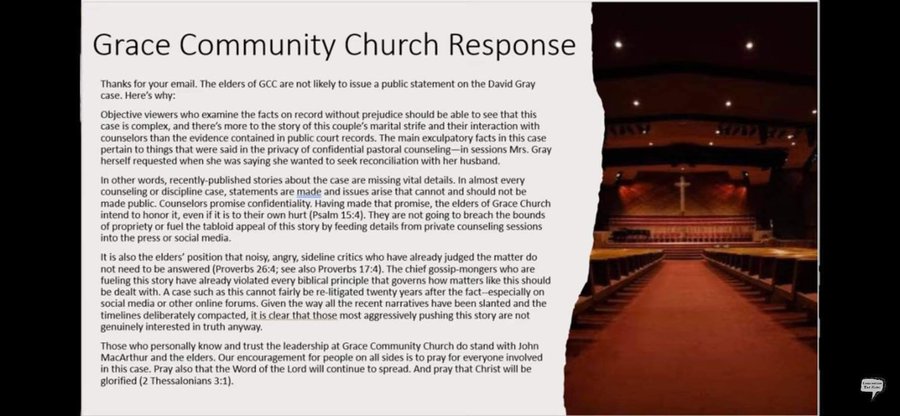
GCC has not publicly responded to the allegations, but this is the email (included in Jon’s video above) they’ve apparently been sending out in response to individual inquiries:

Jon posted a follow-up episode, Recap of David Gray Situation and Russell Moore Weighs in on Abuse and Divorce on March 26. The two main points he made recapping his previous episode were: 1) to apologize for accidentally calling the woman at the center of the issue “Elaine,” throughout the original video, when her actual name is “Eileen,” and 2) to clarify that the “Grace Community Church Response” (above) is not an official, public statement from GCC, but rather what amounts to a “form letter” email sent as a reply to individuals inquiring about the situation.

Jon released yet another follow-up today, March 29: My Position on David Gray & Revisiting the Chicago Statement, responding to pushback and requests for clarification from his initial video. One interesting point you may want to make note of for future reference: In the initial video, Jon said that even if GCC could not release a public statement on the matter due to the confidentiality required in counseling situations, church members who were well acquainted with the Grays and the situation might come forward and speak publicly about what happened. Jon apparently received such an email from a GCC member who is prayerfully considering speaking out. She did not find Eileen’s testimony at trial to be credible.

My personal take on this situation is the same as it was before Roys’ most recent allegations. Julie Roys has an ax to grind against John MacArthur and is not a trustworthy source. (She is not a trustworthy source like the Grand Canyon is not a little hole in the ground.) I would recommend you stay as far away from her writing as possible and get your information from a fair, reliable, biblical source not tainted by ulterior motives.

When I have said things like this on social media, Roys’ supporters have, not surprisingly, accused me of thinking John MacArthur can do no wrong. Not so. First of all, there have been several times over the years when I’ve thought things John MacArthur has said or done were wrong, and I also don’t align 100% with his theology. Second, if Roys went after anybody else, Iโ€™d say the same kinds of things, because the main issue here is not the object of her accusations, but her tactics. And, finally, if Roys’ accusations were reported by a reliable source, and/or admitted to by John MacArthur or Grace Community Church, Iโ€™d believe them.

And that’s all I’ve got to say about this issue.

(If you haven’t already, please read and follow the instructions above the comment box before commenting. I will not be debating this further in the comments section, via email, or on social media, and I will not be publishing any comments, responding to any emails, or entertaining any social media comments which are argumentative or accusatory in nature. You’re free to state your arguments and accusations on the issue on your own platforms.)


1I am intentionally not providing a link to Roys’ article for three reasons: first, because her slander doesn’t deserve the clicks (and the subsequent boost to her analytics); second, because the content of her article is emotionally manipulative, and the purpose of my article is to provide some objectivity; and third, because you can get the salient points of her story (without being emotionally manipulated) from the information I’ve provided here. If you feel you absolutely have to read her article, you’re free to find it by Googling.