Need an opportunity to get together with other godly women for fellowship and good teaching? I’d love for you to come to one of my conferences!
If you haven’t checked out the calendar of events on my Speaking Engagements page (in the blue menu bar at the top of this page), here’s an update. I hope you’ll be able to attend one of these – I’d love to see you! I’ll be posting more about each of these as the dates get nearer, and I hope to add several more!
2021 Calendar:
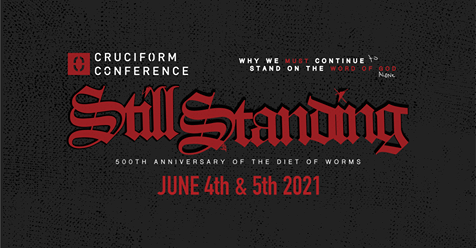
June 4-5-Cruciform Conference, Indianapolis, Indiana. Breakout sessions for women. This one is co–ed (except for my breakout sessions), so bring your husbands, ladies!
July 31- Women’s Conference, Providence Baptist Church in Opelika, Alabama. (This conference is open to women in the surrounding areas, but you must contact the church directlyfor details.)
September 11- Women’s Conference, Maranatha Baptist Church in Nashville, Arkansas. (This conference is open to women in the surrounding areas, but you must contact the church directly for details.)
September 25-26 (Sat./Sun.)- Women’s Conference, Ekalaka Bible Church in Ekalaka, Montana. (This conference is open to women in the surrounding areas, but you must contact the church directly for details.)
October 22-23- Women’s Conference, Pop-Up Church in Faber, Virginia. (This conference will be open to women in the surrounding areas, but you must contact the church directly for details.)
Newly added!
November 5-6- Women’s Conference, New Prospect Baptist Church in Lawrenceburg, Tennessee. (This conference is open to women in the surrounding areas, but you must contact the church directly for details.)
Couldn’t find a conference near you? Stay tuned. I’ve still got a few events pending that I’ll announce as soon as we can get the details ironed out.
Or, if you’re unable to attend one of the events above, host your own! I’d love to come speak to the ladies of your church or Christian organization. I have a few spots left on my 2021 calendar, and now is a great time to start planning for 2022 conference dates.
I also have a speaking engagement option that makes hosting an event easier and less expensive: speaking engagement packages. Choose from my most popular biblical topics and the most common conference formats, and we’ll send you the set speaking fee for that conference. (Of course, if you have another topic you’d like me to speak on or a format that’s unique to your event, that option is still available.)
1. Briefly review the “middle parts” (ex: merciful, poor in spirit) of the Beatitudes, the “salt and light” passage, and the “heart of the law” passage in Matthew 5:1-12, 13-16, 14-20. Now read 38-48 in light of those passages.
Summarize 38-48 in your own words. Is Jesus talking about personal offenses in this passage or crimes which require the governing authorities to mete out justice? In other words, if someone commits a murder, are the police to “turn the other cheek”? Is that what Jesus is saying here?
2. In the Beatitudes, Jesus lists the traits that define Christian character. In much of the rest of the Sermon on the Mount He fleshes out what many of these character traits look like when walked out in “real life”. Which of the traits (the “middle parts” – there could be several) listed in the Beatitudes is Jesus expanding on in 38-48? Especially note verse 45.
(Helpful hint: If you want to get those “middle parts” into your brain so you don’t have to keep flipping back to verses 1-12, here’s a helpful memory aid I discovered last week as I was preparing this lesson – there are 4 “P’s”: poor in spirit, pure in heart, peacemaker, persecuted, 3 “M’s”: mourn, meek, merciful, and 2 “R’s”: (hunger and thirst for) righteousness, reviled. You won’t have them all in order, and you won’t have the entirety of each verse, but those middle parts will stick.)
How does retaliation bland your saltiness? (13-16) How can acting in a loving way toward those who mistreat you make you saltier and brighter?
3. Review from our previous lessons (links above) the idea that the Sermon on the Mount is to the New Testament / new covenant what the Ten Commandments were to the Old Testament / old covenant.
Though retaliation and loving our enemies is not specifically mentioned in the Ten Commandments (it is dealt with elsewhere in the law), which of the Ten Commandments could be connected to instances of retaliating, or refusing to retaliate, against someone who has hurt you? For example: How could murdering or bearing false witness against someone be forms of retaliation? How could refusing to retaliate against a parent who has hurt you be a form of honoring your parent?
Are the Old Testament eye for an eye passages advocating taking personal vengeance on someone who has wronged you, or are they describing the just legal punishment for a criminal offense to be meted out by the governing authorities?
How do Jesus’ phrases “You have heard it said…but I say to you…” verbally transition the people from their focus on outward obedience to the letter of the law to zeroing in on the attitude of their hearts and the spirit of the law? Explain how loving your enemies is the heart of the law behind the Commandments you cited as answers in the paragraph above.
4. Review: Examine again the “You have heard it said…but I say to you…” proclamation. Who had the people heard it (the law) said by? Who taught them the law? How does Jesus saying, “But I say to you…” establish Jesus’ supremacy over the Pharisees, scribes, priests, etc. Imagine you’re one of these Jewish leaders and you’re hearing Jesus say this. What might your initial reaction be?
Recalling our Sermon on the Mount / Ten Commandments motif, how might Jesus’ “You have heard it said…but I say to you…” proclamation have evoked images of Moses as lawgiver, and signaled to the Jewish leaders and people that the better Moses was here?
5. When it comes to responding to someone who has wronged you, is restraining yourself from retaliating enough – a complete response – according to 38-42? How is controlling yourself and restraining yourself from retaliating, but instead doing good (38-42) demonstrating love for that person (43-48)? Compare Jesus’ “preaching” in this passage about retaliation and loving our enemies to His “practice” in these passages. How did he set the perfect example for us of loving our enemies? How does God demonstrate “common grace” love to His enemies in 45b? Why does Jesus instruct us to love our enemies? How does going above and beyond the attitudes and actions of the tax collectors and Gentiles (46,47) demonstrate that we are Christians or “sons of our Father who is in Heaven” (45)?
6. Think of the times when you’ve shared the gospel with someone. Have you ever tried to explain to someone that she is a sinner only to hear her say, “Well nobody’s perfect, but I’m better that that guy over there!” or “Maybe I’m not perfect, but I’ve never murdered anybody.”? How does verse 48 (and 46-47) help us understand that God – not other fallen, sinful people – is the perfect standard we should measure ourselves against? Will we ever measure up to His perfection? How does this help us see why we need Jesus – the perfectsacrifice for our sin – who made us perfect?
Homework
A woman who is reading this passage through the lens of an abusive marriage may wonder, “Does this passage mean I have to allow myself to be abused?”. No, it doesn’t mean that at all. This is an occasion when it’s really helpful to understand the context and culture behind the passage.
If you did the homework in lesson 6 (link above) and read my article The Mailbag: Is Lust a Sin for Women, Too?, you’ll recall the unspoken understanding of the people hearing Jesus preach the Sermon on the Mount that He was addressing the men, and any women and children who were there were basically just along for the ride. Jesus isn’t talking in this passage about a woman being abused by a man. Because He’s understood to be addressing the men, He’s also understood to be talking about an altercation between two men – equals, more or less. No one would have understood Jesus to mean (nor did He mean) that He was endorsing abuse or saying women had to be punching bags for abusers.
Think about how God designed and built men differently from the way He designed and built women. If Joe slaps both Tom and Mary in the face, who is going to be more likely to turn around and beat Joe to a pulp? Tom is – especially if he’s the same size or bigger than Joe is. Men are much more prone to, “You hit me, I kill you back.” (Any mom of two or more boys can vouch for the truth of this statement!) How does Jesus’ instruction to Tom to turn the other cheek to Joe flesh out “blessed are the meek,” “the merciful,” and “the peacemakers”? How does it tie in to the earlier passage on anger?
All of that being said, that doesn’t mean this passage only applies to men, and that if Mary slaps you in the face you can scratch her eyes out because you’re both women. Loving our enemies and treating them in a loving way might look a little different for women, but the principle is still the same. Think about an incident in which someone treated you poorly. How did you respond? What role did pride, selfishness, or anger play in your response? Did you refrain from retaliating and do good to that person? Make a plan for how you will respond the next time someone mistreats you. How can you be meek, merciful, and a peacemaker in that situation?
This article crosses a line…it’s bashing…mean-hearted…We shouldn’t be looking to twist a knife or bask in “I warned you” glory…so settled in our sense of rightness that we can’t grieve for those who are struggling.
…reading that [we should pray for Beth Moore’s salvation] after all the condescension comes off as more of a southern “bless her heart”.
…this article comes across as sanctimonious with zero grace. It complete [sic] discounts the power of God to transform the most wayward heart….ostracizing and belittling those leaders who fall…I felt a lot of smugness in the article…lack of grace and love…[coming] from a place of superiority…[being] gleeful when sin comes to light…take on the role of judge and executioner…
Michelle: So it’s OK for you to bash me, but it’s not OK for me to “bash” Beth?
I’m not bashing you.
Whenever I post an article about Beth Moore or another false teacher, I invariably get comments like this on social media, the gist of which is that I’m being unloving for saying that she is a false teacher, for rebuking her sin, for recommending that Christian women not receive teaching from her, for my “tone” of using stark language, and so on. (I always find it ironic that the commenter is usually bashing me even as she’s accusing me of “bashing” the false teacher.)
Such was the case last Friday when I posted my article Bye-Bye Beth: What Beth Moore’s Split with the SBC Means. I’ve posted excerpts above from several comments about the article made by one woman – not to single her out, but because her accusations and phraseology typify so well the pushback I often receive from those of the “You’re being unloving” persuasion. There were a few other women who responded in the same vein on the same Facebook post(s), so this lady – who, I must say, was much more polite and articulate in expressing her thoughts than most usually are – was not alone in her viewpoint.
I have not excerpted this lady’s comments in order to take them out of context or misrepresent her, but because her comments were far too many and too lengthy to post in full. Assuming they have not been deleted, If you would like to read her comments (and those of the other dissenting women) in full to make sure I’m presenting an accurate picture of the thrust of their sentiments, I would encourage you to do so here, here, and here. (Please do not address these women any further. They have spoken their minds in full, and they have been addressed sufficiently. There is no need to pile on.)
So to those who would accuse me of being unloving or hateful, who shame me that “Jesus would never talk to people that way,” who think my wording is too harsh, unkind, not gentle enough, etc., here’s my answer…
You’re defining “love” as my saying something in a way that you’re comfortable with and doesn’t offend your sensibilities.
That’s not how the Bible defines it. And that’s why Jesus was able to speak to the Pharisees…
…woe to you, scribes and Pharisees, hypocrites! For you shut the kingdom of heaven in people’s faces…you make him twice as much a child of hell as yourselves. Woe to you, blind guides!…You blind fools!…You blind men!…full of greed and self-indulgence…you are like whitewashed tombs, which outwardly appear beautiful, but within are full of dead people’s bones and all uncleanness…you are full of hypocrisy and lawlessness…you are sons of those who murdered the prophets. Fill up, then, the measure of your fathers. You serpents, you brood of vipers, how are you to escape being sentenced to hell?..on you may come all the righteous blood shed on earth, from the blood of righteous Abel to the blood of Zechariah the son of Barachiah, whom you murdered between the sanctuary and the altar.
Matthew 23
…and God was able to speak about His idolatrous people…
And the Babylonians came to her into the bed of love, and they defiled her with their whoring lust. And after she was defiled by them, she turned from them in disgust. When she carried on her whoring so openly and flaunted her nakedness, I turned in disgust from her, as I had turned in disgust from her sister. Yet she increased her whoring, remembering the days of her youth, when she played the whore in the land of Egypt and lusted after her lovers there, whose members were like those of donkeys, and whose issue was like that of horses. Thus you longed for the lewdness of your youth, when the Egyptians handled your bosom and pressed your young breasts.”
Ezekiel 23:17-21
…so much more harshly and starkly than I’ve spoken about Beth in this article, and yet He is still the perfect embodiment of love, and the perfect example of love to us.
Using your definition of love, if you’re going to be fair and consistent, if you accuse me of speaking in an unloving way in this article, you have to accuse God of speaking in an unloving way in Ezekiel 23 and Jesus of speaking in an unloving way in Matthew 23.
But the Bible defines love like this:
God is love. In this the love of God was made manifest among us, that God sent his only Son into the world, so that we might live through him. In this is love, not that we have loved God but that he loved us and sent his Son to be the propitiation for our sins. Beloved, if God so loved us, we also ought to love one another. 1 John 4:8b-11
For God so loved the world, that he gave his only Son, that whoever believes in him should not perish but have eternal life. John 3:16
but God shows his love for us in that while we were still sinners, Christ died for us. Romans 5:8
Because God is love, God alone has the right to define love. And God defines love as the redemption, restoration, and reconciliation of man to Himself. Love isn’t someone making you feel good about yourself or the world or your circumstances. Love isn’t being outwardly “nice”: always being the epitome of sweetness, never confronting anyone, affirming everything, never hurting anyone’s feelings, never saying or doing anything that makes anyone uncomfortable.
Because God is love, God alone has the right to define love. And God defines love as the redemption, restoration, and reconciliation of man to Himself.
While the world looks at a person’s outward, observable behavior and pronounces her loving or unloving depending on how pleasing that behavior is to others, God looks at a person’s heart and pronounces her loving or unloving to the extent that her motives match His.
…the Lord sees not as man sees: man looks on the outward appearance, but the Lord looks on the heart.
1 Samuel 16:7b
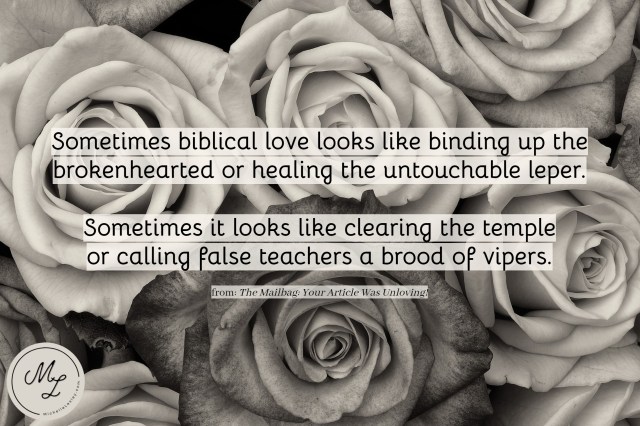
God defines love as cooperating with Him in rescuing the perishing, building up the church, and showcasing His glory. Sometimes that’s going to look like binding up the brokenhearted or healing the untouchable leper, and sometimes that’s going to look clearing the temple or calling false teachers a brood of vipers. While the world would call the former “loving” and the latter “hateful” based on what those behaviors look like, God calls both loving if they spring from a heart motivated to rescue, redeem, restore, and reconcile.
Sometimes biblical love looks like binding up the brokenhearted or healing the untouchable leper, and sometimes it looks like clearing the temple or calling false teachers a brood of vipers.
So, when you say I’m being “unloving” to use stringent language about false teachers (like God, Jesus, the prophets, and the apostles did), and I say you’re wrong, it’s because we’re using two different definitions of love. You’re using a worldly definition of love based on how pleasing my outward behavior was to you. I’m using God’s definition of love that’s based on the motivation of my heart. You cannot tell me I’m not demonstrating biblical love in a situation like this because you don’t know the motivation of my heart. I do. The article in question (like so many others about which I’m accused of being unloving) was motivated by love – God’s definition of love – for
Beth – that God would graciously remove the scales from her eyes and save her
Beth’s fans – that God would open their eyes to deception they’re believing and lead them to repentance and sound doctrine
Discerning Christians – that they might be encouraged not to let their guard down but to keep contending for the faith once for all delivered to saints
The church – that it would cleanse out the leaven of false teaching so that Christ might present her to Himself in splendor, without spot or wrinkle or any such thing, that she might be holy and without blemish.
and the Southern Baptist Convention – that it might forsake the idols of money, power, and celebrity, and return to its first love, Christ.
But it was also motivated by another component of love which the worldly definition of love, being worldly, is completely oblivious to. You see, the world’s definition of love only concerns itself with the “horizontal” love between one human being and another. But God’s definition of love finds its origin in Himself. He is the foundation and the culmination of love. He is both the starting gun and the finish line in the race of love. Where there is no vertical love of God, there is no horizontal love between people. There may be friendship, attraction, affection, attachment, and emotion, but there is no true love.
God’s definition of love finds its origin in *Himself*. Where there is no vertical love of God, there is no horizontal love between people. So any biblical -rather than worldly- definition of love must start and finish with love for God.
And so any biblical – rather than worldly – definition of love must start and finish with love for God. Only a heart that loves Him because He first loved me can extend that same redemptive, restorative love to others.
And though I have never, and will never, this side of Glory, love Him as completely and perfectly as I should – as I want to – those articles that offend your sensibilities, that you feel justified in berating me about because they don’t meet your standards, those articles are rooted in and motivated by love for the Christ whom I serve. I would not continue to do what I do and take the abuse I take for it if I did not love Him.
I’ve heard this whole “tone police” perspective a million times. I’ve prayed about it. I’ve considered it. I’ve weighed the motivations of my heart. And in cases in which I know before the Lord that my motives have truly been unloving, I’ve repented. But the astronomically overwhelming majority of accusations I receive are not from people concerned with the biblical definition of love, but from people using a worldly definition of love whose personal sensibilities have been offended. People who wish to correct me from the authority and standard of their feelings, not from the authority and standard of God’s Word.
And as I’ve prayed, and studied, and weighed, and considered all of these things, the conclusion the Lord has graciously led me to is that there’s no way I will ever please every single one of the thousands of people who hear me. Just like Jesus’ words didn’t please all the people who heard Him, or John the Baptist’s words, or Peter’s, or Paul’s, or Noah’s, or Ezekiel’s, or Jeremiah’s, or… (you know, I’m starting to think I’m in good company!)
So rather than trying to please man, I’m going to strive to please God. If my conscience is clear before Him, that’s all that matters.
The fear of man lays a snare, but whoever trusts in the Lord is safe. Proverbs 29:25
For am I now seeking the approval of man, or of God? Or am I trying to please man? If I were still trying to please man, I would not be a servant of Christ. Galatians 1:10
If you have a question about: a Bible passage, an aspect of theology, a current issue in Christianity, or how to biblically handle a family, life, or church situation, comment below (I’ll hold all questions in queue {unpublished} for a future edition of The Mailbag) or send me an e-mail or private message. If your question is chosen for publication, your anonymity will be protected.
It was the shot heard round the world online Christian neighborhood I hang out in. (I’m sure most of the actual world couldn’t care less.) On Tuesday, March 8 – in a hit piece from RNS (Religion News Service) that came thisclose to libeling everyone who has ever biblically called for her de-platforming – Beth Moore announced she had broken ties with the Southern Baptist Convention, and flounced out the door, smearing the institution that made her what she is on her way out. Classy.
What does this mean for Beth? For you? For Southern Baptist churches? For the SBC?
For Beth personally…
For Beth, personally, it means she no longer has to keep her church membership at a Southern Baptist church. A few months ago, when Beth mentioned that she was looking for a new church, I figured she was probably looking for something much less biblically restrictive than her Southern Baptist home church (which already plays fast and loose with the Scriptures by allowing Beth – a woman and a false teacher – to preach). Something progressive. Politically correct. A church that would fit Beth’s unbiblical worldview on whatever the hot political / social topic du jour might happen to be, be it Critical Race Theory, egalitarianism, social justice, the perversion agenda, abortion, and so on. A social media follower, who knows which church she’s trying out, described it to me, and it sounds like she found the progressive church I imagined she would be looking for.
It also means, assuming she doesn’t tie herself down to a publisher or other entity that places restrictions on her (you know – expects her to act, speak, and teach like the Christian and Bible teacher she claims to be) that she will feel much freer to clearly express exactly what she thinks about those hot topics.
Anyone who has followed Beth on social media for any length of time knows that she can be cryptic at best, and borderline incoherent at worst, when expressing a significant thought – especially a thought on a controversial issue. Which has likely been due, at least in part, to trying to walk the tightrope between expressing her true thoughts and not crossing the line with the powers that be at LifeWay (an entity of the Southern Baptist Convention).
This was abundantly clear during the Open Letter to Beth Moore debacle two years ago. Beth clearly did not want to (and indeed, never did) come right out and flatly say that homosexuality is a sin. Yet because of her financial and contractual relationship with LifeWay (which has a policy and history of dropping authors who affirm homosexuality), she could not come right out and say that homosexuality is not a sin (which, I’m sure, disappointed her homosexual / homosexuality-affirming fans). I have suspected from the day it happened, that LifeWay somehow forced Beth into publishing her final statement on the matter as well as her month-long Twitter hiatus which immediately followed. It will be interesting to see whether she spills the tea about things like that or keeps them to herself. Personally, from a writer’s perspective, I’m very curious to see if she has used this cryptic style of writing as a way to veil her true thoughts just enough to pass LifeWay’s “smell test” and will now feel free to speak clearly and forthrightly, or if “cryptic” is just the style of writing with which she feels most comfortable.
But the darkest, most devastating consequence of this move for Beth is that she is purposefully casting off the last vestiges of biblical restraint God’s common grace has, until now, provided her. You see, there are still biblically faithful people, processes, and provisos in place in the SBC that have acted as guardrails for Beth, keeping her from careening over the cliff of sin and rebellion she’s been so desperately gunning for. The RNS article shamefully makes it seem as though a bunch of petty meanies have long been picking on poor little Beth, and she’s (once again) a victim, pushed out by heartless bullies who just wanna keep a good woman down.
That’s not the case at all.
Beth is not leaving the SBC because people were mean to her for not liking Trump, or for speaking out about abuse, or for taking a stand on racism. That’s just the window dressing diversion she has created as she makes a break for it out the back door.
Beth is leaving the SBC because she chafes at Scripture’s rebuke of her sin.
And in the SBC – even as biblically off track as it is in so many ways – she meets that rebuke at every turn. Beth is leaving because she wants to go somewhere where she can openly sin in peace, with nary a flicker of conscience or whisper of reproof to plague her.
And that’s an extraordinarily dangerous place for anyone to be.
Time after time, God sent Moses to warn Pharaoh. Time after time, Pharaoh hardened his heart. Finally, God gave Pharaoh over and hardened his heart, and Pharaoh cast the last vestige of godly warning and influence out of his presence for good. There was no turning back.
When a person repeatedly hardens her heart against God’s admonitions and commands – come they through reading His Word, circumstances, or the call of faithful Christians to repent – God’s time of forbearance with that person eventually comes to an end. Perhaps he takes the person’s life, or perhaps He takes away His restraining hand and turns her over to a reprobate mind, to “do what ought not to be done,” but continued contumacious sin comes at a steep price.
For Beth’s sake, I dearly hope I’m wrong, but I fear this is what may be happening in the spiritual realm while we sit mesmerized by the trappings of the temporal realm.
For the average Beth Moore fan…
Beth’s average fan isn’t going to see much of a difference in terms of her availability. LifeWay’s publishing arm will no longer be publishing her materials, but LifeWay Retail will still be selling them in their online store. LifeWay’s conference division will no longer be hosting and platforming Beth’s conferences or other live events. But I’m sure Beth has other publishers (maybe Zondervan or Thomas Nelson?) and conference promoters lined up around the block – probably in a bidding war – to offer her their services. So, she’s not going anywhere anytime soon. In fact, you may see an increase in the availability of her materials and conferences, depending on how much (if at all) she felt her contractual obligations to LifeWay may have been holding her back.
But you’ll probably begin noticing some much more important changes. I’m not a prophet, nor the son of a prophet, but here’s an educated guess based on observing Beth’s ministerial trajectory over the last twenty or so years: You’re not going to see a sudden uptick in holiness, humility, and obedience to Scripture. With God’s gracious hand of restraint via the SBC cast off, what you’re going to see is a continued downward spiral – now at breakneck speed – into sin, heresy, and rebellion. More preaching to men1. More yoking with other false teachers. More Scripture twisting. More CRT. More liberal politics. More social justice. More “God told me…”. Clear approval of homosexuality, and maybe even abortion at some point, too.
If you’re still a Beth Moore fan, I urge you, for the sake of your own spiritual well-being, to divorce yourself from her immediately. This is not going to be pretty.
For the discerning Christian…
Some have jokingly speculated that Beth’s announcement of her split with the SBC will be followed by her heeding John MacArthur’s admonition to “Go home.” I can’t see that happening. As I said, if this move affects her availability at all, it will most likely make her more prolific. And even though she is in her 60’s, I would be very surprised if she voluntarily retired any time soon.
You will have to continue to warn your friends and loved ones about Beth, though this shift of hers may prove conducive to that in a couple ways:
With this being a hot story for the moment, some of her followers, and some pastors, are beginning to ask questions. “Why would Beth want to leave the SBC?” “I’m seeing Beth Moore’s name trending online and people saying there are biblical problems with her. What are the issues I should be aware of?” That’s an open door for you to lovingly explain and present evidence for Beth’s false teaching and sinful behavior. (Need a little help? Use my article Living Proof You Should Follow Beth (No) Moore.)
As mentioned above, Beth will most likely become much more open about her false teaching, sinful behavior, and approval of others’ sin. The average evangelical in the pew may not understand the reasons that, say, extra-biblical revelation or preaching to men is unbiblical, but they know homosexuality is a sin. They know Christians are supposed to be 100% against abortion2. And so, if Beth stays on the trajectory she’s on and begins to publicly take an unbiblical stand on these things, it may be easier for you to point to, and for her followers to grasp these polarizing issues as reasons they should stop following her.
For Southern Baptist Churches…
In terms of the availability of Beth’s materials, I wouldn’t think any church who has a purchasing relationship with LifeWay would see much, if any difference when they log on to place an order. The main difference in availability will be for churches that simulcast or purchase blocks of tickets to her live events. They’ll no longer be able to do this via LifeWay. They’ll have to go through whatever platforming agency is handling her event sales. It shouldn’t be too much of an obstacle for any church or women’s ministry that’s determined to keep following Beth, unfortunately.
I had hoped that for Southern Baptist churches Beth’s departure would serve as a wake up call to spur pastors to vet Beth more carefully and stop allowing her to destroy the women of their churches. And, perhaps, for a few, it has. But if comments like this one…
…from Ed Litton (a presumptive nominee for SBC president at the 2021 annual meeting) are any indication, most will remain willfully clueless and derelict in their Titus 1:9 duties.
The impact Beth’s departure should have on the local church is to get pastors and church members alike to start thinking critically – not just about Beth, but about the authors of all the materials they use and about the issues the SBC is currently embroiled in at the national level. Because each SBC church is autonomous, there’s a tendency among a large swath of church members (and even some pastors) not to pay any attention to what’s going on at the national level.
So I imagine, first of all, that a sizable portion of Southern Baptists don’t even know Beth has left the SBC, because they don’t make any effort to keep up with what’s going on in their own denomination3. Also because of that, many of the ones who do know are likely baffled by the issues she’s citing as reasons for leaving, and what is and is not the biblical position on those issues in this hot, chaotic mess.
Southern Baptist churches should take this situation as a Providential Gibbs slap…
…and henceforth stop being so lax about false teachers and so uninformed about current events in the SBC.
For the Southern Baptist Convention…
Beth’s departure isn’t going to change the Southern Baptist Convention in any noticeable way that I can think of. Some have observed, “Well, at least this puts the issue of her being elected SBC president to rest.” I don’t think there was ever much chance of that happening. Not that she couldn’t have been nominated. Not that people wouldn’t have voted for her. I just don’t think she would have accepted the position. It’s a lot of work, and she’s already monumentally busy. Plus, she doesn’t strike me as someone who enjoys administrative work. (I guess that’s one thing we have in common.)
While they will still earn revenue by selling Beth’s materials, LifeWay lost a chunk of change when she decided to take her publishing and live events contracts elsewhere. And the sad and shameful thing is, that’s all they’ve been concerned about all along. Money.
LifeWay didn’t care about Southern Baptist women whose spiritual lives they crippled by the thousands through Beth Moore’s false teaching and ungodly example. They didn’t care about the Southern Baptist churches they sowed division into by peddling Beth’s poison to them. They didn’t care about the discerning Southern Baptist women who have been forced out of their churches and spiritually abused by Southern Baptist pastors, pastors’ wives, and women’s ministry leaders deceived by Beth.
And you know who else LifeWay didn’t care about? Beth. They didn’t care enough to look into her teaching, her beliefs, and her behavior, compare them to Scripture, and go, “Something is off here. This is not the fruit of someone who is saved, much less of a sound teacher. We love this woman as a soul created in the image of God, and we’re not going to help her continue down this road of destruction. She needs the gospel. She needs Christ. And for the sake of the judgment she’s going to face, she doesn’t need to be teaching anybody.”
But, no, they were making money off of Beth, so they just kept building her empire. Why let a little thing like her eternity get in the way? The time came to choose between serving God and mammon, and they picked mammon. They sold Beth’s soul for thirty pieces of silver.
Strong words? Not nearly as strong as they’ll hear when they have to answer to God for caring more about money than they cared about the priceless soul of this precious woman.
I pray God uses Beth’s departure to graciously open the eyes of those at LifeWay and in SBC leadership who have been complicit in encouraging Beth in her false teaching and in gilding the chains that bind her to her sin. I pray He mercifully puts them on the ground in the sackcloth and ashes of repentance, that they might be forgiven. And I pray that they would then reach out to Beth again, this time with a call to turn from her sin and believe the gospel.
Beth Moore, and those in SBC leadership who helped make her what she is, have played no small part in creating, contributing to, or paving the way for the morass of unbiblical issues festering in the SBC today: CRT, women preaching, false doctrine, false teachers being made into celebrities, political posturing, maneuvering, and intimidation, pride and impenitence, and much more.
May Beth’s departure be an opportunity for the SBC to examine itself against Scripture and right the ship.
Indeed, may we all take this opportunity to examine our denominations, our churches, the teachers we learn from, and our own hearts.
1A few have speculated that now that Beth is no longer beholden to the Baptist Faith and Message (the SBC’s statement of faith) which disallows women from holding the office of pastor, that she may decide she wants to pastor a church. If they mean a typical, existing church, I find this extremely unlikely. From Beth’s position and perspective, becoming a pastor would be a huge step down. It would mean less money, less celebrity, more responsibility, and more accountability. I don’t see it happening. But, I guess anything’s possible.
2Beth has not made any pro-abortion statements yet that I’m aware of, but I sense that, as with her devolving unbiblical stance on homosexuality, this is coming. Even before leaving the SBC she had already adopted the liberal “I’m pro-all of life” mantra.
3Yes, I’m aware that the SBC isn’t technically a denomination, but a voluntary cooperative of autonomous churches. But if it looks like a denomination and often functions like a denomination, it’s going to get called a denomination sometimes.
1. Briefly review the “middle parts” (ex: merciful, poor in spirit) of the Beatitudes, the “salt and light” passage, and the “heart of the law” passage in Matthew 5:1-12, 13-16, 14-20. Now read 33-37 in light of those passages.
2. Summarize, in your own words, the main idea of 33-37. Are all oaths inherently sinful? How do you know? Is this passage mainly dealing with swearing oaths to God or to people? Does this passage forbid all oaths, such as a politician’s oath of office, the oath of enlistment for the military, being sworn in as a witness in court, etc.? How do you know this?
Explain the difference between the formal oath of a covenant (such as the oaths God made as part of His covenant with His people) and the casual, reckless oath of someone in a trivial situation who invokes something higher than himself as a guarantee: ex: “I swear by Heaven I’ll be there at 6:00 tomorrow,” or “I swear to Jerusalem, that pig really did fly!”. Would the oath of office / military / court / etc. fall under the category of a formal, covenant-type oath, or a casual, reckless type of oath? Which type of oath does this passage prohibit?
Think about the character of a person who goes around tossing out casual oaths all the time. If you had to swear to something higher than yourself that you really would be there at 6:00, that the story you were telling really was true, that you really would do what you said you were going to do, and so on, in order to convince people to believe you, what would that indicate about your trustworthiness, reliability, honesty, and integrity?
3. In the Beatitudes, Jesus lists the traits that define Christian character. In much of the rest of the Sermon on the Mount He fleshes out what many of these character traits look like when walked out in “real life”. Which of the traits (the “middle parts” – there could be several) listed in the Beatitudes is Jesus expanding on in 33-37 as we think about being trustworthy, reliable, honest, and a person of integrity? How?
How do dishonesty and failing to be a woman of your word bland your saltiness? (13-16) How can being honest, reliable, trustworthy, and a person of integrity make you saltier and brighter?
4. Review from our previous lessons (links above) the idea that the Sermon on the Mount is to the New Testament / new covenant what the Ten Commandments were to the Old Testament / old covenant.
Though taking oaths is not mentioned in the Ten Commandments (it is dealt with elsewhere in the law), which of the Ten Commandments does Jesus touch back to and expand on in verses 33-37? Explain how swearing by God and could end up as taking His name in vain. How is lying connected to the instruction not to take casual oaths in order to convince or deceive people?
How do Jesus’ phrases “You have heard it said…but I say to you…” verbally transition the people from their focus on outward obedience to the letter of the law to zeroing in on the attitude of their hearts and the spirit of the law? Explain how being honest, reliable, trustworthy, and a person of integrity are the heart of the law behind the ninth Commandment. Explain how reverencing God and His name by not invoking Him in a casual or deceptive oath are the heart of the law behind the third Commandment.
5. Review: Examine again the “You have heard it said…but I say to you…” proclamation. Who had the people heard it (the law) said by? Who taught them the law? How does Jesus saying, “But I say to you…” establish Jesus’ supremacy over the Pharisees, scribes, priests, etc. Imagine you’re one of these Jewish leaders and you’re hearing Jesus say this. What might your initial reaction be?
Recalling our Sermon on the Mount / Ten Commandments motif, how might Jesus’ “You have heard it said…but I say to you…” proclamation have evoked images of Moses as lawgiver, and signaled to the Jewish leaders and people that the better Moses was here?
6. Carefully examine verse 33. Is breaking your oaths to people OK as long as you’re keeping your oaths to the Lord?
How would swearing to the things in verses 34-35 be similar to our modern day phrase, “I swear to God,” (when making an oath to a person, not to God)? How would taking an oath “by your head” in verse 36 be similar to our modern day phrase, “I swear on my mother’s grave / life,”. Who or what is being invoked in each oath? Why is it sinful to invoke God or His name in a deceptive or casual oath? Why is it pointless to swear by anything earthly or lesser than God? How do such oaths trivialize God or whatever you’re swearing by? Compare these thoughts and conclusions to what Jesus said to the Pharisees in Matthew 23:16-22.
Why does making the types of oaths forbidden in this passage instead of just saying “yes” or “no” come from evil (37)?
7. How does James emphasize this passage in his epistle?
How should Herod have applied this passage on oaths? What can we learn from his story about the consequences of making rash or casual oaths?
Homework
Oaths and vows are closely related in Scripture. Look up and read all of the passages in Scripture regarding oaths and vows. What are the differences between oaths and vows? What are the similarities? Look at where the passage on oaths falls in Matthew 5. What topics does Jesus deal with immediately before and after the passage on oaths? How does being honest, reliable, trustworthy, and a person of integrity lend itself to keeping your marriage vows? How does refraining from deceptive oaths and being honest, reliable, trustworthy, and a person of integrity connect to retaliation (38-42) and loving your enemies (43-48)?