False Teachers

6 Thoughts on Responding to the Death of a False Teacher

Rachel Held Evans died a couple of weeks ago. Myles Munroe, Paul Crouch, Jan Crouch, Tammy Faye Bakker, and Oral Roberts within the last several years. Eventually, Joel Osteen, Beth Moore, Andy Stanley, Joyce Meyer, Kenneth Copeland, Bill Johnson, and Priscilla Shirer will die.

Death comes for us all, including false teachers and heretics.

And how do we find out, and express our feelings about, the deaths of evangelical celebrities? It used to be via the newspaper and around the water cooler. Now it’s on social media.

There are three typical social media responses when a false teacher dies: Her fans laud her and turn her into a virtual saint. A few who claim to be Christians dance on her grave in celebration. And doctrinally sound Christians are kind of left groping for how to respond, biblically. There’s a feeling of wanting to have compassion for the family who has lost a loved one while not appearing to endorse or approve of the deceased’s false teaching and sin merely because she has died.

So how can we respond biblically to the death of a false teacher?

1.
Distinguish the Biblical Response
from the Cultural Response

“Don’t speak ill of the dead.” Where is this idea taught in Scripture? I can’t find it anywhere, can you? Does that mean weย shouldย speak ill of the dead? Of course not, because we don’t find a command to do that in Scripture either. I’m just trying to point out that a lot of the notions we have about death and other issues in life don’t come from the Bible, they come from our culture, etiquette, tradition, etc. If we truly want to respond to a false teacher’s death – or do anything else, really – in aย biblical way, we need to be able to separate what the Bible tells us to do from what culture and society tell us is the right thing to do. In all aspects of life, that ability has never been more crucial than it is now.

2.
To Respond or Not to Respond; That Is the Question

There’s absolutely no biblical requirement for anyone to proffer an unsolicited public comment on the death of a false teacher. Or anyone else for that matter. Other than mentioning her name in this article, I have not publicly commented on the death of Rachel Held Evans for several reasons, though I found out about her passing shortly after it happened. My friends Gabe and Elizabeth did decide to comment on her death, and, in my opinion, both did a lovely job. Commenting or deciding not to comment can both be perfectly biblical.

The only time it’s really incumbent upon a Christian to speak to the issue of a false teacher’s death is when someone you know asks you about it directly. And even then, if the person seems to be overwrought with emotion, it might be wisest to simply postpone your comment until after a “cooling off” period has taken place.

3.
How to Respond

Briefly. Because the longer your comment, the greater chance you will either slip into eulogizing the false teacher or, conversely, making unnecessarily inflammatory remarks that will only serve to stir the ire of her family and followers and will make you look like a jerk.

Gently. Because even the gentlest remark is going to pour salt into the wound of someone who’s grieving if you’re not outright praising the deceased. And though “Don’t speak ill of the dead” isn’t a biblical concept, if you’re addressing the followers of a false teacher, you’re probably not dealing with people who are going to split that biblical/cultural hair. If they were overly concerned about distinguishing biblical concepts from worldly concepts, they wouldn’t be following a false teacher in the first place. Be sensitive to their cultural mores of gentle speech in this instance or you surely won’t get a hearing.

Non-speculatively. Because you do not have God’s omniscience, and speculation can serve no helpful purpose. Is it possible God ended the false teacher’s life as judgment for her unbiblical teachings? Yes. It is also possible He ended her life for a completely different reason known only to Him. Is it likely she will be spending an eternity in Hell? Yes. But unless you were at her bedside listening to her blaspheme the name of the Lord with her final breath, you don’t know that for certain.

Evangelistically. Because the greatest thing that could come out of the false teacher’s death, or anyone’s really, is for someone whose ultimate hope was in the hopelessness of false doctrine to find her ultimate hope in Christ.

4.
Prepare for Backlash

One of the reasons I intentionally chose not to comment on Rachel Held Evans’ death is that I knew I would receive tons of vitriolic, possibly even threatening, backlash from her disciples if I said anything about Rachel that wasn’t pure praise of her. At that moment in my week, due to various things going on in my life, I had neither the time nor the spiritual strength to deal with an onslaught like that. It’s not that I was afraid or didn’t know how to answer the barbs I’m sure I would have received, it’s just that it would have been a distraction from other things that were a higher priority in my life than responding to strangers about the death of another stranger.

If you choose to make a non-laudatory statement about the death of a false teacher, even if it’s gentle, compassionate, completely biblical, and annotated with Scripture, you must be prepared to be attacked by her followers. No matter how much the teacher claimed to be a Christian or how much her followers claim she helped them grow in the Lord, the fact of the matter is that the overwhelming majority of people who steadfastly follow, love, and defend false teachers over a long period of time are veryย likely not saved and will respond to your biblical remarks in the angry, emotional, often abusive way that can be characteristic of lost people.

This, in fact, happened to a Facebook friend of mine who has a growing platform. She made just such a gentle, compassionate, completely biblical statement on Facebook about Rachel Held Evans’ death. I would link to it except that she had to delete the statement because some of Rachel’s followers found pictures my friend had posted of her child and proceeded to make vile remarks and threats against her child.

This is the kind of thing you can expect if you comment with anything but praise for the deceased, so keep it in mind when you’re deciding whether or not to say anything.

5.
Weep

Romans 12:15b tells us to “weep with those who weep.” It is absolutely good and kind to be compassionate toward someone – anyone – who has lost a loved one, whether it’s your brother or sister in Christ, the widow of your atheist nephew, or even the family of a false teacher. Take a look at what Jesus said in Matthew 5:43-45:

โ€œYou have heard that it was said, โ€˜You shall love your neighbor and hate your enemy.โ€™ย  But I say to you, Love your enemies and pray for those who persecute you, so that you may be sons of your Father who is in heaven. For he makes his sun rise on the evil and on the good, and sends rain on the just and on the unjust.”

Christians showing compassion to the “evil” and the “unjust” is part of God’s common grace to the world. It is an opportunity to reflect the kindness of God that led us to repentance.

But another reason to be grieved by the death of a false teacher is that she is most likely beginning her eternity of death in Hell. Because people who continually and unrepentantly harden their hearts against God’s Word and godly rebuke and correction are displaying the fruit of an unsaved soul. And that is no reason to celebrate. As Ezekiel tells us:

Have I any pleasure in the death of the wicked, declares the Lord God, and not rather that he should turn from his way and live?
Ezekiel 18:23

God does not giddily damn people. His heart is for all to come to repentance and faith in Christ. And that should be our heart as well. Could it be that, in His infinite mercy and grace, God gave that false teacher a final opportunity to repent and trust Him moments before her death? It could, and that is what we should hope for, not only for the false teacher and her eternity, but for the glory it brings to God every time He washes a sinner in the blood of Christ.

6.
Rejoice

But while we demonstrate compassion for the family and grieve the likely condemnation of the false teacher, there is also a righteous, Kingdom-focused, and biblical reason to rejoice: one more voice of blasphemy, lies, and deception has been silenced. At least in the sphere of influence of that particular teacher, no one will be led astray from Christ any longer.

But the wicked will perish;
the enemies of the Lord are like the glory of the pastures;
they vanishโ€”like smoke they vanish away.
Psalm 37:20

God shall arise, his enemies shall be scattered;
and those who hate him shall flee before him!
Psalm 68:1

Will another false teacher step up to take her place? Almost certainly. Where there are those who clamor to have their itching ears scratched, a wicked confidence man will arise to peddle his ungodly snake oil. But for today, for a short time, perhaps, no wares will be sold to this crowd of customers. And that is reason enough to rejoice.


Commenting on the death of a false teacher can be a tricky needle to thread. When we choose to do so, let us exercise the common grace of compassion, reflect the kindness of a merciful God, and always be ready to give a reason for the hope that lies within us with gentleness and respect.


Additional Resources

Can a False Teacher be a Christian?

1&2 Timothy Bible Study

1 & 2 Timothy: Lesson 5

Previous Lessons: 1, 2, 3, 4

Read 1 Timothy 4

Questions to Consider

1. Study verses 1-5. In what ways does this passage contrast truth with falsehood? List the individual words in these verses that convey the idea of falsehood or dishonesty. List the words that convey the idea of truthfulness. Who is the origin of all falsehood and deception? Compare “deceitful spirits” and “demons” (1) with John 8:44. Who is the origin of truth? Compare the statements about truth in 2b-5 with John 14:6, 17:17.

Recalling that 1 Timothy is a letter breathed out by the Holy Spirit to a pastor about the church, explain why it is important to God, to pastors, and to the church body that the church be a place of truth rather than a place of deception, false teaching, and lies.

2. Examine verse 1. What does it mean that “some will depart from the faith“? Does this mean that some people whom Christ has genuinely saved will lose their salvation?

3. Look closely at the way false doctrine and false teaching are described in verses 1-2. Is Paul wrongly using a “harsh tone” or being “unloving” toward false teachers as some Christians might accuse him of today? (Again, Whoย breathed out these Scriptures?)

4. Compare 4-5 with 2:9. Is there anything inherently sinful about braided hair, gold, pearls, or an expensive garment – these objectsย themselves, and/or owning/wearing them? Explain the primacy of the attitude of our hearts when it comes to these objects, marriage, and food (3). What does verse 5 mean when it says that these things are made holy “by the word of God and prayer”? How does this apply to your “relationship” with the things you own, wear, or participate in?

5. What is Paul instructing Timothy to do when he says, “If you put these things before the brothers,” (6)?

6. Examine 6-16. In chapter 3, the Holy Spirit gives a list of character qualifications for pastors – what they are toย be. In 4:6-16 the Holy Spirit gives a list of instructions for pastors – what they are to __. Work your way through these verses and make a list of the things the Holy Spirit wants pastors to do. Circle or highlight any of these instructions and principles that do not apply to the laity (Christians who are not pastors). If pastors are supposed to “set the Believers an example” (12) what does that tell us about the need for us to follow the instructions in 6-16 that apply to both pastors and non-pastors? How does 2:11-15 apply to the wayย women are to follow these instructions? Is there any way in which the qualifications for pastors and deacons in chapter 3 should inform the way in which men follow these instructions? (For example: compare 3:2’s “able to teach” with 4:11’s “teach these things”. If a man is not “able to teach”, should he be in a teaching role in the church?)

7. What metaphor does Paul employ in 6-10 to describe training for godliness? How is spiritual training like physical training? How are they different?

8. Look closely at verse 9. We see this same phraseology four times in 1-2 Timothy. What does this statement mean, and why do you think Paul says it so often?

9. Compare the way Paul again inserts the gospel smack dab into the middle of his instructions to Timothy (10) to the way he has already done this in chapters 1, 2, and 3. How does this motif help us to see that everything we do in the church and in our own lives should revolve around and point back to the gospel?


Homework

Can you think of any churches, denominations, religions, cults, or movements today that “forbid marriage and require abstinence from foods” (3) for its leaders and/or members? Do some research, find out what is forbidden for whom, and examine the major points of the organization’s doctrine (ex: the nature of God, how people can be made right with God, etc.). Does it match up with biblical doctrine?


Suggested Memory Verse


Favorite Finds

Favorite Finds ~ May 14, 2019

Here are a few of my favorite recent online findsโ€ฆ

“Complementarian interpretation of Scripture holds that Godโ€™s creation purpose for man and woman entails equality of individual value but also distinct roles.” Our friends over atย Crosswayย give us 5 Myths about Complementarianism.


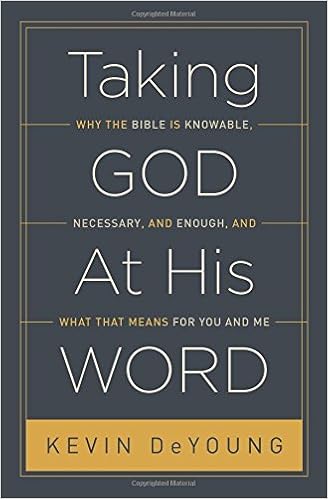
Image result for taking god at his wordHow about a free book? Here’s the PDF of Kevin DeYoung’s book Taking God at His Word: Why the Bible is Knowable, Necessary, and Enough, and What that Means for You and Me.


Image result for 50 of all marriages end in divorce“Youโ€™ve heard it repeatedly on radio, podcasts, and TV. Youโ€™ve read it in various books and articles. Youโ€™ve even heard it in your pastorโ€™s sermon. The problem: itโ€™s a lie: 50% of all marriages end in divorce.”ย The Cripplegate helpfully explains why everything you know about American divorce statistics, including the divorce rate among Christians, is probably wrong in The 50% Lie.


โ€œImage result for ccef‘No’ to a husbandโ€™s advances is a big deal in a marriage. A godly wife can certainly say โ€œnoโ€ but she will also be alert to the way her response might be taken by her husband. Understanding and compassion can go a long way at these moments.”ย CCEF explores the sensitive subject of marital intimacy in โ€œNot tonight dearโ€โ€ฆ men rejected.


On his most recent episode ofย Ask Anything,ย Dr. Albert Mohlerย tackles a number of interesting questions, not the least of which is (from a Southern Baptist perspective) Should women preach the Sunday sermon in church? (8:58).

Mailbag, Sin

The Mailbag: If someone follows false teachers or teaches false doctrine for a long time, is she saved?


I have heard pastors say that believers can sin for a โ€˜seasonโ€™ without repentance. In regards to professing believers who follow false teachers, what is a โ€˜seasonโ€™? Can they continue following them for months? Years?

Is it possible that someone who is a false teacher is actually saved? Could she truly believe the biblical gospel even though, for decades, she has been terribly mishandling Godโ€™s Word, and has been on an increasing trajectory of sin and false doctrine?

Iโ€™ve combined two questions for this edition ofย The Mailbagย because they are very closely related, if not, in fact, the same basic question.

Iโ€™m glad you asked. This is such an important issue to think through because, unfortunately, we are surrounded by professing Christians walking down these paths.

When I hear people use the the term โ€œseasonโ€ when referring to the Christian life, itโ€™s been my experience that they usually mean โ€œan indeterminate period of timeโ€. In my mind, a โ€œseasonโ€ is longer than a couple of weeks, but shorter than several decades. That really narrows it down, doesnโ€™t it? :0) But if you asked a hundred Christians what a season is, youโ€™d probably get a hundred different answers.

When Christians say that someone can sin โ€œfor a seasonโ€ they are likely alluding to the King James translation of Hebrews 11:25:

By faith Moses, when he was come to years, refused to be called the son of Pharaohโ€™s daughter;ย Choosing rather to suffer affliction with the people of God, than to enjoy the pleasures ofย sin for a season;
Hebrews 11:24-25

You might want to take a look at someย other reliable translationsย alongside the King James. The primary emphasis of the end of verse 25 is that theย pleasureย our flesh gets from sinning is fleeting, transitory, temporary. But the KJV looks at another petal on the same rosebud and helpfully explains thatย becauseย that pleasure is temporary, the time spent happily wallowing in that sin should, consequently, also be temporary. Theย prodigal sonย is a good example of this. Once he found himself in the pigpen, sin wasnโ€™t much fun any more, andย thatโ€™sย when his thoughts turned to repentance.ยน

The next issues we need to tackle are sin and salvation. Hereโ€™s what we know:

๐Ÿ•‡ย Anybody who has a basic grasp of the biblical definition of sin knows that even the most Christlike Christians still sin and thatย sinless perfectionismย is a bunch of hooey and hubris.

๐Ÿ•‡ We also know that someone whom God has reached down and genuinely savedย cannot lose her salvationย due to sin. So the issue weโ€™re grappling with in this particular instance is not whether or not a genuine Christian canย loseย her salvation by sinning, but whether or not a person who lives in sin for a long period of time is actually saved as she professes to be.

๐Ÿ•‡ Finally, we know that there are false converts among us, whoย appear to be Christiansย for a โ€œseason,โ€ and then walk away from the faith never to return, proving that they wereย never truly savedย in the first place.

So how can we tell the difference between a genuine Christian who is temporarily walking in sin and a false convert whoโ€™s on her way out the door?

Most of the time, if sheโ€™s still claiming to be a Christian, we canโ€™t know with certainty.

Often, the only way to know for sure that a person who seemed to be a Christian isnโ€™t saved is if she either a) unequivocally renounces Christianity (i.e. โ€œI no longer believe in God,โ€ โ€œI used to be a Christian,โ€ etc.) or b) picks up a new belief system that clearly puts her outside the camp of Christianity, (i.e. โ€œI donโ€™t believe in the Trinity,โ€ โ€œI donโ€™t believe Jesus was God,โ€ โ€œIโ€™m now a Mormon,โ€ etc.). In other words, if a personย tellsย you sheโ€™s not a Christian, you can believe her.

But for the person who is sinning, following false teachers, or teaching false doctrine (that doesnโ€™t conflict withย biblical soteriology), and claims to be a Christian, it can be harder to tell. Why? Because we arenโ€™t God.

When Samuel was trying to figure out which one of Jesseโ€™s sons to anoint as the next king of Israel, God told him something thatโ€™s very instructive to this issue:

When they came, [Samuel] looked on Eliab and thought, โ€œSurely the Lordโ€™s anointed is before him.โ€ But the Lord said to Samuel, โ€œDo not look on his appearance or on the height of his stature, because I have rejected him. For the Lord sees not as man sees:ย man looks on the outward appearance, but the Lord looks on the heart.โ€
1 Samuel 16:6-7

Regardless of what someone appears or claims to be on the outside, only God knows the heart of each person. And thatโ€™s really good news for us, because it relieves us of the burden of having to read another personโ€™s heart. Thatโ€™s Godโ€™s job, not ours.

God judges hearts, we judge behavior.

God has given the church โ€“ Believers โ€“ the responsibility of seeing to the spiritual welfare of our fellow church members who are sinning. We handle the tangible, visible โ€œactionโ€ part of the situation, and God works through our words and actions to handle the invisible, spiritual part of the situation in whatever way He may choose to handle it. And God has given us very clear instructions in Scripture about how to regard, evaluate, and handle these kinds of situations.

๐Ÿ•‡ God clearly explains to us throughout Scripture exactly what constitutes sin and false doctrine. We compare what someone is teaching, believing, or doing with the applicable, rightly handled, in context Scriptures. If the personโ€™s teaching, beliefs, or behavior isnโ€™t in compliance with those Scriptures, the person is sinning.

๐Ÿ•‡ God vests Christians with theย responsibilityย of lovingly confronting sin in our brothers and sisters and urging them to repent and be reconciled to God, and He explains to us, in Scripture, how to do this.

๐Ÿ•‡ God makes clear inย John 10ย that people He has genuinely saved โ€“ His sheep โ€“ย will notย listen to the voice of a stranger (false teacher). I have experienced the truth of this statement myself and seen it play out in the lives of dozens of women over the years: โ€œI went to a womenโ€™s Bible study when I was a young Christian where they were using materials by [a false teacher]. I was really uncomfortable because I knew something was wrong, even though I wasnโ€™t sure what it was. Years later, looking back and having learned my Bible, I now see I felt that way because I was being taught false doctrine.โ€

๐Ÿ•‡ The overwhelming majority of the Scriptures dealing with false teachers seem to indicate that unrepentant false teachers are not saved. (I discussed these Scriptures in my articleย Can a False Teacher Be a Christian?.) But, again, with those who profess to believe the biblical gospel, we cannot know their hearts with certainty, and we do not have to. We evaluate their visible teaching and behavior according to Scripture and carry out the procedures for dealing with sin in the Body that God has prescribed in His Word.

How long of a โ€œseasonโ€ can someone walk in sin, follow a false teacher, or teach (non-soteriological) false doctrine before we know for certain sheโ€™s not saved? The farthest I will go is to say that the longer a person walks in increasing rebellion against God and His Word, the lessย likelyย it is that that person is genuinely saved. Saved peopleย hateย their sin. Saved people respond humbly and obediently to biblicalย correction. Saved peopleย repent. But how long that takes varies from individual to individual. Itโ€™s impossible to put a number of days, weeks, months or years on it, and with many people who profess to be Christians while doing these things, we may never know this side of Glory.


ยนTHERE IS DISAGREEMENT AMONG SOME CHRISTIANS AS TO WHETHER THE PRODIGAL SON REPRESENTS A LOST PERSON WHO SUBSEQUENTLY GOT SAVED, OR WHETHER HE REPRESENTS SOMEONE WHO WAS SAVED, FELL INTO SIN FOR A SEASON, THEN CAME TO HIS SENSES AND REPENTED. I TEND TO BELIEVE THE FORMER DUE TO CONTEXT (SEE LUKE 15:1-2). JESUS WAS ADDRESSING PHARISEES (REPRESENTED BY THE OLDER SON) WHO WERE CRITICIZING HIM FOR RECEIVING AND EATING WITH SINNERS (GENTILES; THE LOST). AT ANY RATE, Iโ€™M ONLY USING THE PRODIGAL SON HERE TO DEMONSTRATE THE TRANSITORY NATURE OF THE PLEASURE OF SIN.

If you have a question about: a Bible passage, an aspect of theology, a current issue in Christianity, or how to biblically handle a family, life, or church situation, comment below (Iโ€™ll hold all questions in queue {unpublished} for a future edition ofย The Mailbag) or send me anย e-mail or private message. If your question is chosen for publication, your anonymity will be protected.

Christian women, Complementarianism

The Mother of All Rebellions: Having a Woman Preach on Mother’s Day

When you gaze out across the landscape of the visible church through an earthly, superficial lens, you’ve got to scratch your head and wonder, “Has evangelicalism lost its ever-lovin’ mind?”.

And the answer is to take off those inch-deep dollar store glasses, fire up the electron microscope of Scripture, look long and deep into God’s Word, and reply to yourself, “Of course it has, silly rabbit. What did you expect?”. The Bible is perfectly clear about these things and why they happen.

Exhibit A: The trend in recent years to invite a woman to preach the Sunday morning sermon in church, to the whole congregation (including men) just because it’s Mother’s Day. Not a brief personal testimonythe sermon. This isn’t anything brand new. Lisa Harper has done it at Max Lucado’s church. Christine Caine has done itLisa Bevere has done it. Lysa TerKeurst has done it. Priscilla Shirer has done it. And a host of other famous and unfamous women at famous and unfamous churches have been doing it for years, even at churches that normally obey Scripture and don’t let women preach.

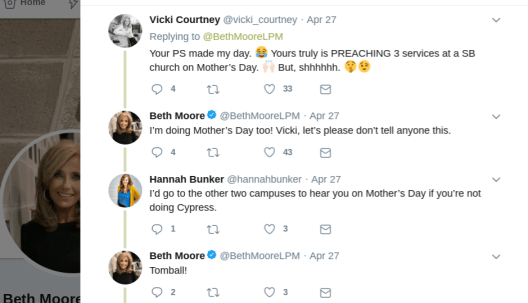
This year (2019), Beth Moore has caused quite the stir by hiding in plain sight the fact that she will be preaching the sermondoing Mother’s Day” this coming Sunday, presumably at the Tomball, Texas, campus of the church she attends (founded and pastored by her son-in-law Curtis Jones1) Bayou City Fellowship:

I say “hiding in plain sight” because she has given enough of an impression here that she is preaching the sermon to test the waters and see what the reaction will be, but has worded her tweet vaguely enough that if she meets too much resistance she can still decide to back out of preaching, give a brief word of biblically appropriate Mother’s Day greeting or encouragement to the ladies at another point during the service, and come back and claim with wide-eyed innocence that that’s what she meant all along by saying she was “doing” Mother’s Day. (Someone asked Beth point blank, in a subsequent tweet if Beth’s tweet meant that she would be preaching the Sunday service and Beth did not answer her. If she’s not, why not just say so? And if she is and isn’t ashamed of it, why not just say so?)

I say “presumably” at BCF-Tomball because, even though she publicizes specific details about time and place with other speaking engagements, she has not mentioned (at least not anywhere I can find as of the time I’m writing this) the specific church she’s preaching at on Sunday, and the church hasn’t mentioned on their website that she’ll be the guest preacher. Additionally, unlike other speaking engagements Beth does, this speaking engagement is not listed on the calendar of events at her website and she hasn’t mentioned it (other than the tweet above) on social media. With all this “open secrecy” I will be surprised if the video or audio of her sermon is posted on YouTube and/or the church website.

Why all this cloak and dagger about the highest profile woman in the Southern Baptist Convention2, possibly in the entirety of evangelicalism, preaching the Mother’s Day sermon?

Because she knows it’s unbiblical. Because we know it’s unbiblical. And it doesn’t take an electron microscope to see it. It’s right there, in black and white, jumping off the pages of Scripture:

I do not permit a woman to teach or to exercise authority over a man; rather, she is to remain quiet. 1 Timothy 2:12

It couldn’t be more clear. And for pastors who ought to know better to either fall prey to or intentionally perpetuate the serpentine seduction of “Did God really say you can’t preach?”, using Mother’s Day as an excuse to induce a woman to sin by having her deliver the sermon is a slap in the face – to God, to the church, and to women.

Using Mother’s Day as an excuse to induce a woman to sin by having her deliver the sermon is a slap in the face – to God, to the church, and to women.

What do his actions say to God? “I don’t like Your way and I won’t submit to it. I don’t trust that Your way is right regardless of what the world says. I’ll do what’s right in my own eyes.” It’s the lesson his church learns from his actions as well.

But why is inviting a woman to preach an affront to Christian women? Take a stroll down to verse 15 of 1 Timothy 2:

Yet she will be saved through childbearingโ€”if they continue in faith and love and holiness, with self-control.

Not only does the pastor who invites a woman to preach adulterate the role God has set aside specifically for men, he also denigrates one of the good and holy roles God has specifically and intentionally set aside for women: the role of literal, and spiritual, mother.

Eve shattered God’s perfect, unique design for women by allowing herself to be seduced into rebellion. But are we daughters of Eve forever doomed to bear the shame and guilt of her sin, never to have a role in building the Kingdom? Pariahs, to be shunned and shut out of God’s plan? No, praise God! Through the cross, the good works Christ has ordained for Christian women to do – including mothering our own children and being spiritual mothers to our daughters in the faith – redeem the prestige of women. Mothering, in every sense in which God intended it, raises the role of women back to its rightful place in God’s plan.

And we don’t need men – especially men who are supposed to be rightly leading God’s people – to come along and entice us to mess that all up again.

But that’s exactly what’s happening.

When a pastor invites a woman to sin by taking over the pulpit, he drags her and the women of his church right back to post-Fall Eden. He trashes the rank and repute of our God-given high and holy role of mother and implicitly says Being a woman isn’t good enough. You have to steal the role of men to be valued and esteemed. 

When a pastor invites a woman to sin by taking over the pulpit, he implicitly says, “Being a woman isn’t good enough. You have to steal the role of men to be valued and esteemed.”

Ladies, he’s wrong.

We don’t need to be second rate imitations of men in order to “count”. We need to be first rate, full throttle, take it to the limit women of God. God loves us and values us so much more than to give men a special and amazing role and leave us without an equally special and amazing, yet totally distinct, role. The God who spoke the universe into existence and planned out an unparalleled purpose for every single plant, animal, bacterium, and every other atom of the cosmos, did not leave the queen of His creation roleless. He did not bring us into being only to toddle along after the Hairy Ones trying to copy their every move. How unloving of God, and devaluing to women, would that be? Why would you want to act like a man when God blessed you with the gift of being a woman?

If, by God’s good Providence, you’ve “stumbled across” this article and you’re a woman who has been invited to preach, I plead with you: don’t buy the lie. Say no. Your Savior has a whole treasure chest of good works for you to do as a woman. You are worth infinitely more to Him as the woman He created you to be than you are to the world, or a worldly church, as a cheap knock-off of a man.

The practice of denigrating women, devaluing our God-given role, disobeying God, and darkening the understanding of the church by inviting women to sinfully take the pulpit must stop in the house of God.

Let us be the mothers our own children need, raising up a godly seed unto the Lord. Let us be the spiritual mothers longed for by younger women in the faith, daughters orphaned by Christian women who have abandoned them to take on the role of men. The practice of denigrating women, devaluing our God-given role, disobeying God, and darkening the understanding of the church by inviting women to sinfully take the pulpit must stop in the house of God and be replaced by strong godly women, unafraid and unashamed to flourish in the precious role our Lord has blessed us with.

Especially on Mother’s Day.


Updates to this article:

1Curtis Jones (Beth Moore’s son-in-law) resigned his pastorate at BCF in July 2020.

2Beth Moore has left the Southern Baptist Convention.


Additional Resources:

Beth Moore vs. Owen Strahan on WWUTT Podcast
(Related links):
โ€ขMichelle Lesley’s Twitter thread on Beth’s Sunday sermon preaching
โ€ขBeth Moore’s Twitter response to Midwestern Seminary professor Owen
Strahan’s article on biblical complementarianism

โ€ขDivine Order in a Chaotic Age: On Women Preaching by Owen Strahan

Why Asking Women to Preach Is Spiritual Abuse by Josh Buice