
Mailbag

The Mailbag: I’m a female executive in the workplace. Is this OK with God?


Women executives and managers in the secular workplace…. I have been battling this and feel I should no longer have the position. My husband is not quite in agreement. I want to honour God. I have been in upper level management since I was 25 years old- 33 years…. About two years ago God started to deal with me here. I do not have a peace.

I’m a tad bit unclear on your question. I’m not sure whether you’re asking if you should be working outside the home at all or if you’re thinking you shouldn’t be working in an executive/management position because it places you in authority over men.

If it’s the former, the short answer is that God’s design is for a wife and mother’s primary focus to be caring for her family and her home. There are seasons in life (for example: before you have children, after they’re grown and have left the home, etc.) in which a woman can do that just fine while holding down a part-time or full-time job, and there are seasons in life in which working outside the home would cause a woman to neglect her primary responsibility of home and family (and sometimes there are emergency situations in which a woman has no choice but to work outside the home).

If your question is whether or not you should work at all, you and your husband will need to sit down, consider all the factors, pray over it, and try to reach a consensus. If you cannot, Scripture is clear that you are to submit to his final decision on the matter.

But I’m guessing your question is the latter: “Is it biblically permissible for a woman to hold a position of authority over men in the workplace?”

Technically, the answer to that question is yes. (Unless, of course, your workplace is a church and it’s a 1 Timothy 2:12 situation.) Scripture does not prohibit women from holding positions of secular authority over men in the workplace, politics, volunteer or civic positions, etc. What the Bible forbids is women preaching to, teaching Scripture to, and holding authority over men in the gathered body of Believers (the church). This command does not apply to non-church gatherings, events, or positions. (Click here for more detailed information.)

However, it’s a little more nuanced than a simple “yes, you can” or “no, you can’t”.

One of the reasons Scripture doesn’t address the issue of women holding positions of authority over men in the workplace is that this wasn’t an issue in the culture and time when Scripture was breathed out by God. Generally speaking, women of the Bible weren’t career women. At that time and in that culture, a woman’s “career” was wife and mother.

We do see women like the Proverbs 31 wife and Lydia earning money from their work, but it was an extension of their work in the home as wives and mothers (Also, in Lydia’s case, her work is mentioned before her conversion. We don’t know whether or not she continued her sales business after she got saved.) They weren’t leaving the home every day to go work in someone else’s business.

The point is, the mere fact Scripture doesn’t address a particular scenario doesn’t give us blanket permission to do whatever we want about it, nor does it mean the Bible blanketly prohibits something. We have to look further.

When Christians make decisions, we always make them by correctly handling and applying Scripture. The first thing we look at is clear cut commands and biblical principles. For example, if you were looking for a job and there was an opening for a stripper or an abortion doctor, or a job that required you to lie, or a job that said you couldn’t (even in your off time) read your Bible or share the gospel, you would know right off the bat that those jobs violate clear commands and principles of Scripture.

So the first thing you’ll want to do in your situation is sit down and think about any clear commands of Scripture or broader biblical principles that apply to your situation. Scripture does not prohibit you from working in a supervisory position over men, but it does command you to submit to your husband and to live peaceably with others (including him) as far as it depends on you.

If, “My husband is not quite in agreement,” means the two of you need to talk about this issue more, then by all means, keep discussing it until a decision is reached. (It might even be helpful to set up an appointment with your pastor for counseling.) But, if it means he has stated that he wants you to continue in your position (and your job does not cause or require you to sin), you need to respect and submit to his decision. You can certainly keep praying about the situation in your personal time with the Lord. You can also revisit the issue if the situation changes (ex: an opportunity to work from home arises, you’re offered a better job or early retirement, etc.). But today, joyfully and graciously submit to your husband.

The next thing Christians need to consider when making a decision is, “Is it wise? Is it helpful?” Just because youย can do something doesn’t mean youย should.

โ€œAll things are lawful for me,โ€ but not all things are helpful. โ€œAll things are lawful for me,โ€ but I will not be dominated by anything. 1 Corinthians 6:12

โ€œAll things are lawful,โ€ but not all things are helpful. โ€œAll things are lawful,โ€ but not all things build up. Let no one seek his own good, but the good of his neighbor. 1 Corinthians 10:23-24

Both of these verses are written in the context of setting aside your personal rights to do something non-sinful for Christ’s higher calling to serve or do good to your neighbor. And remember, your husband and family are your closest neighbors.

Ask yourself some probing questions. Will this non-sinful thing I want to do, and have a right to do, make it more difficult for me to share the gospel with someone? Is it best for my family? Will it be good in the short term, but detrimental in the long term? Is it wise stewardship of the blessings, resources, and positions of influence God has given me? Will it create unnecessary strife in my marriage? Could denying myself the right to do this thing be more impactful for the Kingdom than doing it?

Has the desire to do this non-sinful thing become an obsession you can’t let go of? Repent and determine in your heart not to be dominated by it.

One of the “wisdom questions” you and your husband might want to ponder in your situation is, “Is it difficult for me to transition from being the boss of men at work to submitting to a man at home?”. If your job is tempting you to sin against your husband or making it more difficult to obey Scripture’s command to submit to him, that’s a weighty factor to consider.

You might have noticed that I have not said anything about the necessity of “having a peace” about whatever decision you and/or your husband have reached. That’s because there’s nothing in the Bible about a peaceful easy feeling being a sign that you’ve made a godly decision. Feelings are subjective (and often deceitful and wicked). We can’t depend on them to lead us in a godly direction. Scripture is objective. We can always depend on Scripture to steer us right, regardless of our feelings.

So dig through Scripture with your husband, pray together about the situation, get some wise counsel from your pastor or other mature believers, and come to a mutual conclusion if at all possible. But in the end, make sure you’re submitting first to Christ and His Word, and second, to your husband.


If you have a question about: a Bible passage, an aspect of theology, a current issue in Christianity, or how to biblically handle a family, life, or church situation, comment below (Iโ€™ll hold all questions in queue {unpublished} for a future edition ofย The Mailbag) or send me anย e-mail or private message. If your question is chosen for publication, your anonymity will be protected.
Christian women, Church, Complementarianism

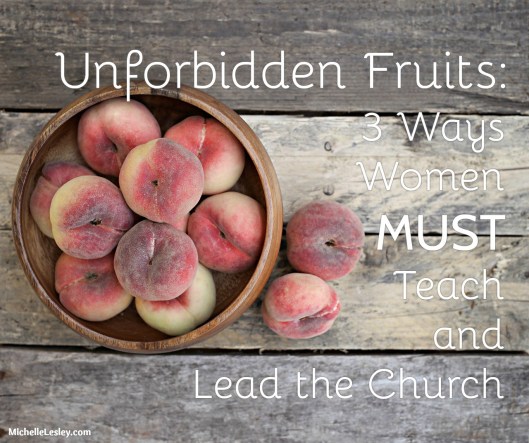
Unforbidden Fruits: 3 Ways Women MUST Lead and Teach the Church

Ladies, we whine too much.

Like petulant little girls, we look at what’s off limits to us, stomp our Mary Janes on the floor and cry “Why can’t I? I want to!” instead of giddily jumping into all the opportunities God has blessed us with. Instead of being happy and thankful for what we have, our greedy little fingers stretch out to grasp what God has said we can’t have because it’s not good for us or anybody else.

God has instructed pastors – who are, in turn, to instruct us – that, in the gathered body of Believers, women are not to preach to men, instruct men in the Scriptures, or exercise authority over men. And that’s what we focus on, and whine and kick our feet about. That part – the childish rebellion and discontent with the role God has graciously placed us in – that’s on us.

But pastors, we badly need your help on this one. Many pastors do a wonderful job of rightly and biblically explaining what women are not to do (And may I take a moment to say, from the bottom of my heart, thank you. I know how difficult that can be and that you take a lot of undeserved flak for simply teaching God’s Word on this subject.), but that “no” teaching has often not been coupled with the “yes” teaching of what women must do and how they must lead in order for women, and the church, to be healthy and function properly.

The “no” teaching of what the Bible forbids has often not been coupled with the “yes” teaching of what women *must* do and how they must lead in order for women, and the church, to be healthy and function properly.

You’ve loved us well to tell us not to bite at the apple from the forbidden tree, but we also desperately need you to take us on a tour of the Garden and introduce us to the all-you-can-eat buffet of pear and peach and cherry and pecan trees that we have the privilege and the responsibility to feast on.

๐ŸŠ The Other Institution ๐ŸŠ

Did you ever notice that the “do” for women in the church comes before the “don’t”? We tend to totally skip over that enormous little word that kicks off 1 Timothy 2:11: “Let a woman learn…”. We have no idea of, nor appreciation for, how huge and groundbreaking it was for the Holy Spirit, through Paul, to proactively instruct pastors: “Hey, get these women in here, make sure they listen up, and train them properly in the Scriptures so they’ll be equipped to fortify their homes with biblical truth.”

We completely miss the fact that, though God installs men as the teachers and leaders in one of His foundational institutions – the church – He has very much made women the functional, boots on the ground, day to day, teachers and leaders by example – of His other foundational institution – the family. The church didn’t even exist for the first few millennia of human history, but the family has existed since Creation. And people who are members of families populate and lead the church. Raising and molding those people is a tremendous position and responsibility. A position and responsibility God has largely given to women.

Wives pray for our husbands’ growth in Christ. We build them up with Scripture. With a gentle and quiet spirit, we set a godly example for them as they observe our respectful and pure conduct. We encourage and help them in their leadership roles at church.

Moms pray for our children’s salvation. We pour the gospel into them at every turn. We train up our children in the way that they should go – in the nurture and admonition of the Lord – so that when they are old they do not depart from it. We teach them to love and serve and invest in the church both directly and by modeling these things for them.

And our single, widowed, and childless sisters work right alongside us in this labor, praying for church leaders and members, nurturing children at church whose parents are unsaved or unequipped to raise them biblically, encouraging and assisting brothers and sisters in Christ.

We grow and develop, nourish and support, exhort and sharpen the population of the body of Christ.

Men may lead the church, but women raise the church.

Men may lead the church, but women *raise* the church.

๐Ÿ Woman to Woman ๐Ÿ

Essential to the health of any church is the component of women training women, whether in the formal setting of a Bible study class and structured women’s ministry programs or an impromptu “let’s get together for coffee this week” discipleship discussion.

Though we receive instruction in Scripture from our pastors, elders, and teachers, there are some counseling and teaching situations it’s not appropriate for a man to address with a woman, or that a woman understands better than a man. There are issues women face that men just don’t “get” in the same way a sister in Christ does. There are insights and perspectives a woman can use to explain Scripture to another woman that a man just doesn’t have. There are times when a woman needs someone to walk through a long term emotional journey with her that requires a personal intimacy which would be inappropriate for a man to engage in with her. And in the same way men are better equipped than women to train men to be godly husbands, fathers, and church members, women are better equipped than men to train women to be godly wives, mothers, and church members.

God knew all of this back when He breathed out the words of Titus 2:3-5…

Older women likewise are to be reverent in behavior, not slanderers or slaves to much wine. They are to teach what is good, and so train the young women to love their husbands and children, to be self-controlled, pure, working at home, kind, and submissive to their own husbands, that the word of God may not be reviled.

…and, again, 1 Timothy 2:11:

Let a woman learn quietly with all submissiveness.

Women must be trained properly in the Scriptures so we can take that training and pour it into other women, teaching and sharpening them into godly women, wives, mothers, and church members.

๐Ÿ‘ Super Models ๐Ÿ‘

Women instruct our brothers and sisters in the church in biblical truth when we lead by example. When we sin against someone, we go to that person and ask forgiveness. We demonstrate the importance of meeting together with the Body by being faithful in our church and Sunday School attendance. We model servanthood by serving the church and our brothers and sisters. We paint a picture of biblical compassion by ministering to the sick and others in need. We show Christians how to carry out the Great Commission by sharing the gospel. We set an example of trusting God when others see us depending on Him through difficult situations.

And one of the most important biblical concepts women have the privilege and responsibility of teaching the church through our example is submission to authority – a lesson the church is sorely in need of these days.

Because God blessed us by creating us as women, we have an opportunity to model submission to authority in a unique way that God has chosen to deny to men.

Because God blessed us by creating us as women, we have an opportunity to model submission to authority in a unique way that God has chosen to deny to men.

As we submit to our husbands, we teach the church what it means to submit to Christ. How to walk in humility and obey Him out of love. How to put selfishness aside. To trust Him to take care of us. To deny ourselves, take up our cross daily, and follow Him.

When we submit to God’s design for leadership in the church and joyfully carry out the work He has planned for us as godly women, we teach the church to submit to God’s authority and love Him by obeying His commands. We instruct our fellow church members in respecting and submitting to the pastors and elders God has placed in spiritual authority over us.

Submission to Christ, to God’s commands, and to pastors and elders is the bedrock of a healthy church. God has graciously given women the role – and the duty – of teaching these and other biblical principles to our churches in a way that men cannot -through our example as godly women.

Remember the series of fun little nutritional books that came out several years ago called Eat This, Not That? The idea the books centered around was, “Don’t eat that unhealthy thing. Eat this similar but healthy thing instead.”

Sadly, many Christian women have only been getting half the story. “Not that” (preaching to/teaching men and exercising authority over men) is biblically correct, but it’s not biblically complete. If all you tell someone is “Don’t eat that,” without showing her the “Eat this,” part, what she needs to eat to be healthy, she’s going to starve, and the church will be malnourished as well.

Christian women need our pastors to teach us to eat the fat of the land of being properly trained in the Scriptures and drink the sweet wine of leading and instructing the church the way God gifts us and requires us to. Only then will the Body be healthy and well nourished.

Women of Genesis Bible Study

The Women of Genesis: Lesson 19- Keturah, Hagar, Sarah, Rebekah

Previous Lessons: 1, 2, 3, 4, 5, 6, 7, 8,ย 9, 10, 11, 12, 13, 14, 15, 16, 17, 18

๐Ÿ“–๐Ÿ“–๐Ÿ“–๐Ÿ“–๐Ÿ“–

Read Genesis 25

๐Ÿ“–๐Ÿ“–๐Ÿ“–๐Ÿ“–๐Ÿ“–


Questions to Consider

1. Who are the three women named in verses 1-18? What was the relationship of each to Abraham? To the Abrahamic Covenant? Based on your answers to these questions, why don’t we hear anything else about the sons of Keturah and Hagar after Genesis 25? Why does the Bible follow the story of Abraham’s lineage through Sarah (Isaac) instead?

2. Why, in terms of inheritance and the Abrahamic Covenant, would Abraham have sent the sons of Keturah and Hagar away from Isaac? (6)

3. Briefly describe Sarah’s, Keturah’s, and Hagar’s “callings” in life.ย Did Hagar and Keturah have less intrinsic value as people in God’s eyes than Sarah did simply because their roles in Old Testament history were different from hers? Does the fact that God calls different people to different roles in life mean that He values or loves people with “important” roles more? Who places or allows people to be in the roles or life circumstances they’re in? Does God view our status in life the same way people do?

4. Do you see some similarities between Sarah and Rebekah in this chapter?

๐Ÿผย What is the first similarity we see in verse 21 (compare with 11:29-30)?

๐Ÿผ๐Ÿผ Compare Isaac’s age when he married Rebekah (20) to his age when Jacob and Esau were born (26). How long did Isaac and Rebekah wait for God to open her womb? How long did Abraham and Sarah wait (compare 12:1-4ย with 21:5)?

๐Ÿผ๐Ÿผ๐Ÿผย After opening their wombs, how many sons of the Covenant did Sarah have? How sons of the Covenant did Rebekah (24) have?

๐Ÿผ๐Ÿผ๐Ÿผ๐Ÿผย How did Rebekah (23) and Sarah (17:19) find out about these Covenant sons?

5. Consider Rebekah’s possible concerns and emotional state at being barren for so long, and then bearing only two sons, when God had promised Abraham that his descendants would be “as many as the stars of heaven and as many as the innumerable grains of sand by the seashore”. How might God have used these circumstances in her life to teach her to trust Him? (22-23)

6. How do the motifs of barrenness, miraculous conception, and the one, promised, long-awaited son of the Covenant foreshadow the birth of Christ?

7. How does the story of Esau despising his birthright and Jacob redeeming it further confirm what God told Rebekah in verse 23 – that Jacob would be the son of the Abrahamic Covenant?


Homework

Think about the roles and statuses God has placed you in. Are you famous? Unknown? Do you wield a lot of power and influence, or very little? Are you wealthy, poor, or somewhere in between?

Read the Parable of the Talents. “Talents” were units of money the master entrusted to his servants to invest. What kinds of blessings, influence, resources, and abilities has God entrusted to you? Your marriage? Your singleness? Your home? The position you serve in at church? Money? Your children? Your job? Your relationships with friends?

What matters to God – how many of these things He has blessed you with, or how you steward them for His glory (see verses 21 &23)? List three ways you can faithfully make the most of the roles and statuses God has called you to for His glory.


Suggested Memory Verse

And the Lord said to her, โ€œTwo nations are in your womb,
and two peoples from within you shall be divided;
the one shall be stronger than the other,
the older shall serve the younger.โ€
Genesis 25:23

Worship

What I’m Listening To (the one with the music)


Most of the time, if I’m listening to something, I’m listening to podcasts. (If you want to check out the ones I like, look to your left under “Blogs and Podcasts I Follow”.)

But when I run, I sometimes listen to music. Most of my “Running Music” playlist is up tempo Southern Gospel. I happen to like Southern Gospel music. I like multi-part harmony and antiphonal songs. I like actual singing (as opposed to the breathy moaning so popular in vocal music today). And I like the fact that I can pick just about any Southern Gospel song at random and know I’m going to hear clear and specific references to Jesus, the cross, sin, repentance, the Bible, and Heaven. None of these veiled allusions to something that might be biblical. Nothing that could be confused for a love song to the lyricist’s girlfriend. I like my gospel unmistakable.

I also choose Southern Gospel because it’s easy to find up tempo songs. I tend to match my running pace to the beat of the music, so slow songs aren’t going to cut it. I’ve tried finding upbeat, doctrinally sound contemporary worship songs with little success.

So here are a few favorites I run to. What are you listening to these days?

He Made A Change


Goodbye World, Goodbye


Hallelujah, I’m Going Home


I Believe It All


Can He, Could He, Would He?

Mailbag

The Mailbag: Is “Jesus loves you” enough of the gospel?


I work in a parachurch organization in which I teach children. I have a passion for these kids to know God and know His Word. My direct supervisor, as well as the head of the organization, want to only emphasize God’s love and that we are ALL children of God. I am wrestling with this because I just don’t believe that I should make saying “Jesus loves you” the main message to the kids but rather the gospel in full context (of course getting down to their level but in no way changing the message). What should I do?

It’s always great to hear from someone who’s working with children and wants to put correct theology on the bottom shelf where their little hands can reach it. Thank you for serving God’s Kingdom this way!

There are three issues I think are important to address in this situation. Let’s take a look…

We are NOT “all” God’s children.
All humans are indeed made in the imago dei – the image of God. That’s definitely an important aspect of theology to teach children, and if that’s what your supervisors actually mean when they say “we’re all God’s children,” that’s super. But they need to use correct, biblical language and say “We’re all made in the image of God,” (age-appropriately explaining what that means, of course) instead of saying “We’re all God’s children.”

It’s not just a quibble over semantics. There are two very important reasons to get this right.

First, it’s simply not true on its face and you don’t want to be teaching the children a lie. I mean, Jesus once told some Jews (aka:ย God’s set apart people group) He was talking to, “If God were your Father, you would love me…You are of your father the devil, and your will is to do your father’s desires.” So, obviously, people fall into one of two categories: you’re either a child of God or you’re a child of the devil. Just as a person has to be physically born into a family, or adopted into a certain family, in order for that particular mom and dad to be her parents and for her to be their daughter, “you must be born again,” – a spiritual birth (and adoption) – must take place in order for God to be your Father and you to be His child.

Second, saying “We’re all God’s children,” smacks of universalism.  Universalism is basically the idea that everybody goes to Heaven when they die. No repentance is necessary, no belief in Christ, it doesn’t matter what religion you are, if any. If this is what your supervisors are teaching or wanting you to teach, I would encourage you to find employment elsewhere. This is blasphemous false doctrine that no Christian organization or its employees should be teaching.

Teaching the WHOLE gospel
Jesus loves you” is part of the gospel, and one that we need to make sure we’re including any time we share the gospel with others. It is only because of the amazing, unfathomable love of God that Christ came to earth to die in the first place. Without the love of God there would be no gospel at all. However, it is not the entirety of the gospel. The gospel also includes the components of sin, repentance, faith, and forgiveness.

Since this is a Christian organization you work for, I’m unclear on why (assuming they’re not universalists) your supervisors would not want the whole gospel taught to the children. Only three possible reasons come to mind:

1. They’re concerned that the children are too young to understand sin, repentance, faith, and forgiveness.
You didn’t mention the specific age of the children you’re working with, but I got the impression from your original message to me that they are elementary school aged. I have six children of my own and have taught every age level of children from birth through high school in church, parachurch, and school settings for most of my adult life, and I can tell you that elementary school aged children are perfectly capable of grasping these concepts when they’re explained at an age-appropriate level.

I would think anyone qualified to be in a supervisory capacity at an organization like yours would – as an experienced professional – know that children this age can intellectually handle these concepts, and would – as a Christian – want them to know the whole gospel so they can be saved and take the gospel home to their families.

2. They’re concerned anything more than a generic “Jesus loves you,” is going to offend some of the parents.
Tough. The gospel is offensive to sinners. They need to get over that fear of man right quick. And it’s not like the parents were tricked into putting their kids into a program they didn’t know was Christian, right? (By the way, this is not the tone I’d recommend using when speaking to your supervisors :0)

3. You’re spending too much of your time evangelizing the kids instead of teaching them the main topic(s) they’re there to learn.
That’s not the impression of you that I got from your original message, but just make sure that, if, for example, you were hired to teach the kids how to play kickball, you’re teaching them how to play kickball, not turning every practice session into a Bible study.

Honestly, I’m having a hard time wrapping my mind around why any organization that openly bills itself as “Christian” would only want part of the gospel presented. I would suggest sitting down with your supervisors and asking them politely why they don’t want the whole gospel presented to the children at appropriate times in age-appropriate ways. Perhaps they have a good, biblical reason for it, but I’m at a loss to imagine what it is.

Submitting to authority
Submission to authority is a big theme in the New Testament. Christians submit to God’s authority, wives submit to our husbands’ authority, church members submit to the authority of their pastors and elders, as citizens we submit to our civil authorities, and, in the present day, we understand the passages about slaves submitting to their masters in light of the employee/employer relationship.

In God’s structure of authority, He is always at the top. So if any other authority in your life – husband, boss, government, pastor, etc. – wants you to do something that conflicts with God’s written Word, your response must be the same as Peter’s: “I must obey God rather than men.”

I’m still unclear as to whether or not your employers are asking you to do something that conflicts with God’s Word. After talking it over with them, praying about it, talking to your husband about it (if you’re married), and possibly seeking counsel from your pastor or a mature sister in Christ at your church, if you come to the conclusion that your supervisors are not asking you to disobey God’s Word, then the proper godly response is for you to submit to their authority and joyfully do as they ask. If you come to the conclusion that they are asking you to disobey God’s Word, prayerfully ask to meet with them again, and kindly, with Scripture, explain to them that you cannot in good conscience truncate the gospel. Perhaps God will open their eyes and they will change their policy. If not, it might be an appropriate time to tender your two week’s notice.


If you have a question about: a Bible passage, an aspect of theology, a current issue in Christianity, or how to biblically handle a family, life, or church situation, comment below (Iโ€™ll hold all questions in queue {unpublished} for a future edition of The Mailbag) or send me an e-mail or private message. If your question is chosen for publication, your anonymity will be protected.