Complementarianism, Mailbag

The Mailbag: “What’s a Woman to Do?” Potpourri

Welcome to another “potpourri” edition of The Mailbag, where I give short(er) answers to several questions rather than a long answer to one question. I also like to take the opportunity in these potpourri editions to let new readers know about my comments/e-mail/messages policy. I’m not able to respond individually to most e-mails and messages, so here are some helpful hints for getting your questions answered more quickly. Remember, the search bar can be a helpful tool!

In these potpourri editions of The Mailbag, I’d also like to address the three questions I’m most commonly asked:

“Do you know anything about [Christian pastor/teacher/author] or his/her materials? Is he/she doctrinally sound?”

Try these links: 
Popular False Teachers /
 Recommended Bible Teachers / search bar
Is She a False Teacher? 7 Steps to Figuring It Out on Your Own
(Do keep bringing me names, though. If I get enough questions about a particular teacher, I’ll probably write an article on her.)

“Can you recommend a good women’s Bible study?”

No. Here’s why:
The Mailbag: Can you recommend a good Bible study for women/teens/kids?
The Mailbag: “We need to stop relying on canned studies,” doesn’t mean, “We need to rely on doctrinally sound canned studies.”.

“You shouldn’t be warning against [popular false teacher] for [X,Y,Z] reason!”

Answering the Opposition- Responses to the Most Frequently Raised Discernment Objections


It’s ladies night!…er…day…or whatever. I’ve accumulated several questions that have to do with women’s roles in the church and home, so that’s the theme of today’s Mailbag. If you have similar questions, you might find my article Rock Your Role FAQs to be helpful.


Is it biblical for women to serve as children’s ministry leaders or directors in the church?

It could be, depending on the situation. (You should not bear the title Children’s “Pastor,” though. Biblically, women are not pastors so carrying that title would be dishonest and misleading.)

It is perfectly biblical for women to teach and lead children in the church setting. (And when I say “children”, I mean birth to about age 12. I’ve addressed women teaching youth/teens here, #13.) The biblical prohibition is against teaching and holding authority over men in the church. Male children are not men.

The potential 1 Timothy 2:12 issue is not with teaching and leading children or supervising other women who teach children. The issue at play is whether or not you’ll be holding unbiblical authority over any men who work or volunteer in the children’s department as Sunday school teachers, Awana leaders, nursery workers, etc. And that’s something that’s got to be examined on a case by case basis. It could be completely biblical for you to serve as a children’s director in one church but not in another simply due to circumstances of the environment.

Does your church only have women working in the children’s department? Is there an associate pastor or elder over you that handles any issues of authority? Would you have to train, evaluate, or correct male volunteers? What kinds of things would male volunteers need to come to you about? These and other questions all need to be carefully considered by your pastor, elders, your husband, and you.

Generally speaking, it is biblically OK for a woman to serve as children’s ministry leaders as long as that position, in that particular church, does not require her to instruct men in the Scriptures or hold unbiblical authority over men.


My husband is a new Christian (Praise the Lord!). I was raised in church and have a firm foundation in the Word, but unfortunately he was not blessed with such an upbringing. When we study the Bible together at home, how can I handle his lack of knowledge in a Godly way? I know what the Bible says about women not teaching men, and I strongly desire to be obedient to God’s Word. I’m just a little confused about what that looks like in this situation.

I rejoice with you over your husband’s salvation! This is a great question that’s probably on the minds of many godly women.

First, I think we might need to review a little bit of “what the Bible says about women not teaching men.” When Scripture prohibits women from teaching or holding authority over men, it does so in a specific setting: the gathered body of Believers (the church – You may want to go back over my article Jill in the Pulpit.). You are talking about helping your newly saved husband privately, at home. That’s different, and it is not included in the 1 Timothy 2:12 prohibition.

At home, between the two of you, the only issue is whether you’re submitting to him and respecting him. If your husband wants you to explain things to him from Scripture and you do that in a loving, kind, and submissive way, there’s absolutely no biblical problem with that. (It’s also important that you know the correct answers to his questions and can handle Scripture rightly. If not, study it together or ask your Sunday School teacher, pastor, etc., for help.)

In Scripture, we see Priscilla and her husband Aquila taking Apollos aside privately (likely in their home) and helping him understand “the way of God more accurately.” And Paul commends Priscilla in “the great thank you list” of Romans 16. She would not have been mentioned in a positive light in Acts nor commended by Paul in Romans if she had been sinning by helping Apollos. And if she wasn’t sinning by helping Apollos, who wasn’t even her husband (again, recalling that this was a private conversation, not teaching in the church), it would not make sense that it would have been wrong for her, or any other woman to help her own husband.

In 1 Peter 3 and 1 Corinthians 7 we see that a woman can be instrumental in bringing her unsaved husband to Christ. Why, then, would she not – privately, at his own request – continue to answer his questions, explain things, or suggest passages of Scripture for him to read after he got saved?

It would be beneficial to your husband for him to begin learning from godly men, not because it’s wrong for you to help him learn, but because other men can help him learn his role as a Christian man and how to handle things men go through better than a woman – even his wife – can. It might be helpful to your husband for you to suggest good books by doctrinally sound men for him to read and good preaching and podcasts to listen to (see some of my favorites in the sidebar to your left). He would probably also benefit tremendously from getting involved with a men’s group or Bible study at church, or having a godly older man disciple him.

What a blessing that God has given your husband a knowledgeable, godly wife who can help him!


I teach the Bible to women and young people in the home of a Christian sister. Frequently, her husband brings his Bible and sits in on the group. I usually just ignore the fact that he’s in there and focus on the youth, because, technically, that’s who I’m there to teach. I feel uncomfortable with him there because I agree with the Bible that I’m not supposed to be teaching men, but I also feel uncomfortable asking him to leave his own den. What do you recommend in this case?

It’s a bit of a sticky situation, but more because of etiquette and logistics than because of Scripture. Let’s explore a few different aspects of this situation.

✢ Is the husband saved? If he’s unsaved, the dilemma stops here. He’s not part of the church (the universal body of Believers), he’s an outsider observing Christians, and the things of God are folly to him. He’s not even capable of understanding Christian teaching on a spiritual level, so you’re not teaching him. At best, he’s absorbing enough of the gospel to eventually lead him to Christ. That would fall under the category of evangelism, and Scripture doesn’t prohibit women from sharing the gospel with men. (See #11 here)

✢ Take into consideration that different people sometimes have different ideas about etiquette and social interactions. Whether or not he’s saved, it’s possible the husband is sitting in on the group because he feels, as the host, it would be rude of him not to. By talking with him about your discomfort with his presence, you might actually be letting him off the hook when there are other things he’d rather be doing.

But from here on out, we’ll assume the husband is saved and doesn’t fully understand that women aren’t to teach men in the gathered body of Believers.

✢ You mentioned that you are teaching “women and young people”/”youth”. I’m inferring from that phraseology that this group of “young people/youth” is a co-ed group in their teens. If I’m correct about that (and maybe I’m not), this could be part of the issue depending on the age of the kids in the group. First, of all, if the males in this group are in their late teens to early 20s or older, you really don’t have a leg to stand on. You’re teaching men (even if they are young men), so that needs to stop. But this could also be a contributing factor to why the husband is coming to the study, especially if he is a younger man. If he sees you teaching 18 year old young men and he’s 25, he probably doesn’t see much difference between those young men and himself and assumes he’s welcome to attend. There’s no hard and fast biblical command about it, but I usually recommend women stop teaching boys around the time they start middle school (12ish). I’ve explained more here, #13.

✢ It’s possible the husband only has a partial understanding of the applicable Scriptures here. Perhaps he thinks Scripture only says women can’t be pastors or that as long as you’re outside the four walls of the church building you can teach men. Maybe you and his wife can pull him aside privately after the meeting or at another time and explain a little bit more about what Scripture says, your desire to obey it, your discomfort with him there, and your discomfort with asking him to leave.

✢ You know the husband and his wife better than I do. Would it work better to explain things to the wife and ask her to talk to him? Or possibly for you and your husband to talk to him and his wife together? It might also be beneficial for you to set up a meeting with your pastor and get some wise counsel from him on how to proceed.

✢ Enlist the aid of your husband and/or some other godly men at church. They could invite this fellow to join them during your class time for a men’s Bible study, bowling, a movie, dinner, watching the game on TV, or whatever. Maybe the husband just needs some friends or a better offer! :0)

✢ If you’ve talked to the husband and he understands what Scripture says, and your dilemma, and he refuses to refrain from attending the class, it’s time to move the class meeting to another location – perhaps your house, the church, or the home of someone else in the group. If it gets to this point, things have moved beyond whether or not you’re teaching a man. Now he’s intentionally being a stumbling block to a sister in Christ (which, if you belong to the same church, actually requires church discipline). He is sinning and he causing you to sin against your conscience. Scripture says if something causes you to sin, remove it. Since you can’t remove him from his house, you’ll have to remove yourself from his house.

✢ Finally, along the lines of removing things from your life that cause you to sin, if you’ve tried every possible way of working things out and you’re still going to be in a situation where you’re sinning against your conscience, step down from teaching. As much as you might want to, you do not have to teach that class. And it’s far better to  give up a “want” and not sin than to keep doing a “want” and sin. God takes sin very seriously, and we should, too.

I’ve tried to cover a range of possibilities and solutions, and some of them may sound extreme, but most of the time situations like this among friends, and especially among church family, can be resolved with a simple, loving conversation. Try talking to him about it, and you’ll most likely be able to work it out.


If you have a question about: a Bible passage, an aspect of theology, a current issue in Christianity, or how to biblically handle a family, life, or church situation, comment below (I’ll hold all questions in queue {unpublished} for a future edition of The Mailbag) or send me an e-mail or private message. If your question is chosen for publication, your anonymity will be protected.

Bible Study

You Have What it Takes to Lead a BIBLE Study?

I am so sick of women’s ministry/discipleship/”Bible” study that centers around narcissistic navel-gazing, I could vomit. My hurts, my feelings, my opinions, my self image.

Newsflash- You’re not the only person on the planet who’s ever been hurt or had problems.

And wallowing in the hurt and your emotions has never been the way to heal and feel better. Healing from the hurt comes from taking your focus off yourself and placing it on Christ: studying the actual Bible, obeying His commands, walking in holiness, praying, worshiping, serving others.

These canned “Bible” studies that masquerade as teaching the Bible – maybe even have the name of a book of the Bible in the title – yet all the “study” questions are about you, your preferences, and how you feel, are doing you no favors, ladies. They are keeping you enslaved to your hurts and self idolatry so you’ll continue to buy more and more of these books. Don’t be naive. LifeWay, CBD¹, and all the major “Christian” publishers know that there’s no money to be made in telling you to study your Bible. If you study your Bible you might actually grow in Christ, learn to glorify Him instead of your own opinions, heal from your hurts, and learn to handle your problems in a biblical way. And then all these divangelistas – whose main function in life seems to be exegeting stories from their own lives and telling you all about their pain- will be out of a job because you won’t need them, their books, their DVDs, their conferences, their simulcasts, or their merch, any more.

The Christian retail machine doesn’t make money when you follow what the Bible says to do: sit under good preaching and teaching at your own church, disciple women in your own church, be discipled by godly older women in your church, serve your church, attend your church like your life depends on it (because your spiritual life does), study your Bible every day, live in obedience to Christ. 

You’re being played and you’re being used by Big Christian Retail, ladies. Stop clinging to the pretty little gilded shackles they have locked around your wrists. Break free and experience the freedom in Christ that can only come from walking faithfully with Him in His Word.

I’m no prophet, nor a son of a prophet, but sometimes I think I might have a tiny inkling of how Jeremiah felt when he said:

If I say, “I will not mention him,
or speak any more in his name,”
there is in my heart as it were a burning fire
shut up in my bones,
and I am weary with holding it in,
and I cannot.
Jeremiah 20:9

When I see the way so many professing Christian pastors, leaders, and teachers in the public eye damage the spiritual lives of their followers by adulterating God’s Word, biblical anger wells up inside me. And sometimes, the pressure gets to be too much and it finds a way to escape, like it did the other day when I tweeted the remarks above.

hate with a holy, biblical hatred what the Christian retail machine, overall, has done to Christians, particularly Christian women, by feeding them fluff and false doctrine.

Go back and read the robust theological thoughts and writings of some of the women who helped usher in the Reformation. And then go stick your head in the door of the average women’s “Bible” study at the church down the street and listen to the teaching and comments. We didn’t get to where we are today without somebody poisoning the water hole.

So it was with no small sense of irony that two days after I had let the fire loose on Twitter, I found myself clicking – with much trepidation – on an article from LifeWay Women that popped up in my feed: You Have What It Takes to Lead a Bible Study.

It was written by a darling young lady named Mickey who made several very good points and was charming and encouraging. I’m certain she wanted the article to be helpful and edifying, and I have no points of contention with her personally. This article was a work product. It expresses LifeWay’s position, not necessarily Mickey’s personal thoughts and opinions. (I wrote for a LifeWay publication once. Believe me, if what you’ve written doesn’t match what they’re trying to convey, they edit it until it does. Which, as a business, they certainly have a right to do.)

“What might LifeWay Women think qualifies someone to lead² a Bible study?” I wondered, as I waited for the page to load. “I have what it takes? What does it take in their eyes?”

The first point of the article was to address women’s feelings of inadequacy about leading a Bible study and reassure them. Feelings. Not what the Bible says about teaching God’s Word, or the qualifications for doing so, or even the need other women have to be taught Scripture. Feelings. For LifeWay, the major obstacle to overcome for a woman who’s on the fence about teaching a Bible study is her feelings of inadequacy.

And how did LifeWay address those feelings of inadequacy and offer reassurance? Again, not with Scripture (indeed, no Scriptures are quoted or even referenced in the article), but by exegeting a personal anecdote from the author’s life. “I felt inadequate too, but then I gave it a try and I was successful. So if you’re feeling inadequate to lead, just give it a try. You’ll be successful, too.” It may be an oversimplification, but that’s the take away.

If this methodology sounds familiar to you, maybe it’s because you’ve worked through one of LifeWay’s most popular women’s “Bible” studies. Generally speaking, this is the core of the majority of LifeWay’s women’s “Bible” study products: your feelings and the exegesis of personal stories from the author’s life to relate to and address those feelings.

The article went on to quote a recent LifeWay Women survey which asked women,

“What is the biggest obstacle keeping you from leading a Bible study?”

Know what the number one answer was? “I don’t feel like I know enough to lead.” (Again with the feelz.)

Is it any wonder, when, for decades now, evangelical women have been fed a steady diet of nothing but girlfriend stories that they feel inadequate to teach the Bible? Of course they feel inadequate! They don’t know their Bibles because the materials they’ve been getting from LifeWay all this time haven’t taught them the Bible. They likely know more about their favorite author than they do about Jesus. Most of them probably correctly feel inadequate because they don’t know enough to lead.

Feelings of inadequacy aren’t wrong simply because they make you feel bad. Sometimes your feelings of inadequacy are wrong because you’re neurotic or unrealistically anxious, and sometimes they’re right because you don’t have the skills to handle the task you’re attempting. We’ve all watched enough American Idol auditions to know that.

Our feelings need to be informed, molded, and submitted to the facts of God’s written Word. And what does God’s written Word have to say about whether or not you have what it takes to lead a Bible study?

Not many of you should become teachers, my brothers, for you know that we who teach will be judged with greater strictness.
James 3:1

Where LifeWay issues a blanket “anybody can do it” encouragement to the hundreds of women (whom LifeWay has never laid eyes on and has no idea whether or not they’re biblically qualified to teach God’s Word) reading this article – “…trust me, friend, you have what it takes, too” – the Bible says that teaching Scripture is a solemn, weighty ministry fraught with the burden of responsibility of imparting God’s Word correctly. And precisely because of that, “not many” should become teachers.

Do your best to present yourself to God as one approved, a worker who has no need to be ashamed, rightly handling the word of truth.
2 Timothy 2:15

What does LifeWay think qualifies someone to lead a Bible study? “…a willing spirit, an open heart for new friendships, and thirst for more of God.” Is that what the Bible says about qualifying for the lofty responsibility of teaching God’s Word? No. The Bible says we need to work hard at studying, understanding, and rightly handling God’s Word so that we don’t end up twisting it or teaching something that conflicts with it. We need to be able to stand before God unashamed to say, “I worked hard, and studied long, and did my very best to teach your Word accurately.”

And the Lord’s servant must not be quarrelsome but kind to everyone, able to teach, patiently enduring evil, correcting his opponents with gentleness.
2 Timothy 2:24-25a

LifeWay seems to think getting over your feelings of inadequacy means you have what it takes to lead a Bible study. The Bible says there’s a much higher standard. Are you even able to teach – to accurately explain what God’s Word says, in a way women can understand, and help them correctly apply it to their lives? Are you quarrelsome? Kind? Able to endure evil patiently? Do you know and can you handle Scripture well enough to correct someone who makes an unbiblical argument, and can you do it gently?

Older women likewise are to be reverent in behavior, not slanderers or slaves to much wine. They are to teach what is good, and so train the young women to love their husbands and children, to be self-controlled, pure, working at home, kind, and submissive to their own husbands, that the word of God may not be reviled.
Titus 2:3-5

LifeWay doesn’t address the character needed to teach the Bible. The Bible says you’re to be mature and behave reverently, you’re not to gossip and slander others, and you’re not be controlled by alcohol.

While one of LifeWay’s tips for leading a small group is to choose a study that fits the “interests, preferences, and characteristics” of the women in your group, the Bible doesn’t really care what they’re interested in or prefer to learn. It prescribes what they need to learn. Do you know “what is good” according to Scripture? You have to know that if you’re going to teach it. And you also have to know what the Bible says about wives loving and submitting to their husbands, loving their children, being self-controlled, kind, and pure, and working at home, if you’re going to teach those things.


The Bible says you have to know your Bible to teach a women’s Bible study. You have to have certain skills, abilities, and character traits. Not just anybody can do it. Not just anybody should do it.

Do you have what it takes to lead a Bible study? If you want to know, don’t check with LifeWay. Check your Bible.


¹Christianbook.com – It used to be called Christian Book Distributors. Old habits die hard. :0)

Additional Resources:

Bible Studies

Basic Training: Bible Studies and Sermons

McBible Study and the Famine of God’s Word²
After I finished writing today’s article, I noticed that the LifeWay article exclusively used the phrase “lead a Bible study” rather than “teach a Bible study.” This is likely due to the fact that many LifeWay studies do not require the leader to teach so much as to play a DVD of a popular LifeWay author teaching. It is probably also intentional – to encourage women to lead without that pesky little need to be biblically qualified to teach. However, most people still rightly understand “leading a Bible study” to mean teaching the Bible, thus the survey response of “I don’t feel like I know enough to lead,” and Mickey’s own fear that “I don’t know enough about the Bible to lead…”. You don’t need to know much about the Bible to push a button on a DVD player. McBible Study and the Famine of God’s Word addresses this harmful practice and the need for the church to have trained teachers teaching the Bible.

4 Ways We’re Getting Women’s Discipleship Wrong, and How We Can Get it Right!

The Mailbag: “We need to stop relying on canned studies,” doesn’t mean, “We need to rely on doctrinally sound canned studies.”.

Biblical Womanhood Bible Study

Imperishable Beauty: Lesson 14- A Beautiful Position in the Church

Previous Lessons: 1, 2, 3, 4, 5, 6, 7, 8, 9, 10, 11, 12, 13

Read These Selected Scriptures

For the past few lessons, we’ve looked at biblical womanhood in the family. Today, we’ll begin looking at biblical womanhood in the church setting, examining the beautiful position God has given women in the gathering of the Body.

Questions to Consider

1. Read Galatians 3:28 (if you have a moment, read all of chapter 3 for a fuller view of the context). What does this verse, especially in light of the remainder of chapter 3, mean? What does it mean to be “one in Christ Jesus”? How does this verse speak to the concept of unity in the church? How does this verse speak to the equal value of every person in the eyes of God? When it comes to a soul being saved, is there any difference between a woman or man, slave or freeman, Jew or Greek? Do Greeks have to repent more than Jews? Does Jesus have to work harder to save women than men?

2. Briefly review the topics of lessons 4-9 (links above). Are any of these concepts (identity in Christ, being created by God, etc.) specific to one sex, or do they apply to all people? Make two lists: “Things Christians Are” and “Things Christians Do”. List about 5-10 things Christians are (ex: forgiven, ambassadors for Christ) and things Christians do (ex: pray, show mercy). Are any of the things you listed specific to men only or women only? Considering all the things the Bible says Christians are and Christians do, what would you estimate is the percentage of things all Christians are to be and do versus the percentage of things that are only for men or only for women?

3. Examine the 1 Corinthians passage. Verse 33 is kind of the “theme verse” of 1 Corinthians 14. What is the main subject of this chapter? (Hint: See section heading here). What is the venue (home, church, marketplace, etc.) in which the instructions of chapter 14 apply? (33b) Briefly skim over the rest of chapter 14. What was the overall, “for the greater good,” reason for the instruction to women in v. 34-35? What were some other activities and people the Holy Spirit, via Paul, placed restrictions on in chapter 14? Why? What is the main priority of chapter 14? Does the instruction in 34-35 mean that women may never utter a word once they step through the doors of the church? How do you know that? What do these instructions mean, and how do they apply to women in the church today? What do these instructions teach us about our responsibility to pay attention to the preaching and teaching of the Word and learn from it? How can this passage help us to see the value and edification in discussing the Scriptures at home with our husbands?

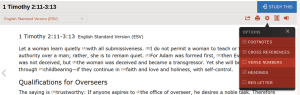
4. Go to the 1 Timothy and Titus passages by clicking on the “Read These Selected Scriptures” link at the top of today’s lesson. Recall that when the Bible was written, there were no chapter and verse numbers. (Those were added much later.) First Timothy and Titus would have read like one long, continuous letter or e-mail. Click on the “options” icon and uncheck the box next to “verse numbers”.

Now read the 1 Timothy passage, noting the flow of thought and how the end of chapter 2 is interconnected with chapter 3. What is the main idea of this passage? (OK, now click the verse numbers back on. :0)

What is the first word of verse 11? Think about women’s social status and value in Paul and Timothy’s culture, and in many cultures since that time, even today. Why does the Holy Spirit instruct pastors to “let” women learn? What does this teach us about the responsibility God places on us as women to learn His Word? Would you categorize verse 11 as a “do this” or “don’t do this” verse?

Examine verse 12. Is this mainly a “do this” or “don’t do this” verse? What two things does the Holy Spirit say women are not to do in the gathering of the church body? What does He say women are to do? Think about God’s nature and character. Does He ever give instructions arbitrarily or just to spoil our fun? Why does God give us commands and instructions, generally speaking? Are the instructions in verse 12 good for women and for the church?

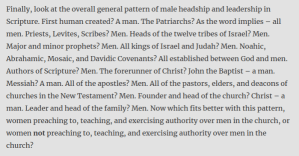
Does God have to give us the reasons behind His instructions, or is “because I said so” sufficient reason for us to obey Him? Take a look at 13-14. God kindly gives not one, but two reasons for His instructions in verses 11-12. What are those two reasons? How do they fall in line with God’s design for male headship and leadership across biblical history in the hierarchical structures He has set up?

The 11-15 passage starts with a “do this” verse (11), followed by a “don’t do this” (12) “and here’s why” (13-14) section, then finishes up with another “do this” verse (15).

Verse 15 can be a little cryptic to us today because we equate the word “saved” with salvation. Does verse 15 mean that women gain salvation by having children? How do we know it doesn’t? The NASB helpfully, and more accurately, renders this word as “preserved“. We don’t feel it much today, but think about the stigma women (particularly Jewish women) carried at the time this was written simply because they were daughters of Eve. Paradise was lost and the curse of sin entered the world because of a woman, many men thought, and they viewed and treated women accordingly. Yet who was chosen to bring the Messiah into the world? And following in her footsteps, a major way godly women can “save” or “preserve” the reputation, esteem, and value of womankind is to “continue in” what 3 godly character traits? (15) Because if they continue in those three godly character traits, they will be raising up a godly seed to the Lord (even if the children they bear aren’t perfect like Mary’s child was :0)

So we’ve seen the position women are to occupy in the church, followed by the positions women aren’t to occupy, and that’s followed, in the 1 Timothy 3 and Titus 1 passages by the p_____s m__ are to o____.

According to the 1 Timothy 3 and Titus 1 passages, which positions are men to occupy in the church? What is an overseer? (Use your cross-references if necessary.) Go through these two passages circling any words or phrases that indicate that pastors, elders, and deacons are to be men. Are these positions open to all men in the church?

Examine each of the three sections (1 Timothy 3:1-7, 3:8-13, and Titus 1:5-9) individually. How could the wife of a pastor, elder, or deacon help him, or make things easier for him, to meet the biblical requirements for his office? (Ex: How could a pastor’s wife make it easier for him to be hospitable?)


Homework

If you’d like to dig deeper on some of these passages, you may enjoy reading the following articles from my Rock Your Role series:

All Things Being Equal (Galatians 3:28)

Order in His Courts: Silencing Women? (1 Corinthians 14:33b-35)

Jill in the Pulpit (1 Timothy 2:11-12)


Suggested Memory Verse

There is neither Jew nor Greek, there is neither slave nor free, there is no male and female, for you are all one in Christ Jesus.
Galatians 3:28

Biblical Womanhood Bible Study

Imperishable Beauty: Lesson 13- The Beauty of Single Sainthood

Previous Lessons: 1, 2, 3, 4, 5, 6, 7, 8, 9, 10, 11, 12

Read These Selected Scriptures

For the past few lessons, we’ve looked at biblical womanhood in the family – our roles as daughters, wives, and mothers. Today, we’re rounding out this portion of the study by examining the unique and honorable biblical role of the single woman. Next week, we’ll begin looking at biblical womanhood in the church setting.

(For the purposes of this lesson, we are simply looking at how a woman who is not currently married – regardless of how she came to be unmarried (never married, divorced, widowed) – can honor God in her daily life as an unmarried woman. We will not be delving into the various biblical/unbiblical aspects of divorce, whether or not never married women want to get married, whether widows today should remarry, etc. Those sorts of things are beyond the scope of this lesson and can be dealt with elsewhere.)

Questions to Consider

1. Briefly review Lesson 11, question 1 (link above). What were some of the character traits you listed from Proverbs 31 that should be traits of a godly woman regardless of her marital status? Today, we’ll be taking a look at some other qualities of godly single women and God’s instructions to them.

2. Examine the Luke 20 passage. Is marriage a temporal (earthly) state or an eternal (Heavenly) state? What will be the marital status of everyone in Heaven? How does the temporality of marriage demonstrate that being married and being single are simply two different avenues for serving Christ during our earthly lives?

3. Examine the Isaiah, Matthew, and Galatians passages together. Which two groups of people does the Isaiah passage talk about? (3) What was a eunuch? Go to the Matthew passage. In what three ways does verse 12 say that people can become eunuchs? How could the phrase “made eunuchs by men” apply to someone who is involuntarily single (wants to marry but hasn’t had the opportunity)? What does the phrase “made themselves eunuchs for the sake of the kingdom of heaven” mean?

How would the people Isaiah was addressing have understood the term “foreigner“? (3)

Think about the supreme importance Israel placed on marriage and offspring, and the importance they (should have) placed on separating themselves from pagan people from foreign nations. What would the social status of eunuchs and foreigners have been in the eyes of the average Israelite? What word does verse 8 use to describe them?

Yet, how does God view eunuchs and foreigners who love Him and are faithful to Him? (3-8) Does He judge them by their nationality or marital status? Is there a “back of the bus” section of the Kingdom for foreigners? (3a) Are eunuchs worthless to God because they have not married and borne children? (3b) What promises and comforts does God give these “outcasts”? (4-7) What is their worth in God’s eyes?

Galatians 3:28 is sometimes described with the phrase, “The ground is level at the foot of the cross.” Explain how this applies to salvation and membership in the Body with regard to the concept “there is neither single nor married”.

Unmarried church members sometimes lament that they are treated as second class citizens by their church families. How should these three passages inform the way married church members value, love, fellowship with, and include unmarried church family members? How should these passages inform the way single church members participate in the church body and reach out to and bond with brothers and sisters who are married?

4. Study the 1 Corinthians passages. Was Paul married or single at this point? (7-8) What is his preference regarding Christians marrying, assuming they can faithfully carry it out? (7-8) What word does Paul use to describe both marriage and singlehood? (7) Is this a positive word or a negative word? List some ways marriage and singlehood can both be good gifts when harnessed for the glory of God.

In your own words, what does verse 9 mean? What is the implicit instruction to single people about sex in this verse?

Look at 32-40. What are some of the reasons Paul’s preference (7-8) is for Christians to remain unmarried? What are some of the ways married people could be distracted from serving Christ? What are some ways single people could be distracted from serving Christ? (9, 36-37) List some ways you can, whether married or single, have an “undivided devotion to the Lord” and be “anxious about the things of the Lord, how to be holy in body and spirit.”

5. Study the 1 Timothy passage. Strictly in its immediate context, what is this passage about? What are the responsibilities of the church toward elderly widows? Toward young widows? What is the responsibility of the widow’s family to care for her (4,8,16)?

Now let’s take a broader view of this passage and examine it strictly for the godly and ungodly character traits and behaviors it describes. Make a list of the godly character traits and behaviors of a widow. Make a list of the ungodly character traits and behaviors of a widow. A widow is, fundamentally, a woman who does not currently have a husband. Could these character traits and behaviors apply to non-widowed unmarried women? What can you learn from this passage about pleasing God in your life as a single woman? What is the church’s responsibility toward single women? What is the single woman’s family’s responsibility toward her? What is her responsibility toward her family?


Homework

Consider the relationship between singles and marrieds in your church. Brainstorm some ways you as a single woman could reach out to, fellowship with, and disciple married women in your church. (Married women- vice versa.) This week, pray about, (and, if necessary, talk to your pastor/elders about) how you could put one of these ideas into practice.


Suggested Memory Verse

There is neither Jew nor Greek, there is neither slave nor free, there is no male and female, for you are all one in Christ Jesus.
Galatians 3:28

Mailbag

The Mailbag: Potpourri (Todd Friel on Rick Warren, Enneagram, Should I stay or should I go?…)

Welcome to another “potpourri” edition of The Mailbag, where I give short(er) answers to several questions rather than a long answer to one question. I also like to take the opportunity in these potpourri editions to let new readers know about my comments/e-mail/messages policy. I’m not able to respond individually to most e-mails and messages, so here are some helpful hints for getting your questions answered more quickly. Remember, the search bar can be a helpful tool!


Do you have any thoughts on Todd Friel’s latest comment that Rick Warren is not a heretic?

Yes, I’m a faithful listener of Wretched Radio, and I did hear that episode. (You can listen to the specific remarks this reader is referencing here starting around the 5:25 mark.)

I’d like to start by saying that I don’t speak for Todd, so if this is of great concern to you, I would recommend contacting Todd directly and getting a “straight from the horse’s mouth” response from him.

The following is what I understood Todd’s remarks to mean:

I believe Todd was using a more classical theological definition of heresy used by many pastors and theologians (and which I agree with), which a lot of people are unaware of these days because the term “heresy” is tossed about so haphazardly (I’m sure I’ve been guilty of it myself). In this definition, real heresy is narrowly focused. It has only to do with the basic doctrines of salvation. In other words, the things you have to believe to be a Christian, and the things you can’t believe to be a Christian.

For example, T.D. Jakes is a heretic for two reasons: a) he is a modalist, a classic heresy which denies the biblical nature of the Trinity, and b) he preaches Word of Faith heresy – “another gospel” as described in Galatians 1:6-9.

Rick Warren, on the other hand, is someone I would categorize as a “false teacher” (again, I cannot speak for Todd, so I don’t know if he would use that label, but I think he would agree with the remainder of this paragraph). He says and does a lot of unbiblical things which he needs to stop and repent of, and nobody should be following him, but he does not preach or claim to believe anything (to my knowledge anyway) that goes against the basic doctrines of salvation. If you sat him down and talked to him, he would affirm the biblical doctrine of the Trinity, the deity of Christ, that Christ is the only way of salvation, etc.

I think the confusion is that the classical definition of heresy differentiates between true heretics and false teachers, but many Christians don’t seem to understand that because the terms “heretic” and “false teacher” are often used interchangeably. This is a definitional thing. Todd is not saying Rick Warren is a doctrinally sound pastor you should be following. He’s made that abundantly clear on a number of occasions.


My friend Samuel had a great question on Twitter recently:

This testimony is true. Therefore rebuke them sharply, that they may be sound in the faith,
Titus 1:13

It’s a great passage with a lot to consider. My thoughts:

1. Look at the rest of 13: “that they may be sound in the faith”. That’s the goal of the sharp rebuke- to bring them out of false doctrine and restore them to sound doctrine. That goal is what should inform the “sharpness” of the rebuke as well as the tone.

2. I think the “sharpness” has more to do with the urgency and immovability of the content of the message you’re conveying, and gentleness, kindness, etc., have more to do with the way (tone) in which you convey it.

3. Notice the word “For” at the beginning of v. 10. It draws our attention back to v. 5-9, the qualifications for elders. In other words, “Elders need to have these qualities (5-9) because of the need to silence and sharply rebuke these false teachers (10-16).” Verses 7-8 call for an elder not to be “arrogant…quick-tempered…violent…but…self-controlled, upright, holy, and disciplined.” Those qualities should govern how an elder gives a sharp rebuke.

4. I totally agree [I think someone else in the Twitter discussion mentioned this] that we should follow Christ’s example in Matthew 23, but we need to keep in mind that a culturally appropriate sharp rebuke in the first century Middle East might not be exactly the same as a culturally appropriate sharp rebuke in 21st century America. We convey the same message, but in a different way.


What is an Enneagram? A church in my area is offering a Bible study on it. Is it biblical?

The Enneagram is basically a tool that purports to help you discover which of nine fundamental personality types you are in order to maximize your strengths and grow in areas in which you are weak.

Is it biblical? There are a lot of different opinions and information out there, so it depends on who you ask. Some would say it’s merely a tool that helps identify less Christlike areas of your personality so you can be aware of, and strive to be more obedient in, those areas of weakness. Others grab on to the Enneagram and dive headfirst into the New Age mysticism that seems to be lurking in all its nooks and crannies.

I would just ask – have you ever read a passage of Scripture that says we need to analyze our personalities – using any tool, for any reason? No, you haven’t. And that’s the main reason I would say you don’t need the Enneagram or any other personality evaluation tool. Just like Christians for the past 2000 years haven’t needed them.

God gives us everything we need for life and godliness in the Bible. Do you tend to be too much of a people pleaser? That’s called fear of man. It’s in the Bible. Too harsh with others? You’re being unkind. It’s in the Bible. Struggle with anxiety? You’re not trusting God. It’s in the Bible.

A lot of people don’t want to hear this again and again because it’s not shiny and new, popular and fun like the Enneagram, personality tests, or internet quizzes (plus it takes longer and involves hard, spiritual work), but we don’t need to be looking for the latest evangelical fad to microwave us into spiritual maturity. We need the slow, deep, plodding work of studying our Bibles, sitting under good preaching and teaching at church, being discipled by older, wiser brothers and sisters in Christ, praying for wisdom, and repenting of sin.

If I were considering using the Enneagram, here’s what I would ask myself:

Why would I rather use the Enneagram – which isn’t mentioned or suggested anywhere in Scripture and has some sketchy spiritual elements to it – than use the methods (prayer, Bible study, discipleship, etc.) I know God has prescribed in Scripture?

For more information on the Enneagram here are some good resources:

Enneagram at Berean Research

Christian Answers for the New Age (Marcia posts great information on her Facebook page. You may have to scroll a bit or ask her to find the specific topic you’re looking for. Here’s something on the Enneagram I happened to find near the top of her feed today.)

Girl What’s Your Number? The Enneagram Episode at Sheologians

The New Age & Quack Spirituality Origins of the Enneagram with Marcia Montenegro and Steve Kozar


Can you recommend a good resource on _____ [a very specific relationship issue]?

There are a lot of wonderful books and other materials out there that can help us deal with certain relational issues, and when I’m aware of those resources I try to recommend them if I think they would help. I am all for reading and learning from helpful, doctrinally sound materials.

But the more specific and interpersonal the issue is, the less helpful resources are, because those resources are general by nature and can’t address every conceivable scenario, including yours. Sometimes you don’t need to read a book, you need to have a conversation with the other person(s) involved in the issue.

For example, if Sally is constantly gossiping about you to other people at church, you don’t need to read a book on gossip or relationships between church members. You need to go to Sally and ask why she’s saying these things. You might need to set the record straight about your behavior that she’s gossiping about. You might have received a false report that she’s gossiping about you. You might need to rebuke her and proceed to the next step of church discipline. But you won’t know any of those things unless you sit down and talk to her. And you’re not going to find those answers in a book.

In other situations, getting the wise counsel of a godly older sister in your church, or setting up an appointment with your pastor for counseling can be much more helpful than simply reading a book. These people know you and care about you. They’re available to help you and answer your questions. They can walk through the changing ups and downs of the situation with you over time. You can’t get all of that from a book.

Materials and resources are great and can be very helpful, but not in every situation.


I still meet with my ladies Bible study group, but they continue to choose very questionable material. Teachers that you have warned against as false and I agree with you. I have voiced my concerns to them over and over and at this point I am just starting to sound like a broken record. My question is, do I still participate and try my level best to help them discern or do I just leave the group?

In my article The Mailbag: Should I attend the “Bible” study to correct false doctrine? I addressed the question, “Should I attend a study using a false teacher’s materials in order to correct false doctrine, or should I decline to attend the study due to the unbiblical materials they’re using?”

Either option can be perfectly biblical depending on the situation and the people involved. This reader chose to go the former route, which brings up an additional question: If I join this group and they continue to teach false doctrine via materials by false teachers despite my correction, how long do I hang in there and continue to correct?

Since every situation is different, I can’t give a hard and fast answer to that. I would reiterate the counsel I gave in the previous article about praying for wisdom and discussing it with your husband and your pastor. If, in these discussions, you and your husband decide that, in addition to the women’s group, there are sufficient biblical reasons to look for another church, you may want to hang in there until you move to a new church.

If you decide to leave the group, another natural time to make the break would be when they finish the book they’re currently using and before they begin a new book.

If the question is less, “When should I leave?” and more, “Is it biblical to leave the group when it’s obvious they aren’t going to listen to biblical rebuke and sound doctrine?” the answer is yes, and practically the whole Bible is precedent for this.

Think back over the Scriptures. What is the Bible’s general posture and response to people – particularly God’s people – who have been repeatedly warned about their sin or presented with biblical truth, and choose to continue in that sin or ignore that truth (as this group seems to be acting toward the reader)?

Think about God’s repeated warnings to Old Testament Israel about their sins of idolatry and syncretism (which are basically what importing false doctrine into a church is). Even God didn’t hang in there continuing to warn them forever. What was His eventual response to them? He used pagan nations to conquer them and send them into exile.

Passages like these also help us see the New Testament’s take on moving on when sound doctrine is rejected:

As for a person who stirs up division, after warning him once and then twice, have nothing more to do with him, knowing that such a person is warped and sinful; he is self-condemned.
Titus 3:10-11 (For more on false doctrine as “division”, see Romans 16:17-18, Jude 18-19.)

And if any place will not receive you and they will not listen to you, when you leave, shake off the dust that is on your feet as a testimony against them.
Mark 6:11 (see verses 7-13 for context)

Do not give dogs what is holy, and do not throw your pearls before pigs, lest they trample them underfoot and turn to attack you.
Matthew 7:6

Do you have scriptural grounds to leave if a group rejects biblical correction of their false doctrine? Yes. When should you leave? You’ll have to ask God to give you the wisdom to decide.


If you have a question about: a Bible passage, an aspect of theology, a current issue in Christianity, or how to biblically handle a family, life, or church situation, comment below (I’ll hold all questions in queue {unpublished} for a future edition of The Mailbag) or send me an e-mail or private message. If your question is chosen for publication, your anonymity will be protected.