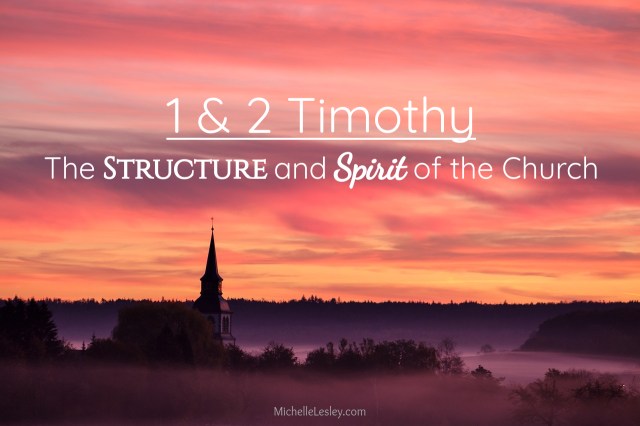
1&2 Timothy Bible Study

1 & 2 Timothy: Lesson 1- Introduction

Welcome to our new study, 1 & 2 Timothy: The Structure and Spirit of the Church!

What is God’s plan for the church? How did He intend for it to be structured and run, and what is His vision for us, His people, as we worship Him and love and care for one another? For the next several weeks we’ll work our way through the books of 1 & 2 Timothy, one of God’s “policy and procedure manuals” for the church, to learn about its organizational skeleton as well as the spirit of its people.

Many thanks to those who worked so hard on their entries for our title pic contest. You ladies were very creative and did some beautiful work! 

Cheryl Toepfer                             Becky McGraw

Patti Green                                    Terri Mobley

In the end, I had such a hard time figuring out how to capture the theme I had in mind for the study – bouncing from one thought to another and discontent with every idea that popped into my mind – that I decided to design the title pic myself. (If there’s a chance I might end up dissatisfied, I’d rather be dissatisfied with my own work than the work of one of you lovely ladies!)

My thought is that the sunrise in this photo conveys the idea of the dawn of the church in history, when 1 & 2 Timothy were written. As the light of God’s instruction “rises” upon the church as they read through these epistles, it clears away the surrounding fog of uncertainty about God’s will and His ways for His people. Also, I really like the colors. :0)

If you’re new to using my Bible studies, just a few housekeeping items and helpful hints:

The studies I’ve written (you can find all of them at the Bible Studies tab at the top of this page) are like “training wheels”. They’re designed to teach you how to study the Bible for yourself and what kinds of questions to ask of the text so that, when you get the hang of it, you won’t have to depend on other people’s books and materials – even mine – any more. To that end, I do not provide answers for the study questions in the studies I’ve written.

My studies are meant to be extremely flexible and self-paced so that you can use them in the way that works best for you. You can do an entire lesson in one day or work on the questions over the course of the week (or longer). You do not need to feel obligated to answer all (or any) of the questions. If the Holy Spirit parks you on one question for several days, enjoy digging deep into that one aspect of the lesson. If He shows you something I haven’t written a question about that captures your attention, dive in and study it! Those are ways the Holy Spirit speaks to us through His Word. This is your time to commune with the Lord, not a school assignment or work project you are beholden to complete in a certain way by a certain deadline.

I will post a new lesson on the blog every Wednesday, so there is nothing to sign up for or commit to. Simply stop by the blog each week, or subscribe to the blog via e-mail to have the lessons delivered to your inbox.

With our last study (Imperishable Beauty) I “beta tested” a Facebook discussion group specific to that study. It was enthusiastically received, but after the first couple of weeks, there was virtually no participation. So with this study, I’ve decided not to put in the extra work of admin-ing a discussion group. You are welcome to form and admin your own discussion group if you like. I will also post the lessons on my own Facebook page each week, and anyone who would like to discuss the lesson can do so in the comments section of those posts.

I use hyperlinks liberallyThe Scriptures for each lesson will be linked either at the beginning of the lesson or in the lesson questions. Whenever you see a word in red, click on it, and it will take you to a Scripture, article, or other resource that will help as you study.

All of the studies I’ve written are suitable for groups or individuals. You are welcome to use them as a Sunday school or Bible study class curriculum (for free) with proper attribution.

You are also welcome to print out any of my Bible studies (or any article I’ve written) for free and make as many copies as you’d like, again, with proper attribution. I’ve explained more about that in this article (3rd section).


Introduction to 1 Timothy

Before we begin studying a book of the Bible, it’s very important that we understand some things about that book. We need to know…

Who the author was and anything we might be able to find out about him or his background.

Who the audience of the book is: Jews or Gentiles? Old Testament Israelites or New Testament Christians? This will help us understand the author’s purpose and approach to what he’s writing.

What kind of biblical literature we’re looking at. We approach books of history differently than books of wisdom, books of wisdom differently than books of prophecy, etc.

What the purpose of the book is. Was it written to encourage? Rebuke? Warn?

What the historical backdrop is for the book. Is Israel at war? At peace? In exile? Under a bad king? Good king? Understanding the historical events surrounding a piece of writing help us understand what was written and why it was written.

When the book was written. Where does the book fall on the timeline of biblical history? This is especially important for Old Testament books which are not always arranged in chronological order.

So this week, before we start studying the actual text of the book of 1 Timothy, we need to lay the foundation to understanding the book by finding the answers to these questions.

Read the following overviews of the book of 1 Timothy, taking notes on anything that might aid your understanding of the book, and answer the questions below:

Bible Introductions: 1 Timothy at Grace to You

Overview of the Book of 1 Timothy at Reformed Answers

Book of 1 Timothy at Got Questions

1. Who wrote the book of 1 Timothy? How do we know this?

2. Approximately when was 1 Timothy written? What is the geographical setting of the book of 1 Timothy? Here are some maps (scroll down to “1 Timothy”) that may be helpful as you study through the book of 1 Timothy.

3. Who is the original, intended audience of the book of 1 Timothy? Describe the historical setting (historic events, politics, sociology of the time, etc.) of 1 Timothy.

4. Which genre of biblical literature is the book of 1 Timothy: law, history, wisdom, poetry, narrative, epistles, or prophecy/apocalyptic? What does this tell us about the approach we should take when studying this book versus our approach to books of other genres?

5. What is the theme or purpose of the book of 1 Timothy?

6. What are some of the major topics of instruction in the book of 1 Timothy? How do these topics relate to the theme of 1 Timothy?

7. What are some ways 1 Timothy points to and connects to Jesus?

8. What else did you learn about 1 Timothy or the setting of this book that might help you understand the text of the book better?

Take some time in prayer this week to begin preparing your heart for this study. What are some ways your pastor and church could be encouraged by the instruction of 1 Timothy? What might you learn that could make you a healthier church member? Do you have any areas that need improvement when it comes to the way you serve God or your brothers and sisters in Christ? Ask God to grow you in those areas as we study together 1 & 2 Timothy: The Structure and Spirit of the Church.
1&2 Timothy Bible Study

New Bible Study Kickoff and Title Pic Contest

Happy Wednesday, Ladies!

Today, we’re kicking off our new study…

…with a fun title pic contest!

It’s common these days to hear pastors say that they have a “vision” for the church. But how often do we stop and think about God’s vision for the church? In 1 & 2 Timothy, God’s instructions to a young pastor, we’ll see the beauty of God’s attribute of administration as He sets the practical aspects of the structure of the church in order, but we’ll also see His heart for the spirit of the church to be wholly oriented toward Him – for His glory and our good. This is church as it was meant to be – then and now.

But before we get started studying, how about a little fun?

You’ve probably noticed that I design a title picture for each Bible study I write. Here are a few past title pics:

(You can see the rest of them at the Bible Studies tab, if you like.)

Y’all have sent in some beautiful and creative entries in our past title pic contests, so, once again, I wanted to get some of you involved in the design process for our new study.

Do you enjoy and have a knack for photo editing? Know someone who does? If so, I’m accepting submissions for title pictures for the 1 & 2 Timothy study. If your submission is chosen it will be used each week of the study, and you’ll be credited (name or website) by watermark. I’d love to be able to offer a huge cash prize, but, hey, we’re small potatoes here. This is just for fun and maybe a little publicity for your site, if you have one.

Contest Guidelines

 You must use images that don’t require attribution. Pictures you’ve taken yourself are fine, as are images from sources such as Pixabay, Pexels, Freely, Unsplash, StockSnap, or other free stock photo web sites. Please include the image source web sites you use along with your submission. (You cannot just grab and use any old picture off the internet. Photographers own their images and usually require permission, attribution, and often a fee, for their use.)

Title pics should be landscape (a horizontal rectangle) with a width of 640-1500 pixels and proportionate height. I prefer JPG images, but PNG is fine, too, if necessary.

 Your title pic must contain the full title of the study: 1 & 2 Timothy: The Structure and Spirit of the Church. (Be sure to double check your spelling). 
 If your submission is selected, I’ll be glad to watermark it with your website address (please submit your picture without any watermarks) as long as your web site doesn’t conflict with my statement of faith or my beliefs outlined in the Welcome tab.

 Deadline for submissions is 11:59 p.m. Monday, April 15, 2019

E-mail your title pic submission along with your full name, web site address (if any), and the source(s) you used for your image(s) to MichelleLesley1@yahoo.com.

 Please don’t be offended if your submission isn’t selected. If I peruse all the submissions and I’m just not “feeling it,” I may still elect to design one of my own.

Feel free to share this around with friends who have an interest in photo editing. If you want to take a whack at it for fun but don’t know where to start, play around with Be Funky, PicMonkey, or Canva and see which one works best for you. Think about God’s vision for His church and try to capture the theme of 1 & 2 Timothy in your image.

Happy designing!

Biblical Womanhood Bible Study

Imperishable Beauty: Lesson 17- The Most Beautiful Girl in the World…er…Bible- Finale

Previous Lessons: 1, 2, 3, 4, 5, 6, 7, 8, 9, 10, 11, 12, 13, 14, 15, 16

Read These Selected Scriptures

It’s been a beautiful 17 weeks studying biblical womanhood with you! Today, we’re bringing things to a close as we reflect on all we’ve learned. Links to all previous lessons are located above.

Questions to Consider

1. We started this study by looking at the Proverbs 31 woman (lessons 2-3), often considered the icon of biblical womanhood. In subsequent lessons, we tried to answer the question, “If the Proverbs 31 woman really is the ideal to attain to, how do we get there from here?”. And we’re finishing up today by looking back again at the Proverbs 31 woman. Is she really the quintessential picture of biblical womanhood? How do all the other Scriptures we’ve studied flesh out the ideal described in Proverbs 31?

2. What does verse 10 mean? Consider verse 10 in light of lessons 4-6. How does the fact that you were uniquely created by God (4), that your identity is found in Christ (5), and that you are a vital member of the Body of Christ (6), provide a foundation to build on for becoming the rare, excellent, godly woman?

3. Examine verses 11-12 in light of lesson 11. What are some of the ways you can be obedient to Scripture that will enable you to do your husband good and not harm, benefit him, and enable his heart to trust in you?

4. Consider verse 17 in light of lessons 7-9. How do knowing and loving God’s Word (7), obeying God’s Word (8), and sharing the gospel (9), dress you with strength and make your arms strong?

5. What is the general motif of verses 17, 22, 25? Compare these verses to the concept of “adorning” we studied in lesson 15. With what “clothing” should a godly woman “dress” or adorn herself?

6. Examine verse 26 in light of lessons 13-16. How can we open our mouths with wisdom and teach kindly through our position in the church (14), our portrayal of biblical womanhood in the church (15), and our proclamation of God’s Word (16) in the church? What are the unique opportunities single women (13) have to teach and model wisdom and kindness in the church?

7. Examine verses 27-28 in light of lessons 10-13. How can we diligently look well to the ways of our households and families as daughters (10), wives (11), mothers (12), and single women (13)?

8. In what specific areas has God grown you in biblical womanhood during the course of this study? What would you say was your most important takeaway from this study?


Homework

Go back over the questions in the “Expectations and Presuppositions” section of lesson 1. Have any of your answers changed? How or why? Did you get out of this study what you were hoping to get out of this study (#6)? Explain.


Suggested Memory Verse

Give her of the fruit of her hands, and let her works praise her in the gates.
Proverbs 31:31

Mailbag

The Mailbag: Potpourri (Prayer quilts, Discouraged husband, Jesus Calling at the CPC…)

Welcome to another “potpourri” edition of The Mailbag, where I give short(er) answers to several questions rather than a long answer to one question. I also like to take the opportunity in these potpourri editions to let new readers know about my comments/e-mail/messages policy. I’m not able to respond individually to most e-mails and messages, so here are some helpful hints for getting your questions answered more quickly. Remember, the search bar can be a helpful tool!

In these potpourri editions of The Mailbag, I’d also like to address the three questions I’m most commonly asked:

“Do you know anything about [Christian pastor/teacher/author] or his/her materials? Is he/she doctrinally sound?”

Try these links: 
Popular False Teachers /
 Recommended Bible Teachers / search bar
Is She a False Teacher? 7 Steps to Figuring It Out on Your Own
(Do keep bringing me names, though. If I get enough questions about a particular teacher, I’ll probably write an article on her.)

“Can you recommend a good women’s Bible study?”

No. Here’s why:
The Mailbag: Can you recommend a good Bible study for women/teens/kids?
The Mailbag: “We need to stop relying on canned studies,” doesn’t mean, “We need to rely on doctrinally sound canned studies.”.

“You shouldn’t be warning against [popular false teacher] for [X,Y,Z] reason!”

Answering the Opposition- Responses to the Most Frequently Raised Discernment Objections


Wondering if you’ve ever commented on “Prayer Quilt Ministries” that some churches have. I was visiting a church recently that had an announcement in the bulletin for those interested to visit the lobby and “tie a knot in a prayer quilt”. On the church’s website the prayer quilt page says, “Gather to help press, pin, cut, sew or design prayer quilts. These are tied with prayer when given away to someone suffering from lengthy or devastating illness.” It’s probably a good work to make a quilt for someone who needs it, but what about the “prayer & tying of knots” issue?

Great question! I think it probably depends on the church’s theology. If it’s a New Apostolic Reformation type of church that believes that touching these quilts and praying while tying the knots in them will heal the recipients or somehow transport some sort of spiritual mojo to them in the warp and woof of the fabric, then that’s false doctrine and it needs to be done away with. That would be kind of like those magic “prayer cloths” that televangelists used to send out if you would only send them a “seed offering”.

However, if the church is doctrinally sound (which your e-mail indicated is the case), it’s very unlikely that it’s anything sinister like that. It sounds to me like the quilts themselves are just a kind ministry to hurting people. It reminds me of the story of Dorcas. “All the widows stood beside [Peter] weeping and showing tunics and other garments that Dorcas made while she was with them.”

The purpose of the knots is probably two-fold. First, it encourages church members to pray for the recipients of the quilts, and gives them a touchstone of having done so. Second, the recipient is probably told that every knot on the quilt was tied by someone who prayed for her. I think the knots are probably sort of like the stones we sometimes see Israel setting up in the Old Testament, or even baptism – a physical reminder of a spiritual moment. It’s an encouragement both to those who tie them and the recipients.

And if that’s as far as it goes, I don’t think that’s unbiblical. In fact, I think it is a great ministry for women to get involved in, it reaches out to people with the love of Christ, and if a Bible or gospel tract is included (I hope!), it’s a form of evangelism. All good and biblical things.


I am married and have a struggle with my wife about our roles. It’s been hard dealing with this. I get more respect from my Starbucks barista than I do at home.

The whole girl power thing is really not bad if it doesn’t come at the expense of men. But it’s gone too far, it’s kinda like idol worship now.

I’m going to be honest I know a lot of men that are tapping out. Young men don’t want to get married, older men can’t afford their wives’ lifestyles. Divorced men are ruined and spiraling down out here. It’s bad… Real bad.

You may never read this, but I hope you keep up the good fight. Not many people, much less women even look at us men as anything more than walking ATM’s and fix it guys. Thank you for making a bold move in the opposite direction. God be with you and keep you.

Every once in a while I get a heartbreaking e-mail like this from a husband. Sadly, there’s usually nothing I can do for them. Their wives are not the type who would care what I had to say even if I could talk to them.

But ladies, I’d like to ask you to do something for our friend here. Would you take just a moment and pray for him, his marriage, and his wife? And, if you wouldn’t mind, would you leave a comment under this article letting him know you’ve prayed for him and offering any words of encouragement you’d like? Thank you.


I volunteer at a Crisis Pregnancy Center that regularly gives away not only Bibles (good) but also Jesus Calling (bad!). I have been researching and note-taking a compilation of what you point out so that I can gently and lovingly bring this to the attention of the director of the center. I am not very confident however that she and others in authority will see the problem. It might be worth noting that my job at the center is strictly data input. I do not see any patients so therefore I myself do not ever have an occasion give a patient a Jesus Calling devotion. But should I not volunteer here if others continue to do so?

Way to be thinking theologically! This is the kind of thing we will all have to be thinking through more and more as the days grow darker, and it’s important that we think them through biblically.

Wow, it hurts my heart to hear that a CPC is doing this. These women are already in a difficult situation and instead of helping them with the truth of Scripture this CPC (and probably others out there) is feeding them false doctrine when they’re at their most vulnerable. 

Approaching the director kindly is the best first step, remembering that the vast majority of Christians simply don’t know what false doctrine is or the extent to which it has infected Christian materials. For most people, it never occurs to them that something sold at a Christian store might not be biblical. It’s my prayer that the director will listen and be convicted to stop using these materials in favor of doctrinally sound ones. When you go in to talk to her, you might want to have a couple of suggestions in mind for alternative materials. This tract from Living Waters might be a fit. Wretched has a great little gospel booklet called Don’t Stub Your Toe. Or you might contact Pre-Born! or another pro-life ministry you trust and ask for ideas.

But if the director brushes off your concerns, you’ll need to make a decision about whether or not to continue to work there. If you are married, the first thing you need to do is discuss this with your husband and find out what he thinks. If he tells you what he’d like you to do, you’ll need to abide by that. But even if he leaves the decision up to you, he will probably have some helpful wisdom and insight. You might also wish to bounce this off your pastor, an elder, or a godly friend.

Since you’re not the one purchasing the books or handing them out, I believe you could still work there – if your conscience allows. I would recommend that you pray about it and ask God to give you the wisdom to make a godly decision.


I need some direction. I’ve been teaching/sharing God’s Word at a nursing home for over two years on Sunday mornings. We have mostly women, but there are two men who join us. I was asked by the nursing home to lead our little church because they haven’t been able to find any men willing to do it. That’s my dilemma, I know Paul said he wouldn’t allow a woman to teach men, I don’t know how to handle this. I myself am not part of any other church, so I don’t have a pastor to help. I’ve reached out to some churches, but no one is getting back to me. Since we can’t find a man willing to lead, am I okay to keep doing what I’m doing? 

That is quite the dilemma! Let me see if I can help.

You started your e-mail by saying, “I need some direction,” so I hope you’ll be open to some direction that’s in a bit of a different direction than the one you’re asking about.

It’s wonderful that you’re wanting to help out at the nursing home and teach God’s Word. We need more women in mercy ministries like this, and I’m sure you’re a joy and a blessing to the ladies. But I’m afraid there’s a bigger issue you need to deal with than whether or not to be teaching at the nursing home.

You need to find a doctrinally sound church, become a member of it, and attend and serve it faithfully. Church membership, fellowship, and service are not optional for Christians (Basic Training: 7 Reasons Church is Not Optional and Non-Negotiable for Christians).

The Bible knows nothing of unchurched Christians, and serving at the nursing home is not a reason not to be joined to a local church. You could always serve at the nursing home on Sunday afternoons after worshiping at your own church, or serve on another day. If you’re asking around at churches for someone to volunteer on Sunday mornings, this is why you’re not getting much of a response – you’re contacting churches. Pastors and their church members are supposed to be in church on Sunday mornings, not somewhere else.

I know you might be thinking that your group of ladies at the nursing home is your church because you called it “our little church”. It might be an awesome group of ladies with super close fellowship, but what you have there is a women’s Bible study class, not a church. It doesn’t have a pastor, elders, or deacons. It doesn’t have a membership, so there’s no mechanism for church discipline. Nobody is giving offerings or serving the Body. You’re not performing the ordinances of baptism and the Lord’s Supper (I hope). This is not a church.

Have you ever been on an airplane and noticed that when the flight attendant gives the safety instructions, she always tells you to put on your own oxygen mask first before assisting others with theirs? It’s good advice in this situation too. Right now, you’re disobeying Scripture by not being joined to a local church, so you’re setting a sinful example for your ladies while simultaneously teaching them that they need to obey God’s Word. Put your mask on first. Repent and join a local church. You also need to be sitting under good preaching and teaching at your own church so you’ll have something to give these ladies and to keep your own theology on track so you can make sure what you’re teaching them doesn’t veer off into false doctrine. Put your mask on first. You can’t help other people breathe if you’re passing out from lack of oxygen. Finally, joining a local church will fix the problem you mentioned of, “I don’t have a pastor to help.” If you’ll put your mask on first by finding a good church to join, you will have a pastor, elders, deacons, and lots of other men to help.

When we do things God’s way, in God’s order, most of the secondary things, like your dilemma about the men at the nursing home, tend to fall into place. Tell you what. You find a good church to join – maybe one of the ones you contacted for help (check out the “Searching for a new church?” tab at the top of this page if you need it) – get plugged in, and ask your pastor for some help with this. If he can’t or won’t help you, write me back, and we’ll go from there, OK? I’ll bet you won’t need to.


If you have a question about: a Bible passage, an aspect of theology, a current issue in Christianity, or how to biblically handle a family, life, or church situation, comment below (I’ll hold all questions in queue {unpublished} for a future edition of The Mailbag) or send me an e-mail or private message. If your question is chosen for publication, your anonymity will be protected.

Biblical Womanhood Bible Study

Imperishable Beauty: Lesson 16- A Beautiful Proclamation in the Church

Previous Lessons: 1, 2, 3, 4, 5, 6, 7, 8, 9, 10, 11, 12, 13, 14, 15

Read These Selected Scriptures

In our last lesson, we examined how we can beautifully portray biblical womanhood in the church. Today, we’ll finish up our section on biblical womanhood in the church by looking at how godly women can beautifully proclaim the Word of God in the Body of Christ.

Questions to Consider

1. Briefly review lessons 14-15 (links above), noting the instructions God has given to and about women regarding our role in the church. What are the do’s and don’ts God has laid out for us, especially in 1 Timothy 2:12, regarding teaching and authority in the gathered Body of Believers (the church)?

2. Examine the first two passages (Titus 2 and 2 Timothy 2) of Scripture. Recalling that these books are pastoral epistles, to whom are these instructions primarily addressed? To which venue (home, marketplace, church, etc.) do these instructions primarily apply?

In the Titus 2 passage, the Holy Spirit gives instructions for which individuals (1, 7-8)/groups (2, 3, 4-5, 6, 9-10)? Examine the instructions for Titus and for each group. Are they instructed to be something (character), or do something (actions), or both? Why does God instruct Titus and these groups to be and do these things? What is the point of all this godly character and behavior? (“so that”: 5b, 8b, 10b)

Who, in the Titus 2 passage, is instructed to “teach”? (1&7, 3-4) Why do you think God singles out only the pastor and older women with the instruction to teach and train? Who is the pastor to teach? Who are older women to teach and train? (4) Using the context of these verses, what age or station in life would you infer this passage means by “older” women? “Young” women? If it is the responsibility of older women to teach and train young women, what is the responsibility of the young women?

Examine verse 3 carefully. Is this a “do” verse or a “be” verse, or both? Which instruction comes first, “be” (character) or “do” (action)? Would it be biblically accurate to say that older women without the godly character described in the first part of verse 3 should not be doing the action (teaching) in the last part of verse 3 – that godly character is a prerequisite for teaching younger women?

Examine 3b-4a: “They are to teach what is good, and so train the young women…”. Does this sound like a command, or is it optional/a suggestion? If it is a command, doesn’t that make the character instructions in 3a a command as well? Take a moment to prayerfully evaluate yourself. How are you doing on the “be” and “do” of verses 3-4?

As you continue to examine 3b-4a- is there a difference between “teaching” and “training“? Could it be biblically accurate to say that teaching is to impart knowledge, and training is to show someone how to apply that knowledge to real life situations? (For example, teaching someone the rules and regulations of basketball in a classroom-type setting, versus putting that person on a basketball court and training her to apply those rules with basketball in hand.) Which comes first in 3b-4a, teaching or training? What does 3b say older women are to teach? What do 4a-5a say older women are to train younger women to be and do? Is it possible to train Christian women “to love their husbands and children, to be self-controlled, pure, working at home, kind, and submissive to their own husbands,” without first teaching them “what is good” – what the Bible says about how to do these things and why they should do them? Is it wise to attempt to train Christian women in these things without basing them in Scripture?

Even though 2 Timothy 2:15 is primarily addressed to pastors, does it still apply to others who teach God’s Word? How should this verse inform your teaching and training of younger women? Whose approval should you be seeking when handling God’s Word? What does this verse mean when it says “Do your best” so you will have “no need to be ashamed”? What does it mean to “rightly handle the Word of Truth”?

3. Carefully read the 2 Timothy 3 passage. How does the Holy Spirit describe people’s attitudes and actions during the last days? (2-5) Considering what He says these people will do in 5-6a, are the people He’s describing in 2-5 Christians or non-Christians? Church-goers or non-church-goers? What does it mean to have the appearance of godliness, but deny its power? (5a) How do verses 8-9 describe these same people from 5a? What term might we use for people like this today? How are we to regard such people? (5b) Why are we to “avoid such people” (5b), and who are “them” (6a)? Why does verse 6 specify “weak women” instead of saying “men” or “people”? How do verses 6-7 describe these at-risk women?

If the (2 Timothy 3) weak woman, unable to arrive at a knowledge of the truth and captured by false teachers who oppose the truth, is one of the (Titus 2) young women in the church, is she going to have a truthful, biblical understanding of how and why “to love their husbands and children, to be self-controlled, pure, working at home, kind, and submissive to their own husbands”? How can the (Titus 2) older woman “rightly handle the Word of Truth” and “teach what is good” to this younger woman? What sorts of good things from Scripture would this older woman need to teach the younger woman? Have you ever seen a scenario like this in your church? How would you apply the Scriptures we’re looking at to that scenario?

4. Look at the final three passages (1 Timothy 2, 2 Timothy 1 & 3). Besides women, what is another part of the church whom women are uniquely gifted to teach? (You may wish to go back to lesson 14 (link above) and re-read the paragraph near the end of the lesson which begins with, “Verse 15 can be a little cryptic…”. ). Who were Lois and Eunice? (1:5) To which child did they teach the Scriptures? (1:2,3:15) What did he go on to do as an adult? Who are some other men from Scripture who had mothers who trained them in godliness? Describe the impact Christian women can have on the church by training children in godliness and the Word.

5. Considering all of today’s passages, which two groups of people in the church has God blessed women to proclaim the Word to? If women were not teaching other women and children in the church, would the church be healthy?


Homework

Egalitarians often cite the women listed in Romans 16 and Priscilla and Aquila’s conversation with Apollos as evidence that God is OK with women preaching or instructing men in the church. How would you answer this argument? Examine both passages. Does Romans 16 say any of the women listed taught or preached? Was Priscilla’s and Aquila’s private conversation with Apollos the same as Priscilla teaching or preaching to the gathered Body of Believers? Would Paul have commended any of these women in Romans 16 if they had disobeyed his instructions in 1 Timothy 2:12?


Suggested Memory Verse

Do your best to present yourself to God as one approved, a worker who has no need to be ashamed, rightly handling the word of truth.
2 Timothy 2:15