1. Briefly review the the introductory questions and materials in Lesson 1 (link above).
2. Read Matthew 1-4. How do the events in these chapters lay the groundwork for Jesus to preach the Sermon on the Mount? What sort of overall context do chapters 1-4 provide for the Sermon?
3. As you read chapters 1-4, notice Matthew’s emphasis on prophecy fulfilled. Make a note of each fulfilled prophecy mentioned and think of them as points on Jesus’ “résumé”. How do each of these fulfilled prophecies point to Jesus’ qualifications to fill the position of Messiah, thus giving Him the divine authority to deliver the Sermon on the Mount?
Besides these instances of fulfilled prophecy, list any other verses that demonstrate Jesus’ qualifications – as God, Messiah, holy, etc. – to authoritatively deliver the Sermon on the Mount. (Hint: Here are a few to get you started.)
4. Explain the various ways God protected and preserved Jesus’ life and safety in chapters 1-4 so that He would be able to fulfill His earthly ministry (chapter 5 and beyond).
5. Why, besides the fact that it fulfilled prophecy, was it necessary for John the Baptist (chapter 3) to “prepare the way of the Lord”? What were some of the things he did to herald and introduce Jesus’ coming, and how did this prepare the hearts of the people to receive Him? What was John’s message to the Pharisees and the people?
Carefully examine 3:7-10. Do any of these ideas or phrases sound familiar as something Jesus Himself later said? Use your cross-references and look up the passages in which Jesus said or taught the same things.
6. How were each of the following significant in laying the foundation for Jesus’ earthly ministry?
Jesus’ baptism
Jesus’ temptation in the wilderness
Jesus relocating to Capernaum
Jesus calling the disciples
Homework
Carefully examine 4:1-11. Which Scriptures does Satan quote to Jesus? Does he rightly handle those Scriptures or use them out of context to further his own agenda? Why is it wrong to use Scripture this way? How does Jesus combat Satan’s temptations and Bible twistings? What is significant about Jesus’ use of the phrase “It is written”? Think of a situation in your life in which you could use rightly handled, in context Scripture to fight temptation or to stand against false teaching. Find a way to put that into practice this week. Use Scripture like Jesus used Scripture, not like Satan used Scripture.
Welcome to our new study, The Sermon on the Mount!
What does God’s Word teach us about thinking biblically and developing Christian character? Jesus’ Sermon on the Mount in Matthew starts off with a list of character traits God blesses (the Beatitudes), then fleshes out how to submit to Scripture in real life scenarios in order for the Holy Spirit to grow us in those godly character traits. For the next several weeks, we’ll be working our way through the Sermon on the Mount in Matthew 5-7.
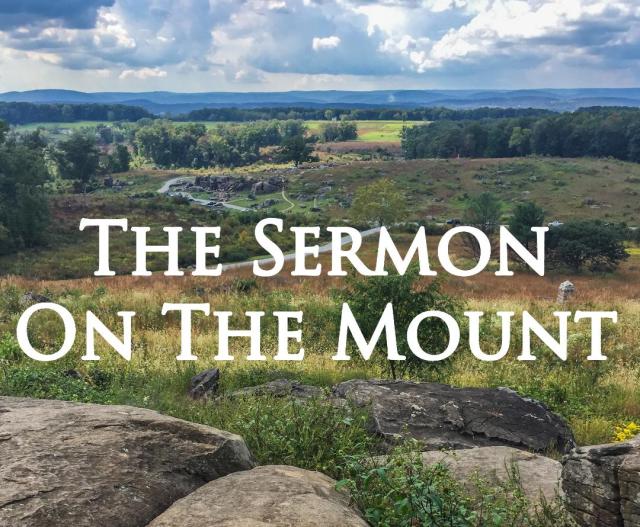
Our lovely title pic for the study was designed by Tammy Athey. The photo is her own, captured in the beautiful mountains of North Carolina. Many thanks to all of those who worked so hard on your entries for our title pic contest. You ladies were very creative and did some outstanding work!
There were too many entries to share all of them with you, but here are a few “honorable mentions”:
Lindsey Portugal
Melody Castle
Kendra Bennett
Kati Champlin
Sabrina Deeter
If you’re new to using my Bible studies, just a few housekeeping items and helpful hints:
The studies I’ve written (you can find all of them at the Bible Studies tab in the blue menu bar at the top of this page) are like “training wheels”. They’re designed to teach you how to study the Bible for yourself and what kinds of questions to ask of the text so that, when you get the hang of it, you won’t have to depend on other people’s books and materials – even mine – any more. To that end, I do not provide answers for the study questions in the studies I’ve written.
My studies are meant to be extremely flexible and self-paced so that you can use them in the way that works best for you. You can do an entire lesson in one day or work on the questions over the course of the week (or longer). You do not need to feel obligated to answer all (or any) of the questions. If the Holy Spirit parks you on one question for several days, enjoy digging deep into that one aspect of the lesson. If He shows you something I haven’t written a question about that captures your attention, dive in and study it! Those are ways the Holy Spirit speaks to us through His Word. This is your time to commune with the Lord, not a school assignment or work project you are beholden to complete in a certain way by a certain deadline.
I will post a new lesson on the blog every Wednesday, so there is nothing to sign up for or commit to. Simply stop by the blog each week, or subscribe to the blog via e-mail to have the lessons delivered to your inbox.
I use hyperlinksliberally. The Scriptures for each lesson will be linked at the beginning of the lesson and in the lesson questions. As you’re reading the lesson, whenever you see a word in a different color text, click on it, and it will take you to a Scripture, article, or other resource that will help as you study.
All of the studies I’ve written are suitable for groups or individuals. You are welcome to use them as a Sunday school or Bible study class curriculum (for free) with proper attribution.
You are also welcome to print out any of my Bible studies (or any article I’ve written) for free and make as many copies as you’d like, again, with proper attribution. I’ve explained more about that in this article (3rd section).
Introduction to The Sermon on the Mount
Before we begin studying a book of the Bible, it’s very important that we understand some things about that book. But even though we’re not going to be studying the whole book this time, we still need to know…
Who the author was and anything we might be able to find out about him or his background.
Who the audience of the book is: Jews or Gentiles? Old Testament Israelites or New Testament Christians? This will help us understand the author’s purpose and approach to what he’s writing.
What kind of biblical literature we’re looking at. We approach books of history differently than books of wisdom, books of wisdom differently than books of prophecy, etc.
What the purpose of the book is. Was it written to encourage? Rebuke? Warn?
What the historical backdrop is for the book. Is Israel at war? At peace? In exile? Under a bad king? Good king? Understanding the historical events surrounding a piece of writing help us understand what was written and why it was written.
When the book was written. Where does the book fall on the timeline of biblical history? This is especially important for Old Testament books which are not always arranged in chronological order.
So this week, before we start studying the actual text of the Sermon on the Mount, we need to lay the foundation to understanding the book by finding the answers to these questions.
Read the following overviews of the book of Matthew, taking notes on anything that might aid your understanding of the book, and, particularly the Sermon on the Mount and answer the questions below:
1. Who wrote the book of Matthew? How do we know this?
2. Approximately when was Matthew written? What is the geographical setting of the book of Matthew? Here are some maps (scroll down to “Matthew”) that may be helpful as you study through the book of Matthew.
3. Who is the original, intended audience of the book of Matthew? Describe the historical setting (historic events, politics, sociology of the time, etc.) of Matthew.
4. Which genre of biblical literature is the book of Matthew: law, history, wisdom, poetry, narrative, epistles, or prophecy/apocalyptic? What does this tell us about the approach we should take when studying this book versus our approach to books of other genres?
5. What is the theme or purpose of the book of Matthew?
6. What are some of the major topics of instruction in the book of Matthew? How do these topics relate to the theme of Matthew?
7. What are some ways Matthew points to and connects to Jesus?
8. What else did you learn about Matthew or the setting of this book that might help you understand the Sermon on the Mount better?
Take some time in prayer this week to begin preparing your heart for this study. Ask God to grow you in holiness and in following the exhortations of Christ as we study together The Sermon on the Mount.
Or maybe I answered your question already? Check out my article The Mailbag: Top 10 FAQs to see if your question has been answered and to get some helpful resources.
So it is by way of this email that I ask you to pray about my request to disciple me as a young woman in accordance to Titus 2.
You are so dear, and your e-mail was so sweet. I would love to say yes, but sadly, I cannot. Please see #10 in my article The Mailbag: Top 10 FAQs.
I would love your thoughts on the study of Scripture using the sentence diagram method. I have never tried it but it does look interesting. However I do not want to get into a mess of confusion.
If reading the phrase “the sentence diagram method” just gave you a fond or traumatic flashback to 7th grade English class, then you pretty much already know what it is. It’s taking a Bible verse and diagramming it – either grammatically (with all the little lines for adverbs and adjectives and conjunctions and whatnot), or conceptually (blocking it out according to concept and how those concepts connect.
If you’d like to see an example, click here. (FYI- This link does not mean I’m recommending this site. She endorses and/or has connections to several false teachers.)
If you’re a grammar nerd or language aficionado like I am, this is method is probably right up your alley, and if you need to employ it from time to time to better understand one of Paul’s numerous lengthy run-on sentences, then go for it!
My only counsel would be, don’t make this your only method of Bible study. For the most part, you need to be reading and studying the overall meaning, concepts, and application of larger passages of Scripture, not focusing on dissecting one verse every day. It’s kind of like cooking supper. You need to focus on fixing the whole meal every night rather than pouring all your focus into mincing that clove of garlic into perfectly symmetrical cubes.
I am convicted because I have not been faithful to be a witness for the Gospel. I get tongue tied even with family! I just want to be faithful like the Apostle Paul. My problem is getting started……I know the Good News and want to share. Can you help guide me? I was invited to church and heard the Word preached and the Holy Spirit convicted me of my guilt as a sinner. Can I just invite someone to church?
What a wonderful encouragement it is to encounter a sister with a zeal for sharing the gospel! If it makes you feel any better, a lot of us have the same experience when it comes to sharing the gospel. Let me see if I can offer a little help:
While we are all commanded to share the gospel with the lost, there are some people who are just really gifted at it. It comes as naturally to them as breathing, they never get flustered, and they make it look easy. I’m not one of those people, but I can point you to a couple of brothers who are: Ray Comfort and Todd Friel. Head on over to the Living Waters YouTube channel and watch a few thousand videos of Ray walking up to strangers and sharing the gospel. Subscribe to Wretched on your favorite podcast platform, and listen in to the “Witness Wednesday” episodes with Todd. These are the kinds of guys you should look to and be learning from when it comes to “cold call” evangelism.
Remember that walking up to a stranger and verbally sharing the gospel is not the only way you can evangelize:
If you have unsaved children at home, they are your primary mission field. They’re just as lost and dead in their sins as any stranger on the street.
Ditto for teaching children at your church. Pour the gospel into those kiddos every week.
Tracts. Get a bunch and carry them around in your purse. Leave them behind at the store, the doctor’s office, the gym, wherever you go. Hand them to people personally when the opportunity arises. I highly recommend the Bezeugen Tract Club and tracts from Living Waters.
If you’re on social media, share the gospel on your timeline. Write it out in your own words, share Scripture, or share links to gospel presentations. Here’s our gospel page at A Word Fitly Spoken. It has a text presentation of the gospel and a couple of videos if you’d like to share them.
It is absolutely fine to invite someone to church (assuming you go to a doctrinally sound church) or any other Christian event where the gospel will be clearly and biblically presented. I would only quibble with people who call inviting someone to church “evangelism”. That’s not evangelism. Evangelism is when you actually share the gospel with someone (which every Christian should do when the opportunity presents itself). Inviting someone to church is inviting her to a place where she’ll be evangelized.
Should I attempt to bribe/beg/force my teenage sons to go to church? My husband is no longer attending or leading the family spiritually. My sons and I do Bible study together, but they have no other church experiences.
Wow, this is such a difficult position for you to be in. I’m so sorry. I’ve taken a moment to pray for you and your family, and I would ask everyone reading this to pause briefly and do the same.
I would strongly encourage you to set up an appointment with your pastor to discuss this. Giving wise counsel to those he pastors is part of his job. You could also more thoroughly explain your situation to him and he could give you better informed counsel than I can.
Not knowing the dynamics of your situation, the best I can tell you is that I don’t see anything in Scripture that would say it’s a sin to offer your sons something they want or to excuse them from a certain chore or something like that in exchange for them attending church.
I’m not sure “beg” and “force” are words I’m comfortable with in the parent/child relationship. You are the parent. You are the one in authority and responsible to God for your children. When you tell them to do something, they should respectfully obey you. Period. “Begging” and “forcing” shouldn’t even be part of the equation.
That being said, I think it would be good and healthy for you to sit them down and have a serious, loving talk with them, explaining that, because you love them and want what’s best for them, you want to urge them to come to church with you. You can also explain how much their attendance would mean to you (just be careful not to guilt or manipulate them). And, since you’re teaching them the Bible, you might want to spend some time on Hebrews 10:24-25. But when you’ve had this talk with them, especially if they’re older teens and not Believers, you will probably need to leave the decision up to them. This is something it would be good to get your pastor’s guidance about.
If a woman were to speak at a church on the issue of abortion, would that fall into the category of a woman exercising authority over men?
No, the issue here would be whether or not she’s preaching to men or instructing them in the Scriptures, not whether or not she’s exercising authority over them. Someone giving an informational talk on a certain topic isn’t exercising authority over anyone, regardless of the venue, the sex of the speaker or the sex of the audience.
It’s a little difficult to answer this question due to the lack of details. Is this woman simply a member of the church who wishes to address the congregation, or is she a special guest speaker from a pro-life organization? Is her talk taking the place of the Sunday morning sermon? Is she going to be going at it from a “professional” angle (ex: stats on abortion, stories about moms who chose life, pro-life legislation), or is she going to get up and preach a sermon on Psalm 139?
It would be perfectly biblical for a special guest speaker to give a professional informational talk (not preaching/teaching the Bible) in any time slot other than when the sermon usually takes place (Tuesday night, during a special Sunday luncheon, etc.). (Because a- nothing should take the place of the preaching of God’s Word, and b- you don’t want her or anyone in attendance to be confused that she’s preaching the sermon.)
It would also be fine a woman who’s a member of the church and does sidewalk counseling or volunteers at a crisis pregnancy center or even a woman who has had an abortion (and repented of it) to speak about her experiences in a “personal testimony” sort of way.
But when it’s time for biblical instruction and admonition from the Scriptures about abortion, that’s the pastor’s job.
If you have a question about: a Bible passage, an aspect of theology, a current issue in Christianity, or how to biblically handle a family, life, or church situation, comment below (I’ll hold all questions in queue {unpublished} for a future edition of The Mailbag) or send me an e-mail or private message. If your question is chosen for publication, your anonymity will be protected.
Thank you so much for all of your helpful input regarding which Bible study you’d like to do next. We will be doing Forgiven to Forgive1 at a later date, but today, we’re kicking off our next study…
…..with a fun title pic contest!
What does God’s Word teach us about thinking biblically and developing Christian character? Jesus’ Sermon on the Mount in Matthew starts off with a list of character traits God blesses (the Beatitudes), then fleshes out how to submit to Scripture in real life scenarios in order for the Holy Spirit to grow us in those godly character traits.
The Sermon on the Mount will be an “expositorially topical” (an expository deep dive into a short segment of Scripture) study of Matthew 5-7, similar in format to The Ten. We will examine the character traits God blesses in Christians and how God develops those traits in us as we walk with Him through the practical circumstances of life and as we develop a biblical worldview.
But before we get started studying, how about a little fun?
You’ve probably noticed that I design a title picture for each Bible study I write. Here are a few past title pics:
You can see the rest of them at the Bible Studies tab in the blue menu bar at the top of this page, if you like, to get a feel for my style and the general appearance I like my title pics to portray.
Y’all have sent in some beautiful and creative entries in our past title pic contests – indeed, the title pics for The Women of Genesis, Living Stones, and Imperishable Beauty were all designed by readers – so, once again, I wanted to get some of you involved in the design process for our new study.
Do you enjoy and have a knack for photo editing? Know someone who does? If so, I’m accepting submissions for title pictures for The Sermon on the Mount study. If your submission is chosen it will be used each week of the study, and you’ll be credited (name or website) by watermark. I’d love to be able to offer a huge cash prize, but, hey, we’re small potatoes here. This is just for fun and maybe a little publicity for your site, if you have one.
Contest Guidelines
☙You must use images that don’t require attribution. Pictures you’ve taken yourself are fine, as are images from sources such as Pixabay, Pexels, Freely, Unsplash, StockSnap, or other free stock photo web sites. Please include the image source web sites you use along with your submission. (You cannot just grab and use any old picture off the internet. Photographers own their images and usually require permission, attribution, and often a fee, for their use.)
☙Title pics should be landscape (a horizontal rectangle) with a width of 1000-2000 pixels and proportionate height. I prefer JPG images, but PNG is fine, too, if necessary.
☙Your title pic must contain the full title of the study: The Sermon on the Mount. (Be sure to double check your spelling).
☙If your submission is selected, I’ll be glad to watermark it with your website address (please submit your picture without any watermarks) if you have one, as long as your web site doesn’t conflict with my statement of faith or my beliefs outlined in the Welcome tab.
☙Deadline for submissions is 11:59 p.m. Monday, January 18, 2021.
☙ E-mail your title pic submission along with your full name, web site address (if any), and the source(s) you used for your image(s) to MichelleLesley1@yahoo.com. You are welcome to submit as many images as you like.
☙Please don’t be offended if your submission isn’t selected. If I peruse all the submissions and I’m just not “feeling it,” I may still elect to design one of my own.
☙☙☙☙☙
Feel free to share this around with friends who have an interest in photo editing. If you want to take a whack at it for fun but don’t know where to start, play around with Be Funky, PicMonkey, or Canva and see which one works best for you.
Think about – maybe even read – the Sermon on the Mount and try to capture in your image the theme of what Jesus was teaching or what it might have looked or felt like to be in the audience Jesus preached it to.
Happy designing!
1For those who were hoping for the study on forgiveness, you’ll notice that the Sermon on the Mount in Matthew 5-7 does touch on that topic, so we will cover it, albeit briefly, as part of this study.
Have I told you lately that I love you? (Some of us are old enough to remember that song! :0) I really do love all of you readers and followers. It is an honor and a joy to serve you in Christ.
Sometimes in an article I’ll say something like, “If you’ve been around the blog for a while, you probably know that…yada, yada, yada.” Well, some of y’all haven’t been around the blog for a while, and to that, I say welcome! It’s always great to have more of the fam gathered ’round.
But because some of y’all are new, you aren’t yet aware of all of the resources here to help you. Let’s remedy that!
Second, be sure to familiarize yourself with all of the tabs in the blue menu bar at the top of the page. That’s where I keep the info I’m most frequently asked about.
Third, there’s a search bar at the bottom of every page (and one in the blue menu bar at the top of every page) which might help you find what you need.
And finally, let me get you newbies some answers to the questions several of you have asked recently. Some of you long time friends may have missed these along the way, so I hope they’ll be helpful to you, too!
Are there any sound Christian musicians anymore?
Yes, they’re just few and far between, and not as well known as the unsound ones. Check out this article which contains both artists to avoid and doctrinally sound artists, plus other helpful resources:
My sister just got ordained by her church as a minister, also she is involved in deliverance ministries. She believes that God speaks outside of Scripture and promotes many false teachers. I’ve been praying for wisdom and compassion and the right opportunity to share. Any suggestions you may have would be greatly appreciated.
It is heartbreaking when a loved one forsakes sound doctrine and does a swan dive into the cesspool of rebellion and false teaching. If you need to approach a loved one in a situation like this, here’s some help:
I think the two best English translations out there right now are the English Standard Version (ESV) and the New American Standard (NASB). I also highly recommend the MacArthur Study Bible. Check out more info on Bible translations, some to avoid, and more great resources here:
Are you on any other social media that is in favor of free speech? I have deleted Twitter and am attempting to get off Facebook but I would still like to follow you.
This is an important one with all the censorship that’s taking place on the major platforms right now. I am currently on Facebook, Twitter, Instagram, Pinterest, MeWe, Parler, and Gab. (I also have a YouTube channel, but I’m not really using it at the moment.) My plan is to remain on Facebook and Twitter (and probably Instagram since it’s owned by Facebook) until I’m banned, then utilize my remaining platforms. You can always find the direct links to all of my social media accounts in the Contact and Social Media tab in the blue menu bar at the top of this page.
I have tried without success to find the answer to: As a woman is it violating 1 Timothy 2:11-12 for me to present the gospel to a man?
There’s a lot of confusion about what it means to “present the gospel” or “share the gospel” or “evangelize”. Some people use those as catchall terms for everything from a woman pastoring a church, to a mom reading a Bible story to her 2 year old, to posting a Bible verse on Facebook. If what you mean is a one on one conversation with a man in which you explain to him that he is a sinner, and how he can be saved (which is the actual defintion of the aforementioned terms), then the answer to your question is no. It is not a violation of Scripture for a woman to do that. See #11 here.
Got questions about the role of women in the church? Check out these resources:
Rock Your Role: A series of articles examining the Scriptures which pertain to the role of women in the church
Rock Your Role FAQs: Frequently asked questions about real life roles and activities in the church and whether or not women may biblically participate in them
Is X teacher, pastor, or author doctrinally sound?
If you don’t find the person you’re looking for there, find the search bar and type in the person’s name. (Make sure you spell it exactly right.) I may have mentioned the person you’re looking for in an article about someone or something else.
If you do both of these and you don’t get any hits, you can be confident that I haven’t written anything on the person you’re looking for. You’re welcome to email me asking about that teacher, but as you know (having read the “Blog Orientation” article linked above) I most likely won’t be able to answer. That brings us to our final resource here at the blog for researching and vetting teachers:
Who are some pastors, teachers, and authors you recommend?
You’ll find a list of several dozen at the Recommended Bible Teachers tab in the blue menu bar at the top of this page.
I live in X area. Can you help me find a doctrinally sound church?
The Searching for a new church? tab in the blue menu bar at the top of this page has multiple church search engines, churches recommended by my readers, information on church planting, what to look for in a doctrinally sound church, and how to biblically leave your current church. Just click and start searching!
Just a couple of notes:
You’ll have to do the legwork of searching and vetting the churches for yourself. I can’t do that for you.
If you’ve thoroughly searched every single search engine and can’t find an established church within achievable driving distance of your home, you may need to check around with local friends or denominational agencies, move, or start utilizing the church planting resources. You can email me, but I’m afraid I won’t be able to help. As I once joked with a friend, “I’m not Walmart. I don’t have any churches in the back stock room. Everything I have is out on the shelves.” :0)
Can you recommend a good women’s Bible study?
Yes, mine. You can find all of them – all free and all suitable for individual or group study, along with my philosophy of Bible study – at the Bible Studies tab in the blue menu bar at the top of this page.
No, I mean, can you recommend a pre-packaged book, DVD, etc., study by a well known Christian author?
No, because I recommend that women study straight from the text of Scripture itself (which is what my studies are designed to teach women how to do).
If you have a question about: a Bible passage, an aspect of theology, a current issue in Christianity, or how to biblically handle a family, life, or church situation, comment below (I’ll hold all questions in queue {unpublished} for a future edition of The Mailbag) or send me an e-mail or private message. If your question is chosen for publication, your anonymity will be protected.





 You can see the rest of them at the
