Mailbag, Parenting

The Mailbag: Potpourri (Rescinding a recommendation… Women at the Last Supper… Consistent discipline)

Welcome to another “potpourri” edition of The Mailbag, where I give short(er) answers to several questions rather than a long answer to one question.

I like to take the opportunity in these potpourri editions to let new readers know about my comments/e-mail/messages policy. I’m not able to respond individually to most e-mails and messages, so here are some helpful hints for getting your questions answered more quickly. Remember, the search bar (at the very bottom of each page) can be a helpful tool!

Or maybe I answered your question already? Check out my article The Mailbag: Top 10 FAQs to see if your question has been answered and to get some helpful resources.


Our women’s ministry team recently asked all of us Bible study teachers to promote the study they have chosen, and I personally recommended it to the women in my class. I told them “I don’t know anything about the author and haven’t read the study, but I trust the women’s ministry team and recommend you participate.” That afternoon I began researching her and discovered she was a woman pastor. I immediately contacted the women’s coordinator and shared my concerns.

I feel TERRIBLE that I have recommended a woman whose life choices make her a stumbling block to the gals I dearly love and have taught for years. My first instinct is to send my students only an email rescinding my recommendation and warning them that the author routinely preaches in her local church. I am torn between protecting them from a very beguiling threat and the implications a warning has for exposing the women’s ministry team. LESSON LEARNED for future recommendations, but for now, what is my Biblical obligation/priority?

That’s a difficult spot to be in. I’ve been there myself, having passed along a recommendation from someone I thought was discerning and trustworthy, only to find out later that she was not.

Here’s what I would suggest:

  • If you haven’t already, get alone with the Lord in prayer and repent of your carelessness. There is grace, mercy, and forgiveness awaiting you.

  • Write out a carefully, kindly, and wisely worded email to your class apologizing for your carelessness and explaining why you need to rescind your recommendation. Support everything you say with Scripture. (If you think it would be helpful, you may wish to include a link to this article of mine.) Don’t hit “send” yet.

  • Talk to your pastor before you do anything else. Explain the situation, plead with him to cancel the study, tell him (don’t ask him) your conscience demands that you send an email to your class rescinding your recommendation of the study, and offer to show it to him if he’d like to see it.

  • I pray your pastor will cancel the study. I really do. That will take the pressure off of you. You will still need to apologize to your class and explain why you agree with the pastor’s decision to cancel the study. Unfortunately, in situations like this, the pastor almost always backs up the study and the women’s director, not the discerning Christian who comes to him with concerns.

  • If your pastor affirms the study and the women’s ministry leader, express your disappointment calmly and politely, and reiterate that you must still send the email. Go to the women’s ministry leader, and as a gesture of courtesy, explain that you’ll be sending an email to your class rescinding your recommendation. Then, send the email.

  • Immediately begin looking for a new, doctrinally sound church. Women who are “pastors” and/or preach to men are false teachers. They preach with their behavior, “I don’t like this command of Scripture, so I’m not going to obey it. If there’s a command of Scripture you don’t like, you don’t have to obey it either.”. If your pastor is so doctrinally ignorant or unsound that he affirms this sin and false teaching, you don’t need to be sitting under his teaching and leadership.

What are the Scripture verses that back up the teachings that women were at the last supper? I know that this is something I’ve heard before, yet now my grandson is asking me about it because that’s what he learned in school.

There aren’t any. In fact, I’ve never heard anyone claim that any person – man or woman – other than Jesus and the twelve disciples were in attendance at the Last Supper.

  • The Matthew account says Jesus “reclined at table with the twelve.”
  • The Mark account says Jesus “came with the twelve. And as they were reclining at table and eating…”
  • The Luke account says Jesus “reclined at table, and the apostles with him.”
  • The John account focuses more on Jesus’ teaching at and after the supper than the actual supper itself, but even John says, “During supper” (v.2) Jesus “began to wash the disciples’ feet…” (v.5)

When you consider all four of the gospel accounts together, there is absolutely no argument to be made that anyone was present at the Last Supper besides Jesus and the twelve. There were no women among the twelve. There were no women apostles. Therefore, no women were at the Last Supper.

I’m guessing what happened is that somebody – perhaps Catholicism, in order to elevate Mary, or perhaps feminists, in order to make Jesus seem like an egalitarian – took a mention of “disciples” (without “the twelve” in front of it) from one of these passages and decided that could mean any follower of Jesus he or she wanted it to mean (most likely Mary, the mother of Jesus, or Mary Magdalene).

If your grandson is asking questions like this, take him to Scripture and teach him how to be a good Berean. Show him how to look up the passages in question and compare what he’s being taught to what the Bible actually says.

And if you have a relationship with his parents that allows you to express your concerns about what he’s being taught at school, express them (kindly, yet seriously, taking care not to be overbearing). I shudder to think about all the unbiblical things that school is indoctrinating your grandson with that he’s not asking you about.


I am a Christian mom, and I rarely accept back talk from my son. I always call it out, and usually give him some kind of discipline, but it doesn’t seem to improve things. Is there a secret formula?😃

That’s something a lot of moms deal with, and I know it’s got to be frustrating. Good for you for looking for ways to make your discipline more effective!

If what you’re doing isn’t working, your discipline either isn’t severe enough or isn’t consistent enough, or both. Discipline has to hurt in order to be effective.

A good example of the importance of consistency is an experiment I learned about when I was a psychology major back in the Stone Age. We were studying conditioning (training a subject in a behavior), and a lot of the studies we looked at had to do with training rats to push a lever for a pellet of food. Some rats got a pellet every time they pushed the lever. Some never got a pellet. Some got a pellet sometimes. Those were the rats who pushed the lever the most because they never knew when they would be rewarded with food or “punished” with none.

It’s the same with inconsistent discipline. You’re actually increasing the undesired behavior by being inconsistent because your child never knows whether that bad behavior is going to be rewarded, ignored, or punished. This is also part of what Ephesians 6:4 is talking about when it says not to exasperate your children.

Especially with boys, Dad needs to be involved. Your son needs to know that if he doesn’t respond to your discipline, Dad is going to step in and take over. The two of you should sit down, talk this through, and put a plan in place for how to work this out in various situations.

Also helpful would be to find a couple in your church whose children are well behaved and respectful and ask them to disciple you and your husband in this area.

Get those things going, and you’ll see improvement.


If you have a question about: a Bible passage, an aspect of theology, a current issue in Christianity, or how to biblically handle a family, life, or church situation, comment below (I’ll hold all questions in queue {unpublished} for a future edition of The Mailbag) or send me an e-mail or private message. If your question is chosen for publication, your anonymity will be protected.


Mailbag, Southern Baptist/SBC

The Mailbag: Where can I get info on #SBC23?

Will you be attending the Southern Baptist Convention in New Orleans this year? I am interested in any news or updates on the Convention. Do you know where I can get reliable information?

The 2023 annual meeting of the Southern Baptist Convention will be held June 13-14 at the Morial Convention Center in New Orleans, Louisiana. The actual business and voting will take place Tuesday, the 13th and Wednesday, the 14th. Ancillary events and activities will take place Saturday June 10 – Wednesday, June 14th. (See the Convention website for more details.)

Yes, Lord willing, I am planning to attend, at least the 13th and 14th. I will probably do some pop up “meet and greets” at the convention center for anyone who would like to stop by and say hello. Those were a lot of fun last year, and meeting so many of you was one of the best things about the ’22 Convention. The timing and location of these will be impromptu, and I will announce them only on Twitter, so be sure to follow me to catch those announcements.

Over the past couple of years, I have written detailed articles (like this one, this one, and this one) in anticipation of the annual meeting to keep my readers informed on the issues and events, and to encourage them to vote biblically. Many thanks to those who have contacted me this year to ask about a similar article for 2023, and have kindly mentioned how helpful previous years’ articles were. For a variety of reasons, I’ve decided against writing an article about this year’s Convention. Other than this one, that is. 🙂

I would recommend following these ministries, organizations, and accounts on Twitter (or wherever you can) for reliable information and a biblical perspective (except Baptist Press) about the latest happenings in the SBC:

I would strongly suggest following these accounts on Twitter rather than another platform because a lot of information comes out in interpersonal conversations rather than just in links to blog posts and such.

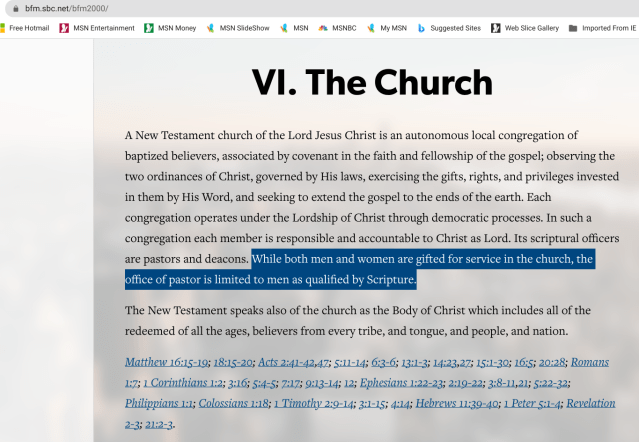
One item of business that is unfolding is a proposed amendment to the SBC constitution (not the BFM) that would exclude churches with women “pastors” from being in friendly cooperation with the SBC. This includes women who bear the title of pastor, even if they’re not functioning as pastors (e.g. “Women’s Pastor” “Children’s Pastor”) as well as women who are functioning as pastors even if they don’t bear the title of pastor (e.g. “Worship Leader” “Director of Education and Discipleship”). Churches with women in these positions or bearing these titles would not be allowed to “join” the SBC. If such a church is already a “member” of the SBC, it would be disfellowshipped (excommunicated) from the SBC.

At the moment, it has not been determined whether or not messengers will get to vote on this amendment. There is a letter of support pastors can sign, and you can get much more information at the SBC Amendment website.

The spotlight issue is going to be Rick Warren’s challenge of the Executive Committee’s decision to disfellowship (cut ties with) the “church” he “pastored” for over forty years – Saddleback, in Lake Forest, California. Saddleback currently has husband and wife “co-pastors” at the helm (appointed by Rick Warren prior to his retirement).

Earlier this year, the Executive Committee announced that Saddleback had been disfellowshipped for this reason, causing quite the stir among Southern Baptists in the know. Less than a year ago at the 2022 Convention, the head of the Credentials Committee, which is responsible for assessing whether or not a church seems to be in friendly cooperation with the SBC, proposed that messengers approve a year long study committee so the CC could figure out what a pastor is.

But apparently, they managed to figure it out without the study committee and quickly determined that Saddleback is, indeed, not closely enough aligned with the Baptist Faith and Message (the SBC’s statement of faith) to remain in fellowship with the SBC.

Conspicuously quickly, that is. Some have suggested that this was a strategic move designed to maneuver Rick Warren (or in collusion with him) into challenging the disfellowshipping. If he can successfully convince the messengers (voting attendees) to vote to overturn the decision (and judging from the standing ovation they gave him after his 6 minute, out of order, ode to himself last year, that’s very likely), the four other churches that were disfellowshipped at the same time as Saddleback can push to have their decisions overturned. And, assuming they’re successful, how much time and energy do you think the CC is going to put into any future complaints about other churches with women pastors? (None. That’s how much.) Not long after that, they’ll amend the BFM and remove the part above about women being pastors.

And that’s how the approval of women pastors is going to end up codified into SBC policy. It’s not a stretch. I think the first time I said that the SBC would affirm women “pastors” within five years was last year. Barring a certifiable miracle, I still believe that.

Now, just because that’s going to be the spotlight issue doesn’t mean that’s all you have to worry about. The whole abuse issue (Guidepost, the ARITF, etc.) is going to be another fairly major issue as well. Plus, there are going to be people who are counting on messengers being so distracted by Warrengate and the abuse advocacy grifters that they won’t be paying attention to any other issues. Keep your eyes and ears open, and pay attention. I’d bet my bottom dollar somebody’s going to try to pull a fast one with some sort of unbiblical issue while everybody’s out of the room.

So, if you haven’t already, talk to your pastor about becoming a messenger, get to New Orleans in June and…

  • Read or listen carefully to anything that’s up for a vote, make sure you understand it correctly, and vote according to Scripture.
  • Be in the room for every vote.
  • Vote against anything Rick Warren / Saddleback proposes
  • Vote for Mike Stone for president. (God bless him, he is not only godly but courageous and tenacious to boot.)
  • Support the constitutional amendment to disfellowship churches with women pastors (read it carefully before voting – sometimes items like this are re-worded from the original)
  • Don’t just blindly trust whoever’s at the podium or let them tug at your heartstrings. Listen, engage your brain, and think critically, biblically, and objectively about the issue.

…and prepare yourself to lose, and lose big time. I was prepared to lose every vote last year. And we did. And it still took a spiritual and emotional toll.

And it was worth it. I would do it all over again – which I kinda am, since I’ll be there again this year.

It’s worth it to know that one day I’ll stand before the Lord and say (speaking only for myself and my own conscience) about this moment, “Lord, by Your grace and strength, I didn’t give up. I did my best with what You gave me in order to honor and glorify You.”.

Won’t you join me in June in New Orleans?


If you have a question about: a Bible passage, an aspect of theology, a current issue in Christianity, or how to biblically handle a family, life, or church situation, comment below (I’ll hold all questions in queue {unpublished} for a future edition of The Mailbag) or send me an e-mail or private message. If your question is chosen for publication, your anonymity will be protected.

Complementarianism, Rock Your Role

The Mailbag: Questions about the role of women in the church

A reader recently left a comment containing numerous questions on my article Rock Your Role: Jill in the Pulpit (1 Timothy 2:11-12). Her individual questions are in bold type below with my answers in regular type.

If you have questions about the role of women in the church, I recommend not only that article, but all of the articles in my Rock Your Role series. Jill, Rock Your Role FAQs, and The Mailbag: Counter Arguments to Egalitarianism seem to answer the questions I’m asked the most, so you may want to start with those.


some honest questions here

Thanks for asking. I hope my answers will help. I’d like to preface my answers with some biblical information I hope will be helpful to all of my readers when addressing questions and issues like this:

You did not say whether or not you are a genuinely regenerated Christian, nor was I able to infer from your questions whether or not you are. This is going to be crucial to your understanding and accepting the biblical answers I’m about to give you, because Scripture makes clear to us that people who aren’t saved do not embrace the things of God. They aren’t even able to understand them in any meaningful way.

The natural person does not accept the things of the Spirit of God, for they are folly to him, and he is not able to understand them because they are spiritually discerned.

1 Corinthians 2:14

Scripture is also clear that those who belong to Christ will obey His written Word, while those who do not belong to Christ -even if they claim to be Christians- don’t obey His written Word.

And by this we know that we have come to know him, if we keep his commandments. Whoever says “I know him” but does not keep his commandments is a liar, and the truth is not in him, but whoever keeps his word, in him truly the love of God is perfected. By this we may know that we are in him: whoever says he abides in him ought to walk in the same way in which he walked.

1 John 2:3-6

Sometimes when we read hard truths in the Bible, we initially struggle to accept them, but genuinely born again Christians are on a general trajectory of increasing in their love for, understanding of, and submission to God’s written Word. False converts (unsaved people who think they’re saved) and unsaved people are on the opposite trajectory and increasingly disdain, harden their hearts against, and rebel against God’s written Word.

If, in examining your own heart, you (or someone else reading this) find yourself on that second trajectory regarding this or any other biblical issue, let me offer you some resources that will help and that are much more urgent for you than the issue of the role of women in the church:

What must I do to be saved? (in the blue menu bar at the top of this page) You must repent and believe the biblical gospel.

Am I Really Saved? A First John Check-Up If you’re not really sure whether or not you’re saved, you may find it helpful to work through my Bible study on 1 John.

Searching for a new church? (in the blue menu bar at the top of this page) If you’re saved, you need to be a faithful, invested member of a doctrinally sound local church. Among many other things, that’s where you’ll learn the biblical answers to questions like the ones you’ve asked below.

As I said in the Jill article:

Godly women don’t look for ways to get around Scripture.
Godly women look for ways to obey Scripture.

If you already know Christ as Savior, awesome! It’s wonderful that you’re asking questions and learning more about Scripture so you can grow in Him.

Now, let’s tackle your specific questions…


—if the letter to Timothy was a letter to him and we are reading his mail, then what about the other NT letters written to the various churches? Are we also not reading their mail and what God was meaning for them to do?

I would encourage you to read that paragraph again carefully. I’ve bold-typed some of the more salient points:

First Timothy (along with 2 Timothy and Titus) is one of the pastoral epistles. It was written by Paul to young pastor Timothy as sort of a job description and operations manual for pastors, elders, and the church. So right off the bat, an important point we often miss about 1 Timothy is that it was written to a man, Timothy, a pastor, who would use this letter to train his elders (also men) and, subsequently, his congregation. That doesn’t mean that 1 Timothy doesn’t apply to women, or shouldn’t be studied by women, or that women aren’t required to obey 1 Timothy. It just means that when we open the letter of 1 Timothy, we need to understand that we, as women, are reading somebody else’s mail. Mail that pertains to us, yes, but mail that’s addressed to Timothy, and by extension, to pastors and elders today. That will help us better understand the tone and perspective of the passage.

So, you could think of it like this: the pastoral epistles (1&2 Timothy and Titus) have three “levels,” if you will, of who they’re addressed to: a) immediate: Timothy and Titus, b) by extension: all other / subsequent pastors and elders, c) with application to every church, Christian group, and individual Christian.

The other epistles, generally speaking, have two “levels” of who they’re addressed to: a) immediate: a specific church or people group of Christians (the church at Colossae, the church at Ephesus, etc.) b) by extension: all other / subsequent churches, groups of Christians, and Christian individuals.

There’s a sense in which, from Genesis through Revelation, we’re “reading somebody else’s mail,” because we were not alive when any of the books of the Bible were written, so we were not the original audience of any of Scripture. That being said, the Bible is still God’s word to us, through those original audiences. All of it, when correctly handled, applies to us in one or more ways, and we are required to obey God’s commands, instructions, laws, and teachings to New Testament Christians, no matter where in the Bible they are located.


—What about women who are called to preach? Like slave Sojourner Truth and 2 quaker women called to preach against slavery in the south USA civil war times. Were they wrong? sinning? going against scripture?

I don’t know who the Quaker women are that you’ve referred to, and I’m not overly familiar Sojourner Truth or any of her “sermons,” but I think you may be conflating and confusing a few things here. Let’s see if we can untangle them.

  1. As I mentioned in my preface remarks, just because someone claims to be a Christian (or history has led us to believe they were Christians) does not mean they have actually been born again. I don’t know whether or not any of these women were truly Believers, and neither do you. Sojourner said and did some things that might cause one to wonder, and, while there could be individuals who get saved while still in Quakerism, the Quaker belief system, generally speaking, is not biblical, and therefore, not Christian.
  2. Making civil speeches against slavery (or on any other topic) is not “preaching” even if the speech maker or others called it preaching. “Preaching” is defined by Scripture alone, not by culture or common parlance. Preaching is the proclamation of God’s rightly handled, written Word for the edification of the church.
  3. If any of these women were actually preaching – proclaiming God’s Word or exhorting people from God’s Word – in a co-ed gathering, then yes, they were “wrong, sinning, and going against Scripture” because God’s written Word prohibits women from doing that as I explained at length in the Jill article. And when God’s written Word says not to do something and we do it anyway, that’s called sin.
  4. God doesn’t call women to preach or pastor. God has never called a single, solitary woman to preach. Ever. First, because God doesn’t give extra-biblical revelation like that. He tells us exactly who He has called to preach (and who He hasn’t) in 1 Timothy 2:11-3:7 and Titus 1:5-9. Second, because, even if He did give extra-biblical revelation, God is not a man that He should lie or change His mind, and He already told us in His Word that women aren’t to pastor, preach to, or teach men, or exercise authority over men in the gathering of the church body.

—Paul gives “commands” about operating under patriarchy and slavery, both part of Roman society. He does not talk against either yet today we Christians abhor slavery but still support patriarchy. Why?

Because patriarchy was God’s design and command and antebellum American slavery wasn’t. I’m not totally sure exactly what you mean by Roman “patriarchy” and the “commands” Paul gave about it, which passages you’re referring to, or what all you many have in mind about patriarchy and slavery as you asked this question, so I can only give you a very general answer.

  • Instructing Christians on how to behave in a godly way when they’re in the middle of ungodly circumstances is not the same thing as God condoning or approving of those ungodly circumstances. There were many Christians who obeyed Scripture’s instructions while in concentration camps during World War II. That doesn’t mean God was in favor of concentration camps.
  • Antebellum American slavery was “man stealing” (which was a different type of slavery than that practiced during New Testament times), and is prohibited by Scripture.
  • Male headship was established by God at Creation and is continually buttressed and re-established throughout the Bible:

Look at the overall general pattern of male headship and leadership in Scripture. First human created? A man. The Patriarchs? As the word implies – all men. Priests, Levites, Scribes? Men. Heads of the twelve tribes of Israel? Men. Major and minor prophets? Men. All kings of Israel and Judah? Men. Noahic, Abrahamic, Mosaic, and Davidic Covenants? All established between God and men. Authors of Scripture? Men. The forerunner of Christ? John the Baptist – a man. Messiah? A man. All of the apostles? Men. All of the pastors, elders, and deacons of churches in the New Testament? Men. Founder and head of the church? Christ – a man. Leader and head of the family? Men. – from: The Mailbag: Counter Arguments to Egalitarianism

Anyone – including the Romans of Paul’s time – who stepped outside of God’s commands regarding patriarchy and slavery was in sin.


—-in Ephesians 5:21 and following verses Paul tells 4 different groups to submit. He uses 2 different forms. For people and spouses he uses the form that means to submit as to one another. For children/slaves he uses the form that means to submit to an authority. Why weren’t women included under the same one as children/slaves?

I’m sorry, but this question is impossible to answer because neither slaves nor children are mentioned in Ephesians 5:21-33 (or even in 5:1-20). If by “following verses” you meant elsewhere in Ephesians or in other places in the New Testament, you should have specified those passages so I could look at them, understand what you’re talking about, and explain them to you in context.

I also don’t know where you’re getting your information about “two different forms” (of the word “submit,” I’m assuming), so I have no way of knowing whether or not that’s accurate, and since I don’t read Greek, and I suspect you don’t either, I prefer to stick to reliable English translations rendered by experts in the biblical languages.

All I can say is, since I don’t know which passages you’re referring to, I don’t know why, allegedly, two different forms of the word submit were used. All I can tell you is – you know whether or not you’re a wife, and you know what the English word “submit” means, and if you’re married, Scripture’s instruction to you in Ephesians 5:22-33 (and elsewhere in Scripture) is to submit to your husband.

There is nowhere in Scripture where husbands are commanded to submit to their wives or that husbands and wives are to “mutually submit” to one another. Many egalitarians try to make Ephesians 5:21 say that, but that is a twisting of Scripture. Notice that verse 21 isn’t even a complete sentence. If you read verse 21 in context (i.e. – read verses 1-21) it should be obvious that Paul is addressing the church, not married couples, and that verse 21 is referring to being unselfish and putting others in the church first. (Check your cross-references on that verse. One of them is probably Philippians 2:3.) See why I keep harping on “rightly handled Scripture”?


—-why do churches send women who say they are called to preach to the mission field?

Because they’re in sin. Those churches are either ignorant of Scripture’s commands about women preaching, or they’re in rebellion against those commands. Both are shameful, and both are sin.

If it is wrong here in the US for a woman to preach/pastor why is it ok in a foreign land?

It isn’t. If it’s a sin in the United States, it’s a sin in Kenya, Croatia, Uruguay, Sri Lanka, Australia, Antarctica, and everywhere else on the planet (and off the planet if God ever allows humans to live on the moon or something like that).

—-why did Jesus break the rules about women? He talked with them, obeyed his mom at the party, let them learn of spiritual things, defended them, the woman at the well was the first evangelist and women were the first to see the empty tomb (all these things broke rules/laws about women and their testimonies were outlawed in that time and place) What was the point of doing this if women were going to be told they could not preach/teach and their only purpose to be wife/mom/homebodies? It does not make sense to me.

Where does the Bible say any of those things, though? Most of the things you’ve listed aren’t God’s law, they were secular law, Pharisaical law, or cultural custom, not commands of God. Jesus never broke any of God’s laws that are spelled out in the Bible. That would be sin, and we know Jesus never sinned. He wasn’t bound by man’s laws, and certainly not if they contradicted God’s Word. That’s why He and the Pharisees butted heads so often. They were trying to bind Him to their man-made laws (which often contradicted Scripture), which they sinfully equated to Scripture. By ignoring man-made laws and customs about women (while obeying God’s law about them) Jesus re-elevated the women He came into contact with to their rightful biblical place.

Let’s look:

  • “He talked with them…defended them” – There’s nothing in Scripture telling men they can’t talk to or defend women. Men talk to women all over the Bible and there are many places in Scripture where men are called upon to take up arms to defend women and children.
  • “Obeyed His mom at the party” – I assume you’re talking about the wedding at Cana. I just want to make sure we’re all understanding this correctly. From an earthly perspective, Jesus was obeying or acquiescing to His mother. However, Jesus, while fully man, was also fully God. He knew exactly what He was going to do next. Mary’s request was in line with His pre-ordained plan to turn the water into wine, and thus, in addition to the miracle, also gave Him an opportunity to set us an example of honoring His mother. Had she requested something that was not in line with His plan to turn the water into wine, He would have honored her in another way, but he would not have “obeyed” her request.
  • “Let them learn of spiritual things” – Not only does Scripture not prohibit women from learning spiritual things, women are commanded to “learn of spiritual things” from Genesis to Revelation. When Adam told Eve, “Hey, God said we can’t eat from this one tree right here,” that was a spiritual thing a woman learned. Deuteronomy 6:7 commanded the Israelites to teach God’s Word to their children, not just their sons. Ezra taught God’s law to “both men and women and all who could understand what they heard”. I also addressed this concept in the Jill article: First Timothy 2:11 (immediately before 2:12, which prohibits women from pastoring, preaching ,etc.) says “Let a woman learn quietly with all submissiveness.” God (remember, Jesus is God) commanded pastors to make sure women had the opportunity to “learn of spiritual things”.
  • “the woman at the well was the first evangelist” – Welllll, technically, no. We don’t even know for sure if she was a Believer when she went back to town and told everyone to come see Jesus. But OK, let’s go with that for a minute. Again, Scripture doesn’t prohibit women from relaying the gospel to lost people they encounter, it commands it of all Christians. (If you’re not clear on the difference between evangelism and preaching/pastoring, listen here.)
  • “women were the first to see the empty tomb…their testimonies were outlawed in that time and place” – I know a woman’s testimony in court was considered unreliable, but I’m not positive it was actually “outlawed”. But even if it was, that would have been a secular law. God’s Word doesn’t outlaw it. Yes, perhaps Jesus allowed women to be the first eyewitnesses to His resurrection in part to honor these women who had followed Him so faithfully, and to demonstrate that the testimony of women isn’t unreliable just because they’re women.

What was the point of doing this if women were going to be told they could not preach/teach and their only purpose to be wife/mom/homebodies? It does not make sense to me.

Because, as I said, Jesus elevated women to their rightful biblical place. He didn’t lower them to the wrongful, unbiblical place of modern day feminism and its rebellion against Scripture.

But really listen to what you’re saying here. I hope you didn’t mean to do this, but you just dismissively swept aside God’s high, holy, good, and biblical calling on the lives of most Christian women to be godly wives and mothers and manage their households well for the glory of God.

“Their only purpose…” Seriously? I don’t mind telling you I’m personally offended that you just insulted what I’ve dedicated my heart, soul, and life to for the past 30 years. You’re saying it doesn’t matter because I wasn’t pastoring or preaching to men. Never mind that I continually poured God’s Word into the six beautiful children He blessed us with. Never mind that I’ve gotten up every day for three decades – with no pay or vacation time, mind you, 24/7/365 – and striven to be a godly example, encouragement, and helpmeet to my husband. Never mind that I’ve taught and discipled more women and children at my church than I can count. No, all of that is worthless because I wasn’t preaching to or teaching men. That women’s teaching is only valuable if they’re teaching men. You may not have meant that, but that’s the effect of what you said. I’m not trying to be unnecessarily harsh with you, I’m trying to give you just enough of a healthy, biblical sting that you’ll realize that you’ve been influenced more by what the world values for women than what God values for women.

Godly women honor and respect the high calling and unique gifting women have to disciple other women and to raise up the next generation of godly men and women by discipling our own, and other, children. Because this is such a weighty and arduous responsibility, we consider it a blessing that God has not also burdened us with the responsibility to preach, teach the Scriptures to men, or exercise authority over men in the context of the gathering of the church. Rather, we encourage the men who have been given this responsibility, leaving godly women free and unfettered to carry out the ministry God has given us. – from: The Mailbag: Counter Arguments to Egalitarianism


I have so many more questions and seeking lots of help to find the answers. The scripture says to study to show yourself approved. I hope this applies to women too!

It absolutely does! I’m glad you’re asking questions and seeking to learn! And you’re right, as I’ve referred to throughout this article, 2 Timothy 2:15 says:

Do your best to present yourself to God as one approved, a worker who has no need to be ashamed, rightly handling the word of truth.

2 Timothy 2:15

As I said at the beginning, the best place to get your questions answered and to learn how to rightly handle Scripture is in a doctrinally sound local church. Ask a godly older woman in your church to disciple you. (Not sure what that’s all about? Listen here and here.) “Pester” your pastor (he’ll love it!). And study, study, study, directly from the text of Scripture (listen here, and check out the Bible studies tab in the blue menu bar at the top of this page).

Thanks for any insight you can give me.

You are most welcome. It is my pleasure to serve you in Christ.


If you have a question about: a Bible passage, an aspect of theology, a current issue in Christianity, or how to biblically handle a family, life, or church situation, comment below (I’ll hold all questions in queue {unpublished} for a future edition of The Mailbag) or send me an e-mail or private message. If your question is chosen for publication, your anonymity will be protected.
Church, Discernment

Throwback Thursday ~ Nine Reasons Discerning Women Are Leaving Your Church

Originally published July 24, 2015

Earlier this week, Thom Rainer, president and CEO of LifeWay, pubished a blog article entitled Six Reasons Why Women May Be Leaving Your Church. Although I am not particularly a fan of Dr. Rainer (due to his allowing materials from false teachers to be sold at LifeWay), I thought this article was a good one, and I agreed with several of the issues he raised, especially, that these issues need to be addressed by church leadership.

As a ministry wife and someone in the field of women’s ministry myself, I, too, have noticed women leaving the church. Not just women in general, but a certain subset of church-attending ladies: discerning women. While Scripture is pretty clear that we can expect women (and men) who are false converts to eventually fall away from the gathering of believers, why are godly, genuinely regenerated women who love Christ, His word, and His church, leaving their local churches?

While Scripture is pretty clear that we can expect false converts to eventually fall away, why are godly, genuinely regenerated women who love Christ, His word, and His church, leaving their local churches?

1.
Eisegetical or otherwise unbiblical preaching

Discerning women don’t want to hear pastors twist God’s word. The Bible is not about us, our problems, and making all our hopes and dreams come true. We don’t want to hear seeker-driven or Word of Faith false doctrine. We don’t need self-improvement motivational speeches or a list of life tips to follow. We want to hear a pastor rightly handle God’s word from a trustworthy translation and simply exegete the text.

2.
The worship hour has become a variety show

Skits, guest stars, movie clips, dance routines, rock concerts, elaborate sets, light shows, and smoke machines. We didn’t sign on for Saturday Night Live on Sunday. This is supposed to be church. Get rid of all that junk, turn the lights on, give us solid preaching, prayer, and some theologically sound songs we can actually sing, and maybe we’ll stick around.

We didn’t sign on for Saturday Night Live on Sunday. This is supposed to be church.

3.
Women in improper places of church leadership

The Bible could not be more clear that women are not to be pastors, instruct men in the Scriptures, or hold authority over men in other capacities in the church. If your church has a female pastor, worship leader, or elders, or if women are teaching and leading men in Sunday school, small groups, or from the platform in the worship service, or if women are heading up certain committees, departments, or ministries which place them in improper authority over men, you’re disobeying Scripture, and we don’t want to help you do that by attending your church.

4.
Children are being entertained, not trained

There’s nothing wrong with a bit of play time or crafts for younger children, but we want our children trained in the Scriptures, not entertained for a couple of hours. We want their teachers to open God’s word and read and explain it to them at a level they can understand. We want them memorizing verses, learning to pray, and demonstrating an age-appropriate comprehension of the gospel. We want them to understand that church is joyful, yet, serious, not a Jesus-laced party at Chuck E. Cheese. We need church to bolster the Scriptural training we’re giving our kids at home.

5.
Women’s “Bible” Studies

The majority (and I don’t use that term flippantly) of churches holding women’s Bible studies are using materials written by Beth Moore, Priscilla Shirer, Joyce Meyer, Lysa TerKeurst, Sarah Young, and others who teach unbiblical ideas and false doctrine. Not minor denominational differences of opinion. Not secondary and tertiary unimportant issues that can be overlooked. False doctrine. While we long to study God’s Word with other women, discerning women will not sacrifice sound doctrine nor the integrity of Scripture to do so.

While we long to study God’s Word with other women, discerning women will not sacrifice sound doctrine nor the integrity of Scripture to do so.

6.
Ecumenism

Is your church partnering with other “churches” whose orthodoxy and/or orthopraxy are at odds with Scripture? “Churches” which approve of homosexuality or female pastors, or which hold to an unbiblical soteriology (grace plus works, baptismal regeneration, Mary as co-redemptrix with Christ, etc.)? Are you partnering with those who deny the biblical Christ altogether such as Muslims, Jews, Jehovah’s Witnesses, Hindus, Mormons, or Buddhists? Discerning women know Scripture forbids yoking ourselves to unbelievers and we want no part of it.

7.
Ageism

Look around at your pastor and staff, your lay leadership, your music team, the “face” of your church. How many of those people are over 40? Usually, discernment and spiritual maturity come through walking with the Lord over many years, yet, increasingly, by design, churches are run by twentysomething pastors, staff, and other leadership, who are often spiritually immature and/or lack the wisdom and life experience that come with age. The staff is often specifically structured this way in order to attract young people to the church. The counsel and wisdom mature, godly men and women have to offer is brushed off as old fashioned, and middle aged and older church members feel alienated and unwanted. While there are those among the twentysomething set who are godly and growing into maturity, discerning women value the wisdom and teaching of their godly elders.

8.
The “troublemaker” label

Discerning women who see unbiblical things happening in their churches and stand up for what God’s Word says about biblical ecclesiology and teaching are often vilified and labeled as troublemakers. We are called haters, threats to unity, complainers, gossips, negative, and a myriad of other scornful names. All this for wanting things done according to Scripture. Can you blame us for shaking the dust off our high heels and leaving?

Discerning women are often vilified and labeled as troublemakers. Can you blame us for shaking the dust off our high heels and leaving?

9.
Spineless or stiff-necked pastors

Discerning women have little respect for, and find themselves unable to submit to the authority of pastors who see people in their churches acting overtly sinful or propagating false teaching yet are so afraid of confrontation that they will not set things right. By the same token, we cannot continue to attend a church in which we bring scriptural evidence of false teaching or sin to the pastor and he outright denies the biblical truth we present to him. We cannot be members of churches in which pastors will not submit to Scripture or carry out biblical mandates.

Frequently, the discerning women you see tearfully leaving your church have been there for years. Sometimes they leave your church because it was never doctrinally sound to begin with, and God has opened their eyes to this as they grow and mature in Christ. Sometimes they leave because false doctrine and unbiblical practices have crept in and taken over a church that was once a refuge of trustworthy biblical teaching. Either way, these things should not be.

Maybe it’s not that discerning women are leaving the church, but that the church is leaving them.

Maybe it’s not that discerning women are leaving the church, but that the church is leaving them.


Additional Resources

Rock Your Role articles

Searching for a new church?

Mailbag

The Mailbag: Potpourri (Breastfeeding videos…Women performing weddings…Only God is awesome?)

Welcome to another “potpourri” edition of The Mailbag, where I give short(er) answers to several questions rather than a long answer to one question.

I like to take the opportunity in these potpourri editions to let new readers know about my comments/e-mail/messages policy. I’m not able to respond individually to most e-mails and messages, so here are some helpful hints for getting your questions answered more quickly. Remember, the search bar (at the very bottom of each page) can be a helpful tool!

Or maybe I answered your question already? Check out my article The Mailbag: Top 10 FAQs to see if your question has been answered and to get some helpful resources.


For any men who might be reading – this question is about breastfeeding. If that’s a sensitive issue for you, please just scroll right on past this section.

I have searching for biblical content about breastfeeding and your post from 3 years ago “The Mailbag: Should Christian women cover up while breastfeeding? really did make think. I’m currently studying to become a pediatric dietitian if God allows it, and I have a debate in myself. I’m starting to create content in social media in order to teach about these topics: breastfeeding, nutrition, etc. But now I don’t know if it’ correct to share real videos that are educative to teach how to properly breastfeed, showing examples and different cases that help mothers to understand. Since it is shameful to show breast according to Bible, am I wrong if I am looking to share or record these types of videos? Just to clarify, these videos only shows the necessary.

I hope my email can reach you and have an advice for this, may the Lord continuing giving you wisdom and excuse me any grammatical error since english is not my first language.

Can I first just say – I have the utmost admiration for anyone who tackles English as a second language. Its intricacies and inconsistencies are often difficult even for us native speakers! When I get English messages from followers whose native language is not English, they almost always apologize for grammar and spelling errors. Please rest assured, when I read your messages, I’m not critiquing them, I’m wishing I were as proficient in a second language as you are!

Instructional videos for mothers about breastfeeding are not the same thing as a mother who is breastfeeding in public. For one thing, your videos are aimed specifically at women (new mothers), and for a legitimate purpose (teaching breastfeeding). If a man (assuming he’s not a health care worker who needs to view your videos for professional purposes) proactively clicks on and watches your videos in order to see women’s bare breasts, he is the one at fault, not you. His actions would be more similar to a man who peeks through the window of a woman’s bedroom to watch her breastfeed, not a man out in public, minding his own business, who’s suddenly confronted with a view of a woman’s breasts because she’s not making any effort to reasonably cover while nursing.

Additionally, aiming your videos at new mothers (women) is more similar to a woman breastfeeding her baby in a group meeting for new moms (all women), than out in public (random men and women present).

Here are a couple of things I would suggest:

  • Make sure the titles of your videos make it obvious in some way that they are educational, instructional videos on breastfeeding for new mothers and postpartum/neonatal healthcare workers.
  • Instead of, say, just posting these videos on your personal Facebook, Twitter, Instagram, etc., pages, set up a separate professional social media page or group specifically for your videos and other breastfeeding materials. (I would suggest also setting up a website and YouTube channel specifically for your breastfeeding materials.) Not only will this help build your professional online platform, but your male friends and family members won’t be randomly running across your videos (which might make them uncomfortable) every time they scroll through social media.

I think that’s really as far as your responsibility goes. Men have to take responsibility for what they view at some point, too. It’s not all on you.


I have a question about women who are ordained. My cousin is ordained to perform marriages in the state of South Carolina. Would that be considered the same as an ordained preacher and against I Timothy 2 teaching? As far as I know all she does is perform marriage ceremonies and does not “preach” in the pulpit.

Great question!

I’m thinking there might be a little confusion about the term “ordained” here. “Ordaining” is what a church does when it sets someone apart for ministry. “Licensing” is what the government does that allows a person to legally perform marriages recognized by the state.

For example, pastors, elders, and (usually) deacons are ordained by the church to their respective offices, but they are not automatically licensed to legally perform marriages. For that, they have to go downtown to the courthouse and fill out some paperwork. By the same token, people can go to the courthouse, fill out the paperwork, and become licensed to perform marriages, and never have set foot in a church in their lives.

So, I think maybe you mean your cousin is licensed by the state to perform marriages, not that she is ordained by her church to do so. (I’ve never heard of a church that ordains someone just to perform marriages, but if that’s what’s going on here, the more pressing problem is the church’s ecclesiology, not your cousin officiating at weddings.)

So let’s go with your cousin being licensed by the state, not ordained by the church: No, that’s not technically a violation of 1 Timothy 2:12, assuming she’s not preaching a sermon as part of the marriage ceremony. The biblical prohibition is against women pastoring, preaching to men, instructing men in the Scriptures, and holding unbiblical authority over men in the context of the church gathering.

But there are all kinds of variables that play into whether or not it’s wise or appropriate for her to be officiating weddings. Does your cousin profess to be a Christian? Where do these weddings take place – in a church, park, reception hall, beach, etc.? Is she performing these weddings, or being viewed as performing these weddings as an official representative of her church? (In other words, would those not in the know confuse her performing weddings for her being a pastor of her church?) Do the bride and groom profess to be Christians? If so, why would they not want their pastor (or at least a pastor) to perform the ceremony in their own church?

I’m just saying I would need to know a lot more, probably on a case by case basis, to weigh in on whether or not it’s actually a good idea for her to perform any or all of these wedding ceremonies.


FIRST, I want to say thank you for your recent list of doctrinally sound men. My reason for writing comes from referring to them as “awesome” in your social media post about them:

Today on the blog: Check out these awesome men to follow and learn from…”

I would just would ask you to consider the use of the word “awesome” when it applies to “mere” men (or women, for that matter.) Never mind the “world,” but Christians use that word so freely when talking about truly “good” things (and we also use it for things like movies and ice cream.)

Is it wrong to want there to be a word that is reserved for God and what he does? When something is clearly a work of God, even working through a person, there are times I can agree that it is something awesome. But largely, the things we call awesome are not.

It’s always good to evaluate our words to make sure we are representing Christ well, and, no, it’s not wrong to want there to be a word that is reserved for God and what He does. But let me challenge us to take this a bit deeper than just the surface level use of a particular word.

I’ve received this same basic question a handful of times over the years, and the question has always been about the word “awesome”. And I just have two questions about that:

First, why “awesome”? I think a much stronger biblical case could be made against using “good” or “holy”.

I’m betting that, like the reader who wrote in, we all use the word “good” in the same ways the word “awesome” is used – “truly good things,” movies, ice cream, saying “Good dog!” etc. – because they both mean the same thing, except that awesome is a little more intense. And yet, while Scripture doesn’t speak to our use of the descriptor “awesome,” Jesus Himself addressed the use of the word “good” in Mark and Luke:

And a ruler asked him, “Good Teacher, what must I do to inherit eternal life?” And Jesus said to him, “Why do you call me good? No one is good except God alone.

Now, when we read this passage in context, we know that Jesus isn’t telling this guy (or us) that he shouldn’t call Him good, that he shouldn’t call anything good, that Jesus isn’t good, or that Jesus isn’t God. Quite the opposite of most of those, in fact.

He’s directing the rich young ruler’s attention to the fact that only God is completely good. That God is the only and perfect standard and embodiment of good. He was basically saying, “You’re calling me good in this context. Does that mean you’re prepared to call me God?”.

But what Jesus doesn’t say (here or anywhere else in Scripture) is, “Since only God is truly, completely, and perfectly good, you can’t use the word “good” to describe anything else.”. In fact God Himself uses the word “good” to describe other, lesser things besides Himself. He has prepared good works for us to do. God pronounced everything He created good. He gives us good gifts. He says good trees bear good fruit. And so on.

Personally, if I got to choose the word we were all going to consecrate to use only for describing God, it would be “holy”. I would be totally OK with us losing expressions like “holy cow,” “holy moly,” etc., forever. (And when my kids were little and would use one of those expressions, I would remind them, “Only God is holy.”.) First of all, there are far fewer people and things that could correctly be called “holy” than “awesome” or “good”.

“Only Thou art holy,” we sing. And it’s true. Though Christians are a holy nation, and we’re to strive for holiness, we are only positionally holy and set apart because Christ’s righteousness has been imputed to us. Even our righteous deeds are as filthy rags. In a common grace sense, we might say someone is a “good” man for the job, or a store is having an “awesome” sale, but there is no common grace sense in which anyone but Christians – and we, only through Christ – could, in any way, properly be called holy.

My second question about reserving “awesome,” or any other adjective, strictly for God is: If you’re going to be consistent with your line of reasoning, how far are you going to take this? If you’re going to stop using “awesome” for anything but God, are you also going to stop using the word “good” for anything but God? What about “perfect”? Powerful? Just? Kind? Compassionate? Merciful? Are you going to stop saying, “I love you” to your family because God is love, and only He loves perfectly and completely?

I hope not. I hope you won’t stop using any of those words, because God doesn’t require you to. It would be self-imposed legalism. Remember when Jesus said to the Pharisees, “The Sabbath was made for man, not man for the Sabbath.”? He was trying to teach them that the Sabbath was meant to be a blessing and a benefit of rest to God’s people, not a slave driver of legalism adding one more day of work (to earn God’s favor) to their week.

It’s kind of the same general idea with language in this case. Language is one of God’s good and awesome gifts to us. It gives us a way to express our reverence for Him, but also our delight in the work of His hands – like ice cream and dogs. Just as with the Sabbath, there’s a godly and appropriate way to use language, but, outside of those parameters, language was never meant to enslave us or hamstring our ability to communicate. When we use language to appreciate God’s good gifts, or to express delight or pleasure, knowing that every good gift and grace redounds to His glory, He is exalted.

When we use language to appreciate God’s good gifts, or to express delight or pleasure, knowing that every good gift and grace redounds to His glory, He is exalted.

If you’re convicted not to use the word “awesome” for anything but God, or you don’t want people calling you awesome as a matter of conscience, that’s totally fine. Don’t violate your conscience. But you must realize that it is a matter of your conscience, not everybody’s. And you can’t bind others to your conscience. Whether or not to use the word “awesome” is an issue of Christian liberty. It is not a biblical command.

Listen in to Christian Liberty on A Word Fitly Spoken

If you have a question about: a Bible passage, an aspect of theology, a current issue in Christianity, or how to biblically handle a family, life, or church situation, comment below (I’ll hold all questions in queue {unpublished} for a future edition of The Mailbag) or send me an e-mail or private message. If your question is chosen for publication, your anonymity will be protected.