Colossians Bible Study

Colossians: Lesson 4

Previous Lessons: 1, 2, 3

Colossians 2

For I want you to know how great a struggle I have for you and for those at Laodicea and for all who have not seen me face to face, that their hearts may be encouraged, being knit together in love, to reach all the riches of full assurance of understanding and the knowledge of God’s mystery, which is Christ, in whom are hidden all the treasures of wisdom and knowledge. I say this in order that no one may delude you with plausible arguments. For though I am absent in body, yet I am with you in spirit, rejoicing to see your good order and the firmness of your faith in Christ.

Therefore, as you received Christ Jesus the Lord, so walk in him, rooted and built up in him and established in the faith, just as you were taught, abounding in thanksgiving.

See to it that no one takes you captive by philosophy and empty deceit, according to human tradition, according to the elemental spirits of the world, and not according to Christ. For in him the whole fullness of deity dwells bodily, 10 and you have been filled in him, who is the head of all rule and authority. 11 In him also you were circumcised with a circumcision made without hands, by putting off the body of the flesh, by the circumcision of Christ, 12 having been buried with him in baptism, in which you were also raised with him through faith in the powerful working of God, who raised him from the dead. 13 And you, who were dead in your trespasses and the uncircumcision of your flesh, God made alive together with him, having forgiven us all our trespasses, 14 by canceling the record of debt that stood against us with its legal demands. This he set aside, nailing it to the cross. 15 He disarmed the rulers and authorities and put them to open shame, by triumphing over them in him.

16 Therefore let no one pass judgment on you in questions of food and drink, or with regard to a festival or a new moon or a Sabbath. 17 These are a shadow of the things to come, but the substance belongs to Christ. 18 Let no one disqualify you, insisting on asceticism and worship of angels, going on in detail about visions, puffed up without reason by his sensuous mind, 19 and not holding fast to the Head, from whom the whole body, nourished and knit together through its joints and ligaments, grows with a growth that is from God.

20 If with Christ you died to the elemental spirits of the world, why, as if you were still alive in the world, do you submit to regulations— 21 “Do not handle, Do not taste, Do not touch” 22 (referring to things that all perish as they are used)—according to human precepts and teachings? 23 These have indeed an appearance of wisdom in promoting self-made religion and asceticism and severity to the body, but they are of no value in stopping the indulgence of the flesh.


The Holy Bible, English Standard Version Copyright © 2001 by Crossway Bibles, a publishing ministry of Good News Publishers.

Questions to Consider:

1. A great little heremeneutical rule of thumb is that when you see the word “therefore” in the text, you look at the previous verses to find out what it’s “there for”. The same could be said of the word “for” at the beginning of verse 1. Paul is continuing a thought here that started in the last verses of chapter 1. Read back a few verses and summarize his entire thought in your own words. What else do we know about the church at Laodicea? (1)

2. What are some things Paul hopes to accomplish, via this epistle, in the churches at Colossae, Laodicea, and others? (2-7) What is the main goal of Paul’s teaching in this epistle? (4) What is the “therefore” in verse 6 “there for”?

3. Recall that the Colossian church was made up of both Jews and Gentiles, and that the Colossian Heresy Paul was combating with this epistle contained both Jewish and Gentile false doctrine. Examine the terms “philosophy” and “human tradition” (8) Do these seem to describe Jewish or Gentile teachings? What about “circumcision” (11-13), “food and drink,” “festivals,” and “Sabbath”? (16) How can Christians and the church avoid being deceived by false doctrine regardless of its source? (6-7, 19)

4. The Judaizers taught that Christians had to follow the Old Testament Mosaic law. What were some of those laws? (11, 16, 21-22) What did Paul tell the Colossians about the Old Testament law and why Christians are not bound by it? (17, see these verses also) How does Paul describe the “circumcision” Christians now receive? Who performs this new “circumcision” and what is “cut away”? (11) On which “body part” of a Christian is it performed? Compare these verses to Deuteronomy 10:16, 30:6. How do all of these passages show that physical circumcision was only to be an outward sign of circumcision of the heart? What is the New Testament outward sign of circumcision of the heart? (12) How does Paul tell the Colossians to respond to the Judaizers’ pressure? (16)

5. Examine verses 20-22. What do believers die to in Christ? Are we to go back to worldly teachings and beliefs, as though we have not died to them, and continue to follow their unbiblical rules and regulations? If we are to be dead to these things, what are we to live to? Compare this passage to Galatians 3:1-9. How would these passages have demonstrated to Jewish believers that keeping Old Testament law was not required of them or of Gentile believers? Does your own church have any rules or teachings that Scripture does not require of Christians? What does following man made rules accomplish? (23)


Homework:

Do you see the similarities between the Judaizers’ teachings and the modern day teaching of the Hebrew Roots Movement? Has anyone ever asked you why you don’t keep Old Testament law? List three teachings from the first two chapters of Colossians that you could use to persuade a friend not to follow the Hebrew Roots Movement or to explain why you’re free to eat lobster and wear poly-cotton blends.

Prayer, Top 10

Top 10 Ways to Pray for Your Pastor

Do you pray for your pastor regularly? I hope you do. Being a ministry wife myself, I’ve gotten to know oodles of pastors over the years. The old joke that a pastor only works an hour a week couldn’t be farther from the truth. Ministry is hard. In the midst of the joys it brings, it’s long hours, lots of stress, and dealing with sometimes stubborn (and sometimes downright mean) sheep. In fact, I’ve often said it’s ministry, not the Peace Corps, that’s “the toughest job you’ll ever love.” Here are ten ways you can pray for your pastor.

1. Pray that he will excel at his job.
Ask God to help your pastor “hold firm to the trustworthy word as taught, so that he may be able to give instruction in sound doctrine and also to rebuke those who contradict it.” (Titus 1:9) This is the Bible’s main job description for pastors. Pray that yours will fulfill it well.

2. Pray that he will be a good Berean.
Pray that God will help your pastor prioritize vetting the theology of anyone he quotes in the sermon, whose reference materials he uses when studying, or whose materials the church is considering using.

3. Pray that God will protect his time.
Weddings, funerals, outreach events, meetings, even fixing the leaky toilet in the men’s room- they all take up a pastor’s most precious commodity: time. And time, particularly uninterrupted time, is what it takes to adequately study and prepare sermons and whatever Bible studies he might teach. Pray that God will provide your pastor with the time he needs (and good time management skills) to attend to study, sermon prep, and all his other pastoral duties.

4. Pray for rest.
There are some pastors out there who are working upwards of 60-80 hours a week, but even a 40 hour week of ministry can be exhausting. Pray that God will help your pastor to get the rest he needs and that he will sleep well.

5. Pray for his areas of pastoral weakness.
Some pastors are really good at preaching but are poor administrators. Some are great at marriage counseling but stink at hospital visits. Pray that God will strengthen your pastor in his areas of ministerial weakness, whatever those might be.

6. Pray for wisdom in difficult church circumstances.
The roof of the sanctuary was damaged in the storm and the church can’t afford to have it fixed. A couple everyone thought was married turns out to be living together and needs to be confronted about their sin. Even if it’s something you don’t know about, your pastor is probably dealing with some sort of difficult church situation. Pray that God will give him the wisdom to make the best and most godly decisions possible and carry them out in a biblical way.

7. Pray for his personal walk with the Lord.
Does your pastor have time to get alone with the Lord for his personal relationship with Christ? Maybe he’s struggling against a particular sin or striving to be more committed to prayer. Pray that God will grow your pastor in Christ as an individual.

8. Pray for his joy.
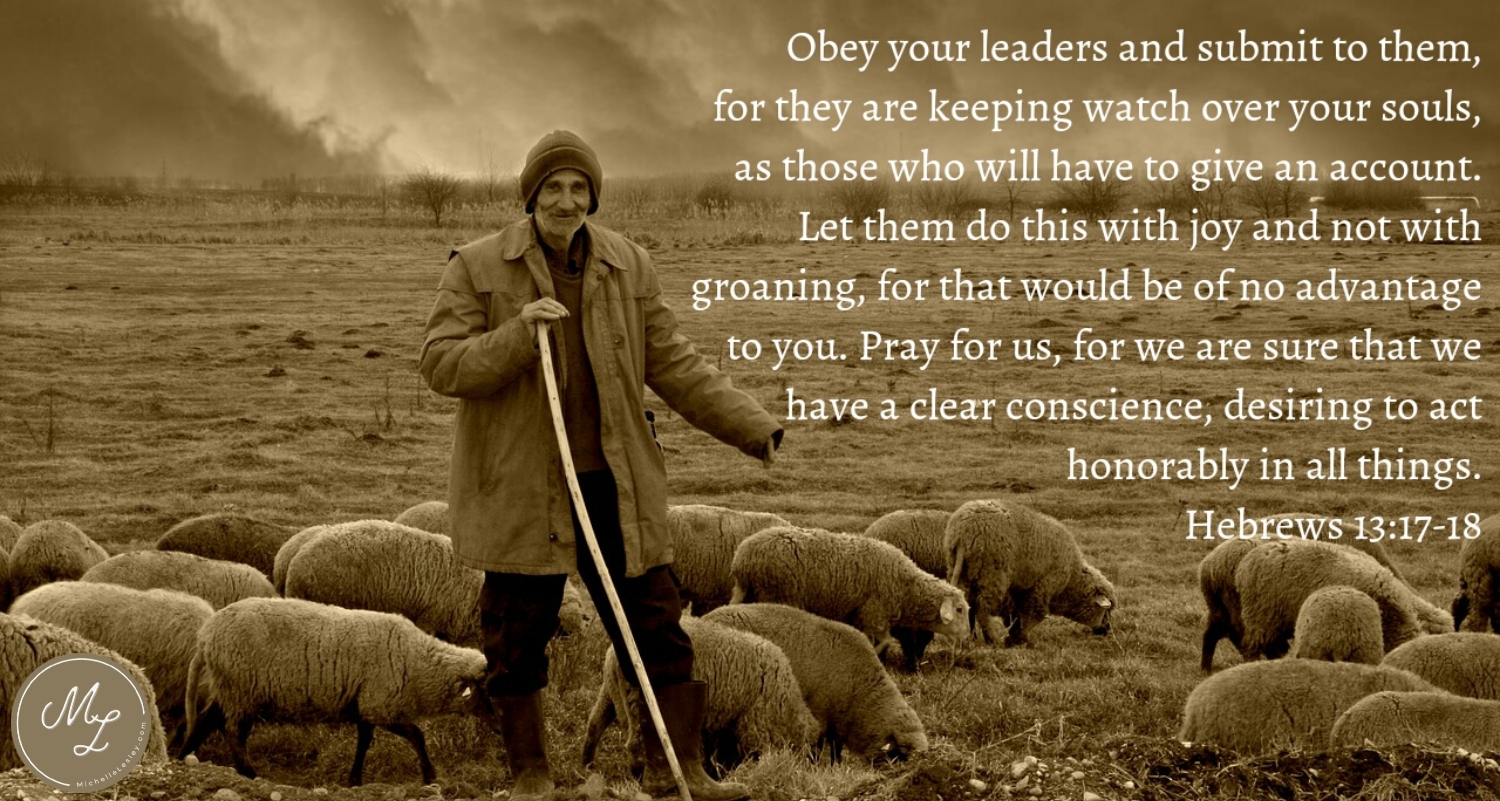
Hebrews 13:17 says: “Obey your leaders and submit to them, for they are keeping watch over your souls, as those who will have to give an account. Let them do this with joy and not with groaning, for that would be of no advantage to you.” It does the church no good to have a pastor who groans at dealing with his sheep because they’re stiff-necked and contrary. Pray that God will make your pastor’s job a joy by praying for the spiritual health and submission of your church.

9. Pray for your pastor’s family relationships.
Before he’s your pastor, he’s her son, her husband, their brother, their father. Pray that God would help your pastor have the time he needs to spend with his family, and to be a godly husband, father, and loved one.

10. Pray about how you can help your pastor.
Pastors have a lot on their shoulders. Is there any way you could take something off your pastor’s plate and allow him to focus on the things only he can do? Could you fix that leaky toilet, teach that class, fill that volunteer slot, counsel that sister, vet that proposed small group study? Could you at least offer him a word of encouragement on a regular basis? Ask God to show you ways you can help out your pastor.

Our pastors need our prayers.
What are some other ways we can pray for them?

Sanctification, Throwback Thursday

Throwback Thursday ~ Abiding in the Vine

Originally published July 30, 2015

abiding-in-the-vine

Ah, the good old summertime! Which, sadly, is rapidly drawing to a close. Summertime brings with it a lot of simple pleasures- a more relaxed schedule, vacations, family reunions, pool parties, and barbecues. But one of the simplest pleasures my husband and I enjoy during the summer is stopping at produce stands to stock up on locally grown fruits and veggies.

In our area, farmers often just fill up the beds of their pick up trucks with watermelons, okra, tomatoes, peaches, or whatever they grow, park on the side of a well-traveled road and sell their wares. As small business owners ourselves, my husband and I like to support other small business owners, plus there’s just something about eating produce that was freshly picked down the road this morning rather than shipped in from across the country a week ago.

Recently, my husband was on his way home from work and ran across a farmer selling cantaloupes. The farmer made him a good deal, so he brought home three of them. Now, my husband loves cantaloupe, but, unfortunately, he forgot that he’s the only one in the family who does. And these were big cantaloupes.

I cut up the first one for him and he finished it in a few days. By the next week he had finished the second one. But by the time I went to cut up the third one for him, there was a soft, mushy spot about the size of a dollar bill along one side.

Nothing untoward had happened to this cantaloupe. It hadn’t been dropped, knocked around, or exposed to extremes of temperature or moisture. The only thing wrong with this cantaloupe was that it had been cut from the vine it was growing on quite some time ago. And the moment it was severed, it started dying.

As I carefully cut away the spoiled area to salvage the rest of the fruit, I was reminded of what Jesus said in John 15:4-6:

purple-grapes-553462_1280

In the first half of John 15, Jesus talks a lot about vines and branches and fruit. The main application of this passage is that Jesus is the vine and we are the branches. The living, fruit-bearing branches are those who have truly been born again. The dried up branches who don’t bear fruit are people who appear to be or claim to be Christians, but aren’t actually saved. But there’s a second layer to this story for those who are genuinely regenerate Christians: obedience. Walking with the Lord day by day and producing healthy fruit.

I looked over at the little stump of cantaloupe branch I had cut off and thrown away. Because it hadn’t been abiding in the main vine, it had dried up. It was no longer bearing new fruit nor was it carrying nutrients from the vine to its already existing fruit, namely, the cantaloupe sitting on my counter, turning to mush.

The same thing happens to Christians when we disobey God by neglecting our relationship with Him. When we go days without picking up our Bibles or praying or gathering for worship with other Believers, we begin to dry out and shrivel up, spiritually. There’s no biblical nutrition flowing from Christ through us, so we’re not bearing any new fruit, and any already existing fruit we’ve produced starts showing signs of rot.

Galatians 5:22-23 tells us:

pineapples-1606852_1280_kindlephoto-18964258

I don’t know about you, but when I’ve skipped my Bible study and prayer time for even a few days, I can tell that I’m not bearing any new spiritual fruit and that I’m less patient, less loving, less self-controlled- more rotten in all of these areas than I normally am. I can tell if my husband is neglecting his time with the Lord, and when my children aren’t having their daily quiet times. I’m surrounded by slowly rotting fruit.

As daughters of Christ, it is imperative that we receive the nourishment He has provided for us in His word, in prayer, through the church, and through obedience to Him so that we can bear good, strong, growing fruit. Because the longer we walk through life at a distance from Christ, the rottener we’ll become. Just ask a cantaloupe.


THIS ARTICLE WAS ORIGINALLY PUBLISHED AT SATISFACTION THROUGH CHRIST.

Colossians Bible Study

Colossians: Lesson 3

Previous Lessons: 1, 2

Colossians 1:15-29

He is the image of the invisible God, the firstborn of all creation. 16 For by him all things were created, in heaven and on earth, visible and invisible, whether thrones or dominions or rulers or authorities—all things were created through him and for him. 17 And he is before all things, and in him all things hold together. 18 And he is the head of the body, the church. He is the beginning, the firstborn from the dead, that in everything he might be preeminent. 19 For in him all the fullness of God was pleased to dwell, 20 and through him to reconcile to himself all things, whether on earth or in heaven, making peace by the blood of his cross.

21 And you, who once were alienated and hostile in mind, doing evil deeds, 22 he has now reconciled in his body of flesh by his death, in order to present you holy and blameless and above reproach before him, 23 if indeed you continue in the faith, stable and steadfast, not shifting from the hope of the gospel that you heard, which has been proclaimed in all creation under heaven, and of which I, Paul, became a minister.

24 Now I rejoice in my sufferings for your sake, and in my flesh I am filling up what is lacking in Christ’s afflictions for the sake of his body, that is, the church, 25 of which I became a minister according to the stewardship from God that was given to me for you, to make the word of God fully known, 26 the mystery hidden for ages and generations but now revealed to his saints. 27 To them God chose to make known how great among the Gentiles are the riches of the glory of this mystery, which is Christ in you,the hope of glory. 28 Him we proclaim, warning everyone and teaching everyone with all wisdom, that we may present everyone mature in Christ. 29 For this I toil, struggling with all his energy that he powerfully works within me.


The Holy Bible, English Standard Version Copyright © 2001 by Crossway Bibles, a publishing ministry of Good News Publishers.


Questions to Consider:

1. At the end of lesson 2 (link above), we saw that Paul gave a brief recap of the gospel (13-14). How was that a good introduction to the passage we’re looking at today? What is the overall theme of today’s passage?

2. Jehovah’s Witnesses use verse 15 to support their idea that Christ was a created (non-eternal) being. Is that what this verse means? What sort of ideas would the term “firstborn” have brought to the minds of first century Jews (and even gentiles)? Verse 15 says that Christ is the firstborn of all creation. Verse 18 says that He is the firstborn from the dead. How do these two positions of Christ “bookend” His supremacy over every aspect of the universe?

3. List the specific roles Christ plays in creation in verses 15-17. Why would it have been important for Paul to emphasize Christ’s role in creation? What did this (as well as verse 19) indicate to his audience about Christ’s deity and His relationship with God the Father?

4. As previous verses emphasized Christ’s deity, what are the references to His humanity in verses 19 and 22? Part of the heresy that was creeping into the Colossian church was elements of mysticism that would later morph into gnosticism. How would the proper Christology Paul was trying to teach them – including Christ being 100% God and 100% man simultaneously (the hypostatic union) – combat that heresy? Why is it important that we, as Christians, believe that Christ was both fully God and fully man? How would it affect Christ’s work on the cross if he had been less than God or less than human? How might understanding the hypostatic union better help you to love Christ more?

5. What do verses 24-29 tell us about Paul’s relationship with and care fo the Colossian church? What was his goal for this church? (28-29) Is this the goal of the leadership at your church? How can verse 28 guide us as we seek to make disciples today? Do we put the same effort and energy into discipleship that Paul did? (29)


Homework:

Read back through the tenets of gnosticism (link in #4). Are there any sort of gnostic beliefs in the church today? Write down some ways biblical Christology (the study of who Christ is, what He did, and why) could combat these false beliefs.

Colossians Bible Study

Colossians: Lesson 2

Previous Lessons: 1

Colossians 1:1-14

Paul, an apostle of Christ Jesus by the will of God, and Timothy our brother,

To the saints and faithful brothers in Christ at Colossae:

Grace to you and peace from God our Father.

We always thank God, the Father of our Lord Jesus Christ, when we pray for you, since we heard of your faith in Christ Jesus and of the love that you have for all the saints, because of the hope laid up for you in heaven. Of this you have heard before in the word of the truth, the gospel, which has come to you, as indeed in the whole world it is bearing fruit and increasing—as it also does among you, since the day you heard it and understood the grace of God in truth, just as you learned it from Epaphras our beloved fellow servant. He is a faithful minister of Christ on your behalf and has made known to us your love in the Spirit.

And so, from the day we heard, we have not ceased to pray for you, asking that you may be filled with the knowledge of his will in all spiritual wisdom and understanding, 10 so as to walk in a manner worthy of the Lord, fully pleasing to him, bearing fruit in every good work and increasing in the knowledge of God. 11 May you be strengthened with all power, according to his glorious might, for all endurance and patience with joy, 12 giving thanks to the Father, who has qualified you to share in the inheritance of the saints in light. 13 He has delivered us from the domain of darkness and transferred us to the kingdom of his beloved Son, 14 in whom we have redemption, the forgiveness of sins.


The Holy Bible, English Standard Version Copyright © 2001 by Crossway Bibles, a publishing ministry of Good News Publishers.


Questions to Consider:

1. Who wrote this epistle? (1) To whom was it written? (2) Who was Epaphras, and what was his connection to the church at Colossae? (7) You may wish to go back to lesson 1 (link above) and review just a bit.

2. How would you classify the first two verses of this chapter? (instruction, rebuke, greeting, worship, etc.?) List the characteristics of the Colossian church that have been reported to Paul. (4, 6, 8) Do these things describe your church? Does Paul seem to regard this church as one that is overtly rebellious, worldly, or sinful? Describe Paul’s overall tone in this passage.

3. In verse 3, what two things does Paul say “we” (he, Timothy, and possibly others) do regarding the Colossian church? List and define the five things Paul says they pray for the Colossian church. (9-10) Do you pray similar things for your own church and for yourself? Why was it important for Paul and Timothy to pray for the Colossian church? Why is it important for you to pray for your own church? Take a moment now to pray through these five requests for your church and yourself.

4. What did we learn in lesson 1 about the situation of the Colossian church that would lead Paul to wish the Holy Spirit to empower them (11) to endure, have patience, have joy, and give thanks? (11-12) How are these characteristics important to your church, and the church at large, today?

5. In verses 13-14, Paul gives a mini-recap of the gospel. Explain in your own words what Paul is saying in these two verses. What does it mean in verse 12 that God has “qualified” the Colossian Christians to “share in the inheritance of the saints”? What is that inheritance, and how did God qualify them? How does this apply to Christians today? Peeking ahead a few verses, why is this recap of the gospel a good precursor to the topic Paul is about to introduce?


Homework:

Think about your church’s unique needs in light of the five things Paul prayed for the Colossian church. Make a list of some specific ways you can pray that your church will be “filled with the knowledge of His will,” “walk in a manner worthy of the Lord,” etc., and include these during your daily prayer time this week.