Wednesday's Word

Wednesday’s Word ~ 2 John

2 john 10 11

2 John

The elder to the elect lady and her children, whom I love in truth, and not only I, but also all who know the truth, because of the truth that abides in us and will be with us forever:

Grace, mercy, and peace will be with us, from God the Father and from Jesus Christ the Father’s Son, in truth and love.

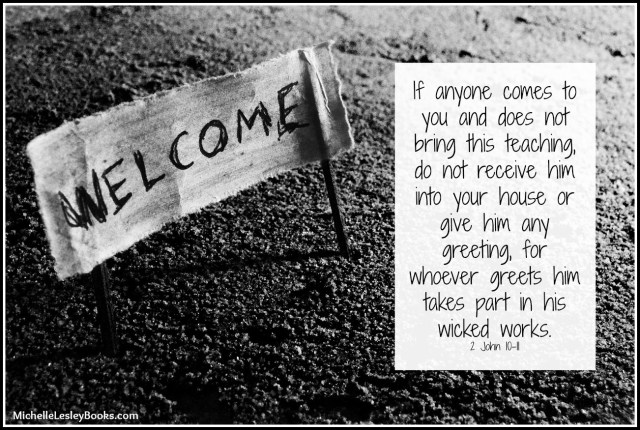
I rejoiced greatly to find some of your children walking in the truth, just as we were commanded by the Father. And now I ask you, dear lady—not as though I were writing you a new commandment, but the one we have had from the beginning—that we love one another. And this is love, that we walk according to his commandments; this is the commandment, just as you have heard from the beginning, so that you should walk in it. For many deceivers have gone out into the world, those who do not confess the coming of Jesus Christ in the flesh. Such a one is the deceiver and the antichrist. Watch yourselves, so that you may not lose what we have worked for, but may win a full reward. Everyone who goes on ahead and does not abide in the teaching of Christ, does not have God. Whoever abides in the teaching has both the Father and the Son. 10 If anyone comes to you and does not bring this teaching, do not receive him into your house or give him any greeting, 11 for whoever greets him takes part in his wicked works.

12 Though I have much to write to you, I would rather not use paper and ink. Instead I hope to come to you and talk face to face, so that our joy may be complete.

13 The children of your elect sister greet you.


The Holy Bible, English Standard Version Copyright © 2001 by Crossway Bibles, a publishing ministry of Good News Publishers.


Questions to Consider:

1. Which genre of biblical literature (epistle, prophecy, history, etc.) is the book of 2 John? Who wrote this book, and to whom was it written? What are two major topics this book deals with in verses 5-6 and in verses 7-11?

2. How many times does the word “truth” appear in this passage? In light of the topic of verses 7-11, why does John place so much emphasis on truth in verses 1-4? Which word, used twice in verse 7, stands in direct contrast to the word “truth” and serves as a pivot point into the topic of verses 7-11?

3. What is the “commandment” in verses 5-6? How does verse 6 say that we demonstrate our love for God? What can we learn about obedience to God from these verses? Can you think of any ways you have shown your love for God today by obeying Him?

4. Which false teaching was John speaking against in verse 7? What does verse 9 say about people who “go on ahead” of what the Bible says Christianity is and believe (or teach) false doctrine? Are they saved? Compare verse 9 to Galatians 1:6-9.

5. What does verse 10 say we should not do when we come across a false teacher? Why? (11) Think about how verses 10-11 might apply today with regard to attending conferences headlined by, or using materials written by, false teachers, following false teachers on social media, re-posting or retweeting false teachers, etc. How is this giving a “greeting” to false teachers and taking part in their wicked works?

Often, when someone is told she’s following a false teacher, she will say, “But she says some good things, too! I just chew up the meat and spit out the bones.” Is this line of thinking supported by verses 10-11 and passages such as Romans 16:17?

Guest Posts

Guest Post: Defiance and Defeat

If your theology pretty much matches up with mine (as outlined in the “Welcome” and “Statement of Faith” tabs) and you’d like to contribute a guest post, drop me an e-mail at MichelleLesley1@yahoo.com,
and let’s chat about it.
karen carrey defiance defeat

Defiance and Defeat
by Karen Carrey

I’ve been reading in Joshua the story of how the Israelites were defeated at Ai, immediately after their resounding victory at Jericho. They couldn’t believe that after such success came crushing defeat. The Lord had led them to defeat Jericho but told them not to take any of the spoils for themselves, because certain items were to be devoted to the Lord. They were explicitly told in Joshua 6:18-19 what the Lord’s command was.

But Achan decided to disobey and take from Jericho some of the items which were to be consecrated to the Lord, and his defiance resulted in the death of himself and his family, just as God had clearly told them would happen if they disobeyed.

God finds Joshua flat on his face wailing and moping after their defeat and basically tells Joshua he can’t expect to be victorious against his enemy whilst disobedience and defiance run rampant in the camp. However he gives them a chance to put it right and come into communion with him again once the sin was purged from among them.

It made me wonder about the sins we try to hide in our own lives, as Achan did, hoping God won’t notice. The things that God can’t bless us in. The things that cause Him to turn His face from us because He is a Holy God. Are we being defeated in areas of our lives and pretending we don’t know why? Are we on our faces crying out to the Lord, “Why me?” when we know we are breaking his commands and breaking His heart? Do we think there are no consequences to our sin? Of course there are. Unless we get before God and confess, seeking his forgiveness, the consequence will be the same as Achan faced. Spiritual and physical death. But our God is as God of forgiveness and if we are truly repentant, he restores us to Himself once again.

Each of us may have our own “accursed thing” that is keeping us from a closer walk with God. Have we gone our own way even though He’s blessed us and given us victory in certain areas of our lives? Have we become cocky in our own strength? Do we think we know better and can flout his commands and expect Him to turn a blind eye? When God gives us his Word, and we deliberately disobey it, we have no excuse. We cannot say “but I didn’t know …” because he makes his expectations very clear in His Word. Whether we like them or not is a different matter. We are to be consecrated and set apart, a holy people, not conformed to this world but transformed by the renewing of our minds. What things do we need to fall on our face before God about, sincerely seeking his forgiveness and help?

God does not bless us with financial gain, perfect health and a bigger house, just because we’re saved or because we speak it into existence with positive words. He promises us that in the final analysis, all things will work together for good (Romans 8:28) but we’re told we will have trouble in this world. The good news is that Christ has overcome the world. Addressing the hidden sin in our lives is not your guarantee to a happy-ever-after on this earth, but it is the key to a closer walk with your Saviour.

It’s important for all of us to turn over to God, those things that we know the Holy Spirit is convicting us of. Flirting with your co-workers is not innocent. Gossiping is not harmless. Arrogance is not becoming. Immodesty is provocative and Jezebel-like. Impatience is not “just the way you are”. Sleeping with your partner just because you’re getting married anyway, is not ok. Seek His Word. Pursue holiness.

Obedience brings victory, but defiance brings defeat.

Lord open our eyes to the accursed things in our own lives that we may gain favour in your eyes and be close to you once again.

Originally published at Faith and Food Chat, January 27, 2016


Karen Carrey is a 40-something wife and mother of two teenagers. She loves to read, bake, cook, and find like-minded Christian women. She was saved at an early age and continues to work out her salvation with fear and trembling. One of her favorite passages is Isaiah 43:2-4. Karen blogs at Faith and Food Chat.


ALTHOUGH I DO MY BEST TO THOROUGHLY VET THE THEOLOGY OF THE BLOGGERS WHO SUBMIT GUEST POSTS, IT IS ALWAYS POSSIBLE FOR THINGS TO SLIP THROUGH THE CRACKS. PLEASE MAKE SURE ANY BLOGGER YOU FOLLOW, INCLUDING ME, RIGHTLY AND FAITHFULLY HANDLES GOD’S WORD AND HOLDS TO SOUND BIBLICAL DOCTRINE.
Parenting, Throwback Thursday

Throwback Thursday ~ The 10 Commandments of Parenting- 8

Originally published June 30, 200810 Commandments Parenting 8

8.
Thou shalt set a good example
for thy children
by thine own Godly behavior.

“…walk in a manner worthy of the calling with which you have been called, with all humility and gentleness, with patience, showing tolerance for one another in love,” Ephesians 4:1-2

Do what I say, not what I do.

Monkey see, monkey do.

Actions speak louder than words.

Practice what you preach.

Which of those maxims seem to ring true when it comes to parenting? For years, every childrearing expert who has come along has reminded us that modeling the behavior we want our kids to exhibit is one of the most effective ways of shaping them. Of course, if you’re a mom of a child who is old enough to walk and talk, you already know that modeling works, because, for better or for worse, you’ve already heard your own words fly out of your child’s mouth or seen him imitate you at some point!

Your kids will imitate you. My kids will imitate me. How do we use that knowledge to pour godliness into them? The Bible tells us that we are to be imitators of Christ (1 Corinthians 11:1; Ephesians 5:1-2). We need to strive for godliness in our own lives until we can say to our kids, as Paul said to the Corinthians, “Be imitators of me, just as I also am of Christ.”

They need to see us studying our Bibles and spending time in prayer. They need to see us resist temptation. They need to see us set aside our own desires in favor of serving others. They need to see us exhibit love, humility, kindness, patience, forgiveness and mercy. They need to hear us building others up instead of criticizing and gossiping. They need to see us work through problems with our husbands, families and friends in a godly way. They need to see us admit when we’re wrong and seek forgiveness.

So, in the spirit of that old children’s song:

Oh, be careful Mommy’s mouth what you say
And be careful Mommy’s feet where you go
And be careful Mommy’s hands what you do

Not only is “the Father up above…looking down in love,” but our little ones are looking up at us too.

Obedience

Faultfinders Contending With the Almighty

faultfinders

Nobody could ever accuse Christianity of being easy. A religion that tells you to die to self and take up your cross daily is no walk in the park. And there’s no magical moment in this life when you’ve suddenly “arrived” at the top level of spiritual 1 tim 2 12maturity where everything in the Bible makes perfect sense, your prayer life is phenomenal every day, obeying Christ’s commands is a breeze, and you’re floating around on a little cloud of holiness.
We are all messed up, muddling through, and constantly battling the flesh, from the person who got saved five minutes ago to the theologian who’s been walking with the Lord for decades.

It’s hard enough to obey the Scriptures we embrace – love one another, be kind, be matt 6 15truthful – but then we encounter Scriptures that, for whatever reason, we butt heads with. Scriptures to which our initial, fleshly reaction is, “No way. I’m not doing that.” We argue with them. We look for loopholes and ways we can get around them. We reason out all sorts of caveats as to why that Scripture doesn’t apply to us or why we don’t have to obey it.

My parents hurt me deeply. There’s no way I’m going to honor the people who did that to me.

God gave me a special gifting and called me to preach. It doesn’t matter that I’m a woman.

Why should I forgive him? He’s never even said he’s sorry!

You have no idea how badly she hurt me. I’ll never be able to love her or pray for her.

ex 20 12There’s no denying it, sometimes obeying a certain Scripture will be the hardest thing we ever do. But slaves to Christ are not given the option of saying “no” to their Master. If you’ll look in your Bible at the verse you’re struggling against, you’ll notice there’s no asterisk next to it that says, “except you.”

When we approach one of God’s commands to Christians and decide we’re not going to obey it because we don’t want to or shouldn’t have to or it’s too hard, what we’re really doing is setting ourselves above the Bible in judgment of it and coming to the conclusion that we know better 1 pet 3 1 2than God.

Yeah, that’s not a good idea. Especially for Christians.

Ever read the book of Job? Job went through some pretty awful stuff. Stuff that I certainly would have argued against and questioned God about just like he did. And yet, despite all of Job’s suffering, God didn’t give him a pass.

And the Lord said to Job:
“Shall a faultfinder contend with the Almighty?

He who argues with God, let him answer it.”

Then Job answered the Lord and said:
“Behold, I am of small account; what shall I answer you?

I lay my hand on my mouth.
I have spoken once, and I will not answer;
twice, but I will proceed no further.”
Job 40:1-5

 And how does this grab you?

But who are you, O man, to answer back to God? Will what is molded say to its molder, “Why have you made me like this?” Has the potter no right over the clay, to make out of the same lump one vessel for honorable use and another for dishonorable use?
Romans 9:20-21

Do you get the sense from these verses, which address very different situations, that God isn’t crazy about people questioning His sovereignty, His decisions, or His word, regardless of their circumstances?

God is God. We are not.

God sets the rules for Christianity, not “everyone doing whatever is right in his own eyes.”

matt 5 44Lots of times we think we have to “feel comfortable” with a certain Scripture if we’re to obey it, but the truth is just the opposite. When we say, “Lord, I don’t want to do this, but I’m going to do it anyway because I love You and Your word says so,” guess what happens? God begins to change our hearts. In time, He helps us grow to embrace the Scriptures we once rejected. He helps us to love others and see them through His eyes.

Yes, it is going to be hard. There are going to be times when we have to grit our teeth, hold our noses, and obey Christ even when everything inside us screams, “NO!

But we have a precious Savior who has promised to help us be content in any circumstance and will give us the strength to do anything He puts in front of us.

I can do all things through him who strengthens me. Philippians 4:13

I’ve fought. I’ve cried. I’ve whined, “I can’t!” And every time God has brought me back to this verse that says, “Yes, you can, and I’ll help you.” And you know what? He did.

Obedience is hard, but Christ is worth it.

1 John Bible Study

Am I Really Saved?: A First John Check Up ~ Lesson 6: What is Love?

1 John Study

Am I Really Saved? A First John Check Up
Lesson 6: What is Love?
Please Read: 1 John 3:10-24

Previous Lessons: 1, 2, 3, 4, 5

Examine yourselves, to see whether you are in the faith. Test yourselves. Or do you not realize this about yourselves, that Jesus Christ is in you?—unless indeed you fail to meet the test!
2 Corinthians 13:5

1 John 3:10-15

Am I Really Saved? Checkpoint 10: Do I love my brothers?

By this it is evident who are the children of God, and who are the children of the devil: whoever does not practice righteousness is not of God, nor is the one who does not love his brother. 11 For this is the message that you have heard from the beginning, that we should love one another. 12 We should not be like Cain, who was of the evil one and murdered his brother. And why did he murder him? Because his own deeds were evil and his brother’s righteous. 13 Do not be surprised, brothers, that the world hates you. 14 We know that we have passed out of death into life, because we love the brothers. Whoever does not love abides in death. 15 Everyone who hates his brother is a murderer, and you know that no murderer has eternal life abiding in him.

Here, John circles back to love versus hate, but he looks at it from a bit of a different perspective than he used in chapter 2. John draws a parallel between the two different types of brothers-  familial and spiritual – and uses these relationships to explain true brotherly love, and why this is a characteristic of Christians.

  • Which phrase in the first sentence of verse 12 compares non-Christians to Cain? How does verse 15 make this comparison?
  • Why, according to verse 12, did Cain murder Abel (his brother)? Was it because Abel provoked him or was evil in some way? Verse 13 indicates that the world will hate us for the same reason Cain hated Abel. What is that reason? How does John 3:19-20 relate to this concept?

God’s righteousness, shining through Abel, reflected Cain’s sin back at him. He felt guilty, convicted, and he wanted to get away from those feelings of condemnation. This is the same foundational reason the world hates Christians today. They hate the Christ who lives within us because, in Him, they see their own evil deeds reflected back at them. They feel guilty and convicted, and, wanting to suppress the truth about their sin, they hate us or do whatever else they can to escape those feelings of condemnation.

  •  How is hatred by the world for being Christlike evidence that we belong to Christ?
  • If hatred is characteristic of the world, what, necessarily, must be characteristic of Christians? (v. 14)
  • How do you feel when you’re around someone you know is a Christian? Do you enjoy open, easy, godly fellowship with her? Do you ever feel guilty or convicted just by being around her? Does talking with her about the things of God make you feel threatened, defensive, or argumentative?

1 John 3:16-17

OK, the Christian’s life is characterized by love for her brothers and sisters in Christ, but what, exactly, is love? Is it just being nice to people? Being a doormat? Never getting angry? Turning a blind eye to sin? How do we know if we’re acting in love or not?

John gives us a very simple definition: he laid down his life for us, and we ought to lay down our lives for the brothers.

Christ sets the standard for what love is. He defines love. Not our feelings. Not our opinions. Not the world’s definition of love. The cross is the measuring stick against which we measure anything we might call “love.” Anything that falls short isn’t love. This is how we know that things like homosexuality, abuse, sinful jealousy, pedophilia, cohabitation, universalism, living vicariously through your children, adultery, and tolerance of sin are not love. Any “love” that doesn’t look like Christ’s holy, righteous, biblical, dying to self love isn’t love.

He laid down his life for us, and we ought to lay down our lives for the brothers. Did you notice John didn’t say “He died for us and we ought to die for our brothers”? I wonder if that might have anything to do with the fact that there’s more than one way to lay your life down for someone. Certainly, Christ demonstrated His love for us by dying for us on the cross, and, that same love should compel us to willingly die for others if circumstances call for it.

But Christ didn’t just lay down His life for us in death, He laid down His life for us in life, too. Every temptation He resisted, every time He put his own wants and needs aside to put someone else first, every time He humbled Himself to serve others, He was laying down His life for us. And in the same way, we ought to lay down our lives for our brothers. We serve people. We provide for people. Even when it comes at a personal cost. We don’t just talk the talk, John says, we walk the walk.

1 John 3:18-22

Am I Really Saved? Checkpoint 11: Am I bearing the fruit of love?

Little children, let us not love in word or talk but in deed and in truth.19 By this we shall know that we are of the truth and reassure our heart before him; 20 for whenever our heart condemns us, God is greater than our heart, and he knows everything. 21 Beloved, if our heart does not condemn us, we have confidence before God; 22 and whatever we ask we receive from him, because we keep his commandments and do what pleases him.

  • What does the word “this” in verse 19 refer to?

Let’s face it, there are going to be times when we sin big or again, and it’s easy to give in to those thoughts of, “How could I possibly be saved if I act like that?”. But whenever our hearts condemn us that way, John urges us to look back over the general direction of our spiritual lives. Not so we can feel good about ourselves or because our good deeds somehow make up for our sins, but because God says when our emotions are getting the best of us, that’s a good, objective way to calm down and get some reassurance of our salvation. Is it the desire of my heart to act in love for God and love for others? Do I generally carry that desire through with action? God says we can look to these things as evidence of our salvation.

God knows everything. He knows whether or not you belong to Him, and He wants you to know, too. And if the objective evidence shows you’re saved, you’ll have the confidence to put aside those feelings of condemnation, and boldly approach the throne in prayer, knowing that you keep God’s commandments and do what pleases Him.

  • What does verse 20 mean when it says “God is greater than our heart”? How does this show us that God is the judge of whether or not we are saved, not us or our feelings?
  • How do keeping God’s commandments and doing what pleases Him (22) impact the way we pray?

1 John 3:23-24

Am I Really Saved? Checkpoint 12: Do I keep the ultimate commandment?

And this is his commandment, that we believe in the name of his Son Jesus Christ and love one another, just as he has commanded us. 24 Whoever keeps his commandments abides in God, and God in him. And by this we know that he abides in us, by the Spirit whom he has given us.

  • What is the commandment in verse 23? How many parts (notice the second “and”) are there to this command? What does verse 24 indicate about the person who keeps this command?
  • How do we know that God abides in us? (24b)
  • Do you keep this commandment? Is your belief in Christ a simple mental acknowledgement, or have you staked your life and eternity on Christ?

The two parts of the ultimate commandment are inseparable: we are to believe in Christ for salvation and love one another. You can’t have one without the other. Those who keep this command can be certain that they are in Christ. The Holy Spirit bears witness to this.


This week we’ve looked at three more checkpoints in our “Am I Really Saved?” study:

Do I love my brothers?

Am I bearing the fruit of love?

Do I keep the ultimate commandment?

Saved people may be hated by the world, but they love their brothers. They can look back over their lives and see evidence of their Christlike love, in word and deed, for others. They keep the ultimate commandment of staking their lives on their belief in Christ and loving their fellow Christians.

Unsaved people often feel guilty, convicted, or defensive around Christians as Christ reflects their sin back at them. They do not have a track record of showing Christlike love for others, and, while they may proclaim belief in Christ, their profession is only lip deep.

Additional Resources:

1 John 3– Matthew Henry’s Commentary

Can I Be Sure I’m Saved?– by R.C. Sproul

True or False? A Study in 1 John– at Naomi’s Table (lessons 13-14)