Christmas

Nativity Scenes and the Second Commandment

Originally published December 10, 2019
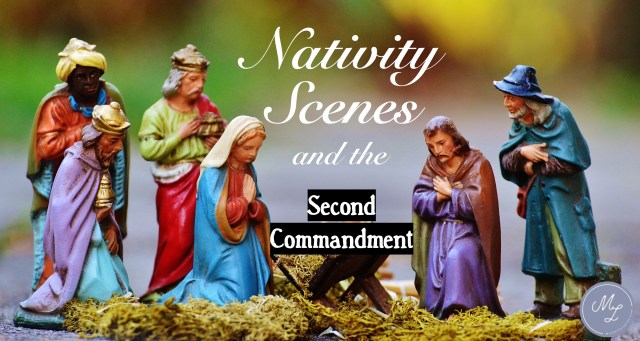
Have you ever heard someone say that nativity scenes, Christmas ornaments, Christmas pageants, and other Christmas items or activities which portray the baby Jesus (with a figurine, a doll, a live baby, pictures, etc.) break the second Commandment even though the portrayal of the baby Jesus isn’t being worshiped?

Some of my brothers and sisters in Christ believe that any representation of Jesus – be it in a manger scene, a painting, a movie, pictures of Jesus in children’s Bibles, flannelgraphs, Bible story pictures used for teaching children or on the mission field, etc. – violates the second Commandment…

You shall not make for yourself a carved image, or any likeness of anything that is in heaven above, or that is in the earth beneath, or that is in the water under the earth. You shall not bow down to them or serve them, for I the Lord your God am a jealous God, visiting the iniquity of the fathers on the children to the third and the fourth generation of those who hate me, but showing steadfast love to thousands of those who love me and keep my commandments.

Exodus 20:4-6

…whether or not that representation of Jesus is being worshiped. It is the mere act of making or displaying the representation which breaks the Commandment.

This is not something any church I’ve ever been a member of has taught, but because I’ve heard this point of doctrine from theologically sound friends I respect, I wanted to take a closer look at the pertinent Scriptures to make sure I wasn’t doing something wrong. I’ve had nativity scenes and children’s Bibles and used flannelgraphs and been in Christmas musicals that depict Jesus all my life and never gave it a second thought. But if having and doing those things conflicts with Scripture, I want to stop.

But, having examined the Scriptures in context, while I respect and admire my friends’ desire to honor the Lord by not using representations of Him, I simply don’t find that the Bible prohibits occasionally depicting Jesus in reverent, not-for-the-purpose-of-worship ways. Here’s why:

Having examined the Scriptures in context, I simply don’t find that the Bible prohibits occasionally depicting Jesus in reverent, not-for-the-purpose-of-worship ways. Here’s why…

1.

Consider the macro-context of Exodus 20. What was going on in the history and culture of Israel at that time? God was setting Israel apart from other nations as His own special possession and establishing Israel as a nation. And what was the preeminent characteristic that was to set Israel apart from the pagan nations? Israel was to be a witness to all the nations of the one true God. They were not to worship idols (which, at that time, were generally carved figures of created things). Not instead of God. Not in addition to God. Not at all. The second Commandment is a command not to worship carved figures as idols.

2.

Examine the immediate context of Exodus 20:4-6. It follows verses 1-3, which establish the supremacy of God above all other gods, and specifically state that Israel is not to worship any other gods.

3.

Take a close look at the content of Exodus 20:4-6. The passage doesn’t say anything about making a representation of God Himself. Jesus had not yet been born when this was written, so this passage could not have been talking about making a representation of Jesus. It talks about making representations of created things in the sky (planets, the sun, etc.), on the earth, and in the water, and worshiping them. And certainly, calling any graven images “God” and worshiping them as God would also be prohibited (Remember the golden calf incidents?)

4.

It would seem to me that to be consistent in saying “no representations of Jesus” folks who hold to this belief would also have to say “no representations of anything” because what Exodus 20:4 plainly says is “you shall not make for yourself…any likeness of anything.” No photographs of anything, no drawings, paintings, or sculpture of anything, no Xeroxing anything, nothing. In fact, I think that would be closer to the actual wording of the passage than “no representations of Jesus,” which, again, this passage does not mention.

5.

The cross references I found for Exodus 20:4 are Leviticus 26:1, Deuteronomy 27:15, and Psalm 97:7. All of them refer to idol worship.

6.

There are at least two occasions in the Old Testament in which God instructs Moses to make a graven figure, and both of these instances are far more conducive to actual worship of the figures than a nativity scene or a Sunday School flannelgraph.

There are at least two occasions in the Old Testament in which God instructs Moses to make a graven figure, and both of these instances are far more conducive to actual worship of the figures than a nativity scene.


The first instance – just five chapters after the second Commandment – is found in God’s instructions for the Ark of the Covenant. God instructs Moses to have the people make two cherubim (angels) for the mercy seat (lid) of the Ark. They were not to worship the cherubim (or the Ark), but the Ark was the holiest object used in Israel’s worship ceremonies. It would have been easy for the people to cross the line and worship it or the cherubim, yet God commanded the making of these not-for-worship figures to point the people to Him. (And guess what was put into the Ark right underneath those graven figures? The two tablets of the 10 Commandments, including the second Commandment.)

The second instance was when God instructed Moses to make the bronze serpent. Anyone who had been fatally snake-bitten could look up at the serpent and his life would be spared. How much more likely would an Israelite have been to worship the bronze serpent, commissioned by God and instrumental in saving his life than we are to worship a picture of Jesus in a children’s Bible? Jesus Himself said that this graven figure pointed ahead to His death on the cross, using it as an illustration of His crucifixion. Much like a nativity scene is an illustration of His incarnation.

Now, if God Himself commissioned the casting of these figures of created things, not to be worshiped, but as tools to point people to Himself, would it stand to reason that He would prohibit reverent representations of Christ that point to or teach about Him? Comparing the second Commandment with these two instances of graven figures demonstrates to us that God expects His people to be able to distinguish between using objects as tools or illustrations that point to Him and worshiping those objects.

God expects His people to be able to distinguish between using objects as tools or illustrations that point to Him and worshiping those objects.

“But if you see pictorial representations of Jesus, you’ll have those images in your mind, and they’ll pop up in your head while you’re worshiping or praying, and then you’ll be worshiping those mental pictures of Jesus, and that’s a violation of the second Commandment.”

If that’s an issue for you, then you definitely shouldn’t view representations of Jesus. But you need to understand that not everyone’s brain works that way. Sometimes when we’re singing in church, an image of my husband, or children, or a beautiful sunset, or whatever the lyrics evoke will pop up in my head. Does that mean I’m worshiping any of those things? Of course not. And for me – and others, I’m sure – any representation I’ve seen of Jesus that happens to pop into my brain is on the same level as those other things. It’s just some random thing I’ve been reminded of, not something I’m worshiping, and it flits out just as quickly as it flitted in.

“But having a pictorial representation of Jesus in your head is worshiping that image.”

No, that is definitionally not the case. Thinking of something is not the same thing as worshiping it. If it were, we’d be guilty of idol worship every time a picture of anything popped up in our brains. There’s a difference between a picture of something randomly popping up in your mind and intentional, purposeful worship.

“But depicting Jesus pictorially, in a nativity scene, or otherwise, could cause a brother or sister who does believe it’s a second Commandment violation to stumble.”

That’s absolutely true, and for that reason, those of us who have the freedom of conscience to use representations of Jesus ought to fulfill our responsibility to those brothers and sisters in Christ. As I’ve learned more about their side of the issue, I have all but eliminated using pictorial representations of Jesus on my blog, social media, etc. I don’t normally display any representations of Jesus in my home, but if I had a friend coming over at Christmas who was sensitive to this, I would certainly remove the baby Jesuses from all of my nativity scenes until she went home. My freedom of conscience comes with a responsibility of love and concern for my brothers and sisters in Christ.

My freedom of conscience comes with a responsibility of love and concern for my brothers and sisters in Christ.

In the end, this issue is an issue of Christian liberty. It is not a sin nor a violation of the second Commandment to use occasional reverent representations of Christ to point people to Him. It is also not a sin to desire to honor the Lord by refraining from using representations of Christ and finding other ways to point people to Him. Whichever side of the issue we come down on, let us make sure we are respectful and loving to those on the other side, not making a law for them where no law exists, nor accusing one side of sin or the other of legalism.


Additional Resources:

When We Understand the Text Podcast (at the 13:36 mark) with Pastor Gabriel Hughes

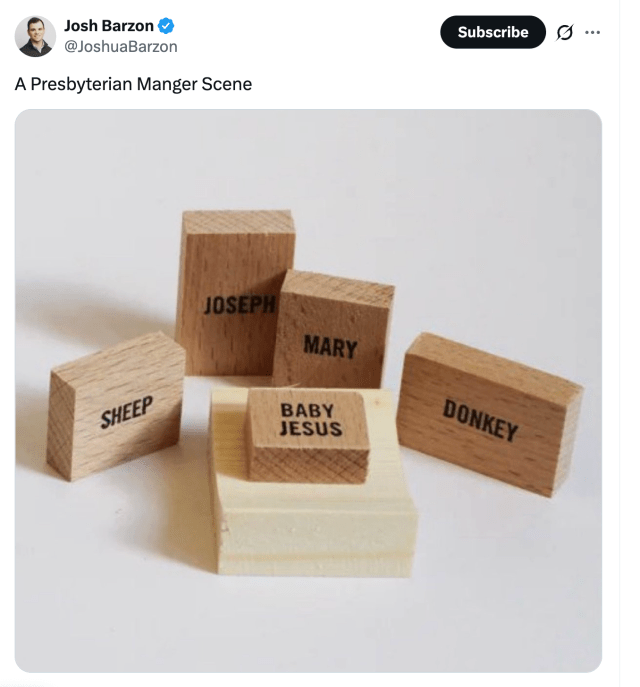
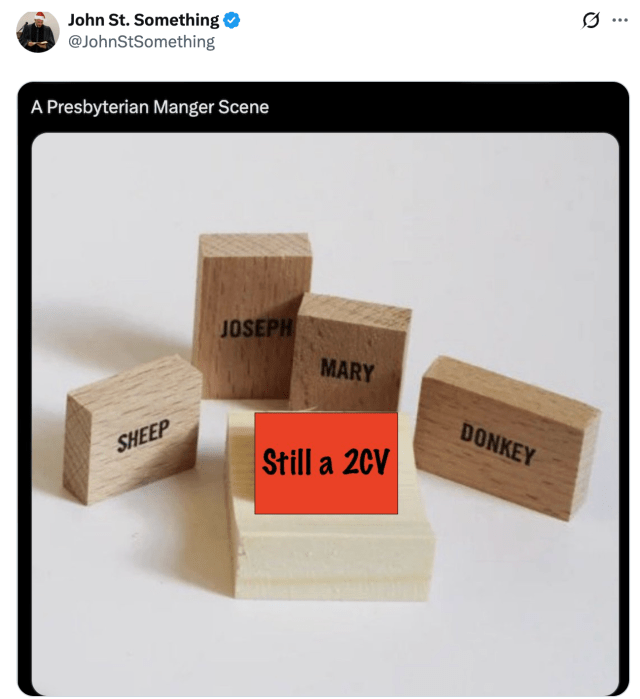
OK, I just thought this was hilarious. Josh is Baptist. John is Presbyterian. And these two images capture the essence of this article really well. John made a great point about his own theology using humor. I love that.โ™ฅ๏ธ

Mailbag

The Mailbag: Potpourri (Book reviews, statues, and conscience issues… Women giving pro-life talks in church)

Welcome to another โ€œpotpourriโ€ edition of The Mailbag, where I give short(er) answers to several questions rather than a long answer to one question.

I like to take the opportunity in these potpourri editions to let new readers know about my comments/e-mail/messages policy. Iโ€™m not able to respond individually to most e-mails and messages, so here are some helpful hints for getting your questions answered more quickly. Remember, the search bar (at the very bottom of each page) can be a helpful tool!

Or maybe I answered your question already? Check out my article The Mailbag: Top 10 FAQs to see if your question has been answered and to get some helpful resources.


I occasionally help launch books by Christian authors. I recently signed on to promote a Christian historical fiction book, and Iโ€™m supposed to write an Amazon review about it. But I am in a dilemma. At the end of the book, one of the characters is miraculously healed from a gunshot wound and claims he heard god tell him that he [“god”] did it for the main character, who doesnโ€™t believe in god. (Notice Iโ€™m not capitalizing “god” because I donโ€™t believe God speaks to us audibly or in dreams.)

When I agreed to promote this book I had no idea this would be in it. Now I am feeling really conflicted. I canโ€™t in good conscience recommend this book but I donโ€™t want to write a negative review on Amazon. Thoughts?

(For readers who may not understand this sister’s dilemma, she is referring to the unbiblical idea of extra-biblical revelation.)

This is a great question, and it’s really awesome that you’re trying to think this through biblically.

What jumps out at me from your comment is that this is bothering your conscience to the point that: a) you’ve used the phrase, “I can’t, in good conscience…” and b) you purposefully didn’t capitalize “God”*. If you think this book is promoting a false god, it’s no wonder it’s bothering your conscience.

* The word “god,” uncapitalized, means “false god” or “idol”.

Romans 14:22b-23 says: Blessed is the one who has no reason to pass judgment on himself for what he approves. But whoever has doubts is condemned if he eats, because the eating is not from faith. For whatever does not proceed from faith is sin.

and James 4:17 says: So whoever knows the right thing to do and fails to do it, for him it is sin.

You should not sin against your conscience by reviewing and promoting this book as though there’s nothing wrong with it, and I think you would agree that option is off the table.

So what are your other options? I’m not sure exactly how this works, so I’m just throwing out a couple of ideas here:

  • Write an honest review praising the good parts of the book but explaining the biblical problems with the scene you mentioned, and agree to promote the book with that caveat included.
  • Write the aforementioned honest review but don’t promote the book at all.
  • Explain the problems with the scene to the author, tell her you’re willing (if you are) to do either of the above, and let her decide what she wants you to do.
  • Explain the problems to the author and tell her you can’t write a review or promote the book.

Personally, I think one of the first two options would make a greater impact for biblical truth on a larger number of people if you feel you can do it without sinning against your conscience. But you have to decide what’s right for your own walk with the Lord first.

I understand your concern about wanting to keep your word when you agreed to do something, but you have to keep in mind that – whether she realizes it or not – this was an unfair agreement on the author’s part. It’s like buying a car. She sold you a car giving you the impression it worked right and when you got it home you discovered it didn’t have a carburetor or whatever (I don’t know – I’m not good with car stuff). That nullifies your end of the agreement to buy the car.

Use biblical wisdom, pray about it, and don’t sin against your conscience.

In case it might help, here’s a critical review I wrote a while back: Redeeming Love: Rants, Raves, andย Reviews


I have a statue of Joseph and Mary holding baby Jesus. Itโ€™s in a corner year round in my living room. As a former Catholic, Iโ€™m questioning myself if I should even have it at all??

As with the reader above, I think the fact that you’re starting to question this is an indication that it’s bothering your conscience. I would point you to the same Scriptures and counsel you not to sin against your conscience as I counseled the reader in the question above.

Some Christians consider any material representation of Christ to be a violation of the second Commandment. Personally, I don’t believe the context or cross-references of the second Commandment support this view. I’ve explained why, here. However, this is an issue you’ll want to study for yourself and be convinced of, one way or the other, by rightly handled, in context Scripture.

But, assuming there’s no second Commandment issue for you, and you’re not worshiping, venerating, or praying to the statue, or using it as some sort of “aid” to help you worship God – all of which all Christians would agree violate the first two Commandments against idolatry – and it’s just sitting there gathering dust in the corner like an umbrella stand or a fern, this is an issue of conscience.

I would suggest praying about it and discussing it with your husband (if you’re married) and then your pastor. You may also want to prayerfully considerโ€ฆ

Why do I still have the statue?

How do I feel about getting rid of it, and why?

What is the proactively good, biblical reason to keep this statue? (You might want to think of it like this: Would you recommend to your best friend that she buy and display a statue like yours? Why or why not?)

If it bothers your conscience and you can’t think of any good, biblical reason to keep it, get rid of it.

And get an umbrella stand or a fern.


Is it against 1 Timothy 2 for a woman to speak, not teach, during a Sunday morning worship service? She is not speaking as to teach or preach or pastor, but simply speaking on a topic to a congregation of men and women about her experiences as the head of a pregnancy resource center on Sanctity of Life Sunday. You say that this is unbiblical?

If she’s just giving a brief, personal testimony as a small part of the worship service, and the pastor will go on to preach his full sermon later in the service, that’s probably OK. (I’ve addressed women giving personal testimonies during the worship service here, #14.)

If her “testimony” is taking the place of the sermon, yes, it’s unbiblical, but not in the way youโ€™re thinking. Someone giving a talk on an informational topic or her personal experiences that takes the place of the sermon is not so much a 1 Timothy 2:12, โ€œwomen preaching/teaching to menโ€ issue as it is a 2 Timothy 4:1-2 โ€œpastors, preach the Wordโ€ issue.

Personal testimonies, speeches on non-biblical topics, panel discussions, interviews, etc. (from anyone, male or female), should not take the place of the preaching of the Word in the worship gathering. Additionally, due to the ignorance of the world and the majority of professing Christians who fail to distinguish between personal testimonies, TED talks, and preaching, a woman giving a personal testimony that takes the place of the sermon appears to most people as though she is preaching the sermon. Weโ€™re to avoid even the appearance of evil, so thatโ€™s another biblical reason not to do it.

May I make a suggestion? If your church is in need of someone to teach about the wickedness of abortion, contact an abolitionist organization such as Abolitionists Rising or Free the States. Because the abolition movement is church-based, they can put you in touch with a biblically qualified, doctrinally sound man (usually a pastor or elder) to come to your church and preach on the biblical reasons we should fight for the total eradication of abortion. We need to be convicted by Scripture on this issue, not swayed by an emotional response to someone’s subjective personal experiences.


If you have a question about: a Bible passage, an aspect of theology, a current issue in Christianity, or how to biblically handle a family, life, or church situation, comment below (Iโ€™ll hold all questions in queue {unpublished} for a future edition of The Mailbag) or send me an e-mail or private message. If your question is chosen for publication, your anonymity will be protected.

Christmas

Nativity Scenes and the Second Commandment

Have you ever heard someone say that nativity scenes, Christmas ornaments, Christmas pageants, and other Christmas items or activities which portray the baby Jesus (with a figurine, a doll, a live baby, pictures, etc.) break the second Commandment even though the portrayal of the baby Jesus isn’t being worshiped?

Some of my brothers and sisters in Christ believe that any representation of Jesus – be it in a manger scene, a painting, a movie, pictures of Jesus in children’s Bibles, flannelgraphs, Bible story pictures used for teaching children or on the mission field, etc. – violates the second Commandment…

You shall not make for yourself a carved image, or any likeness of anything that is in heaven above, or that is in the earth beneath, or that is in the water under the earth. You shall not bow down to them or serve them, for I the Lord your God am a jealous God, visiting the iniquity of the fathers on the children to the third and the fourth generation of those who hate me, but showing steadfast love to thousands of those who love me and keep my commandments.

Exodus 20:4-6

…whether or not that representation of Jesus is being worshiped. It is the mere act of making or displaying the representation which breaks the Commandment.

This is not something any church I’ve ever been a member of has taught, but because I’ve heard this point of doctrine from theologically sound friends I respect, I wanted to take a closer look at the pertinent Scriptures to make sure I wasn’t doing something wrong. I’ve had nativity scenes and children’s Bibles and used flannelgraphs and been in Christmas musicals that depict Jesus all my life and never gave it a second thought. But if having and doing those things conflicts with Scripture, I want to stop.

But, having examined the Scriptures in context, while I respect and admire my friends’ desire to honor the Lord by not using representations of Him, I simply don’t find that the Bible prohibits occasionally depicting Jesus in reverent, not-for-the-purpose-of-worship ways. Here’s why:

Having examined the Scriptures in context, I simply don’t find that the Bible prohibits occasionally depicting Jesus in reverent, not-for-the-purpose-of-worship ways. Here’s why…

1.

Consider the macro-context of Exodus 20. What was going on in the history and culture of Israel at that time? God was setting Israel apart from other nations as His own special possession and establishing Israel as a nation. And what was the preeminent characteristic that was to set Israel apart from the pagan nations? Israel was to be a witness to all the nations of the one true God. They were not to worship idols (which, at that time, were generally carved figures of created things). Not instead of God. Not in addition to God. Not at all. The second Commandment is a command not to worship carved figures as idols.

2.

Examine the immediate context of Exodus 20:4-6. It follows verses 1-3, which establish the supremacy of God above all other gods, and specifically state that Israel is not to worship any other gods.

3.

Take a close look at the content of Exodus 20:4-6. The passage doesn’t say anything about making a representation of God Himself. Jesus had not yet been born when this was written, so this passage could not have been talking about making a representation of Jesus. It talks about making representations of created things in the sky (planets, the sun, etc.), on the earth, and in the water, and worshiping them. And certainly, calling any graven images “God” and worshiping them as God would also be prohibited (Remember the golden calf incidents?)

4.

It would seem to me that to be consistent in saying “no representations of Jesus” folks who hold to this belief would also have to say “no representations of anything” because what Exodus 20:4 plainly says is “you shall not make for yourself…any likeness of anything.” No photographs of anything, no drawings, paintings, or sculpture of anything, no Xeroxing anything, nothing. In fact, I think that would be closer to the actual wording of the passage than “no representations of Jesus,” which, again, this passage does not mention.

5.

The cross references I found for Exodus 20:4 are Leviticus 26:1, Deuteronomy 27:15, and Psalm 97:7. All of them refer to idol worship.

6.

There are at least two occasions in the Old Testament in which God instructs Moses to make a graven figure, and both of these instances are far more conducive to actual worship of the figures than a nativity scene or a Sunday School flannelgraph.

There are at least two occasions in the Old Testament in which God instructs Moses to make a graven figure, and both of these instances are far more conducive to actual worship of the figures than a nativity scene.


The first instance – just five chapters after the second Commandment – is found in God’s instructions for the Ark of the Covenant. God instructs Moses to have the people make two cherubim (angels) for the mercy seat (lid) of the Ark. They were not to worship the cherubim (or the Ark), but the Ark was the holiest object used in Israel’s worship ceremonies. It would have been easy for the people to cross the line and worship it or the cherubim, yet God commanded the making of these not-for-worship figures to point the people to Him. (And guess what was put into the Ark right underneath those graven figures? The two tablets of the 10 Commandments, including the second Commandment.)

The second instance was when God instructed Moses to make the bronze serpent. Anyone who had been fatally snake-bitten could look up at the serpent and his life would be spared. How much more likely would an Israelite have been to worship the bronze serpent, commissioned by God and instrumental in saving his life than we are to worship a picture of Jesus in a children’s Bible? Jesus Himself said that this graven figure pointed ahead to His death on the cross, using it as an illustration of His crucifixion. Much like a nativity scene is an illustration of His incarnation.

Now, if God Himself commissioned the casting of these figures of created things, not to be worshiped, but as tools to point people to Himself, would it stand to reason that He would prohibit reverent representations of Christ that point to or teach about Him? Comparing the second Commandment with these two instances of graven figures demonstrates to us that God expects His people to be able to distinguish between using objects as tools or illustrations that point to Him and worshiping those objects.

God expects His people to be able to distinguish between using objects as tools or illustrations that point to Him and worshiping those objects.

“But if you see pictorial representations of Jesus, you’ll have those images in your mind, and they’ll pop up in your head while you’re worshiping or praying, and then you’ll be worshiping those mental pictures of Jesus, and that’s a violation of the second Commandment.”

If that’s an issue for you, then you definitely shouldn’t view representations of Jesus. But you need to understand that not everyone’s brain works that way. Sometimes when we’re singing in church, an image of my husband, or children, or a beautiful sunset, or whatever the lyrics evoke will pop up in my head. Does that mean I’m worshiping any of those things? Of course not. And for me – and others, I’m sure – any representation I’ve seen of Jesus that happens to pop into my brain is on the same level as those other things. It’s just some random thing I’ve been reminded of, not something I’m worshiping, and it flits out just as quickly as it flitted in.

“But having a pictorial representation of Jesus in your head is worshiping that image.”

No, that is definitionally not the case. Thinking of something is not the same thing as worshiping it. If it were, we’d be guilty of idol worship every time a picture of anything popped up in our brains. There’s a difference between a picture of something randomly popping up in your mind and intentional, purposeful worship.

“But depicting Jesus pictorially, in a nativity scene, or otherwise, could cause a brother or sister who does believe it’s a second Commandment violation to stumble.”

That’s absolutely true, and for that reason, those of us who have the freedom of conscience to use representations of Jesus ought to fulfill our responsibility to those brothers and sisters in Christ. As I’ve learned more about their side of the issue, I have all but eliminated using pictorial representations of Jesus on my blog, social media, etc. I don’t normally display any representations of Jesus in my home, but if I had a friend coming over at Christmas who was sensitive to this, I would certainly remove the baby Jesuses from all of my nativity scenes until she went home. My freedom of conscience comes with a responsibility of love and concern for my brothers and sisters in Christ.

My freedom of conscience comes with a responsibility of love and concern for my brothers and sisters in Christ.

In the end, this issue is an issue of Christian liberty. It is not a sin nor a violation of the second Commandment to use occasional reverent representations of Christ to point people to Him. It is also not a sin to desire to honor the Lord by refraining from using representations of Christ and finding other ways to point people to Him. Whichever side of the issue we come down on, let us make sure we are respectful and loving to those on the other side, not making a law for them where no law exists, nor accusing one side of sin or the other of legalism.


Additional Resources:

When We Understand the Text Podcast (at the 13:36 mark) with Pastor Gabriel Hughes

Women of Genesis Bible Study

The Women of Genesis: Lesson 27- Deborah and Rachel

Previous Lessons: 1, 2, 3, 4, 5, 6, 7, 8,ย 9, 10, 11, 12, 13, 14, 15, 16, 17, 18, 19, 20, 21, 22, 23, 24, 25, 26

๐Ÿ“–๐Ÿ“–๐Ÿ“–๐Ÿ“–๐Ÿ“–

Read Genesis 35-36

๐Ÿ“–๐Ÿ“–๐Ÿ“–๐Ÿ“–๐Ÿ“–


Questions to Consider

1. Study a map of Jacob’s travels, locating Haran, Shechem, and Bethel (35:1). What happened in Jacob’s life at each of these three places (review previous lessons if necessary)?

2. Whereย (city and nation) was Jacob living when God told him to move to Bethel? In what major way had living in the Shechemite area of Canaan influenced Jacob’s family? (35:2-4) In the book of Exodus, when we see Israel journeying through and into the Promised Land, what is the main offense against God that the Canaanites are guilty of? How did their idolatry impact God’s people?

3. Briefly review previous lessons (links above) in which we examined various reasons Abraham, Isaac, and Jacob didn’t want their children to intermarry with Canaanites. Even though the Ten Commandmentsย (prohibiting idolatry) and the Levitical lawย (prohibiting intermarriage with pagans) had not yet been given, how might Canaanite idolatry have played a role in this? And if idol worshiping pagans weren’t good enough for Jacob’s children to marry, why did his own family possess foreign gods? (35:2-4)

4. Regarding the sin of idolatry, what were the three steps (35:2-3) of repentance Jacob led his family in? How can these steps be a model of repentance for us today?

5. Compare Genesis 28:10-22ย with 35:1-15. Why did God tell Jacob to go back to Bethel (35:1)? What are the similarities and differences between the two passages with regard to God’s and Jacob’s words and actions? What promises did God make to Jacob in each passage? Describe the worship that took place in both passages.

6. Who was Deborah (35:8), and about how long had she been with the family? In what ways was Deborah’s death honored and memorialized (using your footnotes, what does Allon-bacuth mean)? Considering that we rarely ever hear the names of servants, much less the memorializing of their deaths, what might we surmise about Deborah, her character, and her relationship with Isaac and Rebekah’s family and Jacob’s family? How can you have an impact for Christ on others by serving them?

7. Refer again to the map in question 1. Where did Jacob travel in 35:16-27?

8. Examine 35:16-26 and review our previous lessons about Rachel. If you were writing Rachel’s obituary, how would you describe her? If Jacob were giving the eulogy at her funeral, what might he say about her? Why do we hear about Deborah’s, Rachel’s, and Isaac’s deaths, but we don’t hear about Leah’s or Rebekah’s deaths?

9. Compare Genesis 30:22-24ย with 35:16-26. How was Rachel’s prayer answered? Using your footnotes, what do Ben-oni and Benjamin mean, respectively? Why do you think Jacob changed the baby’s name?

10. Who wrote the book of Genesis? Who was the original audience of the book of Genesis? Why might God have considered the information in chapter 36 important for this audience to know? How is this chapter a fulfillment of prophecy?


Homework

Jacob’s family was influenced toward idol worship by the Canaanites they lived among (35:2-4). Think about the various environments you live in: your community or neighborhood, your church, family, friends, workplace, clubs or organizations, social media, etc. Do any of these environments influence you toward idolatry – putting something in God’s place in your affections, loyalties, priorities, and time? Idolatry is a sin that should be repented of and forsaken. Read my articleย The Christian Introvert: Putting Off Social Anxiety, Putting On Serving Othersย to learn about the process of putting off sin, renewing your mind, and putting on godly behavior. Thinking about your own idolatry, write down how you can “put away those foreign gods” (put off), “purify yourself and change your garments” (renew your mind) and “arise and go up to Bethel…and make an altar to God” (put on).


Suggested Memory Verse

Then let us arise and go up to Bethel, so that I may make there an altar to the God who answers me in the day of my distress and has been with me wherever I have gone.
Genesis 35:3

The Ten (10 Commandments Bible Study)

The Ten: Lesson 4

Previous Lessons: 1, 2, 3

Exodus 20:4-6

โ€œYou shall not make for yourself a carved image, or any likeness of anything that is in heaven above, or that is in the earth beneath, or that is in the water under the earth. You shall not bow down to them or serve them, for I the Lord your God am a jealous God, visiting the iniquity of the fathers on the children to the third and the fourth generation of those who hate me, but showing steadfast love to thousands of those who love me and keep my commandments.

Exodus 32:1-10

When the people saw that Moses delayed to come down from the mountain, the people gathered themselves together to Aaron and said to him, โ€œUp, make us gods who shall go before us. As for this Moses, the man who brought us up out of the land of Egypt, we do not know what has become of him.โ€ So Aaron said to them, โ€œTake off the rings of gold that are in the ears of your wives, your sons, and your daughters, and bring them to me.โ€ So all the people took off the rings of gold that were in their ears and brought them to Aaron. And he received the gold from their hand and fashioned it with a graving tool and made a golden calf. And they said, โ€œThese are your gods, O Israel, who brought you up out of the land of Egypt!โ€ When Aaron saw this, he built an altar before it. And Aaron made a proclamation and said, โ€œTomorrow shall be a feast to the Lord.โ€ And they rose up early the next day and offered burnt offerings and brought peace offerings. And the people sat down to eat and drink and rose up to play.

And the Lord said to Moses, โ€œGo down, for your people, whom you brought up out of the land of Egypt, have corrupted themselves. They have turned aside quickly out of the way that I commanded them. They have made for themselves a golden calf and have worshiped it and sacrificed to it and said, โ€˜These are your gods, O Israel, who brought you up out of the land of Egypt!โ€™โ€ And the Lord said to Moses, โ€œI have seen this people, and behold, it is a stiff-necked people. 10 Now therefore let me alone, that my wrath may burn hot against them and I may consume them, in order that I may make a great nation of you.โ€

1 John 5:20-21

And we know that the Son of God has come and has given us understanding, so that we may know him who is true; and we are in him who is true, in his Son Jesus Christ. He is the true God and eternal life.21 Little children, keep yourselves from idols.

1 Corinthians 5:9-13

I wrote to you in my letter not to associate with sexually immoral peopleโ€” 10 not at all meaning the sexually immoral of this world, or the greedy and swindlers, or idolaters, since then you would need to go out of the world. 11 But now I am writing to you not to associate with anyone who bears the name of brother if he is guilty of sexual immorality or greed, or is an idolater, reviler, drunkard, or swindlerโ€”not even to eat with such a one. 12 For what have I to do with judging outsiders? Is it not those inside the church whom you are to judge? 13 God judges those outside. โ€œPurge the evil person from among you.โ€


The Holy Bible, English Standard Version. ESVยฎ Permanent Text Editionยฎ (2016). Copyright ยฉ 2001 by Crossway Bibles, a publishing ministry of Good News Publishers.


Questions to Consider:

1. One of the themes of Exodus we’ve discovered in this study is that God is setting His people apart from the surrounding pagan nations and establishing Israel as a nation. How does the second Commandment (Exodus 20:4-6) relate to that theme? Think about what and how pagan nations worshiped. How does the second Commandment set God’s people uniquely apart from pagans and set the worship of God apart from the worship of false gods? How does worshiping God without any sort of visual aid or representation point us to God’s vastness, uniqueness, “other-ness,” and power in comparison with idols?

2. What does it mean that God is a jealous God in the context of the second Commandment (idol worship)? (Exodus 20:5a) Think about God’s nature and character as well as His patience, kindness, and benevolence toward His people both in the Old Testament and today. Doesn’t God have a right to be jealous for His people? What are the consequences of breaking or keeping the second Commandment? (Exodus 20:5b-6)

3. Some Christians believe that the second Commandment prohibits making any representation of God, Jesus, or the Holy Spirit regardless of whether or not that representation is worshiped. They believe, for example, that nativity scenes and plays in which the baby Jesus is depicted, pictures of Jesus in children’s Bibles, pictures of Jesus used for teaching the Bible to non-readers or lost people on the mission field, are a violation of the second Commandment even though these representations of Jesus are not being worshiped. Do you think the context of Exodus 20:4-6 supports this belief? Why or why not? Can you think of any other Scriptures that support or refute this belief?

4. Examine the Exodus 32 passage. How did the people break the second Commandment? Why did the people want Aaron to make an idol for them? (1) When we find ourselves in idolatry – worshiping, loving, or being devoted to something or someone above God – what is the motive of our hearts? Where did the people get the gold jewelry (2-4) that Aaron used to make the calf? What was God’s initial response to this incident? (10) Can you see how it stirs God to anger when we take things that He has created and blessed us with and worship those things rather than the One who gave them to us?

5. In the Exodus 32 passage, what act of God did the people attribute to the golden calf? (4,8) How does it break the second Commandment to call something “God” that is not the God revealed in Scripture? To attribute an action or characteristic of God to something that is not God? How does the 1 John passage and the idea of the “true God” and “him who is true” contrast with the Israelites’ worship of the golden calf as God?

6. Today, in Western culture, we don’t usually carve idols out of wood or stone and bow down to them. But what about creating idols with our hearts and minds instead of our hands? Have you ever “created God in your own image” – a God who fits your opinions, preferences, feelings, or unbiblical beliefs – and worshiped or trusted that god instead of the true God, Jesus, and Holy Spirit of Scripture? How is that similar to the Israelites’ fashioning a golden calf and essentially calling it God? What does the 1 Corinthians passage say about Christians who practice this or any other form of idolatry and how the church is to deal with them?


Homework:

Listen closely this week to the sermon at church, your Sunday School or Bible study class lesson, any Christian books, magazines, blogs, or social media posts you read, and any Christian music you listen to. Is the God depicted in these venues consistent with the way God reveals Himself in Scripture? Do you find any of these sermons, articles, songs, etc., to be breaking the second Commandment by presenting a false view of God, Jesus, or the Holy Spirit?